
Chapter 14 Approaches to the Self 2010 The
- Slides: 18
Chapter 14 Approaches to the Self © 2010 The Mc. Graw-Hill Companies, Inc. All rights reserved. 1
Approaches to self Descriptive Component of the Self: Self. Concept Self-concept is the basis for selfunderstanding n Self-concept forms an answer to question, “Who am I? ” n Development of the Self-Concept n Shyness: When Objective Self-Awareness Becomes Chronic n Self-Schemata: Possible Selves, Ought Selves, and Undesired Selves n © 2010 The Mc. Graw-Hill Companies, Inc. All rights reserved. 2
Descriptive Component of the Self: Self-Concept Development of the Self-Concept n n n n Gradually, infant comes to realize that it is distinct from the rest of the world—distinction forms a rudimentary sense of self-awareness of one’s own body Around age two to three, among the first aspects of self that children learn to identify and associate with themselves are sex and age Children ages two to three also expand self-concept to include the reference to family From ages three to four, children’s self-concept is based mainly on developing skills and talents From ages five to six, children increasingly begin to compare their skills and abilities with those of others (social comparison) Also from ages five to six, the child learns that he can keep secrets and lie—based on the development of the private self-concept During teen years, perspective taking: Ability to take perspectives of others, to see oneself as others do including objective self-awareness— seeing oneself as the object of others’ attention (see next slide shyness as an example for self awareness). © 2010 The Mc. Graw-Hill Inc. Allof rights reserved. 3 Objective self-awareness is the. Companies, beginning social identity
Descriptive Component of the Self: Self-Concept Development of the Self. Concept Shyness: When Objective Self-Awareness Becomes Chronic n n n Shy people desire friendships and social interactions but are held back by insecurities and fears Shy people are not introverts Kagan’s research indicates that parents of formerly shy children encouraged children to socialize Shyness is also referred to as social anxiety— discomfort related to social interactions, or even to the anticipation of social interactions Shy people tend to interpret social interactions negatively—they expect others to dislike them Evaluation apprehension: Shy people are apprehensive about being evaluated by others © 2010 The Mc. Graw-Hill Companies, Inc. All rights reserved. 4
Descriptive Component of the Self: Development of the Self-Concept Self-Schemata: Possible Selves, Ought Selves, and Undesired Selves n n Self-concept provides a person with a sense of continuity and framework for understanding his past and present, and for guiding future behavior Self-concept is like a network of information in memory that organizes and provides coherence for how we experience the self Self-concept also guides how each person processes information about themselves Self-schema: Specific knowledge structures, or cognitive representations, of the self-concept © 2010 The Mc. Graw-Hill Companies, Inc. All rights reserved. 5
Descriptive Component of the Self: Development of the Self-Concept Self-Schemata: Possible Selves, Ought Selves, and Undesired Selves n n Self-schemas are built on past experiences and guide the processing of information about the self, particularly in social interaction Possible selves: Schemata for selves in the future; many ideas each person has about who they might become, hope to become, or fear they will become n n Possible selves acts as inspiration and incentive for behavior Some possible selves are undesired—these are the possible selves the person does not want to become Ideal self (what a person herself want to be) versus ought self (person’s understanding of what other’s want her to be) Ideal and ought selves are self-guides—they represent standards a person uses to organize information and motivate appropriate behavior © 2010 The Mc. Graw-Hill Companies, Inc. All rights reserved. 6
Evaluative Component of the Self: Self. Esteem First glimmer (twinkle, spark) of self-esteem occurs when a child identifies expectations for behavior and either does or does not fulfill expectations n In later childhood, the next shift in the source of self-esteem occurs when the child begins to engage in social comparison n Later, people develop internal standards as part of selfconcept—behaviors or experiences inconsistent with internal standards can cause a decrease in self-esteem ___________________________ n n n Evaluation of Oneself Research on Self-Esteem Beneath the Wheel: The Challenge that College Makes on Self-Esteem Protecting Versus Enhancing the Self 2010 The Mc. Graw-Hill Companies, Inc. All rights reserved. Self-Esteem©Variability 7
Evaluative Component of the Self: Self. Esteem Evaluation of Oneself Self-esteem refers to your general evaluation of your self-concept along a good-bad or like-dislike dimension n How we feel about ourselves can vary from day-today, hour-to-hour, but always around some average level of self-esteem n People can evaluate themselves differently in different areas of life or n different aspects of self © 2010 The Mc. Graw-Hill Companies, Inc. All rights reserved. 8
Evaluative Component of the Self: Self-Esteem Evaluation of Oneself n n n Research on Self-Esteem: Reactions to criticism and failure feedback Following failure feedback, low self-esteem people are more likely to perform poorly and to give up earlier on subsequent tasks For a high self-esteem person, in contrast, failure feedback spurs them into action on subsequent tasks, where they are less likely to give up, and work just as hard as they did on the first task High self-esteem people are concerned with projecting successful, prosperous, and thriving self-image Low self-esteem people are most concerned with avoiding failure Following failure in one area of life, high self-esteem people focus on successes in other areas of life, whereas © 2010 The Mc. Graw-Hill Companies, Inc. All rights reserved. 9 low self-esteem people generalize failure to other areas of
Evaluative Component of the Self: Self-Esteem Evaluation of Oneself Beneath the Wheel: The Challenge that College Makes on Self-Esteem n n n College is intensely evaluative (tests, papers, grades) Students must compartmentalize performances on exams and assignments— poor performance on one exam in one subject doesn’t mean one is a poor student, in general Low self-esteem can become a selfperpetuating cycle of accepting negative evaluations, decreased motivation to do well which leads to more failures, which again are accepted as consistent with a low view of self, © 2010 The Mc. Graw-Hill Companies, Inc. All rights reserved. leading to further giving up, and so on 10
Evaluative Component of the Self: Self-Esteem Evaluation of Oneself Protecting vs. Enhancing the Self n n Low self-esteem people are motivated to protect their self-concept by avoiding failure, whereas high selfesteem people are motivated to enhance their selfconcept by taking risks and striving for successes Low self-esteem people evade new negative information about themselves n One strategy is defensive pessimism: Expect to fail; when failure occurs, no new negative information about the self is revealed n Self-handicapping: Person deliberately does things that increase the probability of failure—when failure occurs, they have the excuse for failure (and hence failure is not attributable to self) © 2010 The Mc. Graw-Hill Companies, Inc. All rights reserved. 11
Evaluative Component of the Self: Evaluation of Oneself Self-Esteem Variability Individual difference characteristic that refers to the magnitude of short-term fluctuations in self-esteem n Self-esteem variability is thought to result from particular vulnerability of a person’s self-worth to events of everyday life n © 2010 The Mc. Graw-Hill Companies, Inc. All rights reserved. 12
Social Component of the Self: Social Identity n n Identity is the self that we show to others, part of ourselves that we use to create impression, to let others know what to expect from us Different from self-concept because identity contains elements that are socially observable, publicly available expressions of self Social identity includes sex, ethnicity, and height Identity has an element of continuity because many of its aspects, such as sex and ethnicity, are constant © 2010 The Mc. Graw-Hill Companies, Inc. All rights reserved. 13
Social Component of the Self: Social Identity n The Nature of Identity n Identity Development n Identity Crises © 2010 The Mc. Graw-Hill Companies, Inc. All rights reserved. 14
Social Component of the Self: Social Identity: The Nature of Identity provides the social definition of a person, refers to social knowledge or what others think of person n Identity has two key features: Continuity and Contrast n Continuity: People can count on you to be the same person tomorrow as you were today n Contrast: Your social identity differentiates you from others, makes you unique in the eyes of others n © 2010 The Mc. Graw-Hill Companies, Inc. All rights reserved. 15
Social Component of the Self: Social Identity Development n According to Erikson (1968), identity can be achieved in several ways n Experimenting with different identities n Adopting a ready-made social role (e. g. , taking over the family business, arranged marriages in India © 2010 The Mc. Graw-Hill Companies, Inc. All rights reserved. 16
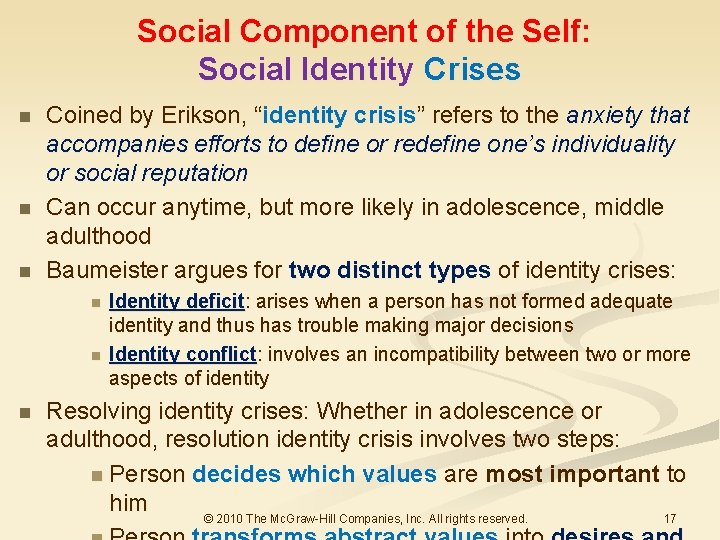
Social Component of the Self: Social Identity Crises n n n Coined by Erikson, “identity crisis” refers to the anxiety that accompanies efforts to define or redefine one’s individuality or social reputation Can occur anytime, but more likely in adolescence, middle adulthood Baumeister argues for two distinct types of identity crises: n n n Identity deficit: arises when a person has not formed adequate identity and thus has trouble making major decisions Identity conflict: involves an incompatibility between two or more aspects of identity Resolving identity crises: Whether in adolescence or adulthood, resolution identity crisis involves two steps: n Person decides which values are most important to him © 2010 The Mc. Graw-Hill Companies, Inc. All rights reserved. 17
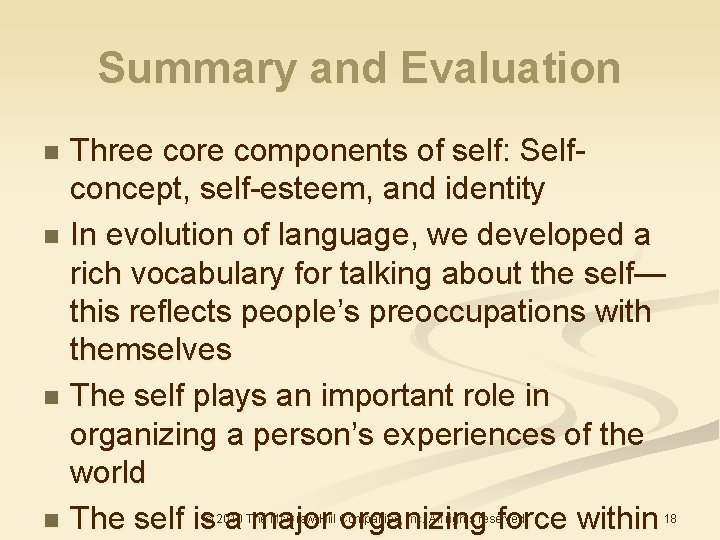
Summary and Evaluation Three core components of self: Selfconcept, self-esteem, and identity n In evolution of language, we developed a rich vocabulary for talking about the self— this reflects people’s preoccupations with themselves n The self plays an important role in organizing a person’s experiences of the world n The self is a major organizing force within n © 2010 The Mc. Graw-Hill Companies, Inc. All rights reserved. 18