
CHAPTER 14 AGGREGATE PLANNING Outline Aggregate Planning Issues
- Slides: 30
CHAPTER 14 AGGREGATE PLANNING Outline • Aggregate Planning – Issues – Costs • Two Strategies – Chase Strategy – Level Strategy • Optimization
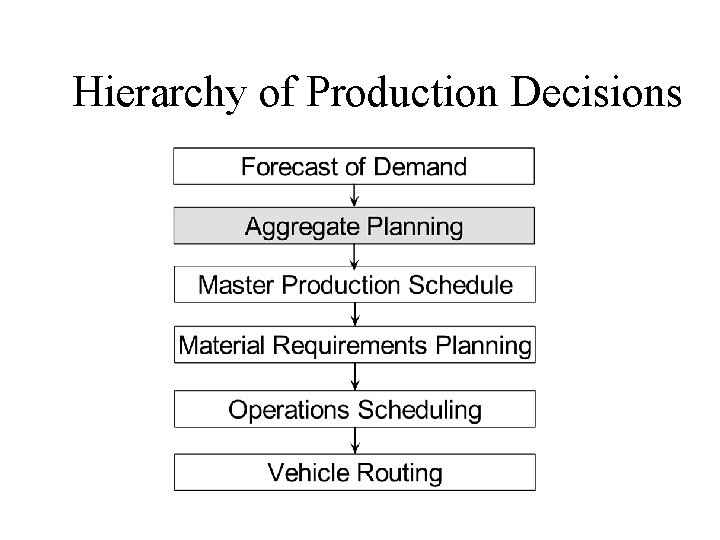
Hierarchy of Production Decisions
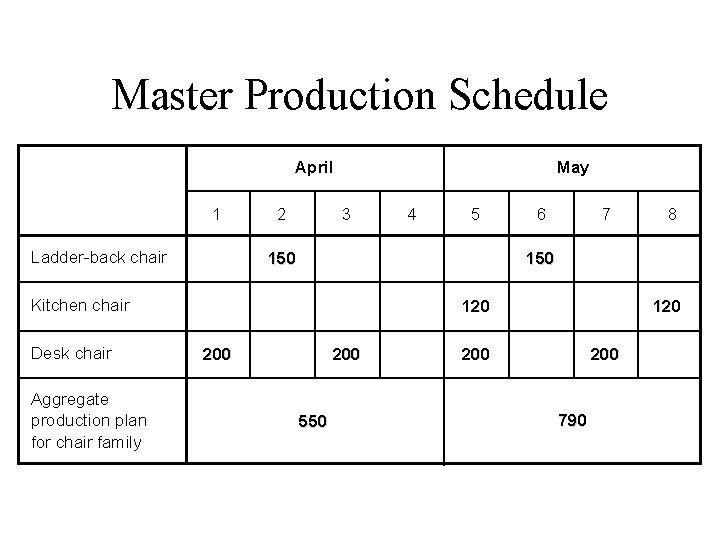
Master Production Schedule April 1 Ladder-back chair 2 May 3 Aggregate production plan for chair family 5 150 6 7 8 150 Kitchen chair Desk chair 4 120 200 550 120 200 790
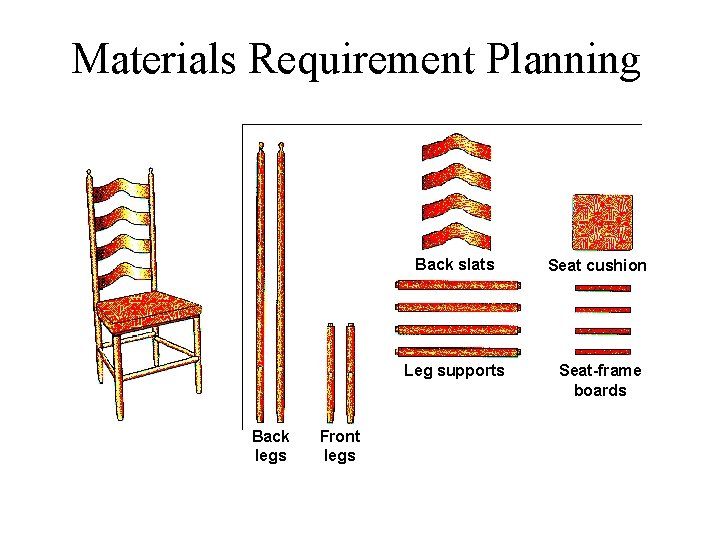
Materials Requirement Planning Back legs Front legs Back slats Seat cushion Leg supports Seat-frame boards
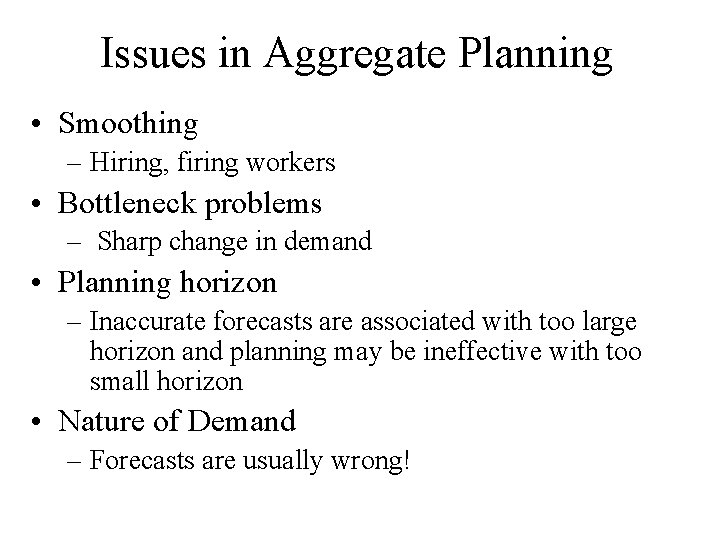
Issues in Aggregate Planning • Smoothing – Hiring, firing workers • Bottleneck problems – Sharp change in demand • Planning horizon – Inaccurate forecasts are associated with too large horizon and planning may be ineffective with too small horizon • Nature of Demand – Forecasts are usually wrong!
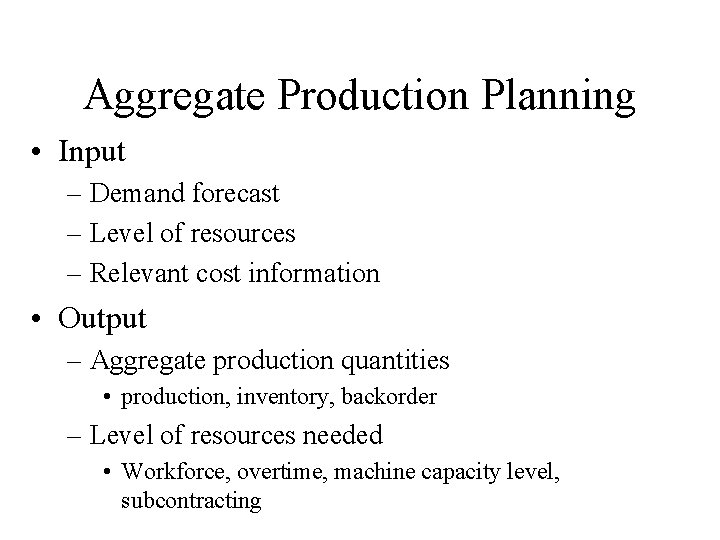
Aggregate Production Planning • Input – Demand forecast – Level of resources – Relevant cost information • Output – Aggregate production quantities • production, inventory, backorder – Level of resources needed • Workforce, overtime, machine capacity level, subcontracting
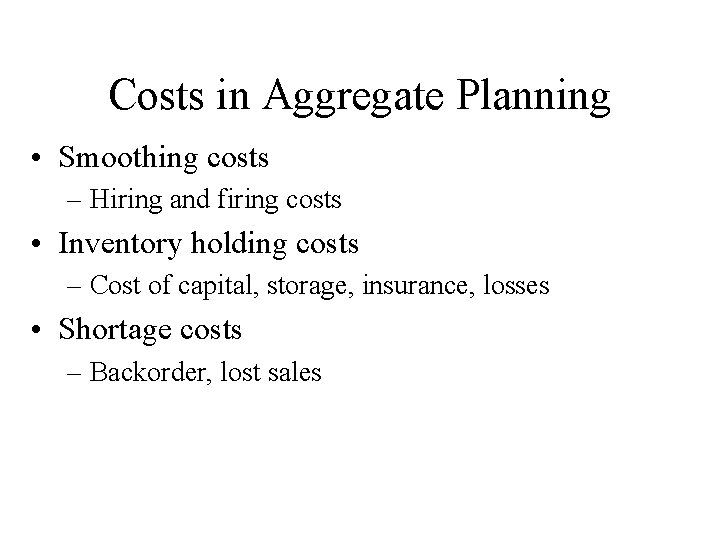
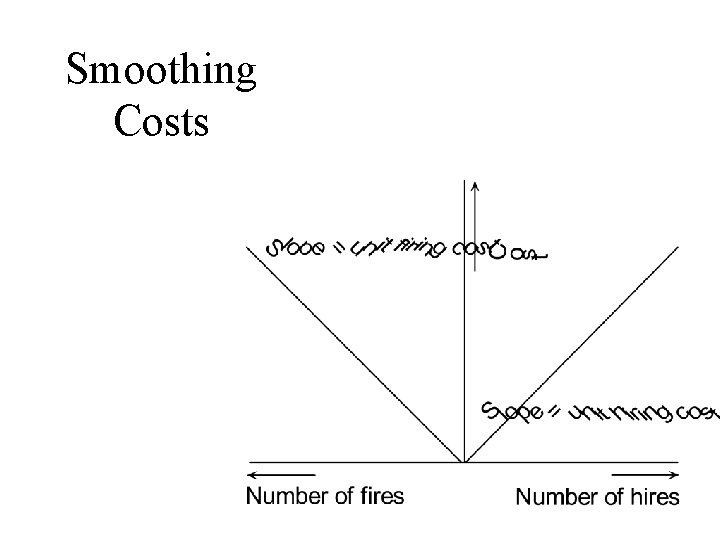
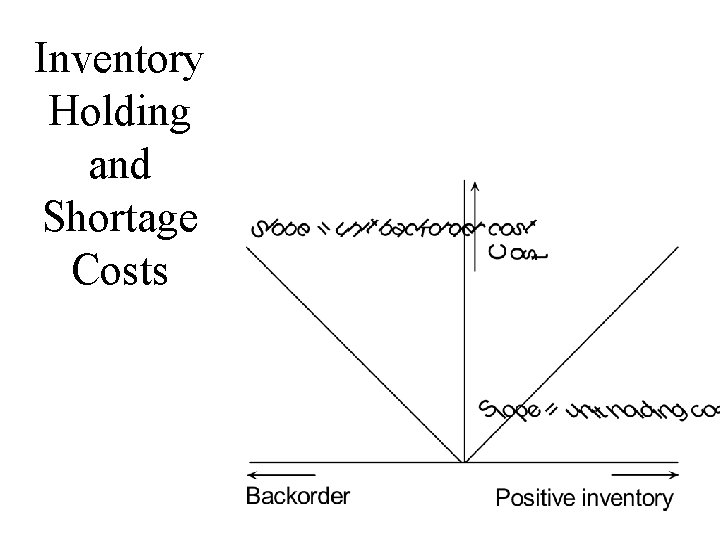
Costs in Aggregate Planning • Smoothing costs – Hiring and firing costs • Inventory holding costs – Cost of capital, storage, insurance, losses • Shortage costs – Backorder, lost sales
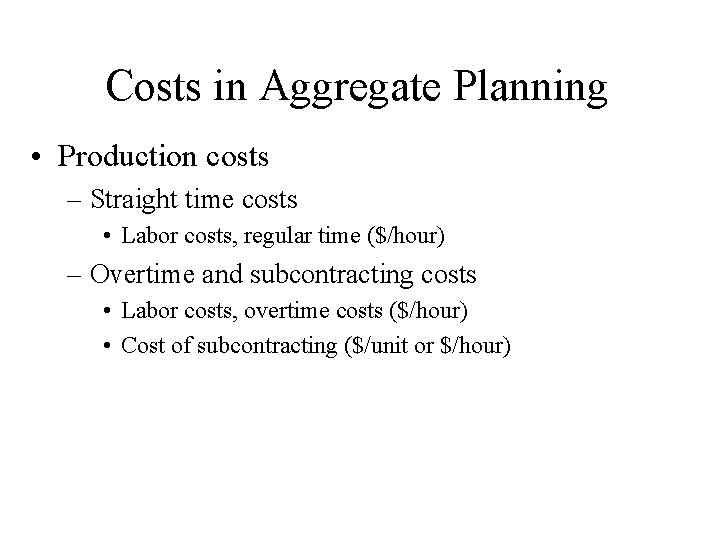
Costs in Aggregate Planning • Production costs – Straight time costs • Labor costs, regular time ($/hour) – Overtime and subcontracting costs • Labor costs, overtime costs ($/hour) • Cost of subcontracting ($/unit or $/hour)
Smoothing Costs
Inventory Holding and Shortage Costs
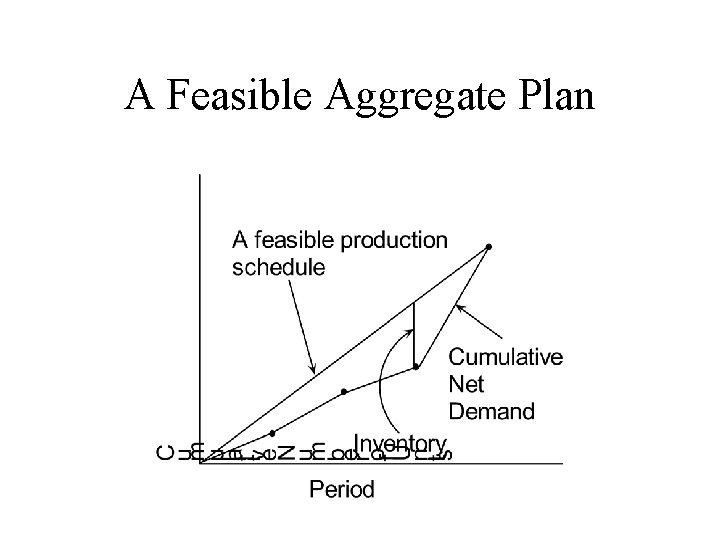
A Feasible Aggregate Plan
Constraints • • Limits on overtime Limits on layoffs Limits on capital available Limits on stockouts and backorders
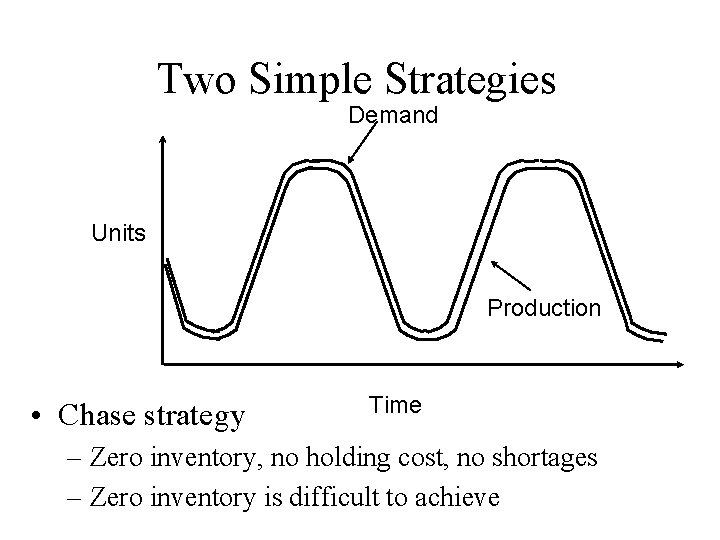
Two Simple Strategies Demand Units Production • Chase strategy Time – Zero inventory, no holding cost, no shortages – Zero inventory is difficult to achieve
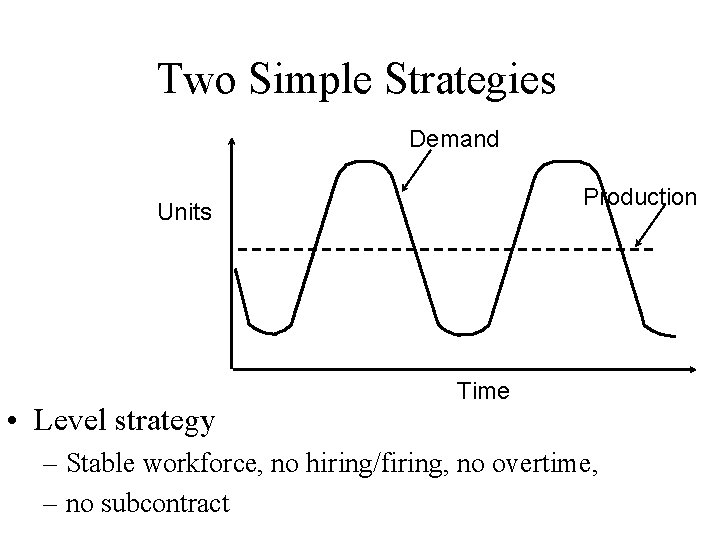
Two Simple Strategies Demand Production Units • Level strategy Time – Stable workforce, no hiring/firing, no overtime, – no subcontract
Optimization • Linear Programming – Excel Solver • Difficulty – Integer variables: number of workers
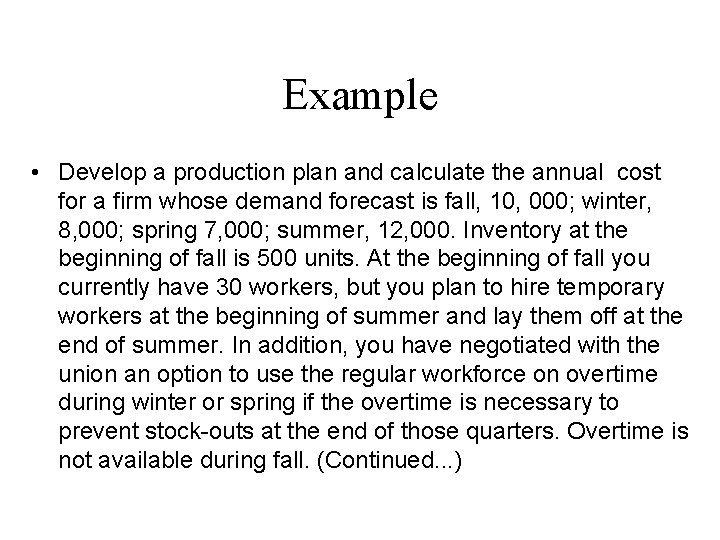
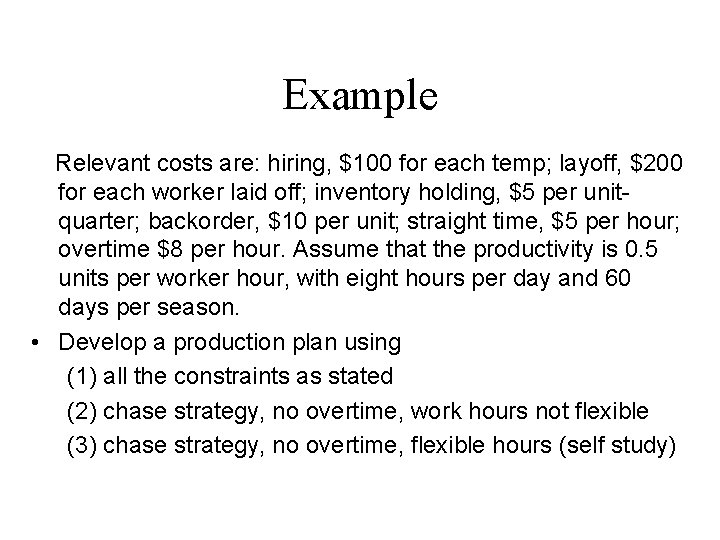
Example • Develop a production plan and calculate the annual cost for a firm whose demand forecast is fall, 10, 000; winter, 8, 000; spring 7, 000; summer, 12, 000. Inventory at the beginning of fall is 500 units. At the beginning of fall you currently have 30 workers, but you plan to hire temporary workers at the beginning of summer and lay them off at the end of summer. In addition, you have negotiated with the union an option to use the regular workforce on overtime during winter or spring if the overtime is necessary to prevent stock-outs at the end of those quarters. Overtime is not available during fall. (Continued. . . )
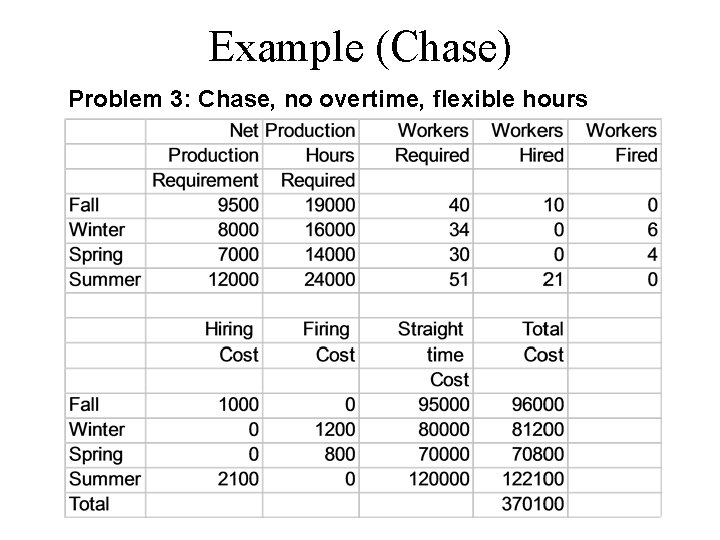
Example Relevant costs are: hiring, $100 for each temp; layoff, $200 for each worker laid off; inventory holding, $5 per unitquarter; backorder, $10 per unit; straight time, $5 per hour; overtime $8 per hour. Assume that the productivity is 0. 5 units per worker hour, with eight hours per day and 60 days per season. • Develop a production plan using (1) all the constraints as stated (2) chase strategy, no overtime, work hours not flexible (3) chase strategy, no overtime, flexible hours (self study)
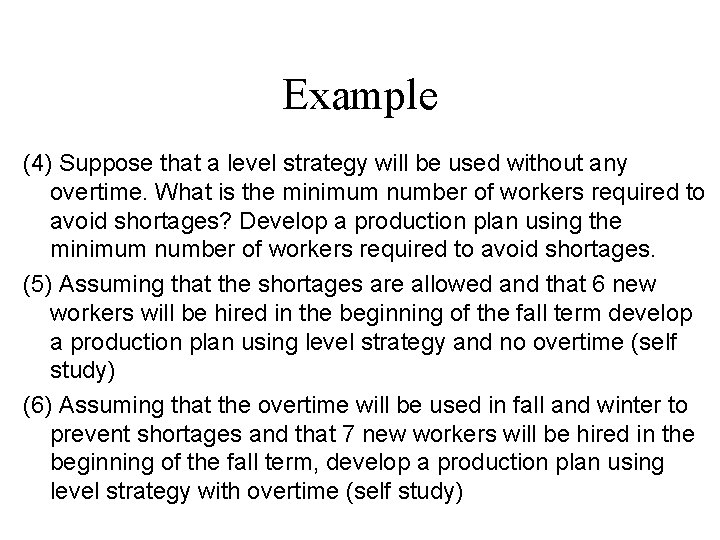
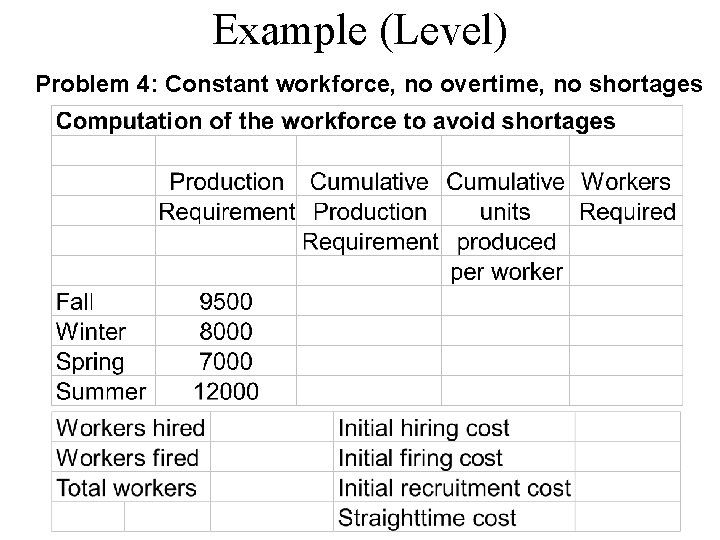
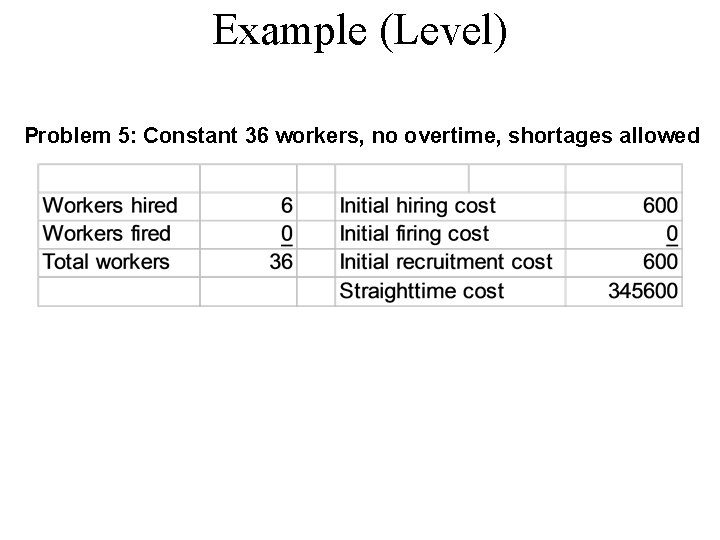
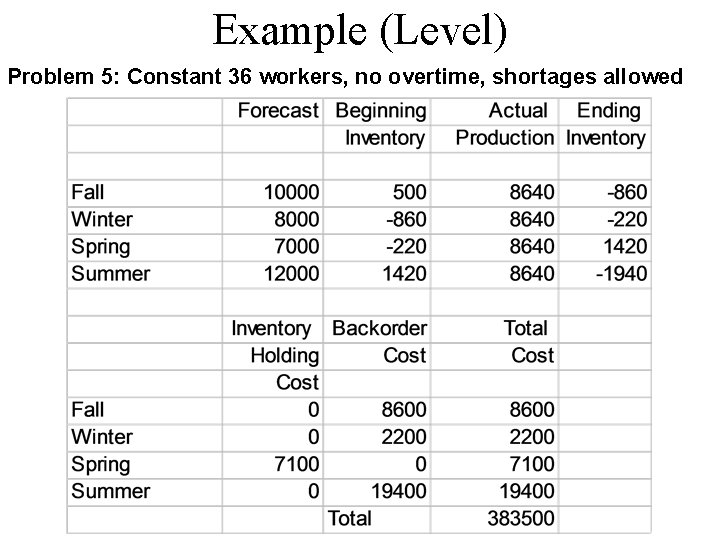
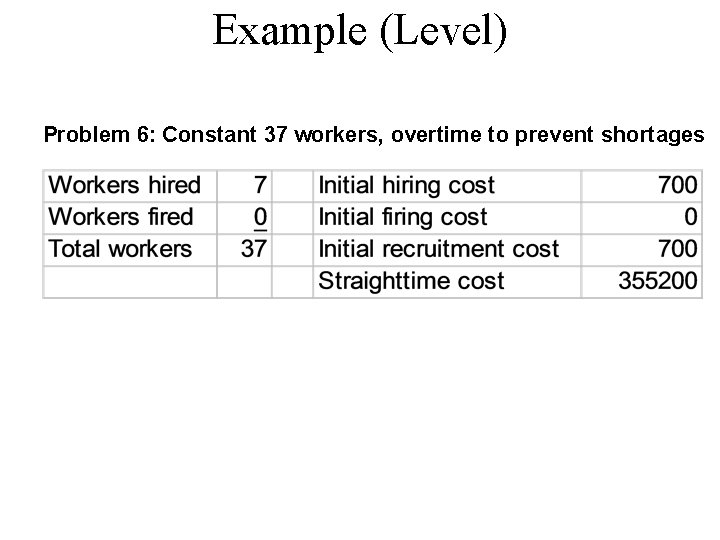
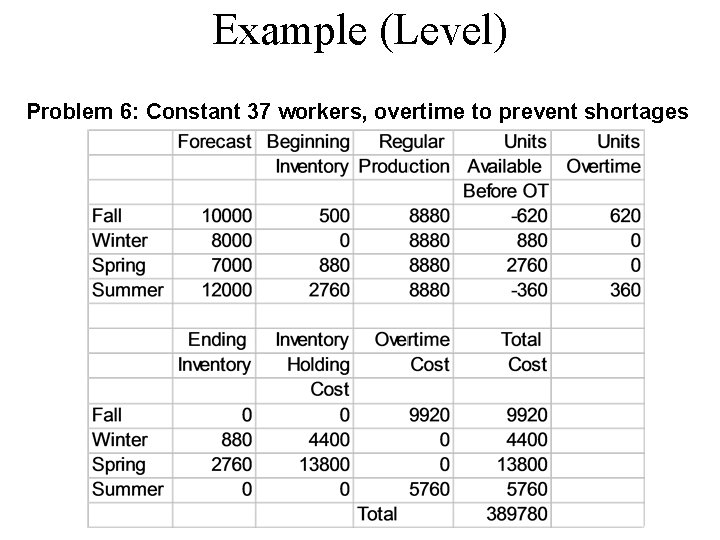
Example (4) Suppose that a level strategy will be used without any overtime. What is the minimum number of workers required to avoid shortages? Develop a production plan using the minimum number of workers required to avoid shortages. (5) Assuming that the shortages are allowed and that 6 new workers will be hired in the beginning of the fall term develop a production plan using level strategy and no overtime (self study) (6) Assuming that the overtime will be used in fall and winter to prevent shortages and that 7 new workers will be hired in the beginning of the fall term, develop a production plan using level strategy with overtime (self study)
Example Problem 1: The original problem
Example Problem 1: The original problem Total
Example (Chase) Problem 2: Chase, no overtime, work hours not flexible
Example (Chase) Problem 2: Chase, no overtime, work hours not flexible Total
Example (Chase) Problem 3: Chase, no overtime, flexible hours
Example (Level) Problem 4: Constant workforce, no overtime, no shortages
Example (Level) Problem 4: Constant workforce, no overtime, no shortages Total
Example (Level) Problem 5: Constant 36 workers, no overtime, shortages allowed
Example (Level) Problem 5: Constant 36 workers, no overtime, shortages allowed
Example (Level) Problem 6: Constant 37 workers, overtime to prevent shortages
Example (Level) Problem 6: Constant 37 workers, overtime to prevent shortages
Reading and Exercises • Chapter 14 Pages 558 -571 • Problems 4, 5