
Chapter 14 Accounting Frameworks An Introduction to International
- Slides: 31
Chapter 14: Accounting Frameworks An Introduction to International Economics: New Perspectives on the World Economy © Kenneth A. Reinert, Cambridge University Press 2021
Analytical Elements n n n Countries Currencies Financial assets © Kenneth A. Reinert, Cambridge University Press 2021
Things Add Up n n From this chapter, we will enter the third realm of the world economy, international finance: the exchange of assets between countries. In this chapter, we consider the implications of a basic economics principle that “things add up” We apply it to open-economy accounts and to balance of payments accounts These provide us with powerful tools to analyze aspects of open economies in their interactions with the world economy © Kenneth A. Reinert, Cambridge University Press 2021
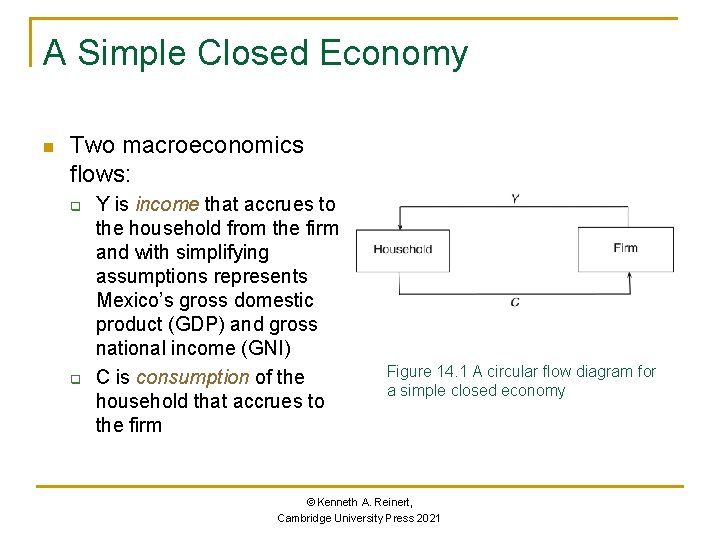
Open-Economy Accounts n n To begin our discussion of open-economy accounts, we are going to consider a circular flow diagram We are going to view the Mexican economy as being aggregated into one, giant sector composed of two accounts q q n Firm Household Figure 13. 1 represents a simple, closed economy q q Simple refers to the absence of capital (savings/investment) and government consideration Closed refers to the absence of transactions with the world economy © Kenneth A. Reinert, Cambridge University Press 2021
A Simple Closed Economy n Two macroeconomics flows: q q Y is income that accrues to the household from the firm and with simplifying assumptions represents Mexico’s gross domestic product (GDP) and gross national income (GNI) C is consumption of the household that accrues to the firm Figure 14. 1 A circular flow diagram for a simple closed economy © Kenneth A. Reinert, Cambridge University Press 2021
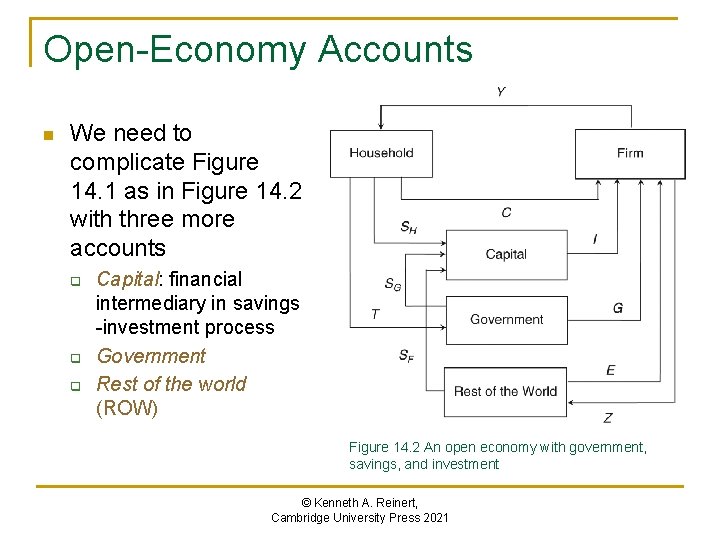
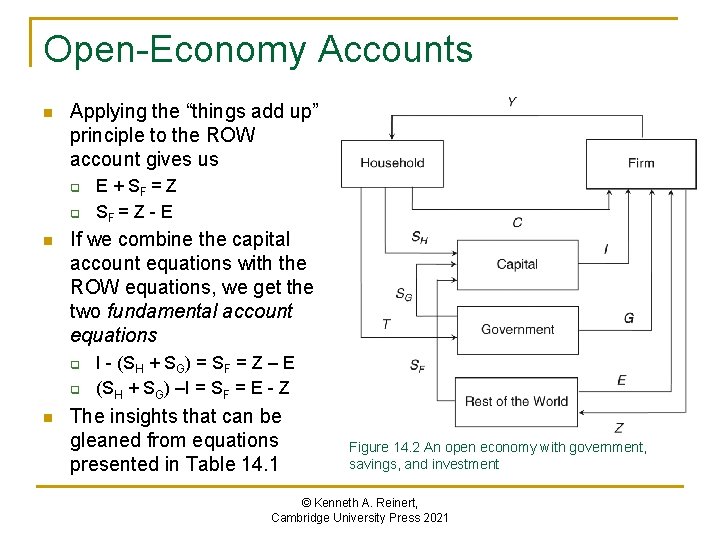
Open-Economy Accounts n We need to complicate Figure 14. 1 as in Figure 14. 2 with three more accounts q q q Capital: financial intermediary in savings -investment process Government Rest of the world (ROW) Figure 14. 2 An open economy with government, savings, and investment © Kenneth A. Reinert, Cambridge University Press 2021
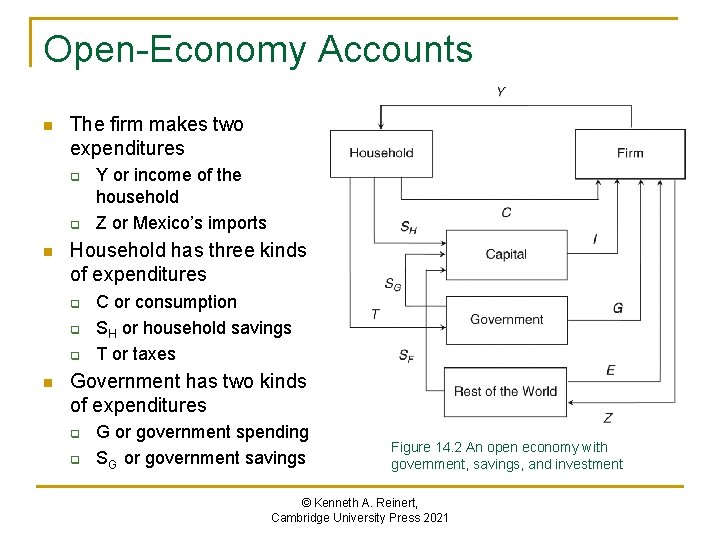
Open-Economy Accounts n The firm makes two expenditures q q n Household has three kinds of expenditures q q q n Y or income of the household Z or Mexico’s imports C or consumption SH or household savings T or taxes Government has two kinds of expenditures q q G or government spending SG or government savings Figure 14. 2 An open economy with government, savings, and investment © Kenneth A. Reinert, Cambridge University Press 2021
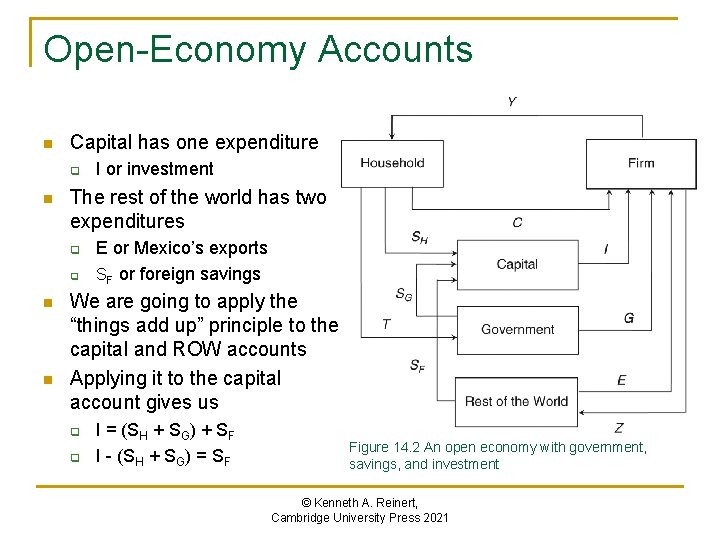
Open-Economy Accounts n Capital has one expenditure q n The rest of the world has two expenditures q q n n I or investment E or Mexico’s exports SF or foreign savings We are going to apply the “things add up” principle to the capital and ROW accounts Applying it to the capital account gives us q q I = (SH + SG) + SF I - (SH + SG) = SF Figure 14. 2 An open economy with government, savings, and investment © Kenneth A. Reinert, Cambridge University Press 2021
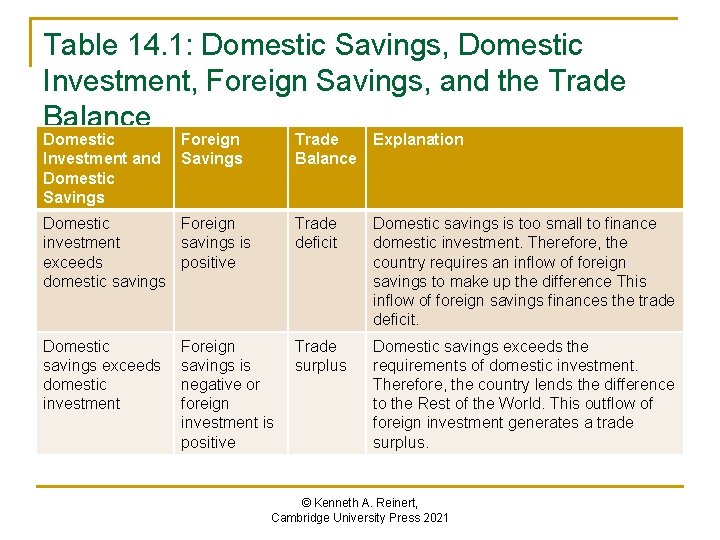
Open-Economy Accounts n Applying the “things add up” principle to the ROW account gives us q q n If we combine the capital account equations with the ROW equations, we get the two fundamental account equations q q n E + SF = Z - E I - (SH + SG) = SF = Z – E (SH + SG) –I = SF = E - Z The insights that can be gleaned from equations presented in Table 14. 1 Figure 14. 2 An open economy with government, savings, and investment © Kenneth A. Reinert, Cambridge University Press 2021
Table 14. 1: Domestic Savings, Domestic Investment, Foreign Savings, and the Trade Balance Domestic Investment and Domestic Savings Foreign Savings Trade Balance Explanation Domestic Foreign investment savings is exceeds positive domestic savings Trade deficit Domestic savings is too small to finance domestic investment. Therefore, the country requires an inflow of foreign savings to make up the difference This inflow of foreign savings finances the trade deficit. Domestic savings exceeds domestic investment Trade surplus Domestic savings exceeds the requirements of domestic investment. Therefore, the country lends the difference to the Rest of the World. This outflow of foreign investment generates a trade surplus. Foreign savings is negative or foreign investment is positive © Kenneth A. Reinert, Cambridge University Press 2021
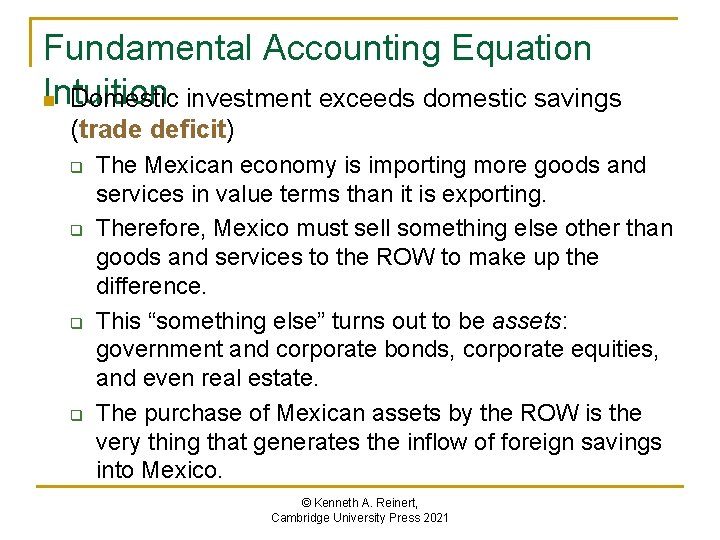
Fundamental Accounting Equation Intuition n Domestic investment exceeds domestic savings (trade deficit) q q The Mexican economy is importing more goods and services in value terms than it is exporting. Therefore, Mexico must sell something else other than goods and services to the ROW to make up the difference. This “something else” turns out to be assets: government and corporate bonds, corporate equities, and even real estate. The purchase of Mexican assets by the ROW is the very thing that generates the inflow of foreign savings into Mexico. © Kenneth A. Reinert, Cambridge University Press 2021
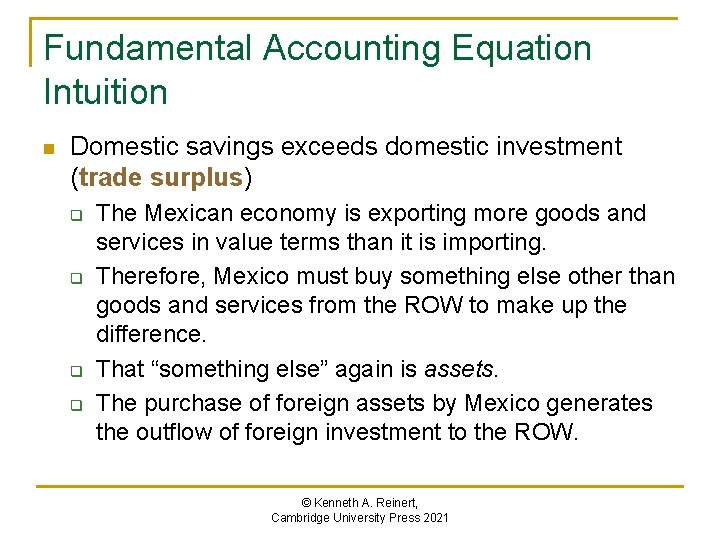
Fundamental Accounting Equation Intuition n Domestic savings exceeds domestic investment (trade surplus) q q The Mexican economy is exporting more goods and services in value terms than it is importing. Therefore, Mexico must buy something else other than goods and services from the ROW to make up the difference. That “something else” again is assets. The purchase of foreign assets by Mexico generates the outflow of foreign investment to the ROW. © Kenneth A. Reinert, Cambridge University Press 2021
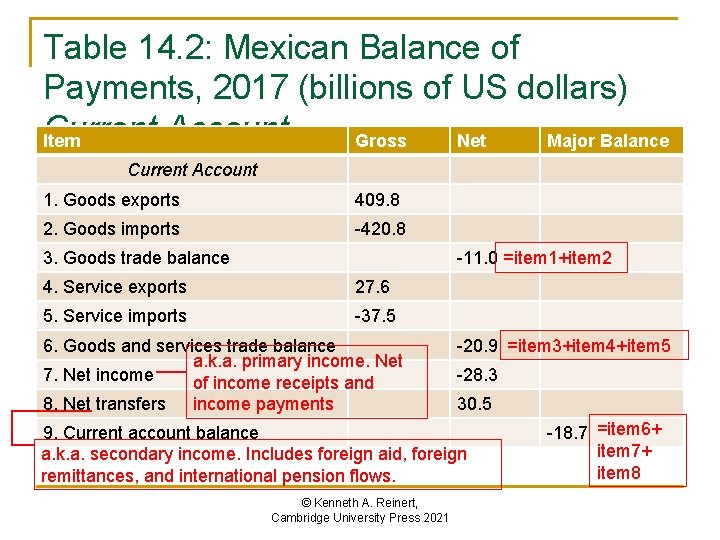
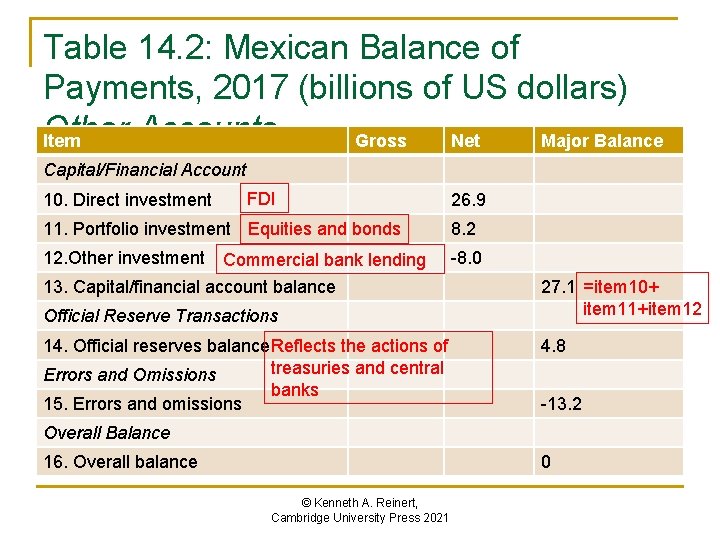
Balance of Payments Accounts n n n The balance of payments accounts of any country focus exclusively on the relationship of the country with the Rest of the World We consider summary accounts for Mexico in 2017 presented in Table 14. 2 The balance of payments has five parts q q q Current account Capital/financial account Official reserve transactions Errors and omissions Overall balance © Kenneth A. Reinert, Cambridge University Press 2021
Balance of Payments Accounts n n n The current account records transactions with the rest of the world that do not involve the exchange of assets The capital account records transactions with the rest of the world that do not involve the exchange of assets The official reserve transactions record governmental (central bank and treasure) transactions involving the exchange of assets © Kenneth A. Reinert, Cambridge University Press 2021
Table 14. 2: Mexican Balance of Payments, 2017 (billions of US dollars) Current Account The overall balance must be zero: things add up • Current Account + Capital/Financial Account + Official Reserves Transactions + Errors and Omissions = 0 © Kenneth A. Reinert, Cambridge University Press 2021
Balance of Payments: Overall Balance n The overall balance must be zero: things add up Current Account + Capital/Financial Account + Official Reserves Transactions + Errors and Omissions =0 n This can be seen in item 16 in Table 14. 2 © Kenneth A. Reinert, Cambridge University Press 2021
Table 14. 2: Mexican Balance of Payments, 2017 (billions of US dollars) Current Account Item Gross Net Major Balance Current Account 1. Goods exports 409. 8 2. Goods imports -420. 8 3. Goods trade balance -11. 0 =item 1+item 2 4. Service exports 27. 6 5. Service imports -37. 5 6. Goods and services trade balance a. k. a. primary income. Net 7. Net income of income receipts and 8. Net transfers income payments -20. 9 =item 3+item 4+item 5 -28. 3 30. 5 9. Current account balance a. k. a. secondary income. Includes foreign aid, foreign remittances, and international pension flows. © Kenneth A. Reinert, Cambridge University Press 2021 -18. 7 =item 6+ item 7+ item 8
Table 14. 2: Mexican Balance of Payments, 2017 (billions of US dollars) Other Accounts Item Gross Net Major Balance Capital/Financial Account 10. Direct investment FDI 26. 9 11. Portfolio investment Equities and bonds 8. 2 12. Other investment -8. 0 Commercial bank lending 13. Capital/financial account balance Official Reserve Transactions 14. Official reserves balance Reflects the actions of treasuries and central Errors and Omissions banks 15. Errors and omissions 27. 1 =item 10+ item 11+item 12 4. 8 -13. 2 Overall Balance 16. Overall balance 0 © Kenneth A. Reinert, Cambridge University Press 2021
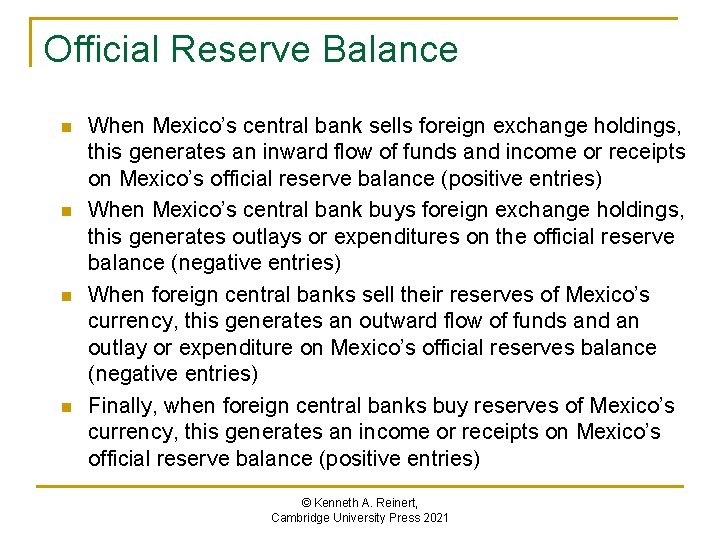
Official Reserve Balance n n When Mexico’s central bank sells foreign exchange holdings, this generates an inward flow of funds and income or receipts on Mexico’s official reserve balance (positive entries) When Mexico’s central bank buys foreign exchange holdings, this generates outlays or expenditures on the official reserve balance (negative entries) When foreign central banks sell their reserves of Mexico’s currency, this generates an outward flow of funds and an outlay or expenditure on Mexico’s official reserves balance (negative entries) Finally, when foreign central banks buy reserves of Mexico’s currency, this generates an income or receipts on Mexico’s official reserve balance (positive entries) © Kenneth A. Reinert, Cambridge University Press 2021
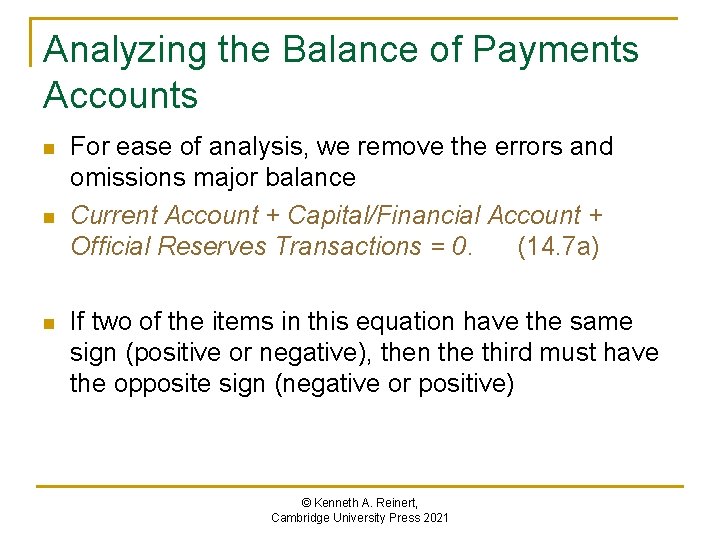
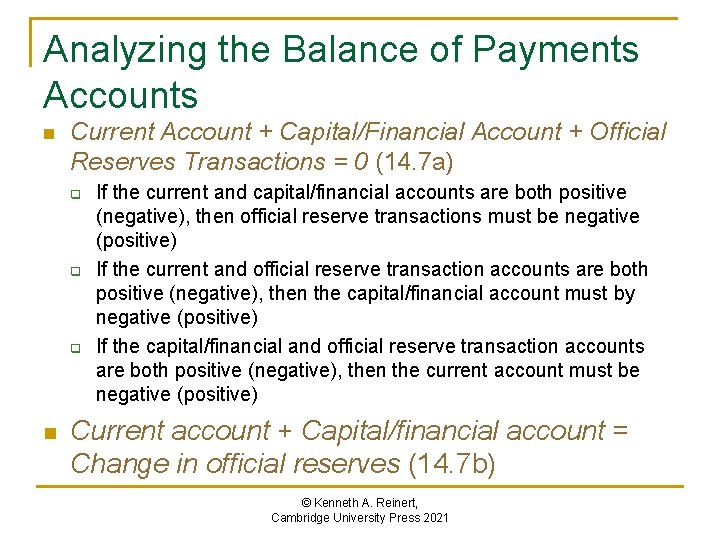
Analyzing the Balance of Payments Accounts n n n For ease of analysis, we remove the errors and omissions major balance Current Account + Capital/Financial Account + Official Reserves Transactions = 0. (14. 7 a) If two of the items in this equation have the same sign (positive or negative), then the third must have the opposite sign (negative or positive) © Kenneth A. Reinert, Cambridge University Press 2021
Analyzing the Balance of Payments Accounts n Current Account + Capital/Financial Account + Official Reserves Transactions = 0 (14. 7 a) q q q n If the current and capital/financial accounts are both positive (negative), then official reserve transactions must be negative (positive) If the current and official reserve transaction accounts are both positive (negative), then the capital/financial account must by negative (positive) If the capital/financial and official reserve transaction accounts are both positive (negative), then the current account must be negative (positive) Current account + Capital/financial account = Change in official reserves (14. 7 b) © Kenneth A. Reinert, Cambridge University Press 2021
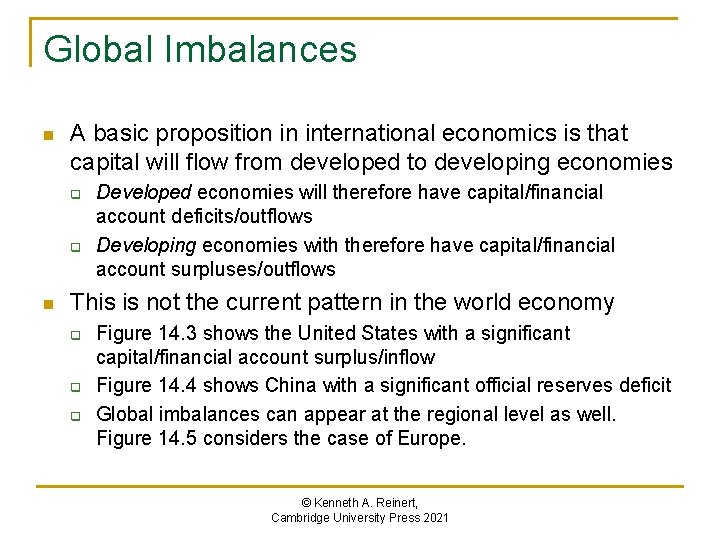
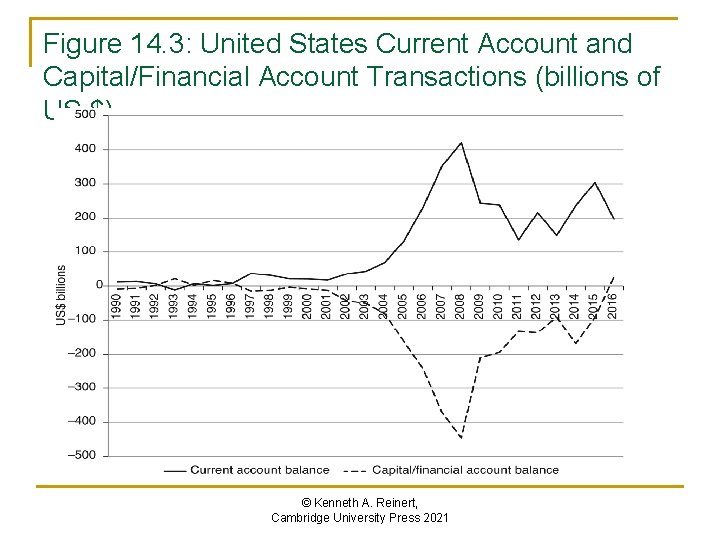
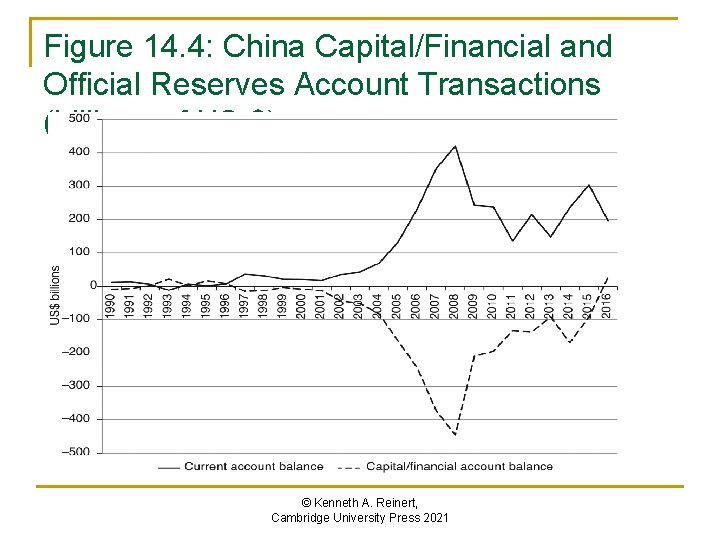
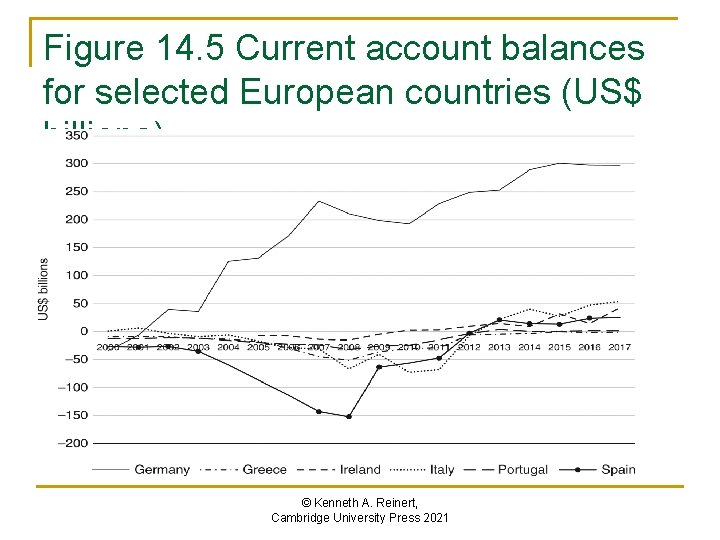
Global Imbalances n A basic proposition in international economics is that capital will flow from developed to developing economies q q n Developed economies will therefore have capital/financial account deficits/outflows Developing economies with therefore have capital/financial account surpluses/outflows This is not the current pattern in the world economy q q q Figure 14. 3 shows the United States with a significant capital/financial account surplus/inflow Figure 14. 4 shows China with a significant official reserves deficit Global imbalances can appear at the regional level as well. Figure 14. 5 considers the case of Europe. © Kenneth A. Reinert, Cambridge University Press 2021
Figure 14. 3: United States Current Account and Capital/Financial Account Transactions (billions of US $) © Kenneth A. Reinert, Cambridge University Press 2021
Figure 14. 4: China Capital/Financial and Official Reserves Account Transactions (billions of US $) © Kenneth A. Reinert, Cambridge University Press 2021
Figure 14. 5 Current account balances for selected European countries (US$ billions) © Kenneth A. Reinert, Cambridge University Press 2021
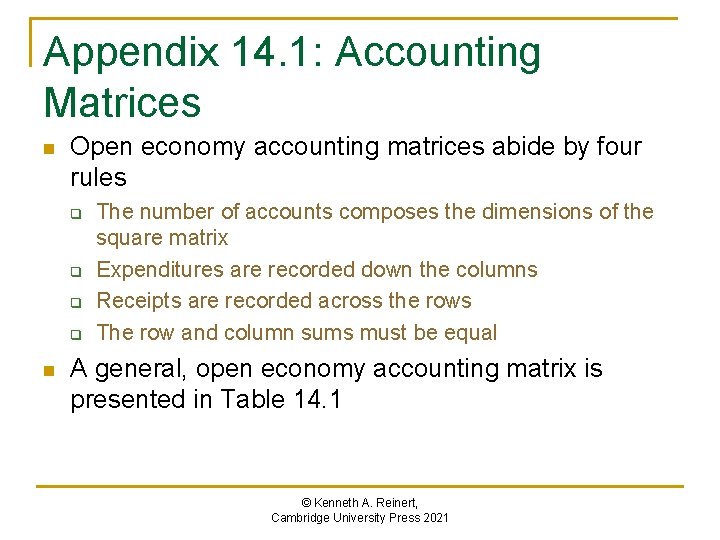
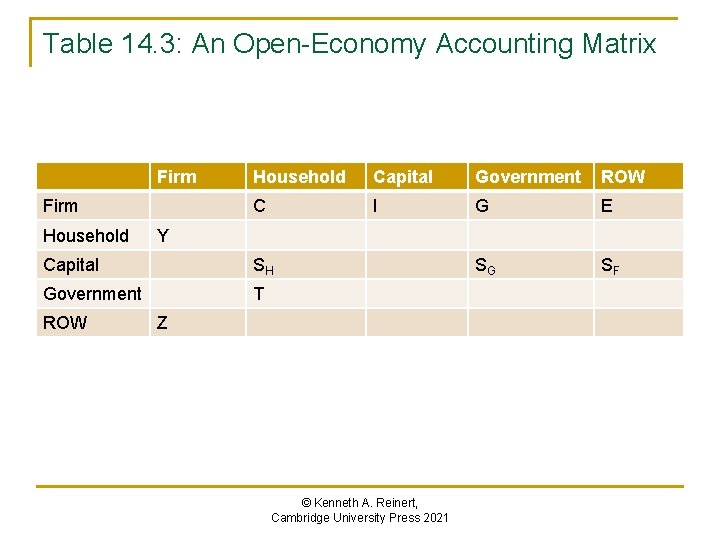
Appendix 14. 1: Accounting Matrices n Open economy accounting matrices abide by four rules q q n The number of accounts composes the dimensions of the square matrix Expenditures are recorded down the columns Receipts are recorded across the rows The row and column sums must be equal A general, open economy accounting matrix is presented in Table 14. 1 © Kenneth A. Reinert, Cambridge University Press 2021
Table 14. 3: An Open-Economy Accounting Matrix Firm Household Capital Government ROW C I G E SG SF Y Capital SH Government T ROW Z © Kenneth A. Reinert, Cambridge University Press 2021
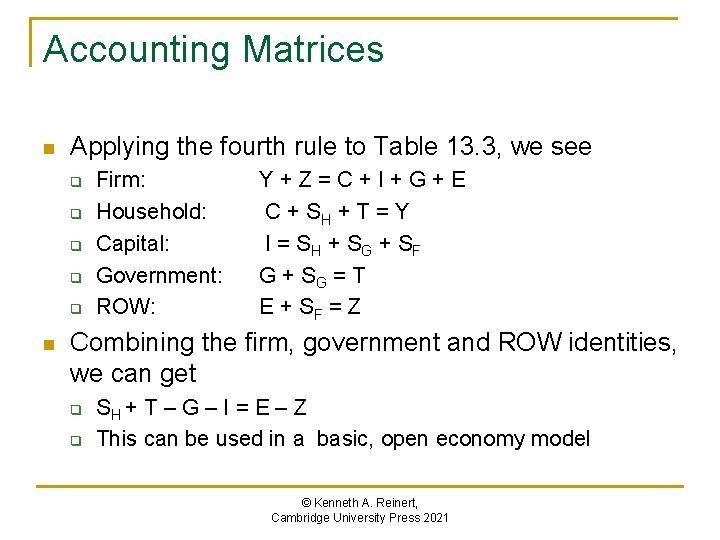
Accounting Matrices n Applying the fourth rule to Table 13. 3, we see q q q n Firm: Household: Capital: Government: ROW: Y+Z=C+I+G+E C + SH + T = Y I = SH + SG + SF G + SG = T E + SF = Z Combining the firm, government and ROW identities, we can get q q SH + T – G – I = E – Z This can be used in a basic, open economy model © Kenneth A. Reinert, Cambridge University Press 2021
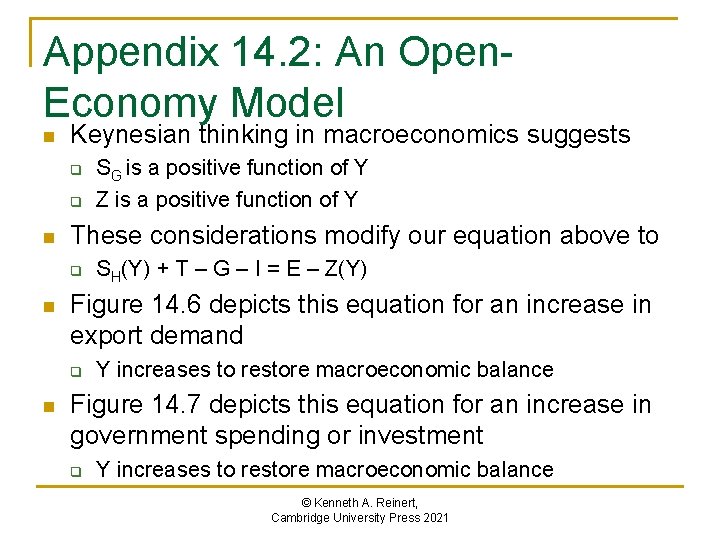
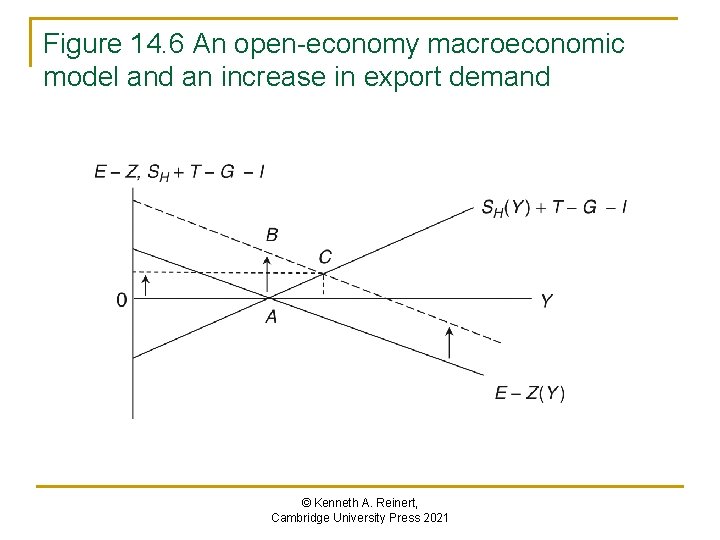
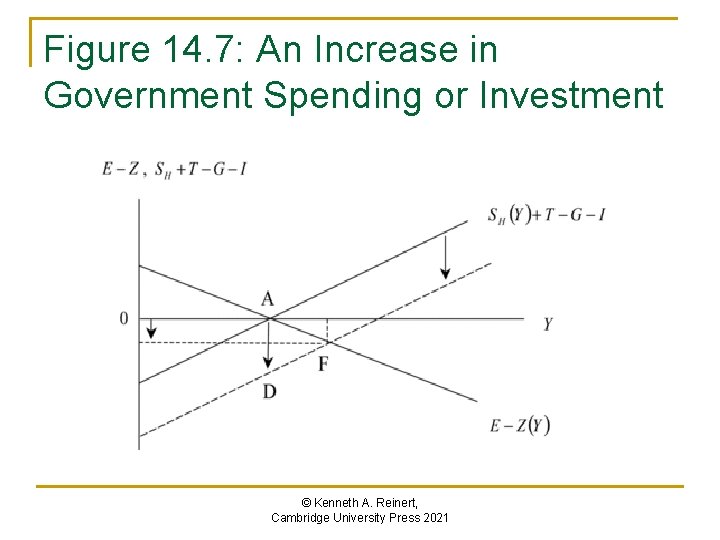
Appendix 14. 2: An Open. Economy Model n Keynesian thinking in macroeconomics suggests q q n These considerations modify our equation above to q n SH(Y) + T – G – I = E – Z(Y) Figure 14. 6 depicts this equation for an increase in export demand q n SG is a positive function of Y Z is a positive function of Y Y increases to restore macroeconomic balance Figure 14. 7 depicts this equation for an increase in government spending or investment q Y increases to restore macroeconomic balance © Kenneth A. Reinert, Cambridge University Press 2021
Figure 14. 6 An open-economy macroeconomic model and an increase in export demand © Kenneth A. Reinert, Cambridge University Press 2021
Figure 14. 7: An Increase in Government Spending or Investment © Kenneth A. Reinert, Cambridge University Press 2021