
Chapter 14 A List ADT Review the Java
- Slides: 14
Chapter 14 A List ADT
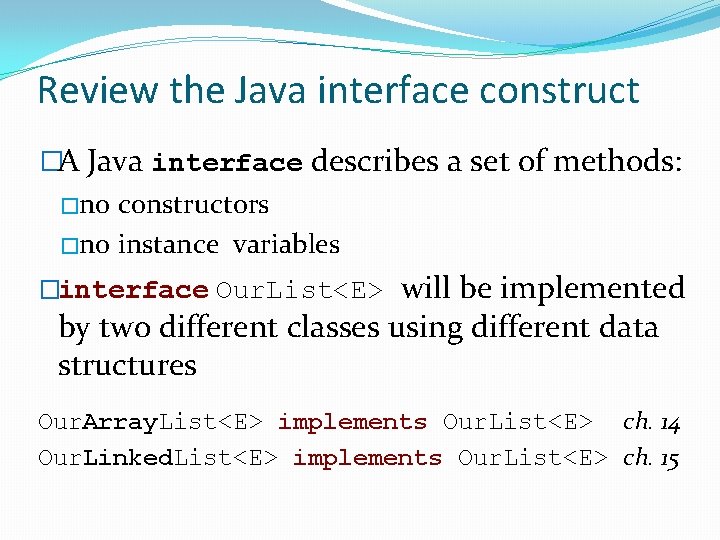
Review the Java interface construct �A Java interface describes a set of methods: �no constructors �no instance variables will be implemented by two different classes using different data structures �interface Our. List<E> Our. Array. List<E> implements Our. List<E> ch. 14 Our. Linked. List<E> implements Our. List<E> ch. 15
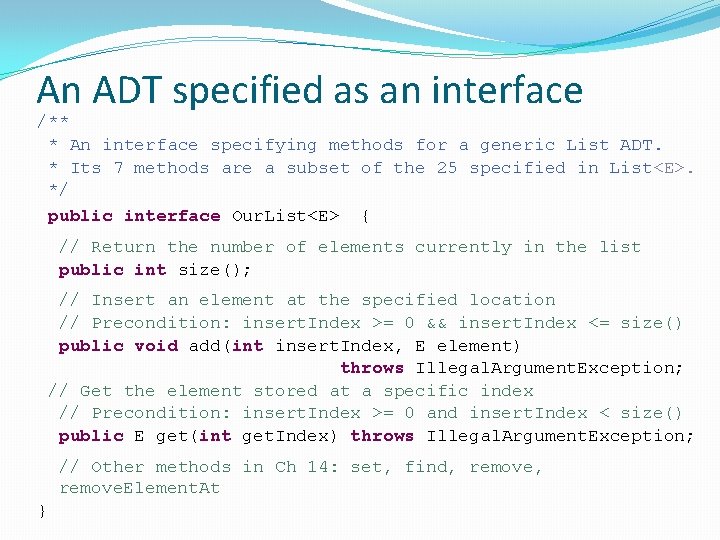
An ADT specified as an interface /** * An interface specifying methods for a generic List ADT. * Its 7 methods are a subset of the 25 specified in List<E>. */ public interface Our. List<E> { // Return the number of elements currently in the list public int size(); // Insert an element at the specified location // Precondition: insert. Index >= 0 && insert. Index <= size() public void add(int insert. Index, E element) throws Illegal. Argument. Exception; // Get the element stored at a specific index // Precondition: insert. Index >= 0 and insert. Index < size() public E get(int get. Index) throws Illegal. Argument. Exception; // Other methods in Ch 14: set, find, remove. Element. At }
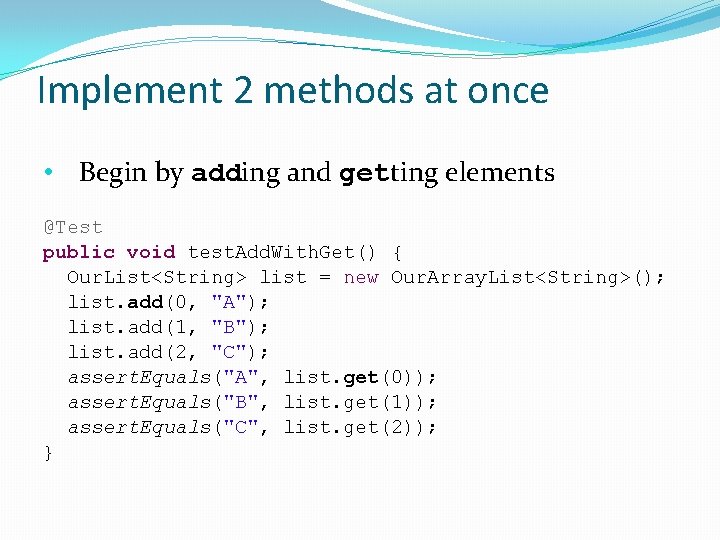
Implement 2 methods at once • Begin by adding and getting elements @Test public void test. Add. With. Get() { Our. List<String> list = new Our. Array. List<String>(); list. add(0, "A"); list. add(1, "B"); list. add(2, "C"); assert. Equals("A", list. get(0)); assert. Equals("B", list. get(1)); assert. Equals("C", list. get(2)); }
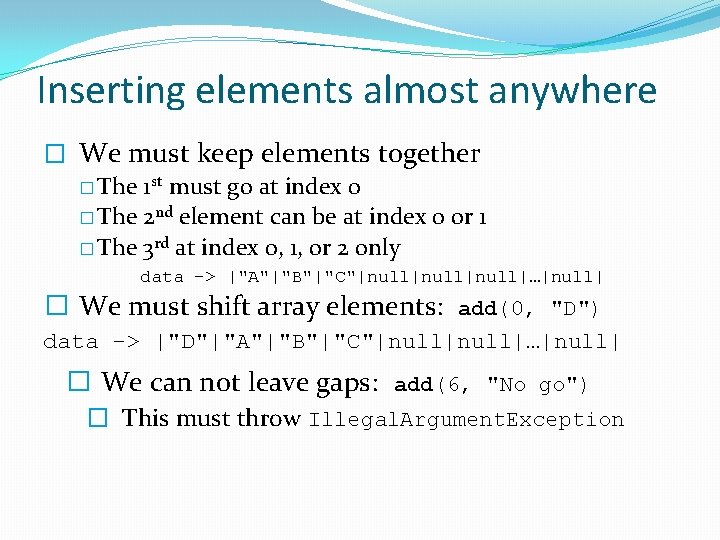
Inserting elements almost anywhere � We must keep elements together � The 1 st must go at index 0 � The 2 nd element can be at index 0 or 1 � The 3 rd at index 0, 1, or 2 only data -> |"A"|"B"|"C"|null|null|…|null| � We must shift array elements: add(0, "D") data -> |"D"|"A"|"B"|"C"|null|…|null| � We can not leave gaps: add(6, "No go") � This must throw Illegal. Argument. Exception
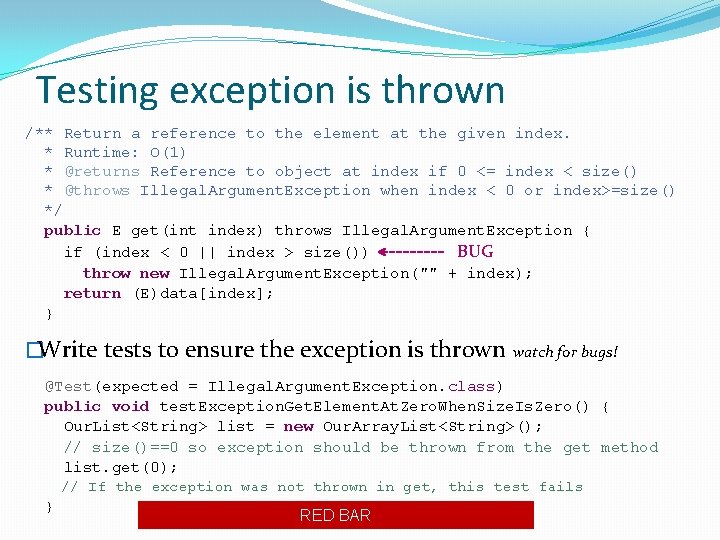
Exceptions �When programs run, exceptional events occur � division by zero � invalid input � next() when a Scanner has no more data � open a file that does not exist � add an element where you shouldn't �Add and get throw Illegal. Argument. Exception � Next slide shows when and how to do that, and � a test to ensure get(0) from an empty list throws it
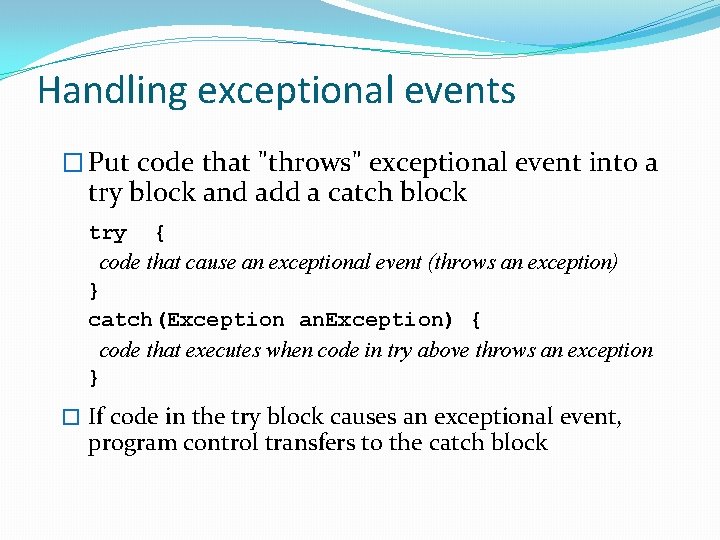
Handling exceptional events � Put code that "throws" exceptional event into a try block and add a catch block try { code that cause an exceptional event (throws an exception) } catch(Exception an. Exception) { code that executes when code in try above throws an exception } � If code in the try block causes an exceptional event, program control transfers to the catch block
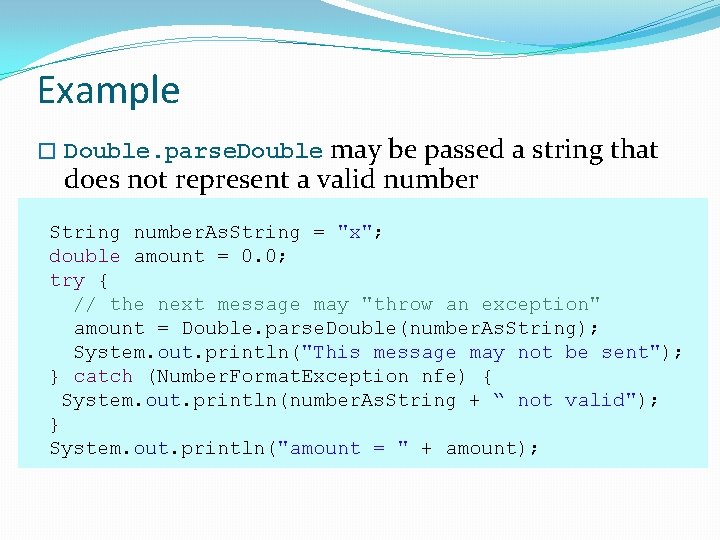
Example may be passed a string that does not represent a valid number � Double. parse. Double String number. As. String = "x"; double amount = 0. 0; try { // the next message may "throw an exception" amount = Double. parse. Double(number. As. String); System. out. println("This message may not be sent"); } catch (Number. Format. Exception nfe) { System. out. println(number. As. String + “ not valid"); } System. out. println("amount = " + amount);
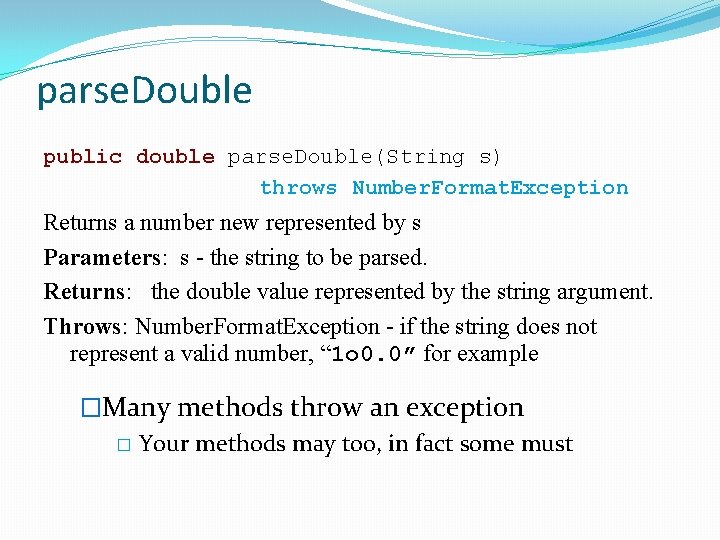
parse. Double public double parse. Double(String s) throws Number. Format. Exception Returns a number new represented by s Parameters: s - the string to be parsed. Returns: the double value represented by the string argument. Throws: Number. Format. Exception - if the string does not represent a valid number, “ 1 o 0. 0” for example �Many methods throw an exception � Your methods may too, in fact some must
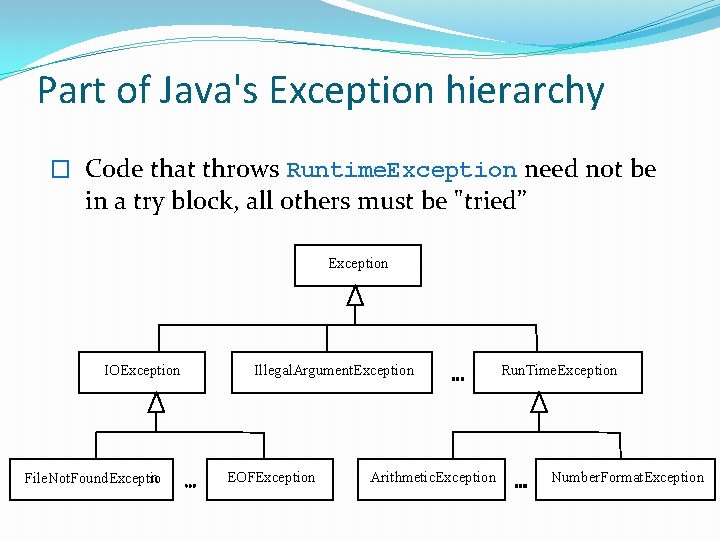
Part of Java's Exception hierarchy � Code that throws Runtime. Exception need not be in a try block, all others must be "tried” Exception IOException n File. Not. Found. Exceptio Illegal. Argument. Exception EOFException Arithmetic. Exception Run. Time. Exception Number. Format. Exception
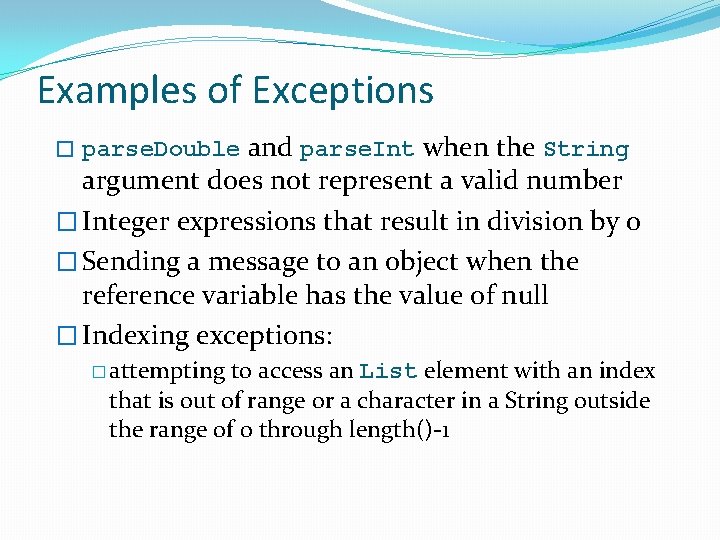
Examples of Exceptions and parse. Int when the String argument does not represent a valid number � Integer expressions that result in division by 0 � Sending a message to an object when the reference variable has the value of null � Indexing exceptions: � parse. Double � attempting to access an List element with an index that is out of range or a character in a String outside the range of 0 through length()-1
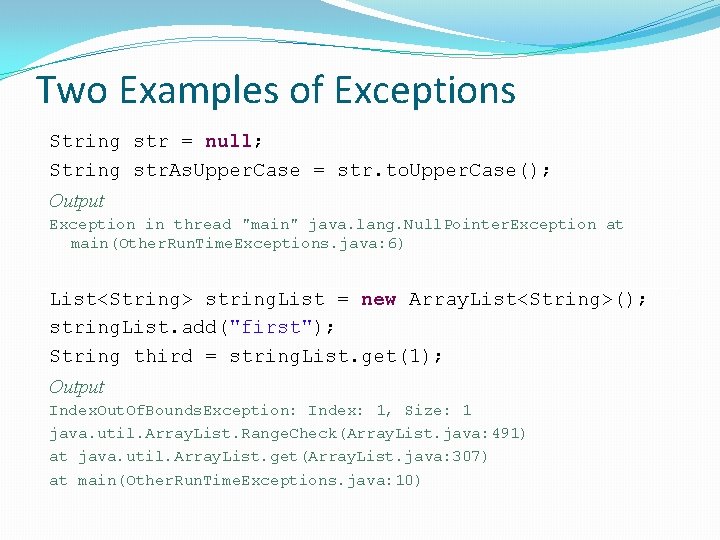
Two Examples of Exceptions String str = null; String str. As. Upper. Case = str. to. Upper. Case(); Output Exception in thread "main" java. lang. Null. Pointer. Exception at main(Other. Run. Time. Exceptions. java: 6) List<String> string. List = new Array. List<String>(); string. List. add("first"); String third = string. List. get(1); Output Index. Out. Of. Bounds. Exception: Index: 1, Size: 1 java. util. Array. List. Range. Check(Array. List. java: 491) at java. util. Array. List. get(Array. List. java: 307) at main(Other. Run. Time. Exceptions. java: 10)
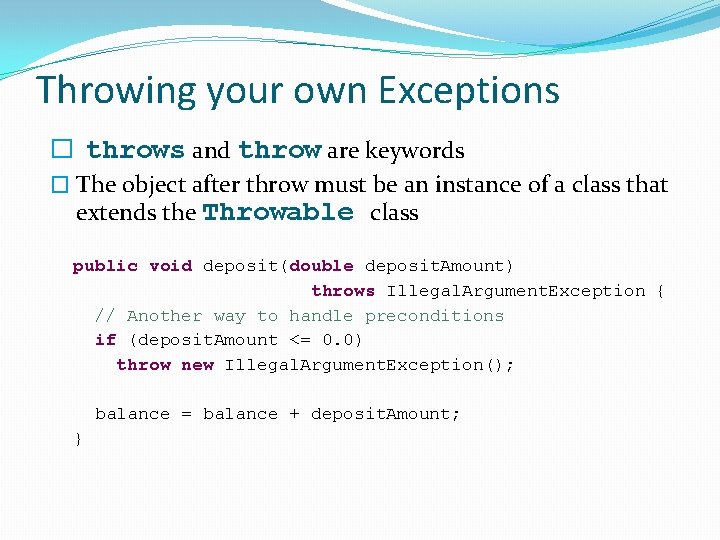
Throwing your own Exceptions � throws and throw are keywords � The object after throw must be an instance of a class that extends the Throwable class public void deposit(double deposit. Amount) throws Illegal. Argument. Exception { // Another way to handle preconditions if (deposit. Amount <= 0. 0) throw new Illegal. Argument. Exception(); balance = balance + deposit. Amount; }
Testing exception is thrown /** Return a reference to the element at the given index. * Runtime: O(1) * @returns Reference to object at index if 0 <= index < size() * @throws Illegal. Argument. Exception when index < 0 or index>=size() */ public E get(int index) throws Illegal. Argument. Exception { if (index < 0 || index > size()) BUG throw new Illegal. Argument. Exception("" + index); return (E)data[index]; } �Write tests to ensure the exception is thrown watch for bugs! @Test(expected = Illegal. Argument. Exception. class) public void test. Exception. Get. Element. At. Zero. When. Size. Is. Zero() { Our. List<String> list = new Our. Array. List<String>(); // size()==0 so exception should be thrown from the get method list. get(0); // If the exception was not thrown in get, this test fails } RED BAR