
Chapter 13 Your Boats Radio Boating Skills And
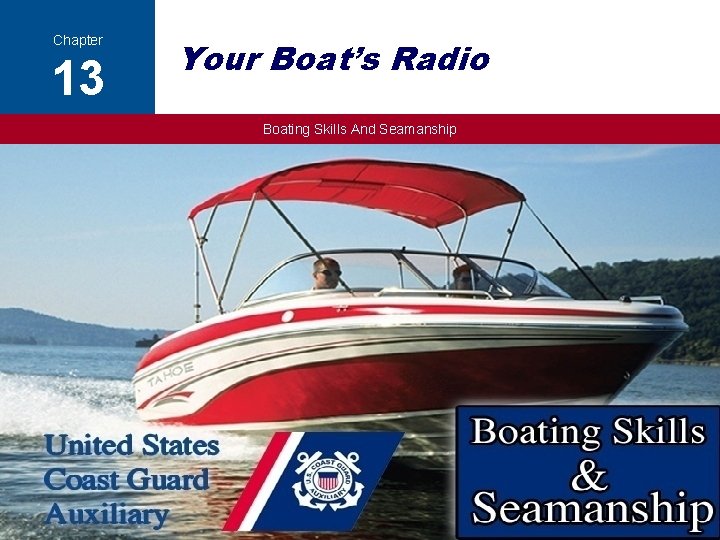
Chapter 13 Your Boat’s Radio Boating Skills And Seamanship Copyright 2014 - Coast Guard Auxiliary Association, Inc. 14 th ed. 1
Test Boating Skills And Seamanship • One • Two • three Copyright 2014 - Coast Guard Auxiliary Association, Inc. 14 th ed. 2
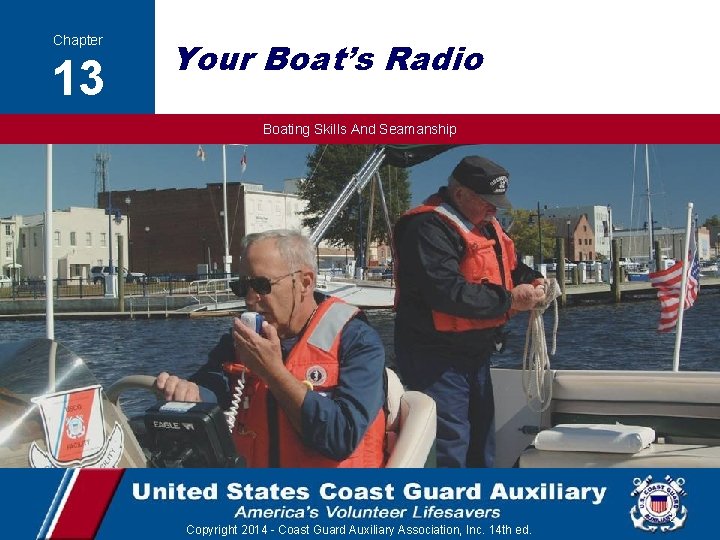
Chapter 13 Your Boat’s Radio Boating Skills And Seamanship Copyright 2014 - Coast Guard Auxiliary Association, Inc. 14 th ed. 3
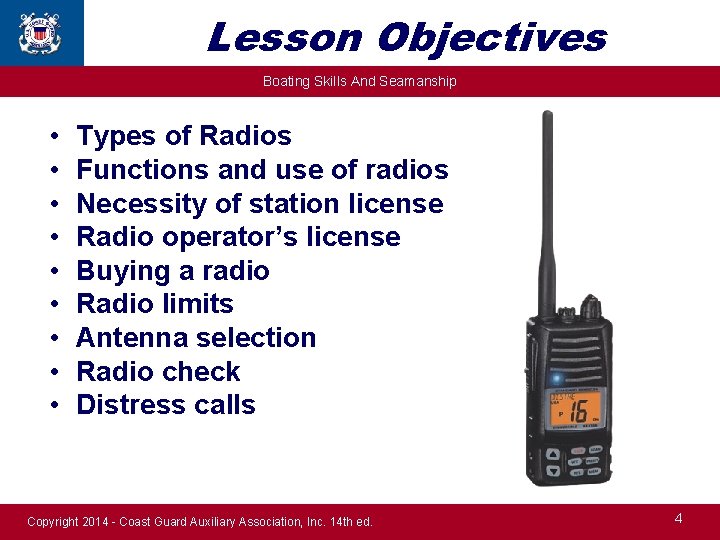
Lesson Objectives Boating Skills And Seamanship • • • Types of Radios Functions and use of radios Necessity of station license Radio operator’s license Buying a radio Radio limits Antenna selection Radio check Distress calls Copyright 2014 - Coast Guard Auxiliary Association, Inc. 14 th ed. 4
Radio Functions Boating Skills And Seamanship • The three functions of the VHF and SSB marine radios are: • Safety messages • Operational messages • Commercial messages • No other type of message is permitted Copyright 2014 - Coast Guard Auxiliary Association, Inc. 14 th ed. 5
FCC License Boating Skills And Seamanship • A FCC Station License is required If – • Vessel is Over 65 feet in Length • Visiting Foreign Ports • Making International Calls Copyright 2014 - Coast Guard Auxiliary Association, Inc. 14 th ed. 6
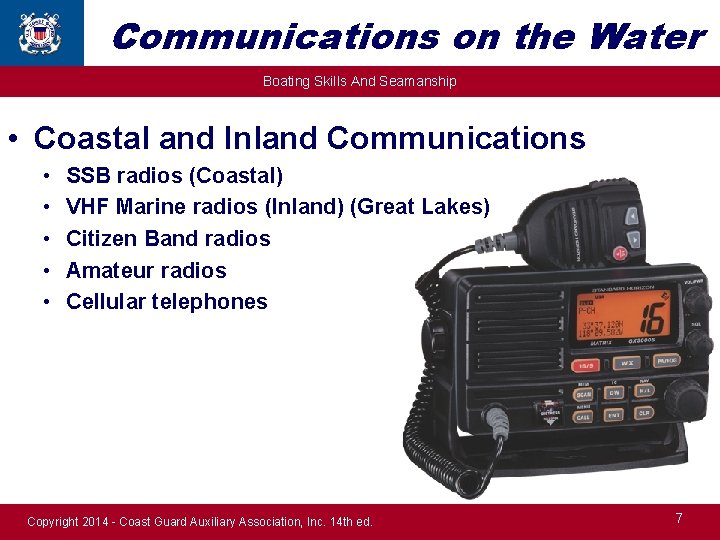
Communications on the Water Boating Skills And Seamanship • Coastal and Inland Communications • • • SSB radios (Coastal) VHF Marine radios (Inland) (Great Lakes) Citizen Band radios Amateur radios Cellular telephones Copyright 2014 - Coast Guard Auxiliary Association, Inc. 14 th ed. 7
VHF-FM Radios Boating Skills And Seamanship • • • FM - Static Free Line Of Sight – 10 - 15 Miles Used & Monitored By U. S. Coast Guard 25 Watts Maximum Power Relatively Inexpensive Used in the Great Lakes Copyright 2014 - Coast Guard Auxiliary Association, Inc. 14 th ed. 8
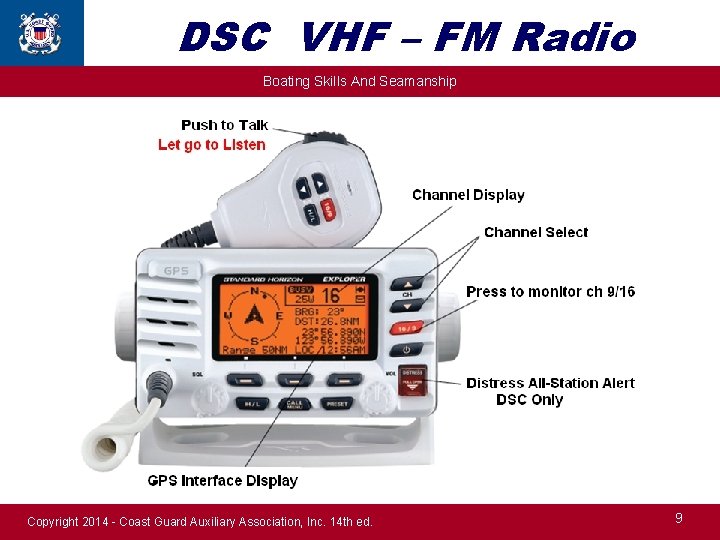
DSC VHF – FM Radio Boating Skills And Seamanship Copyright 2014 - Coast Guard Auxiliary Association, Inc. 14 th ed. 9
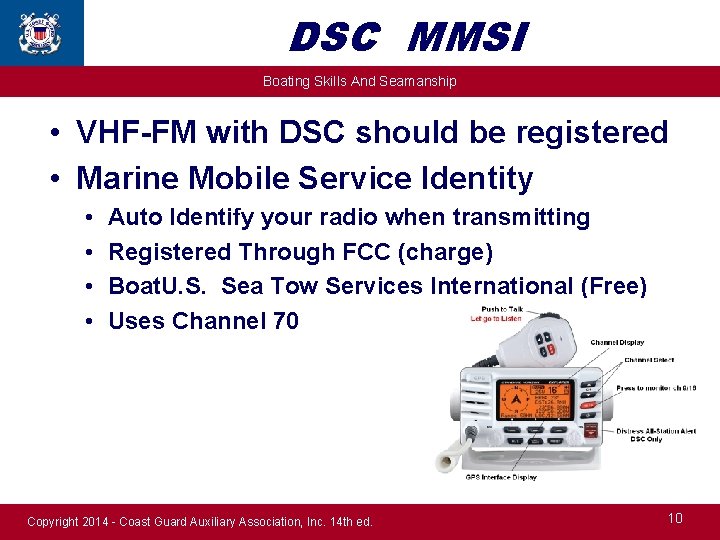
DSC MMSI Boating Skills And Seamanship • VHF-FM with DSC should be registered • Marine Mobile Service Identity • • Auto Identify your radio when transmitting Registered Through FCC (charge) Boat. U. S. Sea Tow Services International (Free) Uses Channel 70 Copyright 2014 - Coast Guard Auxiliary Association, Inc. 14 th ed. 10
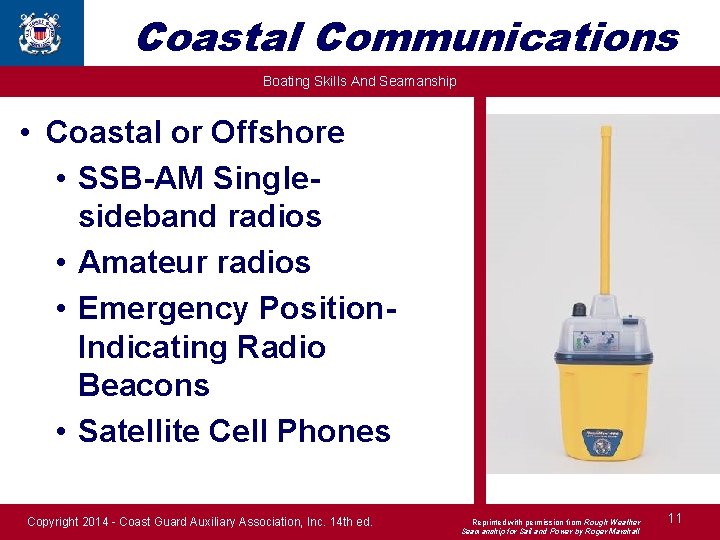
Coastal Communications Boating Skills And Seamanship • Coastal or Offshore • SSB-AM Singlesideband radios • Amateur radios • Emergency Position. Indicating Radio Beacons • Satellite Cell Phones Copyright 2014 - Coast Guard Auxiliary Association, Inc. 14 th ed. Reprinted with permission from Rough Weather Seamanship for Sail and Power by Roger Marshall 11
Citizen Band (CB) Radio Boating Skills And Seamanship • Low power - 5 watts • Limited Range • Not Monitored By Coast Guard • Overcrowded • AM - Susceptible To Static • Channel 9 - Unofficial Emergency Frequency • Inexpensive Copyright 2014 - Coast Guard Auxiliary Association, Inc. 14 th ed. 12
Other Systems Boating Skills And Seamanship • Licensed Amateur Radio Operators (HAM) • Several Short Wave Frequencies Available • Cellular Telephones • Not Monitored By Others • Coast Guard cannot locate with RDF as a Marine Radio • Call Coast Guard or 911 • Limited reception on water Copyright 2014 - Coast Guard Auxiliary Association, Inc. 14 th ed. 13
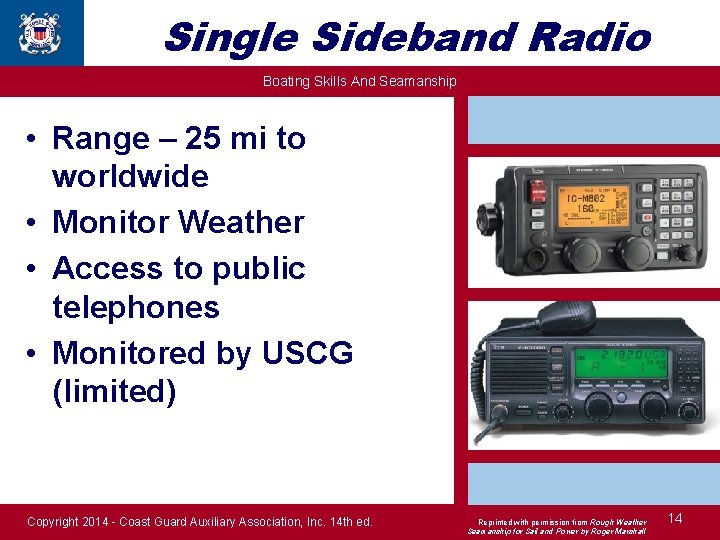
Single Sideband Radio Boating Skills And Seamanship • Range – 25 mi to worldwide • Monitor Weather • Access to public telephones • Monitored by USCG (limited) Copyright 2014 - Coast Guard Auxiliary Association, Inc. 14 th ed. Reprinted with permission from Rough Weather Seamanship for Sail and Power by Roger Marshall 14
SSB Radios Boating Skills And Seamanship • Range • Day - 100 miles • Night - 1000 miles • Recommended for Ocean Operation • Monitored By U. S. Coast Guard • More Costly Than VHF-FM • Must Also Have VHF-FM Radio Copyright 2014 - Coast Guard Auxiliary Association, Inc. 14 th ed. 15
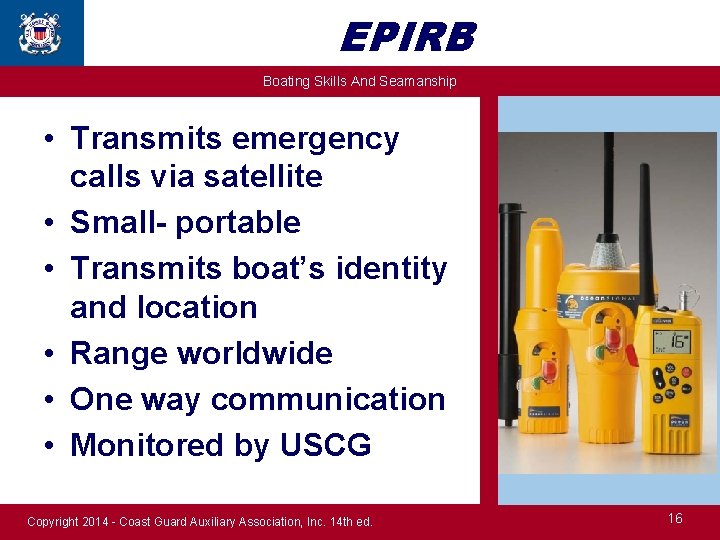
EPIRB Boating Skills And Seamanship • Transmits emergency calls via satellite • Small- portable • Transmits boat’s identity and location • Range worldwide • One way communication • Monitored by USCG Copyright 2014 - Coast Guard Auxiliary Association, Inc. 14 th ed. 16
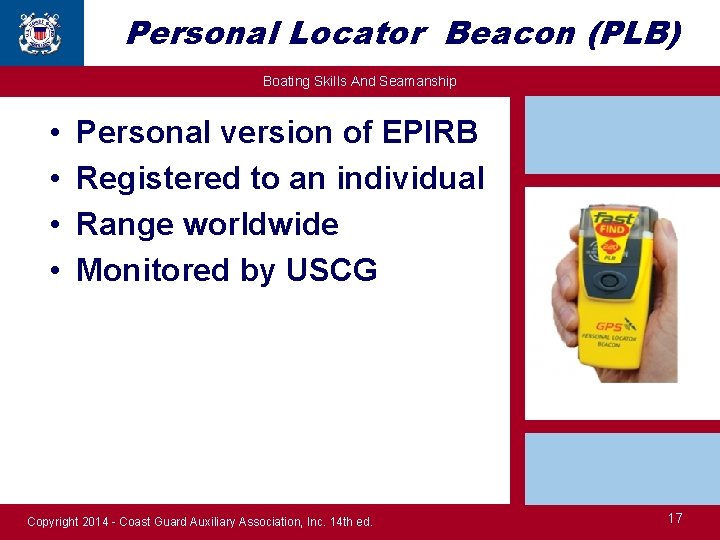
Personal Locator Beacon (PLB) Boating Skills And Seamanship • • Personal version of EPIRB Registered to an individual Range worldwide Monitored by USCG Copyright 2014 - Coast Guard Auxiliary Association, Inc. 14 th ed. 17
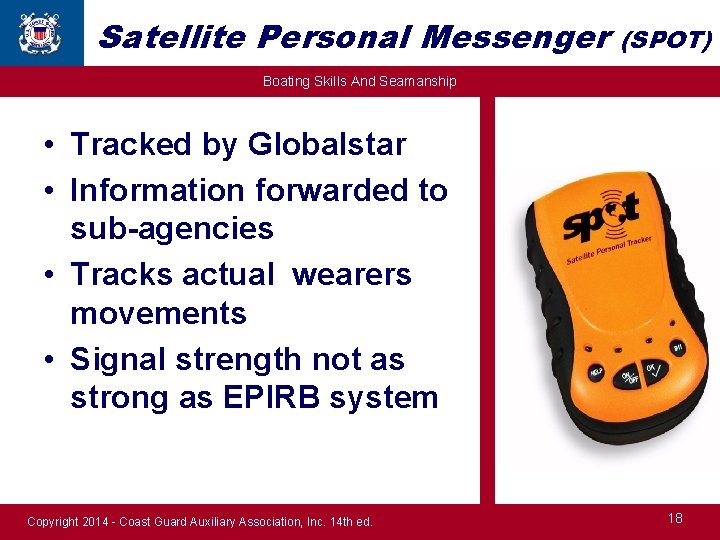
Satellite Personal Messenger (SPOT) Boating Skills And Seamanship • Tracked by Globalstar • Information forwarded to sub-agencies • Tracks actual wearers movements • Signal strength not as strong as EPIRB system Copyright 2014 - Coast Guard Auxiliary Association, Inc. 14 th ed. 18
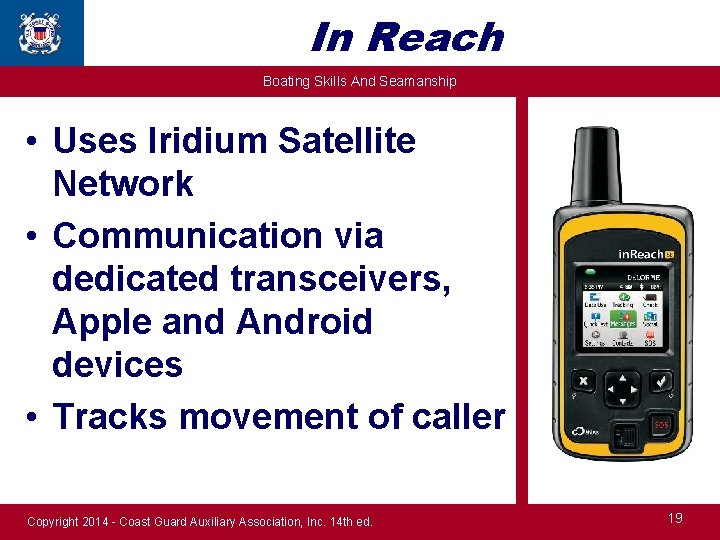
In Reach Boating Skills And Seamanship • Uses Iridium Satellite Network • Communication via dedicated transceivers, Apple and Android devices • Tracks movement of caller Copyright 2014 - Coast Guard Auxiliary Association, Inc. 14 th ed. 19
Automatic Packet Reporting Sys. (APRS) Boating Skills And Seamanship • • General VHF communication system Not specifically for emergencies Messages repeated limited times No assurance responders will be notified Copyright 2014 - Coast Guard Auxiliary Association, Inc. 14 th ed. 20
Student Activities Boating Skills And Seamanship • Who recalls the three functions of the VHF and SSB marine radios? • They are…. • Safety messages • Operational messages • Commercial messages Copyright 2014 - Coast Guard Auxiliary Association, Inc. 14 th ed. 21
Licenses Boating Skills And Seamanship • Station license • Required when using ships SSB radio • Issued by the FCC • Operator permit • Restricted radiotelephone operators permit is required when in foreign waters Copyright 2014 - Coast Guard Auxiliary Association, Inc. 14 th ed. 22
Selecting Your VHF-FM Radio Boating Skills And Seamanship • Advantages of the Global Maritime Distress and Safety System • • Uses Ch. 70 for distress calls MMSI (Maritime Mobile System Identity) provides vital boat info. Can be interfaced with GPS for position info. Operator is free to handle emergency while distress is being sent! • Ship to Ship automated calling Copyright 2014 - Coast Guard Auxiliary Association, Inc. 14 th ed. 23
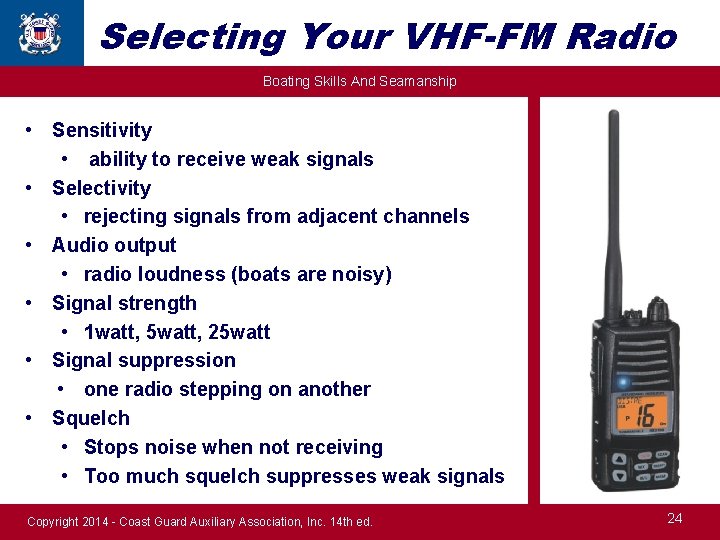
Selecting Your VHF-FM Radio Boating Skills And Seamanship • Sensitivity • ability to receive weak signals • Selectivity • rejecting signals from adjacent channels • Audio output • radio loudness (boats are noisy) • Signal strength • 1 watt, 5 watt, 25 watt • Signal suppression • one radio stepping on another • Squelch • Stops noise when not receiving • Too much squelch suppresses weak signals Copyright 2014 - Coast Guard Auxiliary Association, Inc. 14 th ed. 24
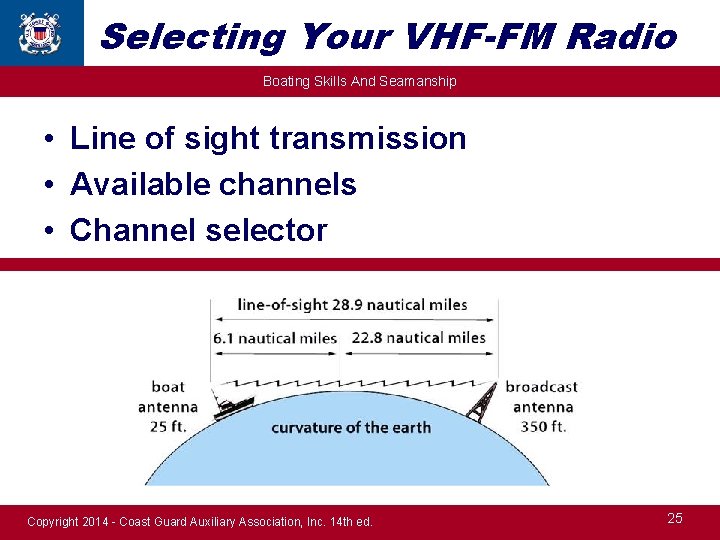
Selecting Your VHF-FM Radio Boating Skills And Seamanship • Line of sight transmission • Available channels • Channel selector Copyright 2014 - Coast Guard Auxiliary Association, Inc. 14 th ed. 25
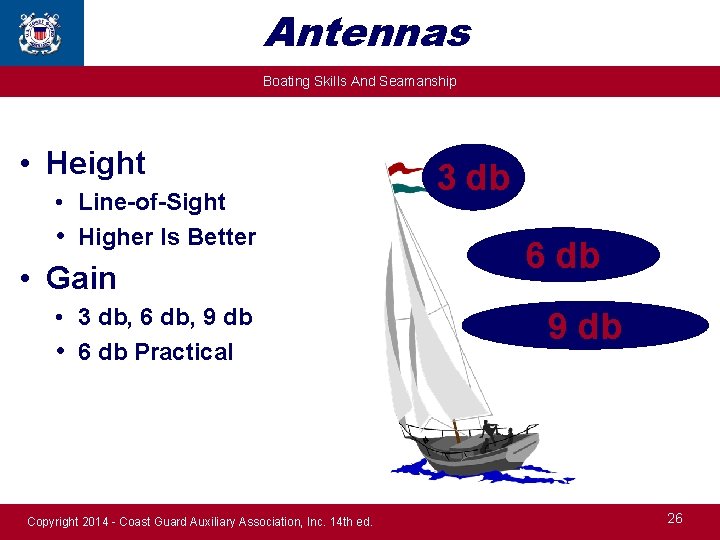
Antennas Boating Skills And Seamanship • Height • Line-of-Sight • Higher Is Better • Gain • 3 db, 6 db, 9 db • 6 db Practical Copyright 2014 - Coast Guard Auxiliary Association, Inc. 14 th ed. 3 db 6 db 9 db 26
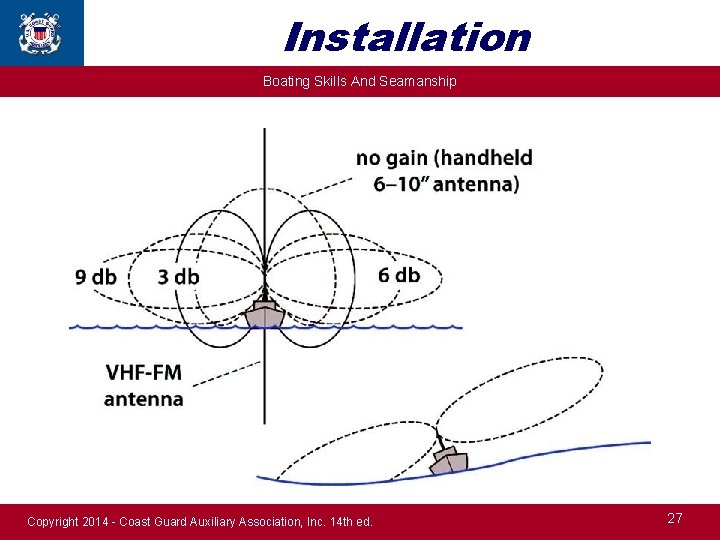
Installation Boating Skills And Seamanship Copyright 2014 - Coast Guard Auxiliary Association, Inc. 14 th ed. 27
Installation Boating Skills And Seamanship • • • Do not try to repair Do not mount near compass Positive power lead RED + goes to radio Install correct type of antenna Place antenna at highest point of boat Allow room to lower antenna as needed Copyright 2014 - Coast Guard Auxiliary Association, Inc. 14 th ed. 28
Operating Your VHF-FM Radio Boating Skills And Seamanship Important caveats: • No false distress calls • No obscenity • Not used inland • Shift from calling to working channel • Speak slowly and distinctly Copyright 2014 - Coast Guard Auxiliary Association, Inc. 14 th ed. 29
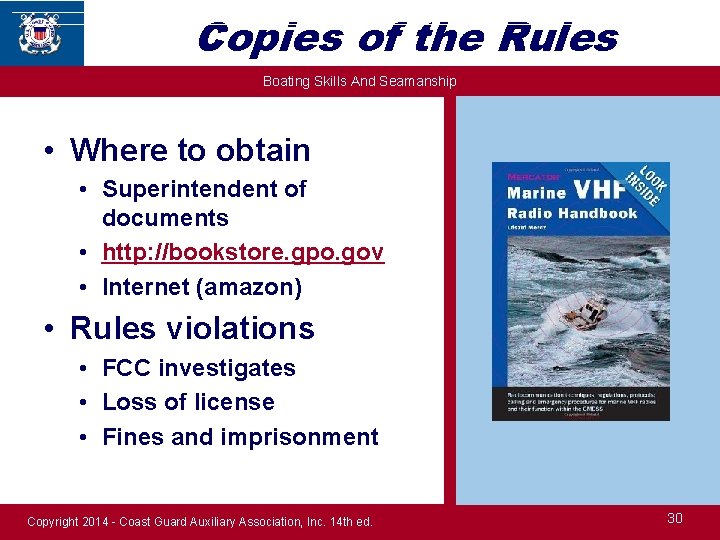
Copies of the Rules Boating Skills And Seamanship • Where to obtain • Superintendent of documents • http: //bookstore. gpo. gov • Internet (amazon) • Rules violations • FCC investigates • Loss of license • Fines and imprisonment Copyright 2014 - Coast Guard Auxiliary Association, Inc. 14 th ed. 30
Calling Another Station Boating Skills And Seamanship • Choose the correct channel when calling • Limit the hailing call to 30 seconds • If there is no answer, wait 1 minute before hailing again • After three attempts wait 15 minutes • Limit ship to ship calls to 3 minutes but move to another working channel first • Limit ship to ship calls to ship’s business • Radio checks are prohibited on Channel 16. • Use Channel 9 for radio checks • Use low power (1 watt) whenever possible Copyright 2014 - Coast Guard Auxiliary Association, Inc. 14 th ed. 31
Calling Another Station Boating Skills And Seamanship • • Remember to …. Check power Listen Press microphone button Normal tone Pro-words to use You can’t hear reply until you let the microphone button go…. . Copyright 2014 - Coast Guard Auxiliary Association, Inc. 14 th ed. 32
Calling Limited Coast Station Boating Skills And Seamanship • Hail Limited Coast Stations on their working Channel first • i. e. bridge operator channel 13 or 9 • Listen • If that doesn’t work try local calling channel i. e. 16 Copyright 2014 - Coast Guard Auxiliary Association, Inc. 14 th ed. 33
Selecting Your VHF-FM Radio Boating Skills And Seamanship • Radio watch • Radios need not be operating while boating. • If you do have radio on, then it should be kept on Ch. 16 when not being used on another channel. • Radio station log • Not required for Vessels 65 feet and smaller. • However all emergency calls you hear must be recorded as completely as possible Copyright 2014 - Coast Guard Auxiliary Association, Inc. 14 th ed. 34
Special Purpose Channels Boating Skills And Seamanship CH 16 - Distress, Urgency, Safety CH 9 Alternate Calling Channel CH 12 - Port Operations CH 13 - Navigation CH 22 A - Coast Guard Liaison CH 68 - Non-Commercial Working WX-1, WX-2, WX-3 Note: “A” designation means USA Copyright 2014 - Coast Guard Auxiliary Association, Inc. 14 th ed. 35
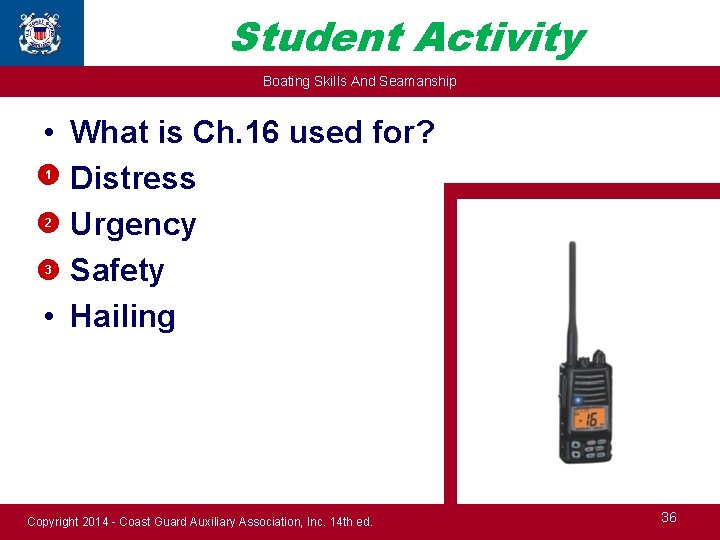
Student Activity Boating Skills And Seamanship • • • 1 2 3 What is Ch. 16 used for? Distress Urgency Safety Hailing Copyright 2014 - Coast Guard Auxiliary Association, Inc. 14 th ed. 36
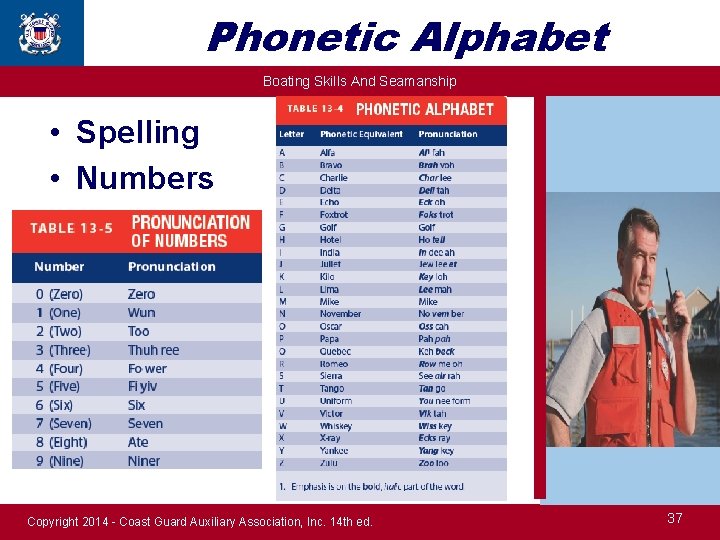
Phonetic Alphabet Boating Skills And Seamanship • Spelling • Numbers Copyright 2014 - Coast Guard Auxiliary Association, Inc. 14 th ed. 37
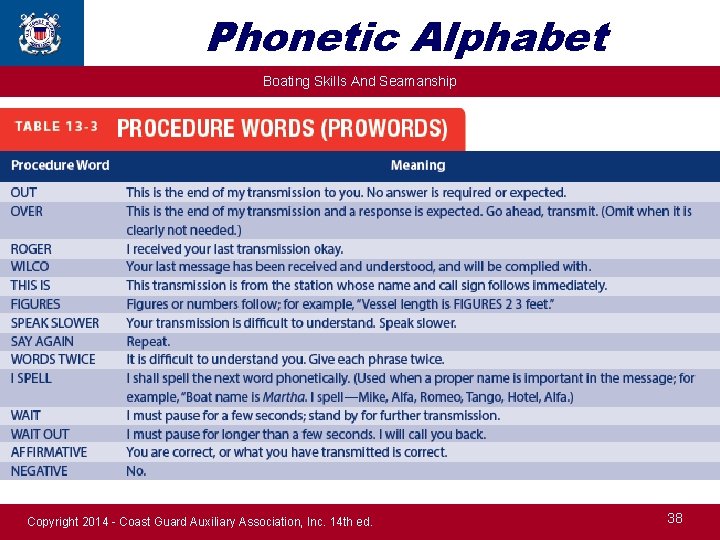
Phonetic Alphabet Boating Skills And Seamanship Copyright 2014 - Coast Guard Auxiliary Association, Inc. 14 th ed. 38
Distress, Urgency, and Safety Calls Boating Skills And Seamanship • Distress signal: Mayday • French venez m'aider - Come Help Me • Urgency signal: Pan-Pan • French panne – Mechanical Breakdown • Safety signal: Secur-i-tay • French Sécurité Copyright 2014 - Coast Guard Auxiliary Association, Inc. 14 th ed. 39
test Boating Skills And Seamanship • One • Two • Three Copyright 2014 - Coast Guard Auxiliary Association, Inc. 14 th ed. 40
Distress Signal Boating Skills And Seamanship • Use When IMMINENT Danger Exists • Call On Channel 16 or Cell Phone 911 • Call Format: • • “Mayday” “This Is (Name Of Your Boat)” Give Location Lat/Long or Visual Problem Number of persons onboard “This Is (Name Of Your Boat), Over” Follow the Coast Guards Direction Copyright 2014 - Coast Guard Auxiliary Association, Inc. 14 th ed. 41
Calling Time Limits Boating Skills And Seamanship • 1 st Call - 30 Seconds Maximum • Then - Wait 2 Minutes • 2 nd Call - 30 Seconds Maximum • Then - Wait 2 Minutes • 3 rd Call - 30 Seconds Maximum • Then - Wait 15 Minutes Before Additional Calls To The Same Station Copyright 2014 - Coast Guard Auxiliary Association, Inc. 14 th ed. 42
Crew Training Boating Skills And Seamanship • Crewmembers to be familiar with how to operate the VHF-FM Marine radio • Everyone on board including children should be able to operate a radio to call for help in an emergency • Before leaving port explain how to operate your boats radio to all onboard Copyright 2014 - Coast Guard Auxiliary Association, Inc. 14 th ed. 43
Automated Identification System (AIS) Boating Skills And Seamanship • Warning system required for 3000+Ton boats • Broadcasts 84 different messages • Less elaborate receivers optional on smaller boats • AIS enabled GPS displays AIS boats Copyright 2014 - Coast Guard Auxiliary Association, Inc. 14 th ed. 44
During Distress Communications Boating Skills And Seamanship • Stop All Other Communications when you hear: • “All Stations” • “SEELONCE Mayday” • “SEELONCE Distress” • When Distress Is Over • “SEELONCE FEENEE Copyright 2014 - Coast Guard Auxiliary Association, Inc. 14 th ed. 45
During Distress Communications Boating Skills And Seamanship • Willful violation of radio regulations carries severe penalties • Revocation of License • Fines • Imprisonment Copyright 2014 - Coast Guard Auxiliary Association, Inc. 14 th ed. 46
Thank you Boating Skills And Seamanship • Illustrations provided by Mc. Graw Hill Education The Copyright 2014 - Coast Guard Auxiliary Association, Inc. 14 th ed. 47
- Slides: 47