
Chapter 13 Working Capital Policy Essentials of Managerial

- Slides: 20
Chapter 13 Working Capital Policy Essentials of Managerial Finance by S. Besley & E. Brigham Slide 1 of 20
Working Capital Policy: Overview • Financial management decisions are divided into the management of assets (investments) and management of liabilities (liabilities). • The short term financial management (working capital management) involves the management of a firm’s current assets and current liabilities • The maximization of the firm’s value in the long run depends on its survival in the short run, i. e. meeting its working capital needs. Essentials of Managerial Finance by S. Besley & E. Brigham Slide 2 of 20
Working Capital Policy: Definitions • Working capital, sometimes called gross working capital, generally refers to cur rent as sets, whilenet working capital is defined as current assets minus current liabilities—the amount of current assets financed by long term liabilities. • The current ratio, calculated as current assets divided by current liabilities, is intended to measure a firm’s liquidity. – A high current ratio does not insure that a firm will have the cash required to meet its needs. • The best and most comprehensive picture of a firm’s liquidity position is obtained by examining its cash budget, which forecasts a firm’s cash inflows and outflows. It focuses on what really counts, the firm’s ability to generate sufficient cash inflows to meet its required cash outflows. Essentials of Managerial Finance by S. Besley & E. Brigham Slide 3 of 20
Working Capital Policy: Definitions • Distinction should be made between current liabilities, specifically used to finance current assets and current liabilities that represent (a) current maturities of long-term debt; (b) financing associated with a construction program, after its completion will be funded with proceeds of a long-term security issue; or (c) the use of short-term debt to finance fixed assets. – Even though we define long-term debt coming due in the next accounting period as a current liability, it is not a working capital decision variable in the current period. – Similarly, when construction is temporarily financed with a short-term loan and later replaced with mortgage bonds, the construction loan would not be considered part of working capital management. – Although such accounts are not part of the working capital decision process, they cannot be ignored because they are due in the current period, and they must be considered when the cash budget is constructed and the firm’s ability to meet its current obligations is assessed. Essentials of Managerial Finance by S. Besley & E. Brigham Slide 4 of 20
Relationship between the current asset levels and financing requirements and the business cycle • At the peak of a business cycle, business carry their maximum amounts of current assets • Financing needs decline during recessions and increase during booms Essentials of Managerial Finance by S. Besley & E. Brigham Slide 5 of 20
The firm’s accounts balance • Once a firm’s operations have stabilized and cash collections from credit sales and cash payments for credit purchases have begun, the balance in accounts receivable and accounts payable can be computed using the following equation: • A decision affecting one working capital account will have an impact on other working capital accounts. Essentials of Managerial Finance by S. Besley & E. Brigham Slide 6 of 20
The cash conversion cycle • The cash conversion cycle focuses on the length of time between when the company makes payments, or invests in the manufacture of inventory, and when it receives cash inflows, or realizes a cash return from its investment in production. Essentials of Managerial Finance by S. Besley & E. Brigham Slide 7 of 20
The cash conversion cycle Definitions • Inventory conversion period is the average length of time required to convert materials into finished goods and then to sell these goods; it is the amount of time the product remains in inventory in various stages of completion. Essentials of Managerial Finance by S. Besley & E. Brigham Slide 8 of 20
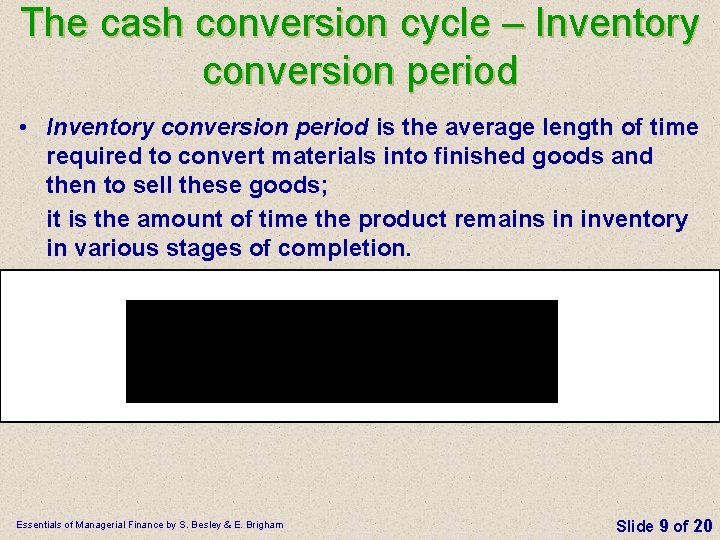
The cash conversion cycle – Inventory conversion period • Inventory conversion period is the average length of time required to convert materials into finished goods and then to sell these goods; it is the amount of time the product remains in inventory in various stages of completion. Essentials of Managerial Finance by S. Besley & E. Brigham Slide 9 of 20
The cash conversion cycle – Receivables collection period • Receivables collection period is the average length of time required to convert the firm’s receivables into cash, that is, to collect cash following a sale. It is also called the days sales outstanding (DSO). Essentials of Managerial Finance by S. Besley & E. Brigham Slide 10 of 20
The cash conversion cycle – Payables deferral period • Payables deferral period is the average length of time between the purchase of raw materials and labor and the payment of cash for them. Essentials of Managerial Finance by S. Besley & E. Brigham Slide 11 of 20
Analysis of the cash conversion cycle • The cash conversion cycle, which nets out the three periods just defined, equals the length of time between the firm’s actual cash expenditures to pay for (invest in) productive resources (materials and labor) and its own cash receipts from the sale of its products. Thus, the cash conversion cycle equals the average length of time a dollar is tied up in current assets. • Using these definitions, the cash conversion cycle is defined as follows: Essentials of Managerial Finance by S. Besley & E. Brigham Slide 12 of 20
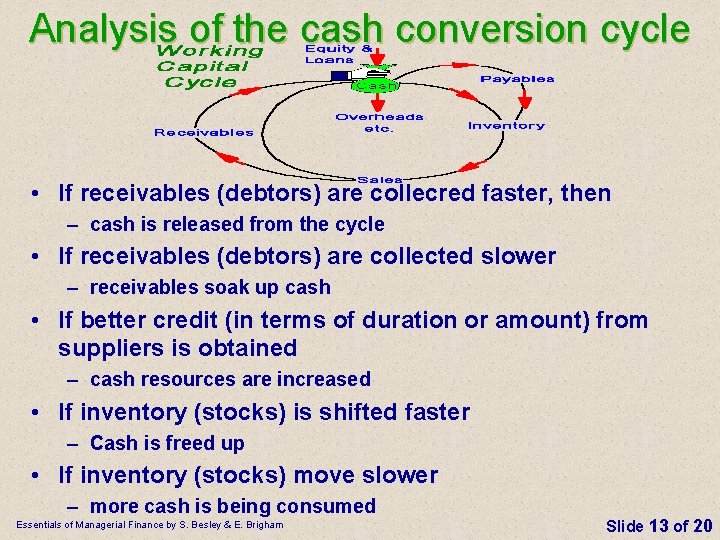
Analysis of the cash conversion cycle • If receivables (debtors) are collecred faster, then – cash is released from the cycle • If receivables (debtors) are collected slower – receivables soak up cash • If better credit (in terms of duration or amount) from suppliers is obtained – cash resources are increased • If inventory (stocks) is shifted faster – Cash is freed up • If inventory (stocks) move slower – more cash is being consumed Essentials of Managerial Finance by S. Besley & E. Brigham Slide 13 of 20
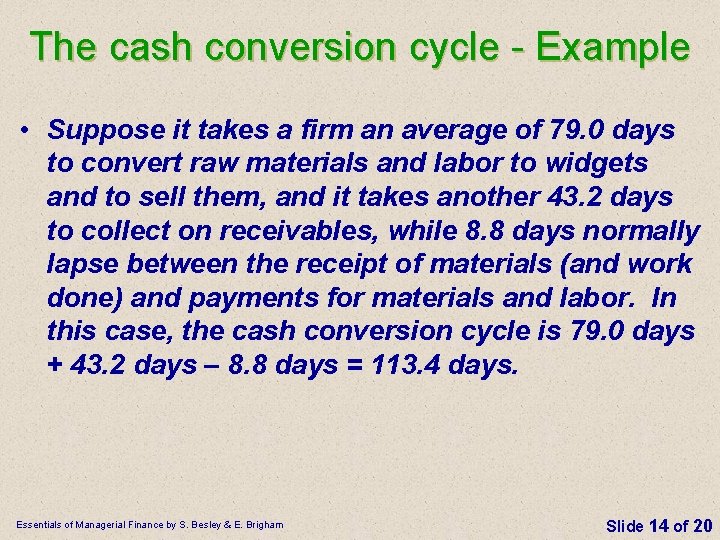
The cash conversion cycle Example • Suppose it takes a firm an average of 79. 0 days to convert raw materials and labor to widgets and to sell them, and it takes another 43. 2 days to collect on receivables, while 8. 8 days normally lapse between the receipt of materials (and work done) and payments for materials and labor. In this case, the cash conversion cycle is 79. 0 days + 43. 2 days – 8. 8 days = 113. 4 days. Essentials of Managerial Finance by S. Besley & E. Brigham Slide 14 of 20
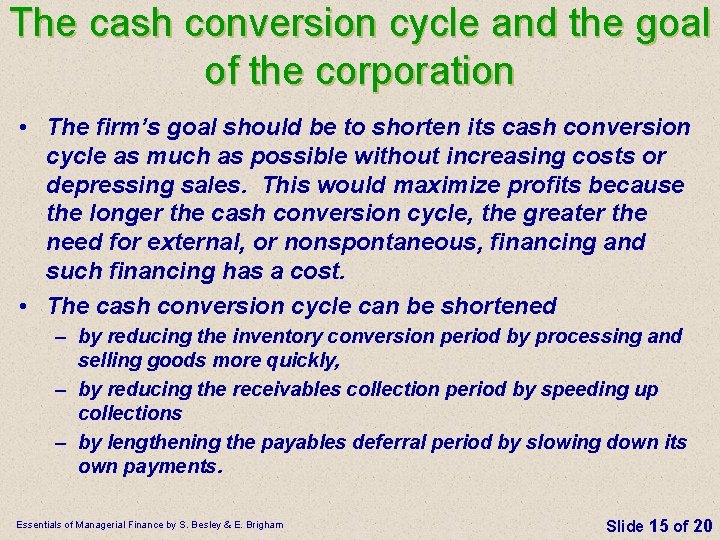
The cash conversion cycle and the goal of the corporation • The firm’s goal should be to shorten its cash conversion cycle as much as possible without increasing costs or depressing sales. This would maximize profits because the longer the cash conversion cycle, the greater the need for external, or nonspontaneous, financing and such financing has a cost. • The cash conversion cycle can be shortened – by reducing the inventory conversion period by processing and selling goods more quickly, – by reducing the receivables collection period by speeding up collections – by lengthening the payables deferral period by slowing down its own payments. Essentials of Managerial Finance by S. Besley & E. Brigham Slide 15 of 20
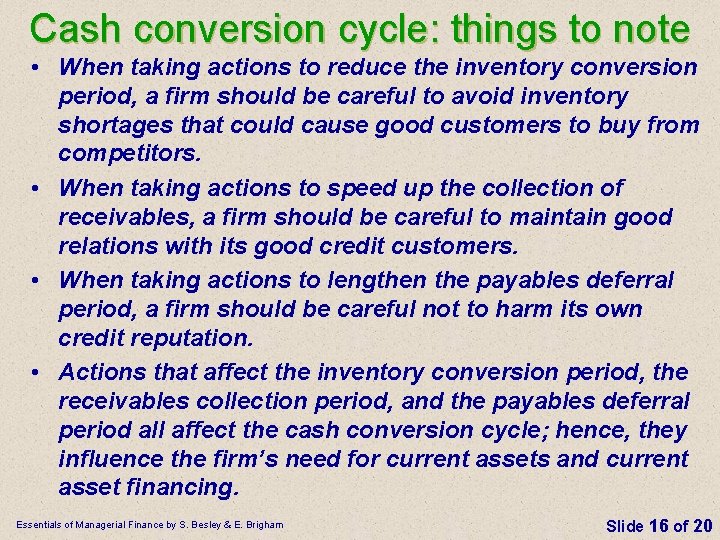
Cash conversion cycle: things to note • When taking actions to reduce the inventory conversion period, a firm should be careful to avoid inventory shortages that could cause good customers to buy from competitors. • When taking actions to speed up the collection of receivables, a firm should be careful to maintain good relations with its good credit customers. • When taking actions to lengthen the payables deferral period, a firm should be careful not to harm its own credit reputation. • Actions that affect the inventory conversion period, the receivables collection period, and the payables deferral period all affect the cash conversion cycle; hence, they influence the firm’s need for current assets and current asset financing. Essentials of Managerial Finance by S. Besley & E. Brigham Slide 16 of 20
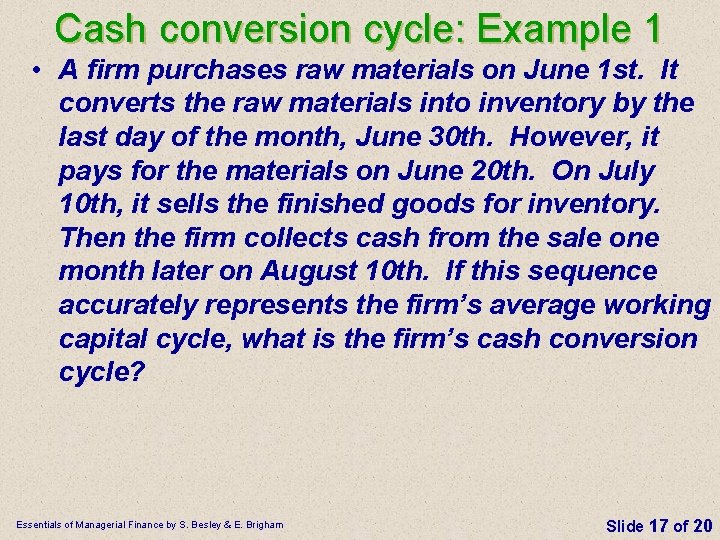
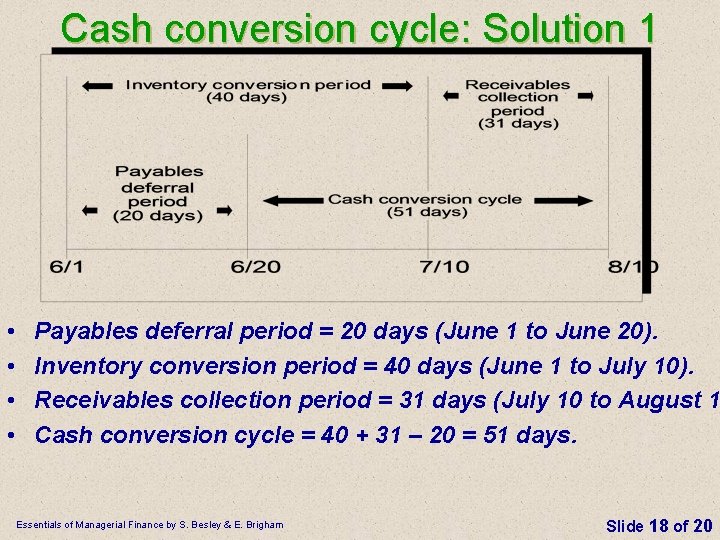
Cash conversion cycle: Example 1 • A firm purchases raw materials on June 1 st. It converts the raw materials into inventory by the last day of the month, June 30 th. However, it pays for the materials on June 20 th. On July 10 th, it sells the finished goods for inventory. Then the firm collects cash from the sale one month later on August 10 th. If this sequence accurately represents the firm’s average working capital cycle, what is the firm’s cash conversion cycle? Essentials of Managerial Finance by S. Besley & E. Brigham Slide 17 of 20
Cash conversion cycle: Solution 1 • • Payables deferral period = 20 days (June 1 to June 20). Inventory conversion period = 40 days (June 1 to July 10). Receivables collection period = 31 days (July 10 to August 1 Cash conversion cycle = 40 + 31 – 20 = 51 days. Essentials of Managerial Finance by S. Besley & E. Brigham Slide 18 of 20
Cash conversion cycle: Example 2 • The Cairn Corporation is trying to determine the effect of its inventory turnover ratio and days sales outstanding (DSO) on its cash flow cycle. Cairn’s sales (which were all on credit) were $750, 000, and it earned a net profit margin of 12 percent, or $90, 000. It turned over its inventory 9 times during the year, its DSO (receivables collection period) was 45 days, and the firm’s cost of goods sold (COGS) was two-thirds of sales. The firm had fixed assets totaling $60, 000. Cairn’s payables deferral period is 30 days. What is Cairn’s cash conversion cycle? Essentials of Managerial Finance by S. Besley & E. Brigham Slide 19 of 20
Cash conversion cycle: Solution 2 • DSO = 45 days; Payables deferral period = 30 days. Because inventory is turned over 9 times during the year, the inventory conversion period must be 40 days = (360 days)/9. Alternatively, calculate the average inventory balance: • Cost of goods sold (COGS) = $750, 000(2/3) = $500, 000. • Inventory = ($500, 000)/9 = $55, 556. So, the inventory conversion period is: Essentials of Managerial Finance by S. Besley & E. Brigham Slide 20 of 20