
CHAPTER 13 WEIGHING NET PRESENT VALUE AND OTHER








- Slides: 25
CHAPTER 13 WEIGHING NET PRESENT VALUE AND OTHER CAPITAL BUDGETING CRITERIA M: Finance 3 rd Edition Cornett, Adair, and Nofsinger Copyright © 2016 by Mc. Graw-Hill Education. All rights reserved.
Capital Budgeting Techniques • Project evaluation methods • Net Present Value (NPV) is preferred method • Internal Rate of Return (IRR) • Payback (PB)
Capital Budgeting Techniques • Project evaluation methods • Discounted Payback (DPB) • Modified Internal Rate of Return (MIRR) • Profitability Index (PI)
Choice of Decision Statistic Format • Financial decisions primarily driven by • Currency • Time • Rate of return
Capital Budgeting Decisions • Deciding on single project acceptance • Compute statistic • Compare with benchmark
Capital Budgeting Decisions • Deciding on mutually exclusive projects • Compute statistic • Conduct “runoff” between mutually exclusive projects • Compare winning project with benchmark
Payback and Discounted Payback • Payback statistic • Break-even calculation for costs of financing new project
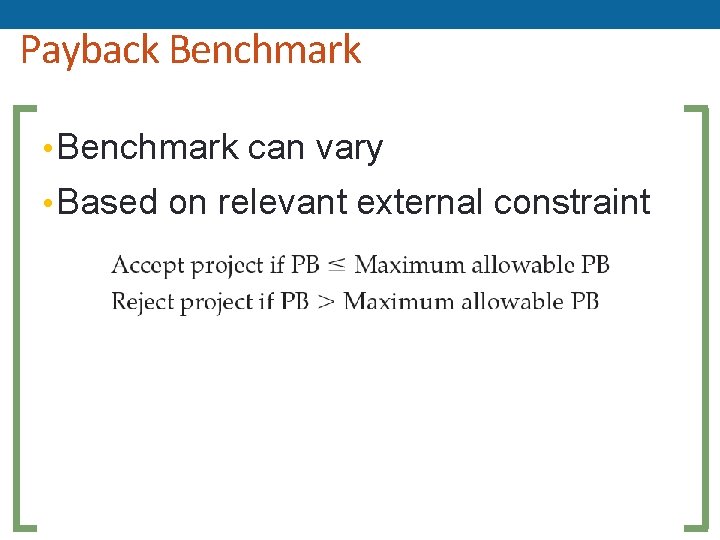
Payback Benchmark • Benchmark can vary • Based on relevant external constraint
Discounted Payback Statistic • Compensates for time value of money
Discounted Payback Benchmark • Not recommended to compare Discounted Payback Benchmark (DPB) with Payback Benchmark (PB) • DPB will be larger than regular PB
Payback and Discounted Payback Strengths • Easy to calculate • Intuitive • Weaknesses • Accept/reject benchmarks are arbitrary • Ignore cash flows after the payback period • PB ignores the time value of money
Net Present Value • Measures value created by the project
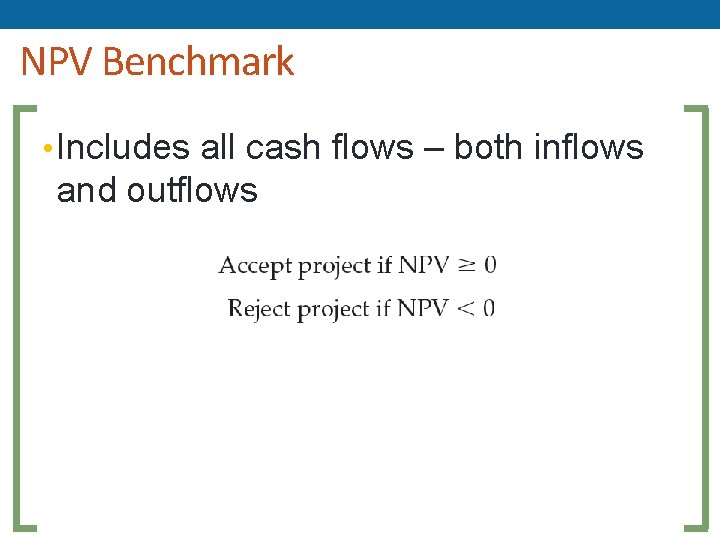
NPV Benchmark • Includes all cash flows – both inflows and outflows
NPV Strengths and Weaknesses • Strengths • Not a ratio • Works well for both independent projects and mutually-exclusive projects • Weaknesses • Managers can misinterpret the results • May compare NPV to cost even though cost already incorporated into the NPV
IRR and Modified Internal Rate of Return • IRR most popular technique • IRR gives same accept/reject decision as NPV when used with normal cashflow projects
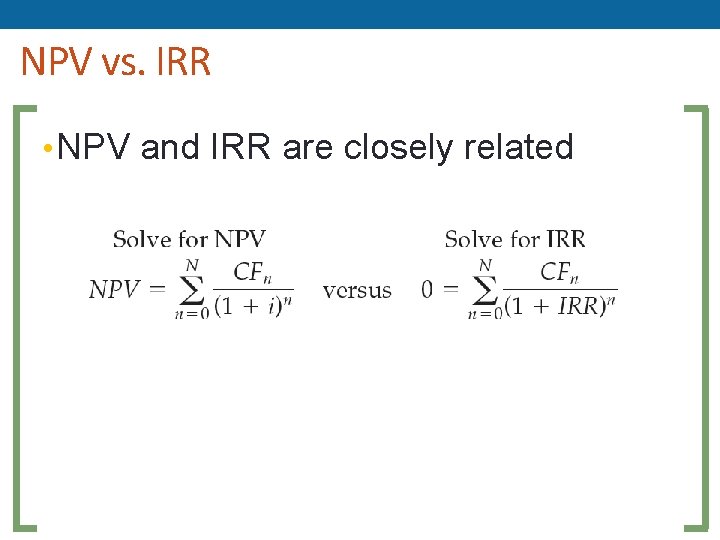
NPV vs. IRR • NPV and IRR are closely related
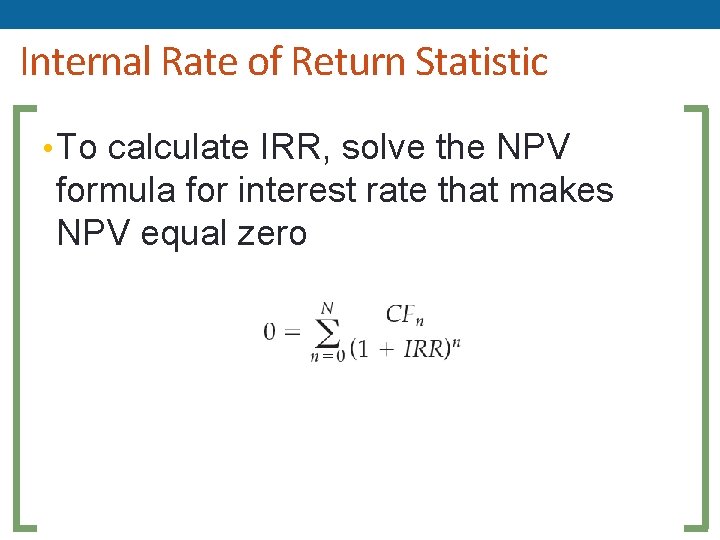
Internal Rate of Return Statistic • To calculate IRR, solve the NPV formula for interest rate that makes NPV equal zero
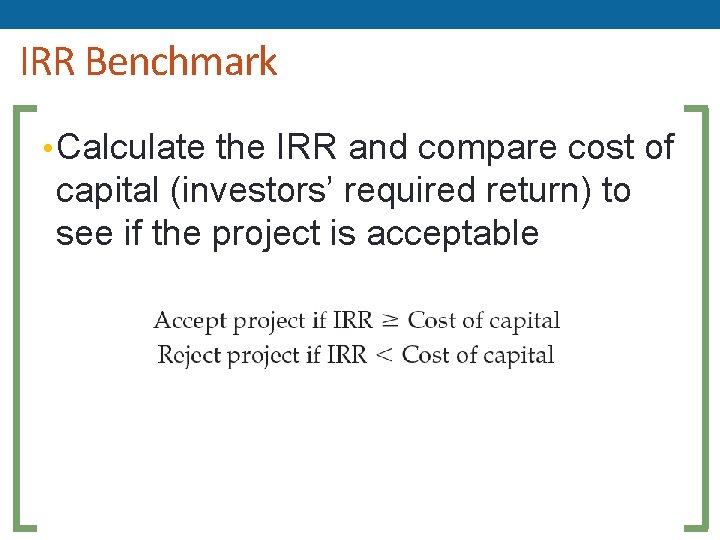
IRR Benchmark • Calculate the IRR and compare cost of capital (investors’ required return) to see if the project is acceptable
Problems with IRR • IRR will be consistent with NPV as long as project • Has normal cash flows • Is independent of other projects
IRR and NPV with Non-Normal Cash Flows • Recommended not to use IRR with non-normal cash flows • Modified Internal Rate of Return is better
Differing Reinvestment Rate Assumptions • NPV and IRR assumptions differ re: reinvestment of cash flows • IRR assumes reinvestment in another project with same earning power • NPV assumes investment are reinvested at cost of capital • NPV’s reinvestment rate assumption is considered superior to IRR’s
Modified Internal Rate of Return • “Fixes” IRR reinvestment rate problem • Uses cost of capital to move cash flows • MIRR not appropriate for mutually exclusive projects
IRR, MIRR, NPV Mutually Exclusive Projects • Rate-based statistics cause problems when project cash flows have differences in • Scale • Timing
MIRR Strengths and Weakness • Strengths • Corrects IRR’s reinvestment rate assumption • Fixes non-normal cash flows problem • Weakness • Does not correct IRR issues with choosing the wrong mutually exclusive project for range of rates
Profitability Index • Based on NPV • Use when firm has resource constraints on capital available for new projects