
Chapter 13 User Defined Types C LEARN BY
Chapter 13 User Defined Types C++: LEARN BY DOING Todd Breedlove Troy Scevers Randal L. Albert
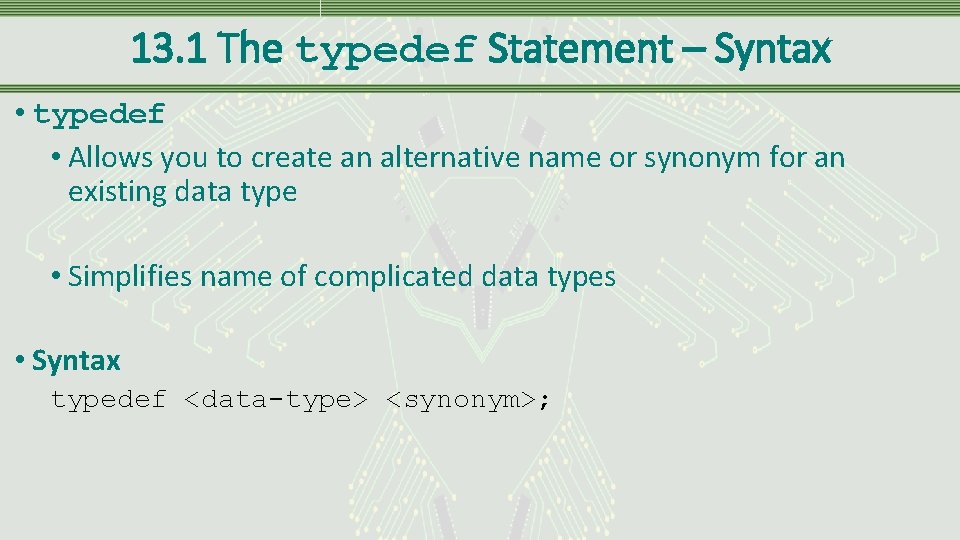
13. 1 The typedef Statement – Syntax • typedef • Allows you to create an alternative name or synonym for an existing data type • Simplifies name of complicated data types • Syntax typedef <data-type> <synonym>;
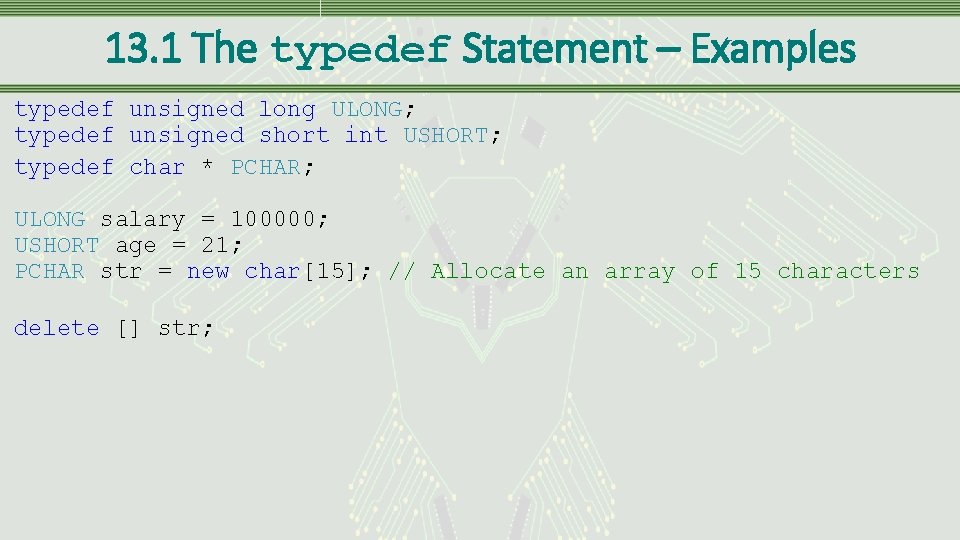
13. 1 The typedef Statement – Examples typedef unsigned long ULONG; typedef unsigned short int USHORT; typedef char * PCHAR; ULONG salary = 100000; USHORT age = 21; PCHAR str = new char[15]; // Allocate an array of 15 characters delete [] str;
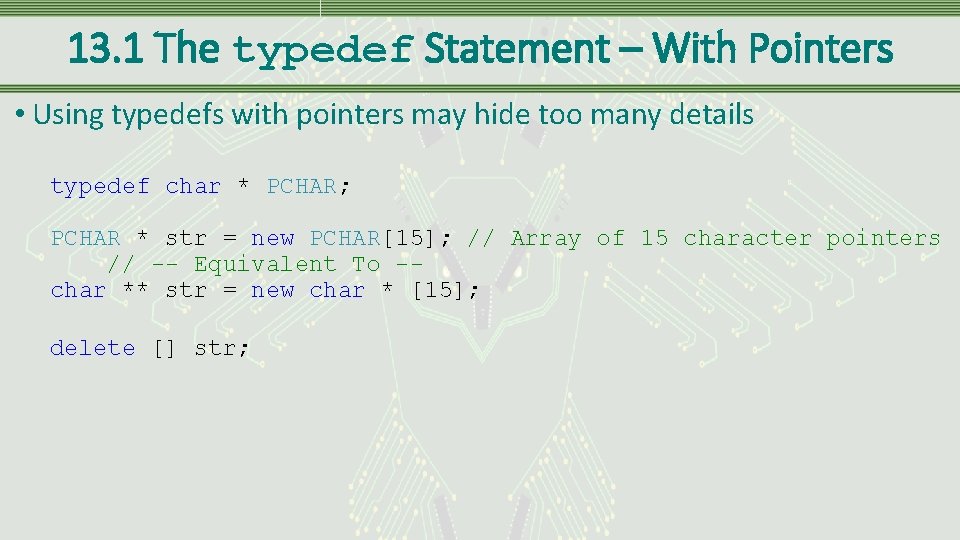
13. 1 The typedef Statement – With Pointers • Using typedefs with pointers may hide too many details typedef char * PCHAR; PCHAR * str = new PCHAR[15]; // Array of 15 character pointers // -- Equivalent To -char ** str = new char * [15]; delete [] str;
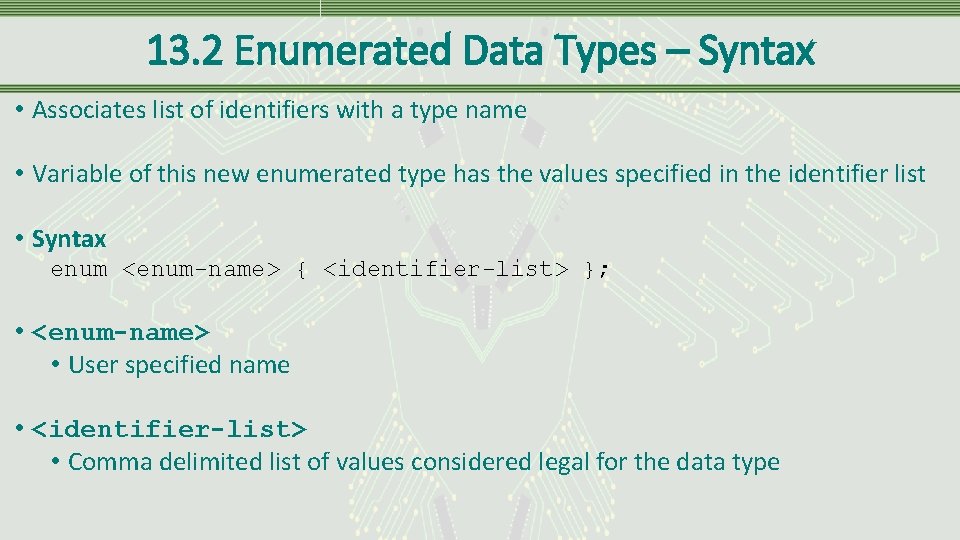
13. 2 Enumerated Data Types – Syntax • Associates list of identifiers with a type name • Variable of this new enumerated type has the values specified in the identifier list • Syntax enum <enum-name> { <identifier-list> }; • <enum-name> • User specified name • <identifier-list> • Comma delimited list of values considered legal for the data type
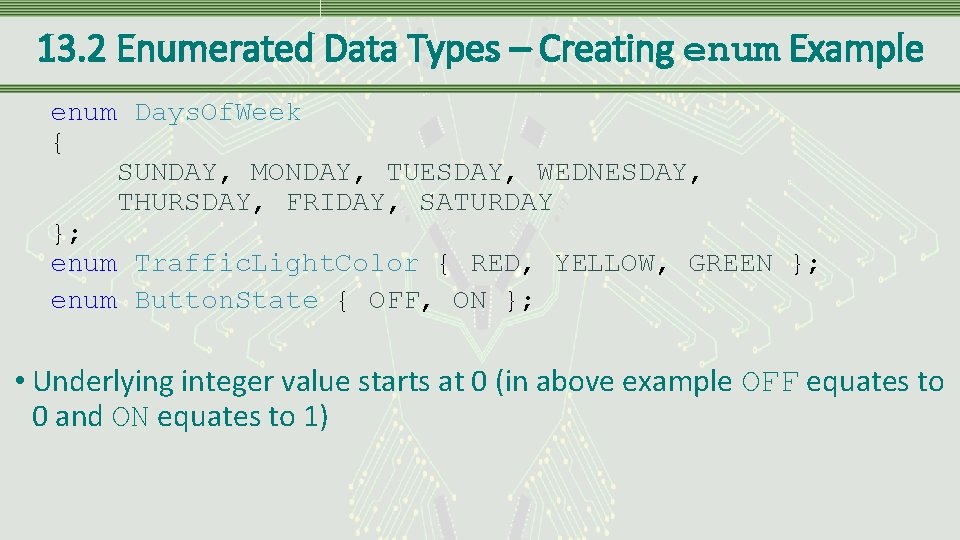
13. 2 Enumerated Data Types – Creating enum Example enum Days. Of. Week { SUNDAY, MONDAY, TUESDAY, WEDNESDAY, THURSDAY, FRIDAY, SATURDAY }; enum Traffic. Light. Color { RED, YELLOW, GREEN }; enum Button. State { OFF, ON }; • Underlying integer value starts at 0 (in above example OFF equates to 0 and ON equates to 1)
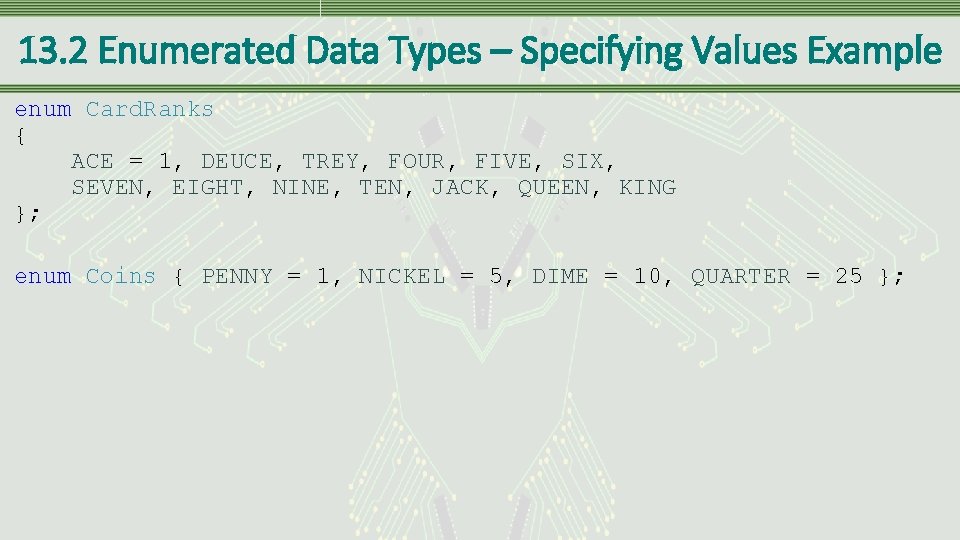
13. 2 Enumerated Data Types – Specifying Values Example enum Card. Ranks { ACE = 1, DEUCE, TREY, FOUR, FIVE, SIX, SEVEN, EIGHT, NINE, TEN, JACK, QUEEN, KING }; enum Coins { PENNY = 1, NICKEL = 5, DIME = 10, QUARTER = 25 };
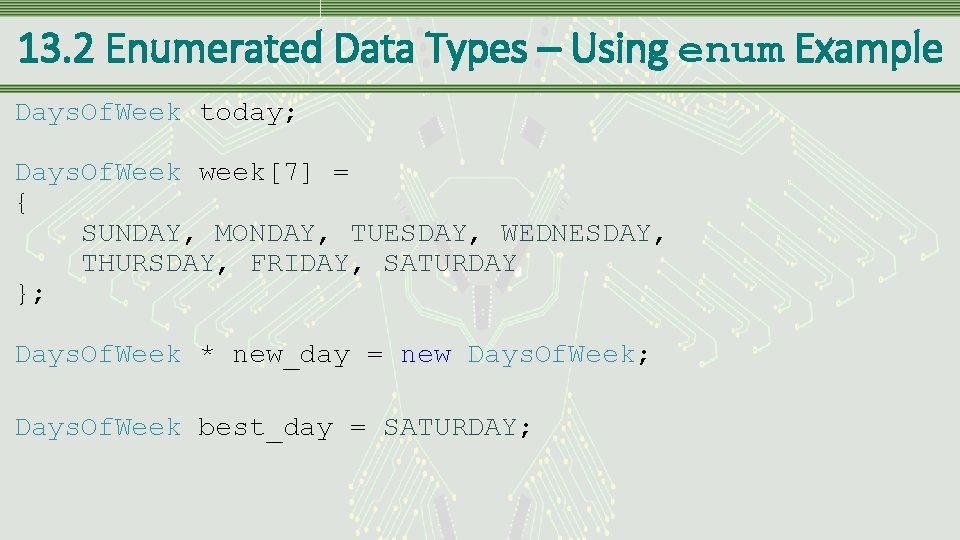
13. 2 Enumerated Data Types – Using enum Example Days. Of. Week today; Days. Of. Week week[7] = { SUNDAY, MONDAY, TUESDAY, WEDNESDAY, THURSDAY, FRIDAY, SATURDAY }; Days. Of. Week * new_day = new Days. Of. Week; Days. Of. Week best_day = SATURDAY;
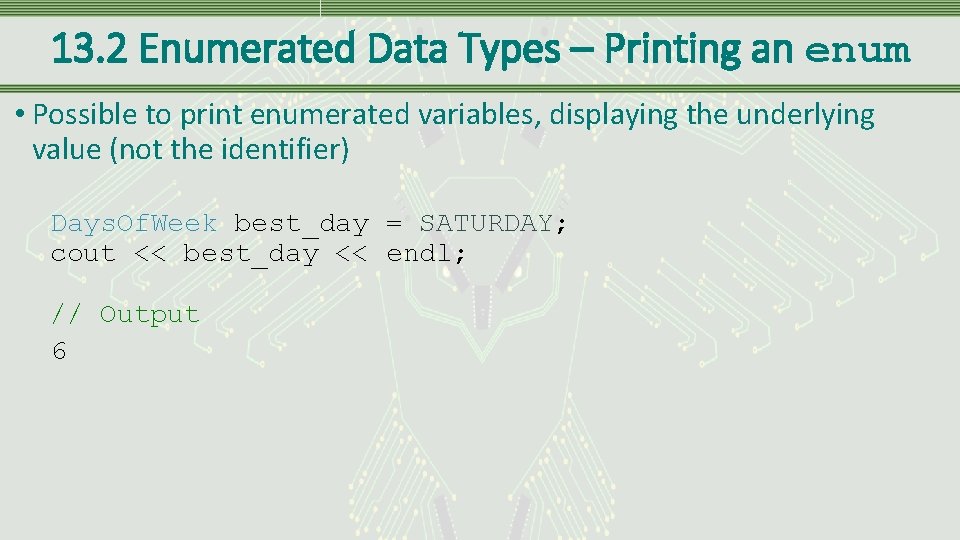
13. 2 Enumerated Data Types – Printing an enum • Possible to print enumerated variables, displaying the underlying value (not the identifier) Days. Of. Week best_day = SATURDAY; cout << best_day << endl; // Output 6
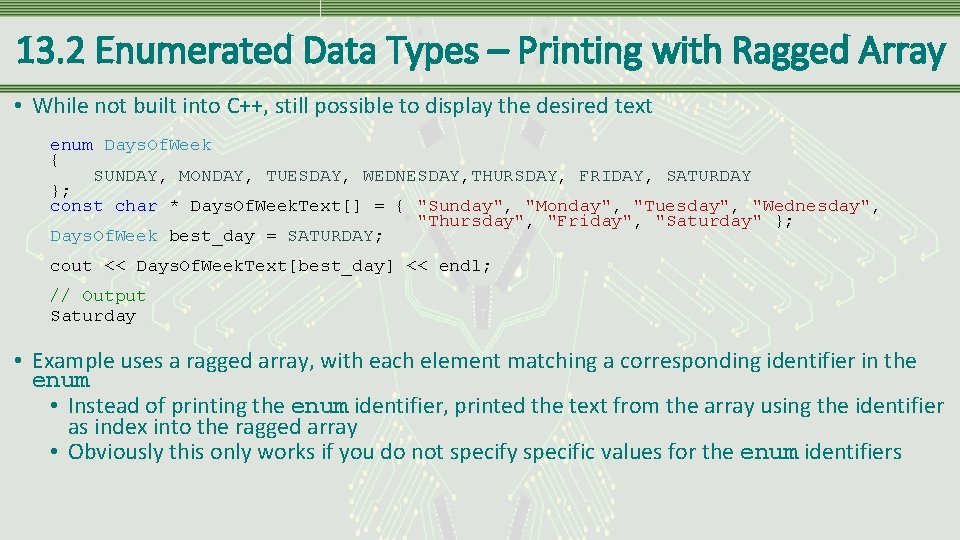
13. 2 Enumerated Data Types – Printing with Ragged Array • While not built into C++, still possible to display the desired text enum Days. Of. Week { SUNDAY, MONDAY, TUESDAY, WEDNESDAY, THURSDAY, FRIDAY, SATURDAY }; const char * Days. Of. Week. Text[] = { "Sunday", "Monday", "Tuesday", "Wednesday", "Thursday", "Friday", "Saturday" }; Days. Of. Week best_day = SATURDAY; cout << Days. Of. Week. Text[best_day] << endl; // Output Saturday • Example uses a ragged array, with each element matching a corresponding identifier in the enum • Instead of printing the enum identifier, printed the text from the array using the identifier as index into the ragged array • Obviously this only works if you do not specify specific values for the enum identifiers
13. 2 Enumerated Data Types – Benefits • Adds safety because of the extra type checking they provide • Only values specified in the enum declaration can be used in variables of that type • Increase program readability • Example on the following slides demonstrates how much more readable code becomes when using enums • Identifiers usually created using all uppercase letters
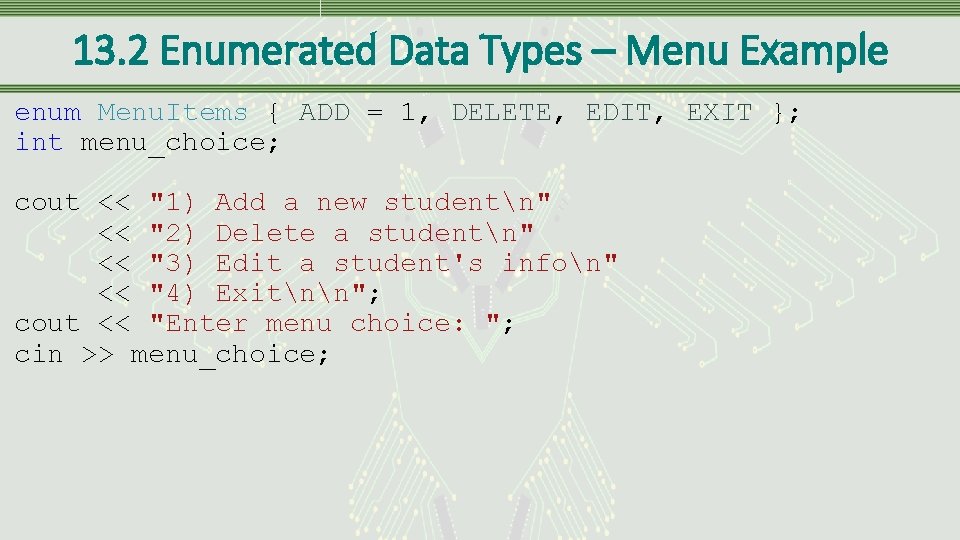
13. 2 Enumerated Data Types – Menu Example enum Menu. Items { ADD = 1, DELETE, EDIT, EXIT }; int menu_choice; cout << "1) Add a new studentn" << "2) Delete a studentn" << "3) Edit a student's infon" << "4) Exitnn"; cout << "Enter menu choice: "; cin >> menu_choice;
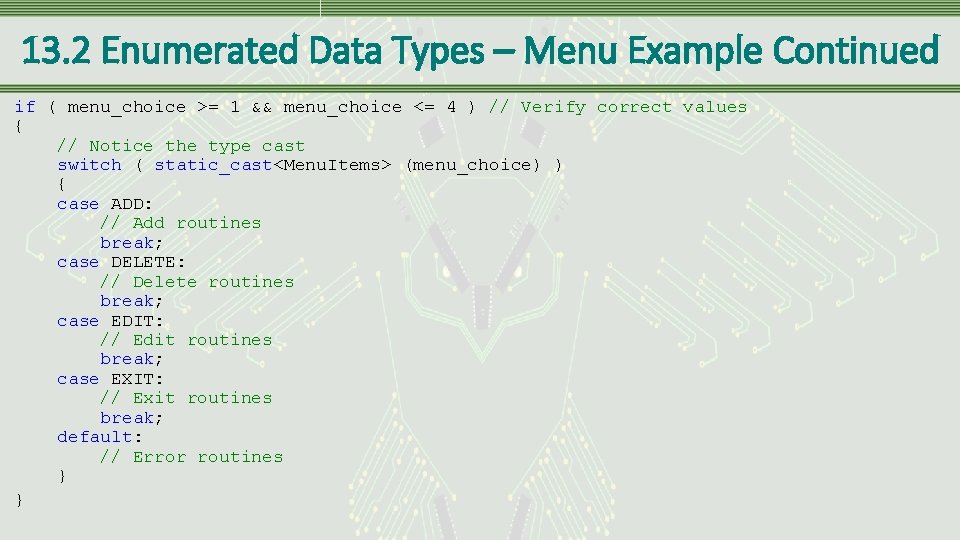
13. 2 Enumerated Data Types – Menu Example Continued if ( menu_choice >= 1 && menu_choice <= 4 ) // Verify correct values { // Notice the type cast switch ( static_cast<Menu. Items> (menu_choice) ) { case ADD: // Add routines break; case DELETE: // Delete routines break; case EDIT: // Edit routines break; case EXIT: // Exit routines break; default: // Error routines } }
13. 3 Structures – Syntax • Encapsulating variables of any type into one UDT • Also referred to as a record • Every variable of this type holds one record • Syntax struct <struct-name>{ <data-members> };
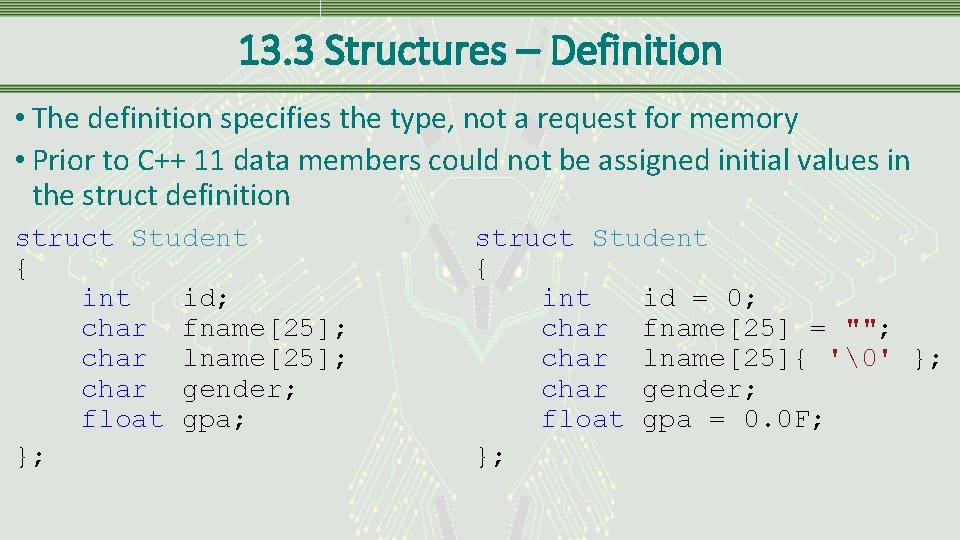
13. 3 Structures – Definition • The definition specifies the type, not a request for memory • Prior to C++ 11 data members could not be assigned initial values in the struct definition struct Student { int id; char fname[25]; char lname[25]; char gender; float gpa; }; struct Student { int id = 0; char fname[25] = ""; char lname[25]{ '' }; char gender; float gpa = 0. 0 F; };
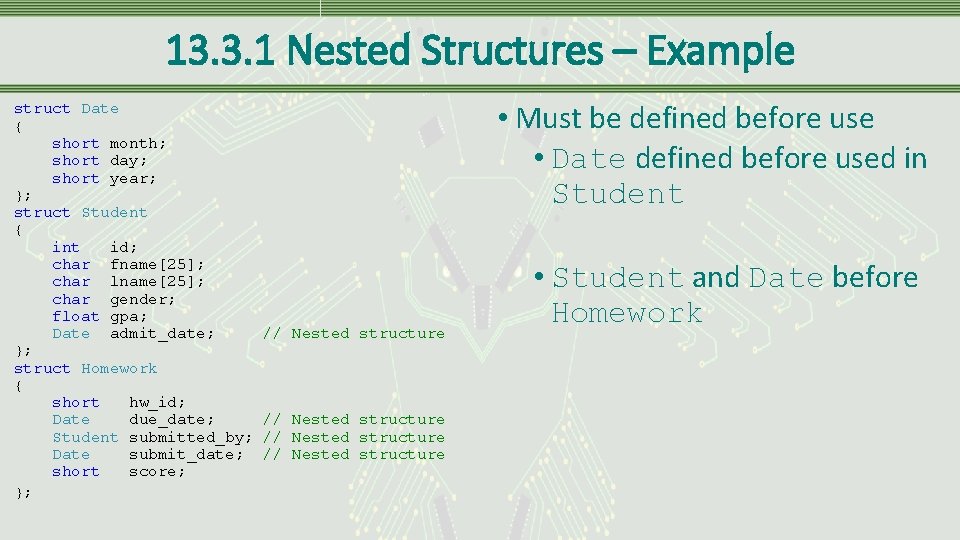
13. 3. 1 Nested Structures – Example struct Date { short month; short day; short year; }; struct Student { int id; char fname[25]; char lname[25]; char gender; float gpa; Date admit_date; }; struct Homework { short hw_id; Date due_date; Student submitted_by; Date submit_date; short score; }; • Must be defined before use • Date defined before used in Student // Nested structure • Student and Date before Homework
![13. 3. 2 Structure Variables Student Student student; cst 126[20]; * student_ptr = new](http://slidetodoc.com/presentation_image_h2/5fd8919deda506b47222886b01ea5d44/image-17.jpg "13. 3. 2 Structure Variables Student Student student; cst 126[20]; * student_ptr = new")
13. 3. 2 Structure Variables Student Student student; cst 126[20]; * student_ptr = new Student; straight_a = { 1, "Ima", "Smarty", 'F', 4. 0 F, {9, 15, 2007} }; avg_student{ 2, "Jon", "Kelley", 'M', 2. 5 F, 9, 25, 2010 }; • Last two lines initialize a structure variable • Values must be in the order in which the data members were specified in the structure definition • Nested curly braces are not necessary, but they do give a more visual indication that we are initializing the values in the nested structure • Last example uses the newer fully uniform type initialization
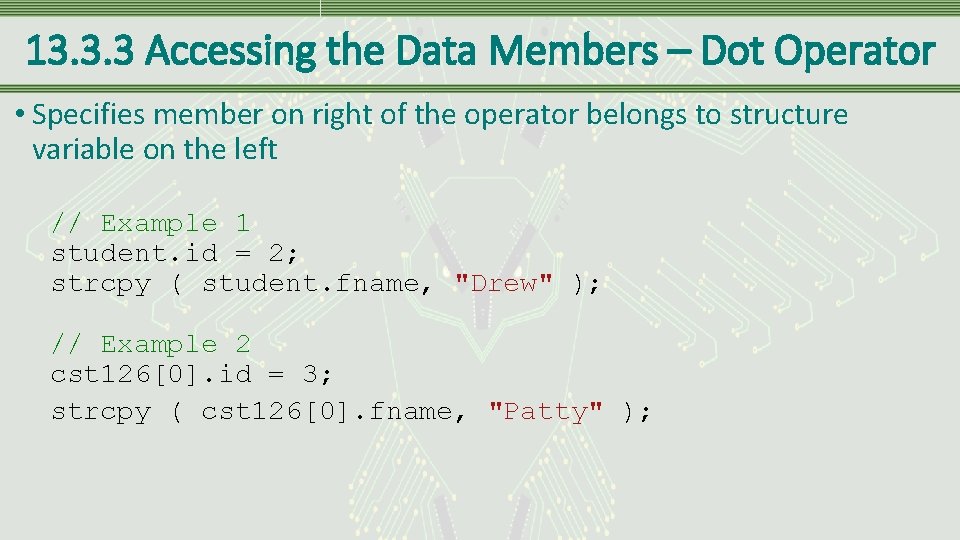
13. 3. 3 Accessing the Data Members – Dot Operator • Specifies member on right of the operator belongs to structure variable on the left // Example 1 student. id = 2; strcpy ( student. fname, "Drew" ); // Example 2 cst 126[0]. id = 3; strcpy ( cst 126[0]. fname, "Patty" );
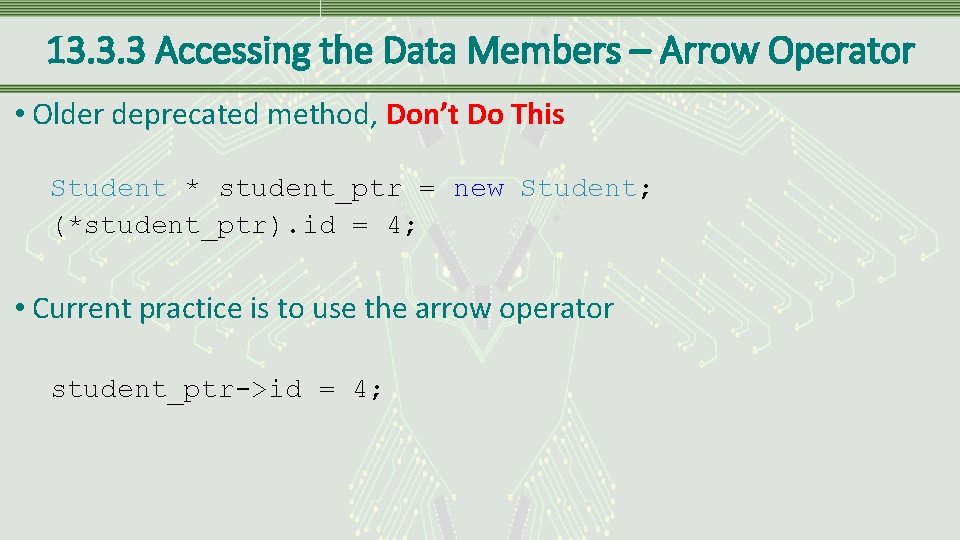
13. 3. 3 Accessing the Data Members – Arrow Operator • Older deprecated method, Don’t Do This Student * student_ptr = new Student; (*student_ptr). id = 4; • Current practice is to use the arrow operator student_ptr->id = 4;
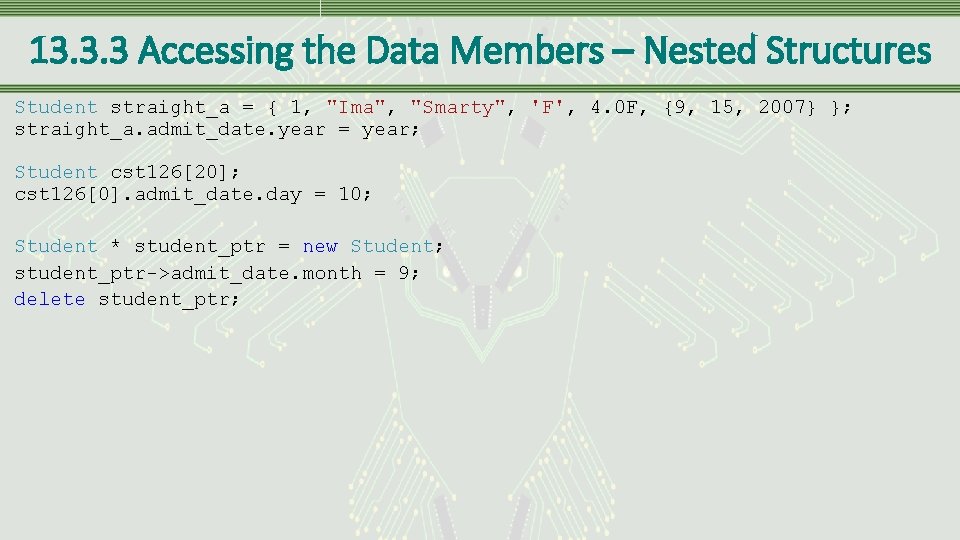
13. 3. 3 Accessing the Data Members – Nested Structures Student straight_a = { 1, "Ima", "Smarty", 'F', 4. 0 F, {9, 15, 2007} }; straight_a. admit_date. year = year; Student cst 126[20]; cst 126[0]. admit_date. day = 10; Student * student_ptr = new Student; student_ptr->admit_date. month = 9; delete student_ptr;
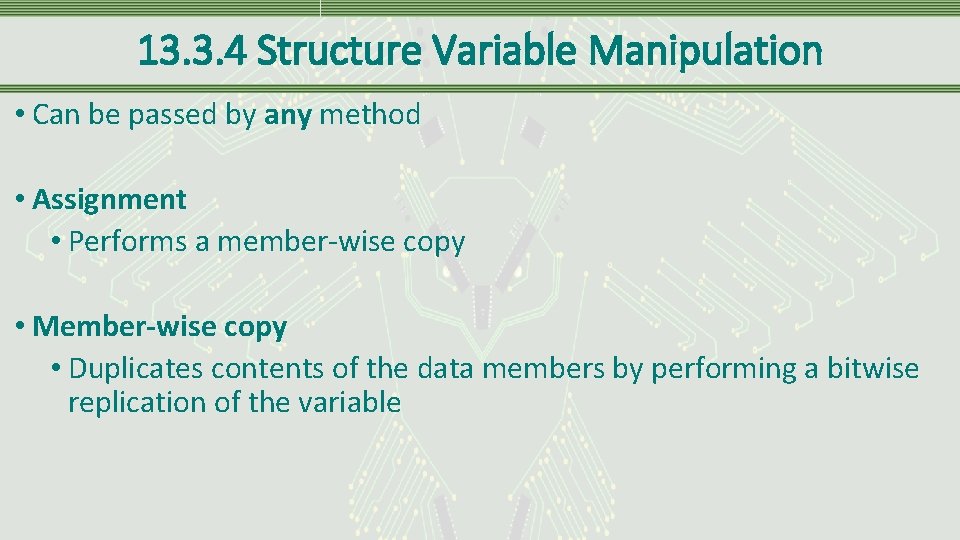
13. 3. 4 Structure Variable Manipulation • Can be passed by any method • Assignment • Performs a member-wise copy • Member-wise copy • Duplicates contents of the data members by performing a bitwise replication of the variable
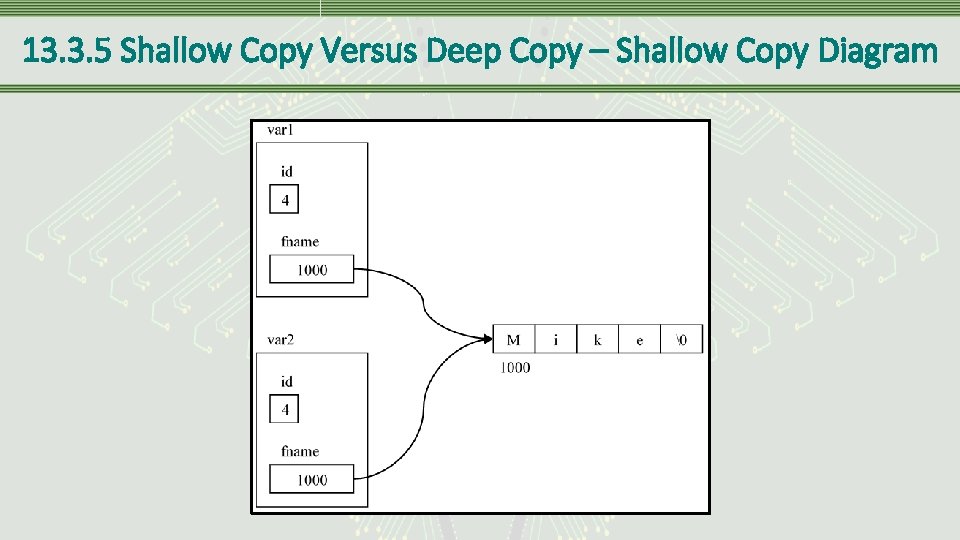
13. 3. 5 Shallow Copy Versus Deep Copy – Shallow Copy Defined • A member-wise copy can cause problems when a structure has pointers as data members • Assignment between two structures causes the addresses in the pointers to be copied (not the data pointed to) • Shallow copy • Two pointers pointing to the same piece of memory as the result of a member-wise copy
13. 3. 5 Shallow Copy Versus Deep Copy – Shallow Copy Example struct Person { int id; char * fname; }; Person var 1, var 2; var 1. id = 4; var 1. fname = new char[5]; strcpy ( var 1. fname, "Mike" ); var 2 = var 1; // Shallow copy • After the assignment of var 1 into var 2, the resulting memberwise/shallow copy causes both pointers to be pointing to "Mike"
13. 3. 5 Shallow Copy Versus Deep Copy – Shallow Copy Diagram
13. 3. 5 Shallow Copy Versus Deep Copy – Shallow Copy Problem • Second line of code below causes the program to crash – its already been deallocated delete [] var 1. fname; delete [] var 2. fname; • Solution to above problem is to perform a deep copy • Deep Copy • A deep copy allocates additional memory for the second variable’s pointer and then copies the contents of fname into the newly allocated memory
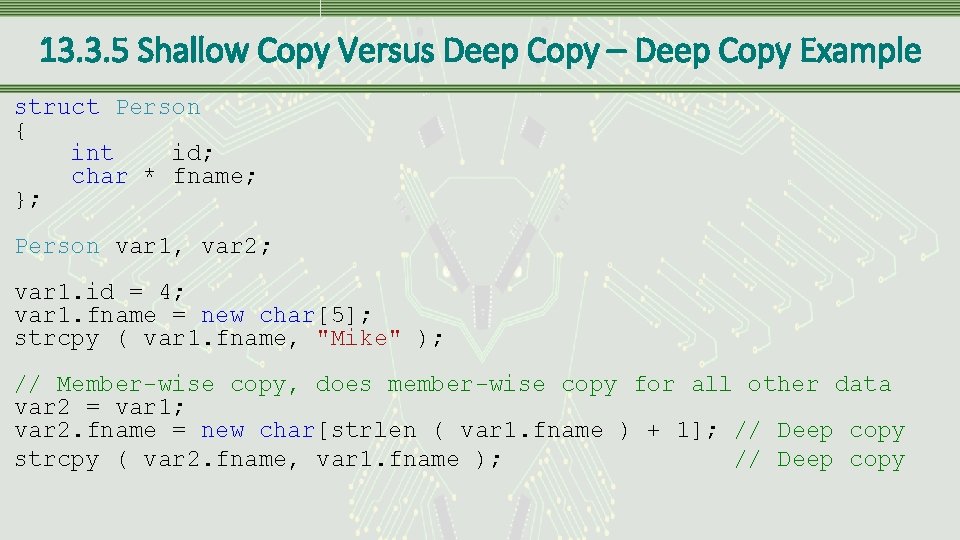
13. 3. 5 Shallow Copy Versus Deep Copy – Deep Copy Example struct Person { int id; char * fname; }; Person var 1, var 2; var 1. id = 4; var 1. fname = new char[5]; strcpy ( var 1. fname, "Mike" ); // Member-wise copy, does member-wise copy for all other data var 2 = var 1; var 2. fname = new char[strlen ( var 1. fname ) + 1]; // Deep copy strcpy ( var 2. fname, var 1. fname ); // Deep copy
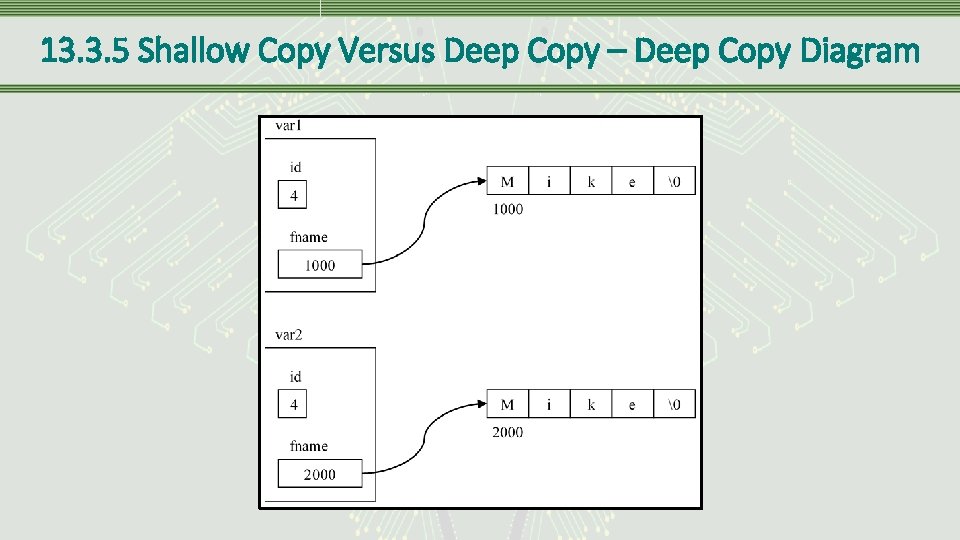
13. 3. 5 Shallow Copy Versus Deep Copy – Deep Copy Diagram
13. 4 Unions – Characteristics • Defines data members like a structure does • Stores one value in memory, regardless of how many members are specified • When created, memory is allocated to hold the largest data member
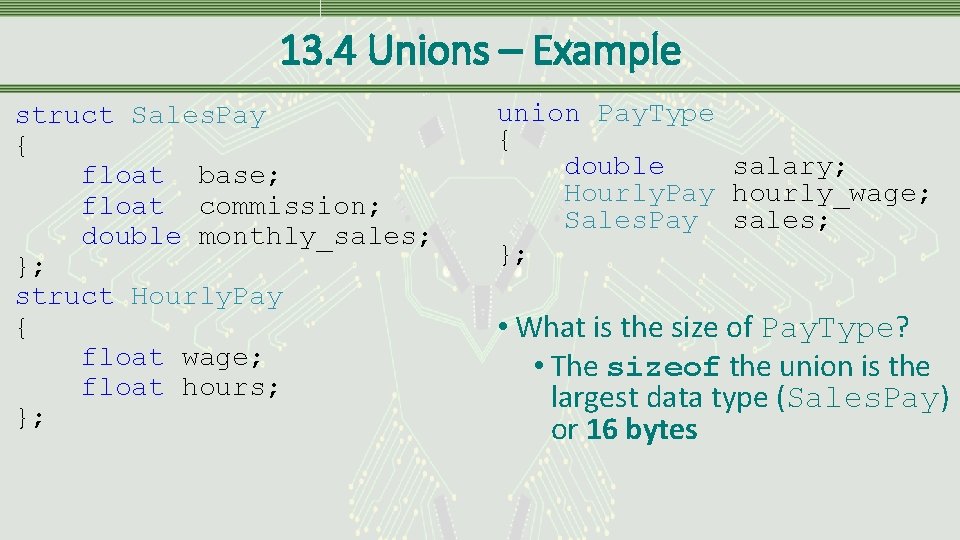
13. 4 Unions – Example struct Sales. Pay { float base; float commission; double monthly_sales; }; struct Hourly. Pay { float wage; float hours; }; union Pay. Type { double salary; Hourly. Pay hourly_wage; Sales. Pay sales; }; • What is the size of Pay. Type? • The sizeof the union is the largest data type (Sales. Pay) or 16 bytes
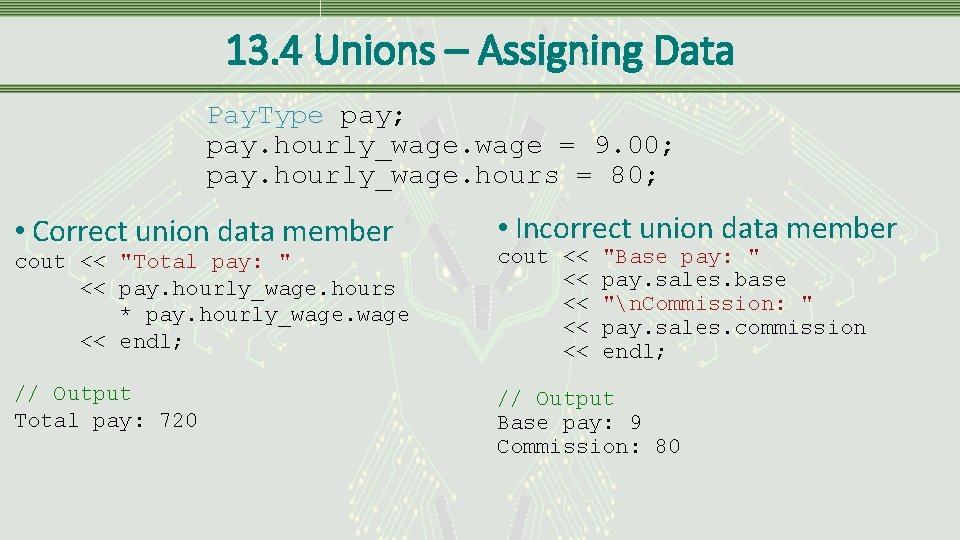
13. 4 Unions – Assigning Data Pay. Type pay; pay. hourly_wage = 9. 00; pay. hourly_wage. hours = 80; • Correct union data member • Incorrect union data member cout << "Total pay: " << pay. hourly_wage. hours * pay. hourly_wage << endl; cout << << << "Base pay: " pay. sales. base "n. Commission: " pay. sales. commission endl; // Output Total pay: 720 // Output Base pay: 9 Commission: 80
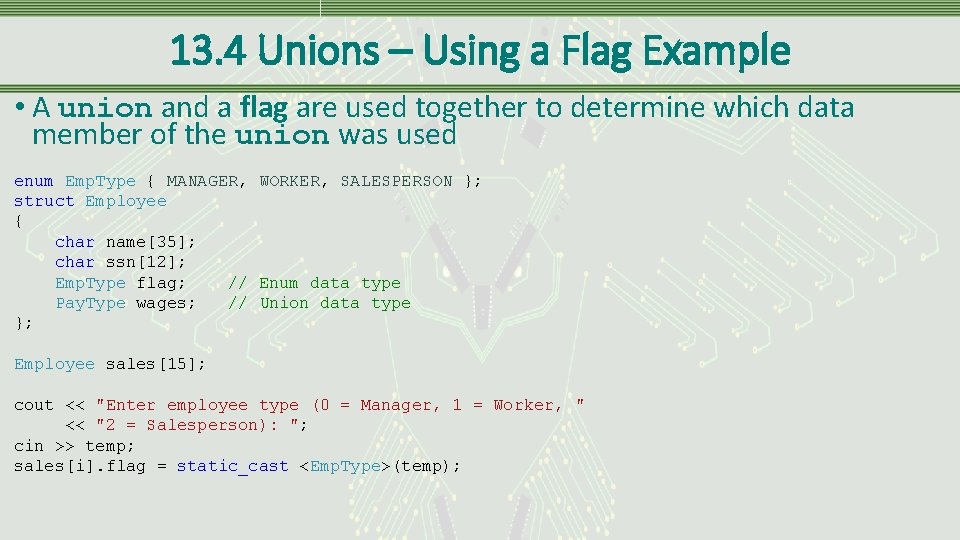
13. 4 Unions – Using a Flag Example • A union and a flag are used together to determine which data member of the union was used enum Emp. Type { MANAGER, WORKER, SALESPERSON }; struct Employee { char name[35]; char ssn[12]; Emp. Type flag; // Enum data type Pay. Type wages; // Union data type }; Employee sales[15]; cout << "Enter employee type (0 = Manager, 1 = Worker, " << "2 = Salesperson): "; cin >> temp; sales[i]. flag = static_cast <Emp. Type>(temp);
![13. 4 Unions – Using a Flag Example Continued switch ( sales[i]. flag )](http://slidetodoc.com/presentation_image_h2/5fd8919deda506b47222886b01ea5d44/image-32.jpg "13. 4 Unions – Using a Flag Example Continued switch ( sales[i]. flag )")
13. 4 Unions – Using a Flag Example Continued switch ( sales[i]. flag ) { case MANAGER: cout << "Enter the manager's salary: "; cin >> sales[i]. wages. salary; break; case WORKER: cout << "Enter the worker's hourly rate: "; cin >> sales[i]. wages. hourly_wage; cout << "Enter the worker's hours: "; cin >> sales[i]. wages. hourly_wage. hours; break; case SALESPERSON: cout << "Enter the salesperson's base salary: "; cin >> sales[i]. wages. sales. base; cout << "Enter the salesperson's commission: "; cin >> sales[i]. wages. sales. commission; cout << "Enter the salesperson's monthly sales: "; cin >> sales[i]. wages. sales. monthly_sales; break; }
13. 4 Unions – Using a Flag Example Explained • Previous example determined the type of Employee to be entered and then used a switch statement to enter the correct data depending upon the specified type • Pairing a flag and union is a common practice to ensure the appropriate use of the union’s data members
13. 4 Unions – Placement in Code • Usually directly after any #includes since definitions must appear before they are used • Function declarations, which are usually global, require the UDTs to specify the types of their parameters • Another, more standard way to include UDT definitions will be discussed in the next section
13. 5 User Defined Header Files – Description • UDT definitions must appear prior to their use, typically they will be found directly after any #includes • This is because function declarations, which are usually global, require the UDTs to specify the types of their parameters • Our programs are getting more complex • The addition of UDTs added a lot of code prior to main • Making our code more difficult to read and maintain • Solution • Create header files to store UDT definitions • Additional header file for function declarations
13. 5 User Defined Header Files – Process • Nothing magical about creating a header file • Just a file with the extension of. h • In Visual Studio you can add one to your project by right clicking on the project’s Header Files folder and adding a new item • Doesn’t automatically allow your source code to access the information in the new header file just because its in the project • Still have to be accessed by using a #include directive
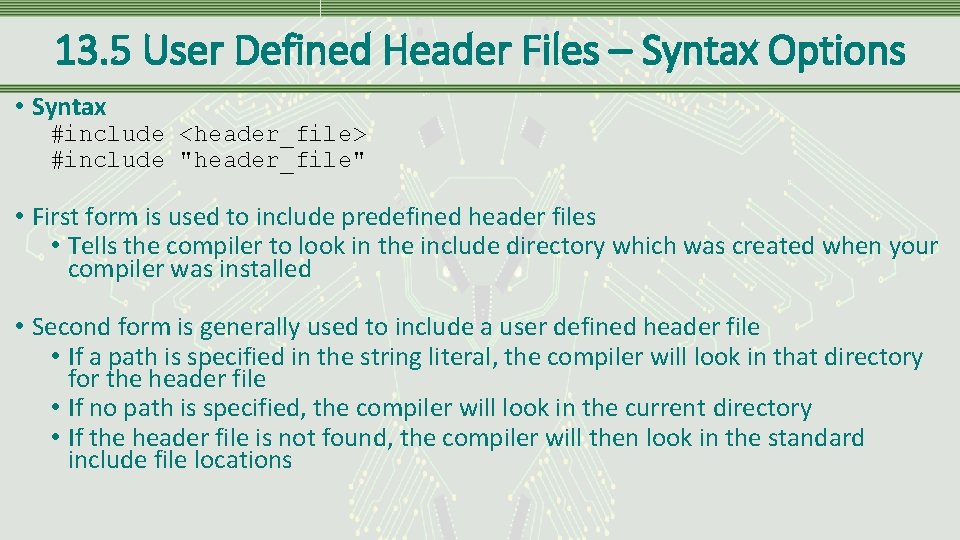
13. 5 User Defined Header Files – Syntax Options • Syntax #include <header_file> #include "header_file" • First form is used to include predefined header files • Tells the compiler to look in the include directory which was created when your compiler was installed • Second form is generally used to include a user defined header file • If a path is specified in the string literal, the compiler will look in that directory for the header file • If no path is specified, the compiler will look in the current directory • If the header file is not found, the compiler will then look in the standard include file locations
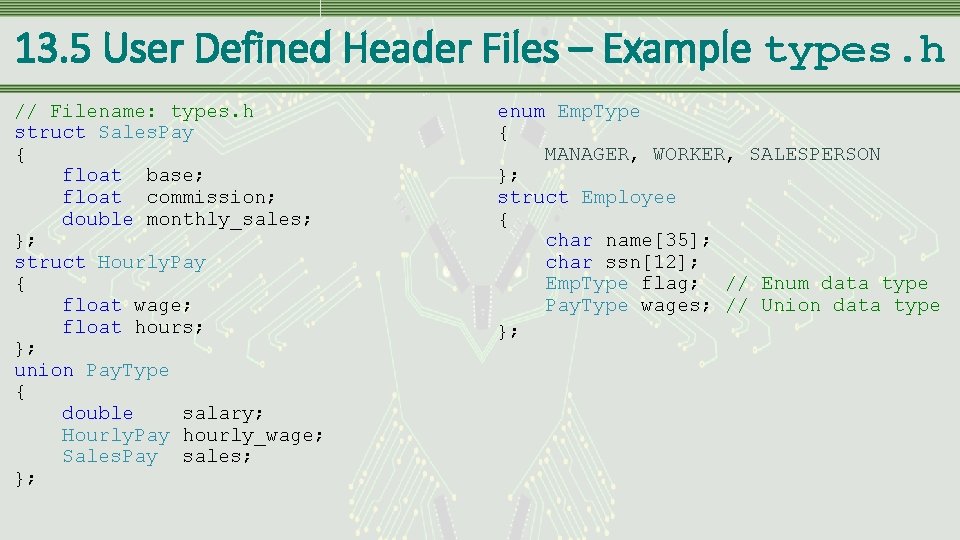
13. 5 User Defined Header Files – Example types. h // Filename: types. h struct Sales. Pay { float base; float commission; double monthly_sales; }; struct Hourly. Pay { float wage; float hours; }; union Pay. Type { double salary; Hourly. Pay hourly_wage; Sales. Pay sales; }; enum Emp. Type { MANAGER, WORKER, SALESPERSON }; struct Employee { char name[35]; char ssn[12]; Emp. Type flag; // Enum data type Pay. Type wages; // Union data type };
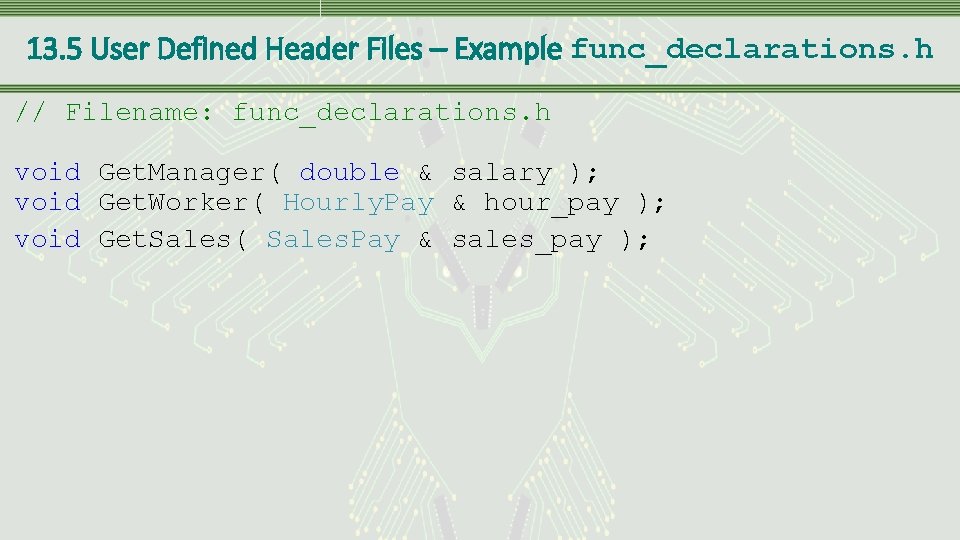
13. 5 User Defined Header Files – Example func_declarations. h // Filename: func_declarations. h void Get. Manager( double & salary ); void Get. Worker( Hourly. Pay & hour_pay ); void Get. Sales( Sales. Pay & sales_pay );
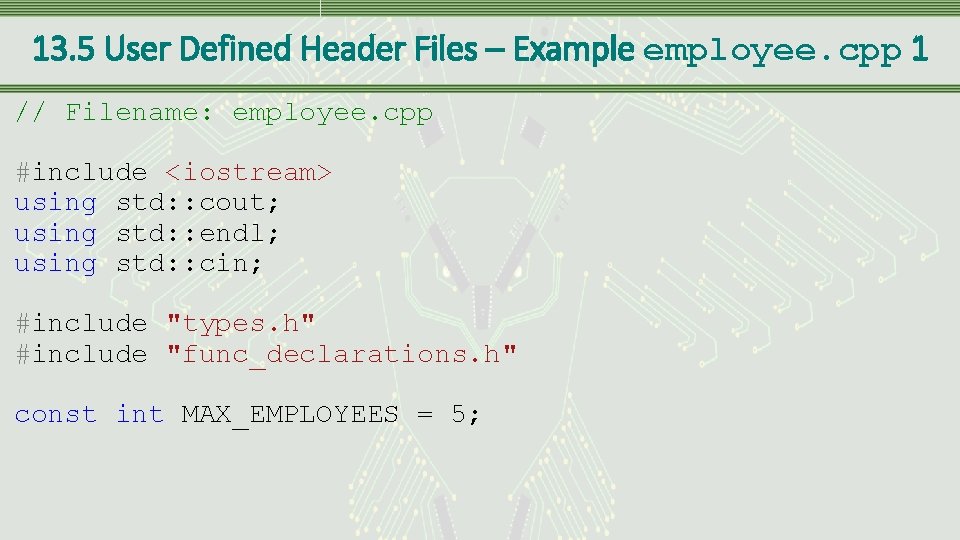
13. 5 User Defined Header Files – Example employee. cpp 1 // Filename: employee. cpp #include <iostream> using std: : cout; using std: : endl; using std: : cin; #include "types. h" #include "func_declarations. h" const int MAX_EMPLOYEES = 5;
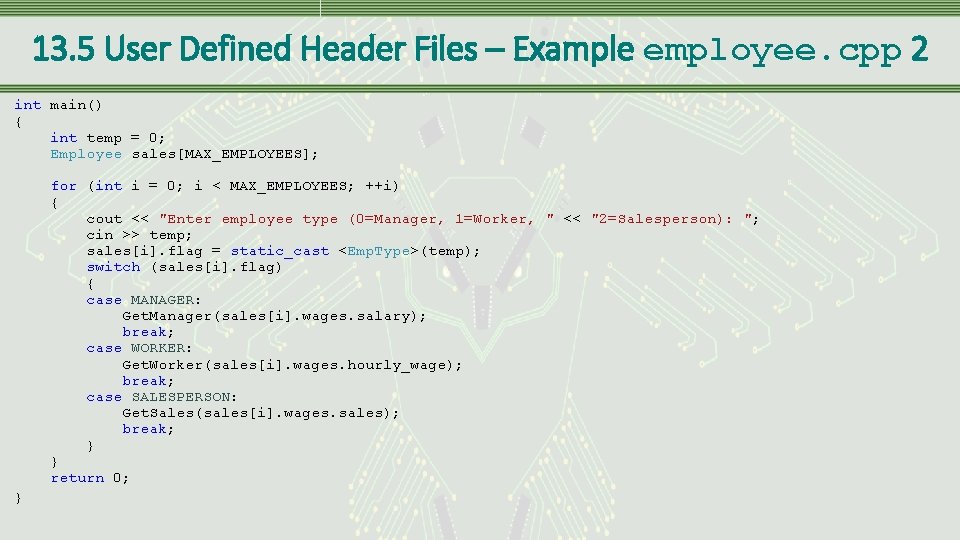
13. 5 User Defined Header Files – Example employee. cpp 2 int main() { int temp = 0; Employee sales[MAX_EMPLOYEES]; for (int i = 0; i < MAX_EMPLOYEES; ++i) { cout << "Enter employee type (0=Manager, 1=Worker, " << "2=Salesperson): "; cin >> temp; sales[i]. flag = static_cast <Emp. Type>(temp); switch (sales[i]. flag) { case MANAGER: Get. Manager(sales[i]. wages. salary); break; case WORKER: Get. Worker(sales[i]. wages. hourly_wage); break; case SALESPERSON: Get. Sales(sales[i]. wages. sales); break; } } return 0; }
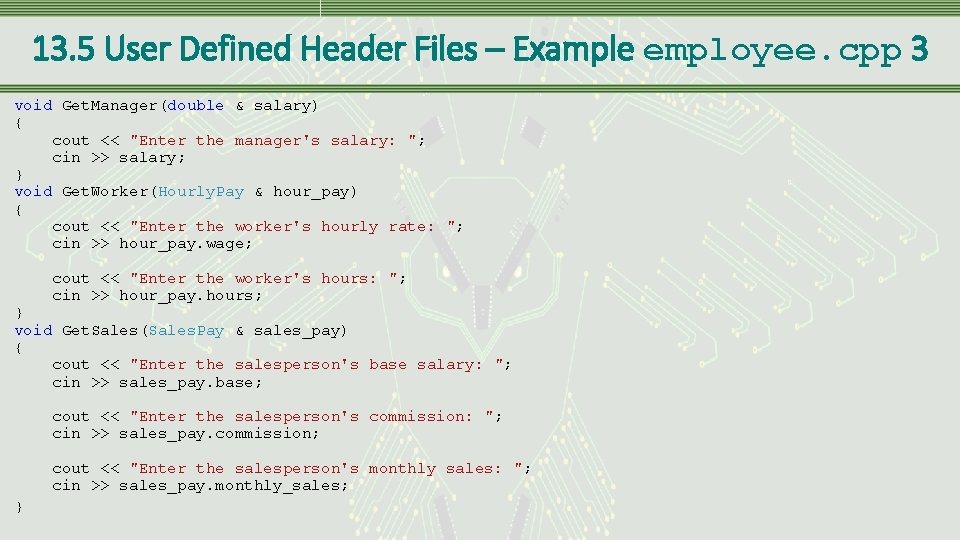
13. 5 User Defined Header Files – Example employee. cpp 3 void Get. Manager(double & salary) { cout << "Enter the manager's salary: "; cin >> salary; } void Get. Worker(Hourly. Pay & hour_pay) { cout << "Enter the worker's hourly rate: "; cin >> hour_pay. wage; cout << "Enter the worker's hours: "; cin >> hour_pay. hours; } void Get. Sales(Sales. Pay & sales_pay) { cout << "Enter the salesperson's base salary: "; cin >> sales_pay. base; cout << "Enter the salesperson's commission: "; cin >> sales_pay. commission; cout << "Enter the salesperson's monthly sales: "; cin >> sales_pay. monthly_sales; }
13. 6 Problem Solving Applied – Description • Which UDT to use in describing the data object • Data that is common among all instances of the data object should be stored in a structure • If the description states, “the book has a title and an author and an ISBN”, a struct will be used • If the description uses an or instead of an and, use a union • If the description states, “the book is either printed or audio”, which indicates a union should be used • If there is a list of related items, such as genre types, use an enum
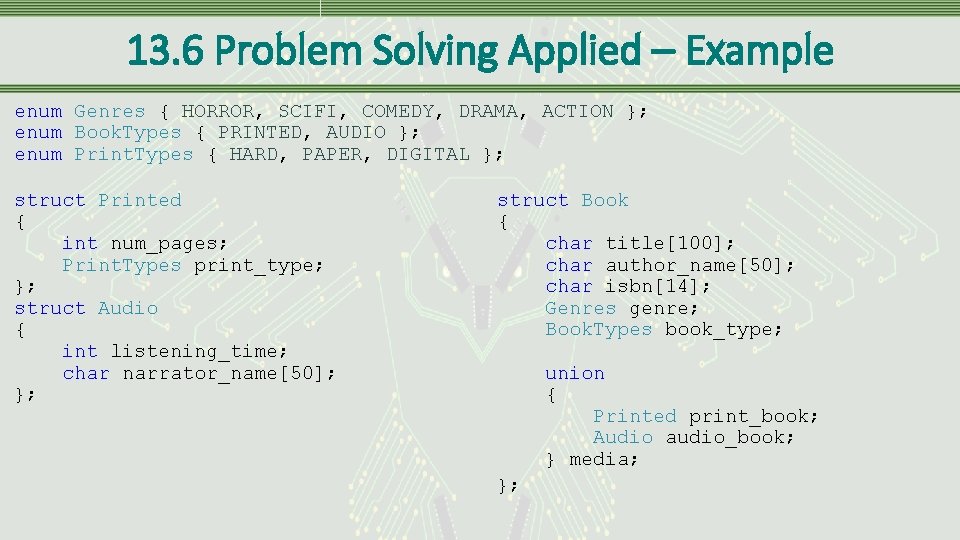
13. 6 Problem Solving Applied – Example enum Genres { HORROR, SCIFI, COMEDY, DRAMA, ACTION }; enum Book. Types { PRINTED, AUDIO }; enum Print. Types { HARD, PAPER, DIGITAL }; struct Printed { int num_pages; Print. Types print_type; }; struct Audio { int listening_time; char narrator_name[50]; }; struct Book { char title[100]; char author_name[50]; char isbn[14]; Genres genre; Book. Types book_type; union { Printed print_book; Audio audio_book; } media; };
13. 7 C The Differences – UDT • C has the capabilities to create user defined types as discussed in this chapter • Usage of the data types, once created, is slightly different • Doesn’t allow the name of the data type to be used directly without specifying the form of UDT used to create the data type • This technique is required regardless of the type of UDT • enum, struct, or union
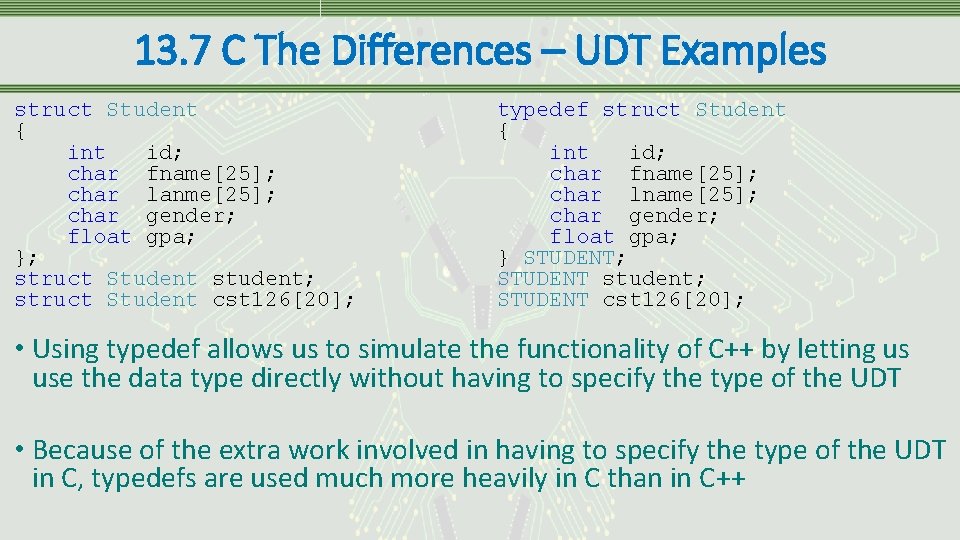
13. 7 C The Differences – UDT Examples struct Student { int id; char fname[25]; char lanme[25]; char gender; float gpa; }; struct Student student; struct Student cst 126[20]; typedef struct Student { int id; char fname[25]; char lname[25]; char gender; float gpa; } STUDENT; STUDENT student; STUDENT cst 126[20]; • Using typedef allows us to simulate the functionality of C++ by letting us use the data type directly without having to specify the type of the UDT • Because of the extra work involved in having to specify the type of the UDT in C, typedefs are used much more heavily in C than in C++
- Slides: 46