
Chapter 13 Theory of Evolution Table of Contents
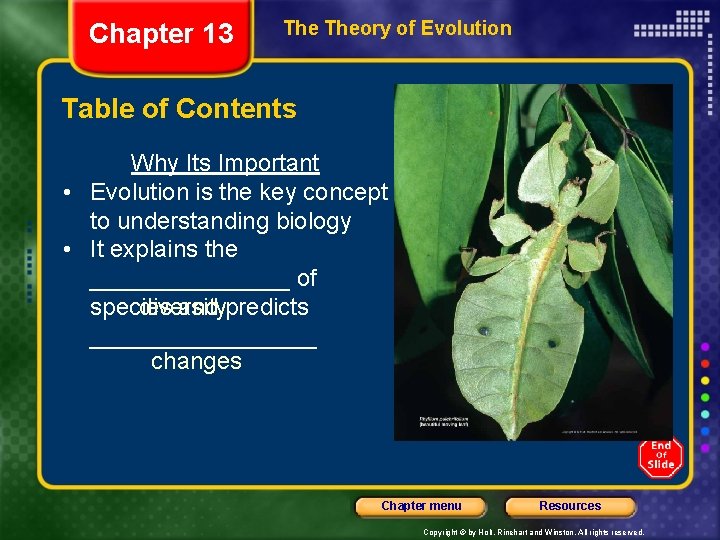
Chapter 13 Theory of Evolution Table of Contents Why Its Important • Evolution is the key concept to understanding biology • It explains the ________ of diversity species and predicts _________ changes Chapter menu Resources Copyright © by Holt, Rinehart and Winston. All rights reserved.
Chapter 13 Section 1 Theory of Evolution by Natural Selection Objectives • Identify several observations that led Darwin to conclude that species evolve. • Relate the process of natural selection to its outcome. • Summarize the main points of Darwin’s theory of evolution by natural selection as it is stated today. • Contrast the gradualism and punctuated equilibrium models of evolution. Chapter menu Resources Copyright © by Holt, Rinehart and Winston. All rights reserved.
New Vocabulary • • • Population Natural Selection Adaptation Reproductive Isolation Gradualism Punctuated equilibrium Chapter menu Resources Copyright © by Holt, Rinehart and Winston. All rights reserved.
Chapter 13 Section 1 Theory of Evolution by Natural Selection Darwin Proposed a Mechanism for Evolution Darwin • In 1859, the English naturalist Charles ______ published convincing _______ that species evidence evolve, and he proposed a reasonable mechanism explaining ____ how evolution occurs. • Like all scientific theories, theory of evolution has developed through decades of scientific ________ and ___________. observation experimentation • Darwin made many of his observations while traveling around the world on a ship called the HMS Beagle ___________ Chapter menu Resources Copyright © by Holt, Rinehart and Winston. All rights reserved.
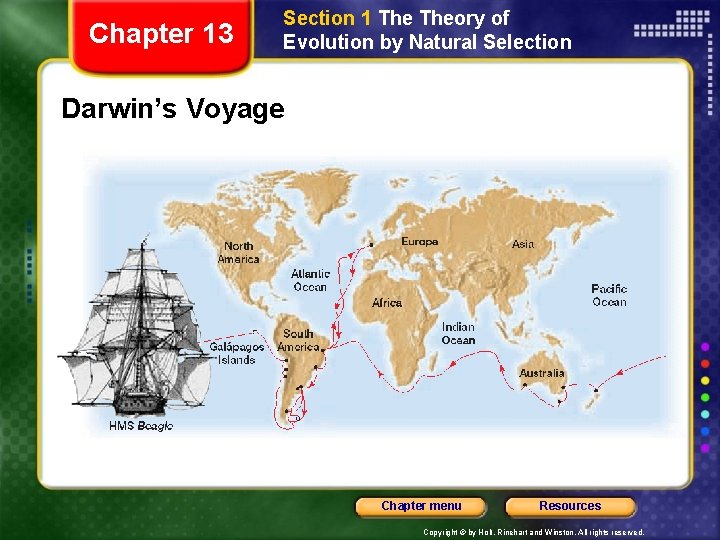
Chapter 13 Section 1 Theory of Evolution by Natural Selection Darwin’s Voyage Chapter menu Resources Copyright © by Holt, Rinehart and Winston. All rights reserved.
Chapter 13 Section 1 Theory of Evolution by Natural Selection Science Before Darwin’s Voyage • In Darwin’s time, most people—including scientists—held the view that each species is a divine creation that exists, unchanging _________, as it was originally created. • However, in 1809, the French Scientist Jean Baptiste _______ proposed a hypothesis for how Lamarck organisms change over generations. • Lamarck incorrectly stated that over the _________ of an individual, physical features lifetime use or reduce in size increase in size because of ____________ disuse Chapter menu Resources Copyright © by Holt, Rinehart and Winston. All rights reserved.
• We now know that individuals cannot gain new adaptations during their lifetime, rather they are ____________ inherited – Ex: giraffes do not acquire long necks by reaching for leaves on trees • However, Lamarck did correctly point out that changes in species are due to their environmental ___________ conditions – Ex: If around tall trees, giraffes with longer necks will survive better than ones with short necks Chapter menu Resources Copyright © by Holt, Rinehart and Winston. All rights reserved.
Chapter 13 Section 1 Theory of Evolution by Natural Selection Darwin’s Observations Galapagos • On the ___________ islands, Darwin found evidence that challenged the traditional belief that species are unchanging • This group of islands is located about 1000 km (620 mi) off the ________ coast of South west America • On the islands, Darwin noticed that many of the resembled plants and animals ___________ those of the nearby coast of South America. Chapter menu Resources Copyright © by Holt, Rinehart and Winston. All rights reserved.
• Darwin proposed that after these organisms migrated ___________ to the islands, they changed __________ overtime slowly • He later called this change “descent with __________” or evolution modification Chapter menu Resources Copyright © by Holt, Rinehart and Winston. All rights reserved.
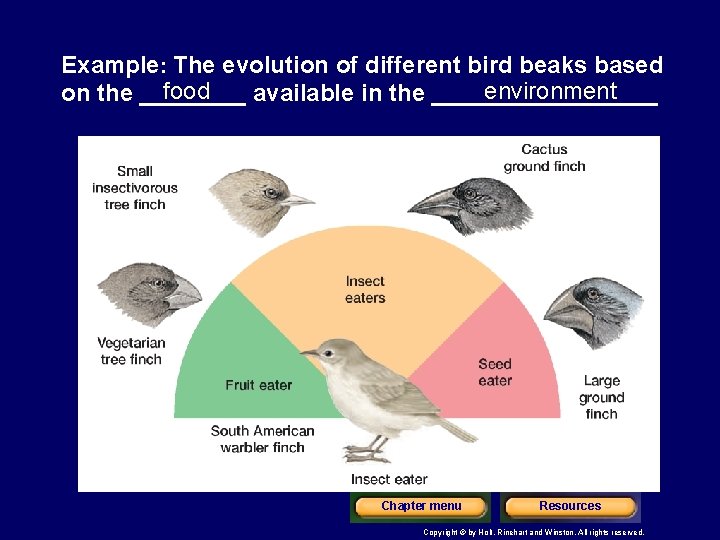
Example: The evolution of different bird beaks based food environment on the ____ available in the _________ Chapter menu Resources Copyright © by Holt, Rinehart and Winston. All rights reserved.
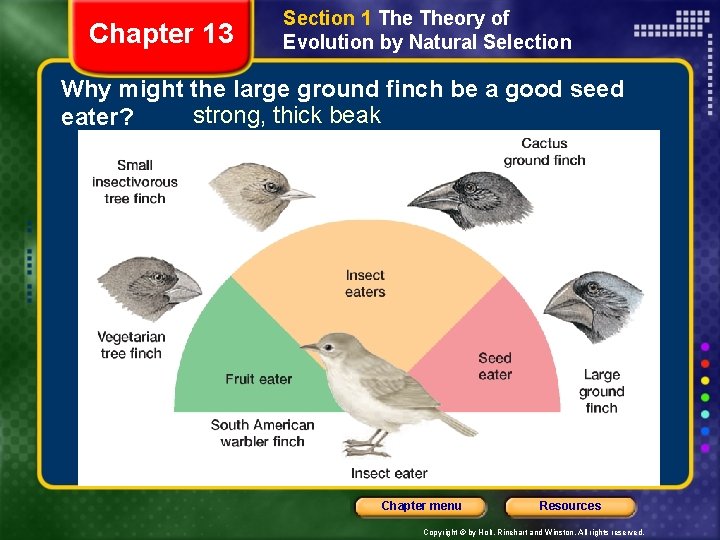
Chapter 13 Section 1 Theory of Evolution by Natural Selection Why might the large ground finch be a good seed strong, thick beak eater? Chapter menu Resources Copyright © by Holt, Rinehart and Winston. All rights reserved.
• Darwin also found ________ fossils of extinct armadillos in South America closely – These fossils _________ resembled, but were not identical, to armadillos living in the area • When Darwin returned home, he continued to study his findings for two _______. He was certain that evolution occurred, hedecades just didn’t know _______. how Chapter menu Resources Copyright © by Holt, Rinehart and Winston. All rights reserved.
Chapter 13 Section 1 Theory of Evolution by Natural Selection Growth of Populations • The key that unlocked Darwin’s thinking about how evolution takes place was an essay written in 1798 by the Malthus English economist Thomas _________. – Malthus suggested that human populations do not grow unchecked _________ because death caused by disease, war, and famine _______ population slow growth. • In the study of biology, a population consists of all the one species that live in a specific individuals of _______ geographical _____ and that can _______. area interbreed Chapter menu Resources Copyright © by Holt, Rinehart and Winston. All rights reserved.
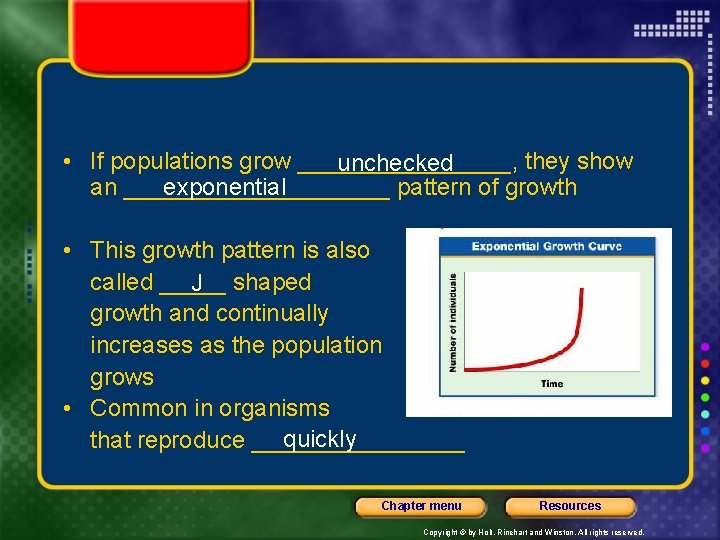
• If populations grow ________, they show unchecked an __________ pattern of growth exponential • This growth pattern is also called _____ J shaped growth and continually increases as the population grows • Common in organisms quickly that reproduce ________ Chapter menu Resources Copyright © by Holt, Rinehart and Winston. All rights reserved.
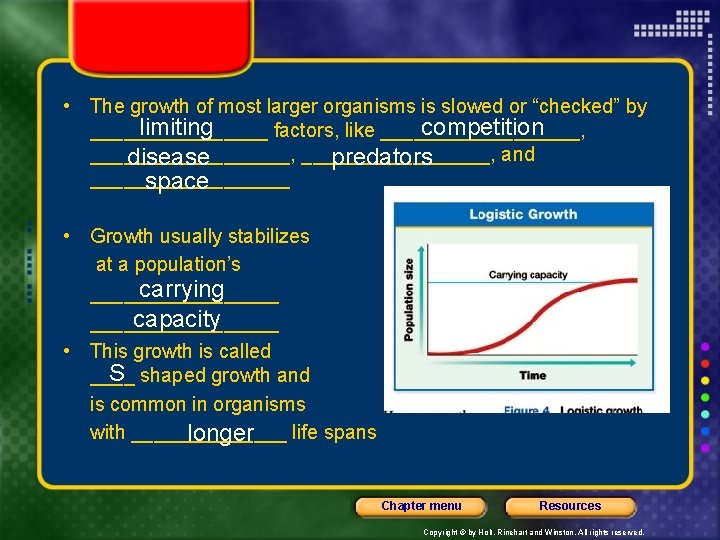
• The growth of most larger organisms is slowed or “checked” by limiting competition ________ factors, like __________________, and disease predators _________ space • Growth usually stabilizes at a population’s carrying _________ capacity _________ • This growth is called S shaped growth and ____ is common in organisms with _______ life spans longer Chapter menu Resources Copyright © by Holt, Rinehart and Winston. All rights reserved.
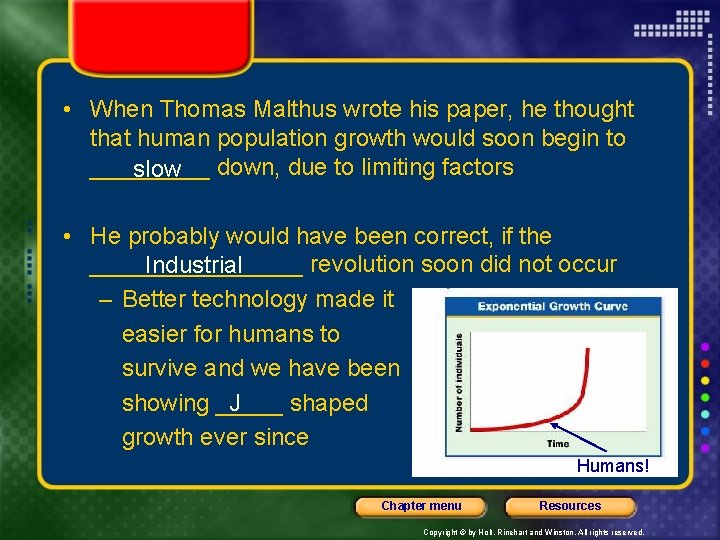
• When Thomas Malthus wrote his paper, he thought that human population growth would soon begin to _____ slow down, due to limiting factors • He probably would have been correct, if the ________ revolution soon did not occur Industrial – Better technology made it easier for humans to survive and we have been showing _____ shaped J growth ever since Humans! Chapter menu Resources Copyright © by Holt, Rinehart and Winston. All rights reserved.
• After reading Malthus’s essay, Darwin recognized that many species produce _____ much offspring, but their population growth is still slowed by limiting factors like __________ competition – and…individuals that have physical or behavior traits _________ that are better adapted to survive their environment are more likely to ______ reproduce and will _________ more successfully than those that do not have such traits Chapter menu Resources Copyright © by Holt, Rinehart and Winston. All rights reserved.
Chapter 13 Section 1 Theory of Evolution by Natural Selection • Remember, adaptations and traits are controlled by genes ______, which are inherited • An adaptation is a feature that has become common in a population because the feature provides a advantage selective __________ in a specific environment _________ • Darwin called this differential rate of reproduction natural selection ____________________. Chapter menu Resources Copyright © by Holt, Rinehart and Winston. All rights reserved.
Chapter 13 Section 1 Theory of Evolution by Natural Selection 1844 Darwin finally wrote down his ideas • In ____, about evolution and natural selection in an early few scientists he outline that he showed to only a ______ knew and trusted. • Darwin decided to publish after he received a letter 1858 and essay in ____ from another naturalist named Alfred Russel ________ , who also Wallace supported the idea of evolution by natural selection. • Darwin’s published work was a book called… On the Origin of Species ________________ by Means of Natural Selection Chapter menu Resources Copyright © by Holt, Rinehart and Winston. All rights reserved.
• disturbed Many people were deeply _________ by Darwin’s theory…but it is supported by four major points… Variation 1. ___________ exists within the genes of every population or species. some 2. In a particular environment, _____ individuals of a population or species are better suited to survive and have more offspring Chapter menu Resources Copyright © by Holt, Rinehart and Winston. All rights reserved.
3. Overtime, the traits that make certain individuals of a population able to survive and reproduce spread tend to _______ in that population 4. There is overwhelming evidence from ______ that living species evolved from fossils organisms that are _______ extinct Evolution by Natural Selection Chapter menu Resources Copyright © by Holt, Rinehart and Winston. All rights reserved.
Chapter 13 Section 1 Theory of Evolution by Natural Selection Darwin’s Ideas Updated • Darwin’s ideas are further supported by the discovery that an organism’s traits are determined alleles by the ________ that they _________ inherit population • So, evolution occurs in a _________ when the ________ of certain alleles frequency increases or decreases over time. Chapter menu Resources Copyright © by Holt, Rinehart and Winston. All rights reserved.
Mutations recombination of • _________ and the ________ alleles that occurs during sexual reproduction provide variations an endless source of new _________ for natural selection to act upon – Keep in mind that most mutations are harmful _______, but if the mutation is beneficial, persisting it will end up _________ in a population Chapter menu Resources Copyright © by Holt, Rinehart and Winston. All rights reserved.
Chapter 13 Section 1 Theory of Evolution by Natural Selection How are New Species Formed? • Populations of the same species living in different locations tend to evolve in different _________. directions • When members of a population became separated physically or ___________, they are also geographically reproductively _________ isolated because they can no longer ____ mate • What are some examples of geographical structures that can separate a population? mountains, rivers, roads Chapter menu Resources Copyright © by Holt, Rinehart and Winston. All rights reserved.
• As members of a divided population reproduce mutations separately, DNA _________ or changes behavior in mating ________ may prevent them from interbreeding even if they are in the same _________ location • When members of a population can no longer different interbreed, they are considered ________ species Chapter menu Resources Copyright © by Holt, Rinehart and Winston. All rights reserved.
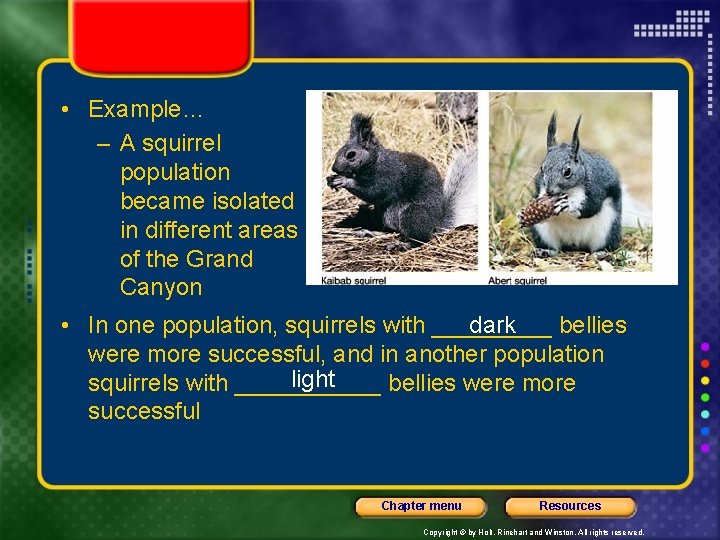
• Example… – A squirrel population became isolated in different areas of the Grand Canyon • In one population, squirrels with _____ dark bellies were more successful, and in another population light squirrels with ______ bellies were more successful Chapter menu Resources Copyright © by Holt, Rinehart and Winston. All rights reserved.
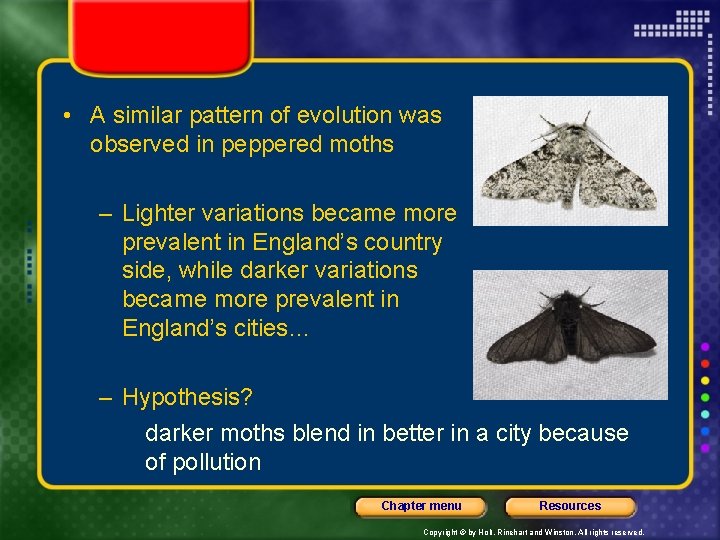
• A similar pattern of evolution was observed in peppered moths – Lighter variations became more prevalent in England’s country side, while darker variations became more prevalent in England’s cities… – Hypothesis? darker moths blend in better in a city because of pollution Chapter menu Resources Copyright © by Holt, Rinehart and Winston. All rights reserved.
• The genetic darkening of a population due to pollution has been coined industrial _________ melanism – Melanin – pigment Chapter menu Resources Copyright © by Holt, Rinehart and Winston. All rights reserved.
Chapter 13 Section 1 Theory of Evolution by Natural Selection The Tempo of Evolution • For decades, most biologists have understood evolution as a _______ process that occurs gradual continuously. gradualism – This model of evolution is called ______. • Another model of evolution, in which periods of rapid ______ change in species are separated by periods of little or _____change, is called no punctuated equilibrium ____________________ – Usually seen after major ________ climatic changes and mass __________ extinctions Chapter menu Resources Copyright © by Holt, Rinehart and Winston. All rights reserved.
Chapter 13 Section 1 Theory of Evolution by Natural Selection Objective 1 • Identify several observations that led Darwin to conclude that species evolve. – Organisms on the Galapagos Islands? Similar, but not identical to organisms in South America – Armadillo fossils in South America? similar, but not identical to living Armadillos in South America Chapter menu Resources Copyright © by Holt, Rinehart and Winston. All rights reserved.
Chapter 13 Section 1 Theory of Evolution by Natural Selection Objective 2 • Relate the process of natural selection to its outcome. Favorable traits…. end up spreading in a population Chapter menu Resources Copyright © by Holt, Rinehart and Winston. All rights reserved.
Chapter 13 Section 1 Theory of Evolution by Natural Selection Objective 3 • Summarize the main points of Darwin’s theory of evolution by natural selection as it is stated today. Variation 1. ___________ exists within the genes of every population or species. some 2. In a particular environment, _____ individuals of a population or species are better suited to survive and have more offspring Chapter menu Resources Copyright © by Holt, Rinehart and Winston. All rights reserved.
3. Overtime, the traits that make certain individuals of a population able to survive and reproduce tend to _______ in that population spread 4. There is overwhelming evidence from ______ that living species evolved from fossils extinct organisms that are _______ Chapter menu Resources Copyright © by Holt, Rinehart and Winston. All rights reserved.
Chapter 13 Section 1 Theory of Evolution by Natural Selection Objective 4 • Contrast the gradualism and punctuated equilibrium models of evolution. Slow, but continuous rapid, with periods of little or no change Chapter menu Resources Copyright © by Holt, Rinehart and Winston. All rights reserved.
- Slides: 34