
Chapter 13 The Spinal Cord Spinal Nerves and
- Slides: 53
Chapter 13 The Spinal Cord, Spinal Nerves, and Spinal Reflexes Clicker Questions © 2015 Pearson Education, Inc.
What is the minimum number of neurons in a reflex arc? a. 1 b. 2 c. 5 d. 7 © 2015 Pearson Education, Inc.
What is the minimum number of neurons in a reflex arc? a. 1 b. 2 c. 5 d. 7 © 2015 Pearson Education, Inc.
Which of these is NOT an important factor concerning reflexes? a. They are rapid, automatic responses to stimuli. b. They preserve homeostasis by making rapid adjustments in the functions of organs. c. They oppose potentially harmful changes in the internal or external environment. d. They involve interaction with the cerebrum. © 2015 Pearson Education, Inc.
Which of these is NOT an important factor concerning reflexes? a. They are rapid, automatic responses to stimuli. b. They preserve homeostasis by making rapid adjustments in the functions of organs. c. They oppose potentially harmful changes in the internal or external environment. d. They involve interaction with the cerebrum. © 2015 Pearson Education, Inc.
Ascending tracts relay information a. from the motor cortex to the PNS b. from the periphery to the sensory cortex c. from the arms to the legs d. through neuroglia © 2015 Pearson Education, Inc.
Ascending tracts relay information a. from the motor cortex to the PNS b. from the periphery to the sensory cortex c. from the arms to the legs d. through neuroglia © 2015 Pearson Education, Inc.
Polysynaptic reflexes include all of the following characteristics EXCEPT a. involve pools of interneurons b. interneuron pools are contained within one spinal segment c. have reverberating circuits d. involve reciprocal inhibition © 2015 Pearson Education, Inc.
Polysynaptic reflexes include all of the following characteristics EXCEPT a. involve pools of interneurons b. interneuron pools are contained within one spinal segment c. have reverberating circuits d. involve reciprocal inhibition © 2015 Pearson Education, Inc.
What is reinforcement as it pertains to spinal reflexes? a. allows brief periods of rest between sets of stimuli b. a chronic depression in spinal reflexes due to IPSPs c. an enhancement of spinal reflexes due to postsynaptic neurons entering a state of facilitation d. strengthening of both the crossed extensor reflex and reciprocal inhibition © 2015 Pearson Education, Inc.
What is reinforcement as it pertains to spinal reflexes? a. allows brief periods of rest between sets of stimuli b. a chronic depression in spinal reflexes due to IPSPs c. an enhancement of spinal reflexes due to postsynaptic neurons entering a state of facilitation d. strengthening of both the crossed extensor reflex and reciprocal inhibition © 2015 Pearson Education, Inc.
You’ve just touched a hot stove. What type of reflex did you experience? In what way was your brain involved in the reflex? a. cranial; the somatosensory cortex b. visceral; only tracts that respond to pain c. complex; all the sensory tracts d. spinal; it was involved later © 2015 Pearson Education, Inc.
You’ve just touched a hot stove. What type of reflex did you experience? In what way was your brain involved in the reflex? a. cranial; the somatosensory cortex b. visceral; only tracts that respond to pain c. complex; all the sensory tracts d. spinal; it was involved later © 2015 Pearson Education, Inc.
A weight lifter is straining to lift a 200 -kg barbell. Shortly after he lifts it to chest height, his muscles appear to relax and he drops the barbell. Which reflex has occurred? a. withdrawal reflex b. stretch reflex c. crossed extensor reflex d. tendon reflex © 2015 Pearson Education, Inc.
A weight lifter is straining to lift a 200 -kg barbell. Shortly after he lifts it to chest height, his muscles appear to relax and he drops the barbell. Which reflex has occurred? a. withdrawal reflex b. stretch reflex c. crossed extensor reflex d. tendon reflex © 2015 Pearson Education, Inc.
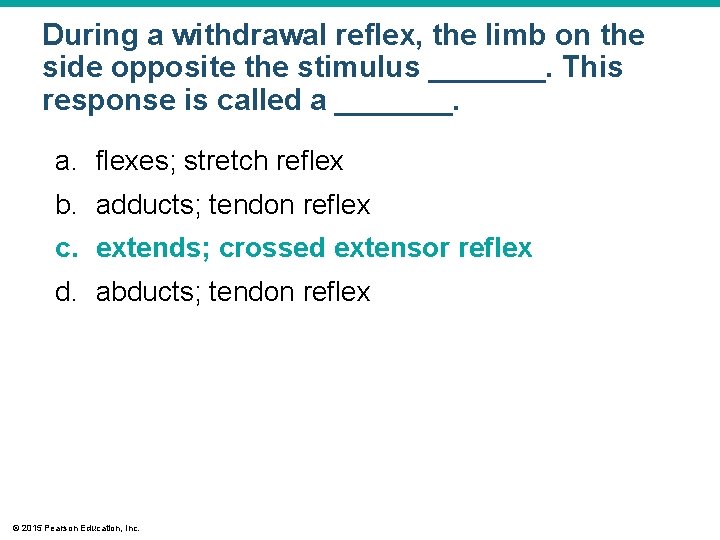
During a withdrawal reflex, the limb on the side opposite the stimulus _______. This response is called a _______. a. flexes; stretch reflex b. adducts; tendon reflex c. extends; crossed extensor reflex d. abducts; tendon reflex © 2015 Pearson Education, Inc.
During a withdrawal reflex, the limb on the side opposite the stimulus _______. This response is called a _______. a. flexes; stretch reflex b. adducts; tendon reflex c. extends; crossed extensor reflex d. abducts; tendon reflex © 2015 Pearson Education, Inc.
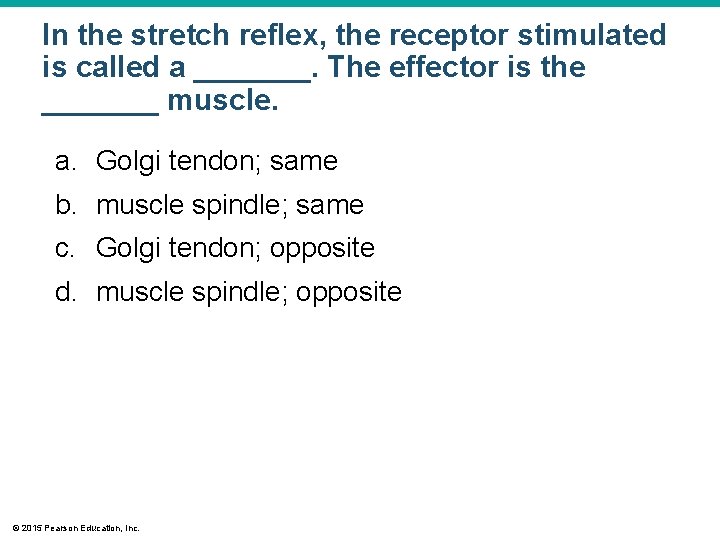
In the stretch reflex, the receptor stimulated is called a _______. The effector is the _______ muscle. a. Golgi tendon; same b. muscle spindle; same c. Golgi tendon; opposite d. muscle spindle; opposite © 2015 Pearson Education, Inc.
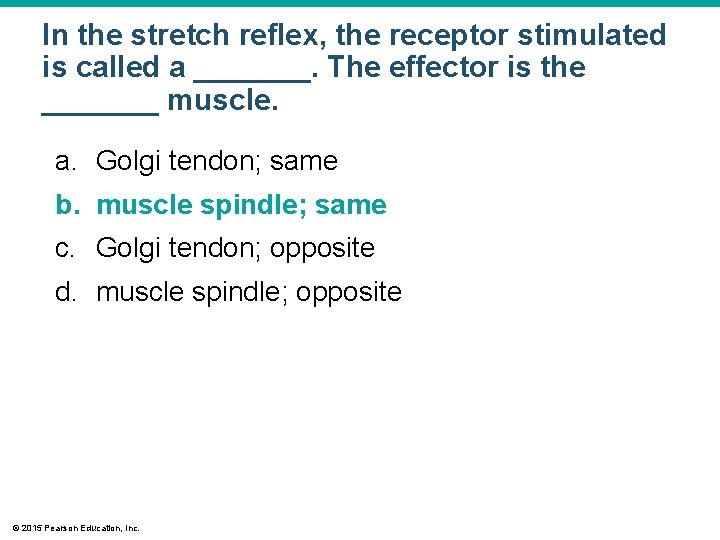
In the stretch reflex, the receptor stimulated is called a _______. The effector is the _______ muscle. a. Golgi tendon; same b. muscle spindle; same c. Golgi tendon; opposite d. muscle spindle; opposite © 2015 Pearson Education, Inc.
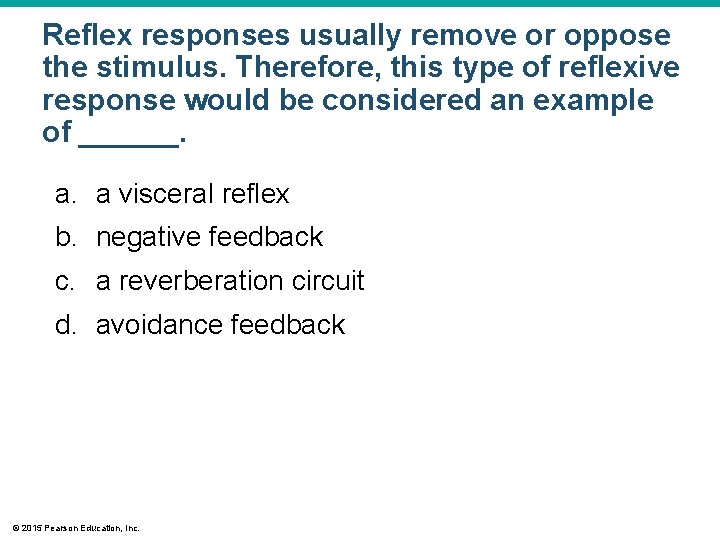
Reflex responses usually remove or oppose the stimulus. Therefore, this type of reflexive response would be considered an example of ______. a. a visceral reflex b. negative feedback c. a reverberation circuit d. avoidance feedback © 2015 Pearson Education, Inc.
Reflex responses usually remove or oppose the stimulus. Therefore, this type of reflexive response would be considered an example of ______. a. a visceral reflex b. negative feedback c. a reverberation circuit d. avoidance feedback © 2015 Pearson Education, Inc.
These neurons interpret information and coordinate responses. a. motor neurons b. sensory neurons c. interneurons d. dendritic spines © 2015 Pearson Education, Inc.
These neurons interpret information and coordinate responses. a. motor neurons b. sensory neurons c. interneurons d. dendritic spines © 2015 Pearson Education, Inc.
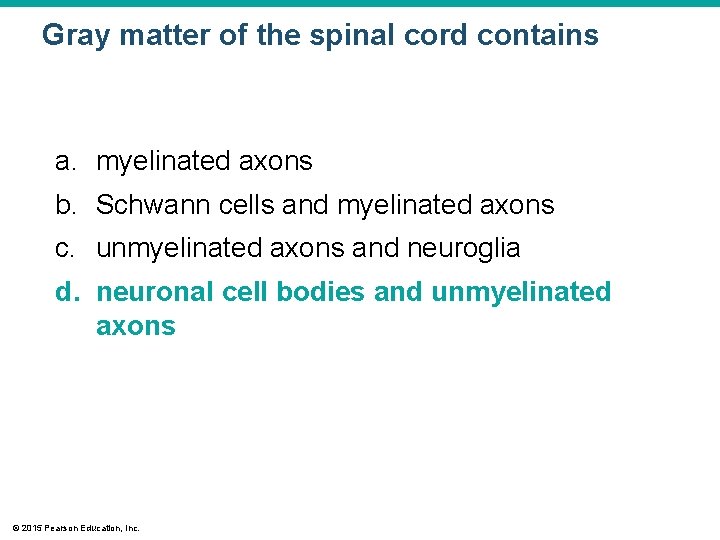
Gray matter of the spinal cord contains a. myelinated axons b. Schwann cells and myelinated axons c. unmyelinated axons and neuroglia d. neuronal cell bodies and unmyelinated axons © 2015 Pearson Education, Inc.
Gray matter of the spinal cord contains a. myelinated axons b. Schwann cells and myelinated axons c. unmyelinated axons and neuroglia d. neuronal cell bodies and unmyelinated axons © 2015 Pearson Education, Inc.
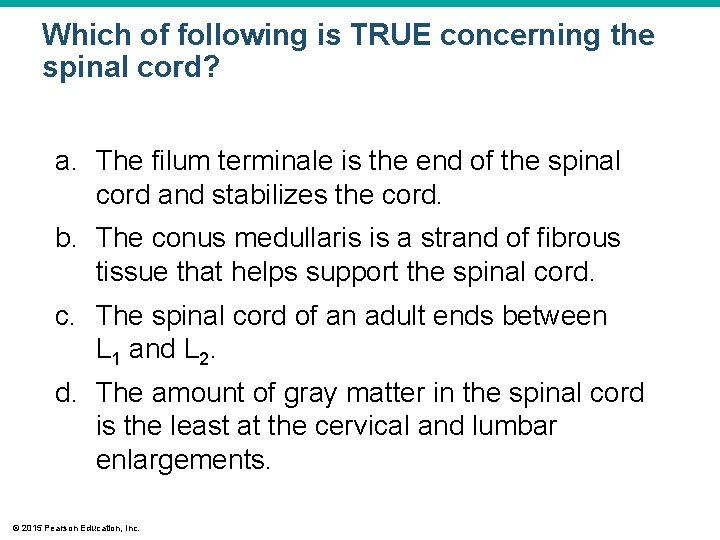
Which of following is TRUE concerning the spinal cord? a. The filum terminale is the end of the spinal cord and stabilizes the cord. b. The conus medullaris is a strand of fibrous tissue that helps support the spinal cord. c. The spinal cord of an adult ends between L 1 and L 2. d. The amount of gray matter in the spinal cord is the least at the cervical and lumbar enlargements. © 2015 Pearson Education, Inc.
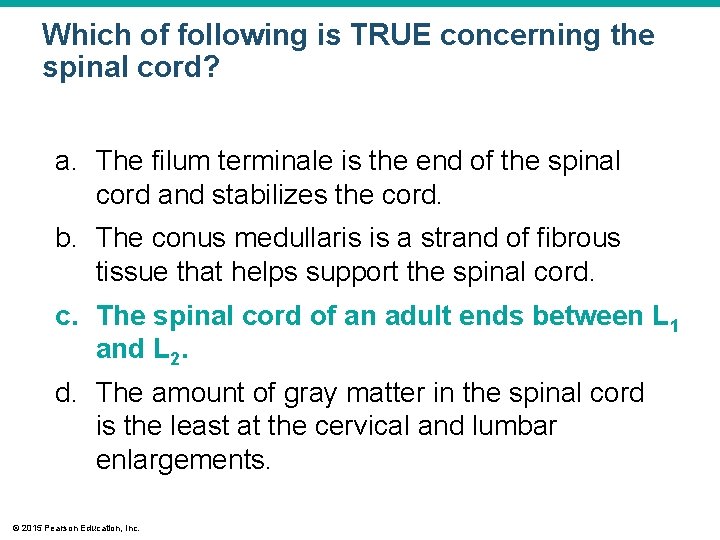
Which of following is TRUE concerning the spinal cord? a. The filum terminale is the end of the spinal cord and stabilizes the cord. b. The conus medullaris is a strand of fibrous tissue that helps support the spinal cord. c. The spinal cord of an adult ends between L 1 and L 2. d. The amount of gray matter in the spinal cord is the least at the cervical and lumbar enlargements. © 2015 Pearson Education, Inc.
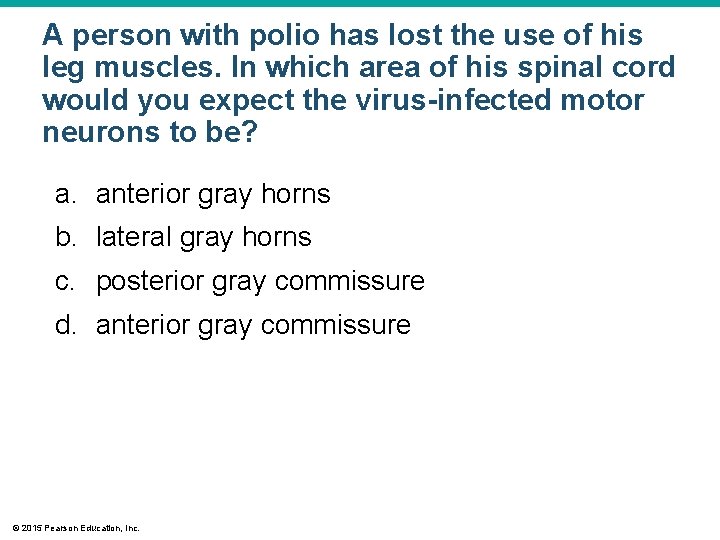
A person with polio has lost the use of his leg muscles. In which area of his spinal cord would you expect the virus-infected motor neurons to be? a. anterior gray horns b. lateral gray horns c. posterior gray commissure d. anterior gray commissure © 2015 Pearson Education, Inc.
A person with polio has lost the use of his leg muscles. In which area of his spinal cord would you expect the virus-infected motor neurons to be? a. anterior gray horns b. lateral gray horns c. posterior gray commissure d. anterior gray commissure © 2015 Pearson Education, Inc.
Which portion of the spinal cord would be affected by a disease that damages myelin sheaths? a. sulci b. columns c. gray horns d. fissures © 2015 Pearson Education, Inc.
Which portion of the spinal cord would be affected by a disease that damages myelin sheaths? a. sulci b. columns c. gray horns d. fissures © 2015 Pearson Education, Inc.
A patient has damage to several spinal nerves. Which of the major divisions of the nervous system has been damaged? a. central nervous system b. peripheral nervous system c. autonomic nervous system d. all of the above © 2015 Pearson Education, Inc.
A patient has damage to several spinal nerves. Which of the major divisions of the nervous system has been damaged? a. central nervous system b. peripheral nervous system c. autonomic nervous system d. all of the above © 2015 Pearson Education, Inc.
When a person always leans their head on their hand in order to stay awake in class, this can put pressure on the elbow and damage the _______. a. ulnar nerve b. median nerve c. radial nerve d. musculocutaneous nerve © 2015 Pearson Education, Inc.
When a person always leans their head on their hand in order to stay awake in class, this can put pressure on the elbow and damage the _______. a. ulnar nerve b. median nerve c. radial nerve d. musculocutaneous nerve © 2015 Pearson Education, Inc.
Compression of which nerve bothers older people on long car rides? a. sural nerve b. sciatic nerve c. femoral nerve d. tibial nerve © 2015 Pearson Education, Inc.
Compression of which nerve bothers older people on long car rides? a. sural nerve b. sciatic nerve c. femoral nerve d. tibial nerve © 2015 Pearson Education, Inc.
Damage to the long thoracic nerve would cause paralysis to which muscle(s)? a. deltoid and teres minor muscles b. rhomboid and levator scapulae muscles c. latissimus dorsi muscle d. serratus anterior muscle © 2015 Pearson Education, Inc.
Damage to the long thoracic nerve would cause paralysis to which muscle(s)? a. deltoid and teres minor muscles b. rhomboid and levator scapulae muscles c. latissimus dorsi muscle d. serratus anterior muscle © 2015 Pearson Education, Inc.
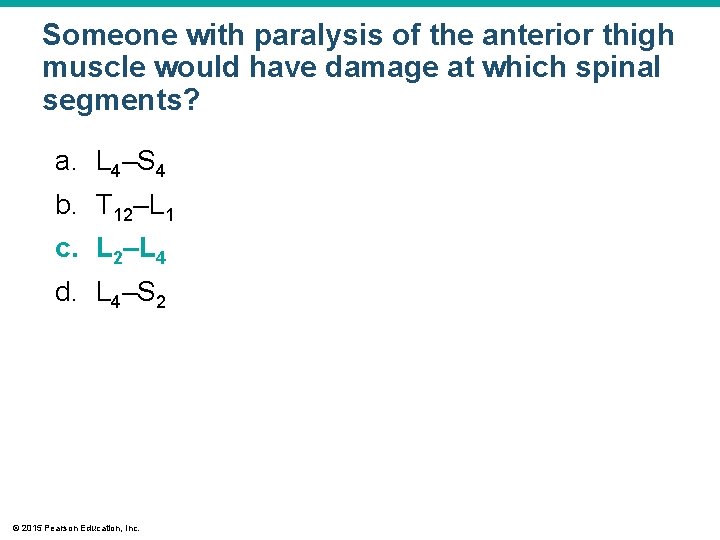
Someone with paralysis of the anterior thigh muscle would have damage at which spinal segments? a. L 4–S 4 b. T 12–L 1 c. L 2–L 4 d. L 4–S 2 © 2015 Pearson Education, Inc.
Someone with paralysis of the anterior thigh muscle would have damage at which spinal segments? a. L 4–S 4 b. T 12–L 1 c. L 2–L 4 d. L 4–S 2 © 2015 Pearson Education, Inc.
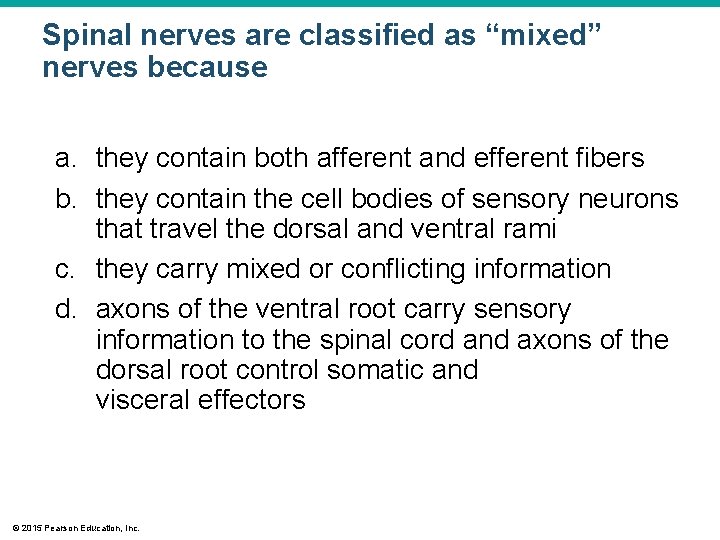
Spinal nerves are classified as “mixed” nerves because a. they contain both afferent and efferent fibers b. they contain the cell bodies of sensory neurons that travel the dorsal and ventral rami c. they carry mixed or conflicting information d. axons of the ventral root carry sensory information to the spinal cord and axons of the dorsal root control somatic and visceral effectors © 2015 Pearson Education, Inc.
Spinal nerves are classified as “mixed” nerves because a. they contain both afferent and efferent fibers b. they contain the cell bodies of sensory neurons that travel the dorsal and ventral rami c. they carry mixed or conflicting information d. axons of the ventral root carry sensory information to the spinal cord and axons of the dorsal root control somatic and visceral effectors © 2015 Pearson Education, Inc.
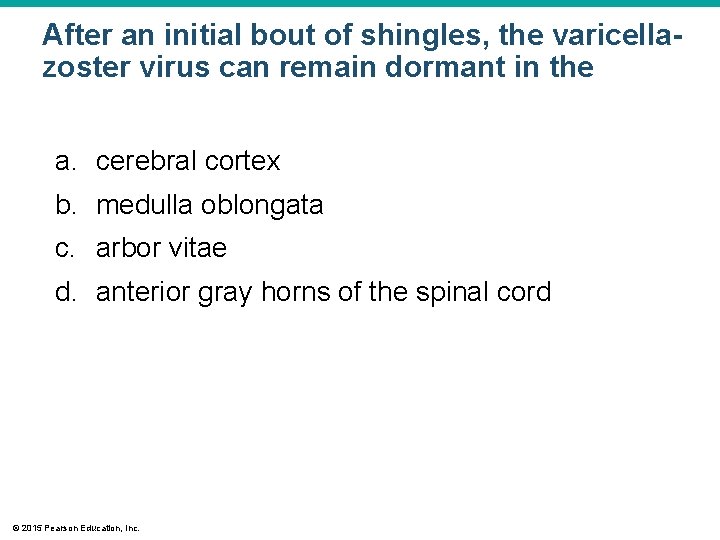
After an initial bout of shingles, the varicellazoster virus can remain dormant in the a. cerebral cortex b. medulla oblongata c. arbor vitae d. anterior gray horns of the spinal cord © 2015 Pearson Education, Inc.
After an initial bout of shingles, the varicellazoster virus can remain dormant in the a. cerebral cortex b. medulla oblongata c. arbor vitae d. anterior gray horns of the spinal cord © 2015 Pearson Education, Inc.
Injury to the _______ plexus would interfere with the ability to breathe. The ______ nerve is the major nerve of this plexus. a. brachial; long thoracic b. cervical; phrenic c. cervical; long thoracic d. brachial; pectoral © 2015 Pearson Education, Inc.
Injury to the _______ plexus would interfere with the ability to breathe. The ______ nerve is the major nerve of this plexus. a. brachial; long thoracic b. cervical; phrenic c. cervical; long thoracic d. brachial; pectoral © 2015 Pearson Education, Inc.
An anesthetic blocks the function of the dorsal rami of the cervical spinal nerves. Which areas of the body will be affected? a. skin and muscles of the back of the neck b. skin and muscles of the shoulders c. both A and B d. none of the above © 2015 Pearson Education, Inc.
An anesthetic blocks the function of the dorsal rami of the cervical spinal nerves. Which areas of the body will be affected? a. skin and muscles of the back of the neck b. skin and muscles of the shoulders c. both A and B d. none of the above © 2015 Pearson Education, Inc.
After injuring her back, 18 -year-old Tina exhibits a positive Babinski reflex. What does this imply about Tina’s injury? a. possible paraplegia b. possible damage to sensory tracts to foot c. possible damage to ascending tracts in spinal cord d. possible damage to descending tracts in the spinal cord © 2015 Pearson Education, Inc.
After injuring her back, 18 -year-old Tina exhibits a positive Babinski reflex. What does this imply about Tina’s injury? a. possible paraplegia b. possible damage to sensory tracts to foot c. possible damage to ascending tracts in spinal cord d. possible damage to descending tracts in the spinal cord © 2015 Pearson Education, Inc.
Which term refers to when a postsynaptic neuron’s axon collateral stimulates the presynaptic neuron? a. parallel processing b. convergence c. divergence d. reverberation © 2015 Pearson Education, Inc.
Which term refers to when a postsynaptic neuron’s axon collateral stimulates the presynaptic neuron? a. parallel processing b. convergence c. divergence d. reverberation © 2015 Pearson Education, Inc.