
Chapter 13 The Preprocessor Associate Prof YuhShyan Chen
- Slides: 14
Chapter 13 - The Preprocessor Associate Prof. Yuh-Shyan Chen Dept. of Computer Science and Information Engineering National Chung-Cheng University
Outline 13. 1 13. 2 13. 3 13. 4 13. 5 13. 6 13. 7 13. 8 13. 9 13. 10 Introduction The #include Preprocessor Directive The #define Preprocessor Directive: Symbolic Constants The #define Preprocessor Directive: Macros Conditional Compilation The #error and #pragma Preprocessor Directives The # and ## Operators Line Numbers Predefined Symbolic Constants Assertions
13. 1 Introduction l Preprocessing n Occurs before a program is compiled n Inclusion of other files n Definition of symbolic constants and macros n Conditional compilation of program code n Conditional execution of preprocessor directives l Format of preprocessor directives n Lines begin with # n Only whitespace characters before directives on a line
13. 2 The #include Preprocessor Directive l #include n Copy of a specified file included in place of the directive #include <filename> u Searches standard library for file u Use for standard library files #include "filename" u Use for user-defined files l Used for u Searches current directory, then standard library n Loading header files (#include <iostream>) n Programs with multiple source files to be compiled together n Header file - has common declarations and definitions (classes, structures, function prototypes) u #include statement in each file
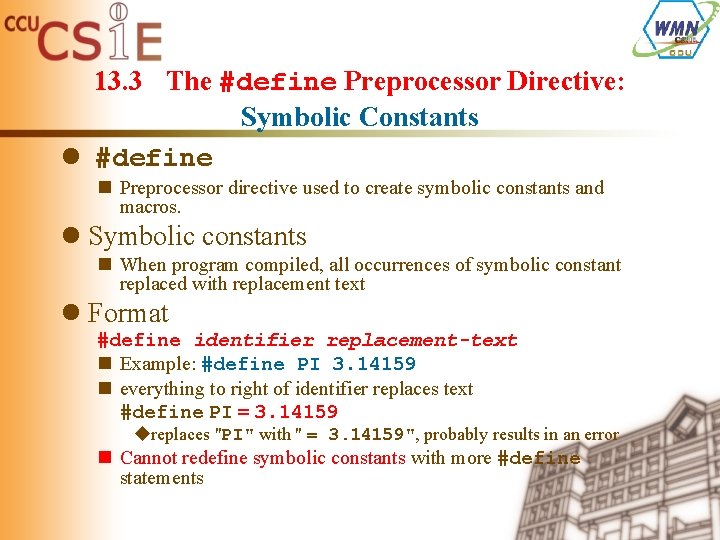
13. 3 The #define Preprocessor Directive: Symbolic Constants l #define n Preprocessor directive used to create symbolic constants and macros. l Symbolic constants n When program compiled, all occurrences of symbolic constant replaced with replacement text l Format #define identifier replacement-text n Example: #define PI 3. 14159 n everything to right of identifier replaces text #define PI = 3. 14159 ureplaces "PI" with " = 3. 14159", probably results in an error n Cannot redefine symbolic constants with more #define statements
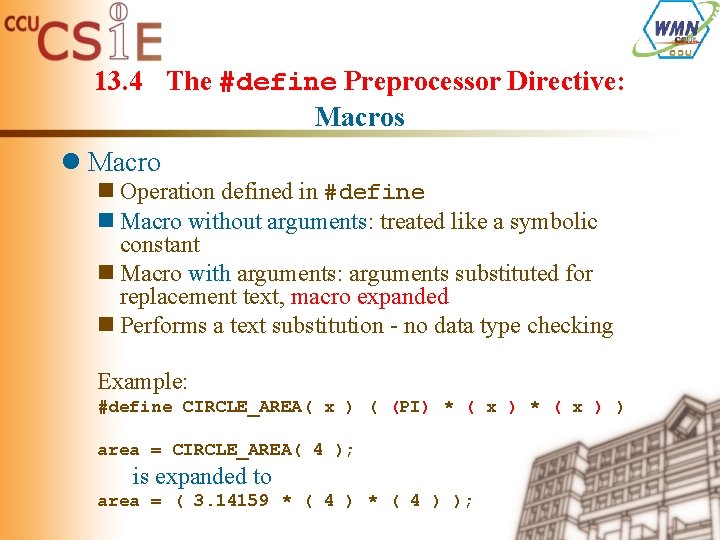
13. 4 The #define Preprocessor Directive: Macros l Macro n Operation defined in #define n Macro without arguments: treated like a symbolic constant n Macro with arguments: arguments substituted for replacement text, macro expanded n Performs a text substitution - no data type checking Example: #define CIRCLE_AREA( x ) ( (PI) * ( x ) ) area = CIRCLE_AREA( 4 ); is expanded to area = ( 3. 14159 * ( 4 ) );
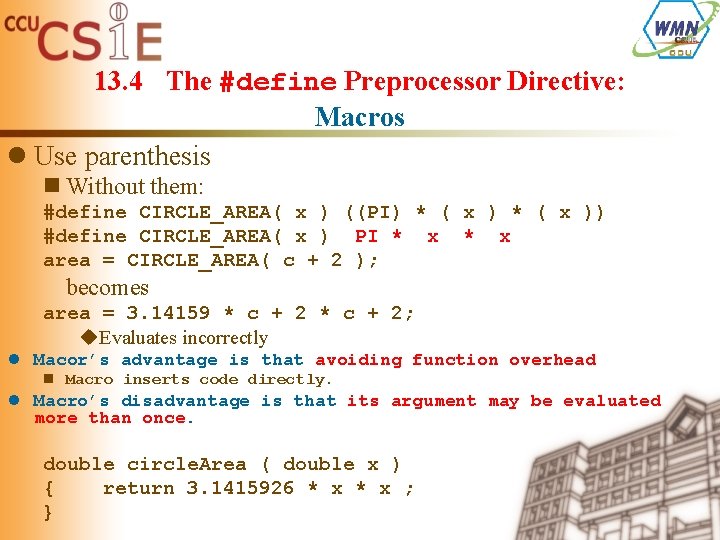
13. 4 The #define Preprocessor Directive: Macros l Use parenthesis n Without them: #define CIRCLE_AREA( x ) ((PI) * ( x )) #define CIRCLE_AREA( x ) PI * x area = CIRCLE_AREA( c + 2 ); becomes area = 3. 14159 * c + 2; u. Evaluates incorrectly l Macor’s advantage is that avoiding function overhead n Macro inserts code directly. l Macro’s disadvantage is that its argument may be evaluated more than once. double circle. Area ( double x ) { return 3. 1415926 * x ; }
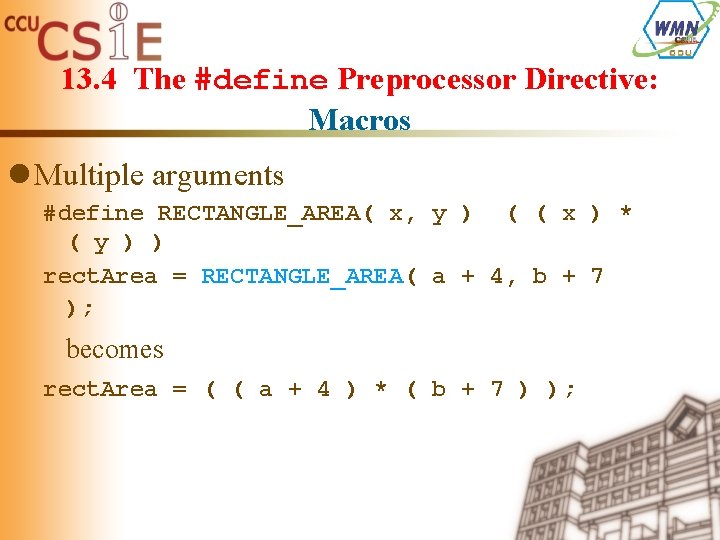
13. 4 The #define Preprocessor Directive: Macros l Multiple arguments #define RECTANGLE_AREA( x, y ) ( ( x ) * ( y ) ) rect. Area = RECTANGLE_AREA( a + 4, b + 7 ); becomes rect. Area = ( ( a + 4 ) * ( b + 7 ) );
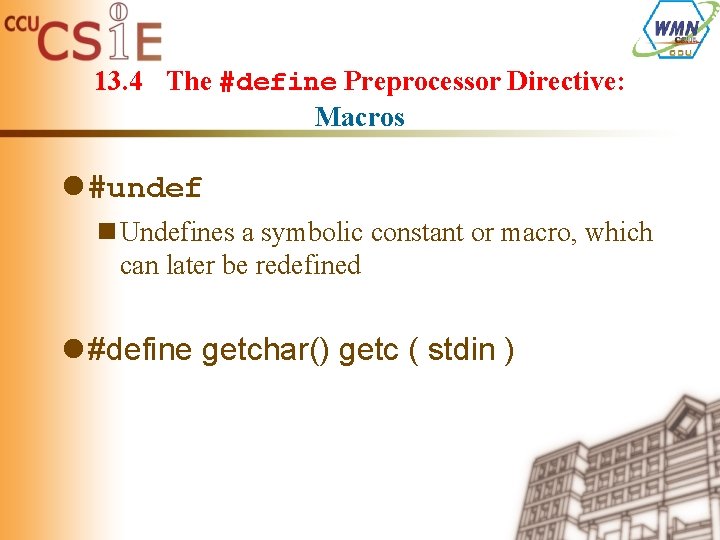
13. 4 The #define Preprocessor Directive: Macros l #undef n Undefines a symbolic constant or macro, which can later be redefined l #define getchar() getc ( stdin )
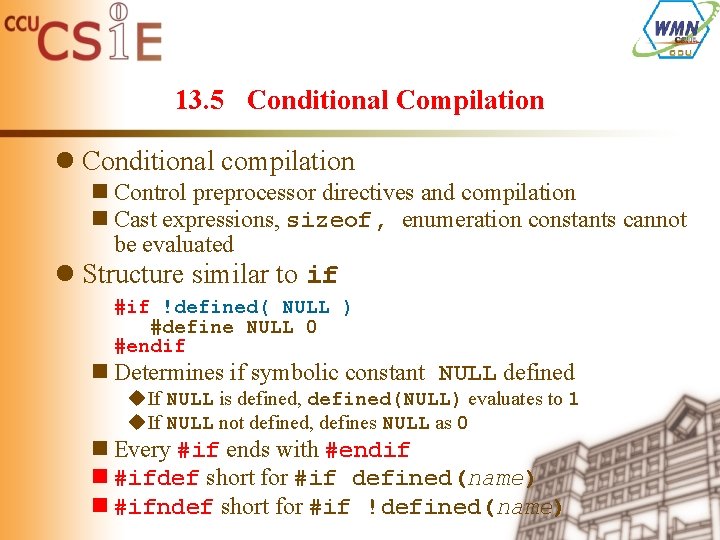
13. 5 Conditional Compilation l Conditional compilation n Control preprocessor directives and compilation n Cast expressions, sizeof, enumeration constants cannot be evaluated l Structure similar to if #if !defined( NULL ) #define NULL 0 #endif n Determines if symbolic constant NULL defined u. If NULL is defined, defined(NULL) evaluates to 1 u. If NULL not defined, defines NULL as 0 n Every #if ends with #endif n #ifdef short for #if defined(name) n #ifndef short for #if !defined(name)
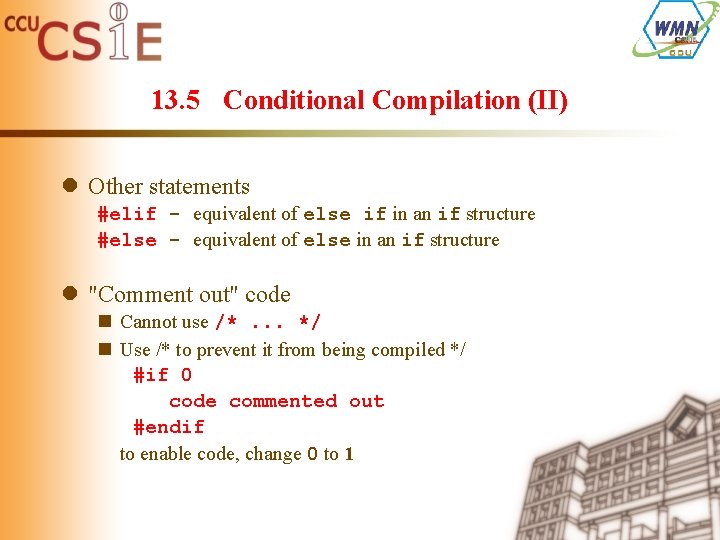
13. 5 Conditional Compilation (II) l Other statements #elif - equivalent of else if in an if structure #else - equivalent of else in an if structure l "Comment out" code n Cannot use /*. . . */ n Use /* to prevent it from being compiled */ #if 0 code commented out #endif to enable code, change 0 to 1
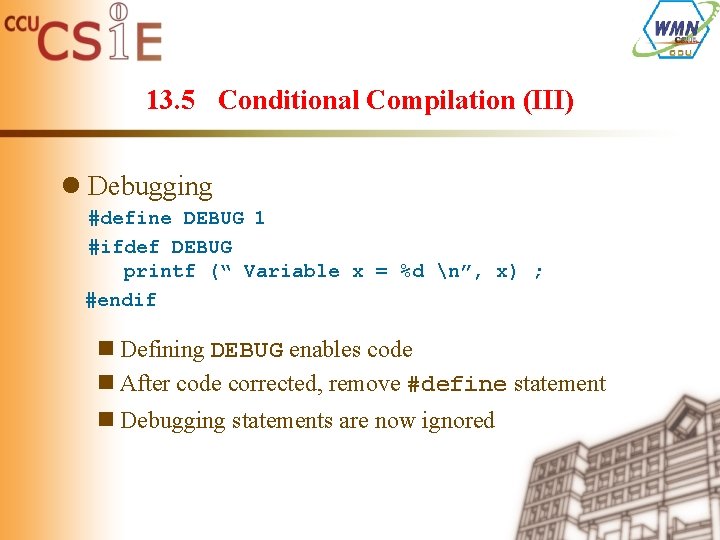
13. 5 Conditional Compilation (III) l Debugging #define DEBUG 1 #ifdef DEBUG printf (“ Variable x = %d n”, x) ; #endif n Defining DEBUG enables code n After code corrected, remove #define statement n Debugging statements are now ignored
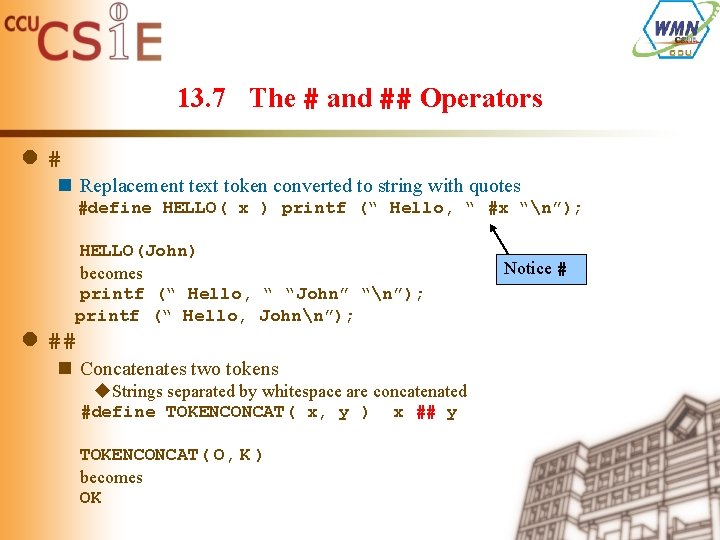
13. 7 The # and ## Operators l# n Replacement text token converted to string with quotes #define HELLO( x ) printf (“ Hello, “ #x “n”); HELLO(John) becomes printf (“ Hello, “ “John” “n”); printf (“ Hello, Johnn”); l ## n Concatenates two tokens u. Strings separated by whitespace are concatenated #define TOKENCONCAT( x, y ) x ## y TOKENCONCAT( O, K ) becomes OK Notice #
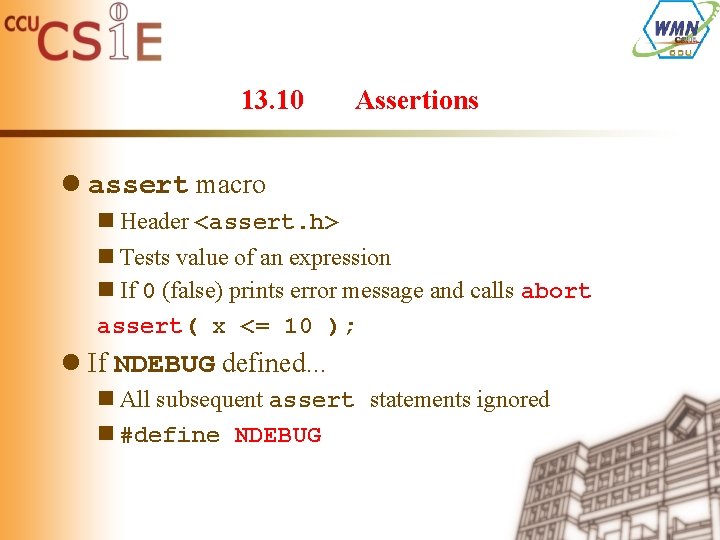
13. 10 Assertions l assert macro n Header <assert. h> n Tests value of an expression n If 0 (false) prints error message and calls abort assert( x <= 10 ); l If NDEBUG defined. . . n All subsequent assert statements ignored n #define NDEBUG