
Chapter 13 The Global Geography of Culture Cultural
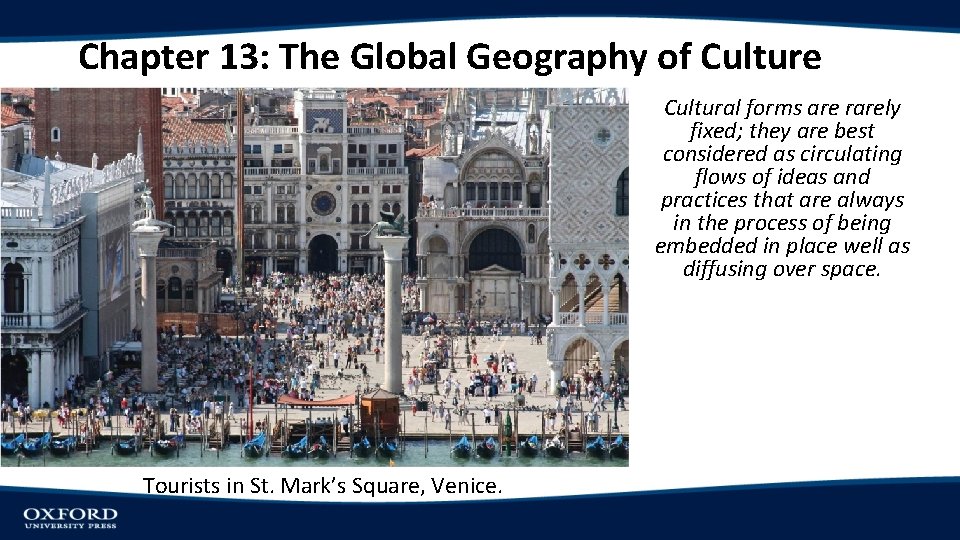
Chapter 13: The Global Geography of Culture Cultural forms are rarely fixed; they are best considered as circulating flows of ideas and practices that are always in the process of being embedded in place well as diffusing over space. Tourists in St. Mark’s Square, Venice.
Chapter Learning Objectives Understand the concept of the cultural region. Describe the process of spatial diffusion of culture. Summarize the sources of cultural production. Explain how cultural products become deterritorialized or reterritorialized, and cultural practices transplanted or transformed. • Reflect on the global production of culture. • •
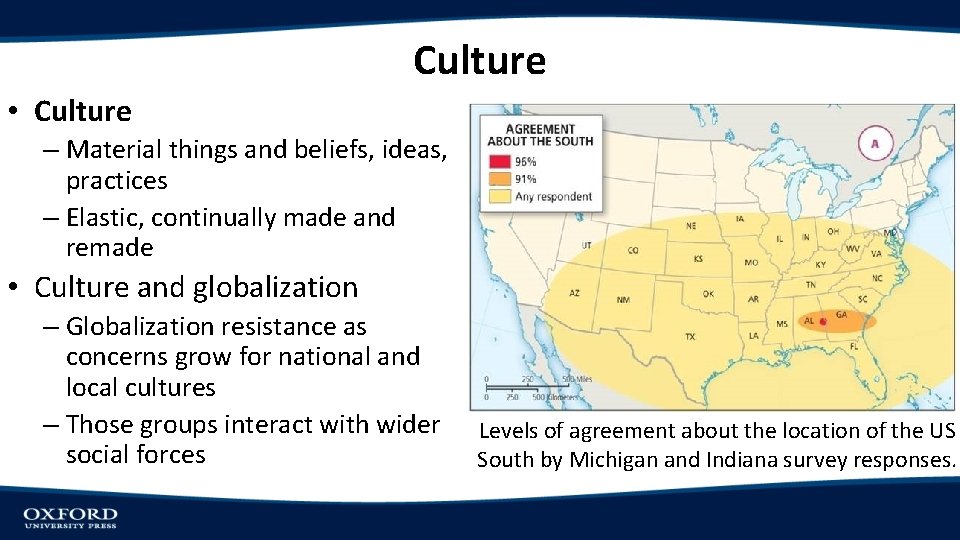
Culture • Culture – Material things and beliefs, ideas, practices – Elastic, continually made and remade • Culture and globalization – Globalization resistance as concerns grow for national and local cultures – Those groups interact with wider social forces Levels of agreement about the location of the US South by Michigan and Indiana survey responses.
Prof. Joe Naumann’s Definition • Expansion of Preston James’ definition • Culture is the dynamic (ever changing) learned (by observation and teaching)and generally accepted pattern or way of life of a group of people which results from their: – World view (cosmology) – Attitudes(conscious and unconscious) – Objectives – And technical skills levels • The foundation (deep culture) may be largely unexamined and unconscious. The deep culture is the major shaper of the surface culture traits which are observable.
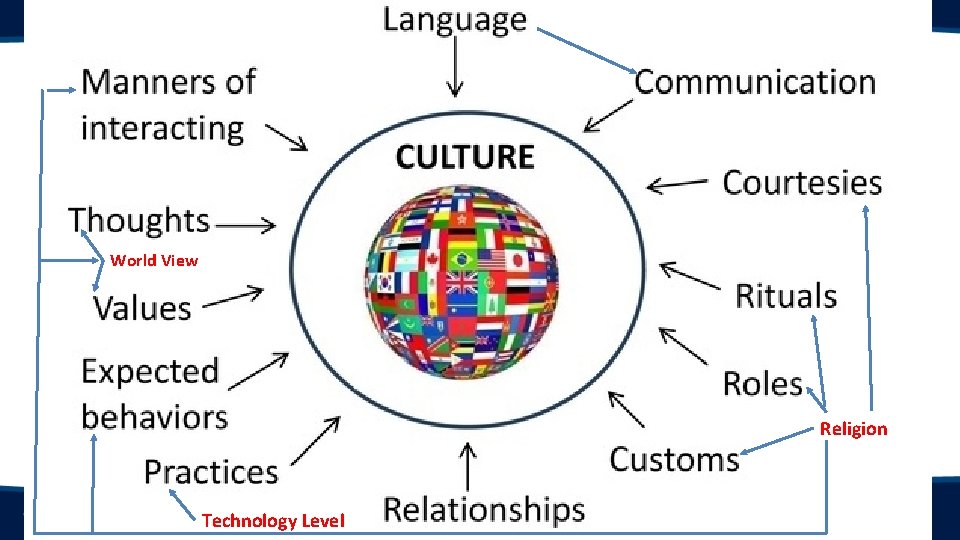
World View Religion Technology Level
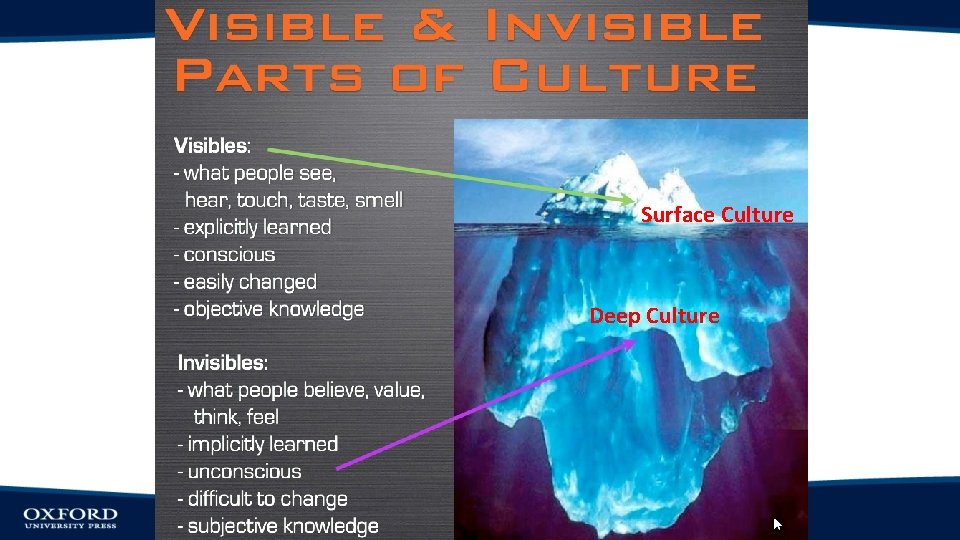
Surface Culture Deep Culture
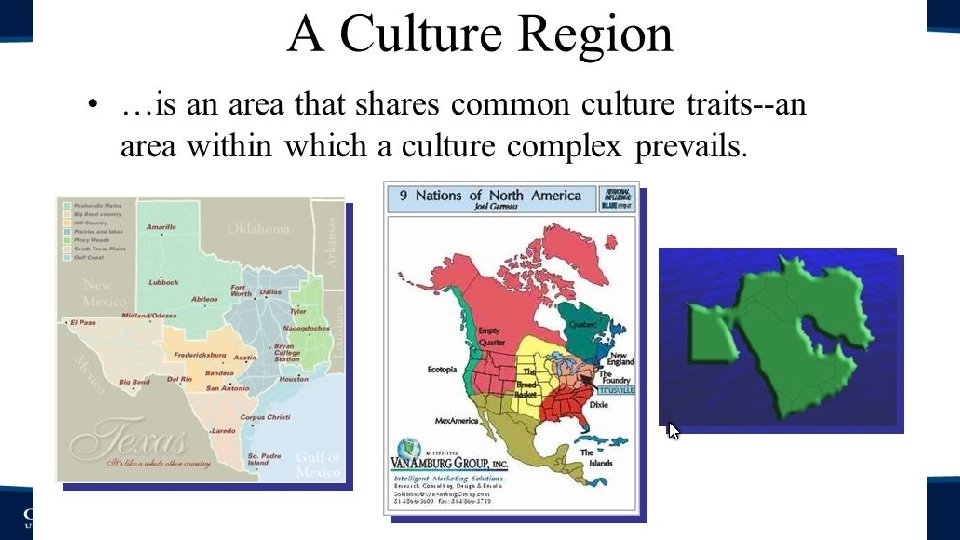
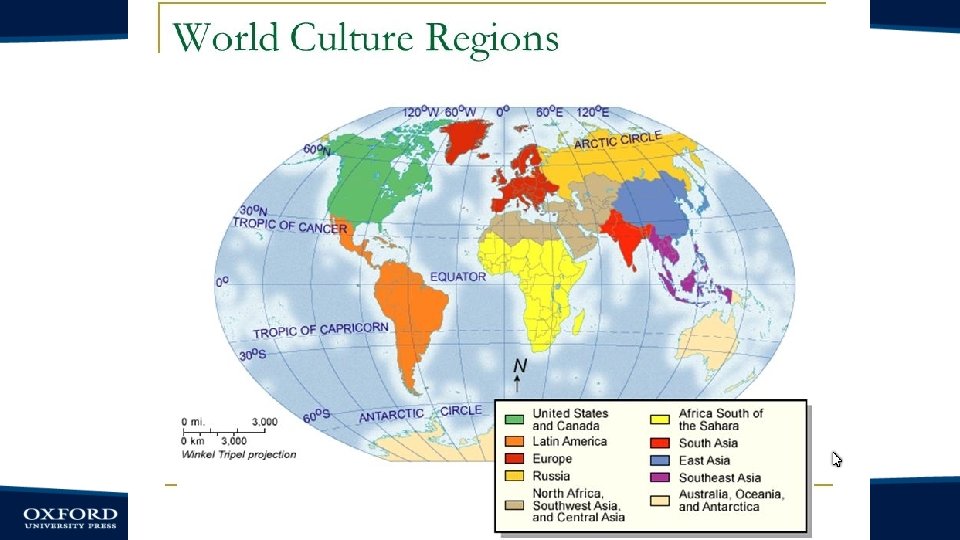
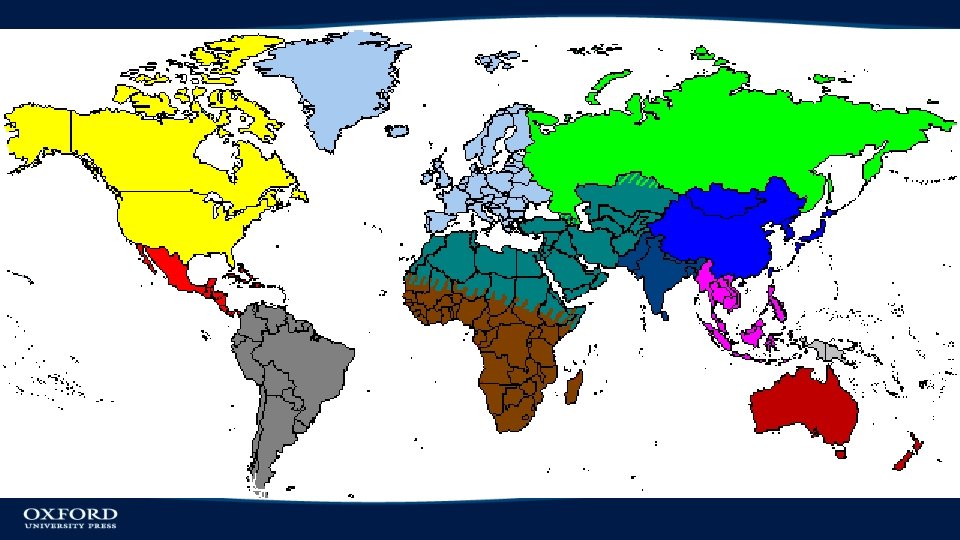
Cultural Regions • Cultural or culture region – Areas with common language, religion, ethnicity, or history – Boundaries are fluid (transition zones), with a core and periphery – Exist through self-identification and external perception – Defining culture can be source of contention, since regions are complex and not homogenous
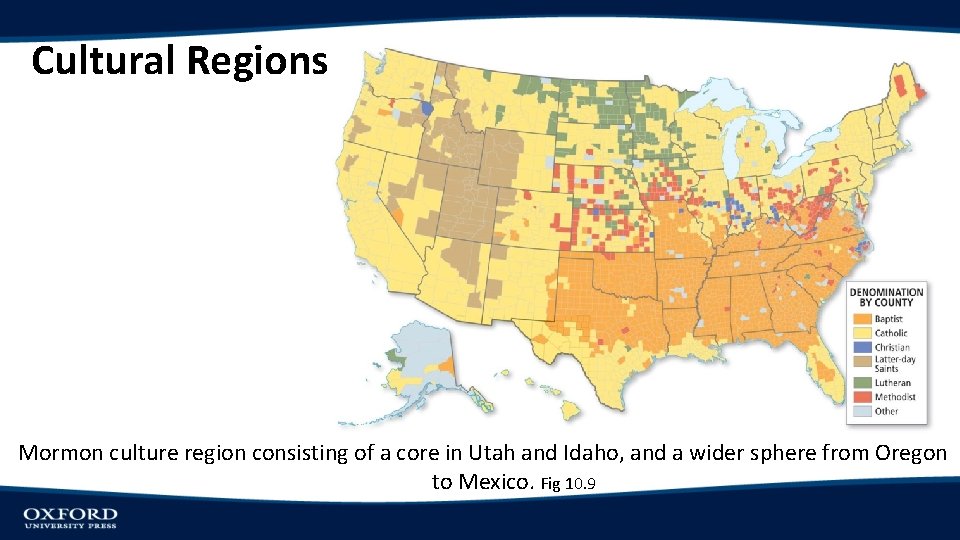
Cultural Regions Mormon culture region consisting of a core in Utah and Idaho, and a wider sphere from Oregon to Mexico. Fig 10. 9
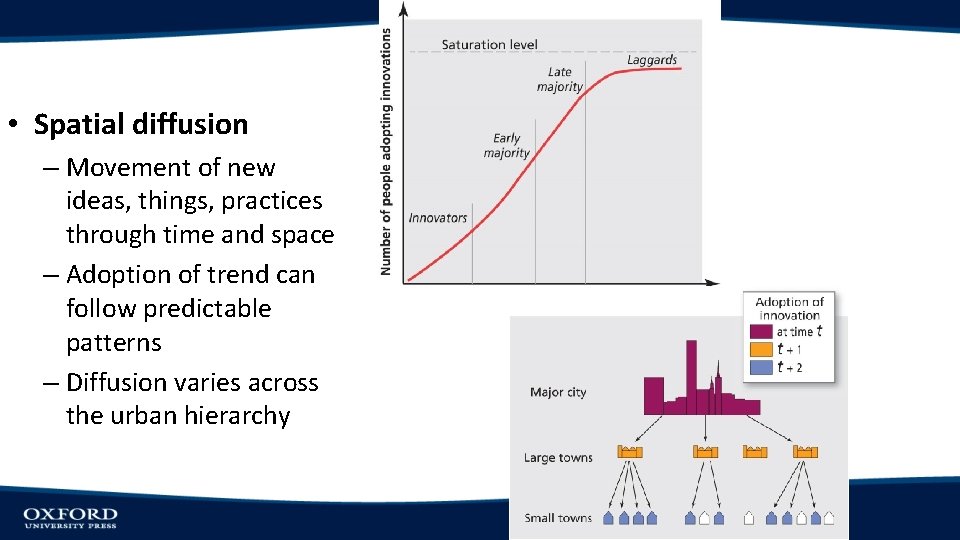
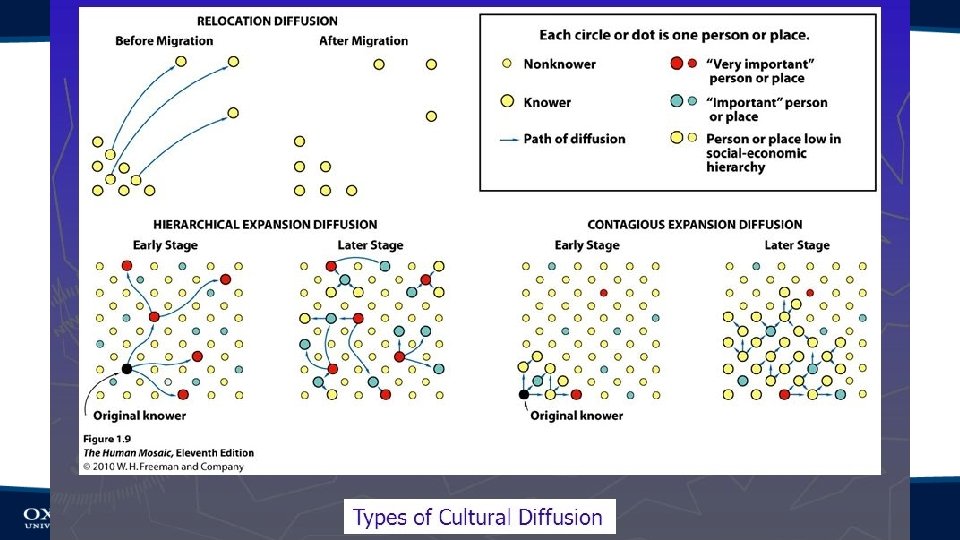
• Spatial diffusion – Movement of new ideas, things, practices through time and space – Adoption of trend can follow predictable patterns – Diffusion varies across the urban hierarchy
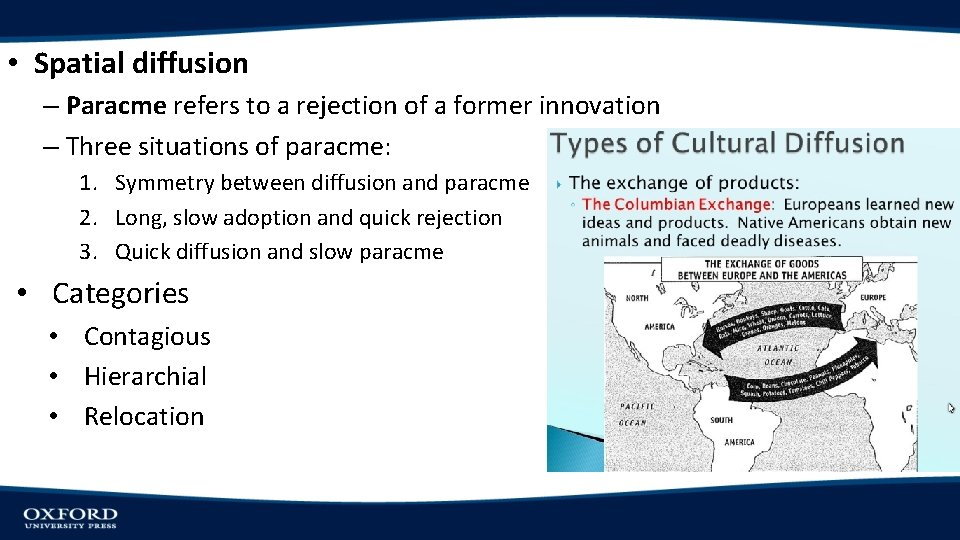
• Spatial diffusion – Paracme refers to a rejection of a former innovation – Three situations of paracme: 1. Symmetry between diffusion and paracme 2. Long, slow adoption and quick rejection 3. Quick diffusion and slow paracme • Categories • Contagious • Hierarchial • Relocation
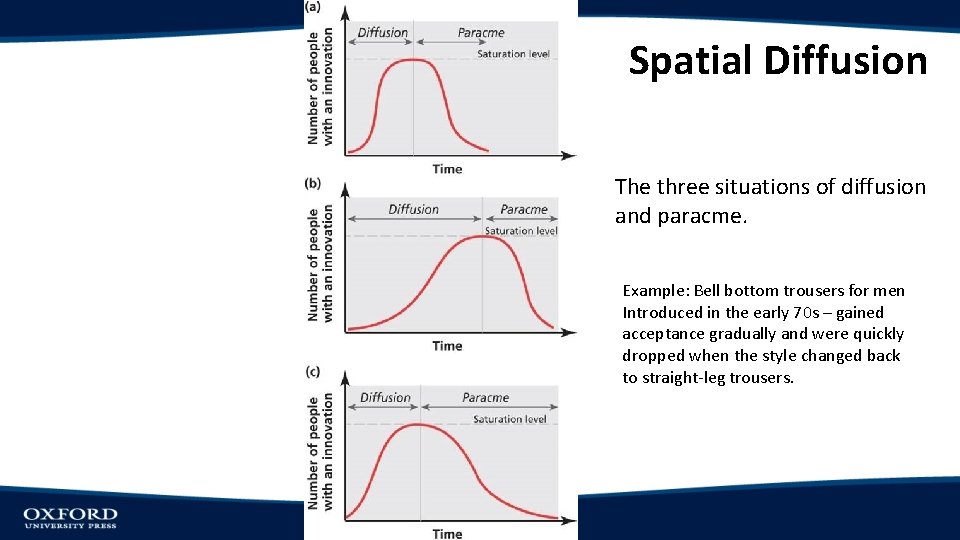
Spatial Diffusion The three situations of diffusion and paracme. Example: Bell bottom trousers for men Introduced in the early 70 s – gained acceptance gradually and were quickly dropped when the style changed back to straight-leg trousers.

The Diffusion of Diseases • Spread of disease illustrates diffusion and space-time convergence – As time shrinks distance, disease diffusion increases – Ease, frequency of transfer for communicable diseases – Global pandemic potential Global dengue fever risk. Source: © Hay on Humanosphere.
Culture as Flow • Culture is active process, not fixed in time and place – Flows circulate globally, (re)expressed in local contexts – Territorialization of culture signifies connection between culture and specific places – Deterritorialization of culture occurs when cultures are lifted from particular places – Reterritorialization occurs as cultural practices are transplanted and transformed • Importance of international migration communities – Shape culture of both destination and origin areas
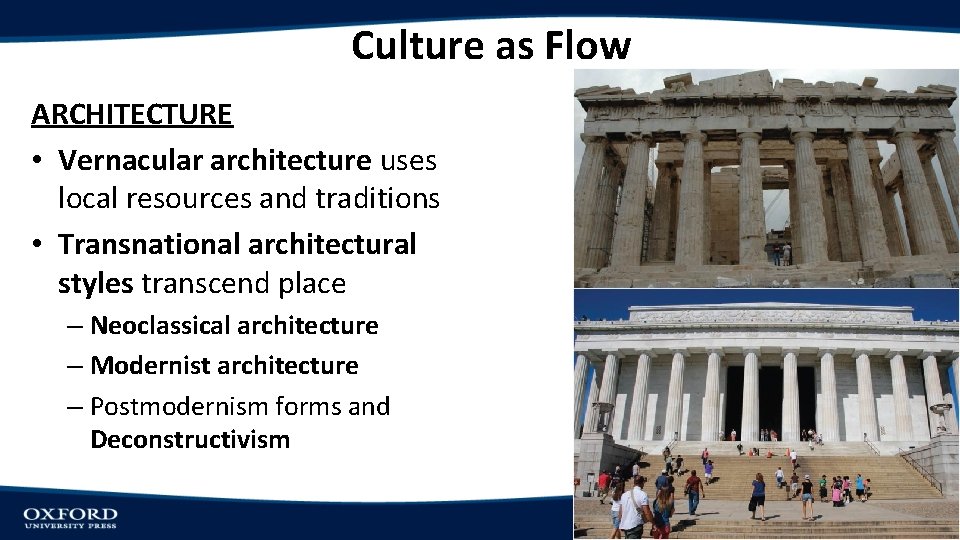
Culture as Flow ARCHITECTURE • Vernacular architecture uses local resources and traditions • Transnational architectural styles transcend place – Neoclassical architecture – Modernist architecture – Postmodernism forms and Deconstructivism
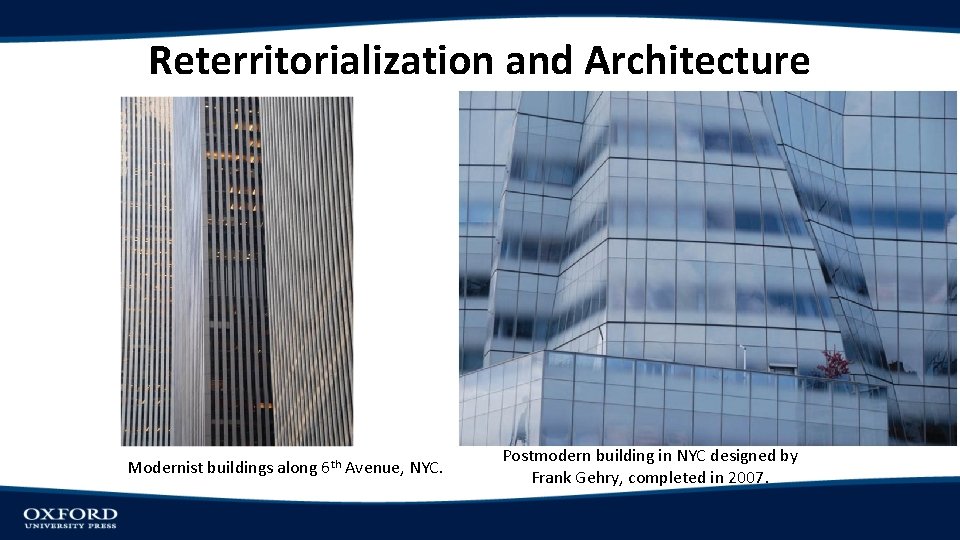
Reterritorialization and Architecture Modernist buildings along 6 th Avenue, NYC. Postmodern building in NYC designed by Frank Gehry, completed in 2007.
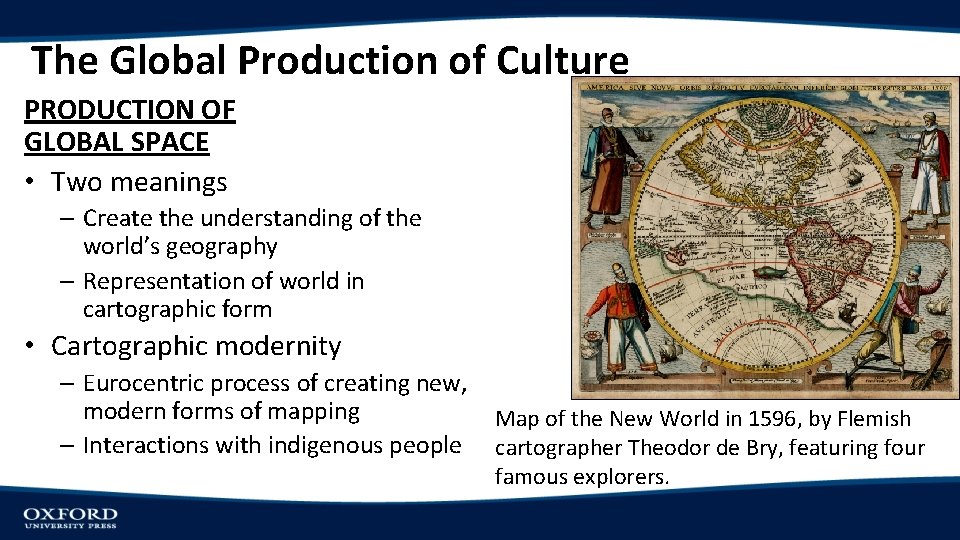
The Global Production of Culture PRODUCTION OF GLOBAL SPACE • Two meanings – Create the understanding of the world’s geography – Representation of world in cartographic form • Cartographic modernity – Eurocentric process of creating new, modern forms of mapping – Interactions with indigenous people Map of the New World in 1596, by Flemish cartographer Theodor de Bry, featuring four famous explorers.
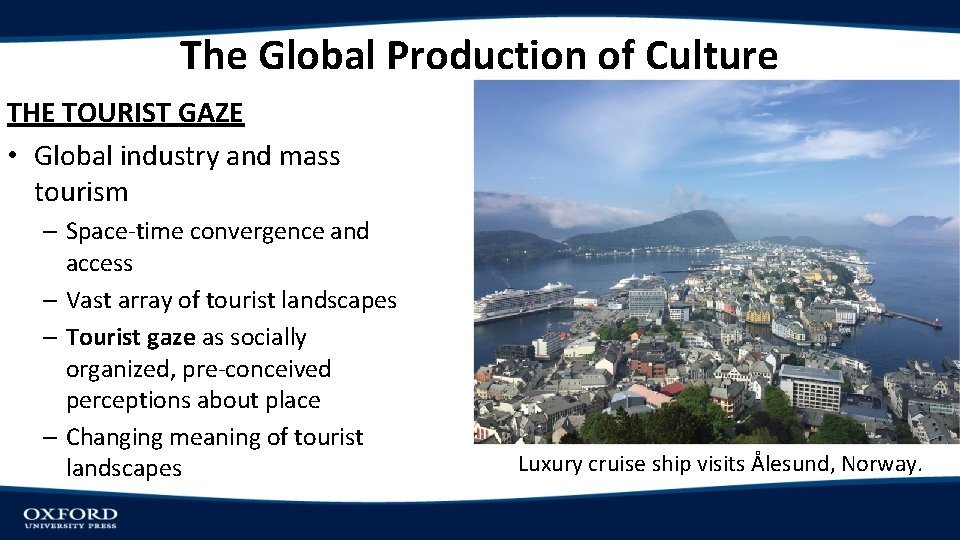
The Global Production of Culture THE TOURIST GAZE • Global industry and mass tourism – Space-time convergence and access – Vast array of tourist landscapes – Tourist gaze as socially organized, pre-conceived perceptions about place – Changing meaning of tourist landscapes Luxury cruise ship visits Ålesund, Norway.
The Global Production of Culture PRODUCTION OF GEOGRAPHICAL KNOWLEDGE • Writing and describing parts of the Earth by the globally privileged – Component of imperialism • Positionality reflects political meanings and operation of military power – Orientalism is a discourse formed in the writing of non-Western places, or the Orient, by those in the West – Ornamentalism is a discourse around similarities between elite social groups of East and West – Occidentalism is a counter discourse of anti-Western ideas
The Commodification of Culture • Selected local cultural forms commodified into globalized forms – Nature of US culture was appropriate for global audiences • Glocalization – Worldwide operations attuned to local markets and conditions • Coca Cola offers locally favored flavors in addition to Coke – Likewise Mc. Donalds • Culture and commerce – Especially in late stage capitalism, symbolic meaning and association determines economic value of goods – Range of cultural industries and “cultural-product” sectors
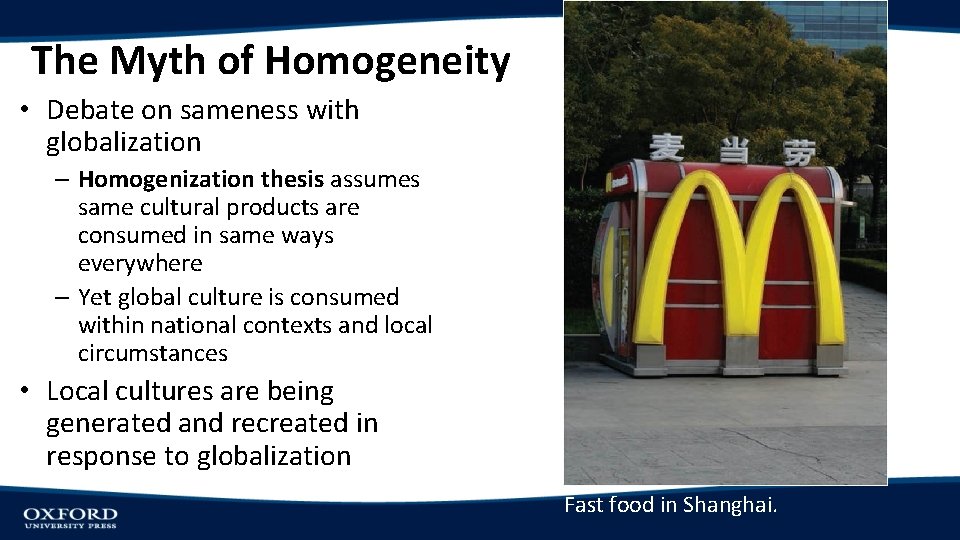
The Myth of Homogeneity • Debate on sameness with globalization – Homogenization thesis assumes same cultural products are consumed in same ways everywhere – Yet global culture is consumed within national contexts and local circumstances • Local cultures are being generated and recreated in response to globalization Fast food in Shanghai.
• • • Chapter Summary Cultural regions share similar cultural features such as language, ideas, religion, or practices. Often divided into core and periphery. Spatial diffusion is the movement across space and time of an innovation, idea, or practice. Three dynamically linked sources of cultural production: connection with local, relationship with national, and interaction with global. Whenever a globalization wave sweeps the world, a corresponding revival of concern and promotion of national and local cultures occurs for groups to forge, redefine, or reestablish their place. Important to consider the process of deterritorialization of culture, in which cultures are lifted from particular places, and the reterritorialization of culture, whereby cultural practices are transplanted and transformed. Architecture offers examples of the de- and reterritorialization of culture.
Chapter Summary • Two forms of architecture that affect human geography are vernacular and global. Vernacular architecture uses local resources and traditions in the design and construction of buildings, while global architecture can incorporate elements of design from around the world, or have elements that eventually transcend national boundaries and impact cultures and geography around the world. • The world is described from the viewpoints of the West and the East, often referred to as Orientalism and Occidentalism. • The commodification of selected cultural forms has transformed some local cultures into globalized forms, while allowing other local cultures to influence global cultural forms.
- Slides: 26