
Chapter 13 The Brain and Cranial Nerves Power
Chapter 13 The Brain and Cranial Nerves Power. Point® Lecture Slides prepared by Jason La. Pres Lone Star College - North Harris Copyright © 2010 Pearson Education, Inc.
An Introduction to the Brain and Cranial Nerves • The Adult Human Brain – Ranges from 750 cc to 2100 cc – Contains almost 97% of the body’s neural tissue – Average weight about 1. 4 kg (3 lb) Copyright © 2010 Pearson Education, Inc.
The Brain • Six Regions of the Brain – Cerebrum – Cerebellum – Diencephalon – Mesencephalon – Pons – Medulla oblongata 3 D Peel-Away of the Brain Copyright © 2010 Pearson Education, Inc.
The Brain • Cerebrum – Largest part of brain – Controls higher mental functions – Divided into left and right cerebral hemispheres – Surface layer of gray matter (neural cortex) Copyright © 2010 Pearson Education, Inc.
The Brain • Cerebrum – Neural cortex • Also called cerebral cortex • Folded surface increases surface area • Elevated ridges (gyri) • Shallow depressions (sulci) • Deep grooves (fissures) Copyright © 2010 Pearson Education, Inc.
The Brain • Cerebellum – Second largest part of brain – Coordinates repetitive body movements – Two hemispheres – Covered with cerebellar cortex Copyright © 2010 Pearson Education, Inc.
The Brain • Diencephalon – Located under cerebrum and cerebellum – Links cerebrum with brain stem – Three divisions • Left thalamus • Right thalamus • Hypothalamus Copyright © 2010 Pearson Education, Inc.
The Brain • Diencephalon – Thalamus • Relays and processes sensory information – Hypothalamus • Hormone production • Emotion • Autonomic function – Pituitary gland • • Major endocrine gland Connected to hypothalamus Via infundibulum (stalk) Interfaces nervous and endocrine systems Copyright © 2010 Pearson Education, Inc.
The Brain • The Brain Stem – Processes information between • Spinal cord and cerebrum or cerebellum – Includes • Mesencephalon • Pons • Medulla oblongata Copyright © 2010 Pearson Education, Inc.
The Brain • The Brain Stem – Mesencephalon • Also called midbrain • Processes sight, sound, and associated reflexes • Maintains consciousness – Pons • Connects cerebellum to brain stem • Is involved in somatic and visceral motor control Copyright © 2010 Pearson Education, Inc.
The Brain • The Brain Stem – Medulla oblongata • Connects brain to spinal cord • Relays information • Regulates autonomic functions: – heart rate, blood pressure, and digestion Copyright © 2010 Pearson Education, Inc.
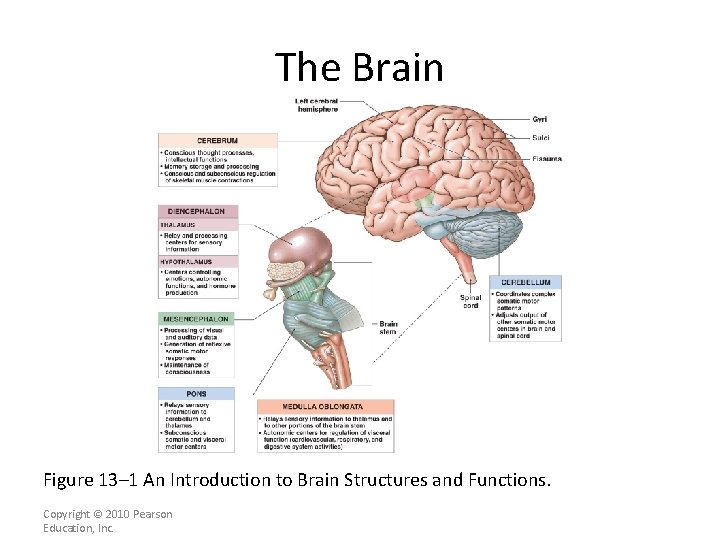
The Brain Figure 13– 1 An Introduction to Brain Structures and Functions. Copyright © 2010 Pearson Education, Inc.
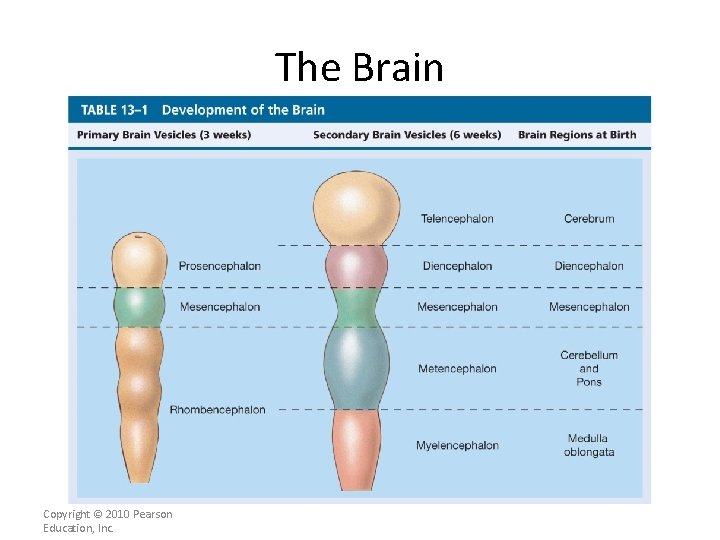
The Brain • Embryological Development – Determines organization of brain structures – Neural tube • Origin of brain • Enlarges into three primary brain vesicles – prosencephalon – mesencephalon – rhombencephalon Copyright © 2010 Pearson Education, Inc.
The Brain • Five Secondary Brain Vesicles – Telencephalon – Diencephalon – Mesencephalon – Metencephalon – Myelencephalon Copyright © 2010 Pearson Education, Inc.
The Brain • Origins of Brain Structures • Diencephalon and mesencephalon persist – Telencephalon: • Becomes cerebrum – Metencephalon • Forms cerebellum and pons – Myelencephalon • Becomes medulla oblongata Copyright © 2010 Pearson Education, Inc.
The Brain Copyright © 2010 Pearson Education, Inc.
The Brain • Ventricles of the Brain – Origins of ventricles • Neural tube encloses neurocoel • Neurocoel expands to form chambers (ventricles) lined with ependymal cells – Each cerebral hemisphere contains one large lateral ventricle • Separated by a thin medial partition (septum pellucidum) Copyright © 2010 Pearson Education, Inc.
The Brain • Ventricles of the Brain – Third ventricle • Ventricle of the diencephalon • Lateral ventricles communicate with third ventricle: – via interventricular foramen (foramen of Monro) Copyright © 2010 Pearson Education, Inc.
The Brain • Ventricles of the Brain – Fourth ventricle • Extends into medulla oblongata • Becomes continuous with central canal of the spinal cord • Connects with third ventricle: – via narrow canal in mesencephalon – aqueduct of midbrain Copyright © 2010 Pearson Education, Inc.
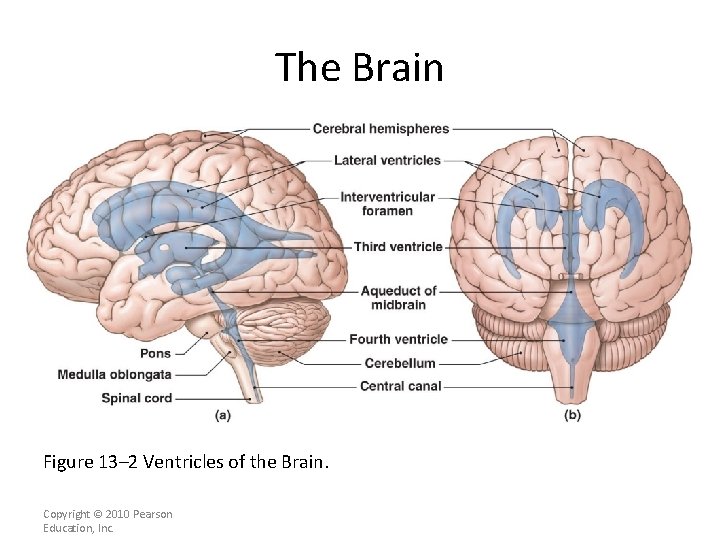
The Brain Figure 13– 2 Ventricles of the Brain. Copyright © 2010 Pearson Education, Inc.
The Brain • The brain is a large, delicate mass of neural tissue containing internal passageways and chambers filled with cerebrospinal fluid • Each of the six major brain regions has specific functions • Ascending from the medulla oblongata to the cerebrum, brain functions become more complex and variable • Conscious thought and intelligence are produced in the neural cortex of the cerebral hemispheres Copyright © 2010 Pearson Education, Inc.
Brain Protection and Support • Physical protection – Bones of the cranium – Cranial meninges – Cerebrospinal fluid • Biochemical isolation – Blood–brain barrier Copyright © 2010 Pearson Education, Inc.
Brain Protection and Support • The Cranial Meninges – Have three layers: • Dura mater • Arachnoid mater • Pia mater – Are continuous with spinal meninges – Protect the brain from cranial trauma Copyright © 2010 Pearson Education, Inc.
Brain Protection and Support • The Cranial Meninges – Dura mater • Inner fibrous layer (meningeal layer) • Outer fibrous layer (endosteal layer) fused to periosteum • Venous sinuses between two layers – Arachnoid mater • Covers brain • Contacts epithelial layer of dura mater • Subarachnoid space: between arachnoid mater and pia mater – Pia mater • Attached to brain surface by astrocytes Copyright © 2010 Pearson Education, Inc.
Brain Protection and Support • Dural Folds – Folded inner layer of dura mater – Extend into cranial cavity – Stabilize and support brain – Contain collecting veins (dural sinuses) – Falx cerebri, tentorium cerebelli, and falx cerebelli Copyright © 2010 Pearson Education, Inc.
Brain Protection and Support • Dural Folds – Falx cerebri • Projects between the cerebral hemispheres • Contains superior sagittal sinus and inferior sagittal sinus – Tentorium cerebelli • Separates cerebellum and cerebrum • Contains transverse sinus – Falx cerebelli • Divides cerebellar hemispheres below the tentorium cerebelli Copyright © 2010 Pearson Education, Inc.
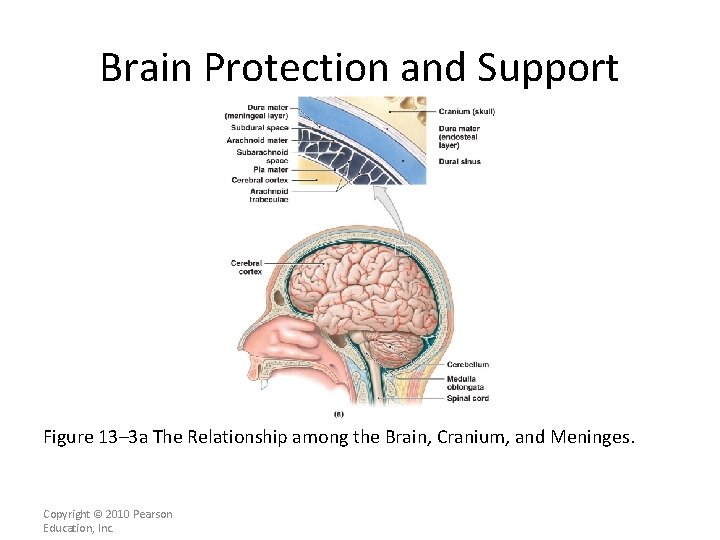
Brain Protection and Support Figure 13– 3 a The Relationship among the Brain, Cranium, and Meninges. Copyright © 2010 Pearson Education, Inc.
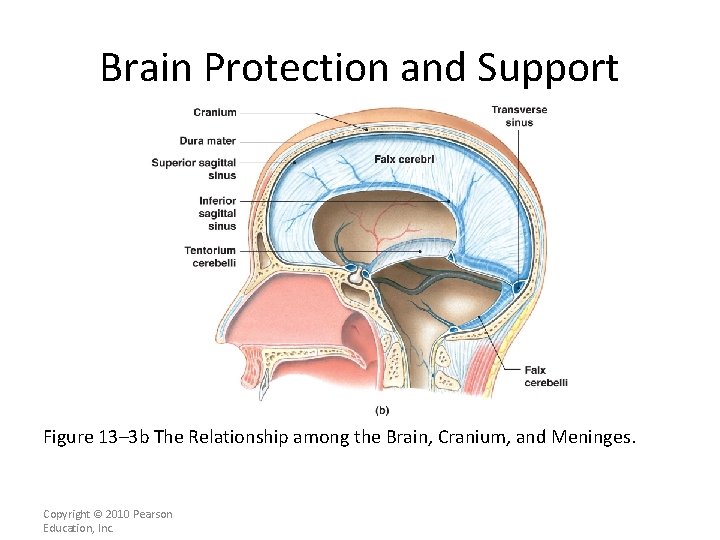
Brain Protection and Support Figure 13– 3 b The Relationship among the Brain, Cranium, and Meninges. Copyright © 2010 Pearson Education, Inc.
Brain Protection and Support • Cerebrospinal Fluid (CSF) – Surrounds all exposed surfaces of CNS – Interchanges with interstitial fluid of brain – Functions of CSF • Cushions delicate neural structures • Supports brain • Transports nutrients, chemical messengers, and waste products Copyright © 2010 Pearson Education, Inc.
Brain Protection and Support • Cerebrospinal Fluid (CSF) – Choroid plexus • Specialized ependymal cells and capillaries: – secrete CSF into ventricles – remove waste products from CSF – adjust composition of CSF • Produces about 500 m. L of CSF/day Copyright © 2010 Pearson Education, Inc.
Brain Protection and Support • Cerebrospinal Fluid (CSF) – CSF circulates • From choroid plexus • Through ventricles • To central canal of spinal cord • Into subarachnoid space around the brain, spinal cord, and cauda equina Copyright © 2010 Pearson Education, Inc.
Brain Protection and Support • Cerebrospinal Fluid (CSF) – CSF in subarachnoid space • Arachnoid villi: – extensions of subarachnoid space – extend through dura mater to superior sagittal sinus • Arachnoid granulations: – large clusters of villi – absorb CSF into venous circulation Copyright © 2010 Pearson Education, Inc.
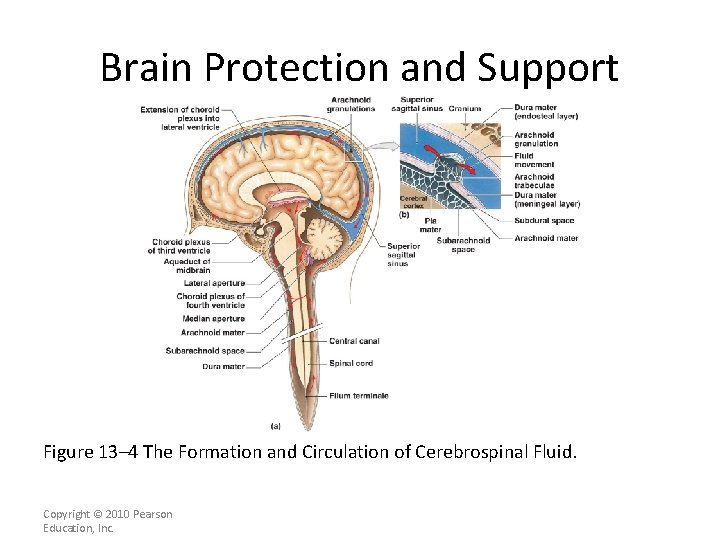
Brain Protection and Support Figure 13– 4 The Formation and Circulation of Cerebrospinal Fluid. Copyright © 2010 Pearson Education, Inc.
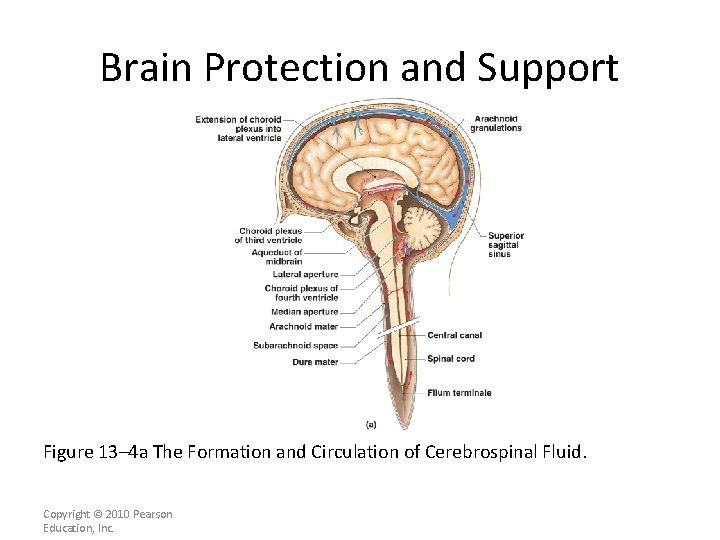
Brain Protection and Support Figure 13– 4 a The Formation and Circulation of Cerebrospinal Fluid. Copyright © 2010 Pearson Education, Inc.
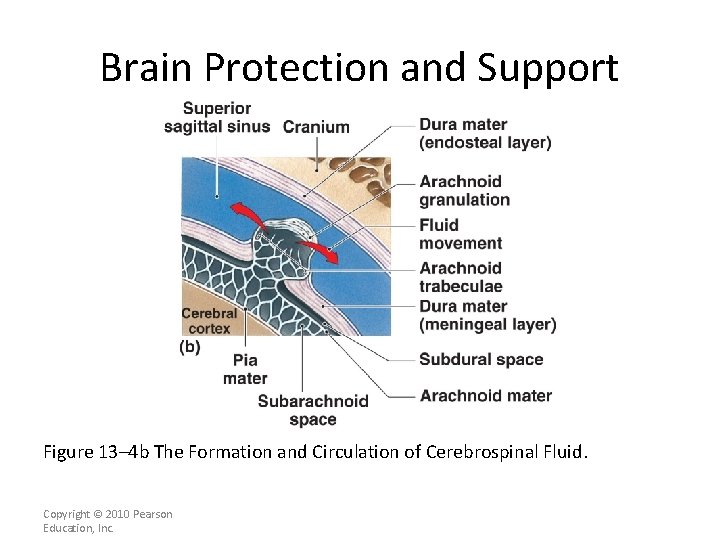
Brain Protection and Support Figure 13– 4 b The Formation and Circulation of Cerebrospinal Fluid. Copyright © 2010 Pearson Education, Inc.
Brain Protection and Support • Blood Supply to the Brain – Supplies nutrients and oxygen to brain – Delivered by internal carotid arteries and vertebral arteries – Removed from dural sinuses by internal jugular veins Copyright © 2010 Pearson Education, Inc.
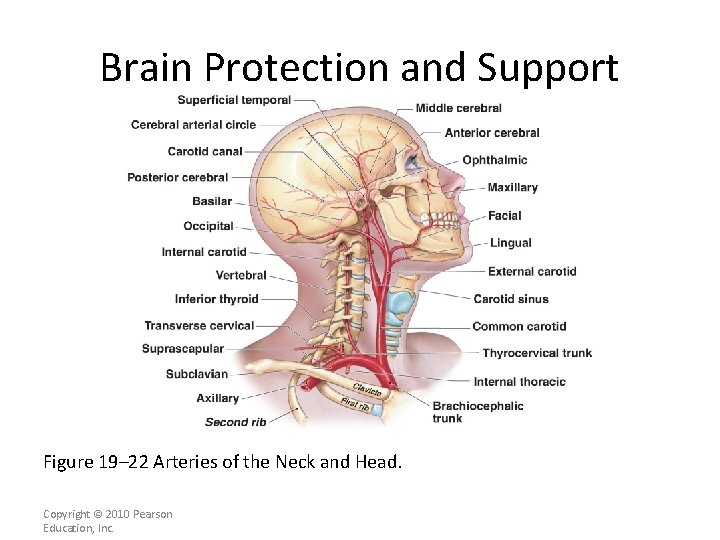
Brain Protection and Support Figure 19– 22 Arteries of the Neck and Head. Copyright © 2010 Pearson Education, Inc.
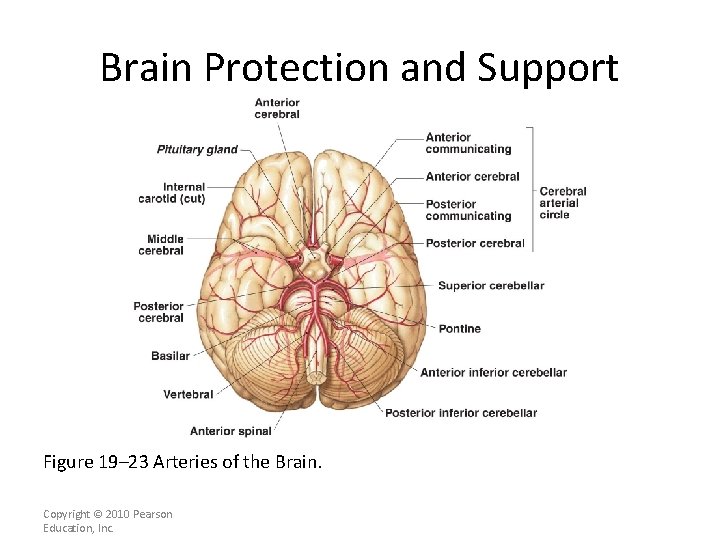
Brain Protection and Support Figure 19– 23 Arteries of the Brain. Copyright © 2010 Pearson Education, Inc.
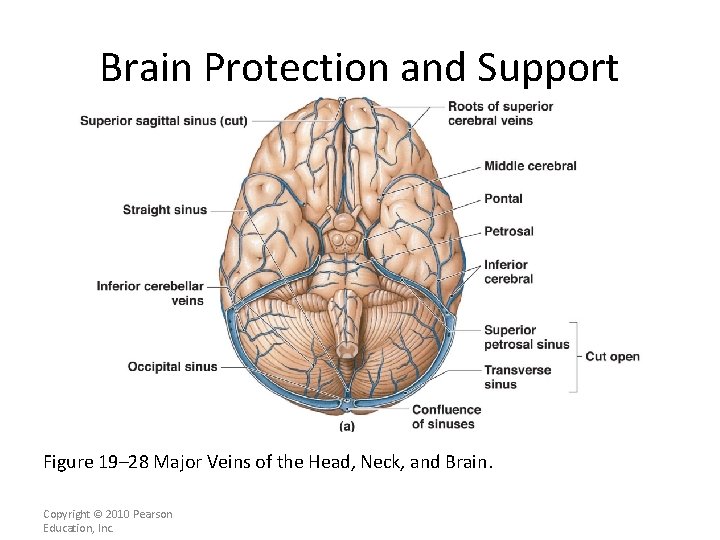
Brain Protection and Support Figure 19– 28 Major Veins of the Head, Neck, and Brain. Copyright © 2010 Pearson Education, Inc.
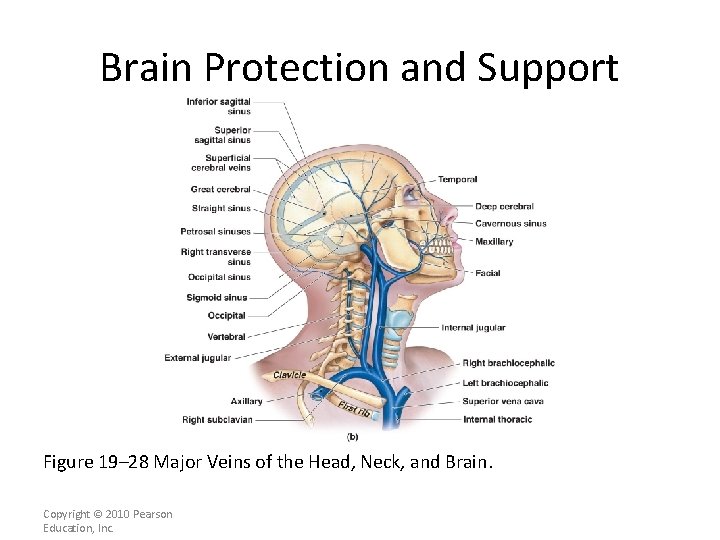
Brain Protection and Support Figure 19– 28 Major Veins of the Head, Neck, and Brain. Copyright © 2010 Pearson Education, Inc.
Brain Protection and Support • Cerebrovascular Disease – Disorders interfere with blood circulation to brain – Stroke or cerebrovascular accident (CVA) • Shuts off blood to portion of brain • Neurons die Copyright © 2010 Pearson Education, Inc.
Brain Protection and Support • Blood–Brain Barrier – Isolates CNS neural tissue from general circulation – Formed by network of tight junctions – Between endothelial cells of CNS capillaries – Lipid-soluble compounds (O 2, CO 2), steroids, and prostaglandins diffuse into interstitial fluid of brain and spinal cord – Astrocytes control blood–brain barrier by releasing chemicals that control permeability of endothelium Copyright © 2010 Pearson Education, Inc.
Brain Protection and Support • Blood–CSF Barrier – Formed by special ependymal cells – Surround capillaries of choroid plexus – Limits movement of compounds transferred – Allows chemical composition of blood and CSF to differ Copyright © 2010 Pearson Education, Inc.
Brain Protection and Support • Four Breaks in the BBB – Portions of hypothalamus • Secrete hypothalamic hormones – Posterior lobe of pituitary gland • Secretes hormones ADH and oxytocin – Pineal glands • Pineal secretions – Choroid plexus • Where special ependymal cells maintain blood–CSF barrier Copyright © 2010 Pearson Education, Inc.
Brain Protection and Support • Meninges stabilize brain in cranial cavity • Cerebrospinal fluid protects against sudden movement • CSF provides nutrients and removes wastes • Blood–brain barrier and blood–CSF barrier – Selectively isolate brain from chemicals in blood that might disrupt neural function Copyright © 2010 Pearson Education, Inc.
The Medulla Oblongata • The Medulla Oblongata – Allows brain and spinal cord to communicate – Coordinates complex autonomic reflexes – Controls visceral functions – Nuclei in the Medulla • Autonomic nuclei: control visceral activities • Sensory and motor nuclei: of cranial nerves • Relay stations: along sensory and motor pathways Copyright © 2010 Pearson Education, Inc.
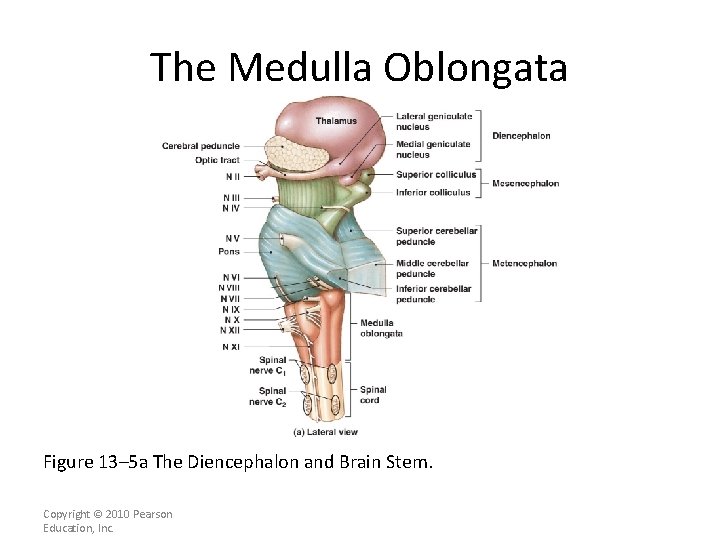
The Medulla Oblongata Figure 13– 5 a The Diencephalon and Brain Stem. Copyright © 2010 Pearson Education, Inc.
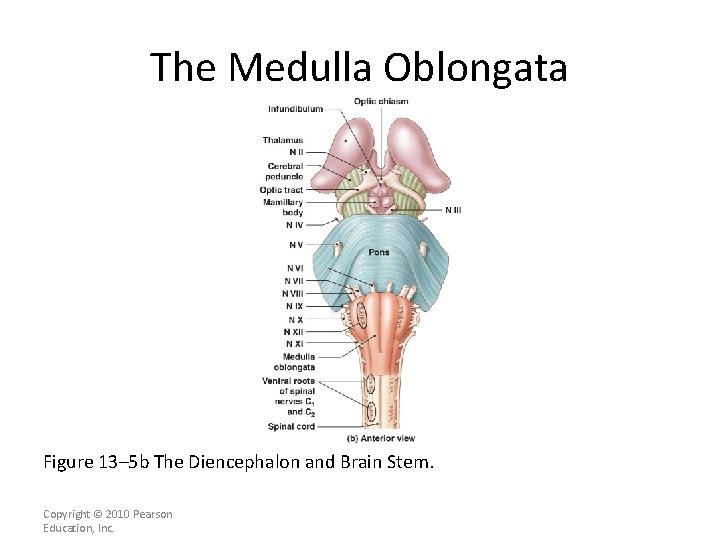
The Medulla Oblongata Figure 13– 5 b The Diencephalon and Brain Stem. Copyright © 2010 Pearson Education, Inc.
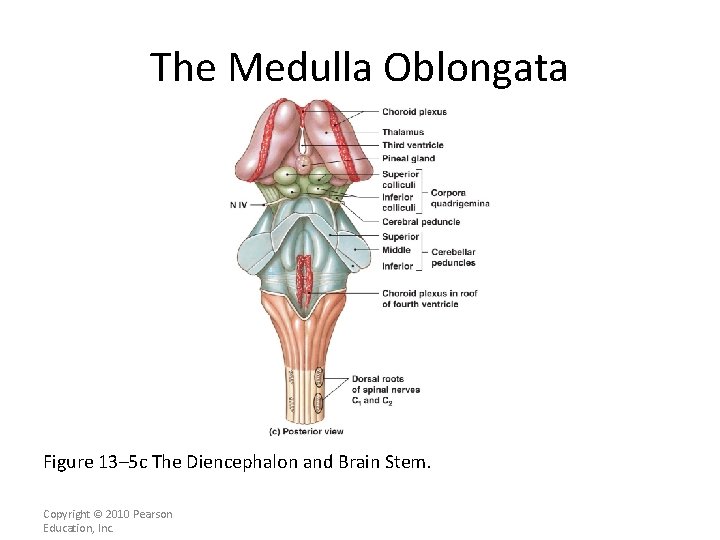
The Medulla Oblongata Figure 13– 5 c The Diencephalon and Brain Stem. Copyright © 2010 Pearson Education, Inc.
The Medulla Oblongata • The Medulla Oblongata – Includes three groups of nuclei • Autonomic nuclei • Sensory and motor nuclei of cranial nerves • Relay stations along sensory and motor pathways Copyright © 2010 Pearson Education, Inc.
The Medulla Oblongata • Autonomic Nuclei of the Medulla Oblongata – Reticular formation • Gray matter with embedded nuclei • Regulates autonomic functions – Reflex centers • Control peripheral systems: – cardiovascular centers: » cardiac center » control blood flow through peripheral tissues – respiratory rhythmicity centers sets pace for respiratory movements Copyright © 2010 Pearson Education, Inc.
The Medulla Oblongata • Sensory and Motor Nuclei of the Medulla Oblongata • Associated with 5 of 12 cranial nerves (VIII, IX, X, XII) Copyright © 2010 Pearson Education, Inc.
The Medulla Oblongata • Relay Stations of the Medulla Oblongata – Nucleus gracilis and nucleus cuneatus • Pass somatic sensory information to thalamus – Solitary nucleus • Receives visceral sensory information – Olivary nuclei (olives) • Relay information about somatic motor commands Copyright © 2010 Pearson Education, Inc.
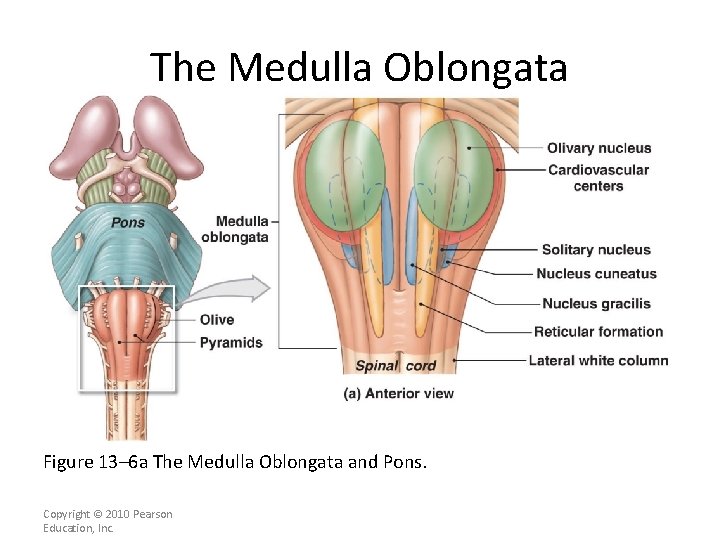
The Medulla Oblongata Figure 13– 6 a The Medulla Oblongata and Pons. Copyright © 2010 Pearson Education, Inc.
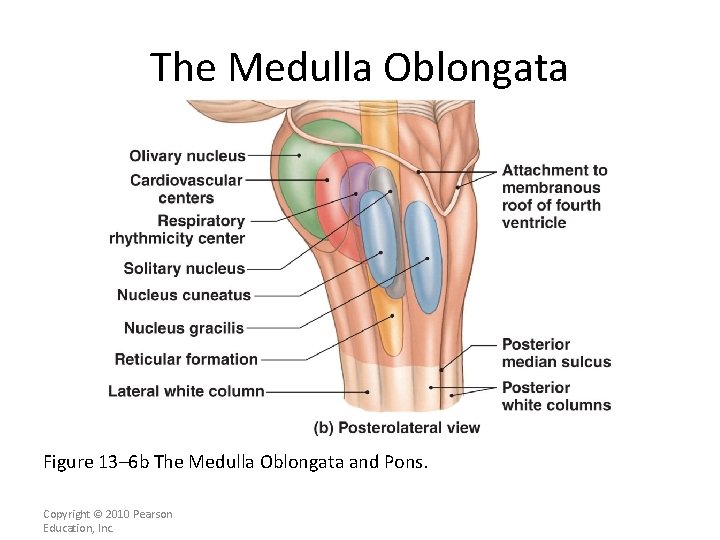
The Medulla Oblongata Figure 13– 6 b The Medulla Oblongata and Pons. Copyright © 2010 Pearson Education, Inc.
The Pons • The Pons – Links cerebellum with mesencephalon, diencephalon, cerebrum, and spinal cord – Sensory and motor nuclei of cranial nerves V, VII, VIII Copyright © 2010 Pearson Education, Inc.
The Pons • The Pons – Nuclei involved with respiration • Apneustic center and pneumotaxic center: – modify respiratory rhythmicity center activity – Nuclei and tracts • Process and relay information to and from cerebellum • Ascending, descending, and transverse tracts: – transverse fibers (axons): » link nuclei of pons with opposite cerebellar hemisphere Copyright © 2010 Pearson Education, Inc.
- Slides: 57