
CHAPTER 13 SUPPLY CHAIN PROCESS INTEGRATION Principles of
- Slides: 19
CHAPTER 13 - SUPPLY CHAIN PROCESS INTEGRATION Principles of Supply Chain Management: A Balanced Approach Prepared by Daniel A. Glaser-Segura, Ph. D Principles of Supply Chain Management: A Balanced
Learning Objectives You should be able to: – Discuss the overall importance of process integration in supply chain management. – Describe advantages & obstacles of process integration. – Understand the important issues of internal & external process integration. – Understand the role of information systems in creating information visibility along the supply chain. – Describe integration needs along the supply chain. – Understand the causes of the bullwhip effect & their impact on process integration. Principles of Supply Chain Management: A Balanced Approach by Wisner, Leong, and Tan. © 2005 Thomson Business and Professional Publishing 2
Chapter Thirteen Outline Supply Chain Mgmt (SCM) Integration Model Identify Key SC Trading Partners Review & Establish SC Strategies Align SC Strategies w/Objectives Develop Performance Measures • Improve Internal Integration of SC Processes • Develop SC Measures for Key Processes • Improve External Integration & SC Performance • Extend Integration to 2 nd-Tier SC Partners • Reevaluate Integration Model Annually Obstacles to Process Integration Along the SC • The Silo Mentality • Lack of SC Visibility • Lack of Trust • Lack of Knowledge Activities Causing the Bullwhip Effect Principles of Supply Chain Management: A Balanced Approach by Wisner, Leong, and Tan. © 2005 Thomson Business and Professional Publishing 3
Introduction Primary Goal of Supply Chain Management- create value for the end customers as well as the firms in the supply chain network. Firms in the supply chain network must integrate process activities internally & with other firms in the network. – Process integration means coordinating & sharing information & resources to jointly manage a process. – Process integration is often a difficult task & requires: • Training • Willing & competent partners • Trust • Organizational culture change Principles of Supply Chain Management: A Balanced Approach by Wisner, Leong, and Tan. © 2005 Thomson Business and Professional Publishing 4
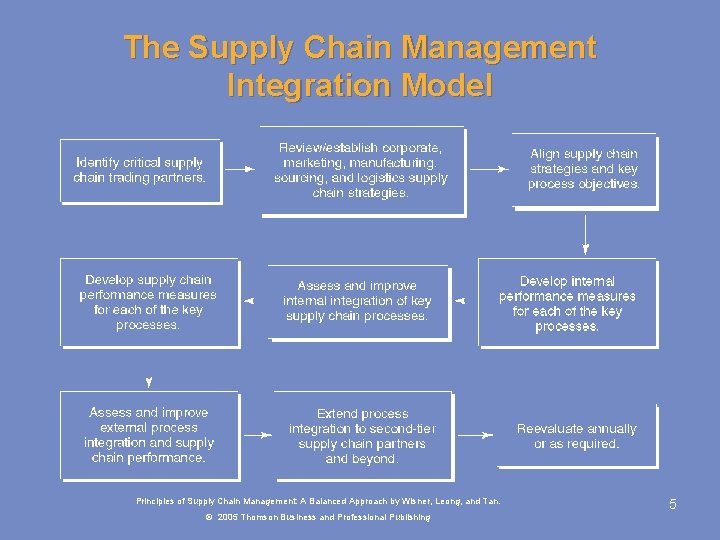
The Supply Chain Management Integration Model Principles of Supply Chain Management: A Balanced Approach by Wisner, Leong, and Tan. © 2005 Thomson Business and Professional Publishing 5
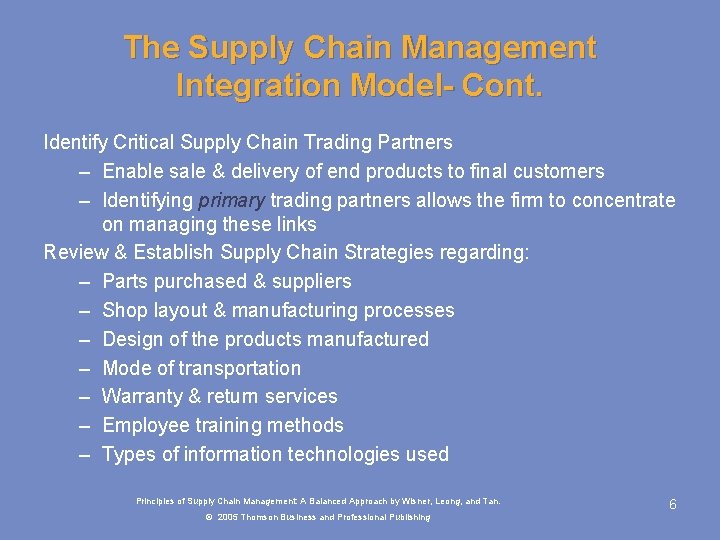
The Supply Chain Management Integration Model- Cont. Identify Critical Supply Chain Trading Partners – Enable sale & delivery of end products to final customers – Identifying primary trading partners allows the firm to concentrate on managing these links Review & Establish Supply Chain Strategies regarding: – Parts purchased & suppliers – Shop layout & manufacturing processes – Design of the products manufactured – Mode of transportation – Warranty & return services – Employee training methods – Types of information technologies used Principles of Supply Chain Management: A Balanced Approach by Wisner, Leong, and Tan. © 2005 Thomson Business and Professional Publishing 6
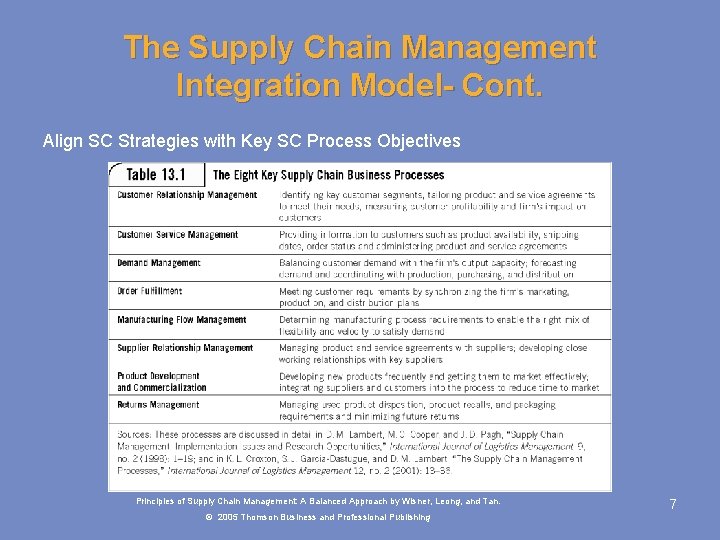
The Supply Chain Management Integration Model- Cont. Align SC Strategies with Key SC Process Objectives Principles of Supply Chain Management: A Balanced Approach by Wisner, Leong, and Tan. © 2005 Thomson Business and Professional Publishing 7
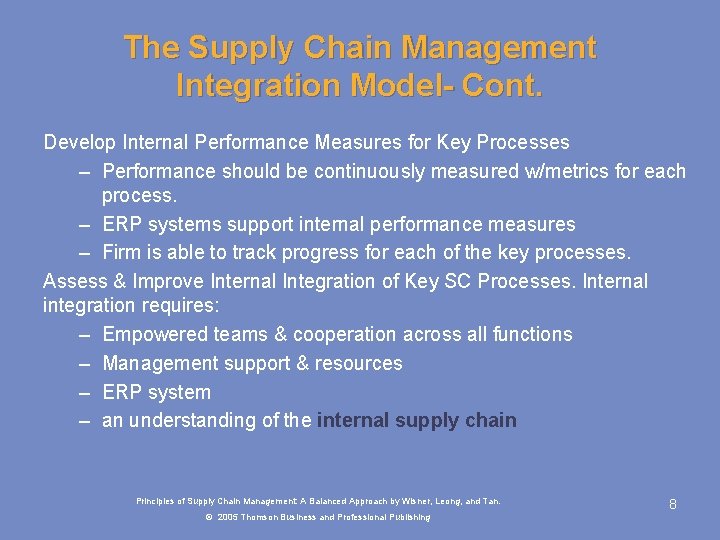
The Supply Chain Management Integration Model- Cont. Develop Internal Performance Measures for Key Processes – Performance should be continuously measured w/metrics for each process. – ERP systems support internal performance measures – Firm is able to track progress for each of the key processes. Assess & Improve Internal Integration of Key SC Processes. Internal integration requires: – Empowered teams & cooperation across all functions – Management support & resources – ERP system – an understanding of the internal supply chain Principles of Supply Chain Management: A Balanced Approach by Wisner, Leong, and Tan. © 2005 Thomson Business and Professional Publishing 8
The Supply Chain Management Integration Model- Cont. Develop SC Performance Measures for Key Processes – Monitor the links with trading partners in the key SCM processes. – Trading partners should monitor a number of cost-oriented measures averaged across the member firms for each of the key supply chain processes. Assess & Improve External Process Integration & Performance – Build, maintain & strengthen relationships – Share information concerning: • Sales, forecast information, new products, expansion plans, new processes, & new marketing campaigns process integration will enable firms to collaborate & share this information. Principles of Supply Chain Management: A Balanced Approach by Wisner, Leong, and Tan. © 2005 Thomson Business and Professional Publishing 9
The Supply Chain Management Integration Model- Cont. Extend Process Integration to Second-Tier SC Partners – Integrate process to second-tier partners & beyond – Radio-frequency identification (RFID) tag- Microchip device relays information on product’s whereabouts as it moves through the supply chain. – Price of RFID tags is economical (about 5 cents each). Reevaluate the Integration Model Annually – Trading partners should revisit the integration model annually to identify changes within supply chains & to assess the impact these changes have on integration efforts. Principles of Supply Chain Management: A Balanced Approach by Wisner, Leong, and Tan. © 2005 Thomson Business and Professional Publishing 10
Obstacles to Process Integration Along the Supply Chain The Silo Mentality – “I win, you lose” – Using the cheapest suppliers. – Ignoring customers. – Assigning few resources to new product & service design. Firm must strive to align SC goals & the goals & incentives of the firm Performance reviews of managers must include their ability to integrate processes internally & externally. Principles of Supply Chain Management: A Balanced Approach by Wisner, Leong, and Tan. © 2005 Thomson Business and Professional Publishing 11
Obstacles to Process Integration Along the Supply Chain- Cont. Lack of Supply Chain Visibility – In a 2002 survey, 67% of manufacturers had not yet successfully synchronized their supply chain operations with those of their trading partners – And 67% said they used different supply chain management applications than their partners 1 RFID technology promises to add real-time information visibility to supply chains. – Technology boards & user boards are being formed now to develop standards & electronic product codes (e. PCs) for the RFID industry. [1] Anonymous, “Survey Finds Manufacturers’ Supply Chains Come Up Short, ” Logistics Management 41, no. 9 (2002): 19 -20. Principles of Supply Chain Management: A Balanced Approach by Wisner, Leong, and Tan. © 2005 Thomson Business and Professional Publishing 12
Obstacles to Process Integration Along the Supply Chain- Cont. Lack of Trust Successful process integration between partners requires trust. Trust occurs over time- Partners earn trust. Creating collaboration & trust are based on: – Start small: Pick a project likely to provide a quick return. – Look inward: establishing trust with internal constituents. – Gather ‘round: meet face-to-face. – Go for the win-win: optimize business for all SC members. – Do not give away the store: Some information should remain proprietary – Just do it: Simple start - sharing information. Principles of Supply Chain Management: A Balanced Approach by Wisner, Leong, and Tan. © 2005 Thomson Business and Professional Publishing 13
Obstacles to Process Integration Along the Supply Chain- Cont. Lack of Knowledge – In a survey of 122 executives practicing SCM, 43 % said lack of core SCM skills & knowledge was the greatest obstacle within their own organizations, & 54 % echoed this opinion for their trading partners. 1 – Firms successfully managing their supply chains must spend significant time influencing & increasing the capabilities of themselves & their partners. [1] Bachelor, B “Implementation Imperative Information Week (28 April 2003), 62 -66 Principles of Supply Chain Management: A Balanced Approach by Wisner, Leong, and Tan. © 2005 Thomson Business and Professional Publishing 14
Obstacles to Process Integration Along the Supply Chain- Cont. Bullwhip Effect – Forecasts & their corresponding orders along the supply chain can become amplified and accumulate, causing what is termed the bullwhip effect. – Variations in demand lead to problems in capacity planning, inventory control, & workforce & production scheduling. – Ultimately, these variations result in lower levels of customer service & higher total supply chain costs. Principles of Supply Chain Management: A Balanced Approach by Wisner, Leong, and Tan. © 2005 Thomson Business and Professional Publishing 15
Obstacles to Process Integration Along the Supply Chain- Cont. To Avoid Bullwhip Effect- Demand Forecast Updating – Make actual demand data available to suppliers. – Vendor-managed inventory (VMI) – Reduce the length of the supply chain. – Reduce the lead times from order to delivery Principles of Supply Chain Management: A Balanced Approach by Wisner, Leong, and Tan. © 2005 Thomson Business and Professional Publishing 16
Obstacles to Process Integration Along the Supply Chain- Cont. To Avoid Bullwhip Effect- Monitor Order Batching – Safety stocks, & the desire to order full container loads of materials causes orders to be placed monthly or even less often, or at varying time interval. – Order batching occurs when sales reps fill end-of-period sales quotas, or when buyers spend end-of-year budgets. Solution: use frequent & smaller order sizes. Firms can order smaller quantities of a variety of items from a supplier or use a freight forwarder to consolidate small shipments. Principles of Supply Chain Management: A Balanced Approach by Wisner, Leong, and Tan. © 2005 Thomson Business and Professional Publishing 17
Obstacles to Process Integration Along the Supply Chain- Cont. To Avoid Bullwhip Effect 1. Reduce price fluctuations through forward buying activities to take advantage of the low price offers between: – retailers & consumers. – distributors & retailers. – manufacturers & distribution. 2. Eliminate price discounting. Many retailers have adopted everyday low prices (EDLP). Principles of Supply Chain Management: A Balanced Approach by Wisner, Leong, and Tan. © 2005 Thomson Business and Professional Publishing 18
Obstacles to Process Integration Along the Supply Chain- Cont. To Avoid Bullwhip Effect- Rationing & Shortage Gaming – Rationing- occurs when demand exceeds the availability of a supplier’s finished goods. To provide a partial supply to all customers, goods are rationed to customers. Buyers tend to inflate their orders to satisfy their real needs. – Shortage gaming- occurs when production capacity eventually equals demand & orders are filled completely, demand suddenly drops to less-than-realistic levels, as the buying firms try to unload their excess inventories. Solution: sellers should allocate short supplies based on the demand histories of their customers. Sharing future order plans with suppliers allows suppliers to increase capacity if needed, thus avoiding a rationing situation. Principles of Supply Chain Management: A Balanced Approach by Wisner, Leong, and Tan. © 2005 Thomson Business and Professional Publishing 19