
CHAPTER 13 Statement of Cash Flows Learning Objective
CHAPTER 13 Statement of Cash Flows
Learning Objective 1 Understand the purpose of a statement of cash flows.
What Does The Statement of Cash Flows Do? l Summarizes a company’s cash flows for a period of time. l Explains how a company’s cash was generated and how that cash was used. l Complementary to the income statement. l Indicates ability of a company to generate income in the future.
Learning Objective 2 Recognize the different types of information reported in the statement of cash flows.

What Are Cash Equivalents? Short-term, highly liquid investments that can be converted easily into cash. Examples: Treasury Bills Money Market Funds Commercial Paper

The Flow of Cash received from operating activities Cash received from investing activities inflows Cash and cash equivalents Cash paid for operating activities Cash paid for investing activities Cash received from financing activities outflows Cash paid for financing activities

Match Classifications of Cash Flows Operating Activities Financing Activities Investing Activities 1. Transactions and events that enter into the determination of net income. 2. Transactions and events that involve the purchase and sale of securities, property, plant, equipment, and other assets not generally held for resale, and the making and collecting of loans. 3. Transactions and events whereby resources are obtained from, or repaid to, owners and creditors.
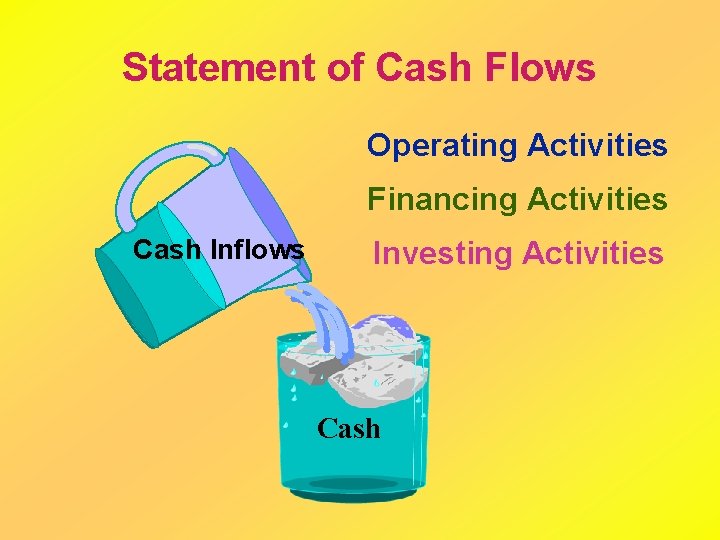
Statement of Cash Flows Operating Activities Financing Activities Cash Inflows Investing Activities Cash

Statement of Cash Flows Cash Operating Activities Financing Activities Investing Activities Cash Outflows
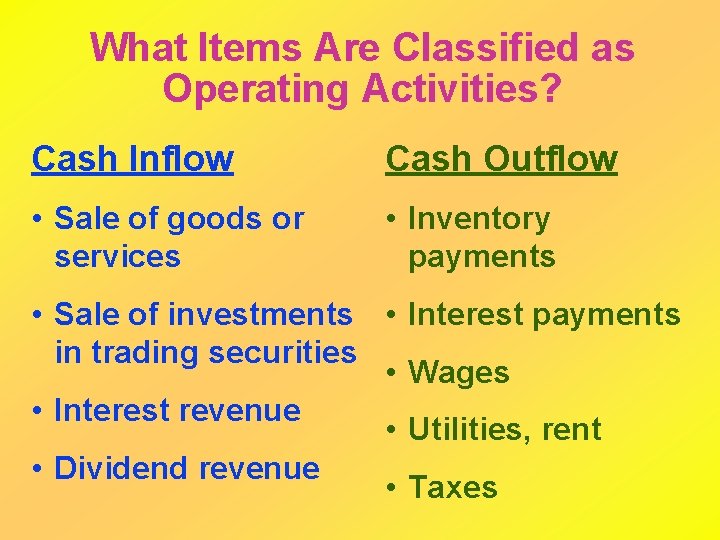
What Items Are Classified as Operating Activities? Cash Inflow Cash Outflow • Sale of goods or services • Inventory payments • Sale of investments • in trading securities • • Interest revenue • • Dividend revenue • Interest payments Wages Utilities, rent Taxes

Investing Activities Cash Inflow Cash Outflow • Sale of plant assets • Sale of securities, other than trading securities • Collection of principal on loans • Purchase of plant assets • Purchase of securities, other than trading securities • Making of loans to other entities

Financing Activities Cash Inflow Cash Outflow • Issuance of own stock • Borrowing • Dividend payments • Repaying principal on borrowing • Treasury stock purchase

Define Noncash Items Noncash items are items included in the determination of net income on an accrual basis that do not affect cash; examples are depreciation and amortization.
Learning Objective 3 Prepare a simple statement of cash flows.
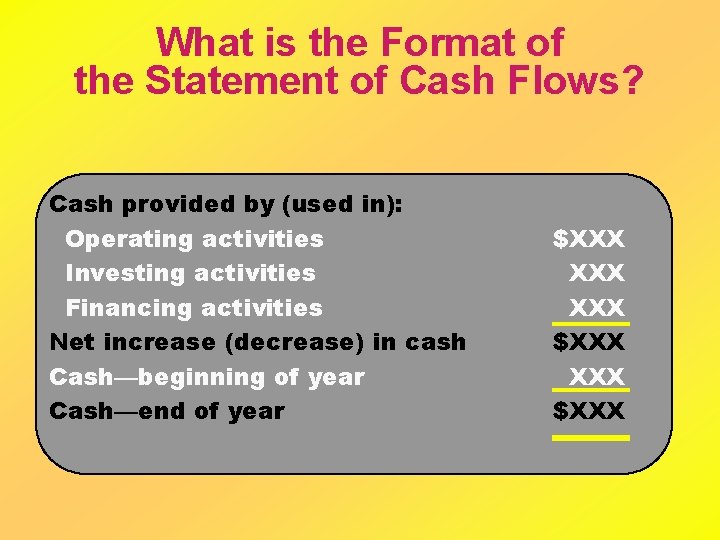
What is the Format of the Statement of Cash Flows? Cash provided by (used in): Operating activities Investing activities Financing activities Net increase (decrease) in cash Cash—beginning of year Cash—end of year $XXX XXX $XXX
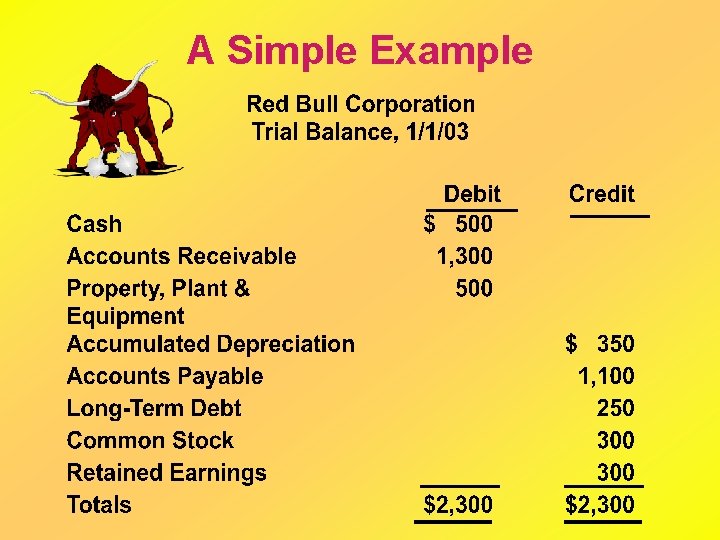
A Simple Example
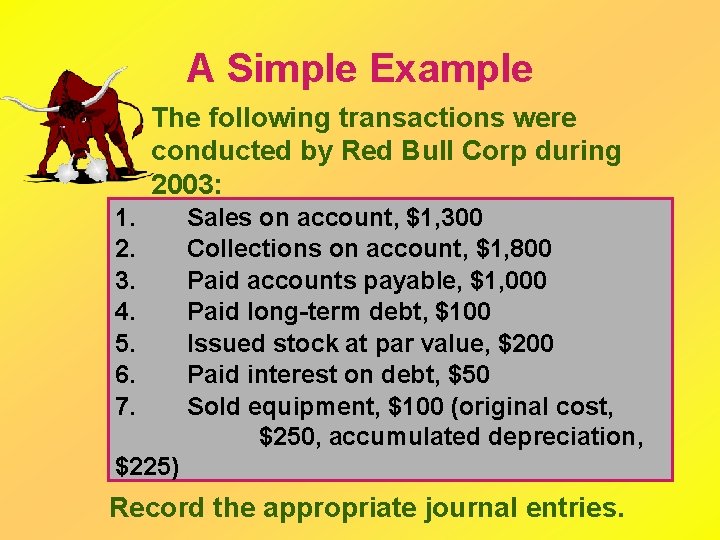
A Simple Example The following transactions were conducted by Red Bull Corp during 2003: 1. 2. 3. 4. 5. 6. 7. Sales on account, $1, 300 Collections on account, $1, 800 Paid accounts payable, $1, 000 Paid long-term debt, $100 Issued stock at par value, $200 Paid interest on debt, $50 Sold equipment, $100 (original cost, $250, accumulated depreciation, $225) Record the appropriate journal entries.
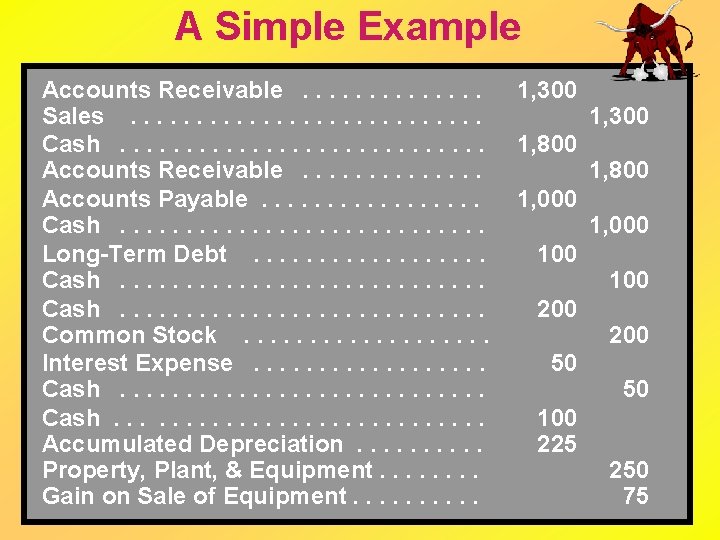
A Simple Example Accounts Receivable. . . Sales. . . . Cash. . . . Accounts Receivable. . . Accounts Payable. . . . Cash. . . . Long-Term Debt. . . . . Cash. . . . . Common Stock. . . . . Interest Expense. . . . . Cash. . . . . Accumulated Depreciation. . Property, Plant, & Equipment. . . . Gain on Sale of Equipment. . 1, 300 1, 800 1, 000 100 200 50 100 225 1, 300 1, 800 1, 000 100 200 50 250 75
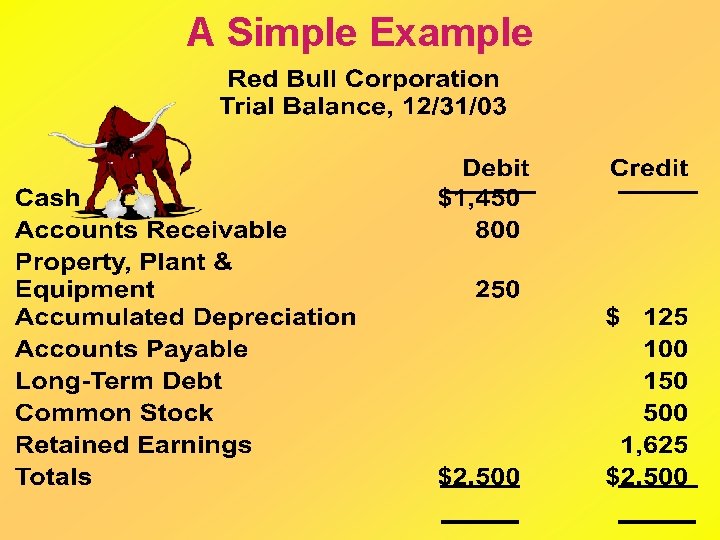
A Simple Example
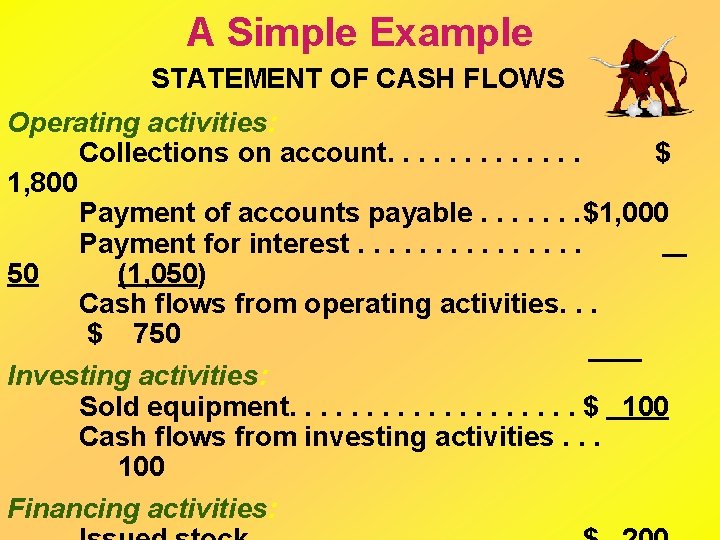
A Simple Example STATEMENT OF CASH FLOWS Operating activities: Collections on account. . . $ 1, 800 Payment of accounts payable. . . . $1, 000 Payment for interest. . . . 50 (1, 050) Cash flows from operating activities. . . $ 750 Investing activities: Sold equipment. . . . . $ 100 Cash flows from investing activities. . . 100 Financing activities:

A Simple Example Statement of Cash Flows (continued) Net increase in cash. . . . 950 Beginning cash balance. . . 500 Ending cash balance. . . . $1, 450 $
Learning Objective 4 Analyze financial statements to prepare a statement of cash flows.
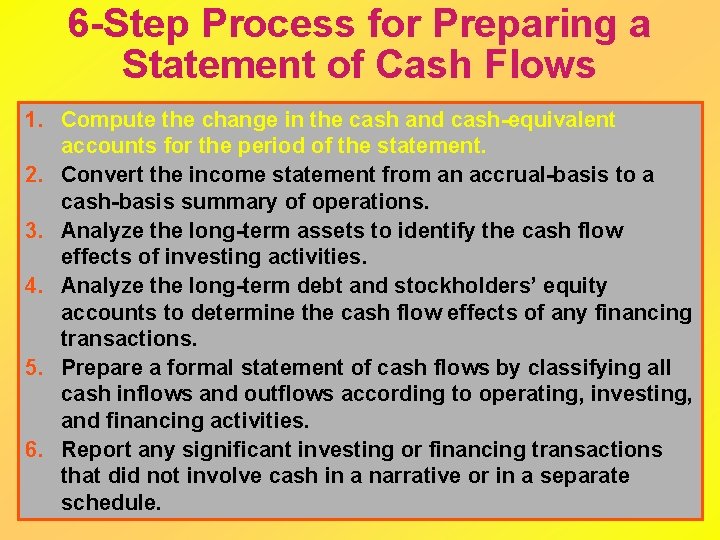
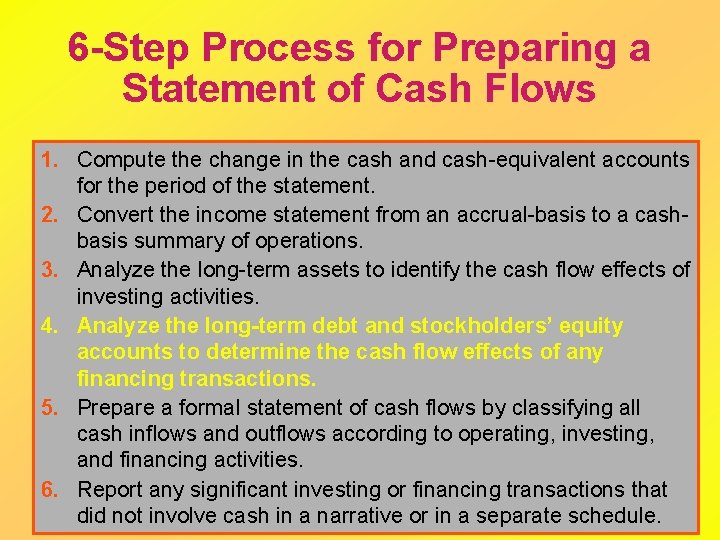
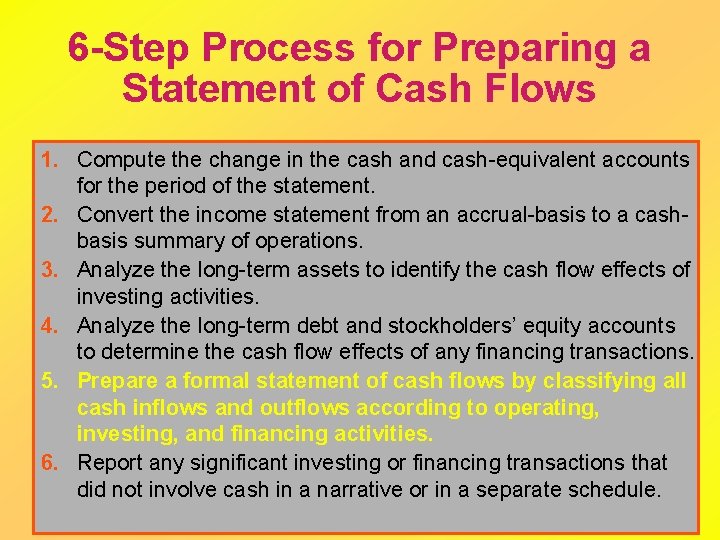
6 -Step Process for Preparing a Statement of Cash Flows 1. Compute the change in the cash and cash-equivalent accounts for the period of the statement. 2. Convert the income statement from an accrual-basis to a cash-basis summary of operations. 3. Analyze the long-term assets to identify the cash flow effects of investing activities. 4. Analyze the long-term debt and stockholders’ equity accounts to determine the cash flow effects of any financing transactions. 5. Prepare a formal statement of cash flows by classifying all cash inflows and outflows according to operating, investing, and financing activities. 6. Report any significant investing or financing transactions that did not involve cash in a narrative or in a separate schedule.

Example: Change in Cash Red Bull Corporation Beginning cash balance. . . $ 500 Ending cash balance. . . . 1, 450 Net increase in cash. . . . $ 950
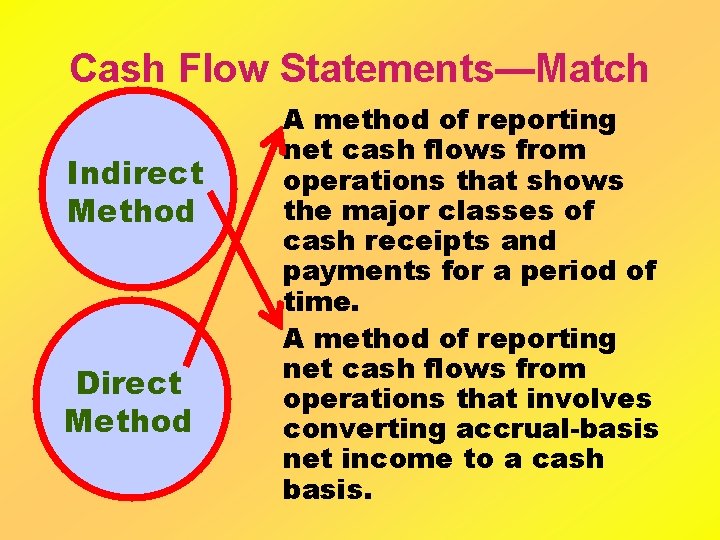
Cash Flow Statements—Match Indirect Method Direct Method A method of reporting net cash flows from operations that shows the major classes of cash receipts and payments for a period of time. A method of reporting net cash flows from operations that involves converting accrual-basis net income to a cash basis.

6 -Step Process for Preparing a Statement of Cash Flows 1. Compute the change in the cash and cash-equivalent accounts for the period of the statement. 2. Convert the income statement from an accrual-basis to a cash-basis summary of operations. 3. Analyze the long-term assets to identify the cash flow effects of investing activities. 4. Analyze the long-term debt and stockholders’ equity accounts to determine the cash flow effects of any financing transactions. 5. Prepare a formal statement of cash flows by classifying all cash inflows and outflows according to operating, investing, and financing activities. 6. Report any significant investing or financing transactions that did not involve cash in a narrative or in a separate schedule.
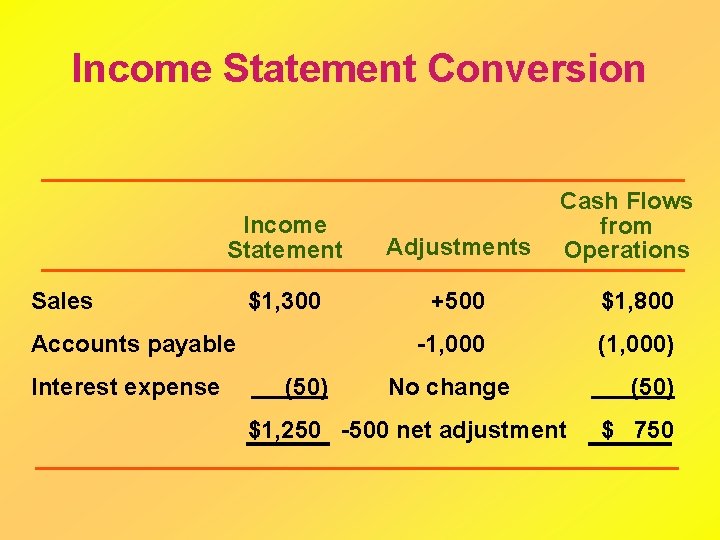
Income Statement Conversion Income Statement Adjustments $1, 300 +500 $1, 800 -1, 000 (1, 000) Sales Accounts payable Interest expense Cash Flows from Operations (50) No change $1, 250 -500 net adjustment (50) $ 750
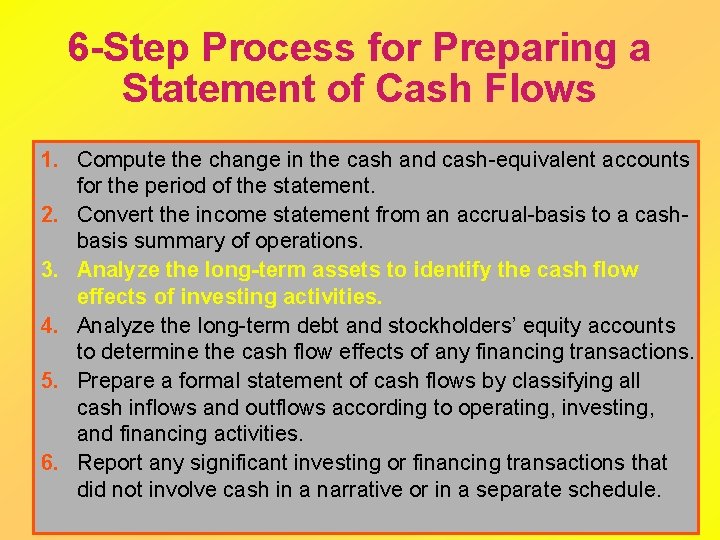
6 -Step Process for Preparing a Statement of Cash Flows 1. Compute the change in the cash and cash-equivalent accounts for the period of the statement. 2. Convert the income statement from an accrual-basis to a cashbasis summary of operations. 3. Analyze the long-term assets to identify the cash flow effects of investing activities. 4. Analyze the long-term debt and stockholders’ equity accounts to determine the cash flow effects of any financing transactions. 5. Prepare a formal statement of cash flows by classifying all cash inflows and outflows according to operating, investing, and financing activities. 6. Report any significant investing or financing transactions that did not involve cash in a narrative or in a separate schedule.
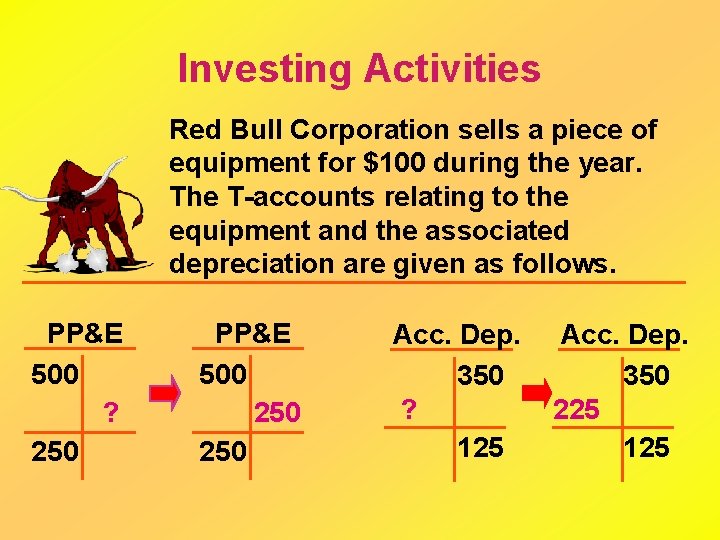
Investing Activities Red Bull Corporation sells a piece of equipment for $100 during the year. The T-accounts relating to the equipment and the associated depreciation are given as follows. PP&E 500 ? 250 PP&E 500 250 Acc. Dep. 350 ? 125 Acc. Dep. 350 225 125
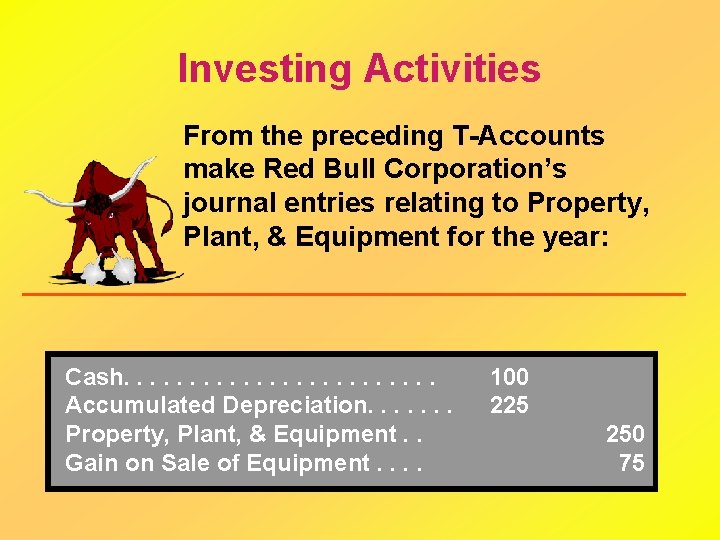
Investing Activities From the preceding T-Accounts make Red Bull Corporation’s journal entries relating to Property, Plant, & Equipment for the year: Cash. . . Accumulated Depreciation. . . . Property, Plant, & Equipment. . Gain on Sale of Equipment. . 100 225 250 75
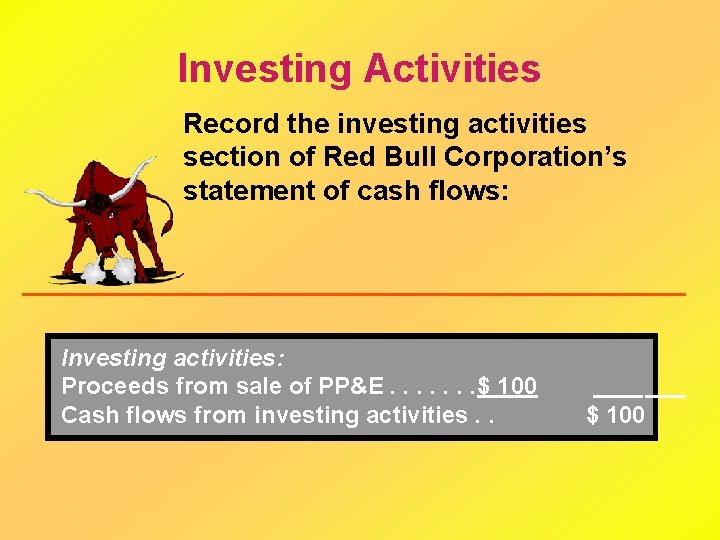
Investing Activities Record the investing activities section of Red Bull Corporation’s statement of cash flows: Investing activities: Proceeds from sale of PP&E. . . . $ 100 Cash flows from investing activities. . $ 100
6 -Step Process for Preparing a Statement of Cash Flows 1. Compute the change in the cash and cash-equivalent accounts for the period of the statement. 2. Convert the income statement from an accrual-basis to a cashbasis summary of operations. 3. Analyze the long-term assets to identify the cash flow effects of investing activities. 4. Analyze the long-term debt and stockholders’ equity accounts to determine the cash flow effects of any financing transactions. 5. Prepare a formal statement of cash flows by classifying all cash inflows and outflows according to operating, investing, and financing activities. 6. Report any significant investing or financing transactions that did not involve cash in a narrative or in a separate schedule.
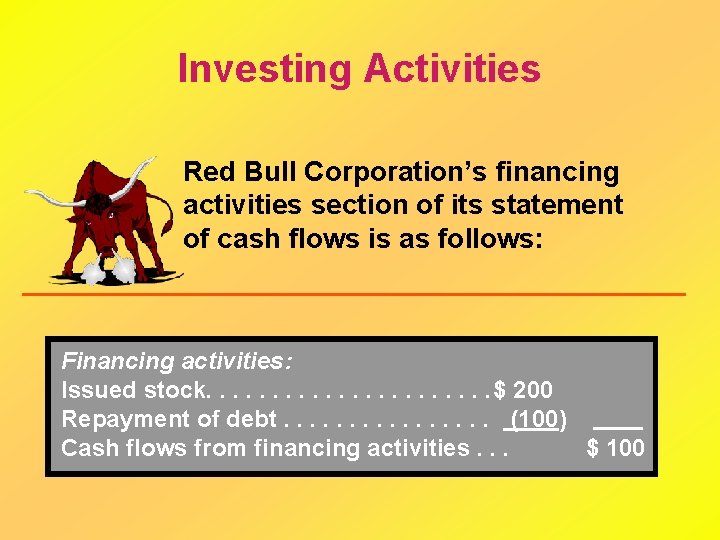
Investing Activities Red Bull Corporation’s financing activities section of its statement of cash flows is as follows: Financing activities: Issued stock. . . . . $ 200 Repayment of debt. . . . (100) Cash flows from financing activities. . . $ 100
6 -Step Process for Preparing a Statement of Cash Flows 1. Compute the change in the cash and cash-equivalent accounts for the period of the statement. 2. Convert the income statement from an accrual-basis to a cashbasis summary of operations. 3. Analyze the long-term assets to identify the cash flow effects of investing activities. 4. Analyze the long-term debt and stockholders’ equity accounts to determine the cash flow effects of any financing transactions. 5. Prepare a formal statement of cash flows by classifying all cash inflows and outflows according to operating, investing, and financing activities. 6. Report any significant investing or financing transactions that did not involve cash in a narrative or in a separate schedule.
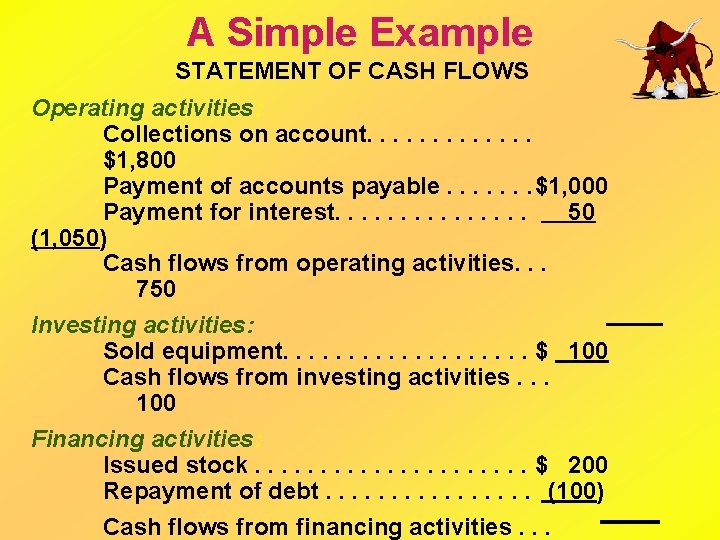
A Simple Example STATEMENT OF CASH FLOWS Operating activities: Collections on account. . . $1, 800 Payment of accounts payable. . . . $1, 000 Payment for interest. . . . 50 (1, 050) Cash flows from operating activities. . . 750 Investing activities: Sold equipment. . . . . $ 100 Cash flows from investing activities. . . 100 Financing activities: Issued stock. . . . . $ 200 Repayment of debt. . . . (100) Cash flows from financing activities. . .
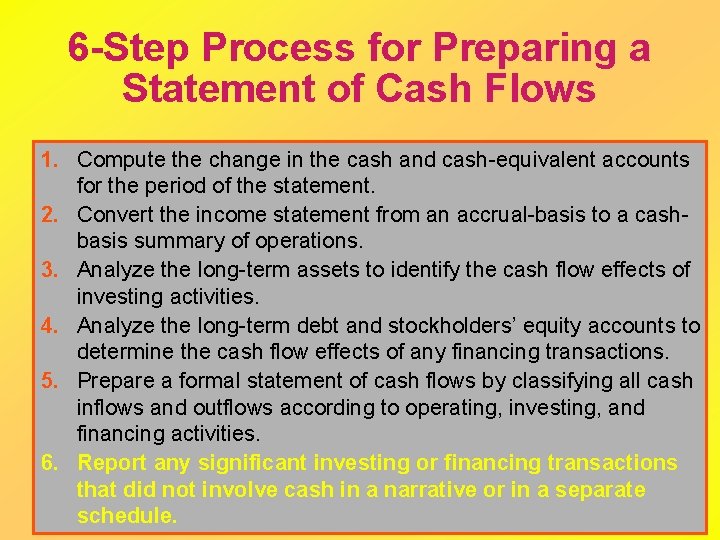
6 -Step Process for Preparing a Statement of Cash Flows 1. Compute the change in the cash and cash-equivalent accounts for the period of the statement. 2. Convert the income statement from an accrual-basis to a cashbasis summary of operations. 3. Analyze the long-term assets to identify the cash flow effects of investing activities. 4. Analyze the long-term debt and stockholders’ equity accounts to determine the cash flow effects of any financing transactions. 5. Prepare a formal statement of cash flows by classifying all cash inflows and outflows according to operating, investing, and financing activities. 6. Report any significant investing or financing transactions that did not involve cash in a narrative or in a separate schedule.

Define Noncash Transactions Noncash transactions are investing and financing activities that do not affect cash; if significant, they are disclosed below the statement of cash flows or in the notes to the financial statements.
Learning Objective 5 Use information from the statement of cash flows to make decisions.
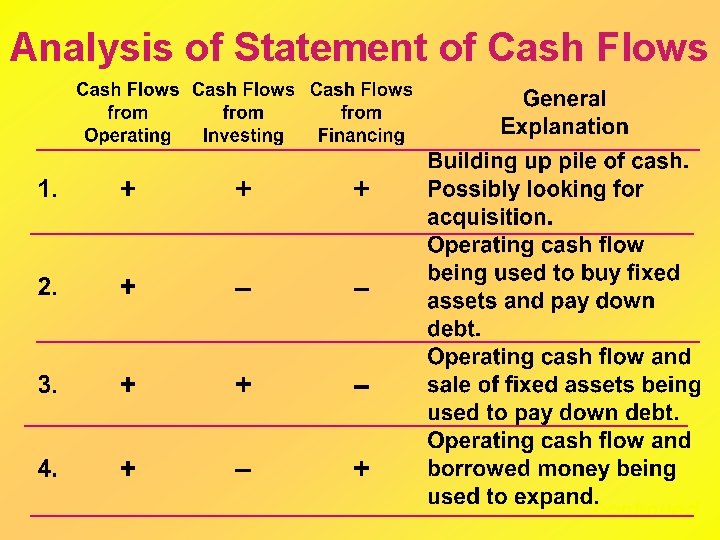
Analysis of Statement of Cash Flows continued
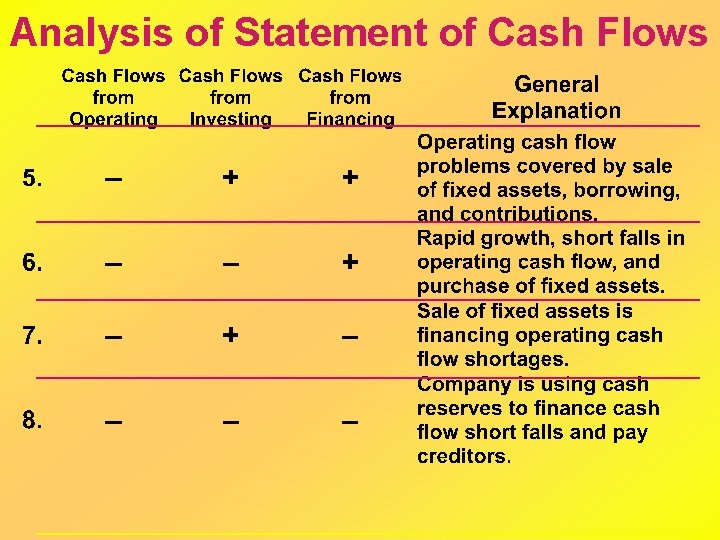
Analysis of Statement of Cash Flows
- Slides: 40