
Chapter 13 Roles of Muscles Joseph E Muscolino
- Slides: 39
Chapter 13: Roles of Muscles Joseph E. Muscolino, DC Copyright © 2011, 2007 by Mosby, Inc. , an affiliate of Elsevier Inc. All rights reserved. 1
Lesson 13. 1 Objectives • Define the key terms of this chapter and state the meanings of the word origins of this chapter. • Describe the relationship between the role that a muscle plays and the action in question. • Compare and contrast the roles of mover and antagonist. • Discuss the concept of cocontraction. Copyright © 2011, 2007 by Mosby, Inc. , an affiliate of Elsevier Inc. All rights reserved. 2
Lesson 13. 1 Objectives (cont’d. ) • State the muscle that is working during the action in question. • Describe the relationship between gravity and joint actions. • Explain the application of tight antagonists to restricted joint motion. • Compare and contrast the roles of fixator and neutralizer. Copyright © 2011, 2007 by Mosby, Inc. , an affiliate of Elsevier Inc. All rights reserved. 3
Section 13. 1—Mover Muscles • Movers: muscles that can do the action in question • Can shorten in two ways: • Concentrically contract and shorten • Relax and shorten • For every joint action, a functional group of movers can contract to make the action happen. Copyright © 2011, 2007 by Mosby, Inc. , an affiliate of Elsevier Inc. All rights reserved. 4
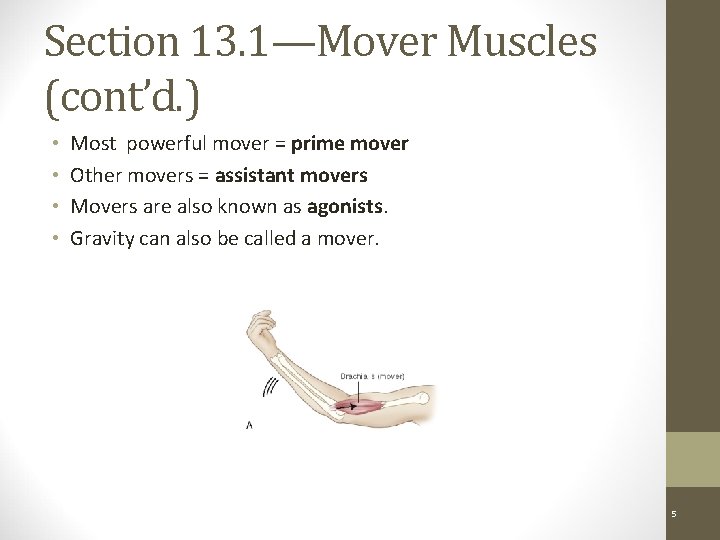
Section 13. 1—Mover Muscles (cont’d. ) • • Most powerful mover = prime mover Other movers = assistant movers Movers are also known as agonists. Gravity can also be called a mover. Figure 13 -1 Copyright © 2011, 2007 by Mosby, Inc. , an affiliate of Elsevier Inc. All rights reserved. 5
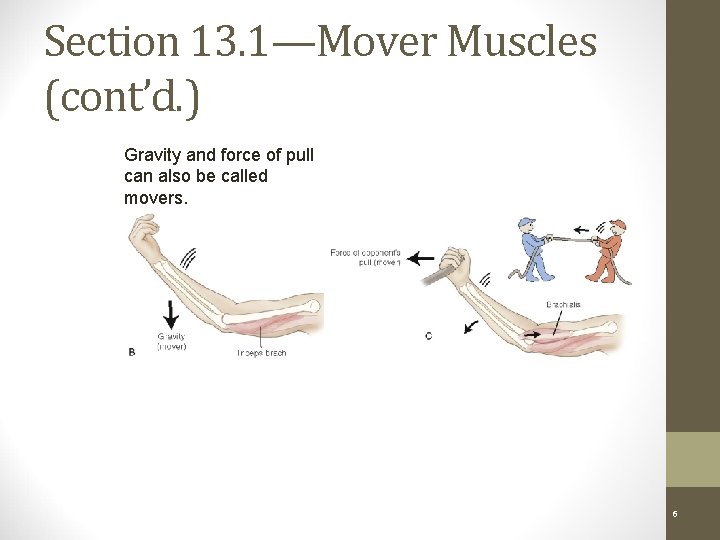
Section 13. 1—Mover Muscles (cont’d. ) Gravity and force of pull can also be called movers. Figure 13 -1 Copyright © 2011, 2007 by Mosby, Inc. , an affiliate of Elsevier Inc. All rights reserved. 6
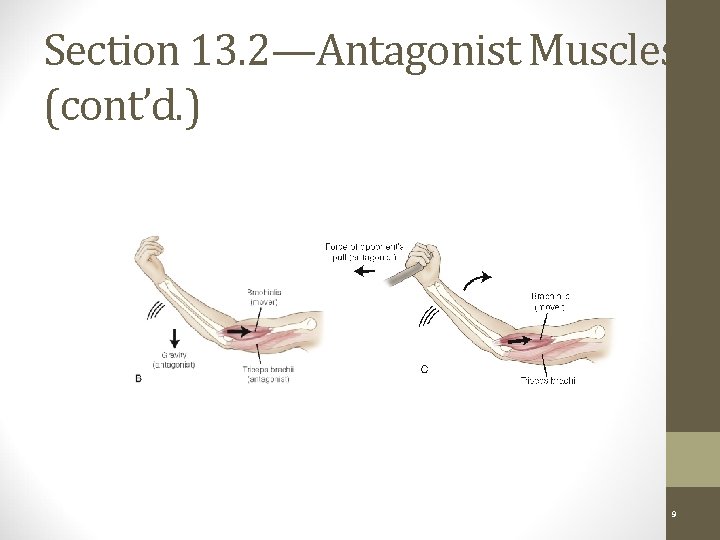
Section 13. 2—Antagonist Muscles • Antagonists do the opposite action of the action in question. • Can lengthen in two ways: • Eccentrically contract and lengthen • Relax and lengthen • Sometimes called contralateral muscle (opposite side) Copyright © 2011, 2007 by Mosby, Inc. , an affiliate of Elsevier Inc. All rights reserved. 7
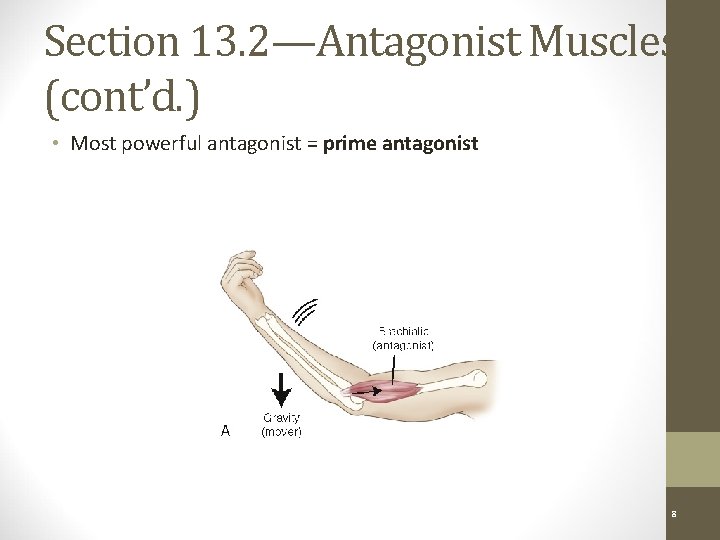
Section 13. 2—Antagonist Muscles (cont’d. ) • Most powerful antagonist = prime antagonist Figure 13 -2 Copyright © 2011, 2007 by Mosby, Inc. , an affiliate of Elsevier Inc. All rights reserved. 8
Section 13. 2—Antagonist Muscles (cont’d. ) Figure 13 -2 Copyright © 2011, 2007 by Mosby, Inc. , an affiliate of Elsevier Inc. All rights reserved. 9
Section 13. 2—Antagonist Muscles (cont’d. ) • Co-contraction: when the agonist and antagonist contract at the same time • Not considered healthy • The same as pressing gas and brake pedals simultaneously • Some kinesiologists believe that co-contraction is a necessary and natural occurrence when learning a new sport of kinesthetic skill. Copyright © 2011, 2007 by Mosby, Inc. , an affiliate of Elsevier Inc. All rights reserved. 10
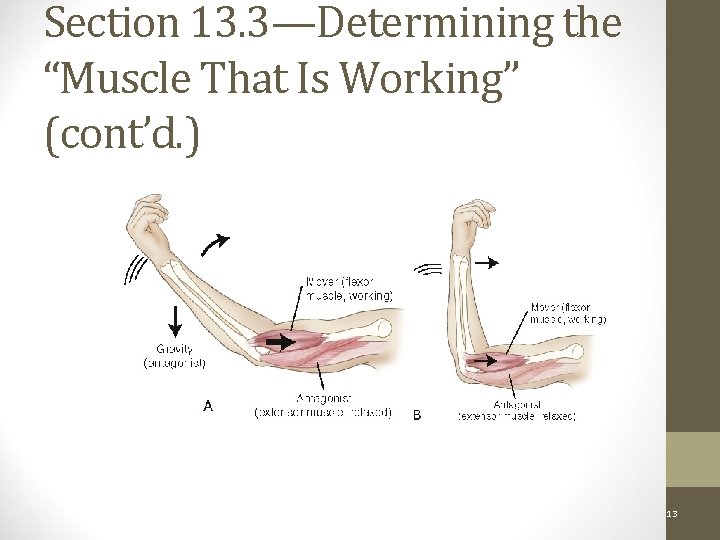
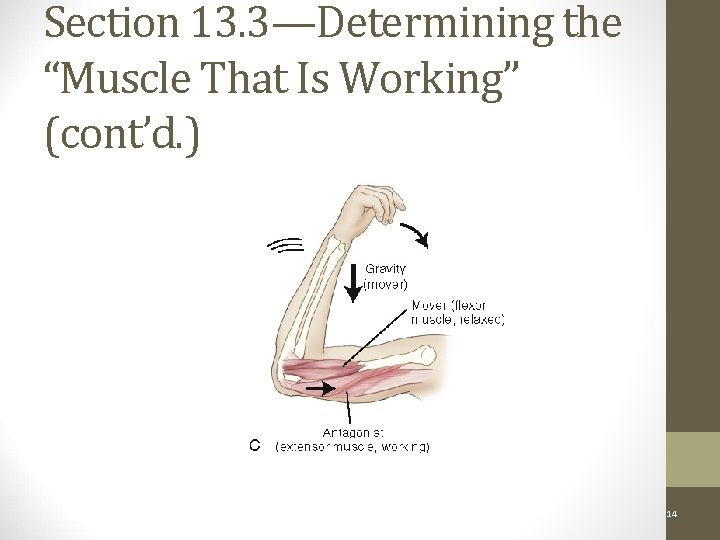
Section 13. 3—Determining the “Muscle That Is Working” • Muscle that is working = muscle that contracts during the action in question • Easiest way is to examine gravity’s role in the action in question • • Gravity’s force pulls downward Upward movement= mover muscles concentrically contract Horizontal= mover muscles concentrically contract Downward movement= mover muscles relax and let gravity create the movement (antagonist muscles eccentrically contract to slow the movement) Copyright © 2011, 2007 by Mosby, Inc. , an affiliate of Elsevier Inc. All rights reserved. 11
Section 13. 3—Determining the “Muscle That Is Working” (cont’d. ) • Three general rules: • Upward movements, movers work and antagonists relax • Horizontal movements, movers work and antagonists relax • Downward movements, antagonists work and movers relax Copyright © 2011, 2007 by Mosby, Inc. , an affiliate of Elsevier Inc. All rights reserved. 12
Section 13. 3—Determining the “Muscle That Is Working” (cont’d. ) Figure 13 -3 Copyright © 2011, 2007 by Mosby, Inc. , an affiliate of Elsevier Inc. All rights reserved. 13
Section 13. 3—Determining the “Muscle That Is Working” (cont’d. ) Figure 13 -3 Copyright © 2011, 2007 by Mosby, Inc. , an affiliate of Elsevier Inc. All rights reserved. 14
Section 13. 4—Stopping Unwanted Actions of the “Muscle That Is Working” • Fixators and neutralizers both stop unwanted actions of working muscle • Fixators stop action at fixed attachment • Neutralizers stop action at mobile attachment • Example: flexion of the fingers into a fist- ECRB acts as a fixator, stops FDS from flexing the hand at the wrist joint. (Flex fingers and palpate lateral elbow at the same time…do you feel a contraction? ) • This explains why lateral epicondylitis is aggravated by grasping objects. Copyright © 2011, 2007 by Mosby, Inc. , an affiliate of Elsevier Inc. All rights reserved. 15
Lesson 13. 2 Objectives • Describe the general concept of the relationship between fixators and neutralizers and the muscle that is working. • Give an example of a fixator and a neutralizer relative to a specific joint action. • State the step-by-step method for determining fixators and neutralizers relative to a specific joint action. Copyright © 2011, 2007 by Mosby, Inc. , an affiliate of Elsevier Inc. All rights reserved. 16
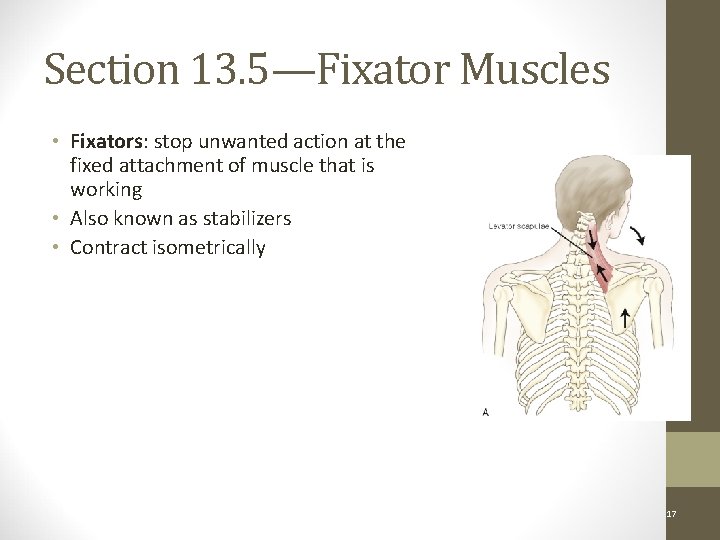
Section 13. 5—Fixator Muscles • Fixators: stop unwanted action at the fixed attachment of muscle that is working • Also known as stabilizers • Contract isometrically Figure 13 -4 Copyright © 2011, 2007 by Mosby, Inc. , an affiliate of Elsevier Inc. All rights reserved. 17
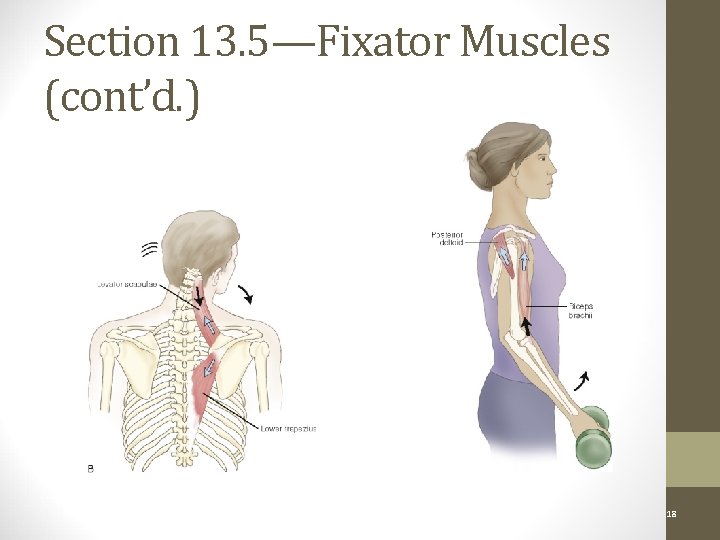
Section 13. 5—Fixator Muscles (cont’d. ) Figure 13 -4 Figure 13 -5 Copyright © 2011, 2007 by Mosby, Inc. , an affiliate of Elsevier Inc. All rights reserved. 18
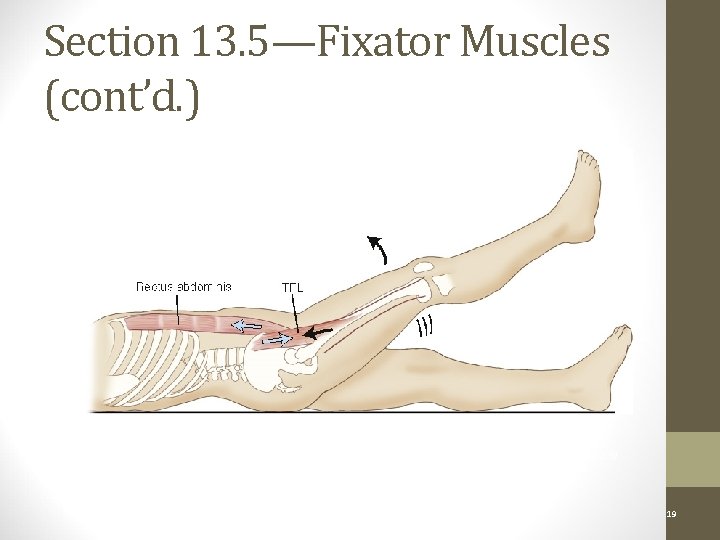
Section 13. 5—Fixator Muscles (cont’d. ) Figure 13 -6 Modeled from Neumann DA: Kinesiology of the musculoskeletal system: foundations for physical rehabilitation, ed 2, St Louis, 2010, Mosby Copyright © 2011, 2007 by Mosby, Inc. , an affiliate of Elsevier Inc. All rights reserved. 19
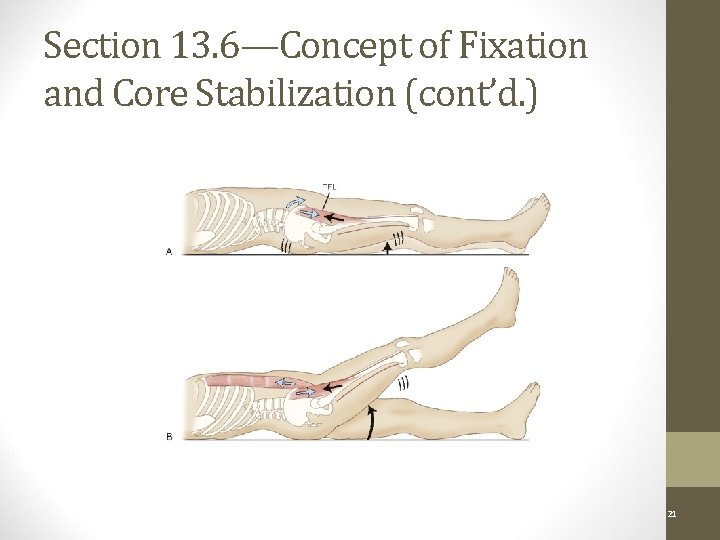
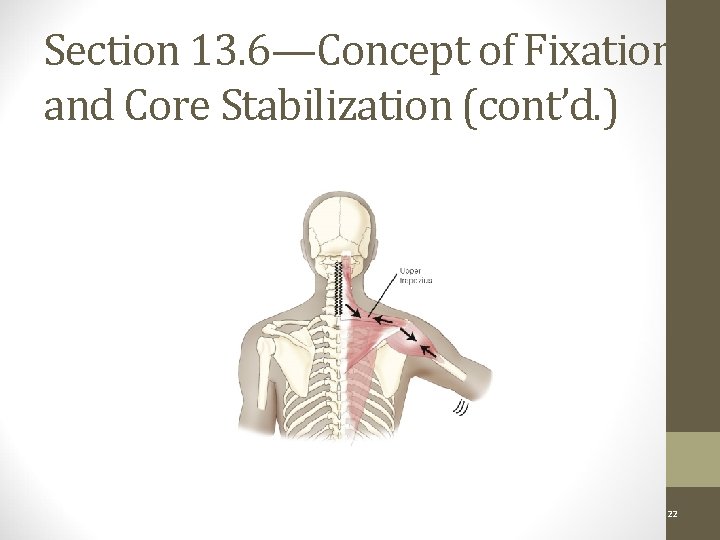
Section 13. 6—Concept of Fixation and Core Stabilization • Mobility (phasic) muscles: larger, longer, more superficial • Postural stabilization (tonic) muscles: smaller, deeper, closer to joints • Core stabilization, strength, and efficiency of movement • Core stabilization and spinal health Copyright © 2011, 2007 by Mosby, Inc. , an affiliate of Elsevier Inc. All rights reserved. 20
Section 13. 6—Concept of Fixation and Core Stabilization (cont’d. ) Figure 13 -7 Modeled from Neumann DA: Kinesiology of the musculoskeletal system: foundations for physical rehabilitation, ed 2, St Louis, 2010, Mosby Copyright © 2011, 2007 by Mosby, Inc. , an affiliate of Elsevier Inc. All rights reserved. 21
Section 13. 6—Concept of Fixation and Core Stabilization (cont’d. ) Figure 13 -8 Copyright © 2011, 2007 by Mosby, Inc. , an affiliate of Elsevier Inc. All rights reserved. 22
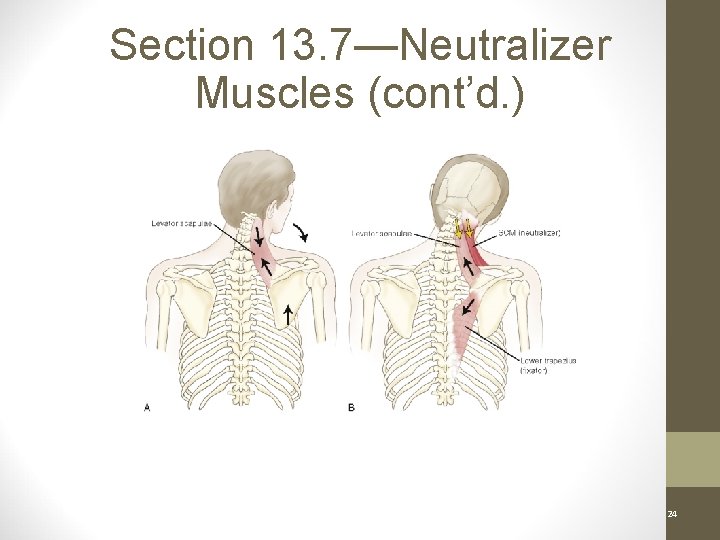
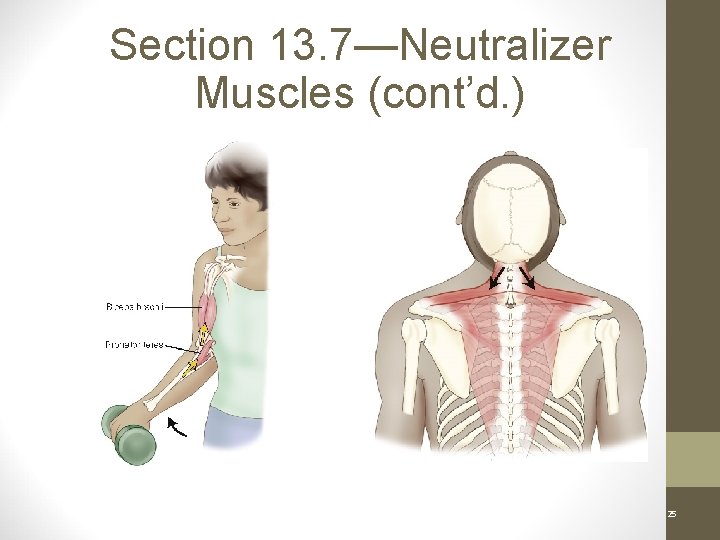
Section 13. 7—Neutralizer Muscles • Neutralizers stop unwanted action at the mobile attachment of the muscle that is working. • They create a contraction force equal in strength but opposite in direction to the force of the unwanted action. Copyright © 2011, 2007 by Mosby, Inc. , an affiliate of Elsevier Inc. All rights reserved. 23
Section 13. 7—Neutralizer Muscles (cont’d. ) Figure 13 -9 Copyright © 2011, 2007 by Mosby, Inc. , an affiliate of Elsevier Inc. All rights reserved. 24
Section 13. 7—Neutralizer Muscles (cont’d. ) Figure 13 -10 Figure 13 -11 Copyright © 2011, 2007 by Mosby, Inc. , an affiliate of Elsevier Inc. All rights reserved. 25
Section 13. 8—Step-by-Step Method for Determining Fixators and Neutralizers • • Determine the action in question. Determine the muscle that is working and its role. Determine the fixed and mobile attachments. List all actions of the muscle that is working, and state whether the actions are desired or undesired. Copyright © 2011, 2007 by Mosby, Inc. , an affiliate of Elsevier Inc. All rights reserved. 26
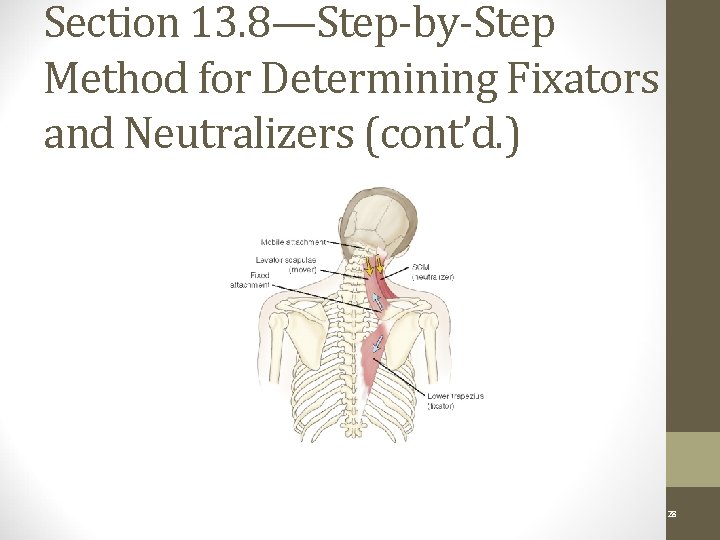
Section 13. 8—Step-by-Step Method for Determining Fixators and Neutralizers (cont’d. ) • • Determine the action of each fixator at the fixed attachment. Choose a muscle that can do the action determined for each fixator. Determine the action of each neutralizer at the mobile attachment. Choose a muscle that can do the action determined for each neutralizer. Copyright © 2011, 2007 by Mosby, Inc. , an affiliate of Elsevier Inc. All rights reserved. 27
Section 13. 8—Step-by-Step Method for Determining Fixators and Neutralizers (cont’d. ) Figure 13 -12 Copyright © 2011, 2007 by Mosby, Inc. , an affiliate of Elsevier Inc. All rights reserved. 28
Lesson 13. 3 Objectives • Describe the role of a support muscle. • Explain the two ways in which a synergist can be defined. • Compare and contrast synergists and antagonists for a given joint action. • Explain the concept of coordination as it relates to the role of muscles. • Describe the possible clinical effects of isometric contractions. Copyright © 2011, 2007 by Mosby, Inc. , an affiliate of Elsevier Inc. All rights reserved. 29
Lesson 13. 3 Objectives (cont’d. ) • Define and give an example of a 2 nd-order fixator. • Explain why it is difficult to isolate a specific muscle contraction; further, explain and give an example of how muscle contractions tend to spread through the body. • Discuss and give an example of the concept of coupled actions in the body. Copyright © 2011, 2007 by Mosby, Inc. , an affiliate of Elsevier Inc. All rights reserved. 30
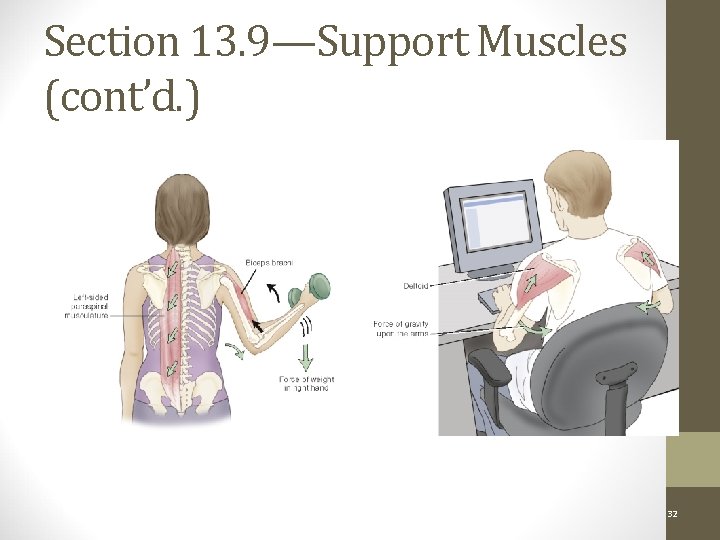
Section 13. 9—Support Muscles • Hold another part of the body in position while the action in question is occurring • Do not work directly at the joint • Oppose the force of gravity on a body part • Contract isometrically Copyright © 2011, 2007 by Mosby, Inc. , an affiliate of Elsevier Inc. All rights reserved. 31
Section 13. 9—Support Muscles (cont’d. ) Figure 13 -13 Figure 13 -14 Copyright © 2011, 2007 by Mosby, Inc. , an affiliate of Elsevier Inc. All rights reserved. 32
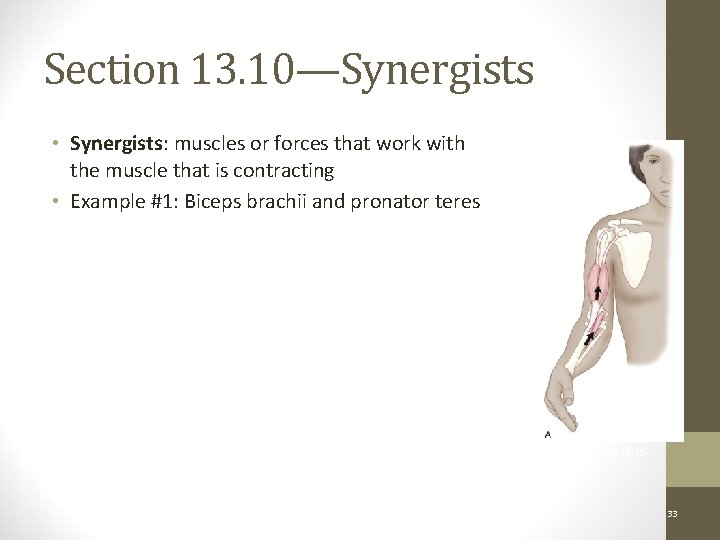
Section 13. 10—Synergists • Synergists: muscles or forces that work with the muscle that is contracting • Example #1: Biceps brachii and pronator teres Figure 13 -15 Copyright © 2011, 2007 by Mosby, Inc. , an affiliate of Elsevier Inc. All rights reserved. 33
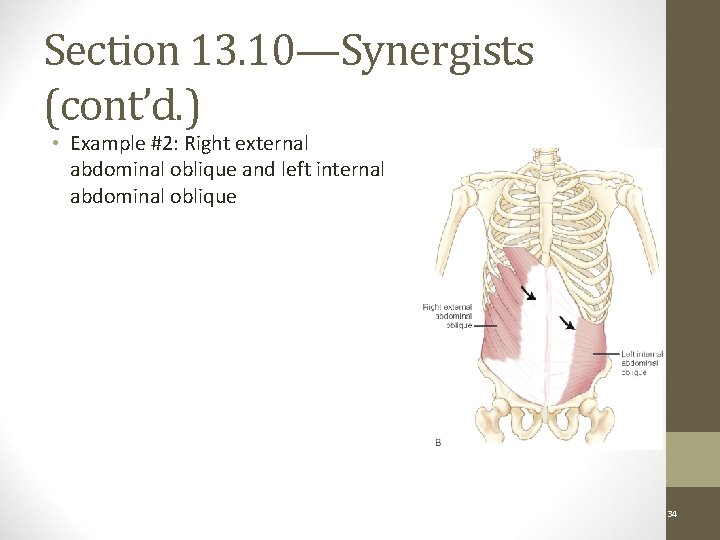
Section 13. 10—Synergists (cont’d. ) • Example #2: Right external abdominal oblique and left internal abdominal oblique Figure 13 -15 Copyright © 2011, 2007 by Mosby, Inc. , an affiliate of Elsevier Inc. All rights reserved. 34
Section 13. 11—Coordinating Muscle Roles • Muscles rarely act in isolation. • A number of muscles may contract for any given joint action. • Coordination is the co-ordering of muscles in the body in their various roles to create smooth and efficient movement. Copyright © 2011, 2007 by Mosby, Inc. , an affiliate of Elsevier Inc. All rights reserved. 35
Section 13. 11—Coordinating Muscle Roles (cont’d. ) • Clinical effects of isometric contractions • Close off veins for the entire length of contraction • Buildup of toxic waste products • Waste products irritate nerves Copyright © 2011, 2007 by Mosby, Inc. , an affiliate of Elsevier Inc. All rights reserved. 36
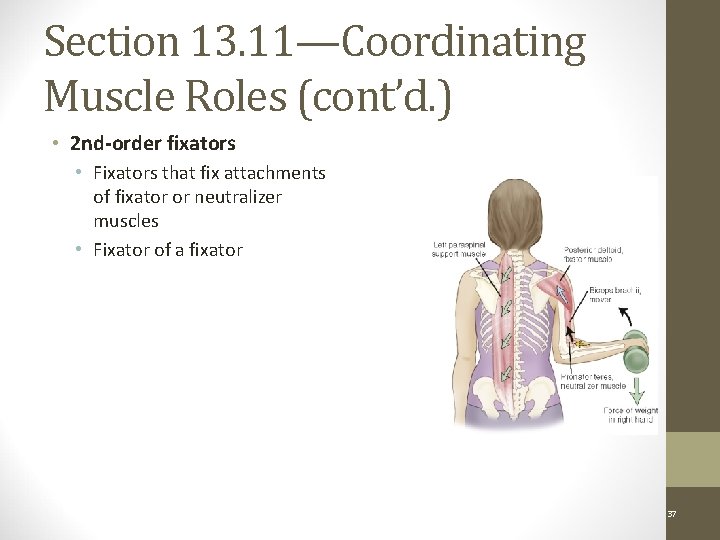
Section 13. 11—Coordinating Muscle Roles (cont’d. ) • 2 nd-order fixators • Fixators that fix attachments of fixator or neutralizer muscles • Fixator of a fixator Figure 13 -16 Copyright © 2011, 2007 by Mosby, Inc. , an affiliate of Elsevier Inc. All rights reserved. 37
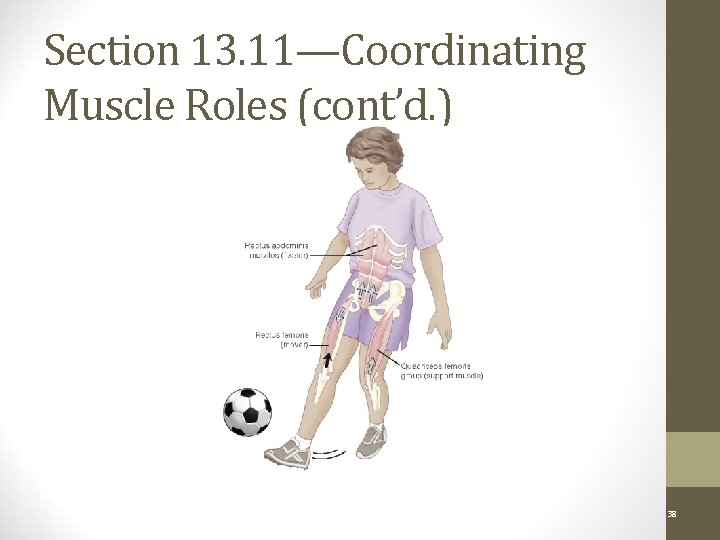
Section 13. 11—Coordinating Muscle Roles (cont’d. ) Figure 13 -17 Copyright © 2011, 2007 by Mosby, Inc. , an affiliate of Elsevier Inc. All rights reserved. 38
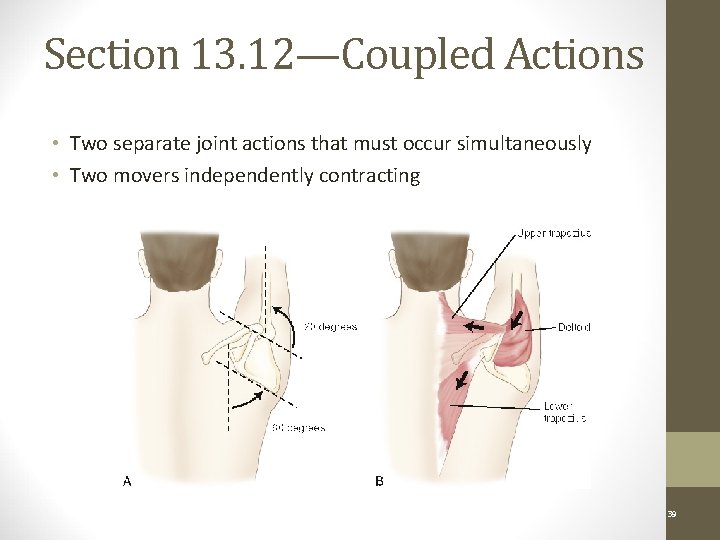
Section 13. 12—Coupled Actions • Two separate joint actions that must occur simultaneously • Two movers independently contracting Figure 13 -18 Copyright © 2011, 2007 by Mosby, Inc. , an affiliate of Elsevier Inc. All rights reserved. 39