
CHAPTER 13 RNA Protein Synthesis 13 1 The




- Slides: 92
CHAPTER 13 RNA & Protein Synthesis
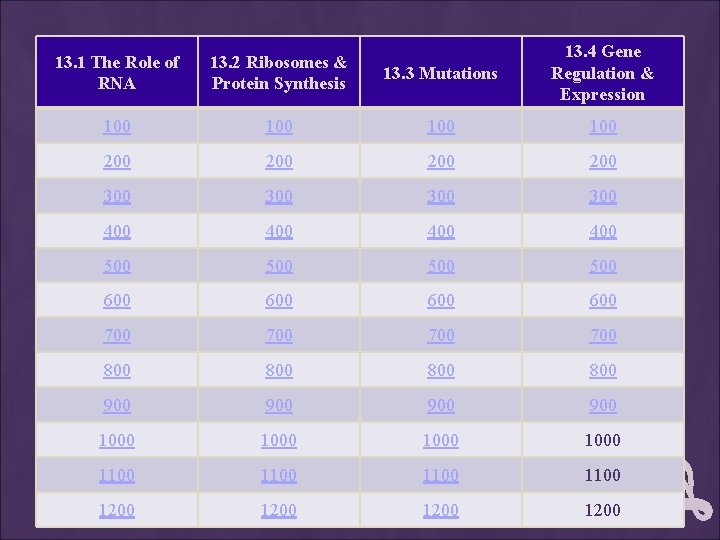
13. 1 The Role of RNA 13. 2 Ribosomes & Protein Synthesis 13. 3 Mutations 13. 4 Gene Regulation & Expression 100 100 200 200 300 300 400 400 500 500 600 600 700 700 800 800 900 900 1000 1100 1200
1. RNA CONTAINS THE SUGAR A ribose. B deoxyribose. C glucose. D lactose.
A RIBOSE.
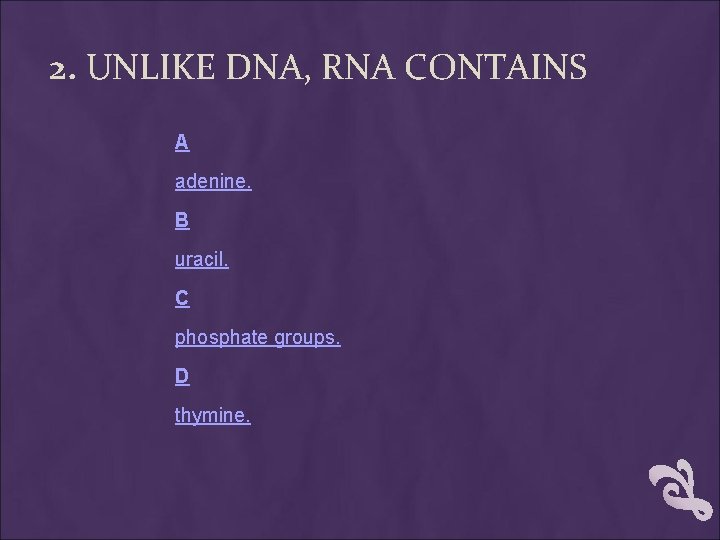
2. UNLIKE DNA, RNA CONTAINS A adenine. B uracil. C phosphate groups. D thymine.
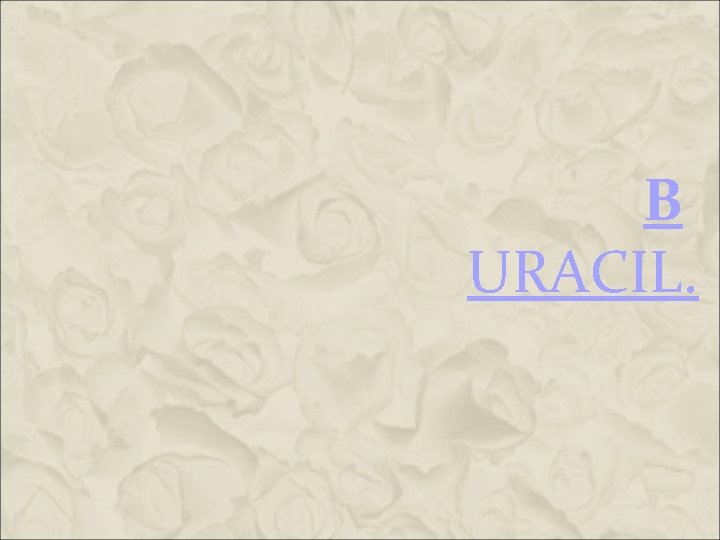
B URACIL.
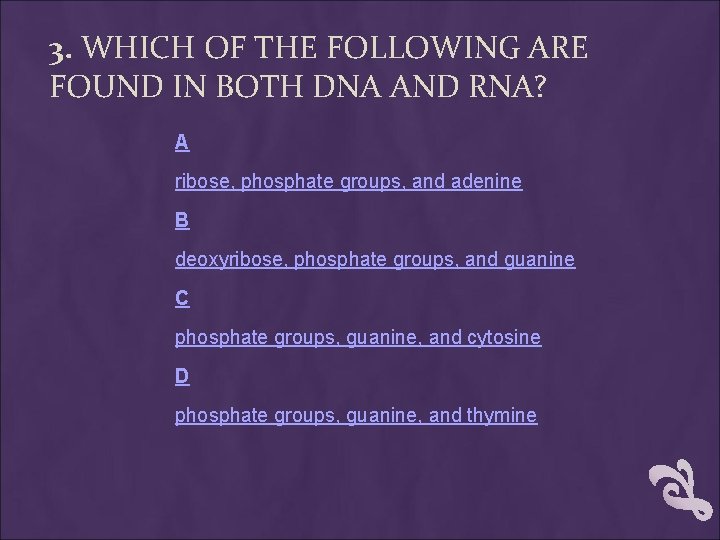
3. WHICH OF THE FOLLOWING ARE FOUND IN BOTH DNA AND RNA? A ribose, phosphate groups, and adenine B deoxyribose, phosphate groups, and guanine C phosphate groups, guanine, and cytosine D phosphate groups, guanine, and thymine
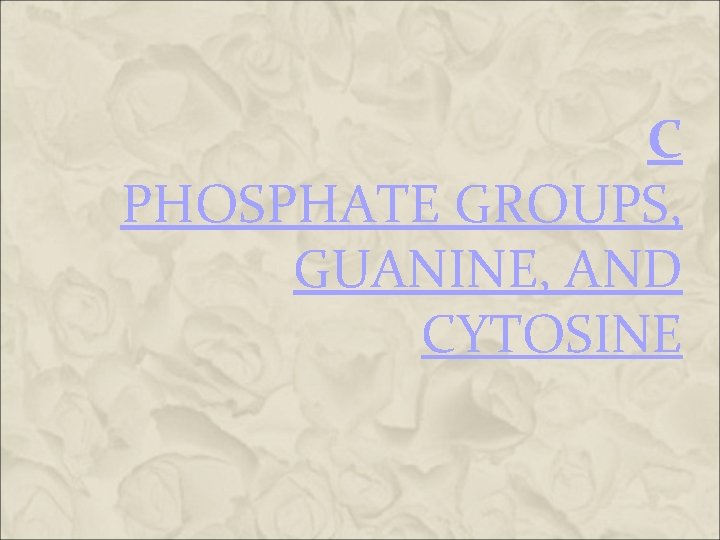
C PHOSPHATE GROUPS, GUANINE, AND CYTOSINE
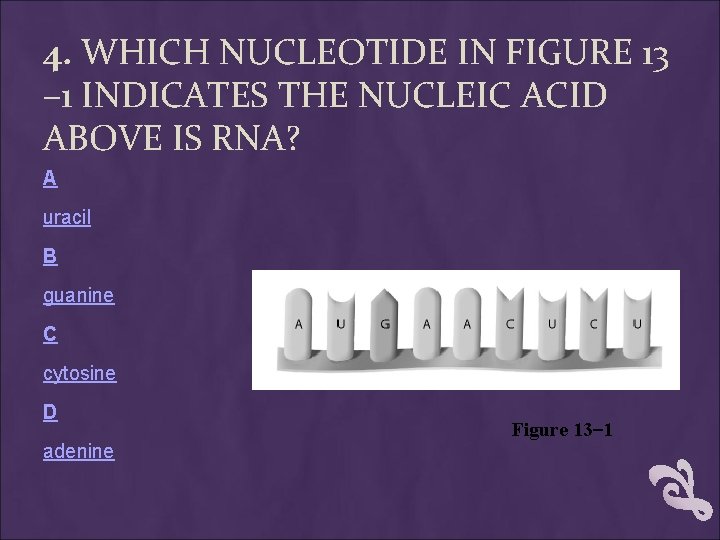
4. WHICH NUCLEOTIDE IN FIGURE 13 – 1 INDICATES THE NUCLEIC ACID ABOVE IS RNA? A uracil B guanine C cytosine D adenine Figure 13– 1
A URACIL
5. WHICH OF THE FOLLOWING IS TRUE? A RNA is usually single-stranded. B DNA is usually single-stranded. C DNA contains uracil. D RNA contains thymine.
A RNA IS USUALLY SINGLE-STRANDED.
6. WHICH TYPE OF RNA BRINGS THE INFORMATION IN THE GENETIC CODE FROM THE NUCLEUS TO OTHER PARTS OF THE CELL? A r. RNA B t. RNA C m. RNA D RNA polymerase
C MRNA
7. HOW MANY MAIN TYPES OF RNA ARE THERE? A 1 B 3 C hundreds D thousands
B 3
8. WHICH OF THE FOLLOWING STATEMENTS IS TRUE OF EUKARYOTIC DNA? A A promoter is part of an intron. B An intron is part of a promoter. C Introns are sequences of DNA. D Exons are edited out of pre-m. RNA.
C INTRONS ARE SEQUENCES OF DNA.
9. WHICH MOLECULES ARE INVOLVED IN PROTEIN SYNTHESIS? A transfer RNA, introns, and mutagens B messenger RNA, introns, and ribosomal RNA C ribosomal RNA, transfer RNA, and mutagens D messenger RNA, ribosomal RNA, and transfer RNA
D MESSENGER RNA, RIBOSOMAL RNA, AND TRANSFER RNA
10. FROM WHICH MOLECULES ARE MRNA MOLECULES TRANSCRIBED? A t. RNA B r. RNA C DNA D proteins
C DNA
11. WHAT IS PRODUCED DURING TRANSCRIPTION? A RNA molecules B DNA molecules C RNA polymerase D proteins
A RNA MOLECULES
12. DURING EUKARYOTIC TRANSCRIPTION, AN RNA MOLECULE IS FORMED THAT IS A complementary to both strands of DNA. B identical to an entire single strand of DNA. C double-stranded and inside the nucleus. D complementary to part of one strand of DNA.
D COMPLEMENTARY TO PART OF ONE STRAND OF DNA.
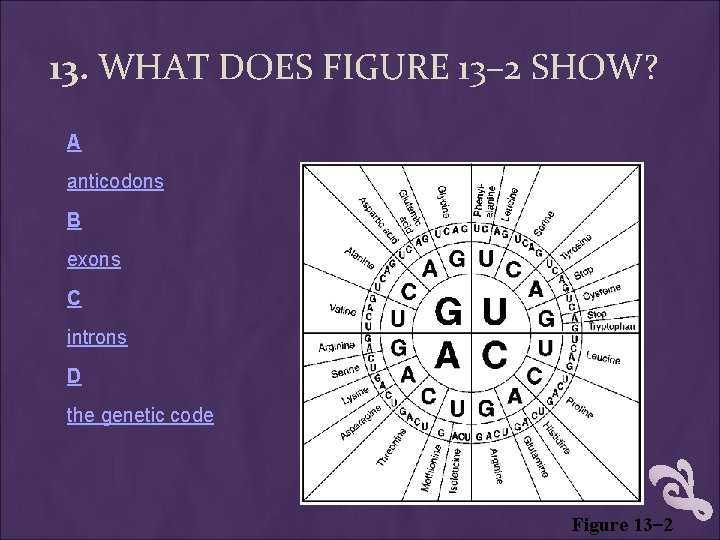
13. WHAT DOES FIGURE 13– 2 SHOW? A anticodons B exons C introns D the genetic code Figure 13– 2
D THE GENETIC CODE
14. HOW MANY NUCLEOTIDES ARE NEEDED TO SPECIFY THREE AMINO ACIDS? A 3 B 6 C 9 D 12
C 9
15. THERE ARE 64 CODONS AND 20 AMINO ACIDS. WHICH OF THE FOLLOWING IS TRUE? A Several different codons can specify the same amino acid. B Each codon specifies a different amino acid. C Some amino acids have no link to a codon. D Each amino acid is specified by only one codon.
A SEVERAL DIFFERENT CODONS CAN SPECIFY THE SAME AMINO ACID.
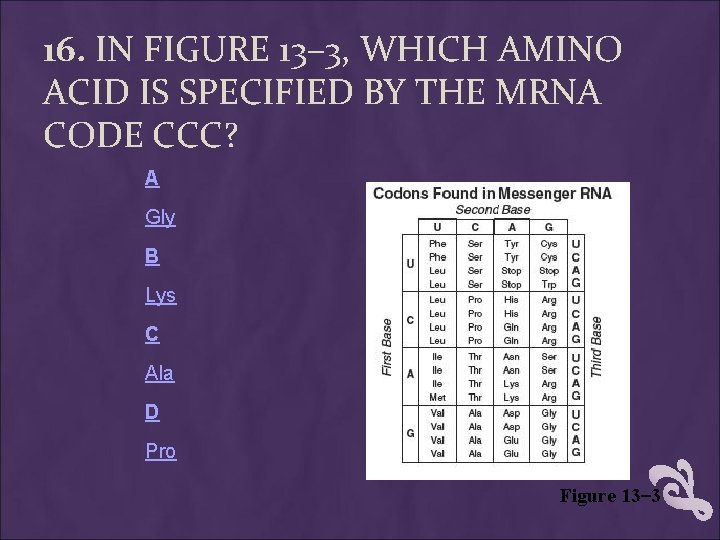
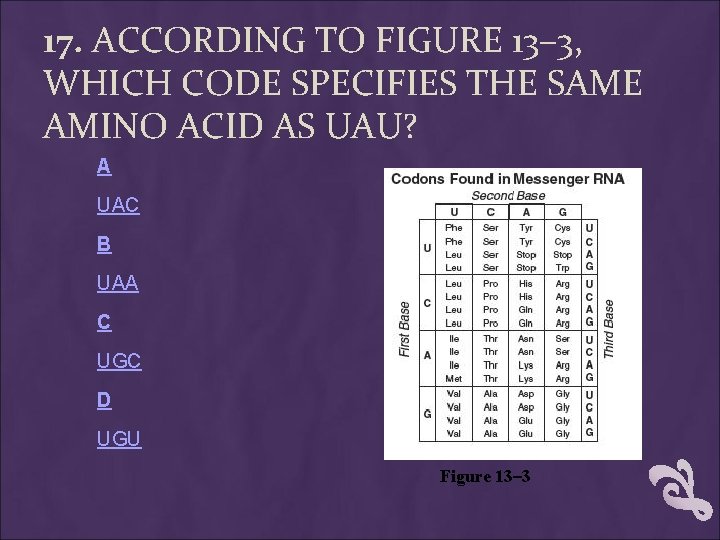
16. IN FIGURE 13– 3, WHICH AMINO ACID IS SPECIFIED BY THE MRNA CODE CCC? A Gly B Lys C Ala D Pro Figure 13– 3
D PRO
17. ACCORDING TO FIGURE 13– 3, WHICH CODE SPECIFIES THE SAME AMINO ACID AS UAU? A UAC B UAA C UGC D UGU Figure 13– 3
A UAC
18. A PROMOTER IS A A binding site for DNA polymerase. B binding site for RNA polymerase. C start signal for replication. D stop signal for transcription.
B BINDING SITE FOR RNA POLYMERASE.
19. WHAT HAPPENS DURING TRANSLATION? A Messenger RNA is made from a DNA code. B The cell uses a messenger RNA code to make proteins. C Transfer RNA is made from a messenger RNA code. D Copies of DNA molecules are made.
B THE CELL USES A MESSENGER RNA CODE TO MAKE PROTEINS.
20. WHICH OF THE FOLLOWING TERMS IS LEAST CLOSELY RELATED TO THE OTHERS? A spindle fiber B t. RNA C polypeptide D anticodon
A SPINDLE FIBER
21. DURING TRANSLATION, THE TYPE OF AMINO ACID THAT IS ADDED TO THE GROWING POLYPEPTIDE DEPENDS ON THE A codon on the m. RNA and the anticodon on the r. RNA. B anticodon on the m. RNA and the anticodon on the t. RNA. C anticodon on the r. RNA and the codon on the m. RNA. D codon on the m. RNA and the anticodon on the t. RNA.
D CODON ON THE MRNA AND THE ANTICODON ON THE TRNA.
22. A PROTEIN IS BEING ASSEMBLED WHEN A DNA is being translated. B RNA is being transcribed. C RNA is being translated. D DNA is being transcribed.
C RNA IS BEING TRANSLATED.
23. GENES CONTAIN INSTRUCTIONS FOR ASSEMBLING A operons. B nucleosomes. C proteins. D mutagens.
C PROTEINS.
24. WHICH IS THE CORRECT SEQUENCE OF THE TRANSFER OF INFORMATION IN MOST ORGANISMS? A protein to DNA to RNA B RNA to DNA to protein C DNA to RNA to protein D RNA to protein to DNA
C DNA TO RNA TO PROTEIN
25. WHAT IS AN EXCEPTION TO THE CENTRAL DOGMA OF MOLECULAR BIOLOGY? A Viruses sometimes transfer information from RNA to DNA. B Viruses sometimes transfer information from DNA to RNA. C Viruses sometimes transfer information from proteins to DNA. D Viruses can translate without RNA.
A VIRUSES SOMETIMES TRANSFER INFORMATION FROM RNA TO DNA.
26. THE GENETIC CODE IS ALWAYS READ A 3 bases at a time in the same direction. B 4 bases at a time in the same direction. C 3 bases at a time and the direction varies. D 4 bases at a time and the direction varies.
A 3 BASES AT A TIME IN THE SAME DIRECTION.
27. IN EUKARYOTES A Transcription takes place in the cytoplasm, and translation takes place in the nucleus. B Transcription takes place in the nucleus, and translation takes place in the cytoplasm. C Transcription and translation both take place in the nucleus. D Transcription and translation both take place in the cytoplasm.
B TRANSCRIPTION TAKES PLACE IN THE NUCLEUS, AND TRANSLATION TAKES PLACE IN THE CYTOPLASM.
28. A MUTATION THAT INVOLVES ONE OR A FEW NUCLEOTIDES IS CALLED A a mutagen. B an inversion. C a point mutation. D a translocation.
C A POINT MUTATION.
29. WHICH OF THE FOLLOWING IS A CHROMOSOMAL MUTATION? A inversion B insertion C point mutation D substitution
A INVERSION
30. WHICH OF THE FOLLOWING IS THE NAME OF A TYPE OF CHROMOSOMAL MUTATION AND A TYPE OF GENE MUTATION? A substitution B insertion C deletion D inversion
C DELETION
31. WHEN A CHROMOSOME UNDERGOES A DELETION MUTATION, INFORMATION IS A repeated. B lost. C reversed. D transferred.
B LOST.
32. MOST MUTATIONS A have no effect on an organism. B are fatal to an organism. C are helpful to an organism. D are harmful to an organism.
A HAVE NO EFFECT ON AN ORGANISM.
33. WHAT ARE SOME CHARACTERISTICS OF POLYPLOIDY PLANTS? A They tend to be weaker and smaller than diploid plants. B They tend to be bigger and stronger than diploid plants. C They tend to be weaker, but bigger than diploid plants. D They tend to be smaller, but stronger than diploid plants.
B THEY TEND TO BE BIGGER AND STRONGER THAN DIPLOID PLANTS.
34. WHICH OF THE FOLLOWING STATEMENTS IS TRUE ABOUT GENE REGULATION IN PROKARYOTES? A Promoters determine whether a gene is expressed. B Expressed genes make more DNA. C DNA-binding proteins determine whether a gene is expressed. D RNA polymerase regulates gene expression.
C DNA-BINDING PROTEINS DETERMINE WHETHER A GENE IS EXPRESSED.
35. IN E. COLI, THE LAC OPERON CONTROLS THE A breakdown of lactose. B production of lactose. C breakdown of glucose. D production of glucose.
A BREAKDOWN OF LACTOSE.
36. A LAC REPRESSOR TURNS OFF THE LAC GENES BY A binding to the promoter. B DNA polymerase. C binding to the operator. D binding to the lac genes.
C BINDING TO THE OPERATOR.
37. WHEN E. COLI IS GROWN ON GLUCOSE, AND THERE IS NO LACTOSE AVAILABLE A lactose molecules bind to the lac repressor. B the lac repressor binds to the operator of the lac operon. C RNA polymerase binds to the promoter of the lac operon. D the lac genes are transcribed into messenger RNA.
B THE LAC REPRESSOR BINDS TO THE OPERATOR OF THE LAC OPERON.
38. WHICH IS INVOLVED WITH THE REGULATION OF EUKARYOTIC GENES? A operon B DNA polymerase C TATA box D operator
C TATA BOX
39. WHICH OF THE FOLLOWING IS PART OF ONLY PROKARYOTIC GENES? A operon B TATA box C promoter sequences D enhancer sequences
A OPERON
40. GENE REGULATION IN EUKARYOTES A usually involves operons. B is simpler than in prokaryotes. C allows for cell specialization. D includes the action of an operator region.
C ALLOWS FOR CELL SPECIALIZATION.
41. SPECIALIZED CELLS REGULATE THE EXPRESSION OF GENES BECAUSE THEY A do not want the genes to become worn out. B cannot control the translation of proteins. C do not carry the complete genetic code in their nuclei. D do not need the proteins that are specified by certain genes.
D DO NOT NEED THE PROTEINS THAT ARE SPECIFIED BY CERTAIN GENES.
42. WHAT REGULATES THE EXPRESSION OF MOST EUKARYOTIC GENES? A mi. RNA B transcription factors C dicer enzymes D silencing complexes
B TRANSCRIPTION FACTORS
43. HOX GENES DETERMINE AN ANIMAL’S A body plan. B size. C skin color. D eye color.
A BODY PLAN.
44. HOX GENES A determine when bacteria replicate their chromosome. B determine where the flagellum is on a bacterium. C determine when a dog’s cells replicate their DNA D determine the location of a dog’s ears.
D DETERMINE THE LOCATION OF A DOG’S EARS.
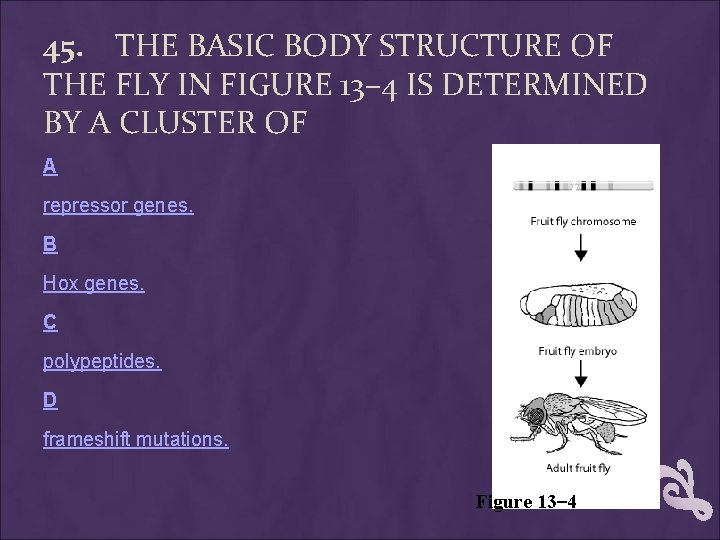
45. THE BASIC BODY STRUCTURE OF THE FLY IN FIGURE 13– 4 IS DETERMINED BY A CLUSTER OF A repressor genes. B Hox genes. C polypeptides. D frameshift mutations. Figure 13– 4
B HOX GENES.