
Chapter 13 Respiratory System Disorders Copyright 2019 by
Chapter 13 Respiratory System Disorders Copyright © 2019 by Elsevier Inc. All rights reserved.
Purpose and General Function Transport of oxygen from air to blood Ø Removal of carbon dioxide from the blood Ø Oxygen is necessary for cellular metabolism. Carbon dioxide is a waste product from metabolism. Two anatomical areas Upper respiratory tract • Resident flora Ø Lower respiratory tract • Sterile Ø Copyright © 2019 by Elsevier Inc. All rights reserved. 2
Upper Respiratory Tract Nasal cavity Warming and moistening of air Ø Foreign material trapped by mucous secretions Ø Nasopharynx Ø Pharyngeal tonsils in posterior wall Palatine tonsils Ø Lymphoid tissue in posterior portion of the oral cavity Copyright © 2019 by Elsevier Inc. All rights reserved. 3
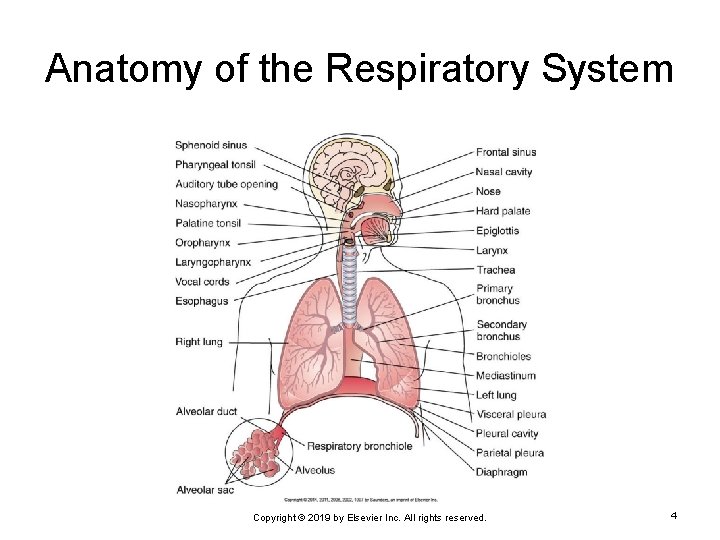
Anatomy of the Respiratory System Copyright © 2019 by Elsevier Inc. All rights reserved. 4
Upper Respiratory Tract (Cont. ) Oropharynx Common passage for air and food Ø Epiglottis protects opening into larynx. • Closes over glottis at swallowing to prevent aspiration Ø Larynx Ø Two pairs of vocal cords Trachea Lined by pseudostratified ciliated epithelium Ø C-shaped rings of cartilage Ø Copyright © 2019 by Elsevier Inc. All rights reserved. 5
Lower Respiratory Tract Bronchial tree (continuous branching) Ø Trachea branches into: • Right and left primary bronchi • Secondary bronchi • Bronchioles • Terminal bronchioles • Respiratory bronchioles • Alveolar ducts • Alveoli—lined by simple squamous epithelium and surfactant to reduce surface tension and maintain inflation End point for inspired air Site of gas exchange Copyright © 2019 by Elsevier Inc. All rights reserved. 6
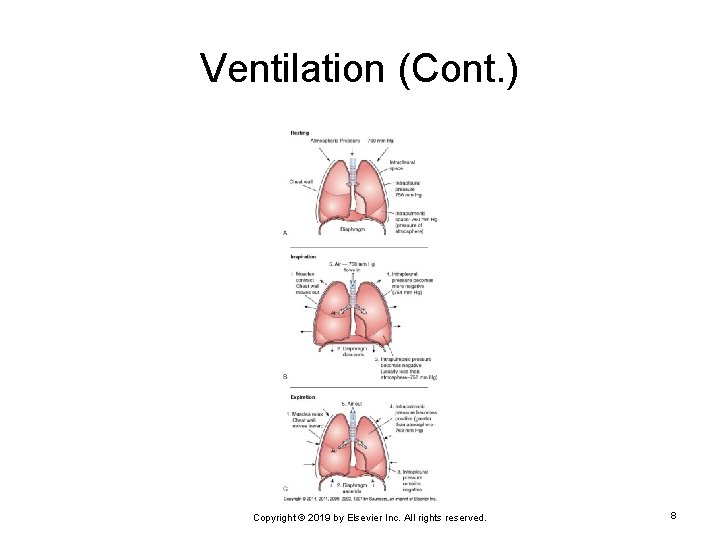
Ventilation Process of inspiration and expiration Ø Airflow depends on pressure gradient (Boyle law). • Air always moves from high-pressure area to low- pressure area. Atmospheric pressure higher than pressure in alveoli • Inspiration—air moves from atmosphere into lungs. Ø Pressure in alveoli higher than in atmosphere • Expiration—air moves from lungs into atmosphere. Ø Copyright © 2019 by Elsevier Inc. All rights reserved. 7
Ventilation (Cont. ) Copyright © 2019 by Elsevier Inc. All rights reserved. 8
Pulmonary Volumes Tidal volume is the amount of air exchanged with quiet inspiration and expiration. Residual volume Ø Volume of air remaining in lungs after maximum respiration Vital capacity Ø Maximal amount of air that can be moved in and out of the lungs with a single forced inspiration and expiration Copyright © 2019 by Elsevier Inc. All rights reserved. 9
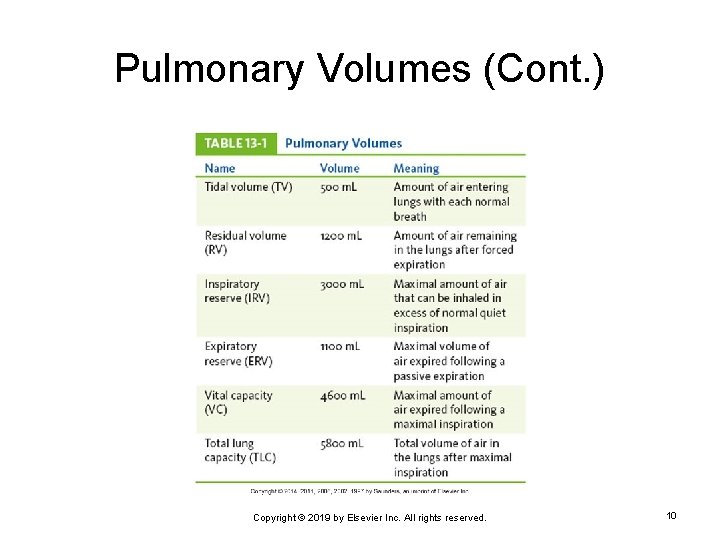
Pulmonary Volumes (Cont. ) Copyright © 2019 by Elsevier Inc. All rights reserved. 10
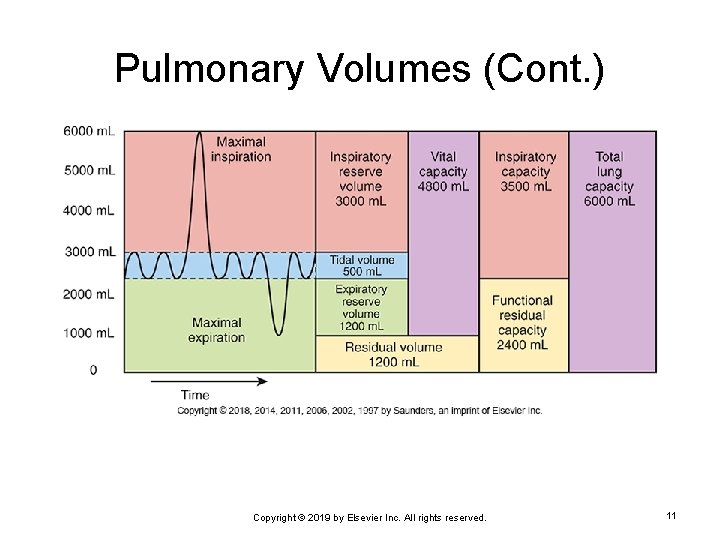
Pulmonary Volumes (Cont. ) Copyright © 2019 by Elsevier Inc. All rights reserved. 11
Control of Ventilation Primary control centers for breathing Ø Located in the medulla and pons Chemoreceptors detect changes in carbon dioxide level, hydrogen ion, and oxygen levels in blood or cerebrospinal fluid (CSF). Central chemoreceptors • Located in the medulla Ø Peripheral chemoreceptors • Located in the carotid bodies Ø Copyright © 2019 by Elsevier Inc. All rights reserved. 12
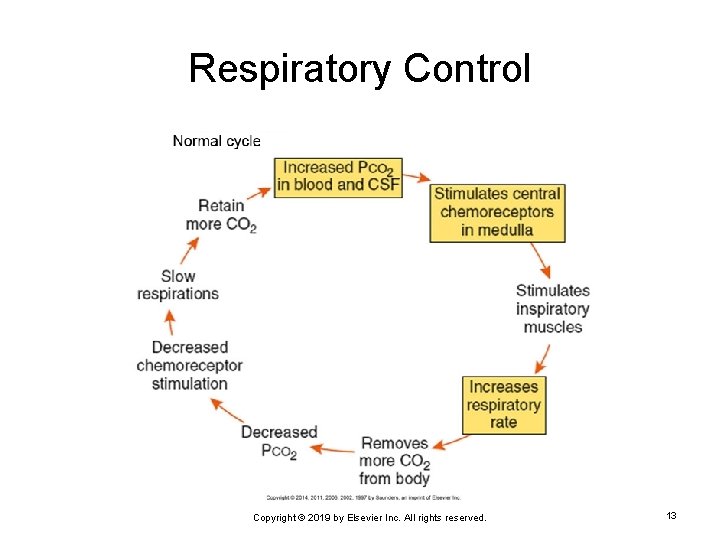
Respiratory Control Copyright © 2019 by Elsevier Inc. All rights reserved. 13
Control of Ventilation (Cont. ) Hypercapnia Carbon dioxide levels in the blood increase. Ø Carbon dioxide easily diffuses into CSF. • Lowers p. H and stimulates respiratory center • Increased rate and depth of respirations (hyperventilation) • Causes respiratory acidosis—nervous system depression Ø Hypoxemia Ø Marked decrease in oxygen • Chemoreceptors respond. • Important control mechanism in individuals with chronic lung disease—move to hypoxic drive Copyright © 2019 by Elsevier Inc. All rights reserved. 14
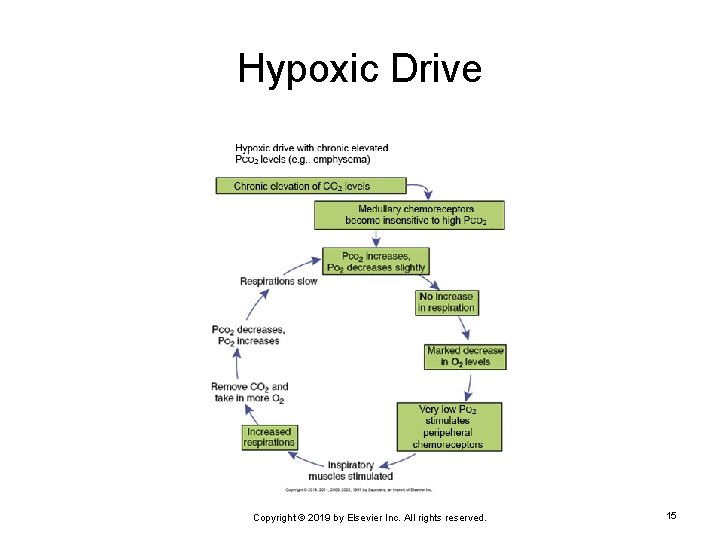
Hypoxic Drive Copyright © 2019 by Elsevier Inc. All rights reserved. 15
Control of Ventilation (Cont. ) Hypocapnia Ø Caused by low carbon dioxide concentration (low partial pressure of carbon dioxide) in blood • May be caused by hyperventilation Excessive amounts of carbon dioxide expired • Causes respiratory alkalosis Copyright © 2019 by Elsevier Inc. All rights reserved. 16
Gas Exchange Flow of gases between the alveolar air and blood (external respiration) Gas exchange depends on the relative concentrations (partial pressures) of the gases. PO 2—partial pressure of oxygen Ø PCO 2—partial pressure of carbon dioxide Ø Each gas in a mixture moves along its partial pressure gradient, independent of other gases (Dalton law). Copyright © 2019 by Elsevier Inc. All rights reserved. 17
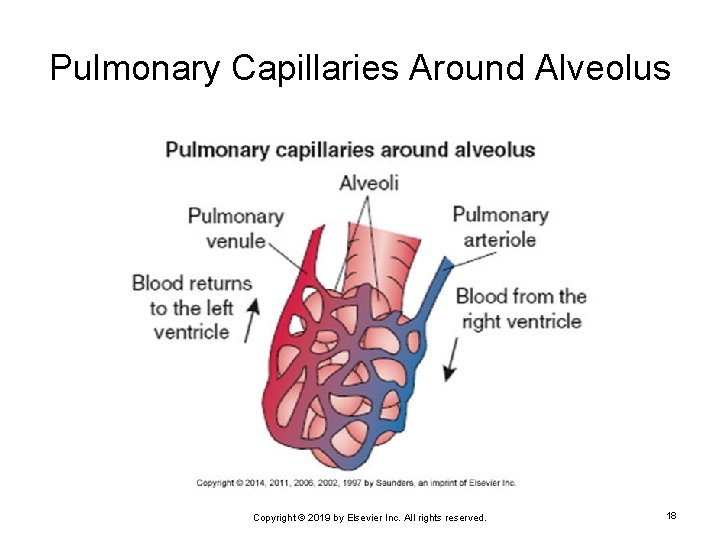
Pulmonary Capillaries Around Alveolus Copyright © 2019 by Elsevier Inc. All rights reserved. 18
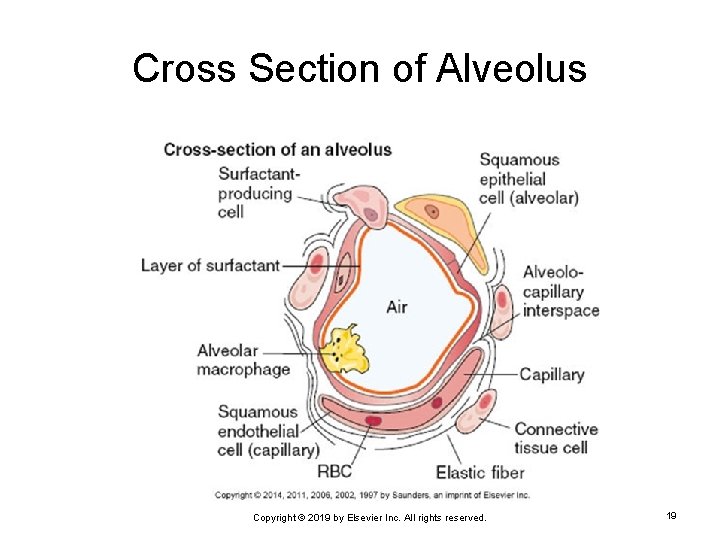
Cross Section of Alveolus Copyright © 2019 by Elsevier Inc. All rights reserved. 19
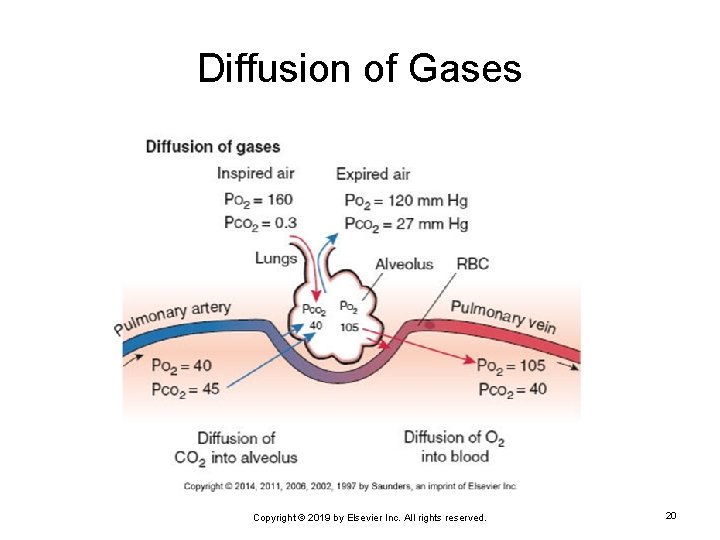
Diffusion of Gases Copyright © 2019 by Elsevier Inc. All rights reserved. 20
Factors Affecting Diffusion of Gases Partial pressure gradient Thickness of the respiratory membrane Ø Total surface area available for diffusion Ø Fluid accumulation in alveoli or interstitial tissue impairs gas exchange. If part of alveolar wall is destroyed, surface area is reduced, so less exchange. Ventilation-perfusion ratio Ø Ventilation (air flow) and perfusion (blood flow) need to match for maximum gas exchange. Copyright © 2019 by Elsevier Inc. All rights reserved. 21
Transport of Oxygen and Carbon Dioxide Oxygen About 1% of oxygen is dissolved in plasma. Ø Most is bound (reversibly) to hemoglobin. Ø Binding and release of oxygen to hemoglobin depend on: • PO 2, PCO 2, temperature, plasma p. H Ø Carbon dioxide Waste product from cellular metabolism Ø About 7% dissolved in plasma Ø About 20% reversibly bound to hemoglobin Ø Most diffuses into red blood cells Ø Copyright © 2019 by Elsevier Inc. All rights reserved. 22
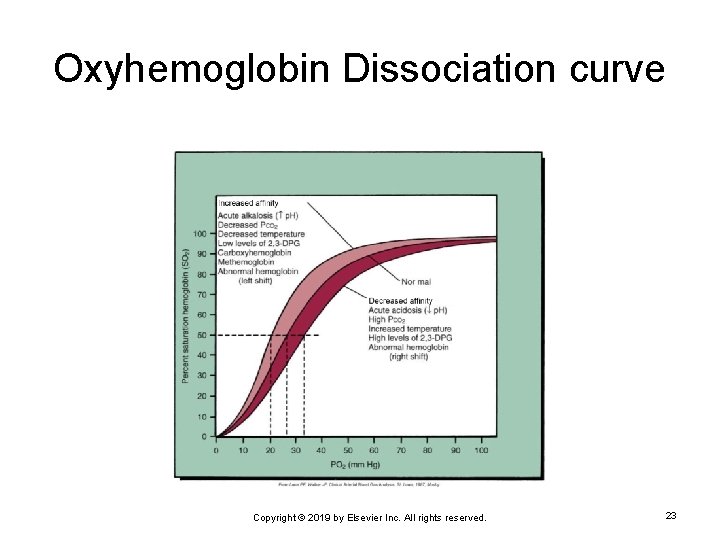
Oxyhemoglobin Dissociation curve Copyright © 2019 by Elsevier Inc. All rights reserved. 23
Diagnostic Tests Spirometry—pulmonary function test (PFT) Ø Arterial blood gas determination Ø Checks oxygen, carbon dioxide, bicarbonate, serum p. H Oximetry Ø Test pulmonary volumes and airflow times Measures O 2 saturation Exercise tolerance testing Ø For patients with chronic pulmonary disease Copyright © 2019 by Elsevier Inc. All rights reserved. 24
Diagnostic Tests (Cont. ) Radiography Helpful in evaluating tumors Ø Evaluate infections Ø Bronchoscopy Perform biopsy. Ø Check site of lesion or bleeding. Ø Culture and sensitivity tests Sputum testing for presence of pathogens Ø Determine antimicrobial sensitivity of pathogen Ø Copyright © 2019 by Elsevier Inc. All rights reserved. 25
General Manifestations of Respiratory Disease Sneezing Ø Reflex response to irritation in upper respiratory tract • Assists in removing irritant • Associated with inflammation or foreign material Coughing Irritation caused by nasal discharge Ø Inflammation or foreign material in lower respiratory tract Ø Caused by inhaled irritants Ø Copyright © 2019 by Elsevier Inc. All rights reserved. 26
General Manifestations of Respiratory Disease (Cont. ) Sputum Yellowish-green, cloudy, thick mucus • Often indication of a bacterial infection Ø Rusty or dark-colored sputum • Usually sign of pneumococcal pneumonia Ø Very large amounts of purulent sputum with foul odor • May be associated with bronchiectasis Ø Thick, tenacious mucus • Asthma or cystic fibrosis, blood-tinged sputum—may result Ø from chronic cough; may also be sign of tumor or tuberculosis Copyright © 2019 by Elsevier Inc. All rights reserved. 27
General Manifestations of Respiratory Disease (Cont. ) Sputum (Cont. ) Ø Hemoptysis • Blood-tinged (bright red) frothy sputum, usually associated with pulmonary edema Breathing patterns and characteristics Eupnea • Normal rate Ø Kussmaul respirations • Deep rapid respirations—typical for acidosis; may follow Ø strenuous exercise Copyright © 2019 by Elsevier Inc. All rights reserved. 28
General Manifestations of Respiratory Disease (Cont. ) Breathing patterns and characteristics (Cont. ) Labored respiration or prolonged inspiration or expiration • Often associated with obstruction of airways Ø Wheezing or whistling sounds • Indicate obstruction in small airways Ø Stridor • High-pitched crowing noise • Usually indicates upper airway obstruction Ø Copyright © 2019 by Elsevier Inc. All rights reserved. 29
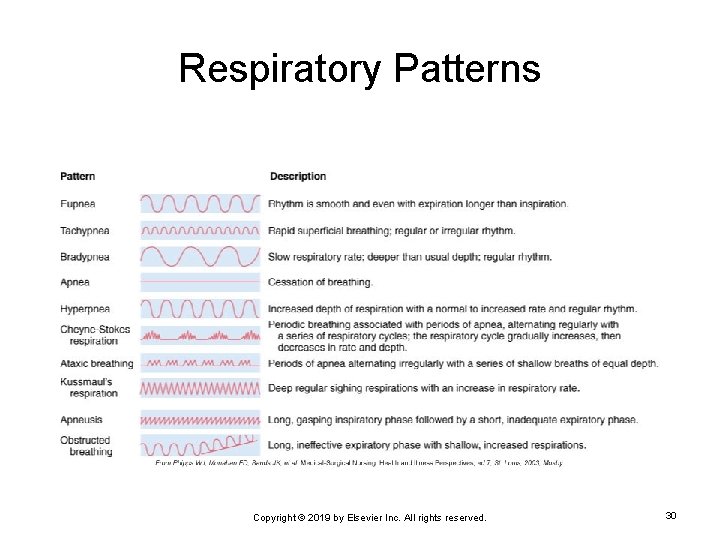
Respiratory Patterns Copyright © 2019 by Elsevier Inc. All rights reserved. 30
General Manifestations of Respiratory Disease (Cont. ) Breath sounds Rales • Light bubbly or crackling sounds, with serous secretions Ø Rhonchi • Deeper or harsher sounds from thicker mucus Ø Absence • Nonaeration or collapse of lungs Ø Copyright © 2019 by Elsevier Inc. All rights reserved. 31
General Manifestations of Respiratory Disease (Cont. ) Dyspnea Ø Severe dyspnea indicative of respiratory distress Ø Ø Ø Subjective feeling of discomfort • May be caused by increased carbon dioxide or hypoxemia • Often noted on exertion, such as climbing stairs Flaring of nostrils Use of accessory respiratory muscles Retraction of muscles between or above ribs Orthopnea Ø Ø Occurs when lying down Usually caused by pulmonary congestion Copyright © 2019 by Elsevier Inc. All rights reserved. 32
General Manifestations of Respiratory Disease (Cont. ) Dyspnea (Cont. ) Ø Paroxysmal nocturnal dyspnea • Sudden acute type of dyspnea • Common in patients with left-sided congestive heart failure Cyanosis Ø Bluish coloring of skin and mucous membranes • Caused by large amounts of unoxygenated hemoglobin in blood Pleural pain Ø Results from inflammation or infection of parietal pleura Copyright © 2019 by Elsevier Inc. All rights reserved. 33
General Manifestations of Respiratory Disease (Cont. ) Friction rub Ø Clubbed digits Ø Soft sound produced as rough, inflamed, or scarred pleural move against each other Result from chronic hypoxia associated with respiratory or cardiovascular diseases • Painless, firm, fibrotic enlargement at the end of the digit Changes in arterial blood gases Hypoxemia—inadequate oxygen in blood Ø Hypercapnea—increased carbon dioxide in blood Ø Copyright © 2019 by Elsevier Inc. All rights reserved. 34
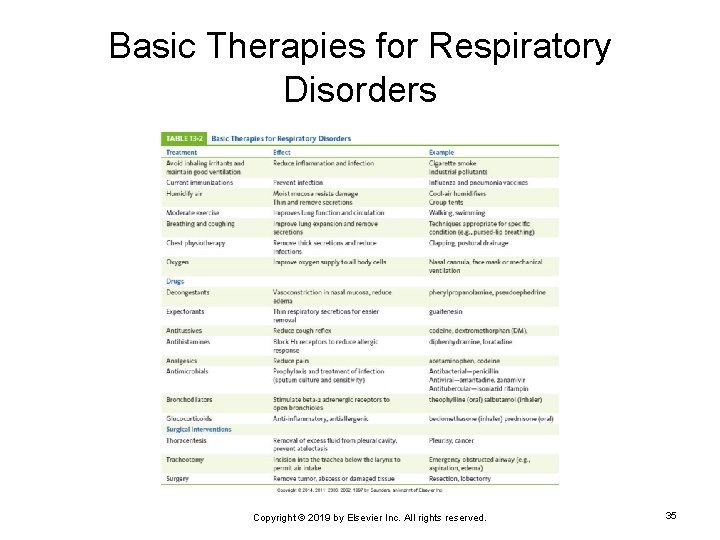
Basic Therapies for Respiratory Disorders Copyright © 2019 by Elsevier Inc. All rights reserved. 35
Infectious Diseases Upper Respiratory Tract Infections Lower Respiratory Tract Infections Copyright © 2019 by Elsevier Inc. All rights reserved. 36
Upper Respiratory Tract Infections Common Cold Sinusitis Epiglottitis Influenza Scarlet Fever Copyright © 2019 by Elsevier Inc. All rights reserved. 37
Common Cold Viral infection More than 200 possible causative agents Spread through respiratory droplets Handwashing and respiratory hygiene important in prevention Symptomatic treatment Secondary bacterial infections may occur. Usually caused by streptococci Ø Purulent exudate; systemic signs, such as fever Ø Copyright © 2019 by Elsevier Inc. All rights reserved. 38
Signs and Symptoms Nasal congestion, copious watery discharge Mouth breathing, change in the tone of voice Possible sore throat Headache Slight fever Malaise Cough may develop. Infection and inflammation may spread to cause pharyngitis, laryngitis, or acute bronchitis. Copyright © 2019 by Elsevier Inc. All rights reserved. 39
Treatment Symptomatic and supportive Ø Unless bacterial infection develops secondarily Antiviral drugs May reduce symptoms and duration Reduces risk to infect others Copyright © 2019 by Elsevier Inc. All rights reserved. 40
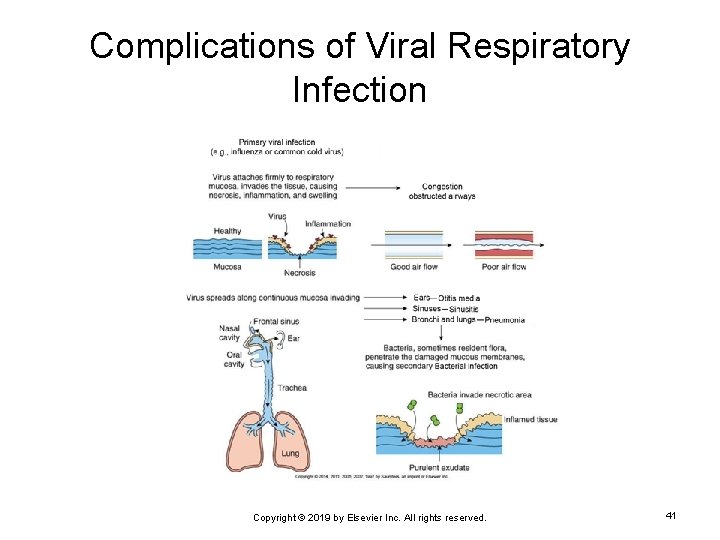
Complications of Viral Respiratory Infection Copyright © 2019 by Elsevier Inc. All rights reserved. 41
Upper Respiratory Tract Infections Sinusitis Usually bacterial infection Ø Analgesics for headache and pain Ø Course of antibiotics often required to eradicate infection Ø Laryngotracheobronchitis (croup) Common viral infection, particularly in children Ø Common causative organism • Parainfluenza viruses and adenoviruses Ø Infection usually self-limited Ø Copyright © 2019 by Elsevier Inc. All rights reserved. 42
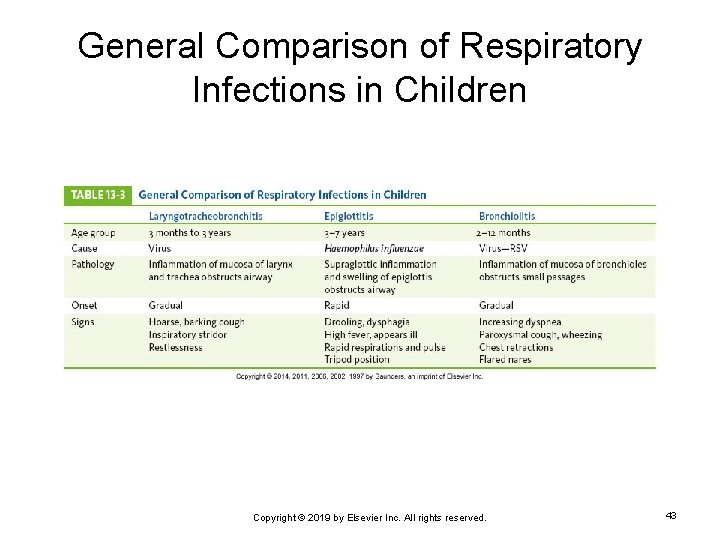
General Comparison of Respiratory Infections in Children Copyright © 2019 by Elsevier Inc. All rights reserved. 43
Upper Respiratory Tract Infections: Epiglottitis Acute infection Ø Common in children ages 3 to 7 years Usually caused by Haemophilus influenzae type B Rapid onset; fever and sore throat Child sits in tripod position. Drooling and difficulty swallowing Heightened anxiety Copyright © 2019 by Elsevier Inc. All rights reserved. 44
Upper Respiratory Tract Infections: Epiglottitis (Cont. ) Swelling of the larynx, supraglottic area, and epiglottis May obstruct airway Ø Spasm of larynx common if area is touched with instruments Ø Treatment Ø Oxygen and antimicrobial therapy Copyright © 2019 by Elsevier Inc. All rights reserved. 45
Upper Respiratory Tract Infections: Influenza (Flu) Viral infection Three groups of influenza viruses Type A (most prevalent), types B and C Ø Viruses constantly mutate. Ø Sudden, acute onset with fever, marked fatigue, aching pain in the body May also cause viral pneumonia Ø Mild case of influenza may be complicated by secondary bacterial pneumonia. Ø Commonly, deaths in flu epidemics result from pneumonia. Ø Copyright © 2019 by Elsevier Inc. All rights reserved. 46
Treatment Symptomatic and supportive Antiviral drugs Amantadine Ø Zanamivir Ø Oseltamivir Ø Prevention is highly recommended. Respiratory hygiene! Ø Vaccination is recommended for most individuals. Ø Copyright © 2019 by Elsevier Inc. All rights reserved. 47
Scarlet Fever Caused by group A β-hemolytic Streptococcus (S. pyogenes) Symptoms Typical “strawberry” tongue Ø Fever, sore throat Ø Chills, vomiting, abdominal pain, malaise Ø Treatment Ø Antibiotics Copyright © 2019 by Elsevier Inc. All rights reserved. 48
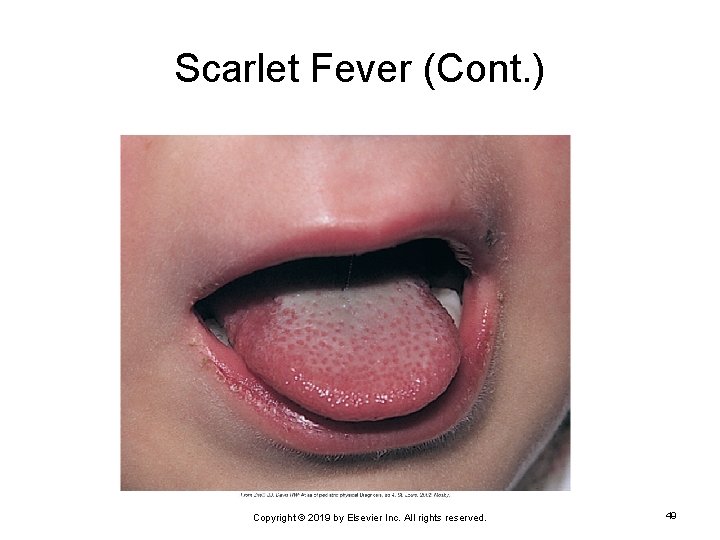
Scarlet Fever (Cont. ) Copyright © 2019 by Elsevier Inc. All rights reserved. 49
Lower Respiratory Tract Infections Bronchiolitis Pneumonia Severe Acute Respiratory Syndrome Tuberculosis Histoplasmosis Anthrax Copyright © 2019 by Elsevier Inc. All rights reserved. 50
Bronchiolitis Caused by the respiratory syncytial virus (RSV) Transmitted by oral droplet Virus causes necrosis, inflammation in small bronchi and bronchioles. Signs Ø Wheezing and dyspnea, rapid shallow respirations, cough, rales, chest retractions, fever, malaise Treatment Ø Supportive and symptomatic Copyright © 2019 by Elsevier Inc. All rights reserved. 51
Pneumonia Classification of pneumonias based on: Causative agent • Viral, bacterial, fungal Ø Anatomical location of infection • Throughout both lungs, or consolidated in one lobe Ø Pathophysiologic changes • Changes in interstitial tissue, alveolar septae, alveoli Ø Epidemiologic data • Nosocomial (hospital-acquired) • Community-acquired Ø Copyright © 2019 by Elsevier Inc. All rights reserved. 52
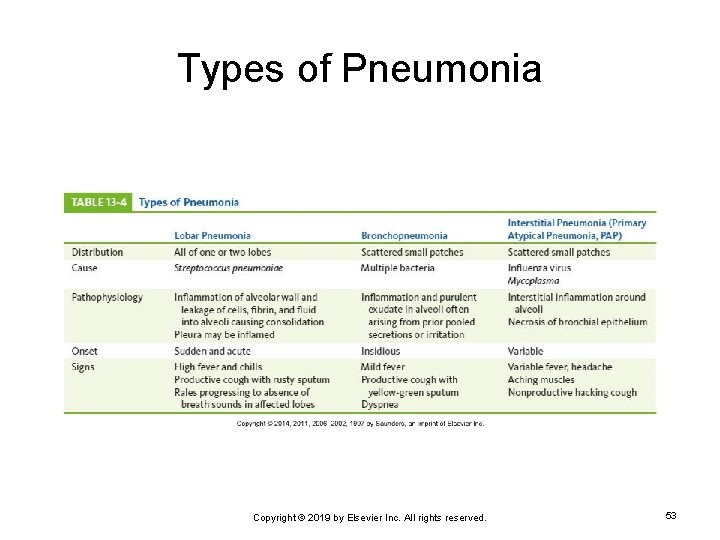
Types of Pneumonia Copyright © 2019 by Elsevier Inc. All rights reserved. 53
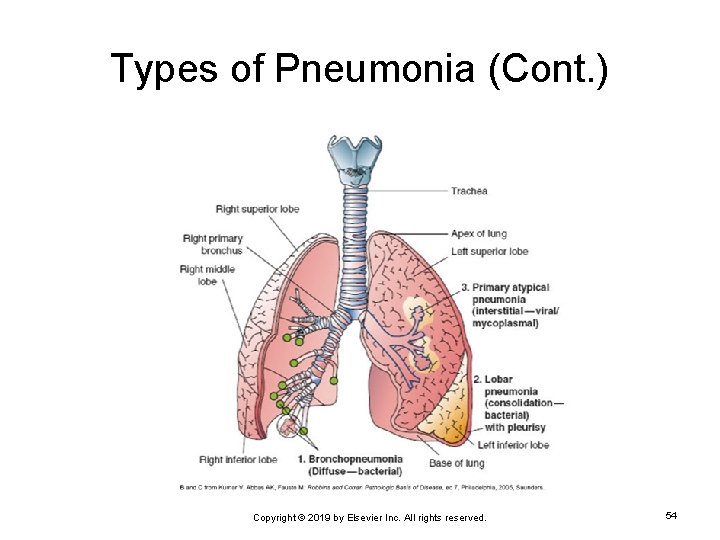
Types of Pneumonia (Cont. ) Copyright © 2019 by Elsevier Inc. All rights reserved. 54
Lobar Pneumonia Bacterial pneumonia Community-based, often in healthy young adults Ø Usually caused by Streptococcus pneumoniae Ø Infection localized in one or more lobes • Inflammation and vascular congestion—exudate forms in Ø the alveoli • Exudate contains fibrin and forms a consolidated mass • Exudate produces rusty sputum Adjacent pleurae frequently involved Ø Infection may spread to pleural cavity—empyema. Ø Copyright © 2019 by Elsevier Inc. All rights reserved. 55
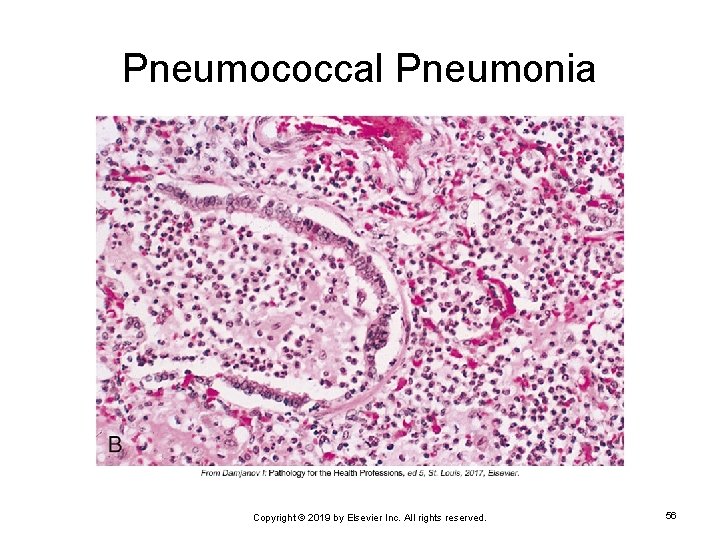
Pneumococcal Pneumonia Copyright © 2019 by Elsevier Inc. All rights reserved. 56
Lobar Pneumonia (Cont. ) Manifestations Sudden onset Ø Systemic signs • High fever with chills, fatigue, leukocytosis Ø Dyspnea, tachycardia Ø Pleural pain Ø Rales Ø Productive cough • Typical rusty-colored sputum Ø Confusion and disorientation Ø Copyright © 2019 by Elsevier Inc. All rights reserved. 57
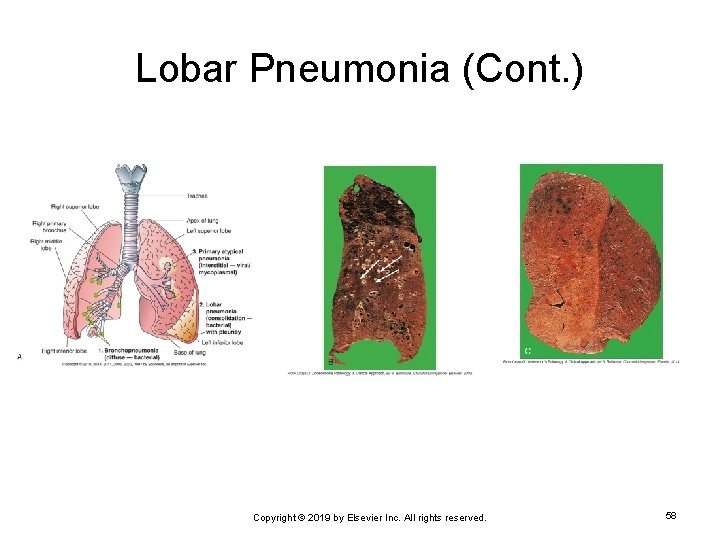
Lobar Pneumonia (Cont. ) Copyright © 2019 by Elsevier Inc. All rights reserved. 58
Bronchopneumonia Diffuse pattern of infection in both lungs Several species of microorganisms may be the cause. Inflammatory exudate forms in alveoli. Onset tends to be insidious Moderate fever, cough, rales Ø Productive cough with purulent sputum—usually yellow or green Ø Antibacterial treatment Copyright © 2019 by Elsevier Inc. All rights reserved. 59
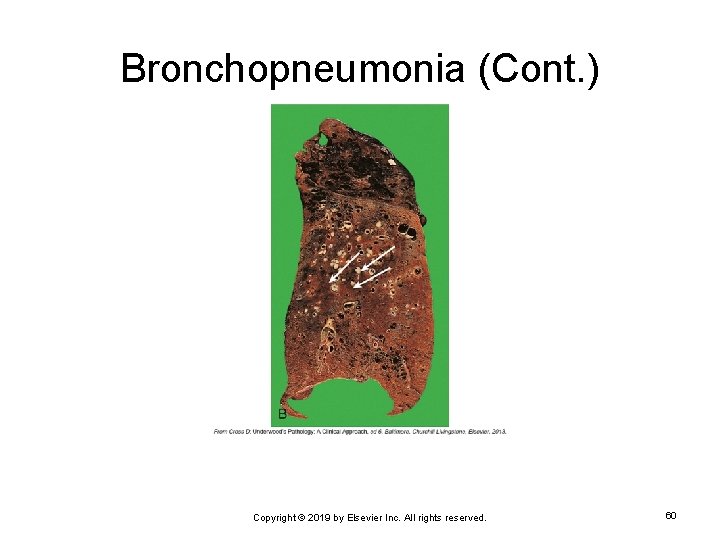
Bronchopneumonia (Cont. ) Copyright © 2019 by Elsevier Inc. All rights reserved. 60
Legionnaires Disease Caused by Legionella pneumophila Thrives in warm, moist environments Ø Often nosocomial infection Ø Difficult to identify—requires special culture medium Untreated infections Cause severe congestion and consolidation Ø Necrosis in the lung Ø Possibly fatal Ø Copyright © 2019 by Elsevier Inc. All rights reserved. 61
Primary Atypical Pneumonia Mycoplasma pneumoniae—bacterial Common in older children and young adults Transmitted by aerosol Frequent cough, antibiotic therapy Ø Viral form caused by influenza A or B, adenoviruses, RSV Ø Unproductive cough, hoarseness, sore throat, headache, mild fever, malaise Ø Infection varies greatly in severity. Ø Infection is usually self-limiting Copyright © 2019 by Elsevier Inc. All rights reserved. 62
Pneumocystis Carinii Pneumonia A type of atypical pneumonia Occurs as an opportunistic infection Often found in patients with AIDS Appears to be inhaled Causes necrosis and diffuse interstitial inflammation Onset marked with difficulty breathing and nonproductive cough Copyright © 2019 by Elsevier Inc. All rights reserved. 63
Severe Acute Respiratory Syndrome (SARS) Acute respiratory infection Causative microbe—SARS-associated coronavirus Transmission by respiratory droplets—close contact Ø First signs • Fever, headache, myalgia, chills, anorexia, possibly Ø diarrhea Ø Later signs • Effect on lungs evident—dry cough, marked dyspnea; areas of interstitial congestion, hypoxia; mechanical ventilation may be required Copyright © 2019 by Elsevier Inc. All rights reserved. 64
Severe Acute Respiratory Syndrome (SARS) (Cont. ) Treatment Antivirals, glucocorticoids Ø High fatality rate Ø Risk factors (monitored to prevent outbreaks) • Travel to endemic or epidemic area • Close contact with an infected traveler Ø Presence of a cluster of undiagnosed atypical pneumonia cases Ø Employment involving close contact with the virus • Active cases quarantined until clear of infection Ø Copyright © 2019 by Elsevier Inc. All rights reserved. 65
Tuberculosis Cause Mycobacterium tuberculosis transmitted by oral droplets from persons with active infection Ø Occurs more frequently with: • People living in crowded conditions • Immunodeficiency • Malnutrition • Alcoholism • Conditions of war • Chronic disease • HIV infection Ø Copyright © 2019 by Elsevier Inc. All rights reserved. 66
Pathophysiology Usual caused by M. tuberculosis Somewhat resistant to drying and many disinfectants Ø Can survive in dried sputum for weeks Ø Destroyed by ultraviolet light, heat, alcohol, glutaraldehyde, formaldehyde Ø Normal neutrophil response does not occur Ø Cell-mediated immunity normally protection Ø Primarily affects lungs; other organs may also be invaded Copyright © 2019 by Elsevier Inc. All rights reserved. 67
Tuberculosis Primary infection is asymptomatic. Ø When organism first enters the lungs • Engulfed by macrophages—local inflammation • If cell-mediated immunity is inadequate Ø mycobacteria reproduce and begin to destroy lung tissue. • This form of disease is contagious! Copyright © 2019 by Elsevier Inc. All rights reserved. 68
Tuberculosis (Cont. ) Secondary or re-infection with TB Occurs when client’s cell-mediated immunity is impaired because of: • Stress • Malnutrition • HIV infection • Age Ø Mycobacteria begin to reproduce and infect lung. Ø Active TB, which can be spread to others! Ø Copyright © 2019 by Elsevier Inc. All rights reserved. 69
Signs and Symptoms Secondary or active stage: Anorexia Ø Malaise Ø Fatigue Ø Weight loss Ø Afternoon low-grade fever and night sweats develop. Ø Cough is prolonged and becomes increasingly severe and, as cavitation develops, more productive. Ø Sputum becomes purulent and often contains blood. Ø Copyright © 2019 by Elsevier Inc. All rights reserved. 70
Tuberculosis If cell-mediated immunity is adequate some bacilli migrate to lymph nodes—granuloma— formation of tubercle (contains live bacilli)—walled off and calcifying. Ø tubercle may be visible on chest radiograph. Ø bacilli may remain viable in a dormant stage for years. Ø individual’s resistance and immune responses high, bacilli remain walled off. Ø primary or latent infection—individual has been exposed and infected, but does not have disease and is asymptomatic. Ø individual cannot transmit disease. Ø Copyright © 2019 by Elsevier Inc. All rights reserved. 71
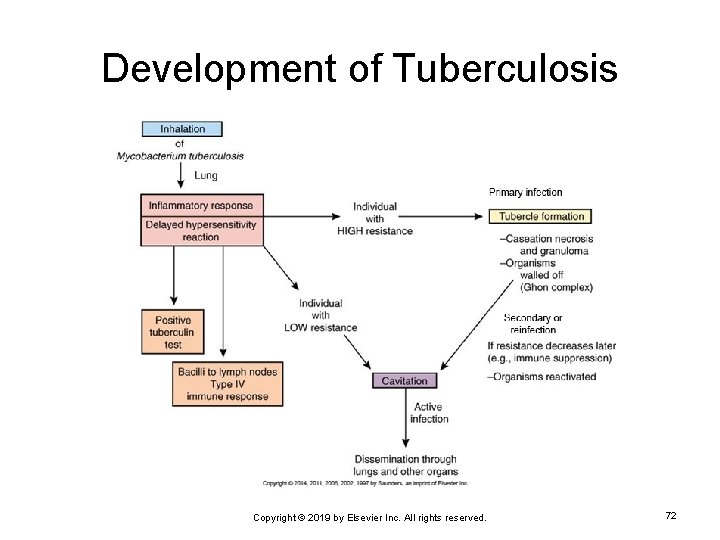
Development of Tuberculosis Copyright © 2019 by Elsevier Inc. All rights reserved. 72
Tuberculosis Miliary or extrapulmonary tuberculosis Ø Rapidly progressive form more common in children < 5 years • Early dissemination to other tissues • If lesions are not found in the lungs, this is not contagious. • Common symptoms include weight loss, failure to thrive, and other infections such as measles. Copyright © 2019 by Elsevier Inc. All rights reserved. 73
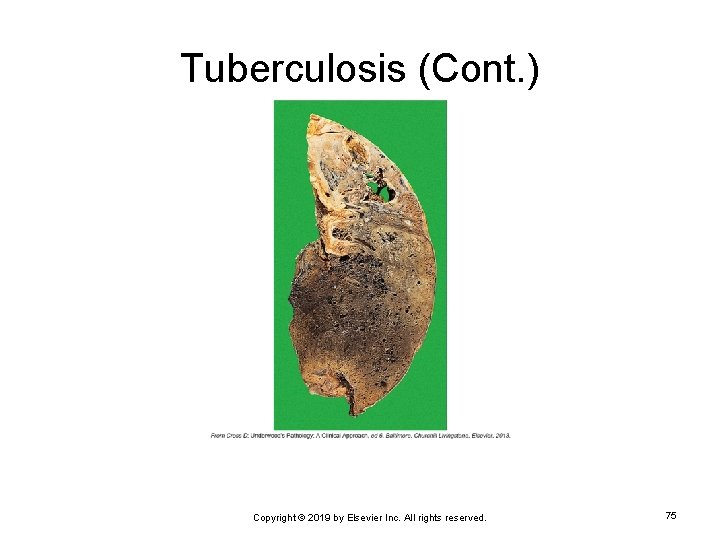
Tuberculosis (Cont. ) Active TB (primary or secondary) Organisms multiply, forming large areas of necrosis. • Cause large open areas in lung—cavitation Ø Cavitation promotes spread into other parts of lung. • Infection may spread into pleural cavity. Ø Cough, positive sputum, radiograph showing cavitation Ø Disease in this form is highly infectious when there is close personal contact over a period of time. Ø Copyright © 2019 by Elsevier Inc. All rights reserved. 74
Tuberculosis (Cont. ) Copyright © 2019 by Elsevier Inc. All rights reserved. 75
Tuberculosis (Cont. ) Diagnostic tests First exposure or primary infection • Indicated by positive tuberculin (skin) test results Ø Active infections • Acid-fast sputum test • Chest radiograph • Sputum culture and sensitivity Ø Treatment Long-term treatment with a combination of drugs Ø Length of treatment varies from 6 to 12 months Ø Copyright © 2019 by Elsevier Inc. All rights reserved. 76
Tuberculosis (Cont. ) Effective treatment requires monitoring and follow-up and is expensive TB is becoming an increasingly serious problem because of: Homelessness and crowding in shelters Ø HIV infection Ø Lack of health care Ø Multidrug resistant TB Ø Copyright © 2019 by Elsevier Inc. All rights reserved. 77
Treatment Latent tuberculosis Isoniazid (INH) Ø Rifapentine Ø Rifampin Ø Copyright © 2019 by Elsevier Inc. All rights reserved. 78
Treatment (Cont. ) Active tuberculosis Isoniazid Ø Rifampin Ø Ethambutol Ø Pyrazinamide Ø Streptomycin Ø Copyright © 2019 by Elsevier Inc. All rights reserved. 79
Histoplasmosis Fungal infection Ø Caused by Histoplasma capsulatum • Spores can be inhaled on dust particles Common opportunistic infection First stage often asymptomatic Second stage Granuloma formation and necrosis Ø Cough, fatigue, fever, night sweats Ø Treatment—antifungal agents Copyright © 2019 by Elsevier Inc. All rights reserved. 80
Anthrax Bacterial infection by gram-positive bacilli Ø Spores can be viable for long periods of time. Skin, respiratory, or digestive tract Cutaneous form Ø Inhalation form Ø Gastrointestinal form Ø Copyright © 2019 by Elsevier Inc. All rights reserved. 81
Signs and Symptoms Cutaneous Group of blisters/bumps that may itch Ø Swelling around the sore Ø Painless open skin sore with a black center that develops from blisters/bumps Ø Sores often on face, neck, arms or hands Ø Copyright © 2019 by Elsevier Inc. All rights reserved. 82
Signs and Symptoms (Cont. ) Inhalation Fever and chills Ø Chest discomfort Ø Shortness of breath Ø Confusion or dizziness Ø Cough Ø Nausea, vomiting, or stomach pains Ø Headache Ø Sweats (often drenching) Ø Extreme tiredness Ø Body aches Ø Copyright © 2019 by Elsevier Inc. All rights reserved. 83
Signs and Symptoms (Cont. ) Gastrointestinal Fever and chills Ø Swelling of neck or neck glands Ø Sore throat, painful swallowing, hoarseness Ø Nausea and vomiting, especially bloody vomiting Ø Diarrhea or bloody diarrhea Ø Headache Ø Flushing (red face) and red eyes Ø Stomach pain Ø Fainting Ø Swelling of abdomen (stomach) Ø Copyright © 2019 by Elsevier Inc. All rights reserved. 84
Treatment Antimicrobial ciprofloxacin (Cipro) Ø Anthrax antitoxin Ø Vaccines Copyright © 2019 by Elsevier Inc. All rights reserved. 85
Obstructive Lung Diseases Cystic Fibrosis Lung Cancer Aspiration Obstructive Sleep Apnea Asthma Copyright © 2019 by Elsevier Inc. All rights reserved. 86
Cystic Fibrosis Inherited (genetic) disorder Ø Gene located on chromosome 7 Tenacious mucus from exocrine glands Primary effects seen in lungs and pancreas Lungs Mucus obstructs airflow in bronchioles and small bronchi. Ø Permanent damage to bronchial walls Ø Infections are common. • Commonly caused by Pseudomonas aeruginosa and Ø Staphylococcus aureus Copyright © 2019 by Elsevier Inc. All rights reserved. 87
Cystic Fibrosis (Cont. ) Digestive tract Meconium ileus in newborns Ø Blockage of pancreatic ducts Ø Obstruction of bile ducts Ø Salivary glands often mildly affected Ø Reproductive tract Obstruction of vas deferens (male) Ø Obstruction of cervix (female) Ø Sweat glands Ø Sweat has high sodium chloride content. Copyright © 2019 by Elsevier Inc. All rights reserved. 88
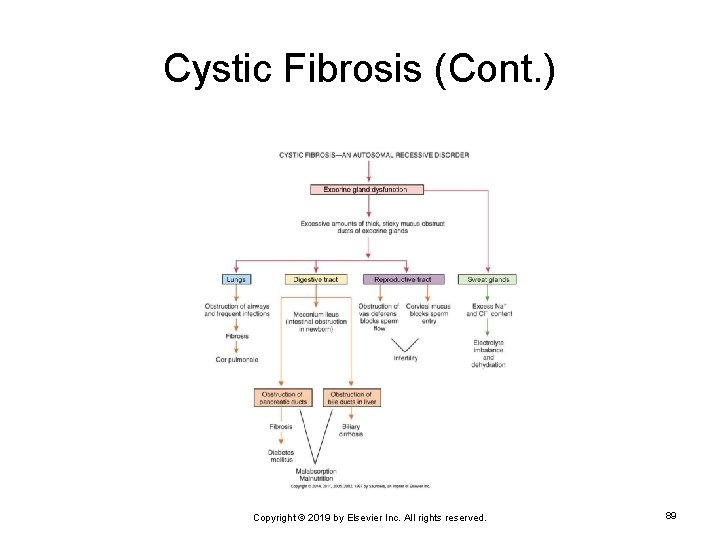
Cystic Fibrosis (Cont. ) Copyright © 2019 by Elsevier Inc. All rights reserved. 89
Cystic Fibrosis (Cont. ) Signs and symptoms Meconium ileus may occur at birth. Ø Salty skin • May lead to performing sweat test and diagnosis of cystic Ø fibrosis Signs of malabsorption • Steatorrhea, abdominal distention Ø Chronic cough and frequent respiratory infections • Tend to increase over time Ø Failure to meet normal growth milestones Ø Copyright © 2019 by Elsevier Inc. All rights reserved. 90
Cystic Fibrosis (Cont. ) Diagnosis Genetic testing Ø Sweat test Ø Testing of stool Ø Radiography, pulmonary function tests Ø Blood gas analysis Ø Treatment Ø Interdisciplinary approach • Replacement therapy and well-balanced diet • Chest physiotherapy Copyright © 2019 by Elsevier Inc. All rights reserved. 91
Lung Cancer About 90% of cases are related to smoking. Bronchogenic carcinoma Most common type of primary malignant lung tumor Ø Arises from bronchial epithelium Ø Squamous cell carcinoma Ø Usually develops from epithelial lining of a bronchus Adenocarcinomas and bronchoalveolar cell carcinomas Ø Usually found on periphery of lung Copyright © 2019 by Elsevier Inc. All rights reserved. 92
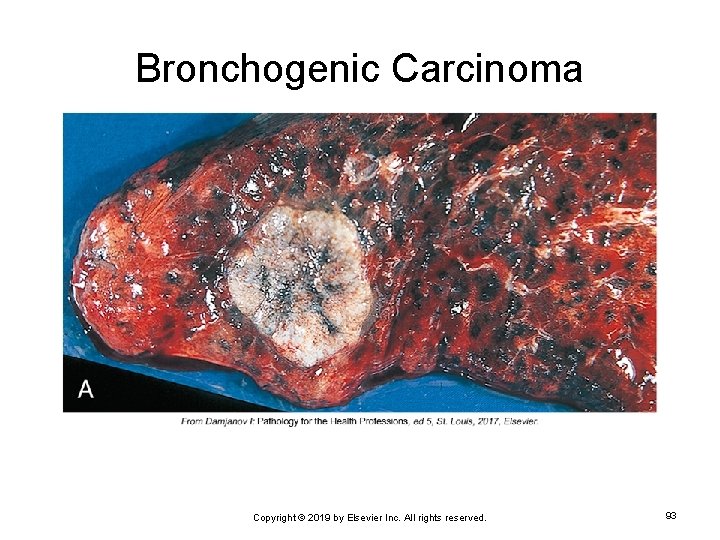
Bronchogenic Carcinoma Copyright © 2019 by Elsevier Inc. All rights reserved. 93
Lung Tumor Effects Obstruction of airflow into a bronchus Ø Inflammation and bleeding surrounding the tumor Ø Cough, hemoptysis, and secondary infections Pleural effusion, hemothorax, pneumothorax Paraneoplastic syndrome Ø Causes abnormal breath sounds and dyspnea Occurs when tumor cell secretes hormones or hormone-like substances Usual systemic effects of cancer Copyright © 2019 by Elsevier Inc. All rights reserved. 94
Signs and Symptoms Early signs Persistent productive cough Ø Detection on radiograph Ø Hemoptysis Ø Pleural involvement Ø Chest pain Ø Hoarseness, facial or arm edema, headache, dysphagia, or atelectasis Ø Copyright © 2019 by Elsevier Inc. All rights reserved. 95
Signs and Symptoms (Cont. ) Systemic signs Ø Paraneoplastic syndrome Ø Weight loss, anemia, fatigue Indicated by signs of an endocrine disorder • Related to the specific hormone secreted Signs of metastases Bone pain Ø Cognitive deficits, motor deficits Ø Copyright © 2019 by Elsevier Inc. All rights reserved. 96
Diagnostic Tests Specialized helical CT scans and MRI Chest radiography Bronchoscopy Biopsy and mediastinoscopy Copyright © 2019 by Elsevier Inc. All rights reserved. 97
Treatment Radiofrequency ablation Surgical resection or lobectomy Chemotherapy and radiation Photodynamic therapy Copyright © 2019 by Elsevier Inc. All rights reserved. 98
Aspiration Passage of food, fluid, emesis, other foreign material into trachea and lungs Common problem in young children or individuals laying down when eating or drinking Result may be: Obstruction • Aspirate is a solid object. Ø Inflammation and swelling • Aspirate is an irritating liquid. Ø Predisposition to pneumonia Ø Copyright © 2019 by Elsevier Inc. All rights reserved. 99
Aspiration (Cont. ) Potential complications Aspiration pneumonia • Inflammation—gas diffusion is impaired. Ø Respiratory distress syndrome • May develop if inflammation is widespread Ø Pulmonary abscess • May develop if microbes are in aspirate Ø Systemic effects • When aspirated materials (solvents) are absorbed into blood Ø Copyright © 2019 by Elsevier Inc. All rights reserved. 100
Signs and Symptoms Coughing and choking with dyspnea Loss of voice if total obstruction Stridor and hoarseness Ø Wheezing Ø Aspiration of liquids Tachycardia and tachypnea Nasal flaring, chest retractions, hypoxia Ø Characteristic of upper airway obstruction In individuals with severe respiratory distress Cardiac or respiratory arrest Copyright © 2019 by Elsevier Inc. All rights reserved. 101
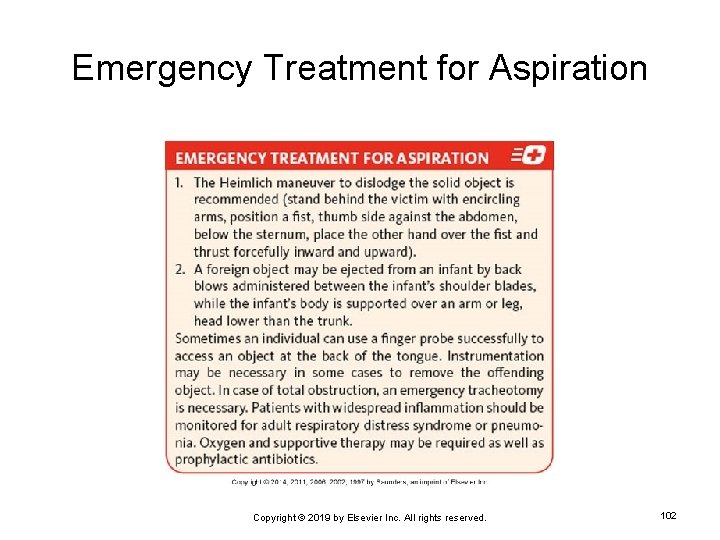
Emergency Treatment for Aspiration Copyright © 2019 by Elsevier Inc. All rights reserved. 102
Obstructive Sleep Apnea Result of pharyngeal tissue collapse during sleep Leads to repeated and momentary cessation of breathing Ø Men are affected more often than women. Ø Obesity and aging are common predisposing factors. Ø Treatment Continuous positive airway pressure pump (CPAP machine) Ø Oral appliances that reduce collapse of pharyngeal tissue Ø Copyright © 2019 by Elsevier Inc. All rights reserved. 103
Asthma Bronchial obstruction Ø Occurs in persons with hypersensitive or hyperresponsive airways May occur in childhood or have an adult onset Often family history of allergic conditions Copyright © 2019 by Elsevier Inc. All rights reserved. 104
Asthma (Cont. ) Extrinsic asthma Ø Acute episodes triggered by type I hypersensitivity reactions Intrinsic asthma Ø Ø Ø Onset during adulthood Hyperresponsive tissue in airway initiates attack Stimuli include: • Respiratory infections • Stress • Exposure to cold • Inhalation of irritants • Exercise • Drugs Copyright © 2019 by Elsevier Inc. All rights reserved. 105
Asthma (Cont. ) Pathophysiologic changes of bronchi and bronchioles Ø Inflammation of the mucosa with edema Ø Bronchoconstriction • Caused by contraction of smooth muscle Ø Increased secretion of thick mucus • In airways Changes create obstructed airways, partial or total. Copyright © 2019 by Elsevier Inc. All rights reserved. 106
Signs and Symptoms Cough, marked dyspnea, tight feeling in chest Wheezing Rapid and labored breathing Expulsion of thick or sticky mucus Tachycardia Ø Might include pulsus paradoxus • Pulse differs on inspiration and expiration Hypoxia Copyright © 2019 by Elsevier Inc. All rights reserved. 107
Signs and Symptoms (Cont. ) Respiratory alkalosis Ø Respiratory acidosis Ø Caused by air trapping Severe respiratory distress Ø Initially caused by hyperventilation Hypoventilation leads to hypoxemia and respiratory acidosis. Respiratory failure Ø Indicated by decreasing responsiveness, cyanosis Copyright © 2019 by Elsevier Inc. All rights reserved. 108
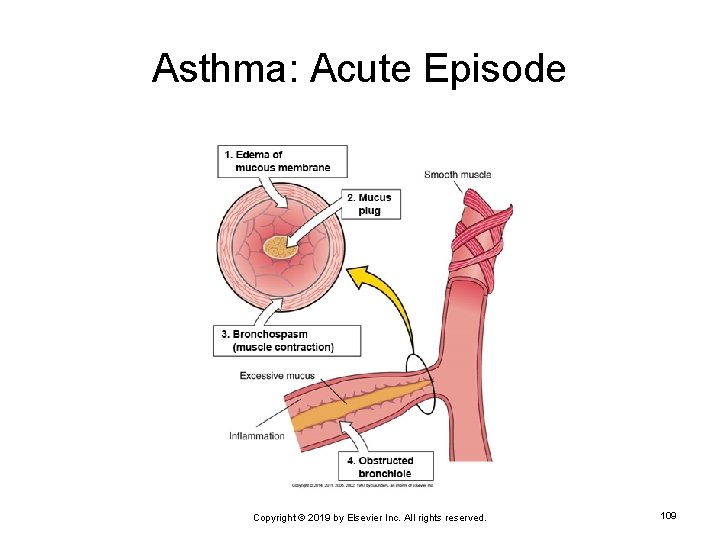
Asthma: Acute Episode Copyright © 2019 by Elsevier Inc. All rights reserved. 109
Asthma: Acute Episode (Cont. ) Status asthmaticus Ø Persistent severe attack of asthma • Does not respond to usual therapy • Medical emergency! • May be fatal because of severe hypoxia and acidosis Copyright © 2019 by Elsevier Inc. All rights reserved. 110
Treatment General measures Skin tests for allergic reactions Ø Avoidance of triggering factors Ø Good ventilation of environment Ø Swimming and walking Ø Use of maintenance inhalers or drugs Ø Measures for acute attacks Controlled breathing techniques Ø Inhalers • Bronchodilators Ø Glucocorticoids Ø Copyright © 2019 by Elsevier Inc. All rights reserved. 111
Treatment (Cont. ) Measures for status asthmaticus Ø Hospital care if no response to bronchodilator Prophylaxis and treatment for chronic asthma Leukotriene receptor antagonists • Block inflammatory responses in presence of stimulus • Not effective for treatment of acute attacks Ø Cromolyn sodium • Prophylactic medication • Inhalation on a daily basis • Useful for athletes and sports enthusiasts • No value during an acute attack Ø Copyright © 2019 by Elsevier Inc. All rights reserved. 112
Chronic Obstructive Pulmonary Disease Emphysema Chronic Bronchitis Bronchiectasis Copyright © 2019 by Elsevier Inc. All rights reserved. 113
Chronic Obstructive Pulmonary Disease (Cont. ) Group of chronic respiratory disorders Causes irreversible and progressive damage to lungs Debilitating conditions that may affect individual’s ability to work May lead to the development of cor pulmonale Respiratory failure may occur. Copyright © 2019 by Elsevier Inc. All rights reserved. 114
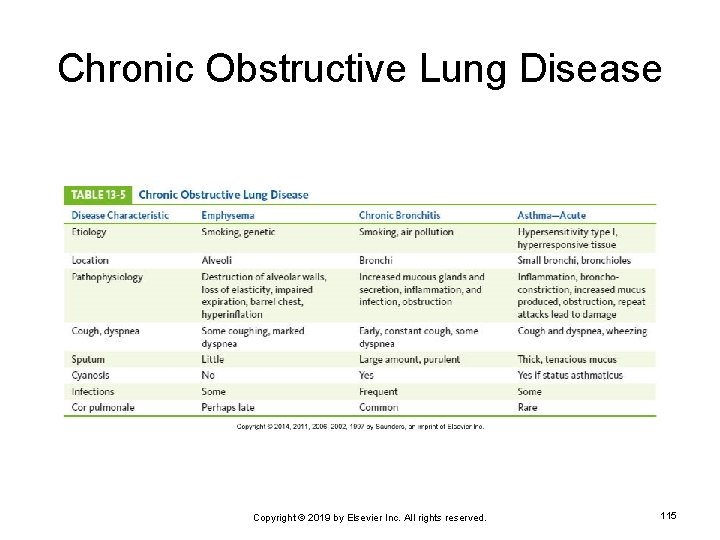
Chronic Obstructive Lung Disease Copyright © 2019 by Elsevier Inc. All rights reserved. 115
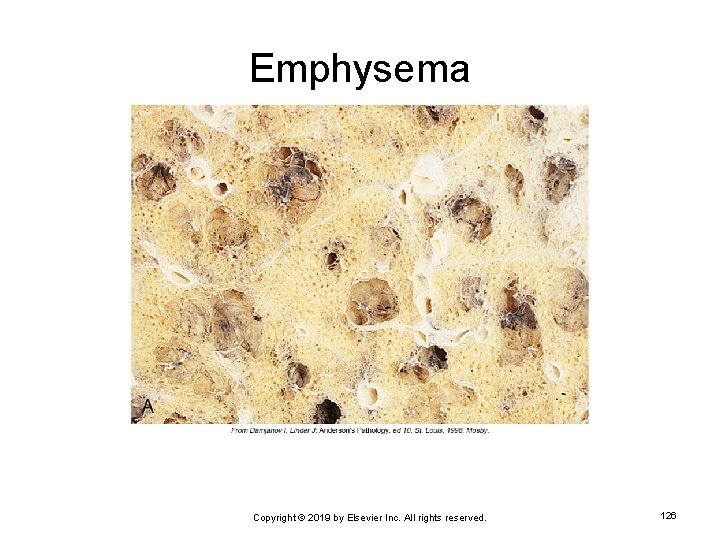
Emphysema Destruction of alveolar walls and septae Ø Leads to large, permanently inflated alveolar air spaces Classified by specific location of changes Contributing factors Genetic deficiency Ø Genetic tendency Ø Cigarette smoking Ø Pathogenic bacteria Ø Copyright © 2019 by Elsevier Inc. All rights reserved. 116
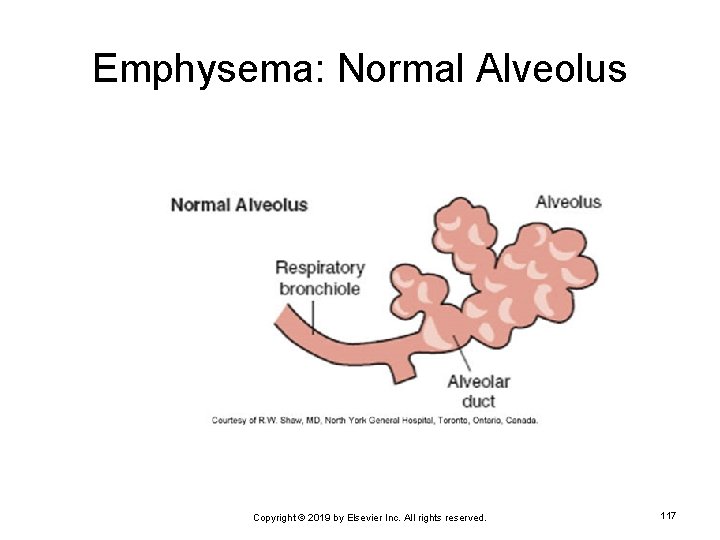
Emphysema: Normal Alveolus Copyright © 2019 by Elsevier Inc. All rights reserved. 117
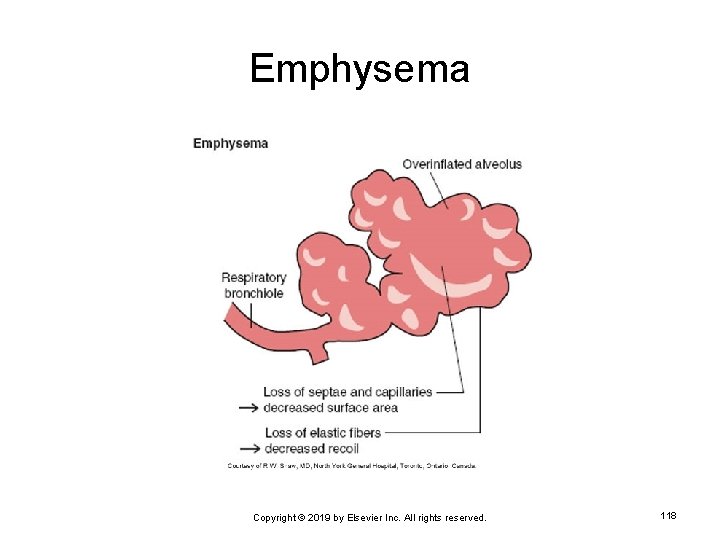
Emphysema Copyright © 2019 by Elsevier Inc. All rights reserved. 118
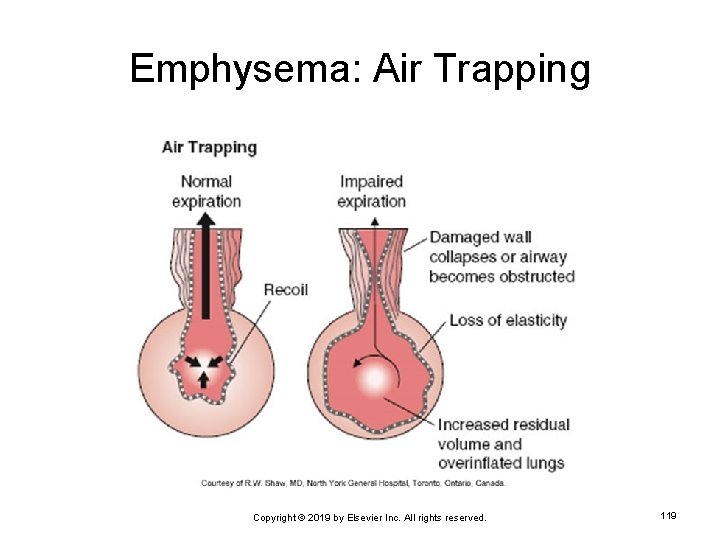
Emphysema: Air Trapping Copyright © 2019 by Elsevier Inc. All rights reserved. 119
Emphysema (Cont. ) Breakdown of alveolar wall results in loss of surface area for gas exchange. Ø loss of pulmonary capillaries. Ø loss of elastic fibers. Ø altered ventilation-perfusion ratio. Ø decreased support for other structures. Ø Fibrosis Narrowed airways Ø Weakened walls Ø Interference with passive expiratory airflow Ø Copyright © 2019 by Elsevier Inc. All rights reserved. 120
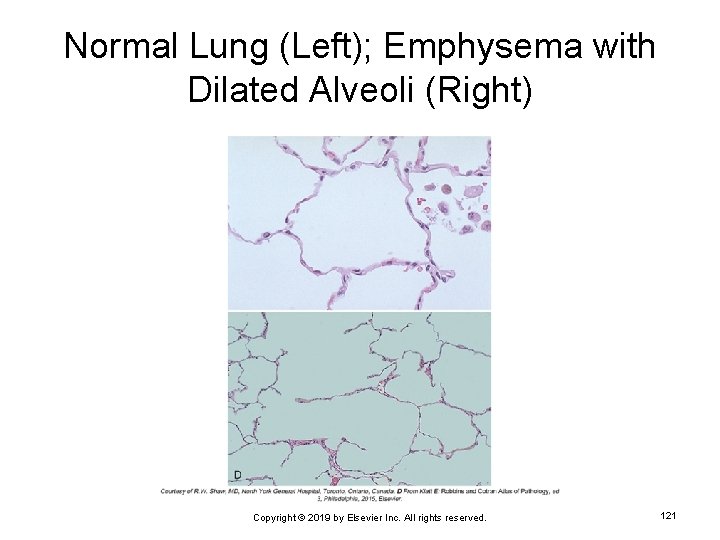
Normal Lung (Left); Emphysema with Dilated Alveoli (Right) Copyright © 2019 by Elsevier Inc. All rights reserved. 121
Emphysema (Cont. ) Progressive difficulty with expiration Air trapping and increased residual volume Ø Overinflation of the lungs Ø Fixation of ribs in an respiratory position, increased anterior-posterior diameter of thorax (barrel chest) Ø Flattened diaphragm (on radiographs) Ø Copyright © 2019 by Elsevier Inc. All rights reserved. 122
Emphysema (Cont. ) Advanced emphysema and loss of tissue Adjacent damaged alveoli coalesce, forming large air spaces. Ø Pneumothorax • Occurs when pleural membrane surrounding large blebs Ø ruptures Hypercapnia becomes marked. Ø Hypoxia becomes driving force of respiration. Ø Frequent infections Ø Pulmonary hypertension and cor pulmonale may develop in late stage. Ø Copyright © 2019 by Elsevier Inc. All rights reserved. 123
Signs and Symptoms Dyspnea Ø Hyperventilation with prolonged expiratory phase Ø Development of barrel chest Anorexia and fatigue Ø Occurs first on exertion Weight loss Clubbed fingers Copyright © 2019 by Elsevier Inc. All rights reserved. 124
Diagnostic Tests Chest radiography Pulmonary function tests Copyright © 2019 by Elsevier Inc. All rights reserved. 125
Emphysema Copyright © 2019 by Elsevier Inc. All rights reserved. 126
Treatment Avoidance of respiratory irritants Immunization against influenza and pneumonia Pulmonary rehabilitation Appropriate breathing techniques Adequate nutrition and hydration Ø Improves energy levels, resistance to infection Bronchodilators, antibiotics, oxygen therapy as condition advances Lung reduction surgery Copyright © 2019 by Elsevier Inc. All rights reserved. 127
Chronic Bronchitis Inflammation, obstruction, repeated infection, chronic coughing twice for 3 months or longer in 2 years • History of cigarette smoking or living in urban or industrial area Mucosa inflamed and swollen Ø Hypertrophy and hyperplasia of mucous glands Ø Fibrosis and thickening of bronchial wall Ø Low oxygen levels Ø Severe dyspnea and fatigue Ø Pulmonary hypertension and cor pulmonale Ø Copyright © 2019 by Elsevier Inc. All rights reserved. 128
Signs and Symptoms Constant productive cough Tachypnea and shortness of breath Frequent thick and purulent secretions Cough and rhonchi more severe in the morning Hypoxia, cyanosis, hypercapnia Ø Caused by airway obstruction Polycythemia, weight loss, signs of cor pulmonale possible As vascular damage and pulmonary hypertension progress Copyright © 2019 by Elsevier Inc. All rights reserved. 129
Treatment Treatment Cessation of smoking and reduction of exposure to irritants Treatment of infection Vaccination for prophylaxis Expectorants Bronchodilator Appropriate chest therapy Ø Including postural drainage and percussion Low-flow oxygen Nutritional supplements Copyright © 2019 by Elsevier Inc. All rights reserved. 130
Bronchiectasis Usually a secondary condition Irreversible abnormal dilation of the mediumsized bronchi (primarily) Ø Arises from recurrent inflammation and infection Ø May be saccular or elongated Leads to obstruction of airways, weakening of muscle and elastic fibers in bronchial walls, or both Infecting organisms Ø Usually mixed • Streptococci, staphylococci, pneumococci, H. influenzae Copyright © 2019 by Elsevier Inc. All rights reserved. 131
Signs and Symptoms Chronic cough Ø Large amounts of sputum Rales and rhonchi in the lungs Foul breath Dyspnea Hemoptysis Weight loss Anemia Fatigue Copyright © 2019 by Elsevier Inc. All rights reserved. 132
Treatment Antibiotics Bronchodilators Chest physiotherapy Treatment of primary condition Copyright © 2019 by Elsevier Inc. All rights reserved. 133
Restrictive Lung Disorders Group of disorders with impaired lung expansion and reduced total lung capacity First group Ø Abnormality of chest wall—limits or impairs lung expansion • Kyphosis or scoliosis, poliomyelitis, amyotrophic lateral sclerosis, botulism, muscular dystrophy Second group Ø Diseases affecting the supporting framework of lungs • Idiopathic pulmonary fibrosis, occupational diseases Copyright © 2019 by Elsevier Inc. All rights reserved. 134
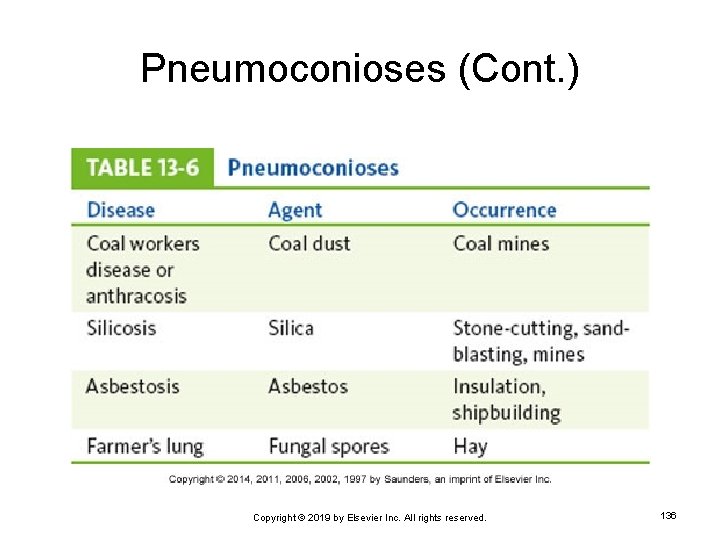
Pneumoconioses Chronic restrictive diseases resulting from longterm exposure to irritating particles Inflammation—gradual destruction of connective tissue Ø Onset insidious Ø Functional areas of the lungs lost Dyspnea develops first Treatment—ending exposure, treatment of infection Copyright © 2019 by Elsevier Inc. All rights reserved. 135
Pneumoconioses (Cont. ) Copyright © 2019 by Elsevier Inc. All rights reserved. 136
Vascular Disorders Pulmonary Edema Pulmonary Embolus Copyright © 2019 by Elsevier Inc. All rights reserved. 137
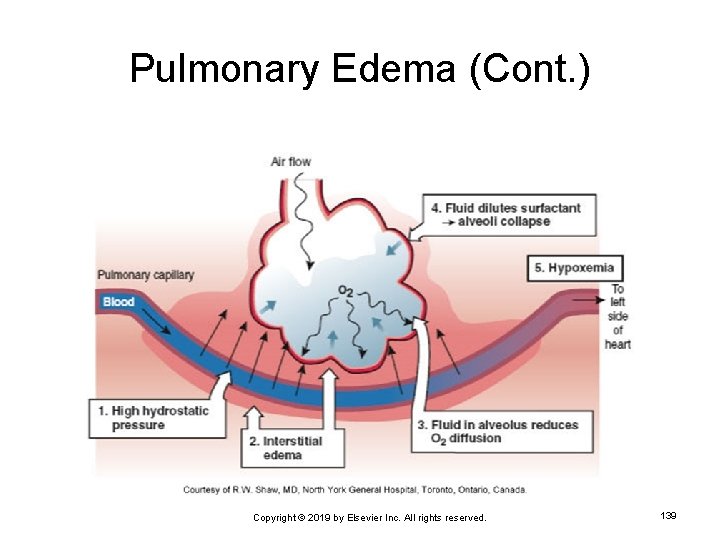
Pulmonary Edema Fluid collecting in alveoli and interstitial area Can result from many primary conditions Ø Reduces amount of oxygen diffusing into blood Ø Interferes with lung expansion Ø May develop when Inflammation in lungs is present. • Increases permeability of capillaries Ø Plasma protein levels are low. • Decreases osmotic pressure of plasma Ø Pulmonary hypertension develops. Ø Copyright © 2019 by Elsevier Inc. All rights reserved. 138
Pulmonary Edema (Cont. ) Copyright © 2019 by Elsevier Inc. All rights reserved. 139
Signs and Symptoms Mild pulmonary edema Cough Ø Orthopnea Ø Rales Ø With increased congestion hemoptysis often occurs. Ø sputum is frothy. Ø breathing becomes. Ø hypoxemia increases. Ø cyanosis develops in the advanced stage. Ø Copyright © 2019 by Elsevier Inc. All rights reserved. 140
Treatment Treat causative factors Supportive care Possibility of positive-pressure mechanical ventilation Copyright © 2019 by Elsevier Inc. All rights reserved. 141
Pulmonary Embolus Blood clot or mass that obstructs pulmonary artery or any of its branches Effect of embolus depends on material, size, and location. Small pulmonary emboli might be “silent” unless they involve a large area of lung. Large emboli may cause sudden death. 90% of pulmonary emboli originate from deep vein thromboses in legs and are preventable. Copyright © 2019 by Elsevier Inc. All rights reserved. 142
Signs and Symptoms Small emboli Transient chest pain Ø Cough Ø Dyspnea may occur Ø Larger emboli Chest pain Ø Tachypnea Ø Dyspnea develops suddenly. Ø Later, hemoptysis and fever are present. Ø Hypoxia stimulates a sympathetic response, with anxiety and restlessness, pallor, and tachycardia. Ø Copyright © 2019 by Elsevier Inc. All rights reserved. 143
Signs and Symptoms (Cont. ) Massive emboli Severe crushing chest pain Ø Low blood pressure Ø Rapid weak pulse Ø Loss of consciousness Ø Copyright © 2019 by Elsevier Inc. All rights reserved. 144
Pulmonary Embolus Prevention Health teaching prior to surgery Ø Antiembolic stockings Ø Exercise to prevent thrombosis Ø Use of anticoagulant drugs Ø Diagnosis Ø Radiography, lung scan, MRI, pulmonary angiography Copyright © 2019 by Elsevier Inc. All rights reserved. 145
Treatment Assessment of risk factors Prolonged bed rest and compression stockings Surgically Inserted filter into vena cava (some cases) Heparin or streptokinase Mechanical ventilation Embolectomy Copyright © 2019 by Elsevier Inc. All rights reserved. 146
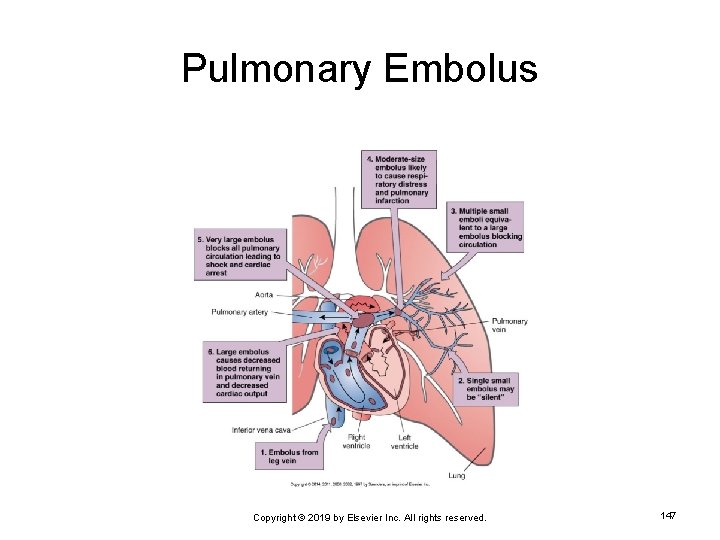
Pulmonary Embolus Copyright © 2019 by Elsevier Inc. All rights reserved. 147
Expansion Disorders Atelectasis Pleural effusion Pneumothorax Flail chest Infant respiratory distress syndrome Acute respiratory failure Copyright © 2019 by Elsevier Inc. All rights reserved. 148
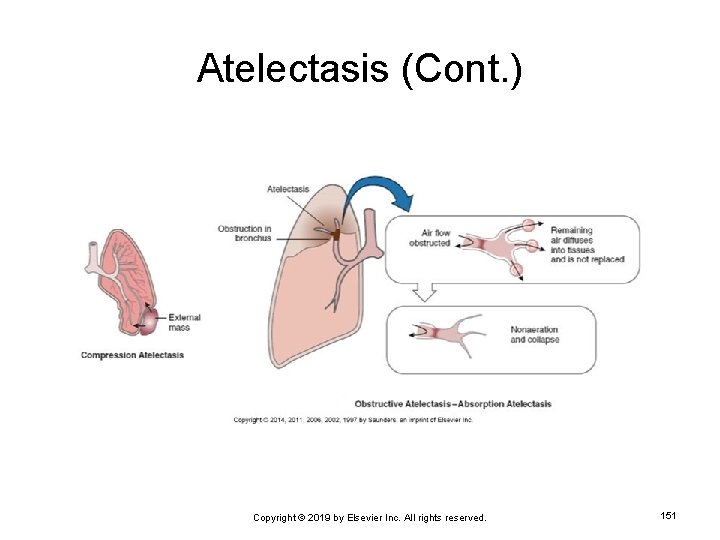
Atelectasis Nonaeration or collapse of lung or part of a lung Ø Alveoli become airless. Ø Leads to decreased gas exchange and hypoxia Collapse and inflammation or atrophy occur. Process interferes with blood flow through the lung. Both ventilation and perfusion are altered. Ø Affects oxygen diffusion Copyright © 2019 by Elsevier Inc. All rights reserved. 149
Atelectasis (Cont. ) Mechanisms that can result in atelectasis Obstructive or resorption atelectasis • Caused by total obstruction of airway Ø Compression atelectasis • Mass or tumor exerts pressure on part of the lung. Ø Increased surface tension in alveoli • Prevents expansion of lung Ø Fibrotic tissue in lungs or pleura • May restrict expansion and lead to collapse Ø Postoperative atelectasis • Can occur after surgery Ø Copyright © 2019 by Elsevier Inc. All rights reserved. 150
Atelectasis (Cont. ) Copyright © 2019 by Elsevier Inc. All rights reserved. 151
Signs and Symptoms Signs and symptoms Small areas are asymptomatic. Large areas Dyspnea Ø Increased heat and respiratory rates Ø Chest pain Ø Copyright © 2019 by Elsevier Inc. All rights reserved. 152
Treatment Result of surgery Deep breathing exercises Ø Changing body positions Ø Forced coughing Ø Caused by external pressure Ø Removal of fluid, tissue or tumor causing the pressure on the lungs Caused by blockage Chest clapping or percussion Ø Postural drainage Ø Medications to open airways and loosen mucus Ø Copyright © 2019 by Elsevier Inc. All rights reserved. 153
Pleural Effusion Presence of excessive fluid in the pleural cavity Causes increased pressure in pleural cavity Ø Exudative effusions Ø Separation of pleural membranes Response to inflammation Transudate effusions Watery effusions (hydrothorax) Ø Result of increased hydrostatic pressure or decreased osmotic pressure in blood vessels Ø Copyright © 2019 by Elsevier Inc. All rights reserved. 154
Signs and Symptoms Dyspnea Chest pain Increased respiratory and heart rates Usually dullness to percussion and absence of breath sounds over the affected area Tracheal deviation and hypotension Copyright © 2019 by Elsevier Inc. All rights reserved. 155
Treatment Remove underlying cause to treat respiratory impairment. Analyze fluid to confirm cause Chest drainage, thoracocentesis to remove fluid and relieve pressure Copyright © 2019 by Elsevier Inc. All rights reserved. 156
Pneumothorax Air in pleural cavity Closed pneumothorax Air can enter pleural cavity from internal airways—no opening in chest wall. Ø Simple or spontaneous pneumothorax • Tear on the surface of the lung Ø Secondary pneumothorax • Associated with underlying respiratory disease • Rupture of an emphysematous bleb on lung surface or Ø erosion by a tumor or tubercular cavitation Copyright © 2019 by Elsevier Inc. All rights reserved. 157
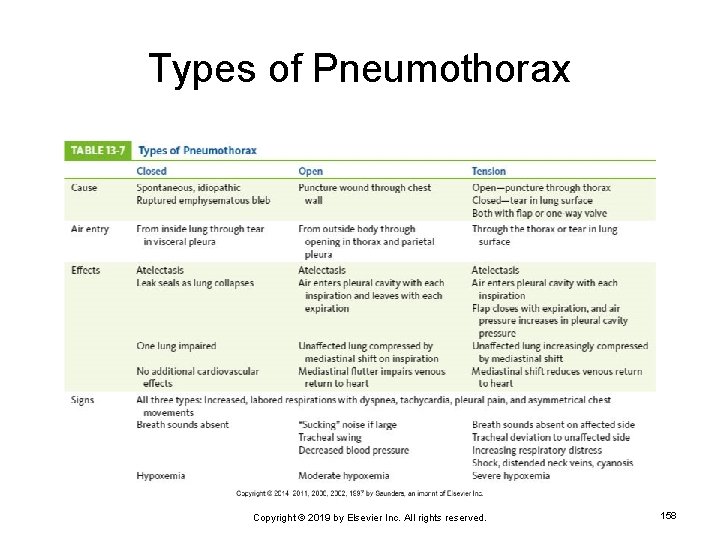
Types of Pneumothorax Copyright © 2019 by Elsevier Inc. All rights reserved. 158
Pneumothorax (Cont. ) Open pneumothorax Atmospheric air enters the pleural cavity though an opening in the chest wall. Ø “Sucking” wound • Large opening in chest wall Ø Tension pneumothorax • Most serious form • Result of an opening through chest wall and parietal pleura Ø or from a tear in the lung tissue and visceral pleura • Air enters into pleural cavity on inspiration but hole closes on expiration. • Trapping air leads to increased pleural pressure and atelectasis. Copyright © 2019 by Elsevier Inc. All rights reserved. 159
Signs and Symptoms Atelectasis Dyspnea Cough Chest pain Breath sounds are reduced Unequal chest expansion Hypoxia Interference with venous return leads to hypotension Copyright © 2019 by Elsevier Inc. All rights reserved. 160
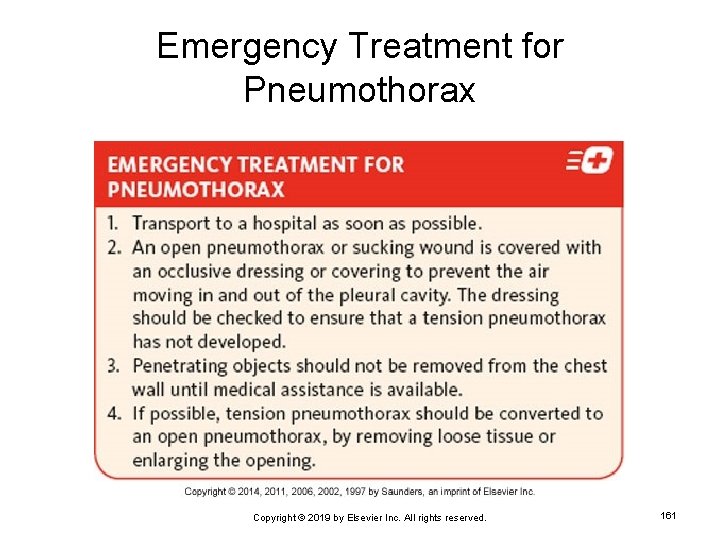
Emergency Treatment for Pneumothorax Copyright © 2019 by Elsevier Inc. All rights reserved. 161
Flail Chest Results from fractures of ribs, which allow ribs to move independently during respiration During inspiration Flail or broken section moves inward rather than outward. Ø Inward movement of ribs prevents expansion of affected lung. Ø Large flail section can compress adjacent lung tissue. • Pushing air out of that section—up the bronchus • Air (stale) from damaged lung crosses into the other lung with Ø newly inspired air. Copyright © 2019 by Elsevier Inc. All rights reserved. 162
Flail Chest (Cont. ) During expiration Unstable fail section pushed outward by increasing intrathoracic pressure Ø Large flail section • Paradoxical movement of ribs alters airflow during expiration. Ø Air from unaffected lung moves across into affected lung. Ø Hypoxia results from limited expansion and decreased inspiratory volume. Copyright © 2019 by Elsevier Inc. All rights reserved. 163
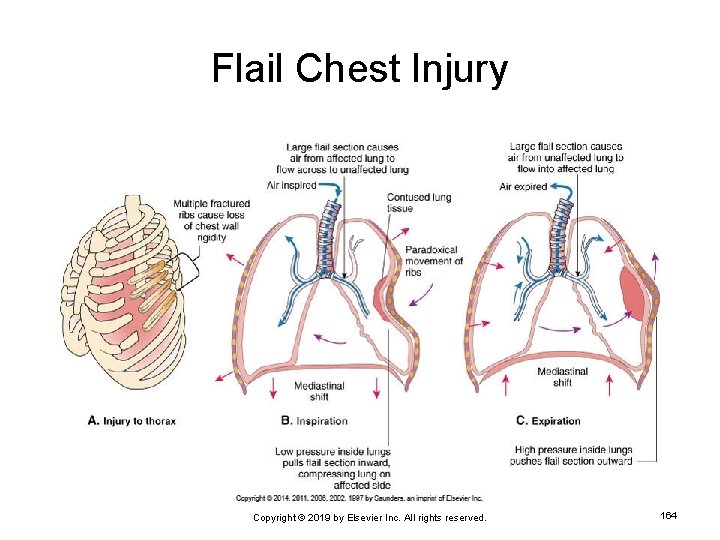
Flail Chest Injury Copyright © 2019 by Elsevier Inc. All rights reserved. 164
Infant Respiratory Distress Syndrome Usually related to premature birth Lack of surfactant in alveoli Poorly developed alveoli are difficult to inflate. Diffuse atelectasis results. Ø Decreased pulmonary blood flow—pulmonary vasoconstriction—severe hypoxia Ø Poor lung perfusion and lack of surfactant Increased alveolar capillary permeability Ø Fluid and protein are leaking into the interstitial area and alveoli, hyaline membrane formation. Ø Copyright © 2019 by Elsevier Inc. All rights reserved. 165
Signs and Symptoms Respiratory difficulties may be evident at birth. Respirations rapid and shallow Frothy sputum and expiratory grunt Blood pressure falls. Cyanosis and peripheral edema Severe hypoxemia and decreased responsiveness Irregular respirations with periods of apnea Ø Decreased breath sounds Copyright © 2019 by Elsevier Inc. All rights reserved. 166
Infant Respiratory Distress Syndrome Diagnostic tests Ø Arterial blood gas analysis Treatment Glucocorticoids for women in premature labor Ø Synthetic surfactant for high-risk neonate Ø Ventilation using CPAP Ø Oxygen therapy Ø Nitrous oxide drugs Ø Copyright © 2019 by Elsevier Inc. All rights reserved. 167
Adult Respiratory Distress Syndrome Results from injury to the alveolar wall and capillary membrane Causes the release of chemical mediators • Increases permeability of alveolar capillary membranes • Increased fluid and protein in interstitial area and alveoli • Damage to surfactant-producing cells • Diffuse necrosis and fibrosis if patient survives Ø Multitude of predisposing conditions Ø Often associated with multiple organ dysfunction or failure Ø Copyright © 2019 by Elsevier Inc. All rights reserved. 168
Signs and Symptoms Dyspnea Restlessness Rapid, shallow respiration Increased heart rate Combination of respiratory and metabolic acidosis Copyright © 2019 by Elsevier Inc. All rights reserved. 169
Treatment of underlying cause Supportive respiratory therapy Copyright © 2019 by Elsevier Inc. All rights reserved. 170
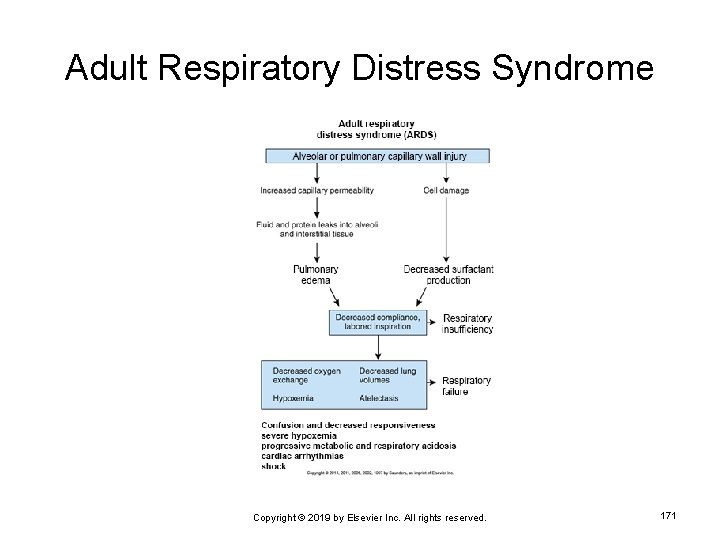
Adult Respiratory Distress Syndrome Copyright © 2019 by Elsevier Inc. All rights reserved. 171
Acute Respiratory Failure May result from acute or chronic disorders Emphysema Ø Combination of chronic and acute disorders Ø Acute respiratory disorders Ø Many neuromuscular diseases Ø Signs may be masked or altered by primary problem Ø Treatment Primary problem must be resolved. Ø Supportive treatment to maintain respiratory function Ø Copyright © 2019 by Elsevier Inc. All rights reserved. 172
- Slides: 172