
Chapter 13 Reliability THE MANAGEMENT AND CONTROL OF
Chapter 13 Reliability THE MANAGEMENT AND CONTROL OF QUALITY, 5 e, © 2002 South-Western/Thomson Learning. TM 1
Reliability • Generally defined as the ability of a product to perform as expected over time • Formally defined as the probability that a product, piece of equipment, or system performs its intended function for a stated period of time under specified operating conditions THE MANAGEMENT AND CONTROL OF QUALITY, 5 e, © 2002 South-Western/Thomson Learning. TM 2
Maintainability • The probability that a system or product can be retained in, or one that has failed can be restored to, operating condition in a specified amount of time. THE MANAGEMENT AND CONTROL OF QUALITY, 5 e, © 2002 South-Western/Thomson Learning. TM 3
Types of Failures • Functional failure – failure that occurs at the start of product life due to manufacturing or material detects • Reliability failure – failure after some period of use THE MANAGEMENT AND CONTROL OF QUALITY, 5 e, © 2002 South-Western/Thomson Learning. TM 4

Types of Reliability • Inherent reliability – predicted by product design • Achieved reliability – observed during use THE MANAGEMENT AND CONTROL OF QUALITY, 5 e, © 2002 South-Western/Thomson Learning. TM 5

Reliability Measurement • Failure rate (l) – number of failures per unit time • Alternative measures – Mean time to failure – Mean time between failures THE MANAGEMENT AND CONTROL OF QUALITY, 5 e, © 2002 South-Western/Thomson Learning. TM 6
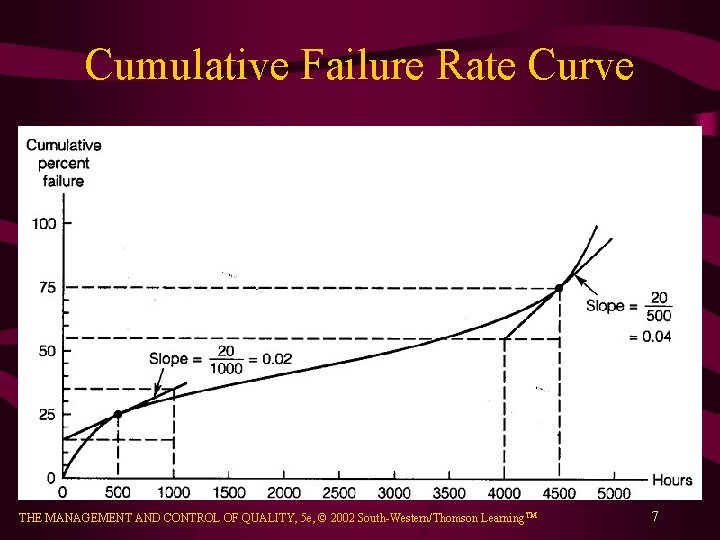
Cumulative Failure Rate Curve THE MANAGEMENT AND CONTROL OF QUALITY, 5 e, © 2002 South-Western/Thomson Learning. TM 7
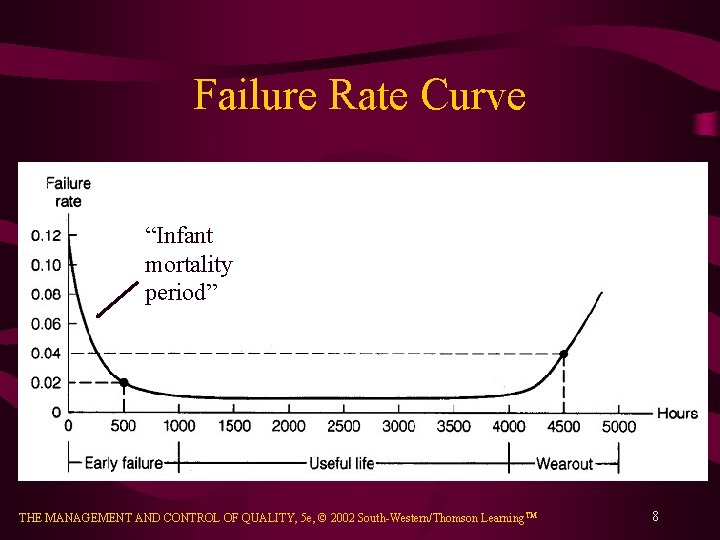
Failure Rate Curve “Infant mortality period” THE MANAGEMENT AND CONTROL OF QUALITY, 5 e, © 2002 South-Western/Thomson Learning. TM 8
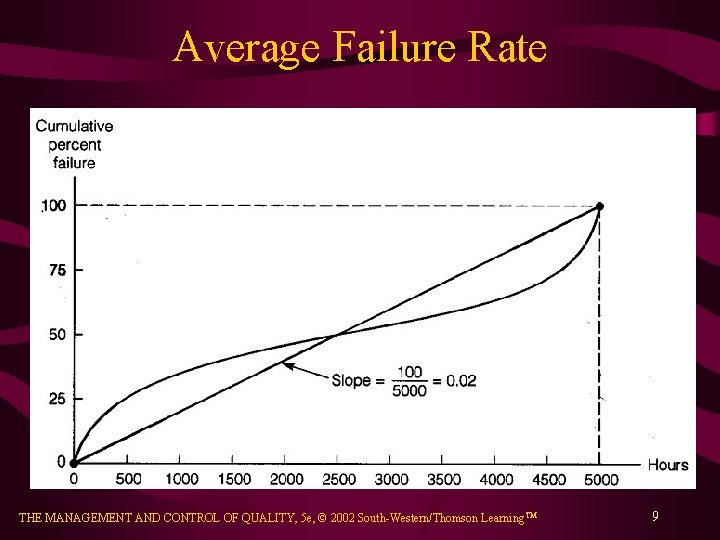
Average Failure Rate THE MANAGEMENT AND CONTROL OF QUALITY, 5 e, © 2002 South-Western/Thomson Learning. TM 9
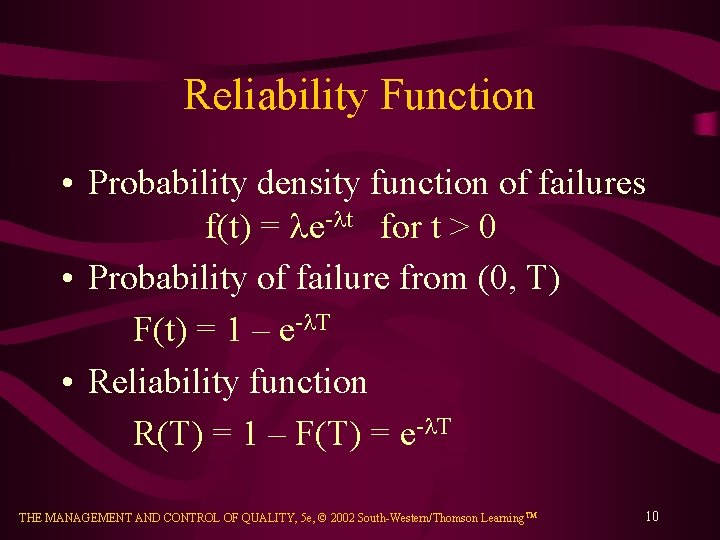
Reliability Function • Probability density function of failures f(t) = le-lt for t > 0 • Probability of failure from (0, T) F(t) = 1 – e-l. T • Reliability function R(T) = 1 – F(T) = e-l. T THE MANAGEMENT AND CONTROL OF QUALITY, 5 e, © 2002 South-Western/Thomson Learning. TM 10
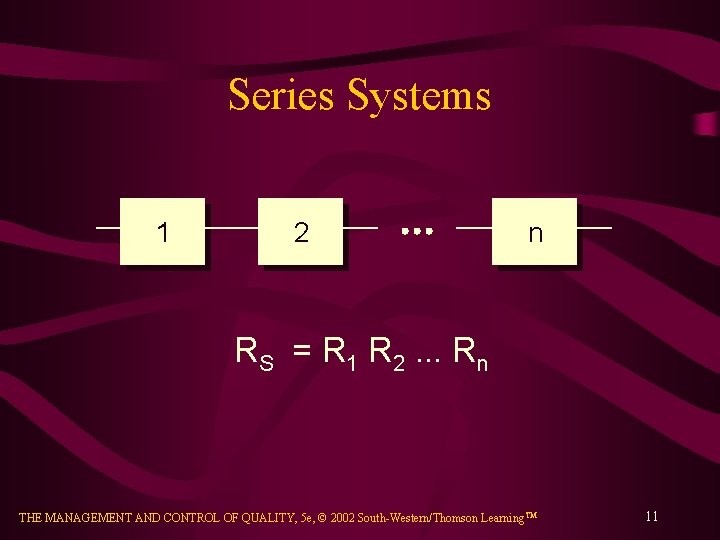
Series Systems 1 2 n RS = R 1 R 2. . . Rn THE MANAGEMENT AND CONTROL OF QUALITY, 5 e, © 2002 South-Western/Thomson Learning. TM 11
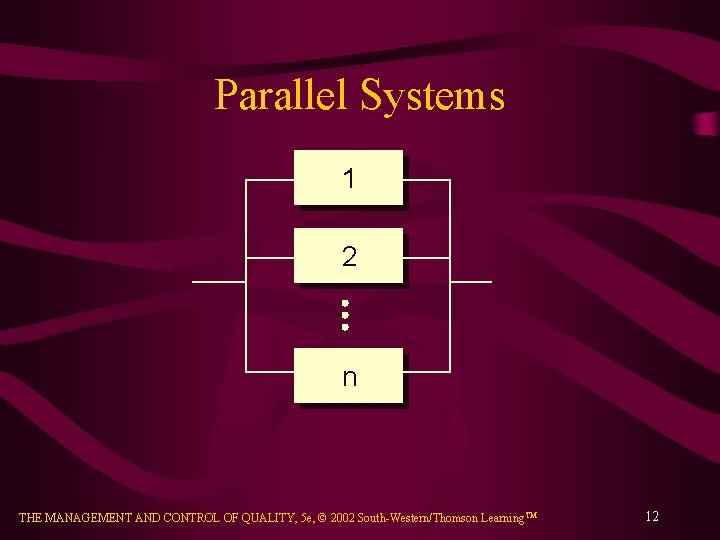
Parallel Systems 1 2 n THE MANAGEMENT AND CONTROL OF QUALITY, 5 e, © 2002 South-Western/Thomson Learning. TM 12
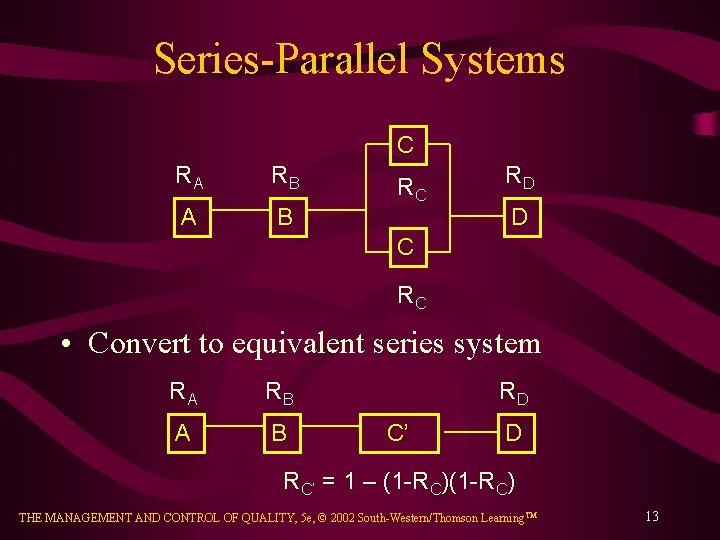
Series-Parallel Systems C RA RB A B RC RD D C RC • Convert to equivalent series system RA RB A B RD C’ D RC’ = 1 – (1 -RC) THE MANAGEMENT AND CONTROL OF QUALITY, 5 e, © 2002 South-Western/Thomson Learning. TM 13
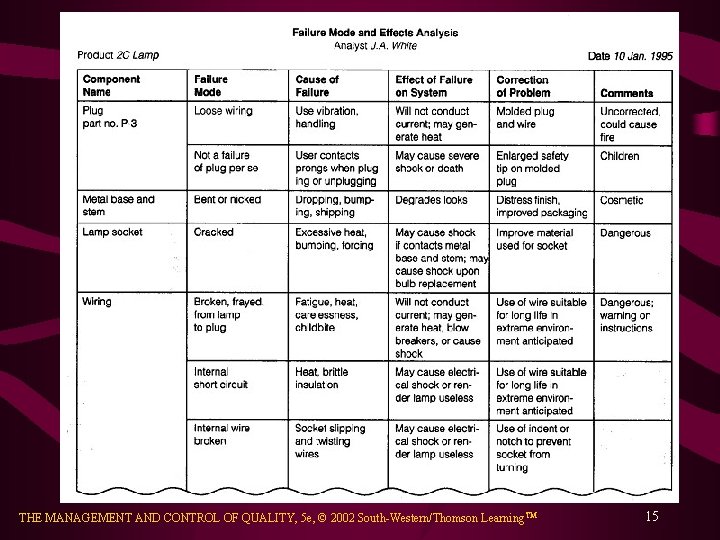
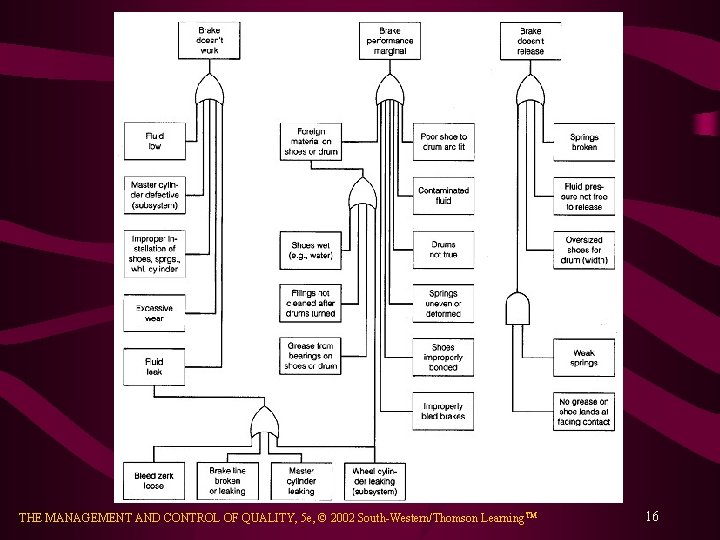
Reliability Engineering • • Standardization Redundancy Physics of failure Reliability testing Burn-in Failure mode and effects analysis Fault tree analysis THE MANAGEMENT AND CONTROL OF QUALITY, 5 e, © 2002 South-Western/Thomson Learning. TM 14
THE MANAGEMENT AND CONTROL OF QUALITY, 5 e, © 2002 South-Western/Thomson Learning. TM 15
THE MANAGEMENT AND CONTROL OF QUALITY, 5 e, © 2002 South-Western/Thomson Learning. TM 16
Reliability Management • Define customer performance requirements • Determine important economic factors and relationship with reliability requirements • Define the environment and conditions of product use • Select components, designs, and vendors that meet reliability and cost criteria • Determine reliability requirements for machines and equipment • Analyze field reliability for improvement THE MANAGEMENT AND CONTROL OF QUALITY, 5 e, © 2002 South-Western/Thomson Learning. TM 17
Configuration Management • • • Establish approved baseline configurations (designs) Maintain control over all changes in the baseline programs (change control) Provide traceability of baselines and changes (configuration accounting) THE MANAGEMENT AND CONTROL OF QUALITY, 5 e, © 2002 South-Western/Thomson Learning. TM 18
Maintainability • Maintainability is the totality of design factors that allows maintenance to be accomplished easily • Preventive maintenance reduces the risk of failure • Corrective maintenance is the response to failures THE MANAGEMENT AND CONTROL OF QUALITY, 5 e, © 2002 South-Western/Thomson Learning. TM 19
Design Issues • Access of parts for repair • Modular construction and standardization • Diagnostic repair procedures and expert systems THE MANAGEMENT AND CONTROL OF QUALITY, 5 e, © 2002 South-Western/Thomson Learning. TM 20
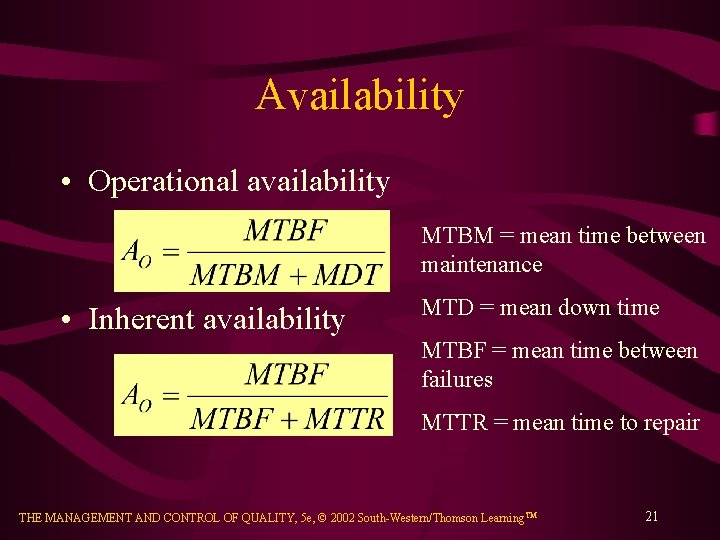
Availability • Operational availability MTBM = mean time between maintenance • Inherent availability MTD = mean down time MTBF = mean time between failures MTTR = mean time to repair THE MANAGEMENT AND CONTROL OF QUALITY, 5 e, © 2002 South-Western/Thomson Learning. TM 21
- Slides: 21