
Chapter 13 Recursion Copyright 2014 by John Wiley
Chapter 13 - Recursion Copyright © 2014 by John Wiley & Sons. All rights reserved. 1
Chapter Goals § To learn to “think recursively” § To be able to use recursive helper methods § To understand the relationship between recursion and iteration § To understand when the use of recursion affects the efficiency of an algorithm § To analyze problems that are much easier to solve by recursion than by iteration § To process data with recursive structures using mutual recursion Copyright © 2014 by John Wiley & Sons. All rights reserved. 2
Recursion § Recursion is a programming technique in which a method can call itself to fulfill its purpose § A recursive definition is one which uses the word or concept being defined in the definition itself § In some situations, a recursive definition can be an appropriate way to express a concept § Before applying recursion to programming, it is best to practice thinking recursively Java Software Structures, 4 th Edition, Lewis/Chase Copyright © 2014 by John Wiley & Sons. All rights reserved. 8 - 3 3
Recursive Definitions § Consider the following list of numbers: 24, 88, 40, 37 § Such a list can be defined recursively: A LIST is a: or a: number comma LIST § That is, a LIST can be a number, or a number followed by a comma followed by a LIST § The concept of a LIST is used to define itself Java Software Structures, 4 th Edition, Lewis/Chase Copyright © 2014 by John Wiley & Sons. All rights reserved. 8 - 4 4
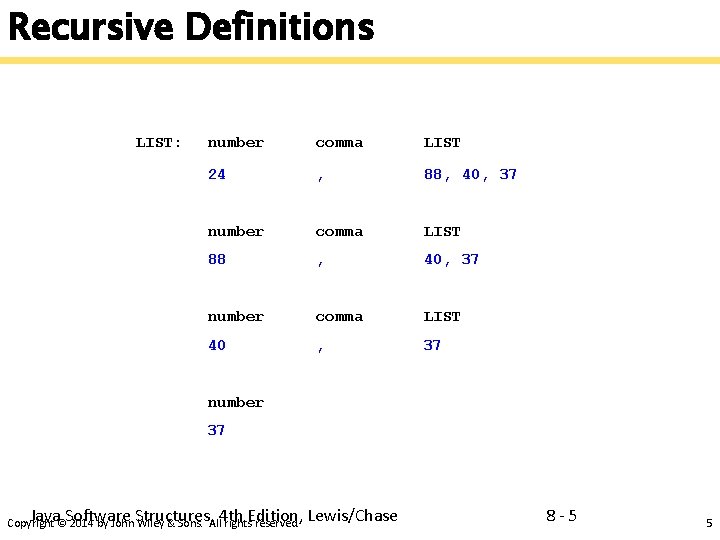
Recursive Definitions LIST: number comma LIST 24 , 88, 40, 37 number comma LIST 88 , 40, 37 number comma LIST 40 , 37 number 37 Java Software Structures, 4 th Edition, Lewis/Chase Copyright © 2014 by John Wiley & Sons. All rights reserved. 8 - 5 5
Infinite Recursion § All recursive definitions must have a non-recursive part § If they don't, there is no way to terminate the recursive path § A definition without a non-recursive part causes infinite recursion § This problem is similar to an infinite loop -- with the definition itself causing the infinite “looping” § The non-recursive part is called the base case Java Software Structures, 4 th Edition, Lewis/Chase Copyright © 2014 by John Wiley & Sons. All rights reserved. 8 - 6 6
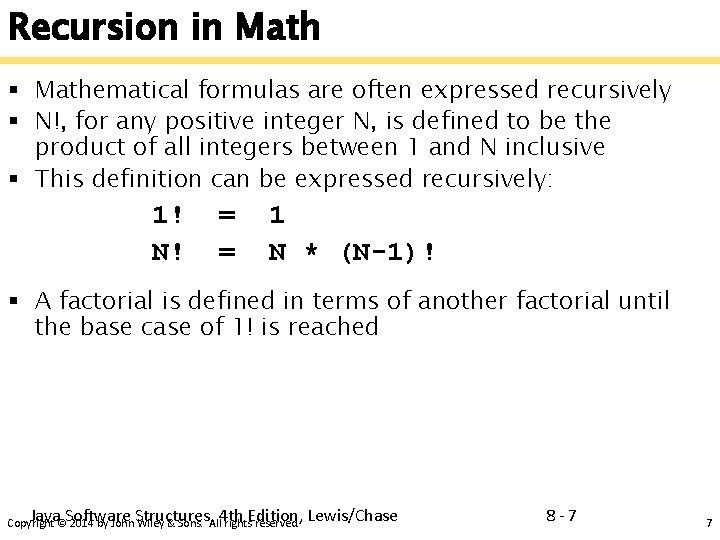
Recursion in Math § Mathematical formulas are often expressed recursively § N!, for any positive integer N, is defined to be the product of all integers between 1 and N inclusive § This definition can be expressed recursively: 1! N! = = 1 N * (N-1)! § A factorial is defined in terms of another factorial until the base case of 1! is reached Java Software Structures, 4 th Edition, Lewis/Chase Copyright © 2014 by John Wiley & Sons. All rights reserved. 8 - 7 7
Recursive Programming § A method in Java can invoke itself; if set up that way, it is called a recursive method § The code of a recursive method must handle both the base case and the recursive case § Each call sets up a new execution environment, with new parameters and new local variables § As always, when the method completes, control returns to the method that invoked it (which may be another instance of itself) Java Software Structures, 4 th Edition, Lewis/Chase Copyright © 2014 by John Wiley & Sons. All rights reserved. 8 - 8 8
Recursive Programming § Consider the problem of computing the sum of all the integers between 1 and N, inclusive § If N is 5, the sum is 1+2+3+4+5 § This problem can be expressed recursively as: The sum of 1 to N is N plus the sum of 1 to N-1 Java Software Structures, 4 th Edition, Lewis/Chase Copyright © 2014 by John Wiley & Sons. All rights reserved. 8 - 9 9
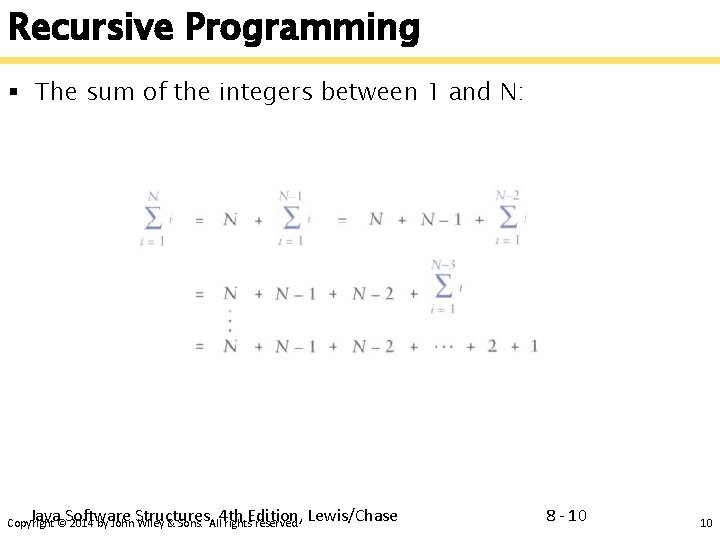
Recursive Programming § The sum of the integers between 1 and N: Java Software Structures, 4 th Edition, Lewis/Chase Copyright © 2014 by John Wiley & Sons. All rights reserved. 8 - 10 10
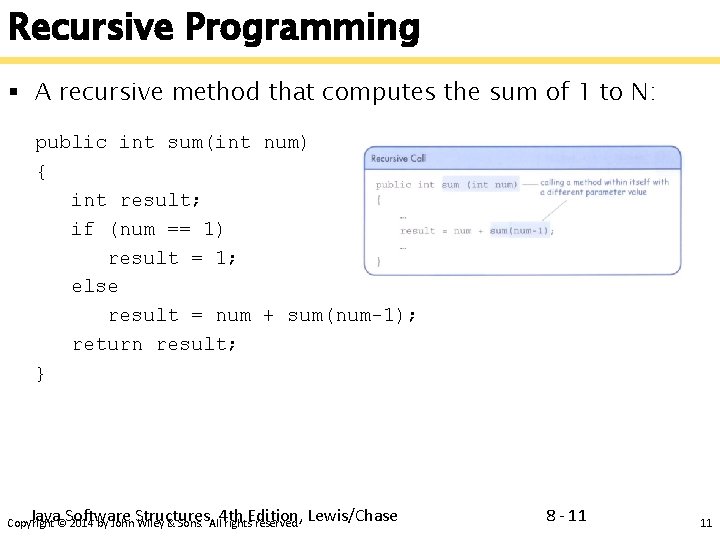
Recursive Programming § A recursive method that computes the sum of 1 to N: public int sum(int num) { int result; if (num == 1) result = 1; else result = num + sum(num-1); return result; } Java Software Structures, 4 th Edition, Lewis/Chase Copyright © 2014 by John Wiley & Sons. All rights reserved. 8 - 11 11
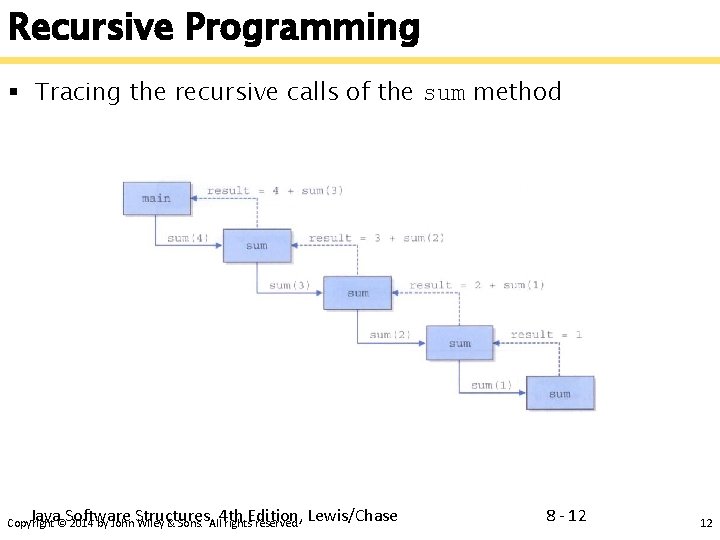
Recursive Programming § Tracing the recursive calls of the sum method Java Software Structures, 4 th Edition, Lewis/Chase Copyright © 2014 by John Wiley & Sons. All rights reserved. 8 - 12 12
Recursion vs. Iteration § Just because we can use recursion to solve a problem, doesn't mean we should § For instance, we usually would not use recursion to solve the sum of 1 to N § The iterative version is easier to understand (in fact there is a formula that computes it without a loop at all) § You must be able to determine when recursion is the correct technique to use Java Software Structures, 4 th Edition, Lewis/Chase Copyright © 2014 by John Wiley & Sons. All rights reserved. 8 - 13 13
Recursion vs. Iteration § Every recursive solution has a corresponding iterative solution § A recursive solution may simply be less efficient § Furthermore, recursion has the overhead of multiple method invocations § However, for some problems recursive solutions are often more simple and elegant to express Java Software Structures, 4 th Edition, Lewis/Chase Copyright © 2014 by John Wiley & Sons. All rights reserved. 8 - 14 14
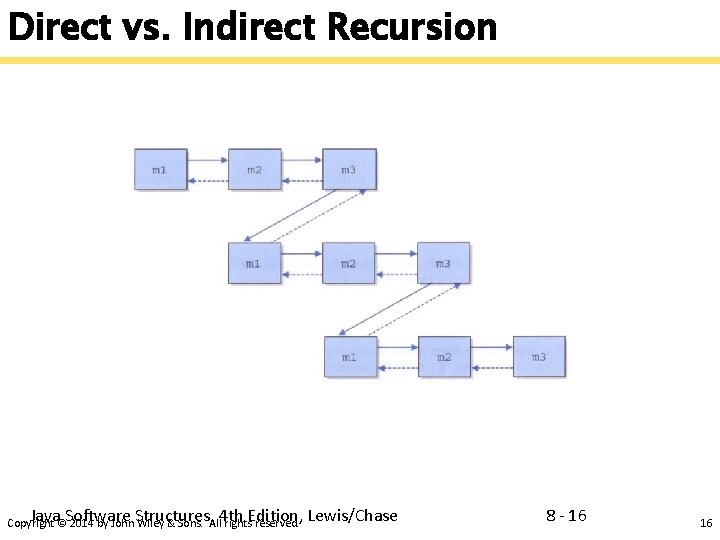
Direct vs. Indirect Recursion § A method invoking itself is considered to be direct recursion § A method could invoke another method, which invokes another, etc. , until eventually the original method is invoked again § For example, method m 1 could invoke m 2, which invokes m 3, which invokes m 1 again § This is called indirect recursion § It is often more difficult to trace and debug Java Software Structures, 4 th Edition, Lewis/Chase Copyright © 2014 by John Wiley & Sons. All rights reserved. 8 - 15 15
Direct vs. Indirect Recursion Java Software Structures, 4 th Edition, Lewis/Chase Copyright © 2014 by John Wiley & Sons. All rights reserved. 8 - 16 16
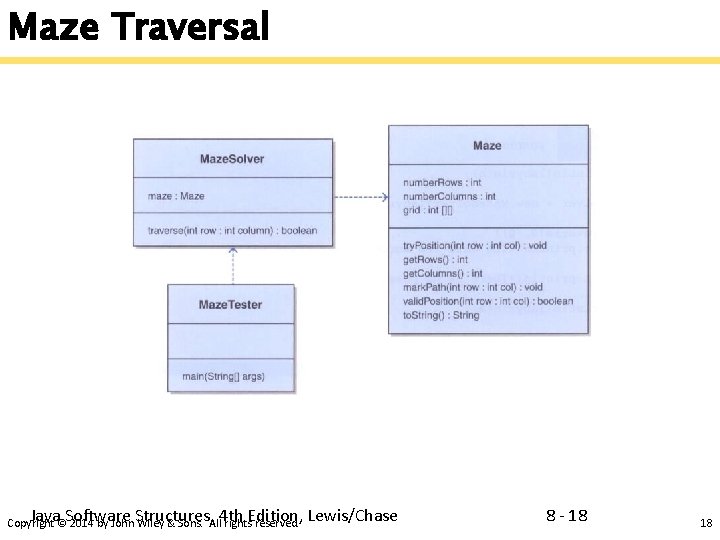
Maze Traversal § We've seen a maze solved using a stack § The same approach can also be done using recursion § The run-time stack tracking method execution performs the same function § As before, we mark a location as "visited" and try to continue along the path § The base cases are: • a blocked path • finding a solution Java Software Structures, 4 th Edition, Lewis/Chase Copyright © 2014 by John Wiley & Sons. All rights reserved. 8 - 17 17
Maze Traversal Java Software Structures, 4 th Edition, Lewis/Chase Copyright © 2014 by John Wiley & Sons. All rights reserved. 8 - 18 18
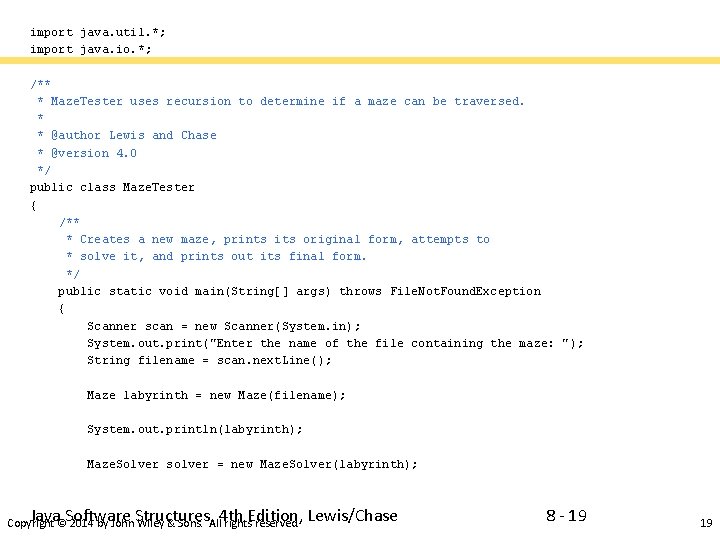
import java. util. *; import java. io. *; /** * Maze. Tester uses recursion to determine if a maze can be traversed. * * @author Lewis and Chase * @version 4. 0 */ public class Maze. Tester { /** * Creates a new maze, prints its original form, attempts to * solve it, and prints out its final form. */ public static void main(String[] args) throws File. Not. Found. Exception { Scanner scan = new Scanner(System. in); System. out. print("Enter the name of the file containing the maze: "); String filename = scan. next. Line(); Maze labyrinth = new Maze(filename); System. out. println(labyrinth); Maze. Solver solver = new Maze. Solver(labyrinth); Java Software Structures, 4 th Edition, Lewis/Chase Copyright © 2014 by John Wiley & Sons. All rights reserved. 8 - 19 19
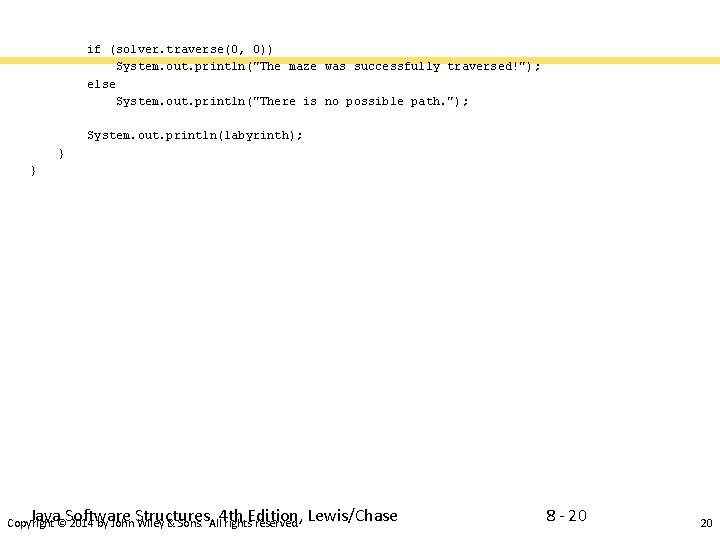
if (solver. traverse(0, 0)) System. out. println("The maze was successfully traversed!"); else System. out. println("There is no possible path. "); System. out. println(labyrinth); } } Java Software Structures, 4 th Edition, Lewis/Chase Copyright © 2014 by John Wiley & Sons. All rights reserved. 8 - 20 20
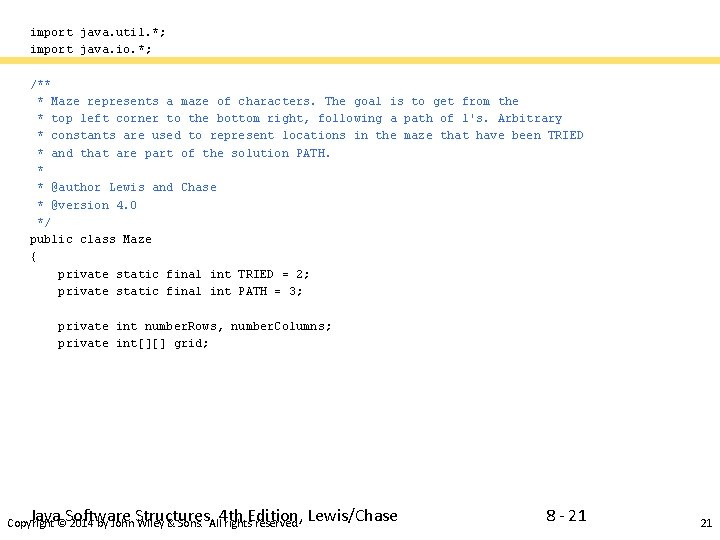
import java. util. *; import java. io. *; /** * Maze represents a maze of characters. The goal is to get from the * top left corner to the bottom right, following a path of 1's. Arbitrary * constants are used to represent locations in the maze that have been TRIED * and that are part of the solution PATH. * * @author Lewis and Chase * @version 4. 0 */ public class Maze { private static final int TRIED = 2; private static final int PATH = 3; private int number. Rows, number. Columns; private int[][] grid; Java Software Structures, 4 th Edition, Lewis/Chase Copyright © 2014 by John Wiley & Sons. All rights reserved. 8 - 21 21
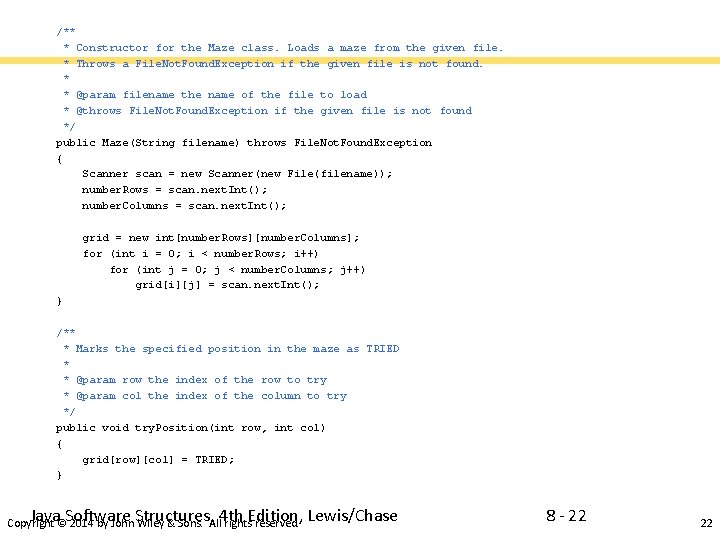
/** * Constructor for the Maze class. Loads a maze from the given file. * Throws a File. Not. Found. Exception if the given file is not found. * * @param filename the name of the file to load * @throws File. Not. Found. Exception if the given file is not found */ public Maze(String filename) throws File. Not. Found. Exception { Scanner scan = new Scanner(new File(filename)); number. Rows = scan. next. Int(); number. Columns = scan. next. Int(); grid = new int[number. Rows][number. Columns]; for (int i = 0; i < number. Rows; i++) for (int j = 0; j < number. Columns; j++) grid[i][j] = scan. next. Int(); } /** * Marks the specified position in the maze as TRIED * * @param row the index of the row to try * @param col the index of the column to try */ public void try. Position(int row, int col) { grid[row][col] = TRIED; } Java Software Structures, 4 th Edition, Lewis/Chase Copyright © 2014 by John Wiley & Sons. All rights reserved. 8 - 22 22
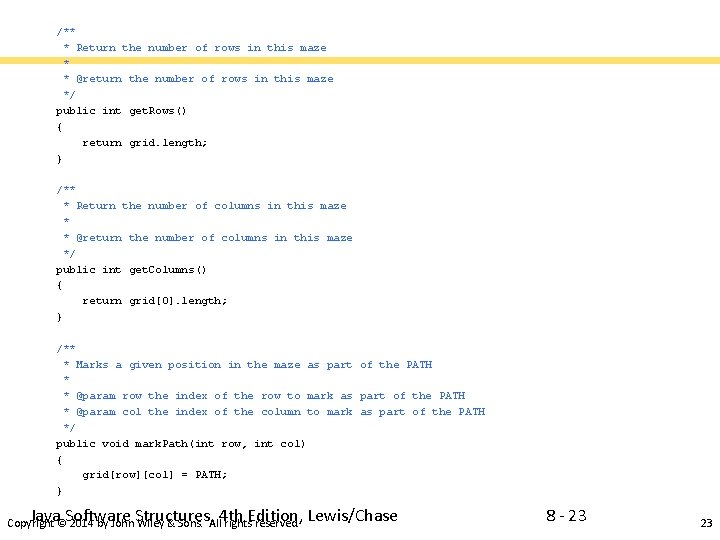
/** * Return the number of rows in this maze * * @return the number of rows in this maze */ public int get. Rows() { return grid. length; } /** * Return the number of columns in this maze * * @return the number of columns in this maze */ public int get. Columns() { return grid[0]. length; } /** * Marks a given position in the maze as part of the PATH * * @param row the index of the row to mark as part of the PATH * @param col the index of the column to mark as part of the PATH */ public void mark. Path(int row, int col) { grid[row][col] = PATH; } Java Software Structures, 4 th Edition, Lewis/Chase Copyright © 2014 by John Wiley & Sons. All rights reserved. 8 - 23 23
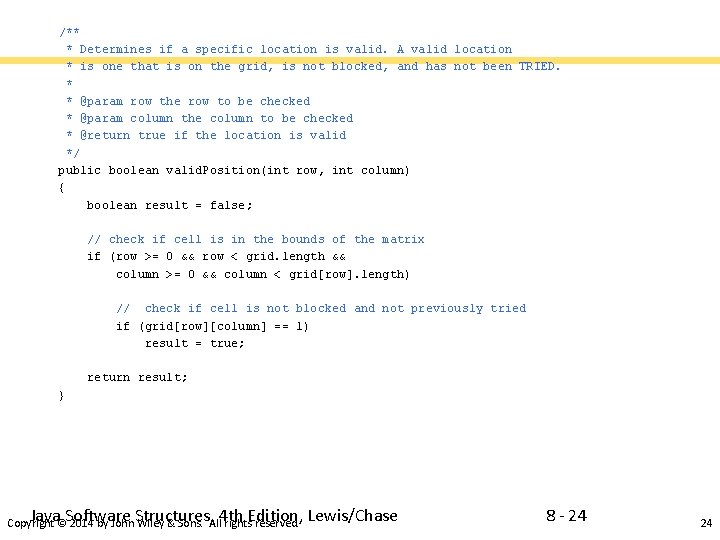
/** * Determines if a specific location is valid. A valid location * is one that is on the grid, is not blocked, and has not been TRIED. * * @param row the row to be checked * @param column the column to be checked * @return true if the location is valid */ public boolean valid. Position(int row, int column) { boolean result = false; // check if cell is in the bounds of the matrix if (row >= 0 && row < grid. length && column >= 0 && column < grid[row]. length) // check if cell is not blocked and not previously tried if (grid[row][column] == 1) result = true; return result; } Java Software Structures, 4 th Edition, Lewis/Chase Copyright © 2014 by John Wiley & Sons. All rights reserved. 8 - 24 24
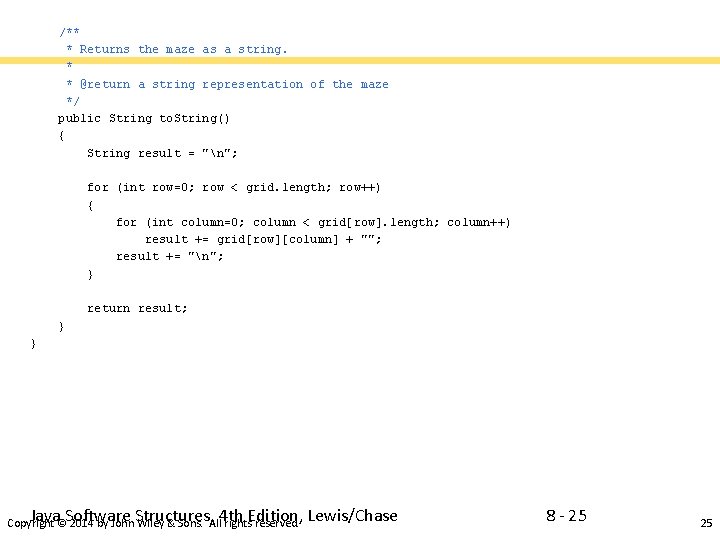
/** * Returns the maze as a string. * * @return a string representation of the maze */ public String to. String() { String result = "n"; for (int row=0; row < grid. length; row++) { for (int column=0; column < grid[row]. length; column++) result += grid[row][column] + ""; result += "n"; } return result; } } Java Software Structures, 4 th Edition, Lewis/Chase Copyright © 2014 by John Wiley & Sons. All rights reserved. 8 - 25 25
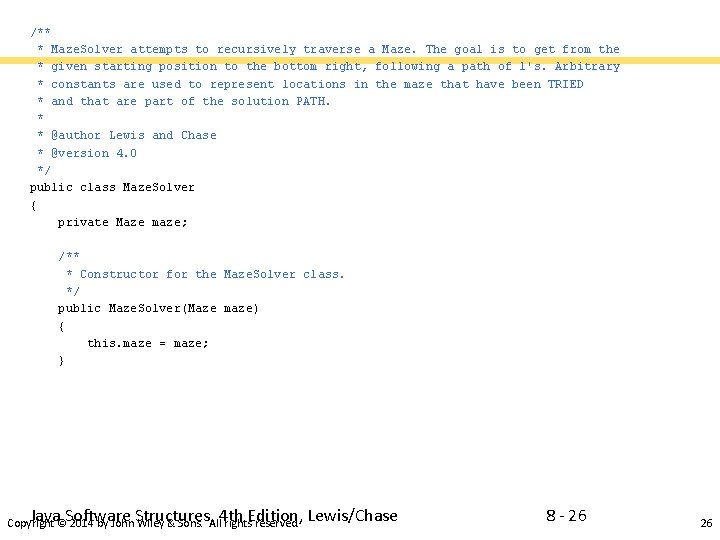
/** * Maze. Solver attempts to recursively traverse a Maze. The goal is to get from the * given starting position to the bottom right, following a path of 1's. Arbitrary * constants are used to represent locations in the maze that have been TRIED * and that are part of the solution PATH. * * @author Lewis and Chase * @version 4. 0 */ public class Maze. Solver { private Maze maze; /** * Constructor for the Maze. Solver class. */ public Maze. Solver(Maze maze) { this. maze = maze; } Java Software Structures, 4 th Edition, Lewis/Chase Copyright © 2014 by John Wiley & Sons. All rights reserved. 8 - 26 26
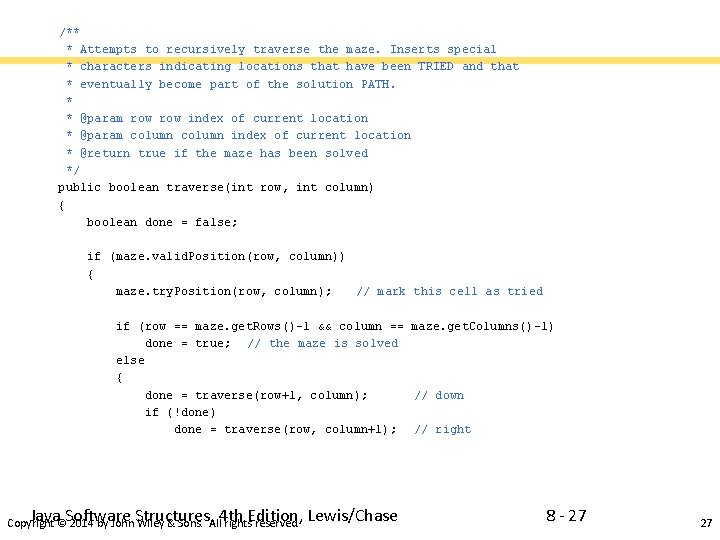
/** * Attempts to recursively traverse the maze. Inserts special * characters indicating locations that have been TRIED and that * eventually become part of the solution PATH. * * @param row index of current location * @param column index of current location * @return true if the maze has been solved */ public boolean traverse(int row, int column) { boolean done = false; if (maze. valid. Position(row, column)) { maze. try. Position(row, column); // mark this cell as tried if (row == maze. get. Rows()-1 && column == maze. get. Columns()-1) done = true; // the maze is solved else { done = traverse(row+1, column); // down if (!done) done = traverse(row, column+1); // right Java Software Structures, 4 th Edition, Lewis/Chase Copyright © 2014 by John Wiley & Sons. All rights reserved. 8 - 27 27
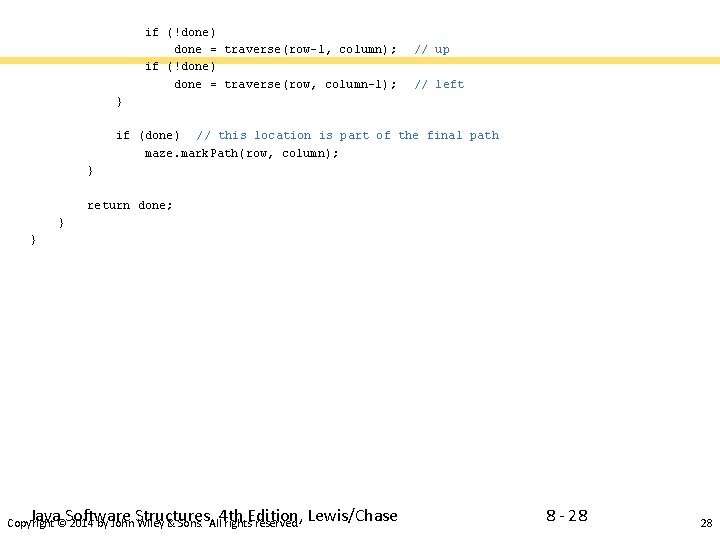
if (!done) done = traverse(row-1, column); if (!done) done = traverse(row, column-1); // up // left } if (done) // this location is part of the final path maze. mark. Path(row, column); } return done; } } Java Software Structures, 4 th Edition, Lewis/Chase Copyright © 2014 by John Wiley & Sons. All rights reserved. 8 - 28 28
Factorials § Develop a recursive application to compute factorials § Compare to iterative solution § Which is better? Why? Copyright © 2014 by John Wiley & Sons. All rights reserved. 29
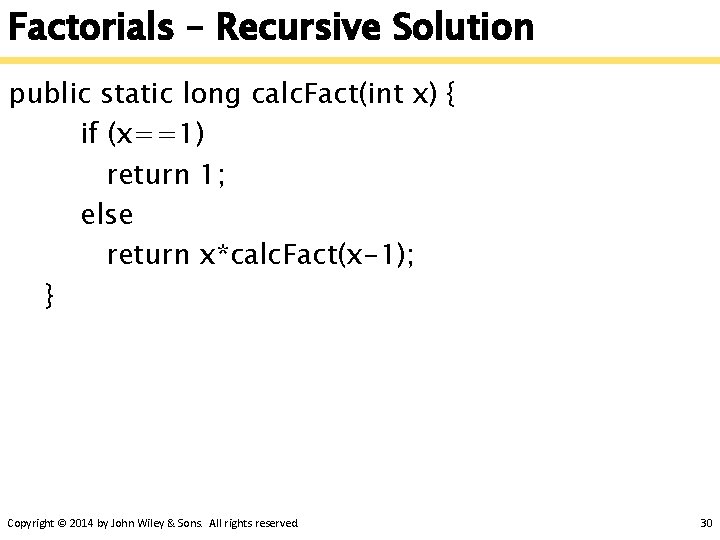
Factorials – Recursive Solution public static long calc. Fact(int x) { if (x==1) return 1; else return x*calc. Fact(x-1); } Copyright © 2014 by John Wiley & Sons. All rights reserved. 30
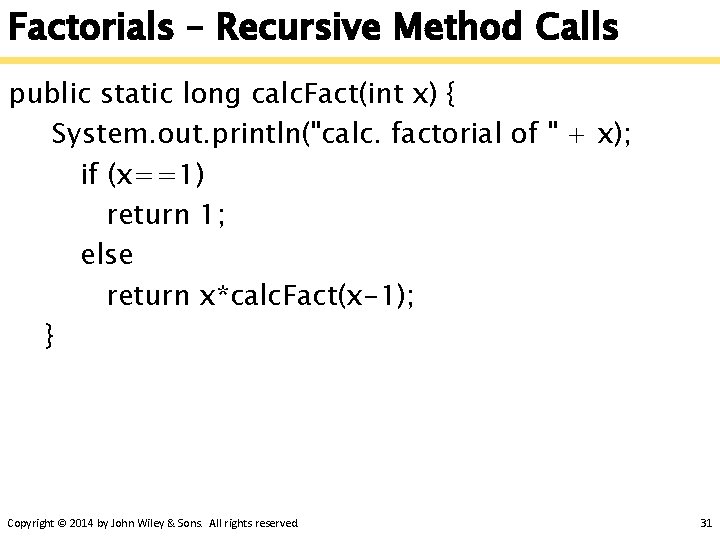
Factorials – Recursive Method Calls public static long calc. Fact(int x) { System. out. println("calc. factorial of " + x); if (x==1) return 1; else return x*calc. Fact(x-1); } Copyright © 2014 by John Wiley & Sons. All rights reserved. 31
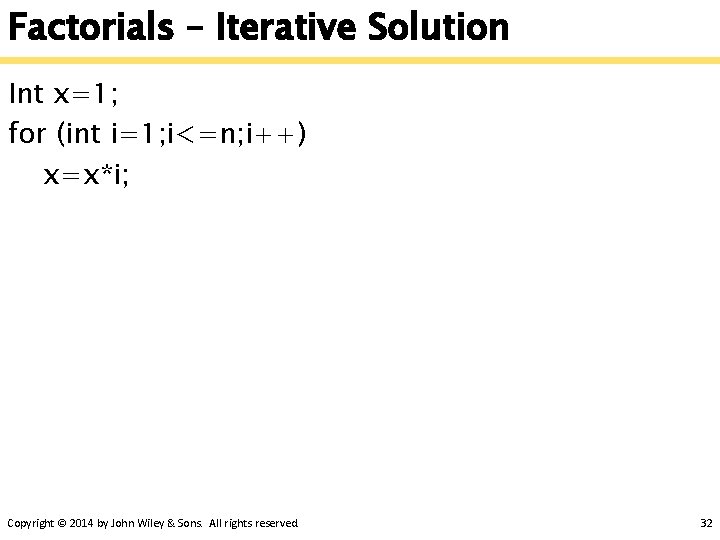
Factorials – Iterative Solution Int x=1; for (int i=1; i<=n; i++) x=x*i; Copyright © 2014 by John Wiley & Sons. All rights reserved. 32
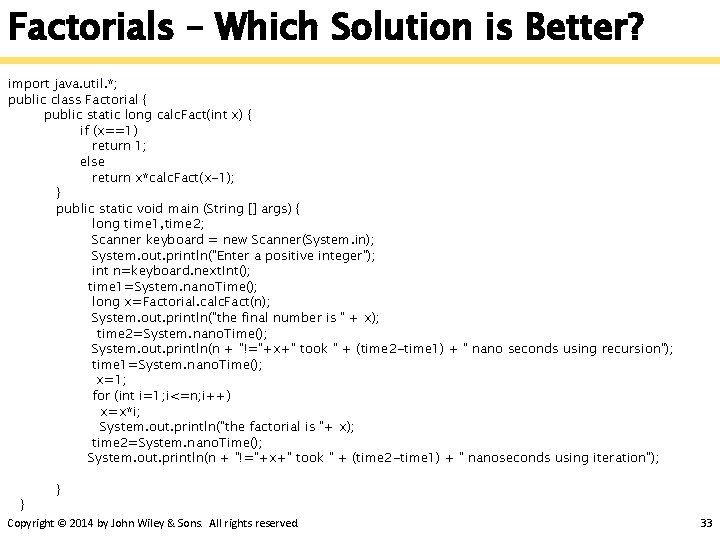
Factorials – Which Solution is Better? import java. util. *; public class Factorial { public static long calc. Fact(int x) { if (x==1) return 1; else return x*calc. Fact(x-1); } public static void main (String [] args) { long time 1, time 2; Scanner keyboard = new Scanner(System. in); System. out. println("Enter a positive integer"); int n=keyboard. next. Int(); time 1=System. nano. Time(); long x=Factorial. calc. Fact(n); System. out. println("the final number is " + x); time 2=System. nano. Time(); System. out. println(n + "!="+x+" took " + (time 2 -time 1) + " nano seconds using recursion"); time 1=System. nano. Time(); x=1; for (int i=1; i<=n; i++) x=x*i; System. out. println("the factorial is "+ x); time 2=System. nano. Time(); System. out. println(n + "!="+x+" took " + (time 2 -time 1) + " nanoseconds using iteration"); } } Copyright © 2014 by John Wiley & Sons. All rights reserved. 33
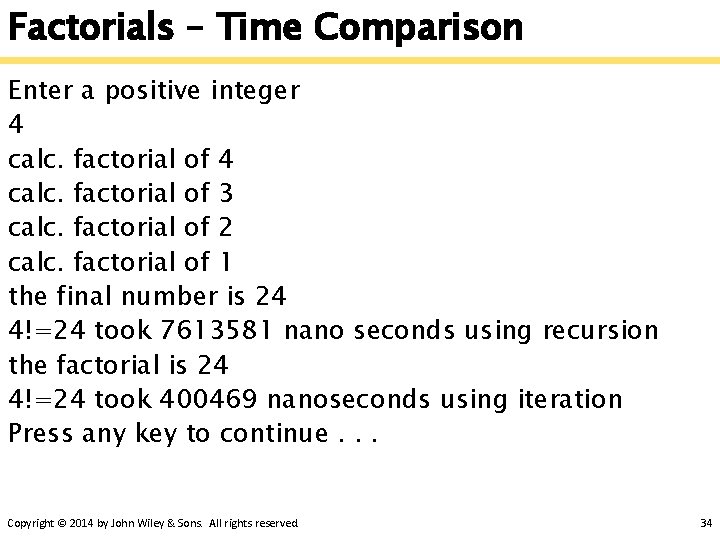
Factorials – Time Comparison Enter a positive integer 4 calc. factorial of 3 calc. factorial of 2 calc. factorial of 1 the final number is 24 4!=24 took 7613581 nano seconds using recursion the factorial is 24 4!=24 took 400469 nanoseconds using iteration Press any key to continue. . . Copyright © 2014 by John Wiley & Sons. All rights reserved. 34
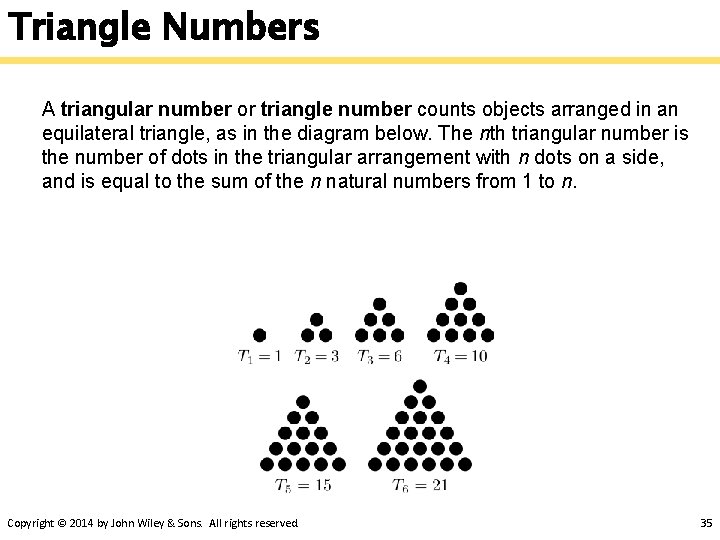
Triangle Numbers A triangular number or triangle number counts objects arranged in an equilateral triangle, as in the diagram below. The nth triangular number is the number of dots in the triangular arrangement with n dots on a side, and is equal to the sum of the n natural numbers from 1 to n. Copyright © 2014 by John Wiley & Sons. All rights reserved. 35
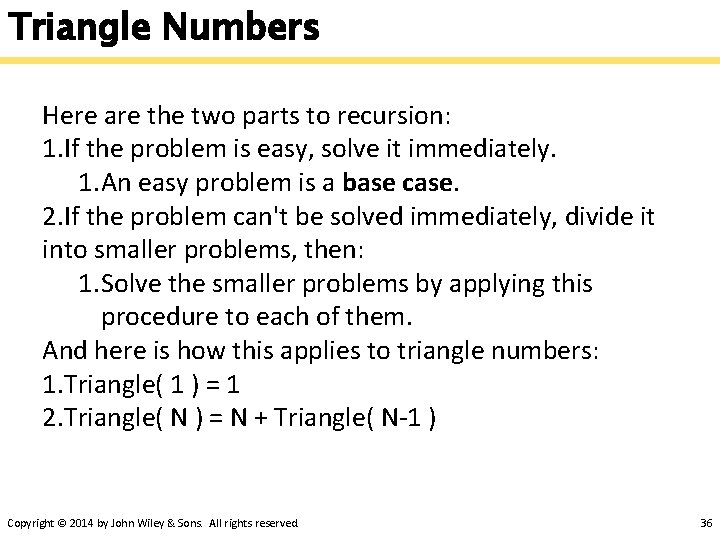
Triangle Numbers Here are the two parts to recursion: 1. If the problem is easy, solve it immediately. 1. An easy problem is a base case. 2. If the problem can't be solved immediately, divide it into smaller problems, then: 1. Solve the smaller problems by applying this procedure to each of them. And here is how this applies to triangle numbers: 1. Triangle( 1 ) = 1 2. Triangle( N ) = N + Triangle( N-1 ) Copyright © 2014 by John Wiley & Sons. All rights reserved. 36
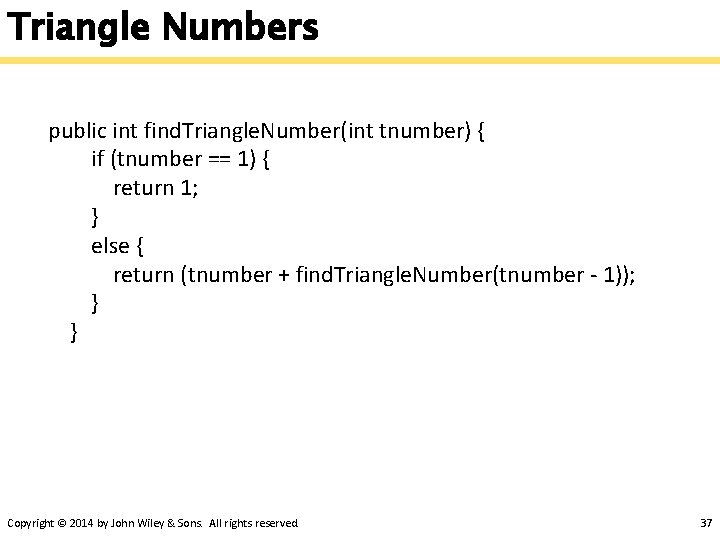
Triangle Numbers public int find. Triangle. Number(int tnumber) { if (tnumber == 1) { return 1; } else { return (tnumber + find. Triangle. Number(tnumber - 1)); } } Copyright © 2014 by John Wiley & Sons. All rights reserved. 37
Finding the Area of a Triangle The area of a triangle can also be found recursively. Copyright © 2014 by John Wiley & Sons. All rights reserved. 38
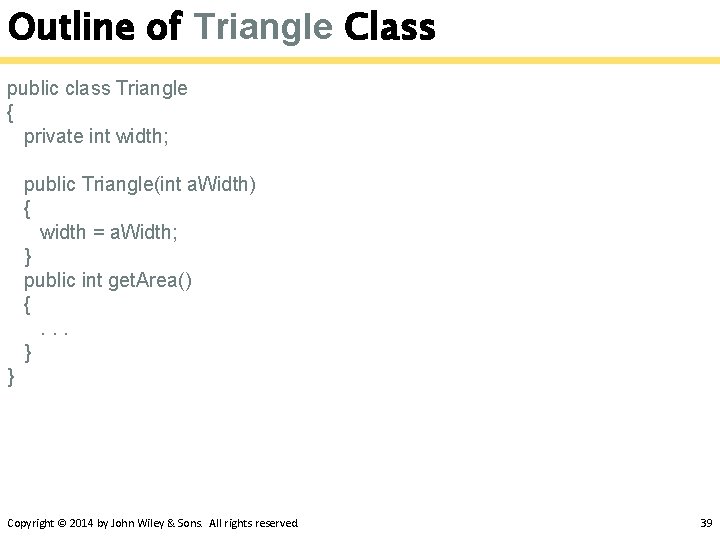
Outline of Triangle Class public class Triangle { private int width; public Triangle(int a. Width) { width = a. Width; } public int get. Area() { . . . } } Copyright © 2014 by John Wiley & Sons. All rights reserved. 39
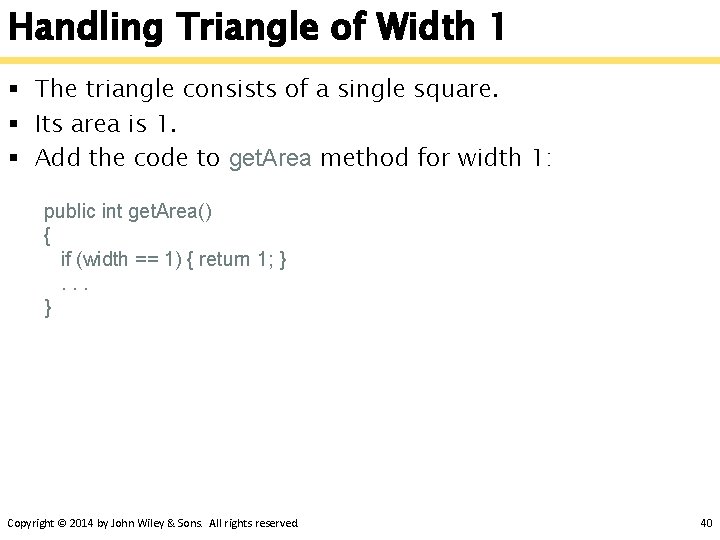
Handling Triangle of Width 1 § The triangle consists of a single square. § Its area is 1. § Add the code to get. Area method for width 1: public int get. Area() { if (width == 1) { return 1; } . . . } Copyright © 2014 by John Wiley & Sons. All rights reserved. 40
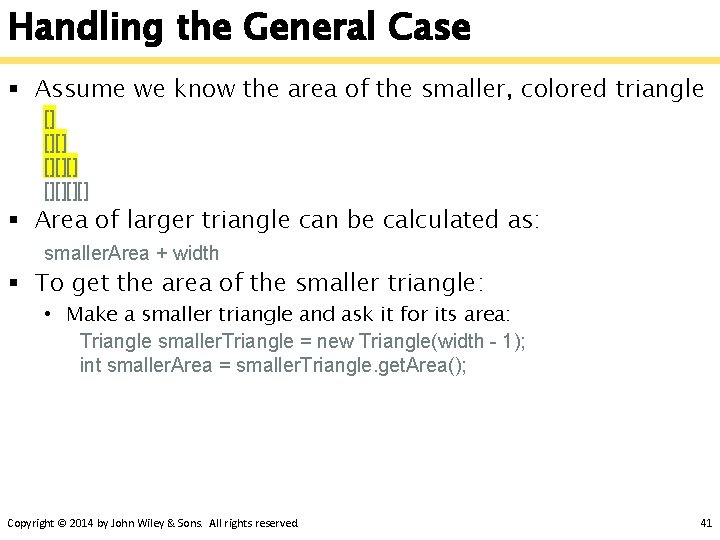
Handling the General Case § Assume we know the area of the smaller, colored triangle [] [][][] § Area of larger triangle can be calculated as: smaller. Area + width § To get the area of the smaller triangle: • Make a smaller triangle and ask it for its area: Triangle smaller. Triangle = new Triangle(width - 1); int smaller. Area = smaller. Triangle. get. Area(); Copyright © 2014 by John Wiley & Sons. All rights reserved. 41
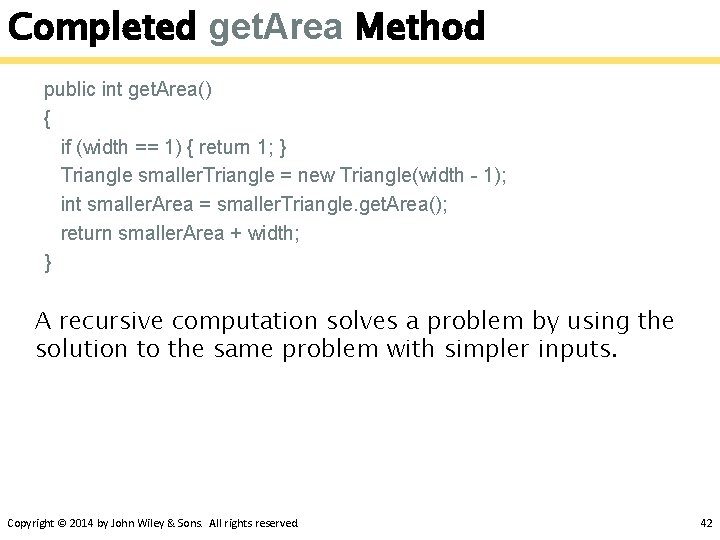
Completed get. Area Method public int get. Area() { if (width == 1) { return 1; } Triangle smaller. Triangle = new Triangle(width - 1); int smaller. Area = smaller. Triangle. get. Area(); return smaller. Area + width; } A recursive computation solves a problem by using the solution to the same problem with simpler inputs. Copyright © 2014 by John Wiley & Sons. All rights reserved. 42
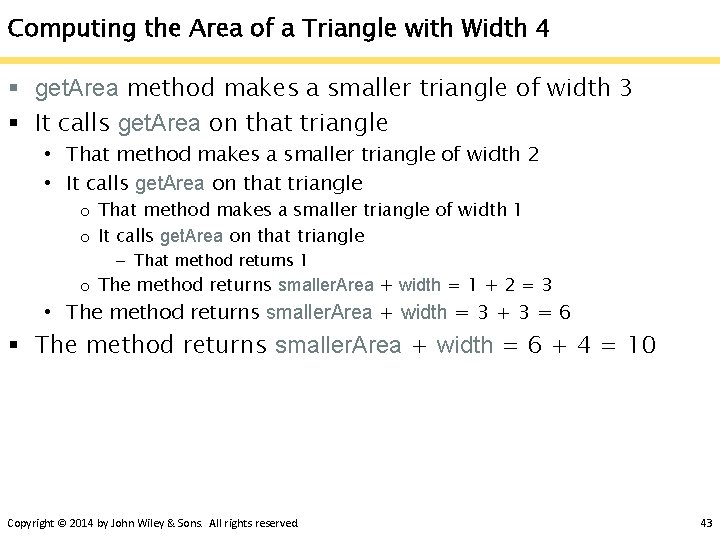
Computing the Area of a Triangle with Width 4 § get. Area method makes a smaller triangle of width 3 § It calls get. Area on that triangle • That method makes a smaller triangle of width 2 • It calls get. Area on that triangle o That method makes a smaller triangle of width 1 o It calls get. Area on that triangle – That method returns 1 o The method returns smaller. Area + width = 1 + 2 = 3 • The method returns smaller. Area + width = 3 + 3 = 6 § The method returns smaller. Area + width = 6 + 4 = 10 Copyright © 2014 by John Wiley & Sons. All rights reserved. 43
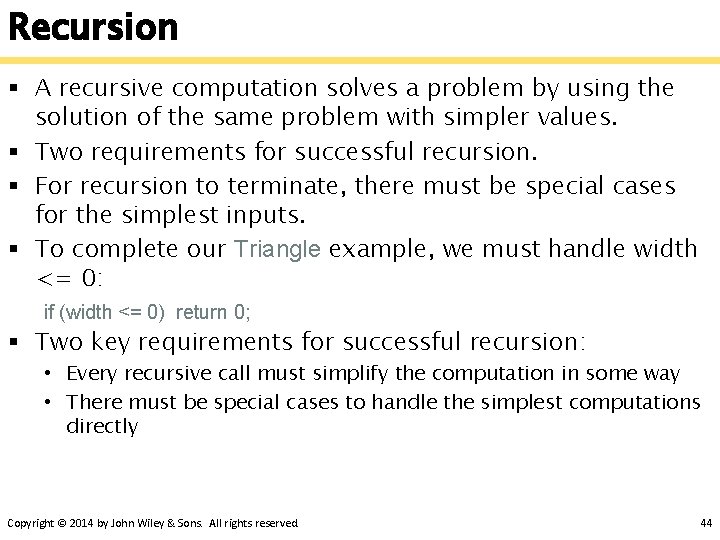
Recursion § A recursive computation solves a problem by using the solution of the same problem with simpler values. § Two requirements for successful recursion. § For recursion to terminate, there must be special cases for the simplest inputs. § To complete our Triangle example, we must handle width <= 0: if (width <= 0) return 0; § Two key requirements for successful recursion: • Every recursive call must simplify the computation in some way • There must be special cases to handle the simplest computations directly Copyright © 2014 by John Wiley & Sons. All rights reserved. 44
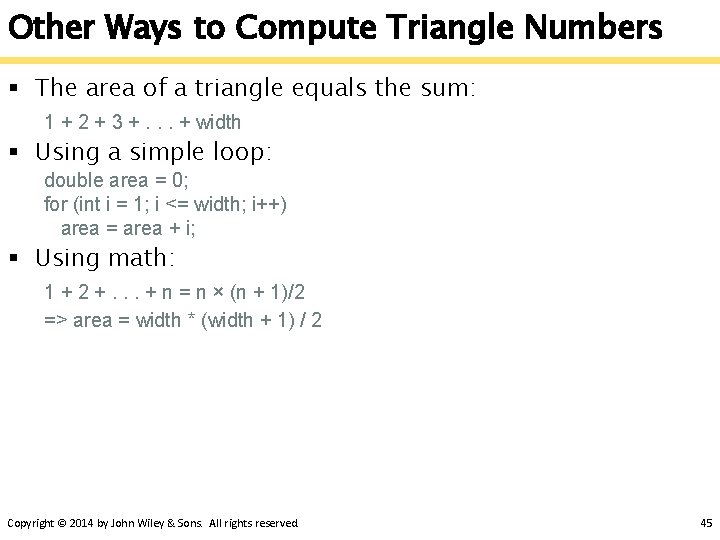
Other Ways to Compute Triangle Numbers § The area of a triangle equals the sum: 1 + 2 + 3 +. . . + width § Using a simple loop: double area = 0; for (int i = 1; i <= width; i++) area = area + i; § Using math: 1 + 2 +. . . + n = n × (n + 1)/2 => area = width * (width + 1) / 2 Copyright © 2014 by John Wiley & Sons. All rights reserved. 45
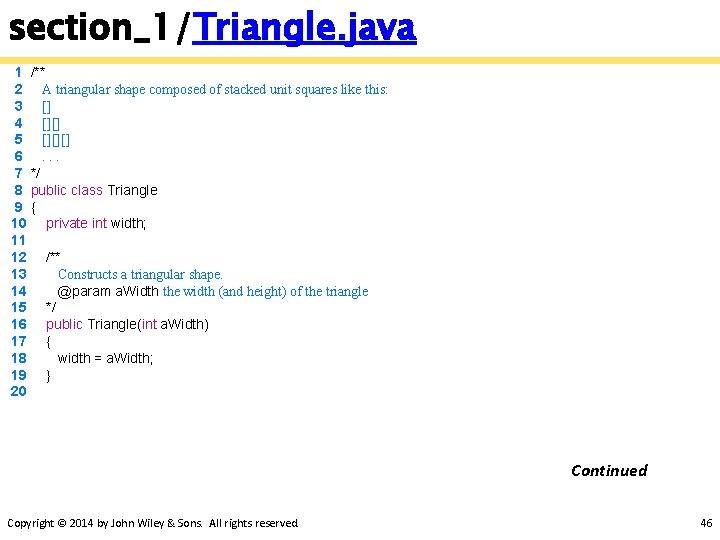
section_1/Triangle. java 1 /** 2 A triangular shape composed of stacked unit squares like this: 3 [] 4 [][] 5 [][][] 6 . . . 7 */ 8 public class Triangle 9 { 10 private int width; 11 12 /** 13 Constructs a triangular shape. 14 @param a. Width the width (and height) of the triangle 15 */ 16 public Triangle(int a. Width) 17 { 18 width = a. Width; 19 } 20 Continued Copyright © 2014 by John Wiley & Sons. All rights reserved. 46
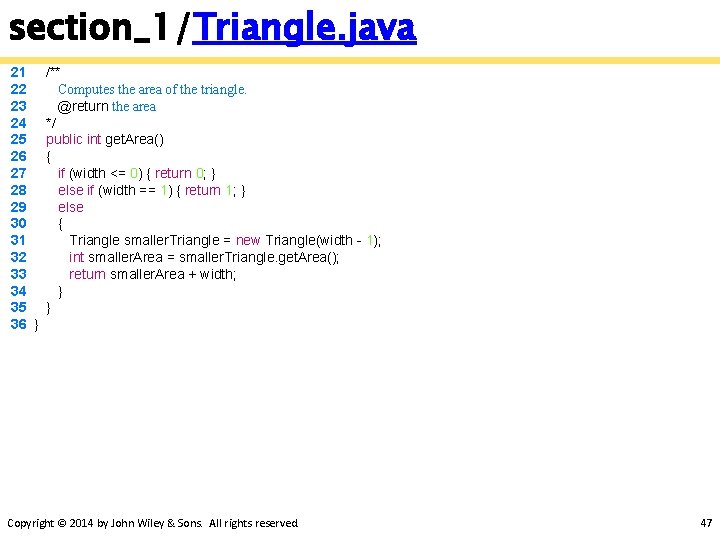
section_1/Triangle. java 21 22 23 24 25 26 27 28 29 30 31 32 33 34 35 36 /** Computes the area of the triangle. @return the area */ public int get. Area() { if (width <= 0) { return 0; } else if (width == 1) { return 1; } else { Triangle smaller. Triangle = new Triangle(width - 1); int smaller. Area = smaller. Triangle. get. Area(); return smaller. Area + width; } } } Copyright © 2014 by John Wiley & Sons. All rights reserved. 47
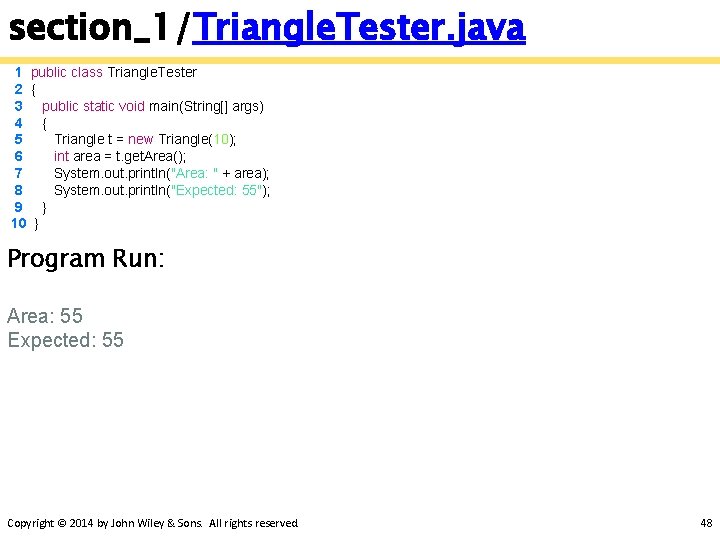
section_1/Triangle. Tester. java 1 public class Triangle. Tester 2 { 3 public static void main(String[] args) 4 { 5 Triangle t = new Triangle(10); 6 int area = t. get. Area(); 7 System. out. println("Area: " + area); 8 System. out. println("Expected: 55"); 9 } 10 } Program Run: Area: 55 Expected: 55 Copyright © 2014 by John Wiley & Sons. All rights reserved. 48
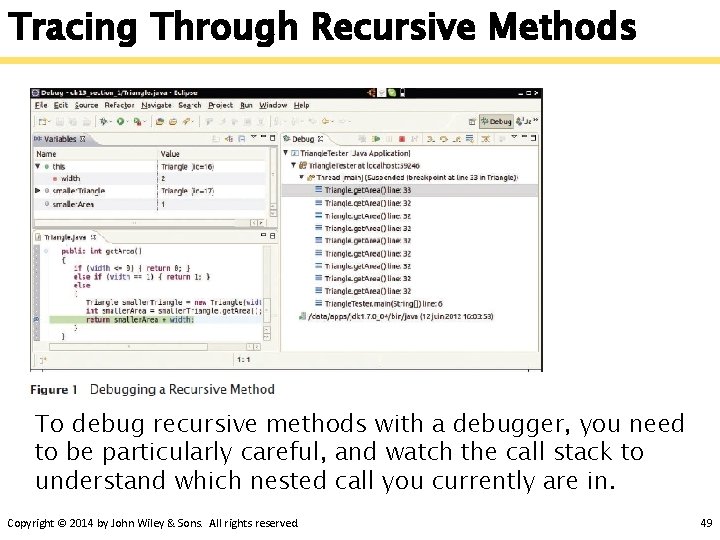
Tracing Through Recursive Methods To debug recursive methods with a debugger, you need to be particularly careful, and watch the call stack to understand which nested call you currently are in. Copyright © 2014 by John Wiley & Sons. All rights reserved. 49
Tracing Through Recursive Methods § Another means of debugging is the liberal use of System. out. println() statements Copyright © 2014 by John Wiley & Sons. All rights reserved. 50
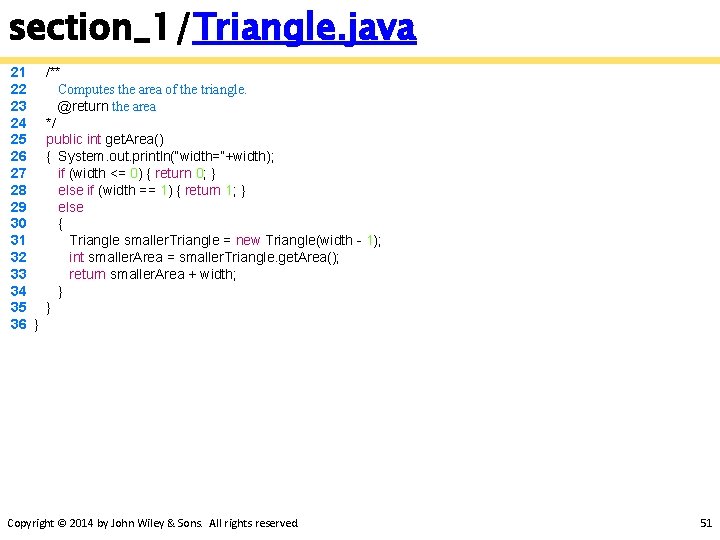
section_1/Triangle. java 21 22 23 24 25 26 27 28 29 30 31 32 33 34 35 36 /** Computes the area of the triangle. @return the area */ public int get. Area() { System. out. println(“width=“+width); if (width <= 0) { return 0; } else if (width == 1) { return 1; } else { Triangle smaller. Triangle = new Triangle(width - 1); int smaller. Area = smaller. Triangle. get. Area(); return smaller. Area + width; } } } Copyright © 2014 by John Wiley & Sons. All rights reserved. 51
Thinking Recursively Thinking recursively is easy if you can recognize a subtask that is similar to the original task. § Problem: test whether a sentence is a palindrome § Palindrome: a string that is equal to itself when you reverse all characters • A man, a plan, a canal – Panama! • Go hang a salami, I'm a lasagna hog • Madam, I'm Adam Copyright © 2014 by John Wiley & Sons. All rights reserved. 52
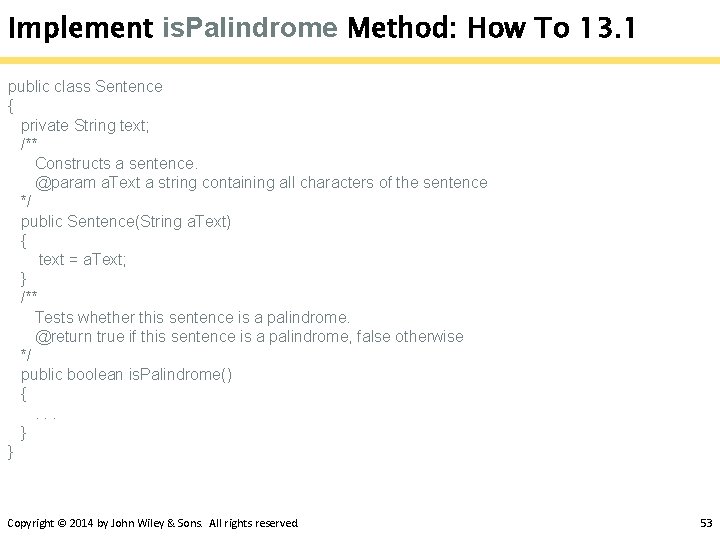
Implement is. Palindrome Method: How To 13. 1 public class Sentence { private String text; /** Constructs a sentence. @param a. Text a string containing all characters of the sentence */ public Sentence(String a. Text) { text = a. Text; } /** Tests whether this sentence is a palindrome. @return true if this sentence is a palindrome, false otherwise */ public boolean is. Palindrome() { . . . } } Copyright © 2014 by John Wiley & Sons. All rights reserved. 53
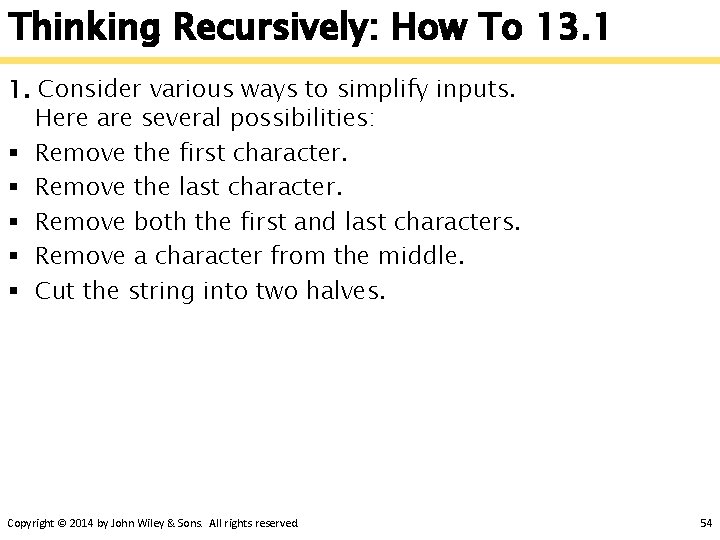
Thinking Recursively: How To 13. 1 1. Consider various ways to simplify inputs. Here are several possibilities: § Remove the first character. § Remove the last character. § Remove both the first and last characters. § Remove a character from the middle. § Cut the string into two halves. Copyright © 2014 by John Wiley & Sons. All rights reserved. 54
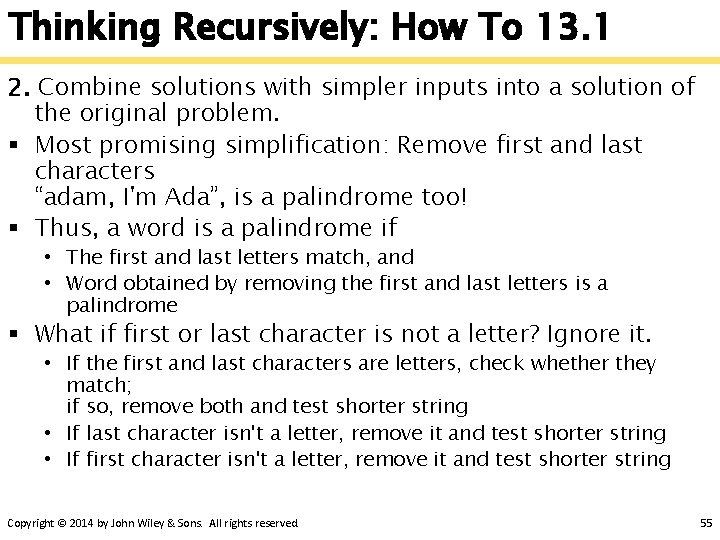
Thinking Recursively: How To 13. 1 2. Combine solutions with simpler inputs into a solution of the original problem. § Most promising simplification: Remove first and last characters “adam, I'm Ada”, is a palindrome too! § Thus, a word is a palindrome if • The first and last letters match, and • Word obtained by removing the first and last letters is a palindrome § What if first or last character is not a letter? Ignore it. • If the first and last characters are letters, check whether they match; if so, remove both and test shorter string • If last character isn't a letter, remove it and test shorter string • If first character isn't a letter, remove it and test shorter string Copyright © 2014 by John Wiley & Sons. All rights reserved. 55
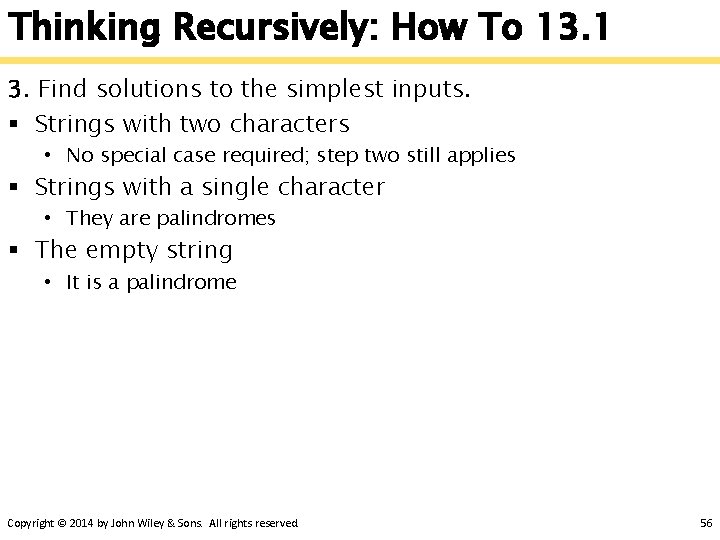
Thinking Recursively: How To 13. 1 3. Find solutions to the simplest inputs. § Strings with two characters • No special case required; step two still applies § Strings with a single character • They are palindromes § The empty string • It is a palindrome Copyright © 2014 by John Wiley & Sons. All rights reserved. 56
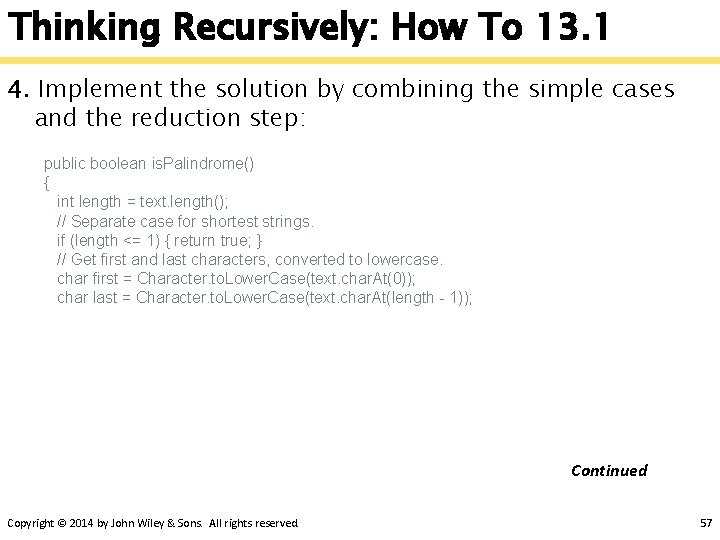
Thinking Recursively: How To 13. 1 4. Implement the solution by combining the simple cases and the reduction step: public boolean is. Palindrome() { int length = text. length(); // Separate case for shortest strings. if (length <= 1) { return true; } // Get first and last characters, converted to lowercase. char first = Character. to. Lower. Case(text. char. At(0)); char last = Character. to. Lower. Case(text. char. At(length - 1)); Continued Copyright © 2014 by John Wiley & Sons. All rights reserved. 57
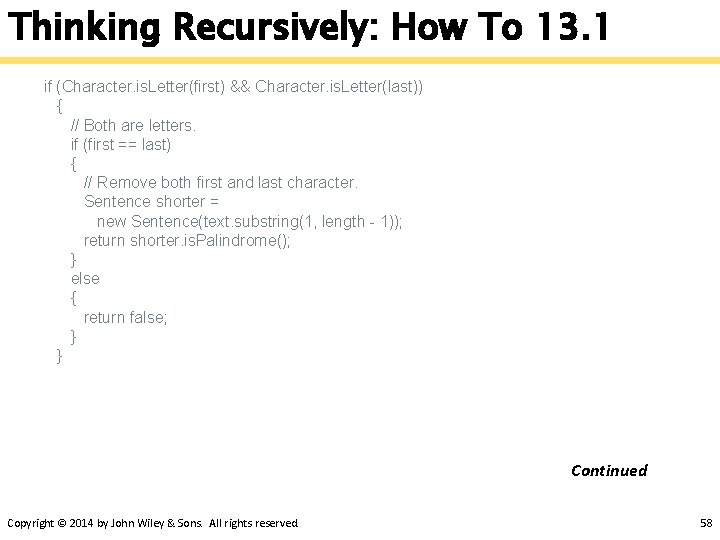
Thinking Recursively: How To 13. 1 if (Character. is. Letter(first) && Character. is. Letter(last)) { // Both are letters. if (first == last) { // Remove both first and last character. Sentence shorter = new Sentence(text. substring(1, length - 1)); return shorter. is. Palindrome(); } else { return false; } } Continued Copyright © 2014 by John Wiley & Sons. All rights reserved. 58
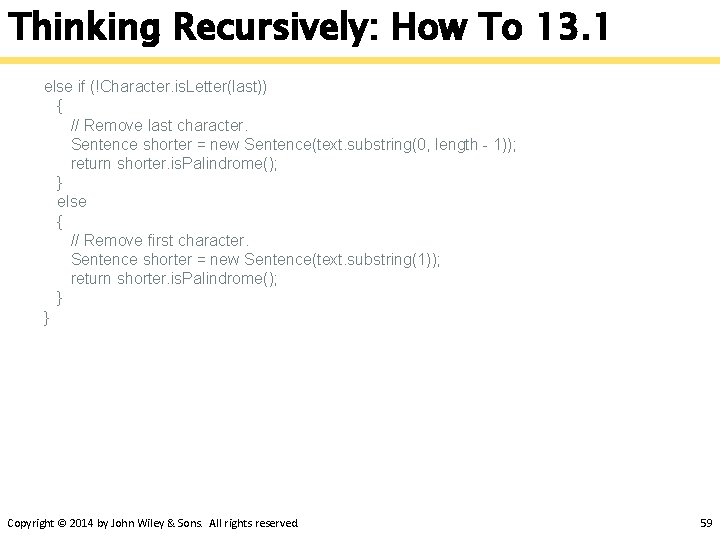
Thinking Recursively: How To 13. 1 else if (!Character. is. Letter(last)) { // Remove last character. Sentence shorter = new Sentence(text. substring(0, length - 1)); return shorter. is. Palindrome(); } else { // Remove first character. Sentence shorter = new Sentence(text. substring(1)); return shorter. is. Palindrome(); } } Copyright © 2014 by John Wiley & Sons. All rights reserved. 59
Recursive Helper Methods § Sometimes, a task can be solved by handing it off to a recursive helper method. § Sometimes it is easier to find a recursive solution if you make a slight change to the original problem. § Consider the palindrome test of previous slide. • It is a bit inefficient to construct new Sentence objects in every step Copyright © 2014 by John Wiley & Sons. All rights reserved. 60
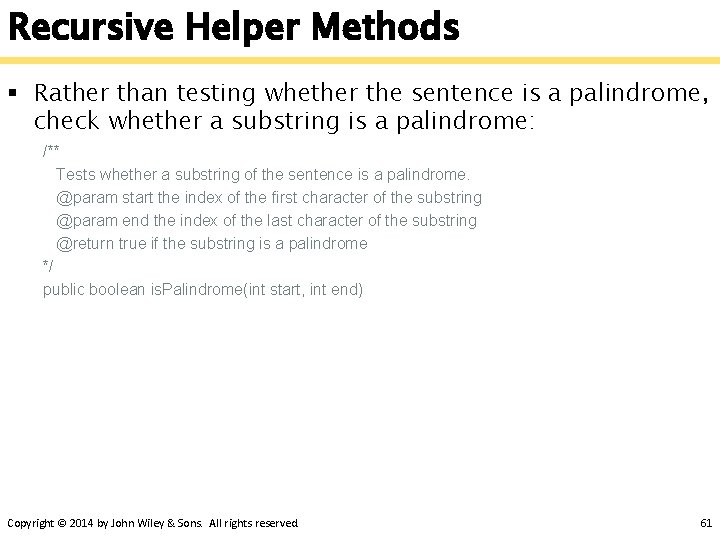
Recursive Helper Methods § Rather than testing whether the sentence is a palindrome, check whether a substring is a palindrome: /** Tests whether a substring of the sentence is a palindrome. @param start the index of the first character of the substring @param end the index of the last character of the substring @return true if the substring is a palindrome */ public boolean is. Palindrome(int start, int end) Copyright © 2014 by John Wiley & Sons. All rights reserved. 61
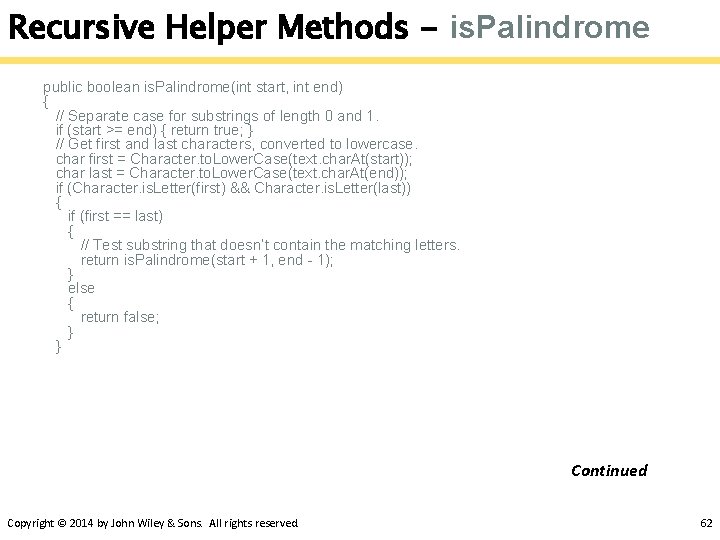
Recursive Helper Methods - is. Palindrome public boolean is. Palindrome(int start, int end) { // Separate case for substrings of length 0 and 1. if (start >= end) { return true; } // Get first and last characters, converted to lowercase. char first = Character. to. Lower. Case(text. char. At(start)); char last = Character. to. Lower. Case(text. char. At(end)); if (Character. is. Letter(first) && Character. is. Letter(last)) { if (first == last) { // Test substring that doesn’t contain the matching letters. return is. Palindrome(start + 1, end - 1); } else { return false; } } Continued Copyright © 2014 by John Wiley & Sons. All rights reserved. 62
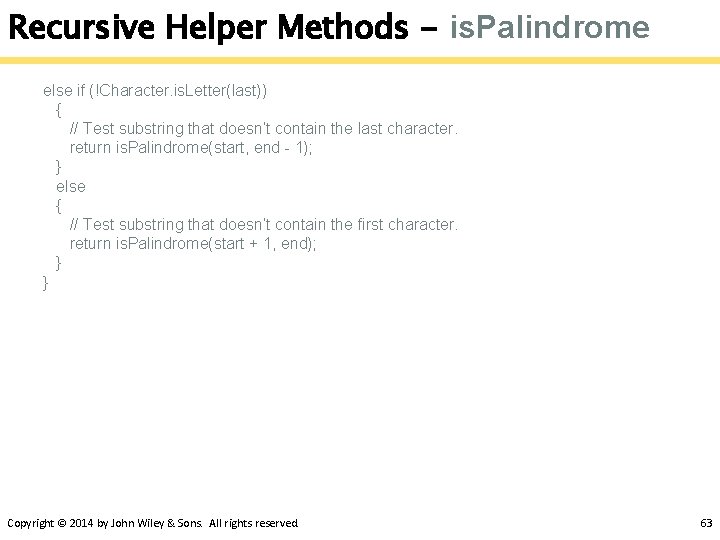
Recursive Helper Methods - is. Palindrome else if (!Character. is. Letter(last)) { // Test substring that doesn’t contain the last character. return is. Palindrome(start, end - 1); } else { // Test substring that doesn’t contain the first character. return is. Palindrome(start + 1, end); } } Copyright © 2014 by John Wiley & Sons. All rights reserved. 63
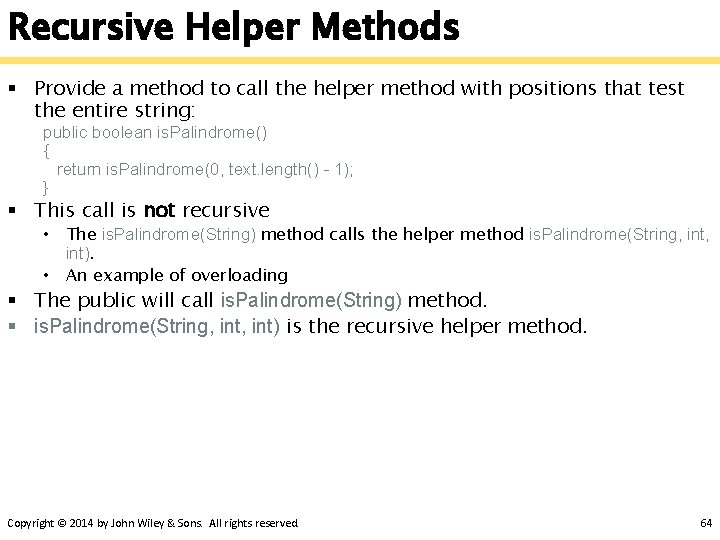
Recursive Helper Methods § Provide a method to call the helper method with positions that test the entire string: public boolean is. Palindrome() { return is. Palindrome(0, text. length() - 1); } § This call is not recursive • The is. Palindrome(String) method calls the helper method is. Palindrome(String, int, int). • An example of overloading § The public will call is. Palindrome(String) method. § is. Palindrome(String, int) is the recursive helper method. Copyright © 2014 by John Wiley & Sons. All rights reserved. 64
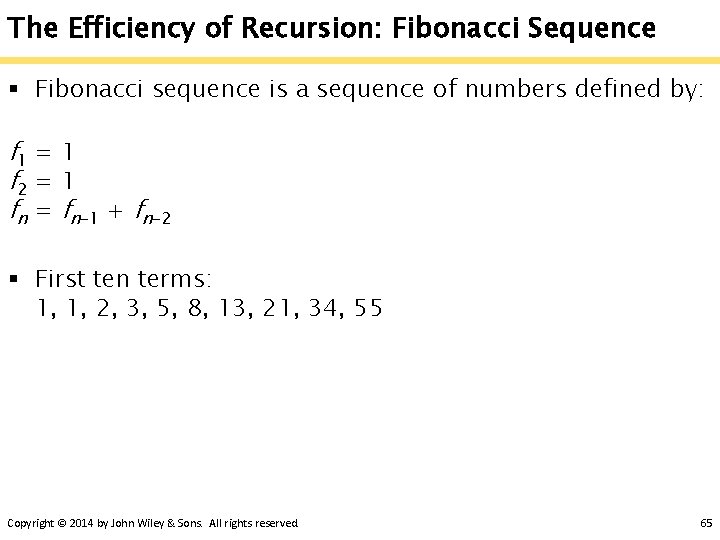
The Efficiency of Recursion: Fibonacci Sequence § Fibonacci sequence is a sequence of numbers defined by: f 1 = 1 f 2 = 1 fn = fn-1 + fn-2 § First ten terms: 1, 1, 2, 3, 5, 8, 13, 21, 34, 55 Copyright © 2014 by John Wiley & Sons. All rights reserved. 65
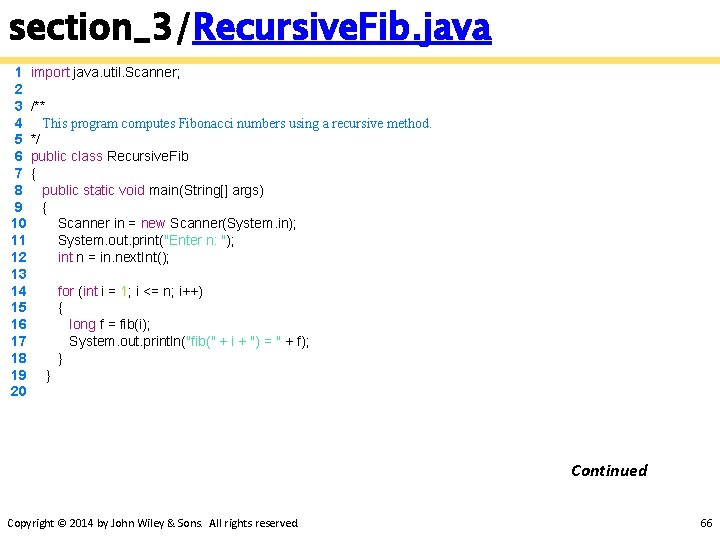
section_3/Recursive. Fib. java 1 import java. util. Scanner; 2 3 /** 4 This program computes Fibonacci numbers using a recursive method. 5 */ 6 public class Recursive. Fib 7 { 8 public static void main(String[] args) 9 { 10 Scanner in = new Scanner(System. in); 11 System. out. print("Enter n: "); 12 int n = in. next. Int(); 13 14 for (int i = 1; i <= n; i++) 15 { 16 long f = fib(i); 17 System. out. println("fib(" + i + ") = " + f); 18 } 19 } 20 Continued Copyright © 2014 by John Wiley & Sons. All rights reserved. 66
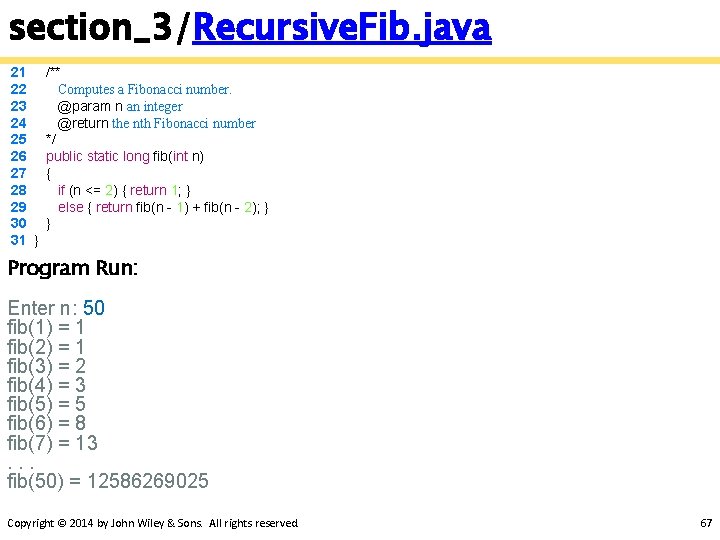
section_3/Recursive. Fib. java 21 22 23 24 25 26 27 28 29 30 31 /** Computes a Fibonacci number. @param n an integer @return the nth Fibonacci number */ public static long fib(int n) { if (n <= 2) { return 1; } else { return fib(n - 1) + fib(n - 2); } } } Program Run: Enter n: 50 fib(1) = 1 fib(2) = 1 fib(3) = 2 fib(4) = 3 fib(5) = 5 fib(6) = 8 fib(7) = 13. . . fib(50) = 12586269025 Copyright © 2014 by John Wiley & Sons. All rights reserved. 67
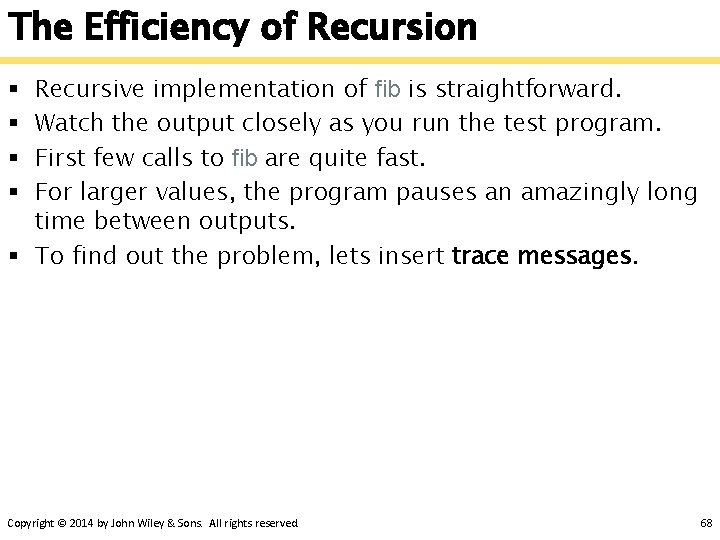
The Efficiency of Recursion Recursive implementation of fib is straightforward. Watch the output closely as you run the test program. First few calls to fib are quite fast. For larger values, the program pauses an amazingly long time between outputs. § To find out the problem, lets insert trace messages. § § Copyright © 2014 by John Wiley & Sons. All rights reserved. 68
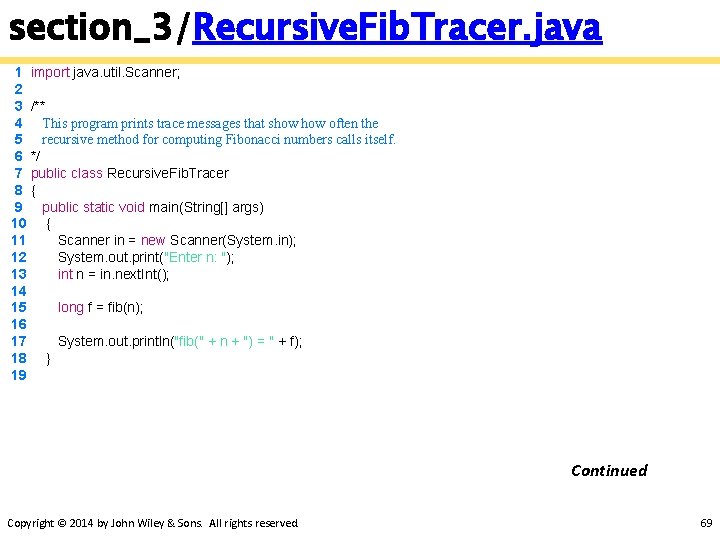
section_3/Recursive. Fib. Tracer. java 1 import java. util. Scanner; 2 3 /** 4 This program prints trace messages that show often the 5 recursive method for computing Fibonacci numbers calls itself. 6 */ 7 public class Recursive. Fib. Tracer 8 { 9 public static void main(String[] args) 10 { 11 Scanner in = new Scanner(System. in); 12 System. out. print("Enter n: "); 13 int n = in. next. Int(); 14 15 long f = fib(n); 16 17 System. out. println("fib(" + n + ") = " + f); 18 } 19 Continued Copyright © 2014 by John Wiley & Sons. All rights reserved. 69
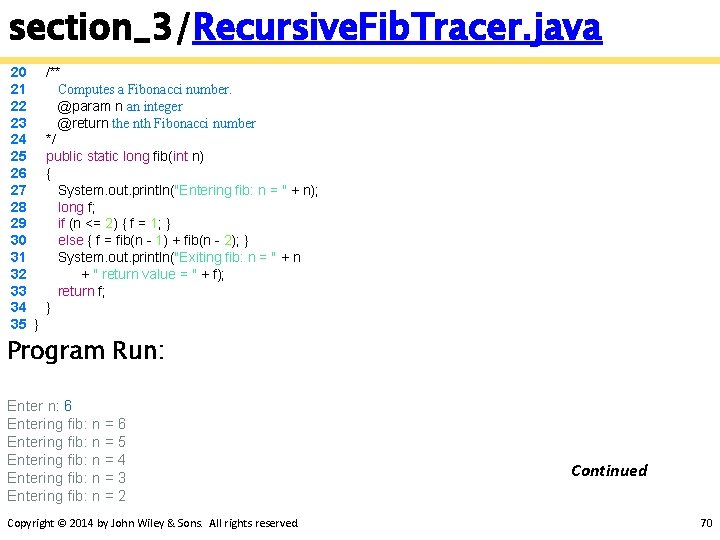
section_3/Recursive. Fib. Tracer. java 20 21 22 23 24 25 26 27 28 29 30 31 32 33 34 35 /** Computes a Fibonacci number. @param n an integer @return the nth Fibonacci number */ public static long fib(int n) { System. out. println("Entering fib: n = " + n); long f; if (n <= 2) { f = 1; } else { f = fib(n - 1) + fib(n - 2); } System. out. println("Exiting fib: n = " + n + " return value = " + f); return f; } } Program Run: Enter n: 6 Entering fib: n = 5 Entering fib: n = 4 Entering fib: n = 3 Entering fib: n = 2 Copyright © 2014 by John Wiley & Sons. All rights reserved. Continued 70
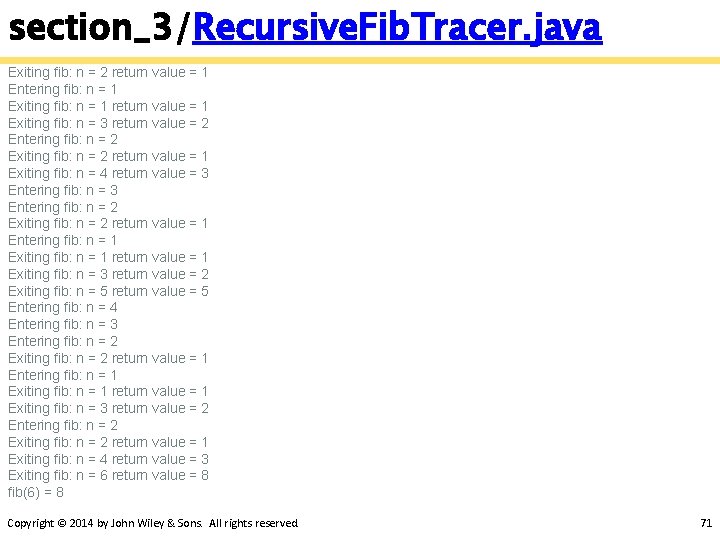
section_3/Recursive. Fib. Tracer. java Exiting fib: n = 2 return value = 1 Entering fib: n = 1 Exiting fib: n = 1 return value = 1 Exiting fib: n = 3 return value = 2 Entering fib: n = 2 Exiting fib: n = 2 return value = 1 Exiting fib: n = 4 return value = 3 Entering fib: n = 2 Exiting fib: n = 2 return value = 1 Entering fib: n = 1 Exiting fib: n = 1 return value = 1 Exiting fib: n = 3 return value = 2 Exiting fib: n = 5 return value = 5 Entering fib: n = 4 Entering fib: n = 3 Entering fib: n = 2 Exiting fib: n = 2 return value = 1 Entering fib: n = 1 Exiting fib: n = 1 return value = 1 Exiting fib: n = 3 return value = 2 Entering fib: n = 2 Exiting fib: n = 2 return value = 1 Exiting fib: n = 4 return value = 3 Exiting fib: n = 6 return value = 8 fib(6) = 8 Copyright © 2014 by John Wiley & Sons. All rights reserved. 71
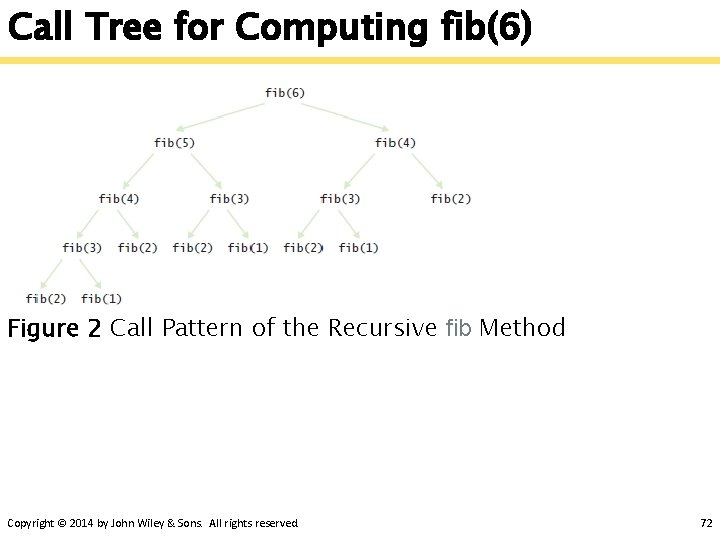
Call Tree for Computing fib(6) Figure 2 Call Pattern of the Recursive fib Method Copyright © 2014 by John Wiley & Sons. All rights reserved. 72
The Efficiency of Recursion § Method takes so long because it computes the same values over and over. § The computation of fib(6) calls fib(3) three times. § Imitate the pencil-and-paper process to avoid computing the values more than once. Copyright © 2014 by John Wiley & Sons. All rights reserved. 73
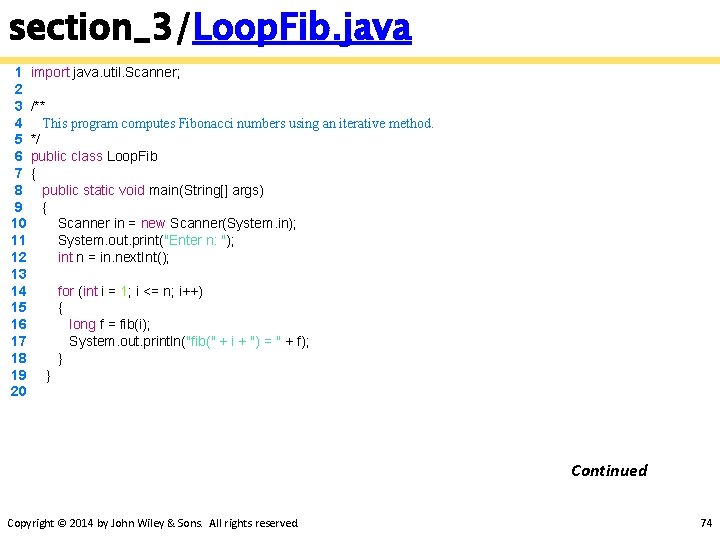
section_3/Loop. Fib. java 1 import java. util. Scanner; 2 3 /** 4 This program computes Fibonacci numbers using an iterative method. 5 */ 6 public class Loop. Fib 7 { 8 public static void main(String[] args) 9 { 10 Scanner in = new Scanner(System. in); 11 System. out. print("Enter n: "); 12 int n = in. next. Int(); 13 14 for (int i = 1; i <= n; i++) 15 { 16 long f = fib(i); 17 System. out. println("fib(" + i + ") = " + f); 18 } 19 } 20 Continued Copyright © 2014 by John Wiley & Sons. All rights reserved. 74
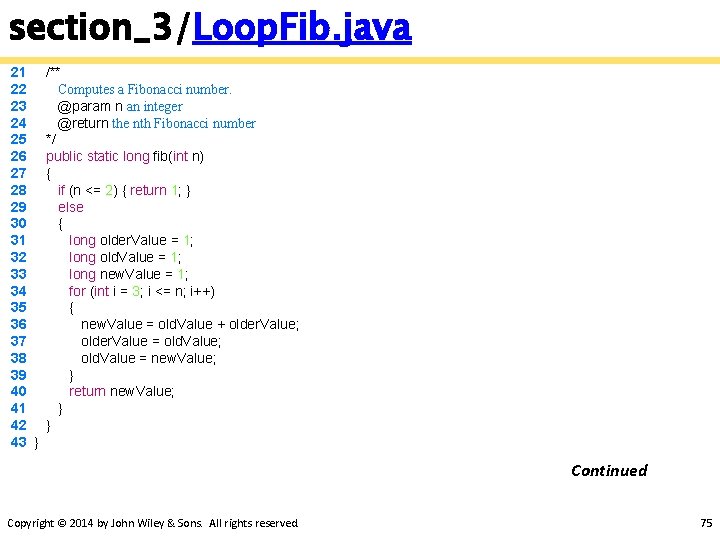
section_3/Loop. Fib. java 21 22 23 24 25 26 27 28 29 30 31 32 33 34 35 36 37 38 39 40 41 42 43 /** Computes a Fibonacci number. @param n an integer @return the nth Fibonacci number */ public static long fib(int n) { if (n <= 2) { return 1; } else { long older. Value = 1; long old. Value = 1; long new. Value = 1; for (int i = 3; i <= n; i++) { new. Value = old. Value + older. Value; older. Value = old. Value; old. Value = new. Value; } return new. Value; } } } Continued Copyright © 2014 by John Wiley & Sons. All rights reserved. 75
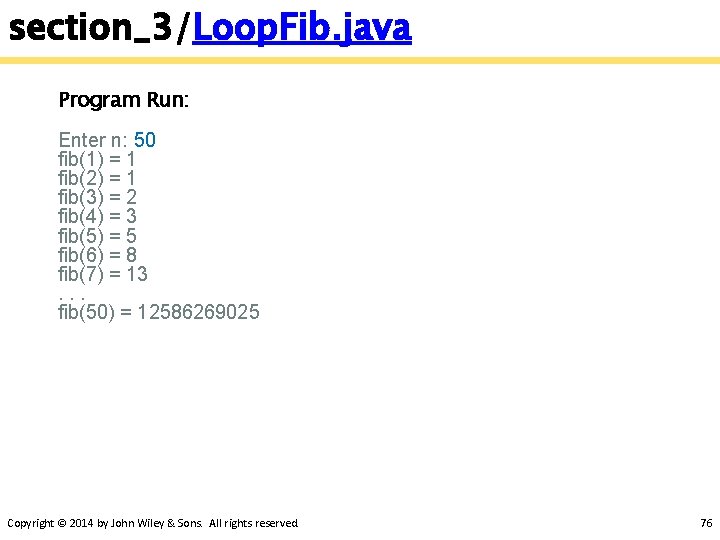
section_3/Loop. Fib. java Program Run: Enter n: 50 fib(1) = 1 fib(2) = 1 fib(3) = 2 fib(4) = 3 fib(5) = 5 fib(6) = 8 fib(7) = 13. . . fib(50) = 12586269025 Copyright © 2014 by John Wiley & Sons. All rights reserved. 76
The Efficiency of Recursion § In most cases, the iterative and recursive approaches have comparable efficiency. § Occasionally, a recursive solution runs much slower than its iterative counterpart. § In most cases, the recursive solution is only slightly slower. § The iterative is. Palindrome performs only slightly better than recursive solution. • Each recursive method call takes a certain amount of processor time Copyright © 2014 by John Wiley & Sons. All rights reserved. 77
The Efficiency of Recursion § Smart compilers can avoid recursive method calls if they follow simple patterns. § Most compilers don't do that. § In many cases, a recursive solution is easier to understand implement correctly than an iterative solution. Copyright © 2014 by John Wiley & Sons. All rights reserved. 78
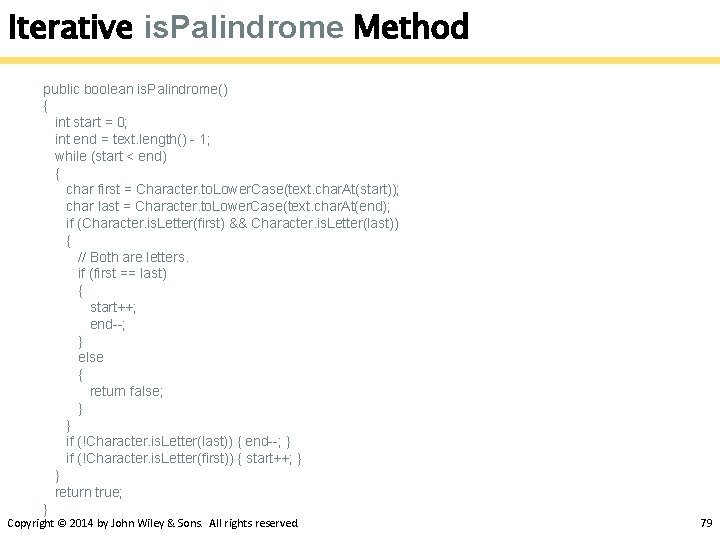
Iterative is. Palindrome Method public boolean is. Palindrome() { int start = 0; int end = text. length() - 1; while (start < end) { char first = Character. to. Lower. Case(text. char. At(start)); char last = Character. to. Lower. Case(text. char. At(end); if (Character. is. Letter(first) && Character. is. Letter(last)) { // Both are letters. if (first == last) { start++; end--; } else { return false; } } if (!Character. is. Letter(last)) { end--; } if (!Character. is. Letter(first)) { start++; } } return true; } Copyright © 2014 by John Wiley & Sons. All rights reserved. 79
Permutations § Using recursion, you can find all arrangements of a set of objects. § Design a class that will list all permutations of a string. A permutation is a rearrangement of the letters. Copyright © 2014 by John Wiley & Sons. All rights reserved. 80
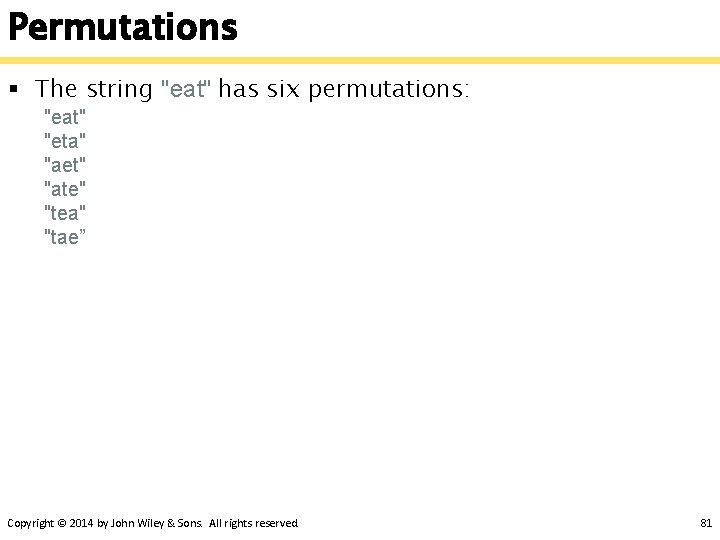
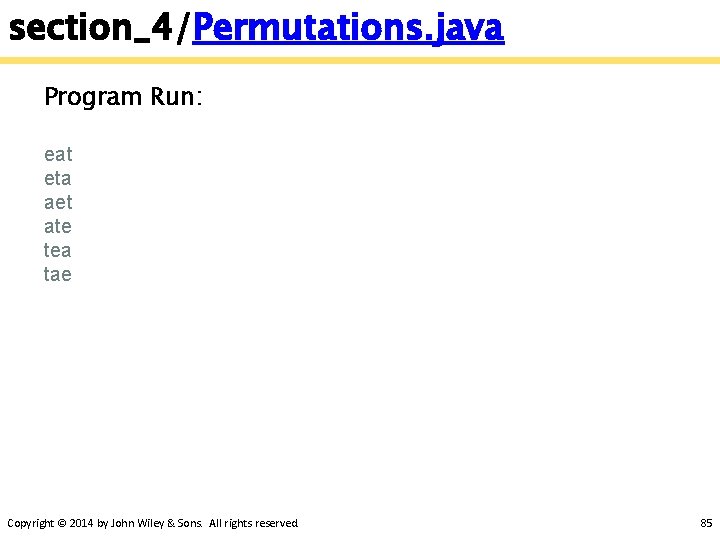
Permutations § The string "eat" has six permutations: "eat" "eta" "aet" "ate" "tea" "tae” Copyright © 2014 by John Wiley & Sons. All rights reserved. 81
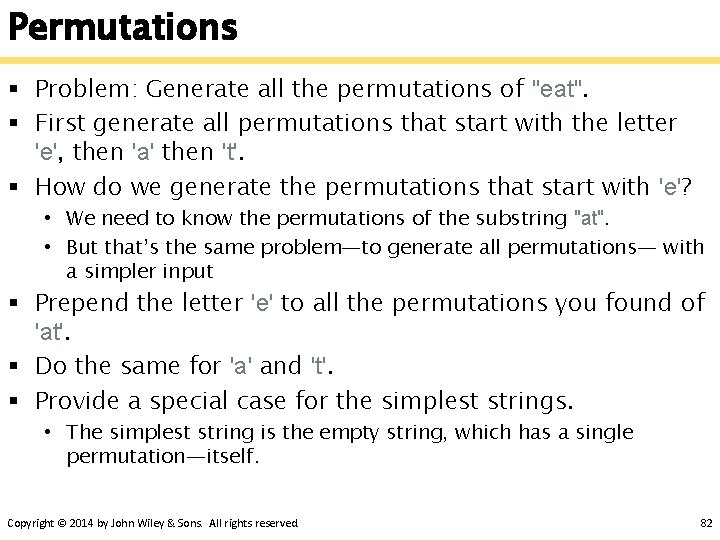
Permutations § Problem: Generate all the permutations of "eat". § First generate all permutations that start with the letter 'e', then 'a' then 't'. § How do we generate the permutations that start with 'e'? • We need to know the permutations of the substring "at". • But that’s the same problem—to generate all permutations— with a simpler input § Prepend the letter 'e' to all the permutations you found of 'at'. § Do the same for 'a' and 't'. § Provide a special case for the simplest strings. • The simplest string is the empty string, which has a single permutation—itself. Copyright © 2014 by John Wiley & Sons. All rights reserved. 82
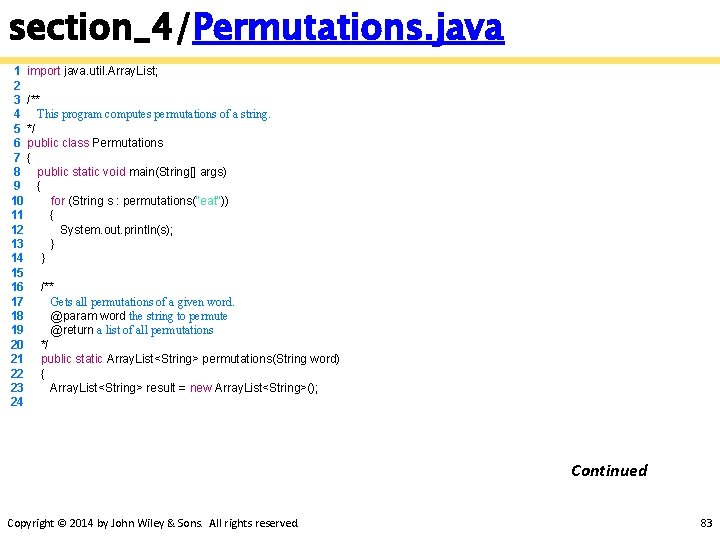
section_4/Permutations. java 1 import java. util. Array. List; 2 3 /** 4 This program computes permutations of a string. 5 */ 6 public class Permutations 7 { 8 public static void main(String[] args) 9 { 10 for (String s : permutations("eat")) 11 { 12 System. out. println(s); 13 } 14 } 15 16 /** 17 Gets all permutations of a given word. 18 @param word the string to permute 19 @return a list of all permutations 20 */ 21 public static Array. List<String> permutations(String word) 22 { 23 Array. List<String> result = new Array. List<String>(); 24 Continued Copyright © 2014 by John Wiley & Sons. All rights reserved. 83
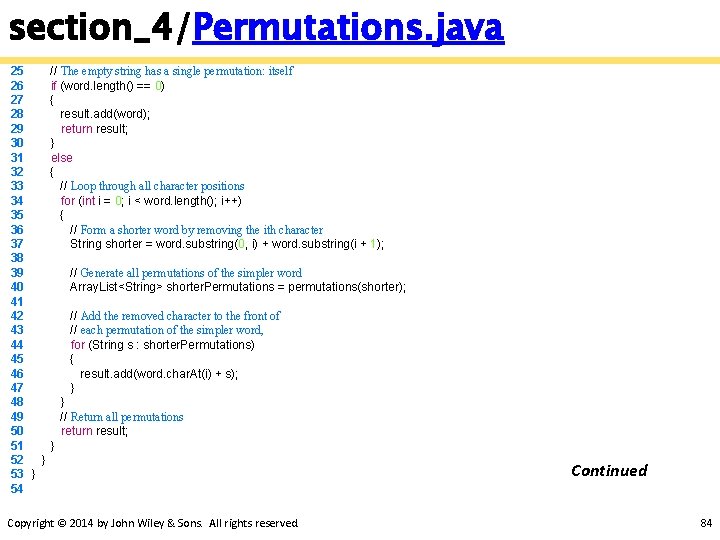
section_4/Permutations. java 25 26 27 28 29 30 31 32 33 34 35 36 37 38 39 40 41 42 43 44 45 46 47 48 49 50 51 52 53 54 // The empty string has a single permutation: itself if (word. length() == 0) { result. add(word); return result; } else { // Loop through all character positions for (int i = 0; i < word. length(); i++) { // Form a shorter word by removing the ith character String shorter = word. substring(0, i) + word. substring(i + 1); // Generate all permutations of the simpler word Array. List<String> shorter. Permutations = permutations(shorter); // Add the removed character to the front of // each permutation of the simpler word, for (String s : shorter. Permutations) { result. add(word. char. At(i) + s); } // Return all permutations return result; } } } Copyright © 2014 by John Wiley & Sons. All rights reserved. Continued 84
section_4/Permutations. java Program Run: eat eta aet ate tea tae Copyright © 2014 by John Wiley & Sons. All rights reserved. 85
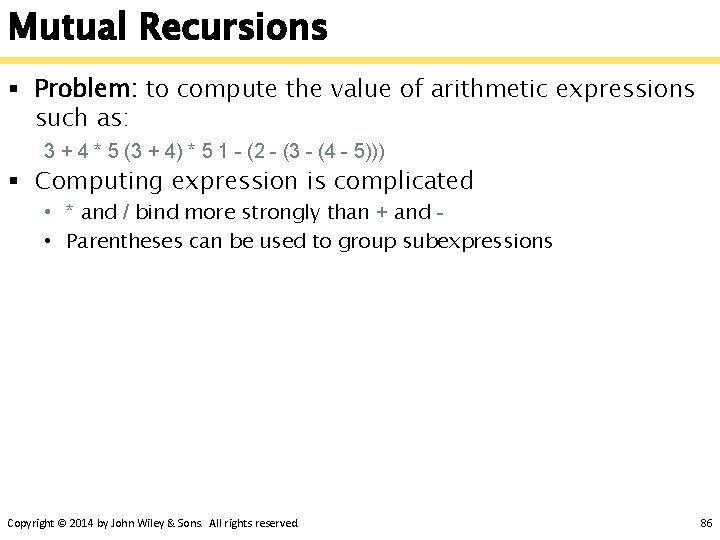
Mutual Recursions § Problem: to compute the value of arithmetic expressions such as: 3 + 4 * 5 (3 + 4) * 5 1 - (2 - (3 - (4 - 5))) § Computing expression is complicated • * and / bind more strongly than + and • Parentheses can be used to group subexpressions Copyright © 2014 by John Wiley & Sons. All rights reserved. 86
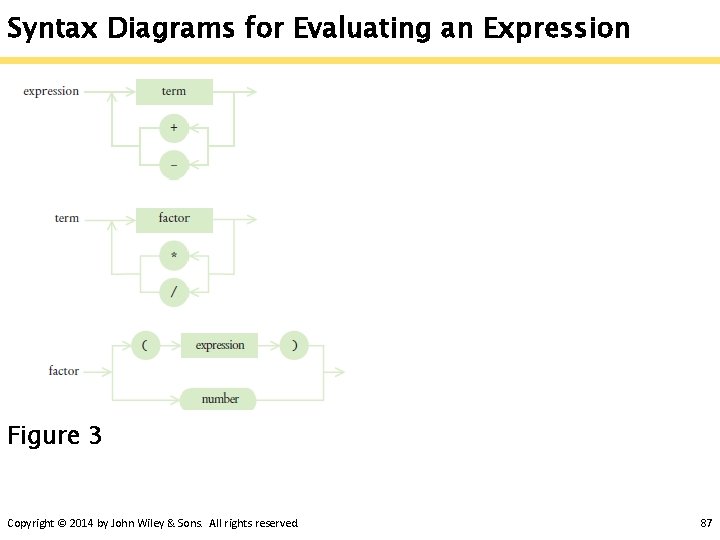
Syntax Diagrams for Evaluating an Expression Figure 3 Copyright © 2014 by John Wiley & Sons. All rights reserved. 87
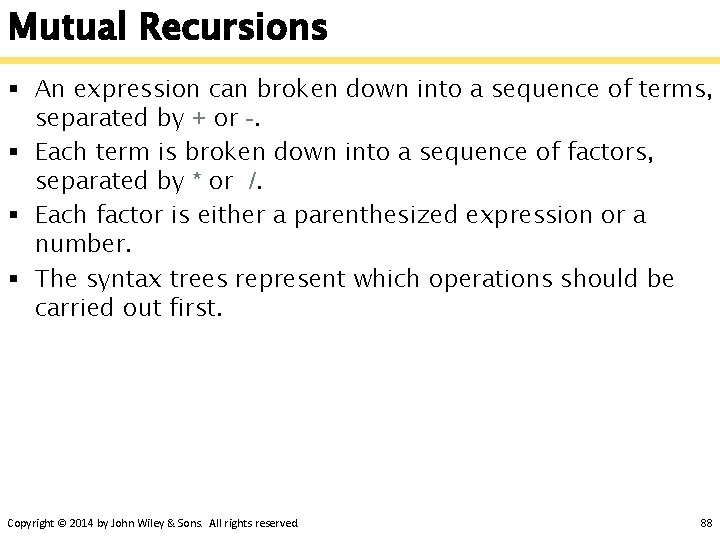
Mutual Recursions § An expression can broken down into a sequence of terms, separated by + or -. § Each term is broken down into a sequence of factors, separated by * or /. § Each factor is either a parenthesized expression or a number. § The syntax trees represent which operations should be carried out first. Copyright © 2014 by John Wiley & Sons. All rights reserved. 88
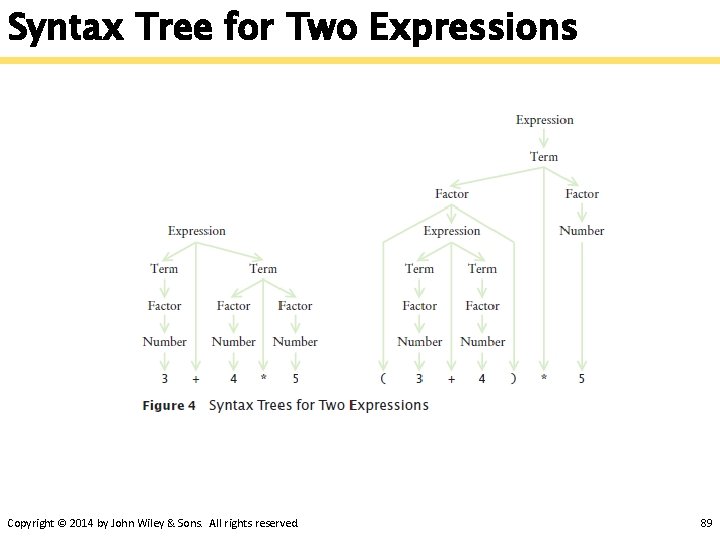
Syntax Tree for Two Expressions Copyright © 2014 by John Wiley & Sons. All rights reserved. 89
Mutually Recursive Methods § In a mutual recursion, a set of cooperating methods calls each other repeatedly. § To compute the value of an expression, implement 3 methods that call each other recursively: • get. Expression. Value • get. Term. Value • get. Factor. Value Copyright © 2014 by John Wiley & Sons. All rights reserved. 90
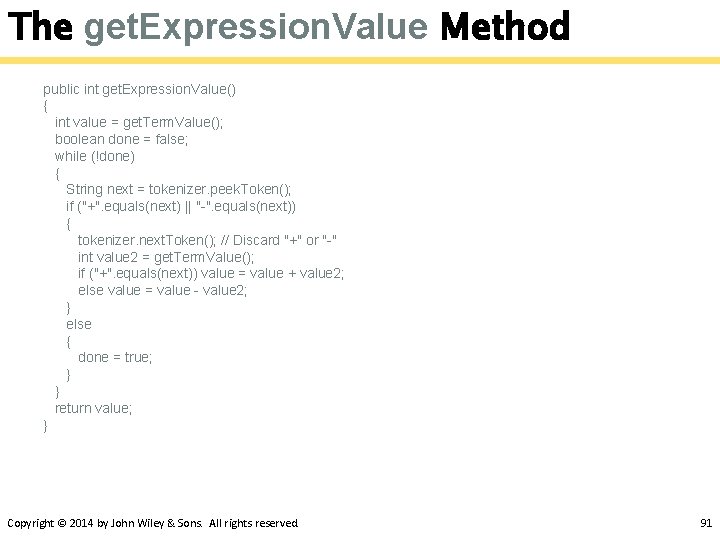
The get. Expression. Value Method public int get. Expression. Value() { int value = get. Term. Value(); boolean done = false; while (!done) { String next = tokenizer. peek. Token(); if ("+". equals(next) || "-". equals(next)) { tokenizer. next. Token(); // Discard "+" or "-" int value 2 = get. Term. Value(); if ("+". equals(next)) value = value + value 2; else value = value - value 2; } else { done = true; } } return value; } Copyright © 2014 by John Wiley & Sons. All rights reserved. 91
The get. Term. Value Method § The get. Term. Value method calls get. Factor. Value in the same way, multiplying or dividing the factor values. Copyright © 2014 by John Wiley & Sons. All rights reserved. 92
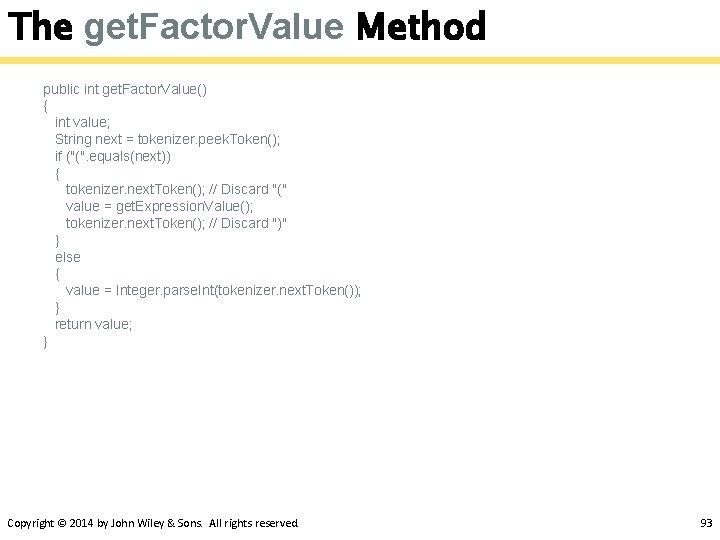
The get. Factor. Value Method public int get. Factor. Value() { int value; String next = tokenizer. peek. Token(); if ("(". equals(next)) { tokenizer. next. Token(); // Discard "(" value = get. Expression. Value(); tokenizer. next. Token(); // Discard ")" } else { value = Integer. parse. Int(tokenizer. next. Token()); } return value; } Copyright © 2014 by John Wiley & Sons. All rights reserved. 93
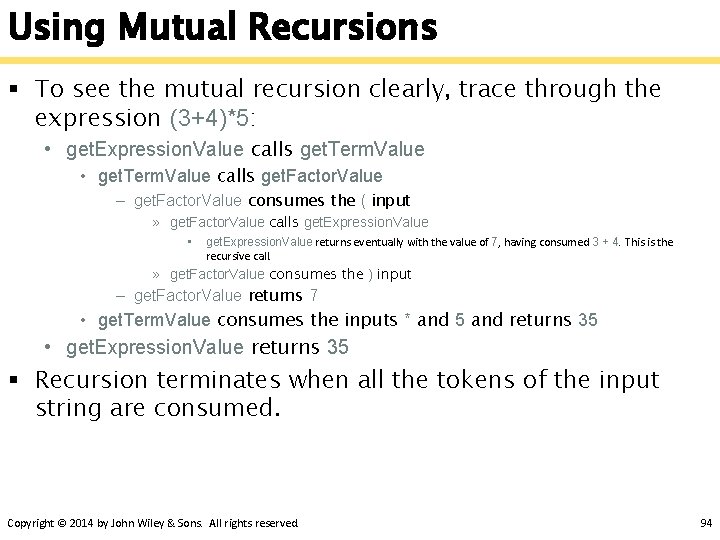
Using Mutual Recursions § To see the mutual recursion clearly, trace through the expression (3+4)*5: • get. Expression. Value calls get. Term. Value • get. Term. Value calls get. Factor. Value – get. Factor. Value consumes the ( input » get. Factor. Value calls get. Expression. Value • get. Expression. Value returns eventually with the value of 7, having consumed 3 + 4. This is the recursive call. » get. Factor. Value consumes the ) input – get. Factor. Value returns 7 • get. Term. Value consumes the inputs * and 5 and returns 35 • get. Expression. Value returns 35 § Recursion terminates when all the tokens of the input string are consumed. Copyright © 2014 by John Wiley & Sons. All rights reserved. 94
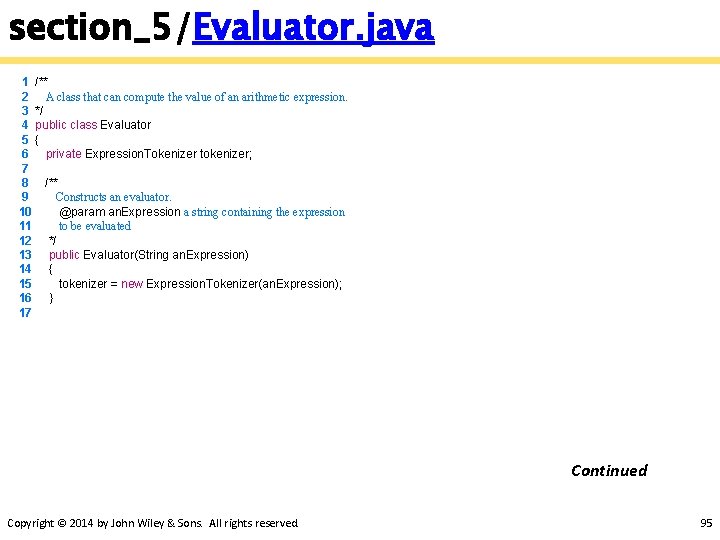
section_5/Evaluator. java 1 /** 2 A class that can compute the value of an arithmetic expression. 3 */ 4 public class Evaluator 5 { 6 private Expression. Tokenizer tokenizer; 7 8 /** 9 Constructs an evaluator. 10 @param an. Expression a string containing the expression 11 to be evaluated 12 */ 13 public Evaluator(String an. Expression) 14 { 15 tokenizer = new Expression. Tokenizer(an. Expression); 16 } 17 Continued Copyright © 2014 by John Wiley & Sons. All rights reserved. 95
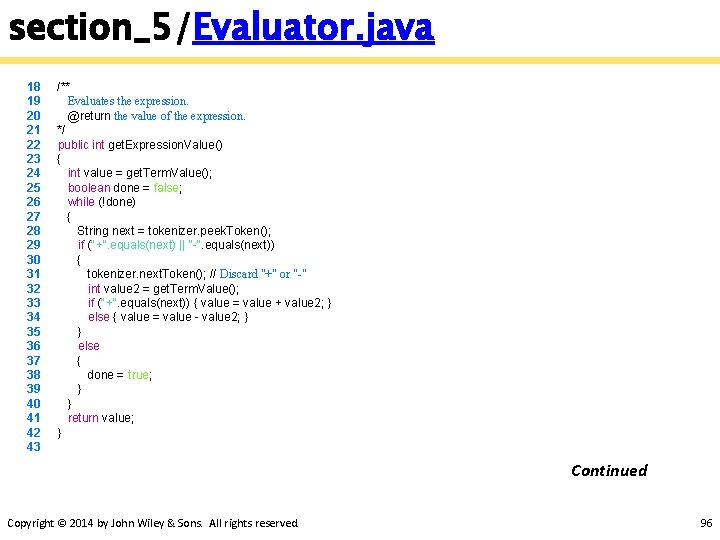
section_5/Evaluator. java 18 19 20 21 22 23 24 25 26 27 28 29 30 31 32 33 34 35 36 37 38 39 40 41 42 43 /** Evaluates the expression. @return the value of the expression. */ public int get. Expression. Value() { int value = get. Term. Value(); boolean done = false; while (!done) { String next = tokenizer. peek. Token(); if ("+". equals(next) || "-". equals(next)) { tokenizer. next. Token(); // Discard "+" or "-" int value 2 = get. Term. Value(); if ("+". equals(next)) { value = value + value 2; } else { value = value - value 2; } else { done = true; } } return value; } Continued Copyright © 2014 by John Wiley & Sons. All rights reserved. 96
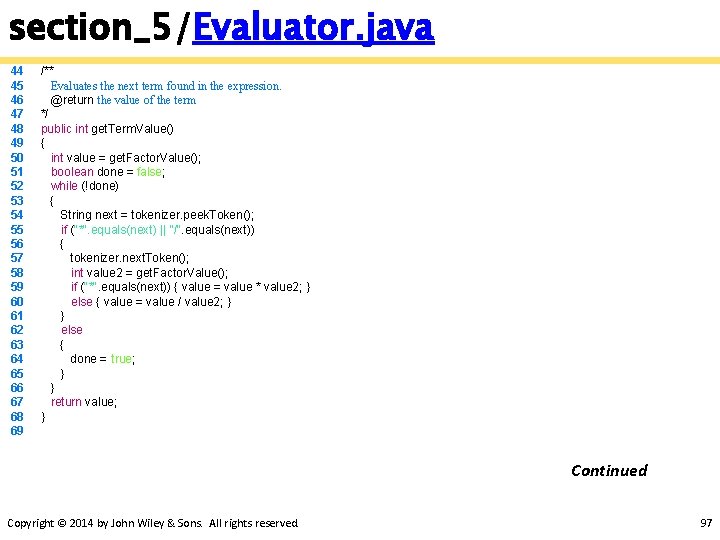
section_5/Evaluator. java 44 45 46 47 48 49 50 51 52 53 54 55 56 57 58 59 60 61 62 63 64 65 66 67 68 69 /** Evaluates the next term found in the expression. @return the value of the term */ public int get. Term. Value() { int value = get. Factor. Value(); boolean done = false; while (!done) { String next = tokenizer. peek. Token(); if ("*". equals(next) || "/". equals(next)) { tokenizer. next. Token(); int value 2 = get. Factor. Value(); if ("*". equals(next)) { value = value * value 2; } else { value = value / value 2; } else { done = true; } } return value; } Continued Copyright © 2014 by John Wiley & Sons. All rights reserved. 97
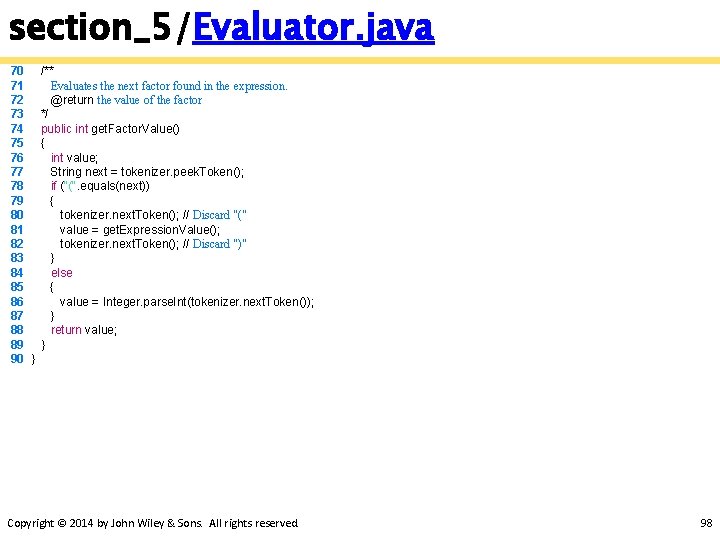
section_5/Evaluator. java 70 71 72 73 74 75 76 77 78 79 80 81 82 83 84 85 86 87 88 89 90 /** Evaluates the next factor found in the expression. @return the value of the factor */ public int get. Factor. Value() { int value; String next = tokenizer. peek. Token(); if ("(". equals(next)) { tokenizer. next. Token(); // Discard "(" value = get. Expression. Value(); tokenizer. next. Token(); // Discard ")" } else { value = Integer. parse. Int(tokenizer. next. Token()); } return value; } } Copyright © 2014 by John Wiley & Sons. All rights reserved. 98
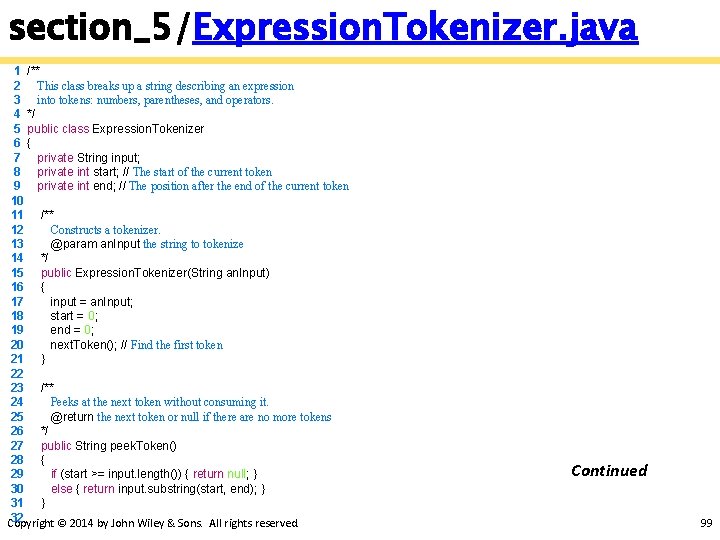
section_5/Expression. Tokenizer. java 1 /** 2 This class breaks up a string describing an expression 3 into tokens: numbers, parentheses, and operators. 4 */ 5 public class Expression. Tokenizer 6 { 7 private String input; 8 private int start; // The start of the current token 9 private int end; // The position after the end of the current token 10 11 /** 12 Constructs a tokenizer. 13 @param an. Input the string to tokenize 14 */ 15 public Expression. Tokenizer(String an. Input) 16 { 17 input = an. Input; 18 start = 0; 19 end = 0; 20 next. Token(); // Find the first token 21 } 22 23 /** 24 Peeks at the next token without consuming it. 25 @return the next token or null if there are no more tokens 26 */ 27 public String peek. Token() 28 { 29 if (start >= input. length()) { return null; } 30 else { return input. substring(start, end); } 31 } 32 Copyright © 2014 by John Wiley & Sons. All rights reserved. Continued 99
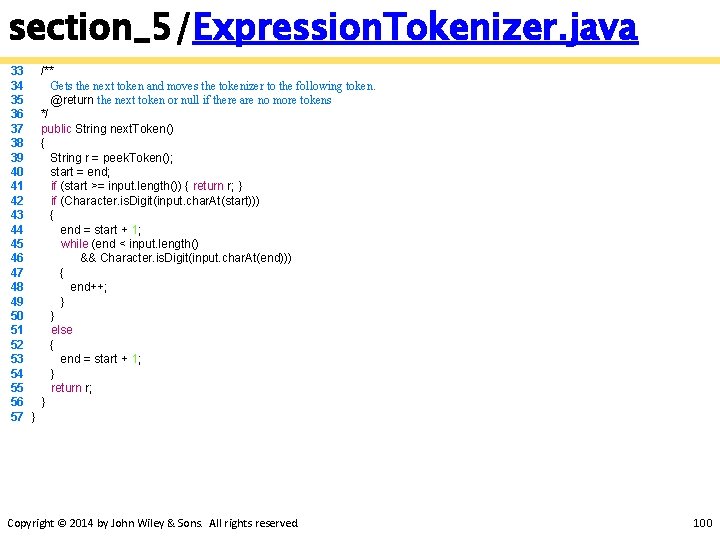
section_5/Expression. Tokenizer. java 33 34 35 36 37 38 39 40 41 42 43 44 45 46 47 48 49 50 51 52 53 54 55 56 57 /** Gets the next token and moves the tokenizer to the following token. @return the next token or null if there are no more tokens */ public String next. Token() { String r = peek. Token(); start = end; if (start >= input. length()) { return r; } if (Character. is. Digit(input. char. At(start))) { end = start + 1; while (end < input. length() && Character. is. Digit(input. char. At(end))) { end++; } } else { end = start + 1; } return r; } } Copyright © 2014 by John Wiley & Sons. All rights reserved. 100
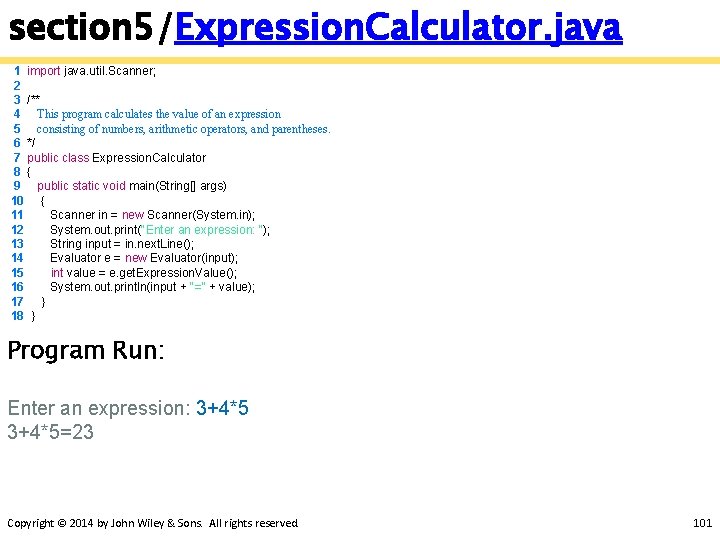
section 5/Expression. Calculator. java 1 import java. util. Scanner; 2 3 /** 4 This program calculates the value of an expression 5 consisting of numbers, arithmetic operators, and parentheses. 6 */ 7 public class Expression. Calculator 8 { 9 public static void main(String[] args) 10 { 11 Scanner in = new Scanner(System. in); 12 System. out. print("Enter an expression: "); 13 String input = in. next. Line(); 14 Evaluator e = new Evaluator(input); 15 int value = e. get. Expression. Value(); 16 System. out. println(input + "=" + value); 17 } 18 } Program Run: Enter an expression: 3+4*5=23 Copyright © 2014 by John Wiley & Sons. All rights reserved. 101
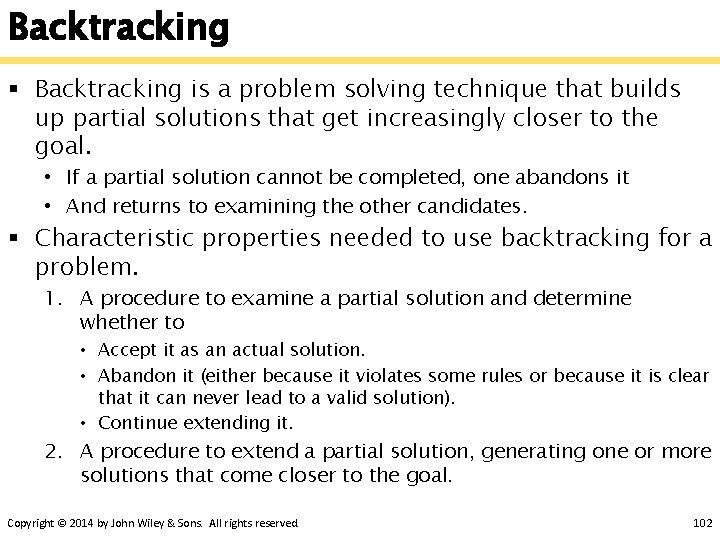
Backtracking § Backtracking is a problem solving technique that builds up partial solutions that get increasingly closer to the goal. • If a partial solution cannot be completed, one abandons it • And returns to examining the other candidates. § Characteristic properties needed to use backtracking for a problem. 1. A procedure to examine a partial solution and determine whether to • Accept it as an actual solution. • Abandon it (either because it violates some rules or because it is clear that it can never lead to a valid solution). • Continue extending it. 2. A procedure to extend a partial solution, generating one or more solutions that come closer to the goal. Copyright © 2014 by John Wiley & Sons. All rights reserved. 102
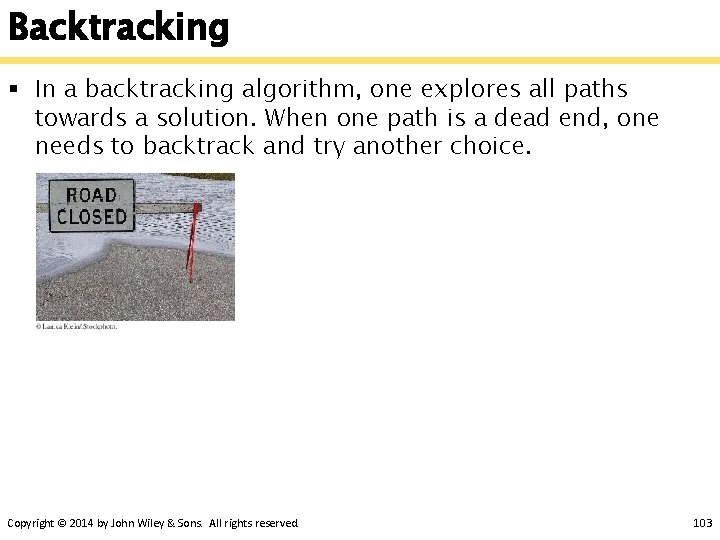
Backtracking § In a backtracking algorithm, one explores all paths towards a solution. When one path is a dead end, one needs to backtrack and try another choice. Copyright © 2014 by John Wiley & Sons. All rights reserved. 103
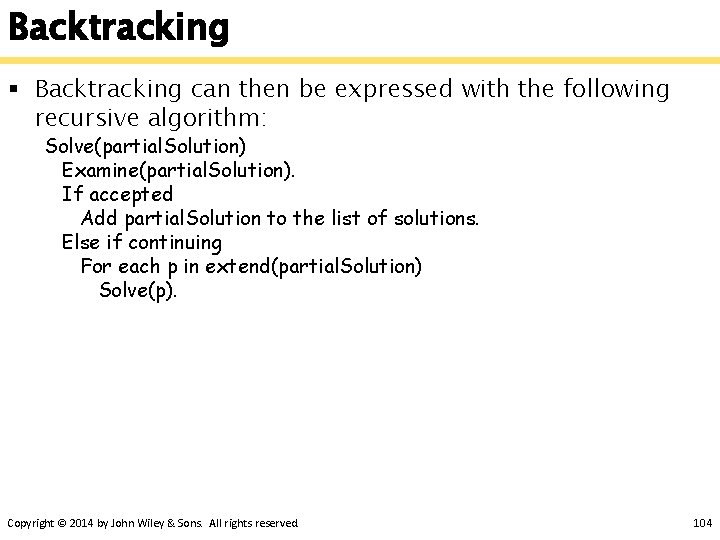
Backtracking § Backtracking can then be expressed with the following recursive algorithm: Solve(partial. Solution) Examine(partial. Solution). If accepted Add partial. Solution to the list of solutions. Else if continuing For each p in extend(partial. Solution) Solve(p). Copyright © 2014 by John Wiley & Sons. All rights reserved. 104
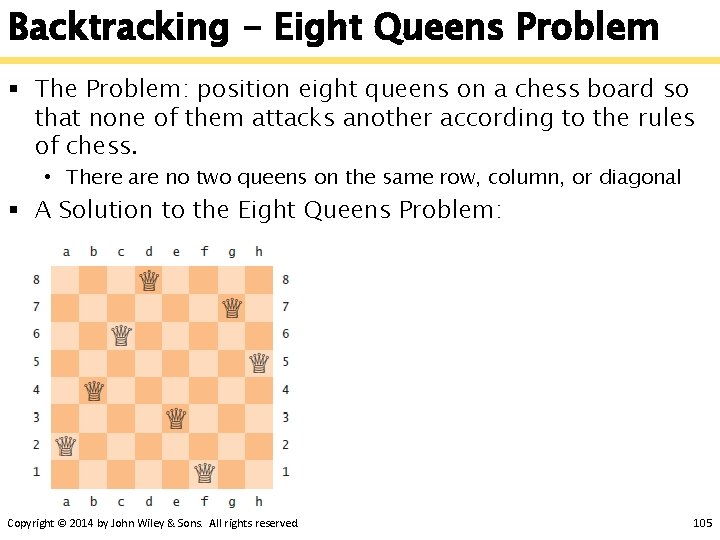
Backtracking - Eight Queens Problem § The Problem: position eight queens on a chess board so that none of them attacks another according to the rules of chess. • There are no two queens on the same row, column, or diagonal § A Solution to the Eight Queens Problem: Copyright © 2014 by John Wiley & Sons. All rights reserved. 105
Backtracking - Eight Queens Problem § To examine a partial solution: • If two queens attack each other, reject it. • Otherwise, if it has eight queens, accept it. • Otherwise, continue. § To extend a partial solution: • Add another queen on an empty square • For efficiency, place first queen in row 1, the next in row 2, and so on Copyright © 2014 by John Wiley & Sons. All rights reserved. 106
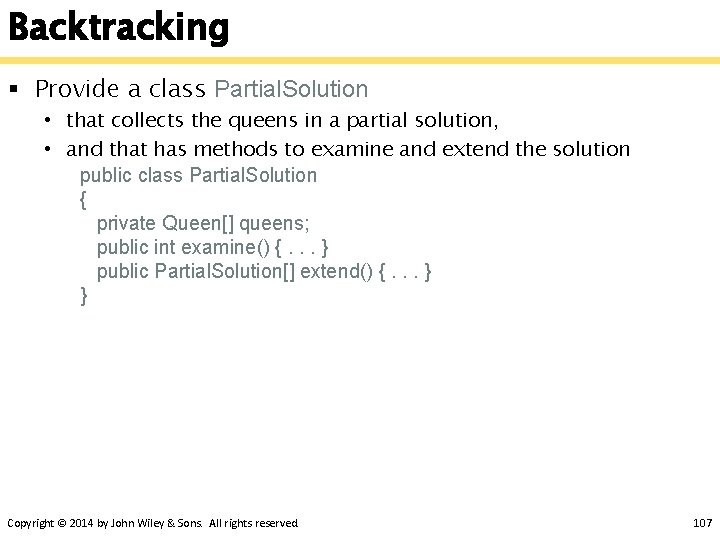
Backtracking § Provide a class Partial. Solution • that collects the queens in a partial solution, • and that has methods to examine and extend the solution public class Partial. Solution { private Queen[] queens; public int examine() {. . . } public Partial. Solution[] extend() {. . . } } Copyright © 2014 by John Wiley & Sons. All rights reserved. 107
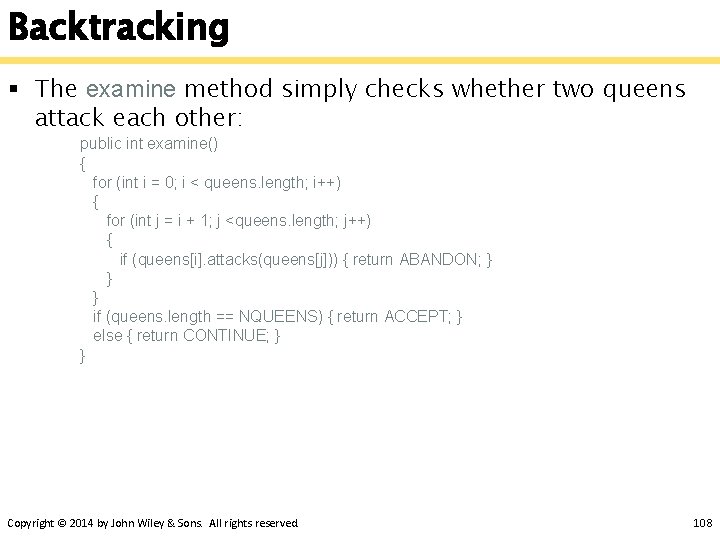
Backtracking § The examine method simply checks whether two queens attack each other: public int examine() { for (int i = 0; i < queens. length; i++) { for (int j = i + 1; j <queens. length; j++) { if (queens[i]. attacks(queens[j])) { return ABANDON; } } } if (queens. length == NQUEENS) { return ACCEPT; } else { return CONTINUE; } } Copyright © 2014 by John Wiley & Sons. All rights reserved. 108
Backtracking § The extend method takes a given solution • And makes eight copies of it. • Each copy gets a new queen in a different column. Copyright © 2014 by John Wiley & Sons. All rights reserved. 109
![Backtracking public Partial. Solution[] extend() { // Generate a new solution for each column](http://slidetodoc.com/presentation_image_h/d72d4e1d9ecf528d806895b7b28724ab/image-110.jpg "Backtracking public Partial. Solution[] extend() { // Generate a new solution for each column")
Backtracking public Partial. Solution[] extend() { // Generate a new solution for each column Partial. Solution[] result = new Partial. Solution[NQUEENS]; for (int i = 0; i < result. length; i++) { int size = queens. length; // The new solution has one more row than this one result[i] = new Partial. Solution(size + 1); // Copy this solution into the new one for (int j = 0; j < size; j++) { result[i]. queens[j] = queens[j]; } // Append the new queen into the ith column result[i]. queens[size] = new Queen(size, i); } return result; } Copyright © 2014 by John Wiley & Sons. All rights reserved. 110
Backtracking § To determine if two queens attack each other diagonally • Compute the slope. • If it ± 1 the queens attack each other diagonally? § Just check: |row 2 - row 1| = |column 2 - column 1| Copyright © 2014 by John Wiley & Sons. All rights reserved. 111
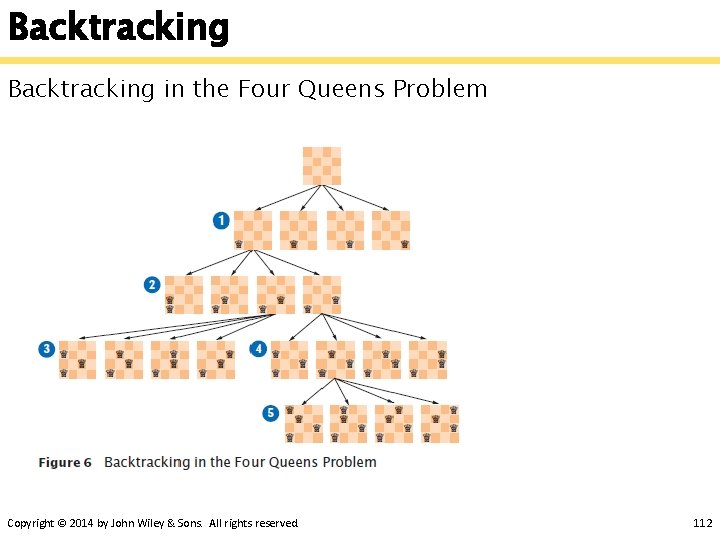
Backtracking in the Four Queens Problem Copyright © 2014 by John Wiley & Sons. All rights reserved. 112
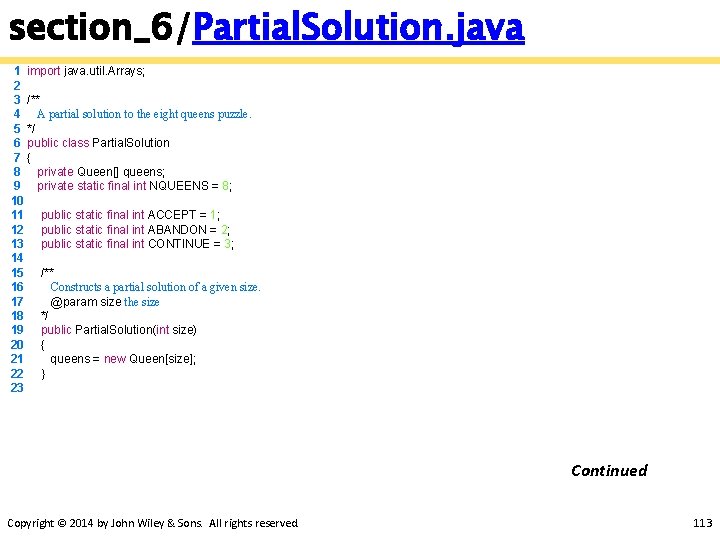
section_6/Partial. Solution. java 1 import java. util. Arrays; 2 3 /** 4 A partial solution to the eight queens puzzle. 5 */ 6 public class Partial. Solution 7 { 8 private Queen[] queens; 9 private static final int NQUEENS = 8; 10 11 public static final int ACCEPT = 1; 12 public static final int ABANDON = 2; 13 public static final int CONTINUE = 3; 14 15 /** 16 Constructs a partial solution of a given size. 17 @param size the size 18 */ 19 public Partial. Solution(int size) 20 { 21 queens = new Queen[size]; 22 } 23 Continued Copyright © 2014 by John Wiley & Sons. All rights reserved. 113
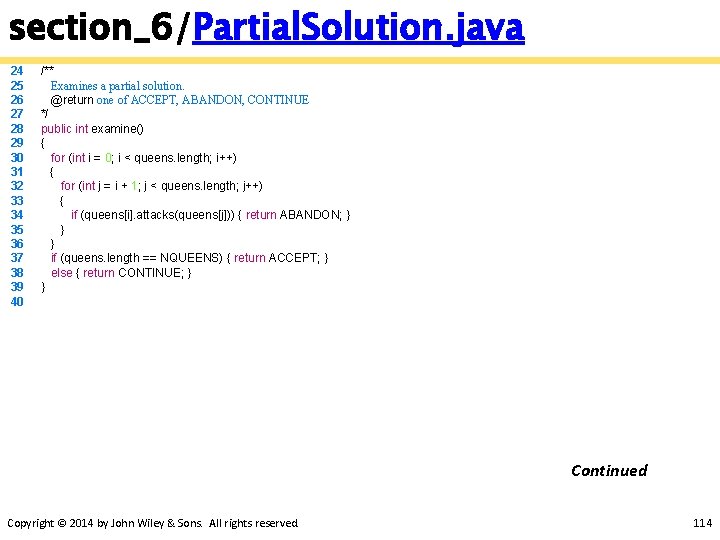
section_6/Partial. Solution. java 24 25 26 27 28 29 30 31 32 33 34 35 36 37 38 39 40 /** Examines a partial solution. @return one of ACCEPT, ABANDON, CONTINUE */ public int examine() { for (int i = 0; i < queens. length; i++) { for (int j = i + 1; j < queens. length; j++) { if (queens[i]. attacks(queens[j])) { return ABANDON; } } if (queens. length == NQUEENS) { return ACCEPT; } else { return CONTINUE; } } Continued Copyright © 2014 by John Wiley & Sons. All rights reserved. 114
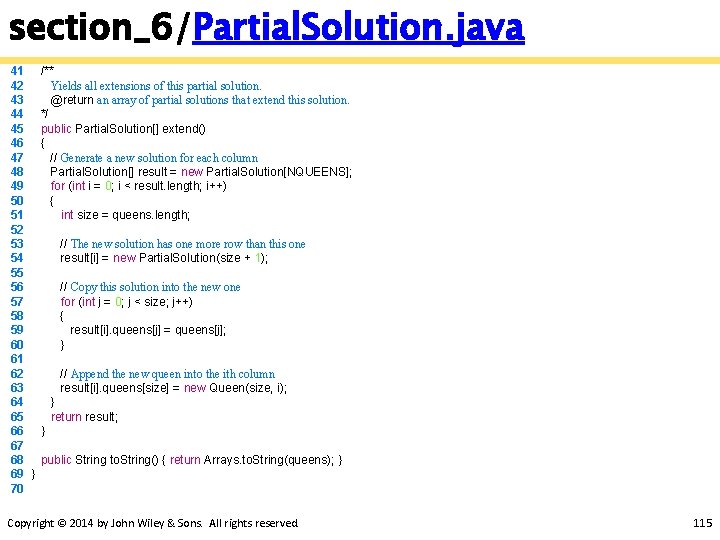
section_6/Partial. Solution. java 41 42 43 44 45 46 47 48 49 50 51 52 53 54 55 56 57 58 59 60 61 62 63 64 65 66 67 68 69 70 /** Yields all extensions of this partial solution. @return an array of partial solutions that extend this solution. */ public Partial. Solution[] extend() { // Generate a new solution for each column Partial. Solution[] result = new Partial. Solution[NQUEENS]; for (int i = 0; i < result. length; i++) { int size = queens. length; // The new solution has one more row than this one result[i] = new Partial. Solution(size + 1); // Copy this solution into the new one for (int j = 0; j < size; j++) { result[i]. queens[j] = queens[j]; } // Append the new queen into the ith column result[i]. queens[size] = new Queen(size, i); } return result; } public String to. String() { return Arrays. to. String(queens); } } Copyright © 2014 by John Wiley & Sons. All rights reserved. 115
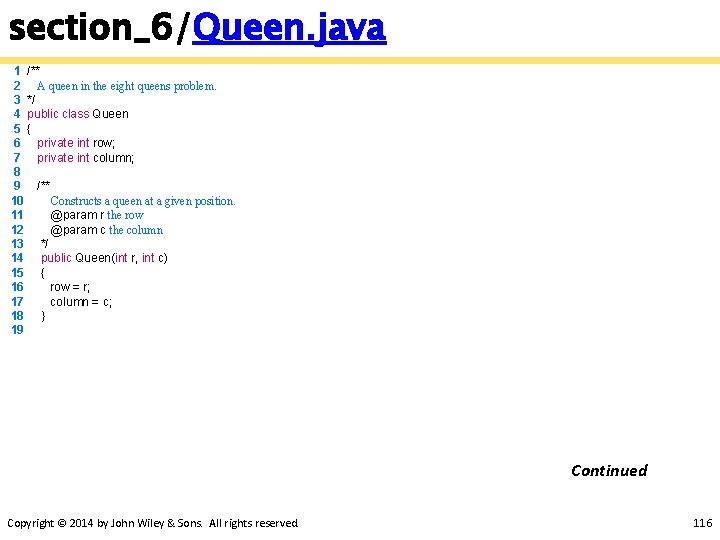
section_6/Queen. java 1 /** 2 A queen in the eight queens problem. 3 */ 4 public class Queen 5 { 6 private int row; 7 private int column; 8 9 /** 10 Constructs a queen at a given position. 11 @param r the row 12 @param c the column 13 */ 14 public Queen(int r, int c) 15 { 16 row = r; 17 column = c; 18 } 19 Continued Copyright © 2014 by John Wiley & Sons. All rights reserved. 116
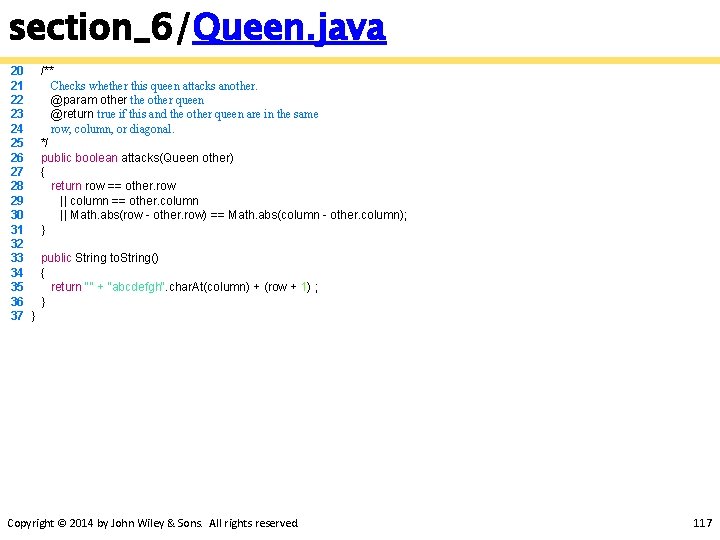
section_6/Queen. java 20 21 22 23 24 25 26 27 28 29 30 31 32 33 34 35 36 37 /** Checks whether this queen attacks another. @param other the other queen @return true if this and the other queen are in the same row, column, or diagonal. */ public boolean attacks(Queen other) { return row == other. row || column == other. column || Math. abs(row - other. row) == Math. abs(column - other. column); } public String to. String() { return "" + "abcdefgh". char. At(column) + (row + 1) ; } } Copyright © 2014 by John Wiley & Sons. All rights reserved. 117
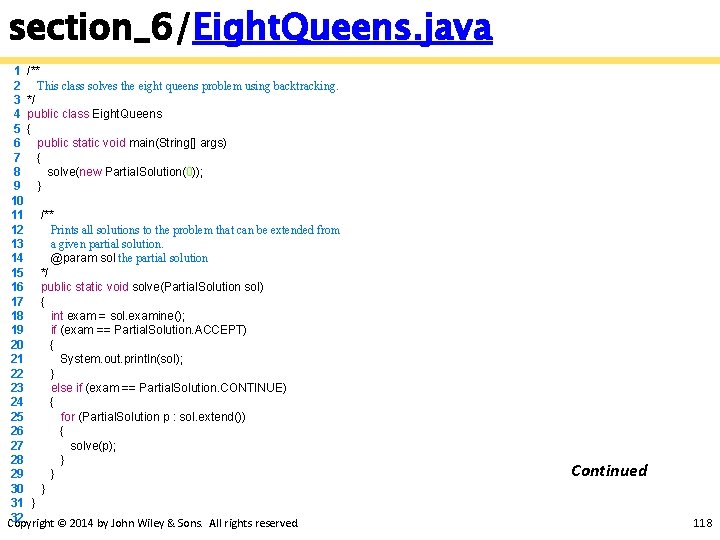
section_6/Eight. Queens. java 1 /** 2 This class solves the eight queens problem using backtracking. 3 */ 4 public class Eight. Queens 5 { 6 public static void main(String[] args) 7 { 8 solve(new Partial. Solution(0)); 9 } 10 11 /** 12 Prints all solutions to the problem that can be extended from 13 a given partial solution. 14 @param sol the partial solution 15 */ 16 public static void solve(Partial. Solution sol) 17 { 18 int exam = sol. examine(); 19 if (exam == Partial. Solution. ACCEPT) 20 { 21 System. out. println(sol); 22 } 23 else if (exam == Partial. Solution. CONTINUE) 24 { 25 for (Partial. Solution p : sol. extend()) 26 { 27 solve(p); 28 } 29 } 30 } 31 } 32 Copyright © 2014 by John Wiley & Sons. All rights reserved. Continued 118
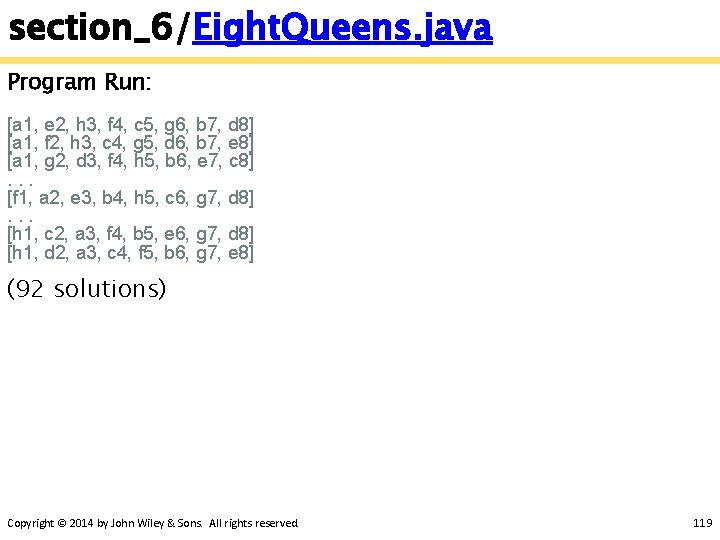
section_6/Eight. Queens. java Program Run: [a 1, e 2, h 3, f 4, c 5, g 6, b 7, d 8] [a 1, f 2, h 3, c 4, g 5, d 6, b 7, e 8] [a 1, g 2, d 3, f 4, h 5, b 6, e 7, c 8]. . . [f 1, a 2, e 3, b 4, h 5, c 6, g 7, d 8]. . . [h 1, c 2, a 3, f 4, b 5, e 6, g 7, d 8] [h 1, d 2, a 3, c 4, f 5, b 6, g 7, e 8] (92 solutions) Copyright © 2014 by John Wiley & Sons. All rights reserved. 119
Towers of Hanoi § History § The Tower of Hanoi is a puzzle that was invented by the French mathematician Eduoard Lucas in 1883. The puzzle was created out of an old Hindu legend. The story tells of a Hindu temple at the center of the world where priests were given a stack of 64 golden disks of decreasing size. The disks were stacked on one of three towers. The priests were to transfer the stack of disks from the starting tower to another. The priests, tasked by God to complete the game, were to work diligently. It was said that when they completed their task, the temple would crumble to dust and the world would come to an end. Copyright © 2014 by John Wiley & Sons. All rights reserved. 120
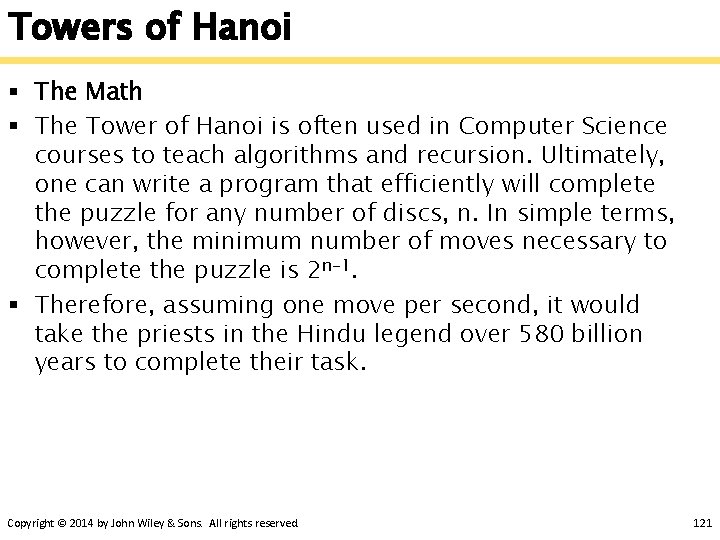
Towers of Hanoi § The Math § The Tower of Hanoi is often used in Computer Science courses to teach algorithms and recursion. Ultimately, one can write a program that efficiently will complete the puzzle for any number of discs, n. In simple terms, however, the minimum number of moves necessary to complete the puzzle is 2 n-1. § Therefore, assuming one move per second, it would take the priests in the Hindu legend over 580 billion years to complete their task. Copyright © 2014 by John Wiley & Sons. All rights reserved. 121
The Towers of Hanoi § The Towers of Hanoi is a puzzle made up of three vertical pegs and several disks that slide onto the pegs § The disks are of varying size, initially placed on one peg with the largest disk on the bottom and increasingly smaller disks on top § The goal is to move all of the disks from one peg to another following these rules: • Only one disk can be moved at a time • A disk cannot be placed on top of a smaller disk • All disks must be on some peg (except for the one in transit) Java Software Structures, 4 th Edition, Lewis/Chase Copyright © 2014 by John Wiley & Sons. All rights reserved. 8 - 122
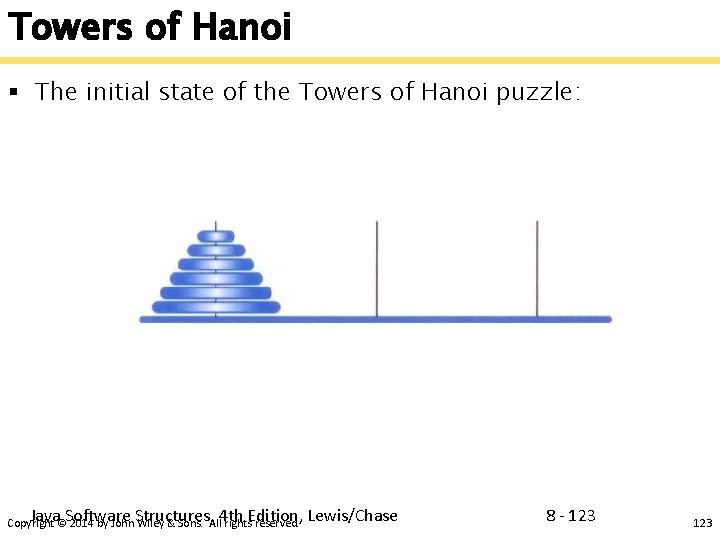
Towers of Hanoi § The initial state of the Towers of Hanoi puzzle: Java Software Structures, 4 th Edition, Lewis/Chase Copyright © 2014 by John Wiley & Sons. All rights reserved. 8 - 123
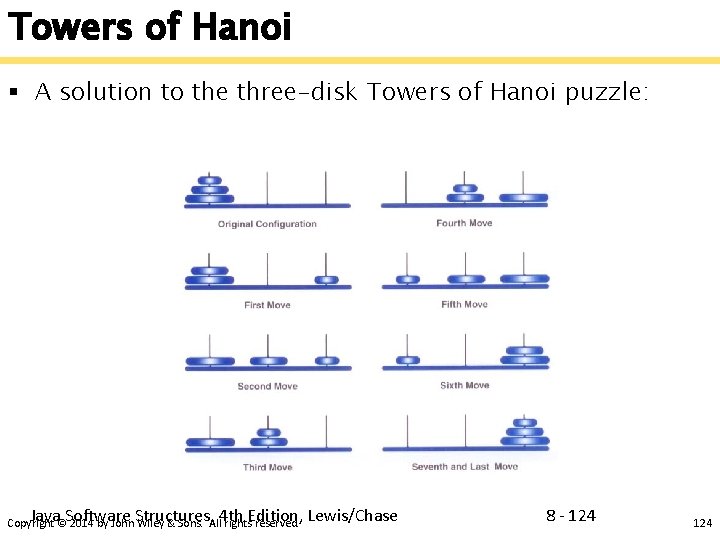
Towers of Hanoi § A solution to the three-disk Towers of Hanoi puzzle: Java Software Structures, 4 th Edition, Lewis/Chase Copyright © 2014 by John Wiley & Sons. All rights reserved. 8 - 124
Towers of Hanoi § A solution to To. H can be expressed recursively § To move N disks from the original peg to the destination peg: • Move the topmost N-1 disks from the original peg to the extra peg • Move the largest disk from the original peg to the destination peg • Move the N-1 disks from the extra peg to the destination peg § The base case occurs when a peg contains only one disk Java Software Structures, 4 th Edition, Lewis/Chase Copyright © 2014 by John Wiley & Sons. All rights reserved. 8 - 125
Towers of Hanoi § The number of moves increases exponentially as the number of disks increases § The recursive solution is simple and elegant to express and program, but is very inefficient § However, an iterative solution to this problem is much more complex to define and program Java Software Structures, 4 th Edition, Lewis/Chase Copyright © 2014 by John Wiley & Sons. All rights reserved. 8 - 126
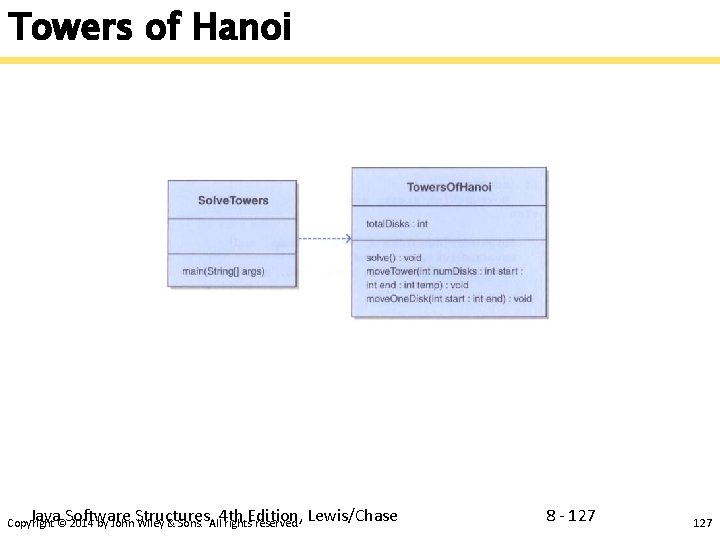
Towers of Hanoi Java Software Structures, 4 th Edition, Lewis/Chase Copyright © 2014 by John Wiley & Sons. All rights reserved. 8 - 127
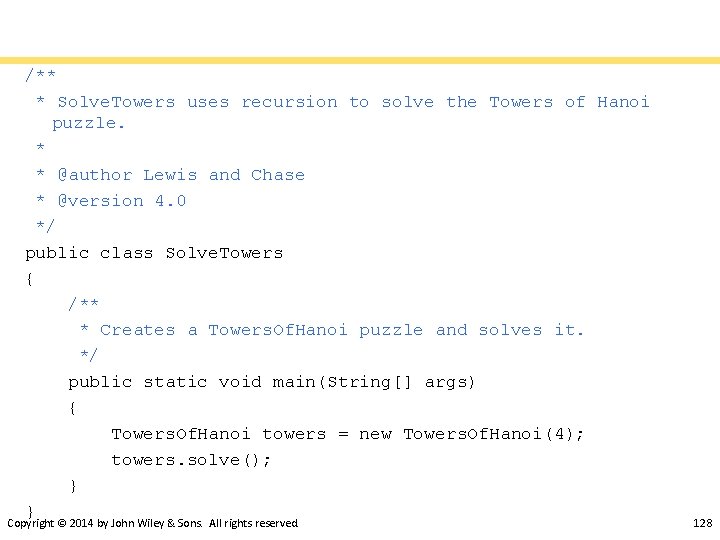
/** * Solve. Towers uses recursion to solve the Towers of Hanoi puzzle. * * @author Lewis and Chase * @version 4. 0 */ public class Solve. Towers { /** * Creates a Towers. Of. Hanoi puzzle and solves it. */ public static void main(String[] args) { Towers. Of. Hanoi towers = new Towers. Of. Hanoi(4); towers. solve(); } } Copyright © 2014 by John Wiley & Sons. All rights reserved. 128
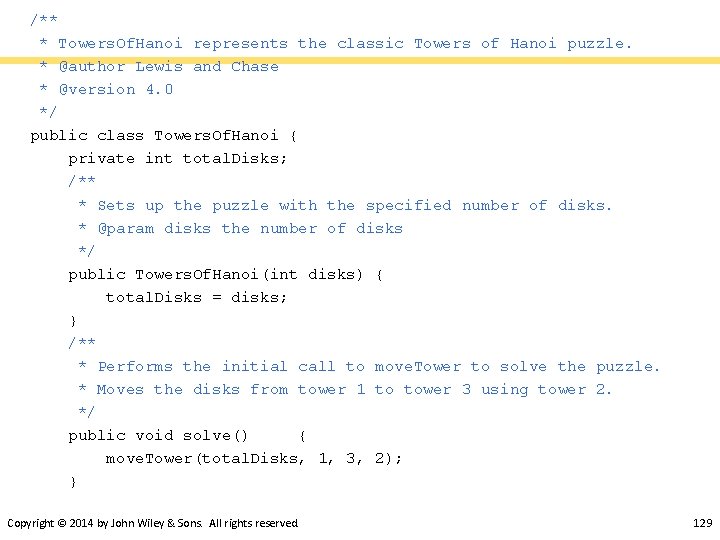
/** * Towers. Of. Hanoi represents the classic Towers of Hanoi puzzle. * @author Lewis and Chase * @version 4. 0 */ public class Towers. Of. Hanoi { private int total. Disks; /** * Sets up the puzzle with the specified number of disks. * @param disks the number of disks */ public Towers. Of. Hanoi(int disks) { total. Disks = disks; } /** * Performs the initial call to move. Tower to solve the puzzle. * Moves the disks from tower 1 to tower 3 using tower 2. */ public void solve() { move. Tower(total. Disks, 1, 3, 2); } Copyright © 2014 by John Wiley & Sons. All rights reserved. 129
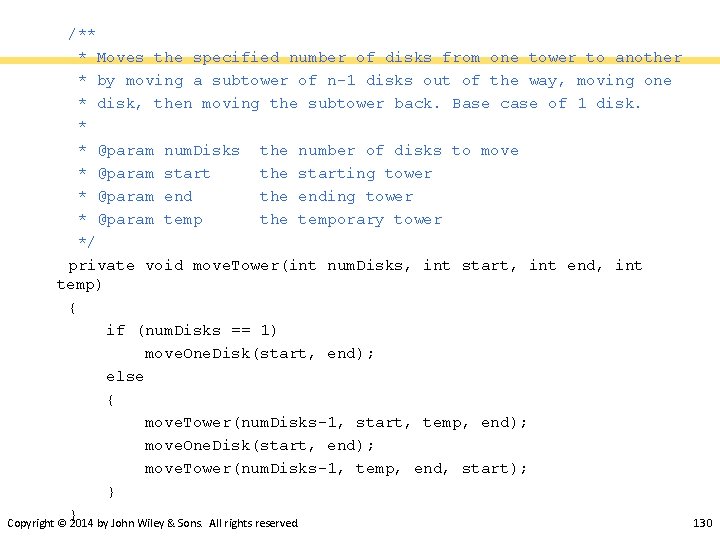
/** * Moves the specified number of disks from one tower to another * by moving a subtower of n-1 disks out of the way, moving one * disk, then moving the subtower back. Base case of 1 disk. * * @param num. Disks the number of disks to move * @param start the starting tower * @param end the ending tower * @param temp the temporary tower */ private void move. Tower(int num. Disks, int start, int end, int temp) { if (num. Disks == 1) move. One. Disk(start, end); else { move. Tower(num. Disks-1, start, temp, end); move. One. Disk(start, end); move. Tower(num. Disks-1, temp, end, start); } } Copyright © 2014 by John Wiley & Sons. All rights reserved. 130
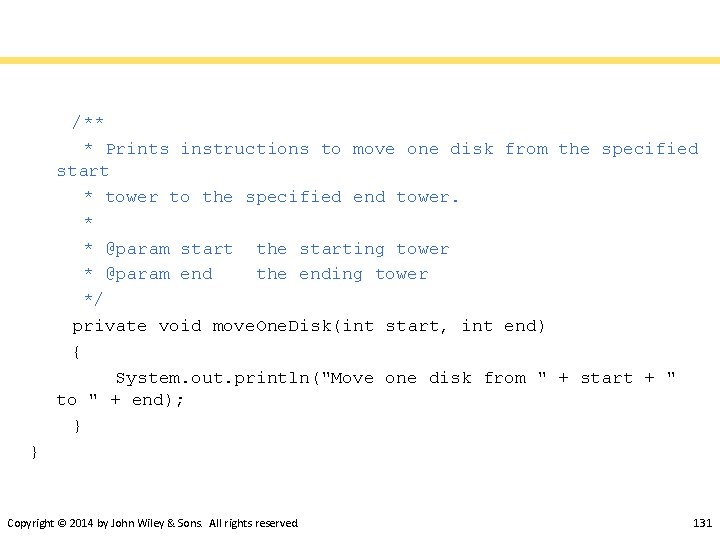
/** * Prints instructions to move one disk from the specified start * tower to the specified end tower. * * @param start the starting tower * @param end the ending tower */ private void move. One. Disk(int start, int end) { System. out. println("Move one disk from " + start + " to " + end); } } Copyright © 2014 by John Wiley & Sons. All rights reserved. 131
- Slides: 131