
CHAPTER 13 Personality OVERVIEW What is personality Theories



- Slides: 40
CHAPTER 13 Personality
OVERVIEW What is personality? Theories: �Trait theories �Psychoanalytic theory (Freud) �Humanistic theories �Behavioral theories Assessing Personality
WHO ARE YOU? Who are you? �What words would you use to describe yourself? Personality is a collection of these and many more traits and attributes �sum total = a unique person Difficulty in studying �collections of traits are not easy to observe objectively
DEFINING PERSONALITY Distinctive patterns of thinking, feeling, and behaving �Stable over time & across situations Personality Psychology is the study of individuals �Their distinctive characteristics and traits �Very Broad domain (all aspects of human functioning) Focus is the WHOLE person
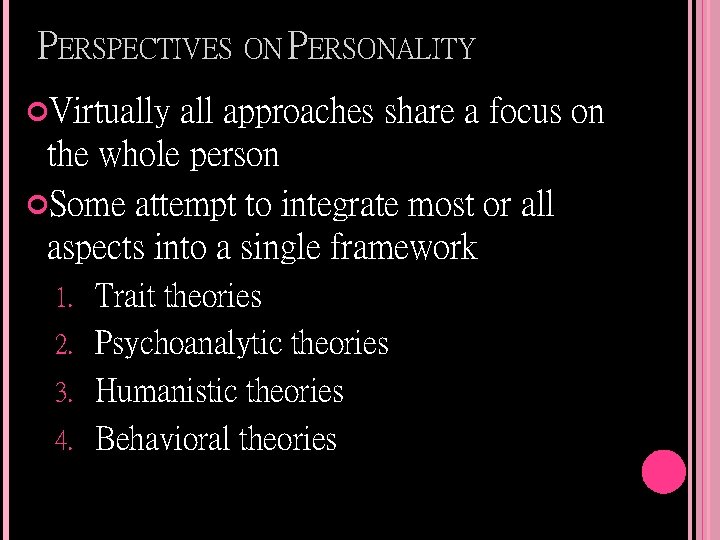
PERSPECTIVES ON PERSONALITY Virtually all approaches share a focus on the whole person Some attempt to integrate most or all aspects into a single framework Trait theories 2. Psychoanalytic theories 3. Humanistic theories 4. Behavioral theories 1.
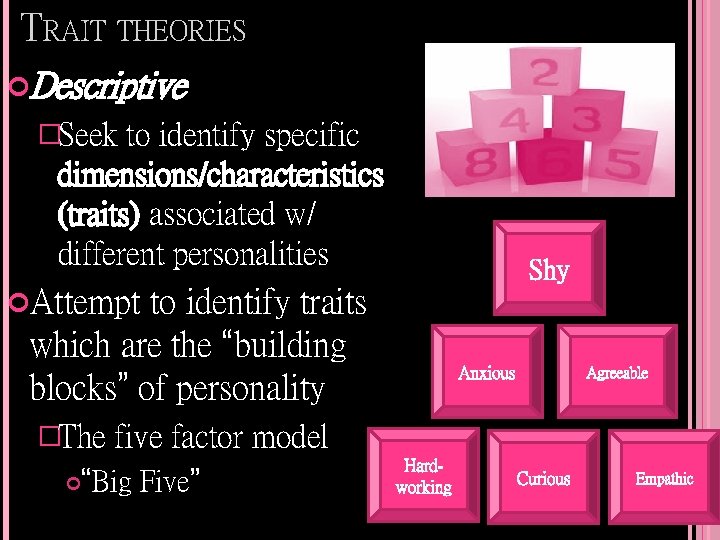
TRAIT THEORIES Descriptive �Seek to identify specific dimensions/characteristics (traits) associated w/ different personalities Shy Attempt to identify traits which are the “building blocks” of personality �The Anxious Agreeable five factor model “Big Five” Hardworking Curious Empathic
THE FIVE FACTOR MODEL Five basic dimensions define personality CANOE Each on a continuum (low to high) � Conscientiousness Self-disciplined, responsible, & dependable � Agreeableness to experience (vs. reserved/resistant) Enjoy adventures, new ideas, curious, creative � Extraversion (vs. positive emotionality) Prone to frequent, intense bouts of negative emotion/ pessimistic � Openness (vs. disagreeable) Compassionate, cooperative, good natured � Neuroticism (vs. careless/impulsive) (vs. introverted) Outgoing, confident, energetic, optimistic
FIVE FACTOR MODEL (CONT. ) Most widely adopted trait theory These traits are typically assessed using multi-item surveys Research on the five-factor model shows that traits stabilize around the age of 30 and persist into adulthood �However, as we age we become slightly more conscientious and agreeable, and slightly less neurotic Week 5 Discussion will ask you to assess these traits!
EVALUATING TRAIT THEORIES Advantages: � Provide specific methods for measuring (assessing) basic characteristics � Provides a way to compare individuals Disadvantages: � Traits only describe behavior; they do not explain it! Why is a person neurotic? � Traits may not predict consistent behavior from one situation to the next You are shy in some contexts, and more assertive in others � Offer essentially no explanation of how personality develops
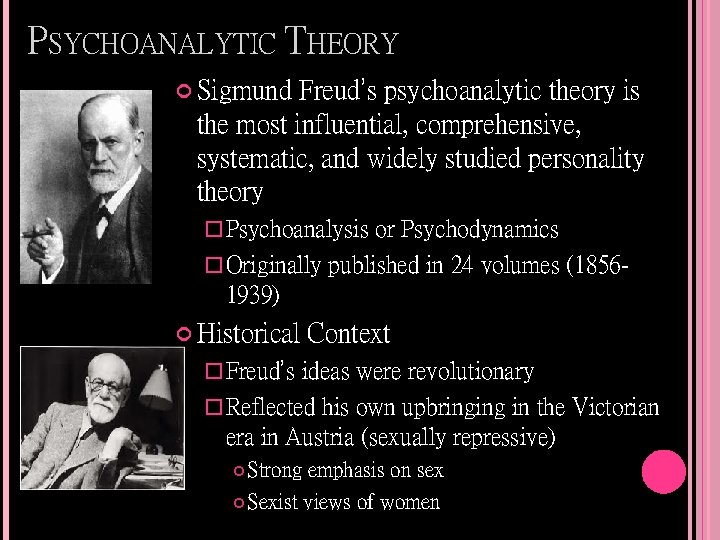
PSYCHOANALYTIC THEORY Sigmund Freud’s psychoanalytic theory is the most influential, comprehensive, systematic, and widely studied personality theory � Psychoanalysis or Psychodynamics � Originally published in 24 volumes (18561939) Historical Context � Freud’s ideas were revolutionary � Reflected his own upbringing in the Victorian era in Austria (sexually repressive) Strong emphasis on sex Sexist views of women
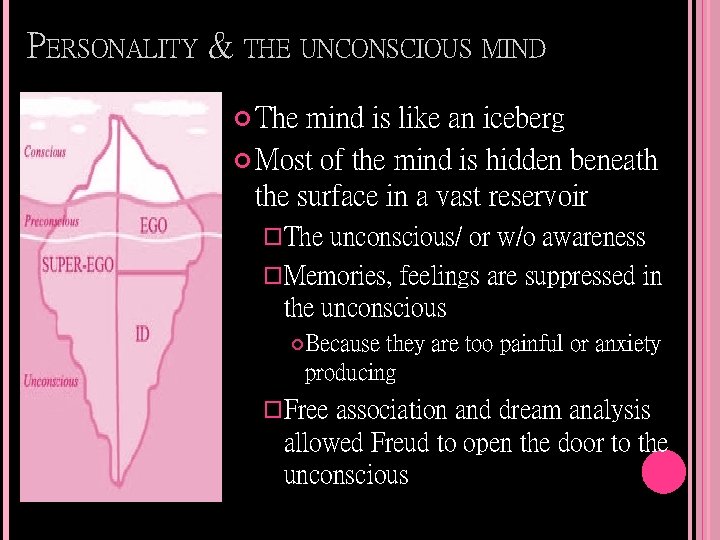
PERSONALITY & THE UNCONSCIOUS MIND The mind is like an iceberg Most of the mind is hidden beneath the surface in a vast reservoir �The unconscious/ or w/o awareness �Memories, feelings are suppressed in the unconscious Because they are too painful or anxiety producing �Free association and dream analysis allowed Freud to open the door to the unconscious
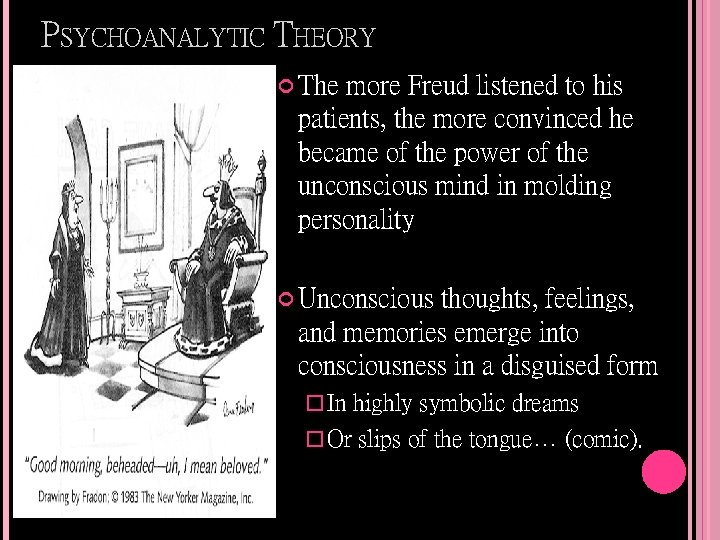
PSYCHOANALYTIC THEORY The more Freud listened to his patients, the more convinced he became of the power of the unconscious mind in molding personality Unconscious thoughts, feelings, and memories emerge into consciousness in a disguised form � In highly symbolic dreams � Or slips of the tongue… (comic).
PSYCHOANALYTIC THEORY Freud believed we are biological organisms dominated by certain biological needs (motives) � Sexual urges/needs � & Aggressive urges/needs These urges must be controlled if we are to become civilized human beings � Can’t go around having sex with or fighting everybody we meet A view that people’s personalities are shaped by ongoing conflicts between instincts/needs and social pressures of society
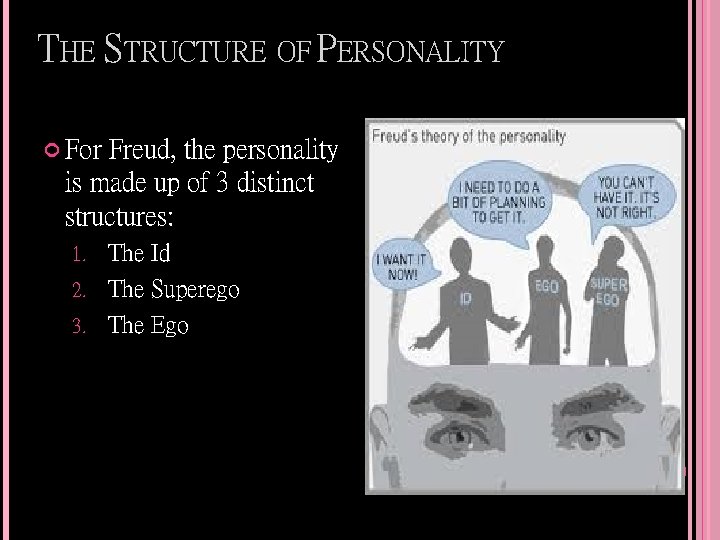
THE STRUCTURE OF PERSONALITY For Freud, the personality is made up of 3 distinct structures: The Id 2. The Superego 3. The Ego 1.
THE ID Most basic/primitive component of personality Consists of a vast reservoir of unconscious instincts (drives) Everyone is born with an Id containing: � Life instincts Hunger, thirst, sex � Death instincts Aggressiveness, destruction Operates according to pleasure principle � Immediate gratification of urges/instincts � Regardless of reason, logic, or impact of behavior � Id wants what it wants…right now! � The Devil on your shoulder
THE SUPEREGO As a child grows, it internalizes morals/rules of parents/society Prompts development of superego; our conscience � The angel on your shoulder � Also unconscious Operates according to the morality principle � Strives �In for perfection direct conflict w/ Id
THE EGO Infants & young toddlers soon learn that immediate gratification is not always possible Prompts growth of ego (an outgrowth of the id) Operates according to the reality principle � Seeks to gratify both id and superego, but only in ways consistent with reality � Delicate Balance and difficult for ego … The only personality structure that is conscious (because it has to operate within reality)
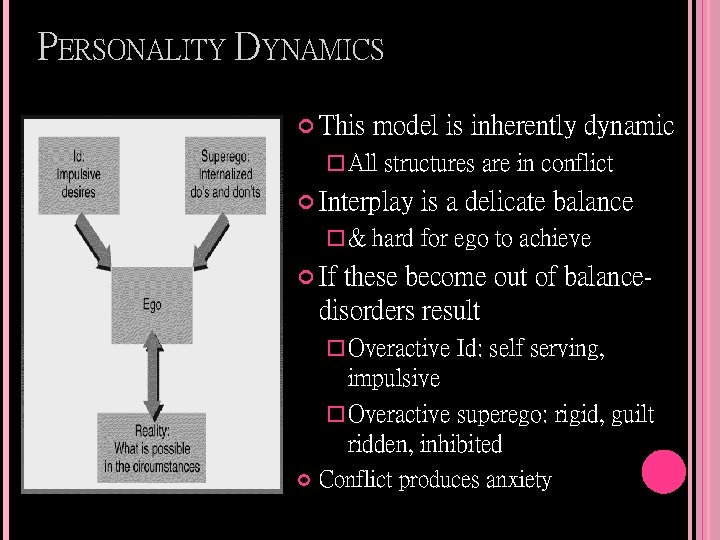
PERSONALITY DYNAMICS This model is inherently dynamic � All structures are in conflict Interplay �& is a delicate balance hard for ego to achieve If these become out of balancedisorders result � Overactive Id: self serving, impulsive � Overactive superego: rigid, guilt ridden, inhibited Conflict produces anxiety
ANXIETY &DEFENSE MECHANISMS To deal with anxiety we use defense mechanisms � shield Operate the ego from anxiety by distorting/denying reality at an unconscious level � We don’t even know we are doing it � Are irrational/ not subject to reality We all use defense mechanisms at some time or another � Denial � Projection � Regression
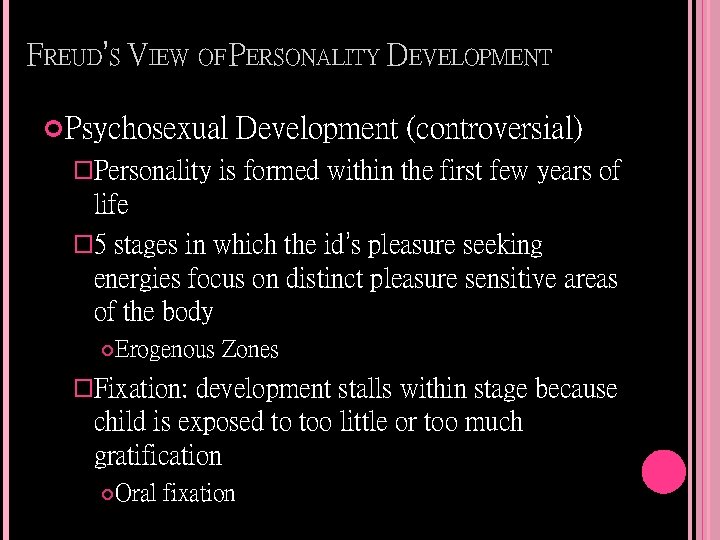
FREUD’S VIEW OF PERSONALITY DEVELOPMENT Psychosexual �Personality Development (controversial) is formed within the first few years of life � 5 stages in which the id’s pleasure seeking energies focus on distinct pleasure sensitive areas of the body Erogenous Zones �Fixation: development stalls within stage because child is exposed to too little or too much gratification Oral fixation
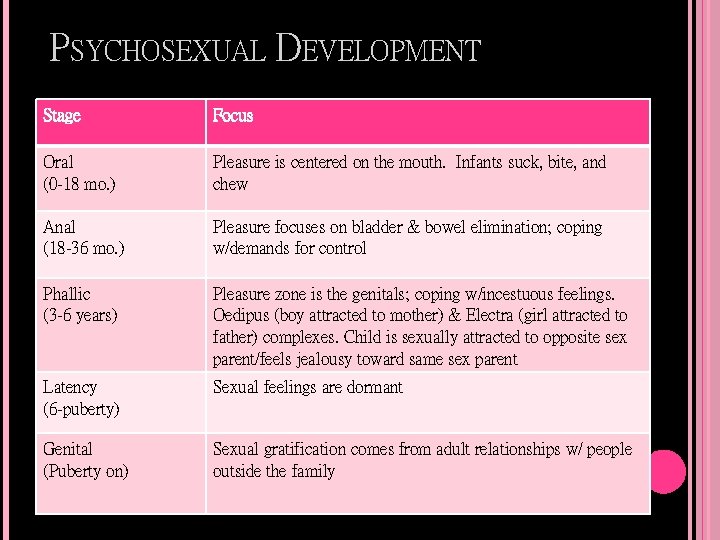
PSYCHOSEXUAL DEVELOPMENT Stage Focus Oral (0 -18 mo. ) Pleasure is centered on the mouth. Infants suck, bite, and chew Anal (18 -36 mo. ) Pleasure focuses on bladder & bowel elimination; coping w/demands for control Phallic (3 -6 years) Pleasure zone is the genitals; coping w/incestuous feelings. Oedipus (boy attracted to mother) & Electra (girl attracted to father) complexes. Child is sexually attracted to opposite sex parent/feels jealousy toward same sex parent Latency (6 -puberty) Sexual feelings are dormant Genital (Puberty on) Sexual gratification comes from adult relationships w/ people outside the family
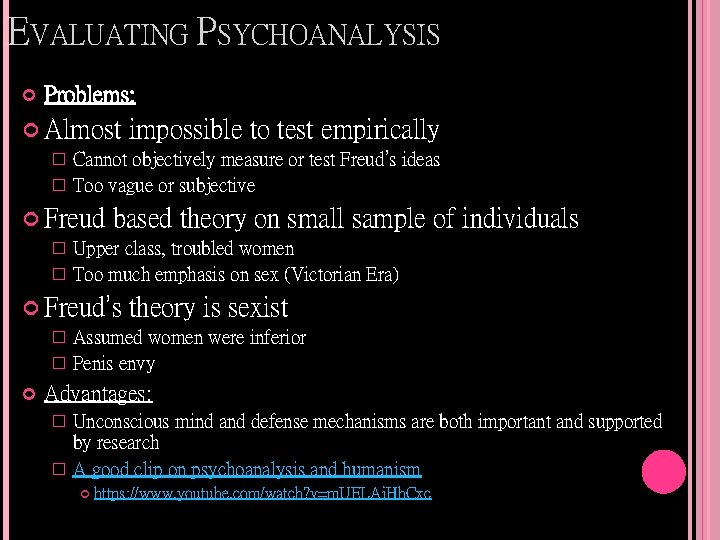
EVALUATING PSYCHOANALYSIS Problems: Almost impossible to test empirically � Cannot objectively measure or test Freud’s ideas � Too vague or subjective Freud based theory on small sample � Upper class, troubled women � Too much emphasis on sex (Victorian Era) of individuals Freud’s theory is sexist � Assumed women were inferior � Penis envy Advantages: Unconscious mind and defense mechanisms are both important and supported by research � A good clip on psychoanalysis and humanism � https: //www. youtube. com/watch? v=m. UELAi. Hb. Cxc
BEHAVIORAL PERSPECTIVES Different type of approach Emphasis on the role of external events in determining personality
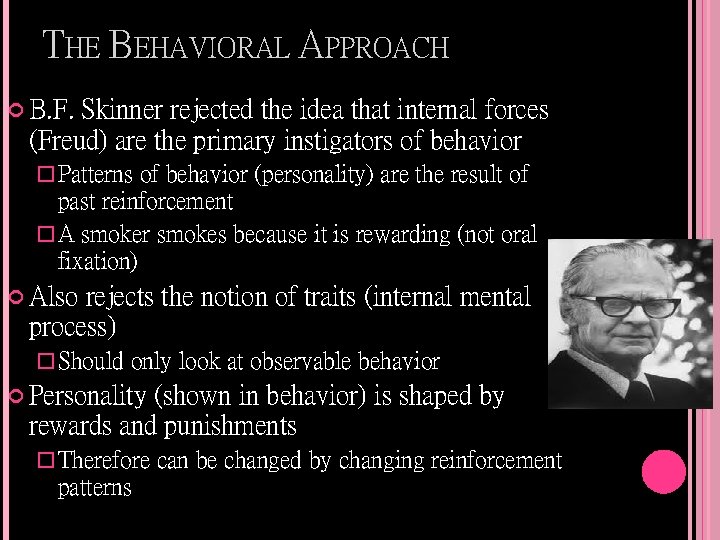
THE BEHAVIORAL APPROACH B. F. Skinner rejected the idea that internal forces (Freud) are the primary instigators of behavior � Patterns of behavior (personality) are the result of past reinforcement � A smoker smokes because it is rewarding (not oral fixation) Also rejects the notion of traits (internal mental process) � Should only look at observable behavior Personality (shown in behavior) is shaped by rewards and punishments � Therefore patterns can be changed by changing reinforcement
THE BEHAVIORIST APPROACH Consider a child that is socially withdrawn & reserved If a parent or guardian reinforce slight indications of sociability This will increase the frequency of these behaviors Gradually replaces introverted patterns w/extroverted
EVALUATING BEHAVIORAL THEORIES Advantages: � Provided an important contribution because of the emphasis on rigorous experimental research � Has been the basis for some of the most effective models to treat psychological problems Criticisms: � Discounts the role of inner needs and drives � ignores the role of biological factors Certain traits appear to be quite heritable (E, N) Some twins reared apart are eerily similar
HUMANISTIC THEORIES Emphasis on the unique characteristics of humanity � Rejection of animal models of behavior Emerged in early 1960’s Discontented w/: � Unconscious drives -> personality � Behavior -> personality Primary motives for behavior come from a person striving to develop, change, and grow in pursuit of full human potential 2 major theorists
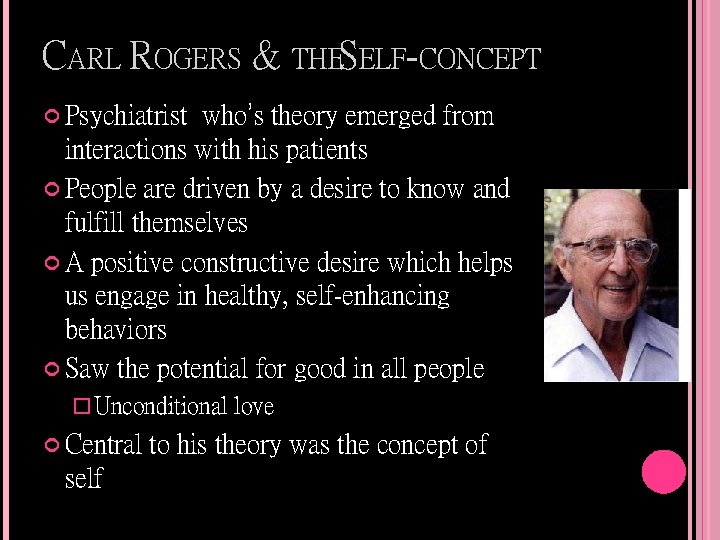
CARL ROGERS & THESELF-CONCEPT Psychiatrist who’s theory emerged from interactions with his patients People are driven by a desire to know and fulfill themselves A positive constructive desire which helps us engage in healthy, self-enhancing behaviors Saw the potential for good in all people � Unconditional Central self love to his theory was the concept of
CARL ROGERS &SELF-CONCEPT We derive a self-concept or image of ourselves Determines how we perceive & respond to the world � If we see ourselves as likeable & attractive, we will approach the person we like � If we see ourselves as ugly and lonely, we are less likely to do so Key to happiness was consistency or congruence between our self-concept and what we actually experience � If you consider yourself easy � & your relationships actually � You will be happy People to get along with are consistent with this should come to know, accept, and be true to themselves
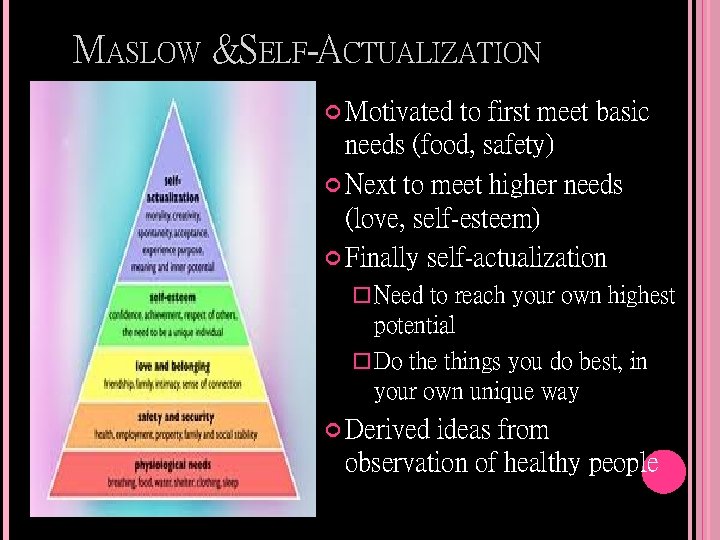
MASLOW &SELF-ACTUALIZATION Motivated to first meet basic needs (food, safety) Next to meet higher needs (love, self-esteem) Finally self-actualization � Need to reach your own highest potential � Do the things you do best, in your own unique way Derived ideas from observation of healthy people
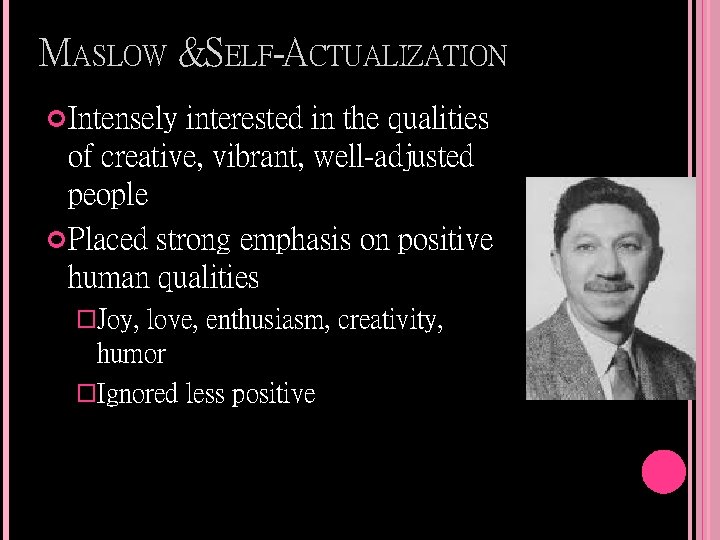
MASLOW &SELF-ACTUALIZATION Intensely interested in the qualities of creative, vibrant, well-adjusted people Placed strong emphasis on positive human qualities �Joy, love, enthusiasm, creativity, humor �Ignored less positive
EVALUATING HUMANISTIC THEORIES Advantages: � Provokes us to consider the positive dimensions of personality � Focus on the healthy individual Disadvantages: � Is subjective, does not lend itself to research Vague concepts which cannot be studied � Ignores biological and environmental impact in shaping behavior
ASSESSING PERSONALITY Personality assessment: the measurement of personality Main uses of personality assessment: � Clinical (Diagnosis of psychological disorders) � Psychological Research � Occupational selection (identifying who to hire) 4 most common methods: � Behavioral observation � Self-Report Inventories/Questionnaires � Projective Tests
BEHAVIORAL OBSERVATION Method of assessing personality which involves observing people’s behavior as they interact w/ their environment � Used by behavioral/social cognitive perspectives � & clinical psychologists Watching a child in a variety of situations Important information about how environment shapes behavior Beware of observer bias & effect!
SELF-REPORT INVENTORIES/QUESTIONNAIRES An objective, self-report inventory designed to measure scientifically the variety of characteristics which make up personality Can be very specific � The NEO inventory � 240 items that assess big-five traits Or very broad � Minnesota Multi-phasic Personality Inventory (MMPI): 550 Items � measures clinical conditions such as: depression, introversion, schizophrenia, paranoia, psychopathic personality
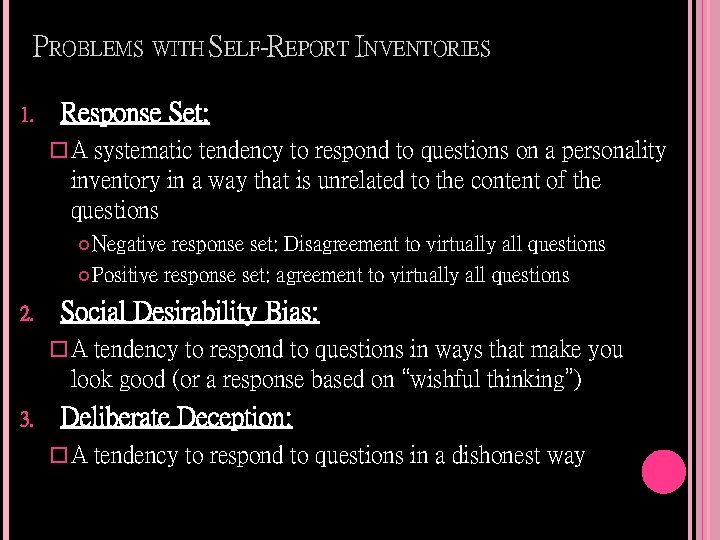
PROBLEMS WITH SELF-REPORT INVENTORIES 1. Response Set: �A systematic tendency to respond to questions on a personality inventory in a way that is unrelated to the content of the questions Negative response set: Disagreement to virtually all questions Positive response set: agreement to virtually all questions 2. Social Desirability Bias: �A tendency to respond to questions in ways that make you look good (or a response based on “wishful thinking”) 3. Deliberate Deception: �A tendency to respond to questions in a dishonest way
PROJECTIVE TESTS Very loosely structured test which presents subject with ambiguous (unclear) stimuli and requires the subject to interpret it Used by psychoanalysts to assess unconscious needs/urges Subject’s are said to project these on the test Trained administrator interprets the subject’s responses
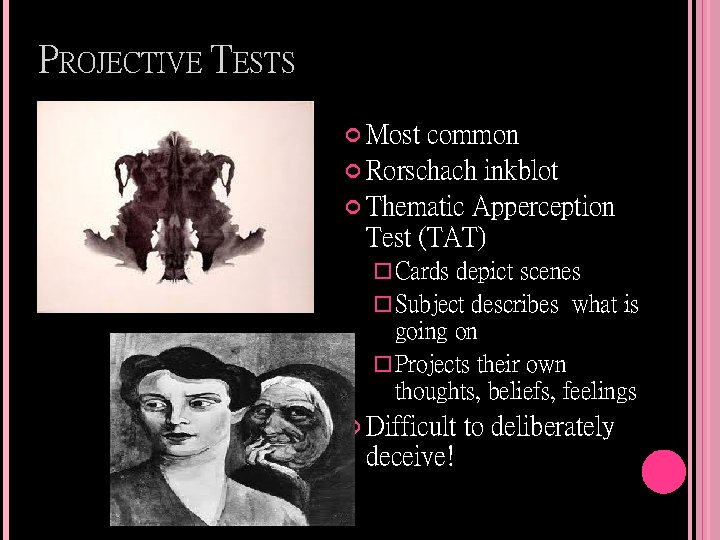
PROJECTIVE TESTS Most common Rorschach inkblot Thematic Apperception Test (TAT) � Cards depict scenes � Subject describes what is going on � Projects their own thoughts, beliefs, feelings Difficult deceive! to deliberately
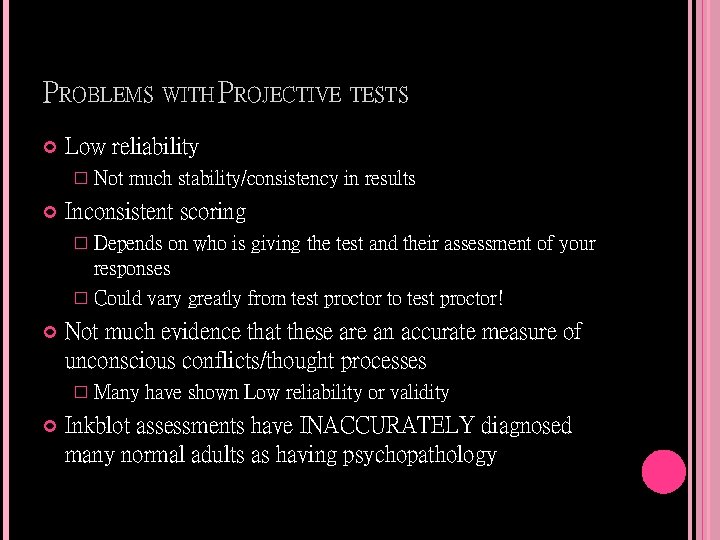
PROBLEMS WITH PROJECTIVE TESTS Low reliability � Not much stability/consistency in results Inconsistent scoring � Depends on who is giving the test and their assessment of your responses � Could vary greatly from test proctor to test proctor! Not much evidence that these are an accurate measure of unconscious conflicts/thought processes � Many have shown Low reliability or validity Inkblot assessments have INACCURATELY diagnosed many normal adults as having psychopathology
SUMMARY What is personality? Theories: �Trait theories �Psychoanalytic theory (Freud) �Humanistic theories �Behavioral theories Assessing Personality