
Chapter 13 Part C The Peripheral Nervous System
- Slides: 46
Chapter 13 Part C The Peripheral Nervous System and Reflex Activity © Annie Leibovitz/Contact Press Images © 2017 Pearson Education, Inc. Power. Point® Lecture Slides prepared by Karen Dunbar Kareiva Ivy Tech Community College
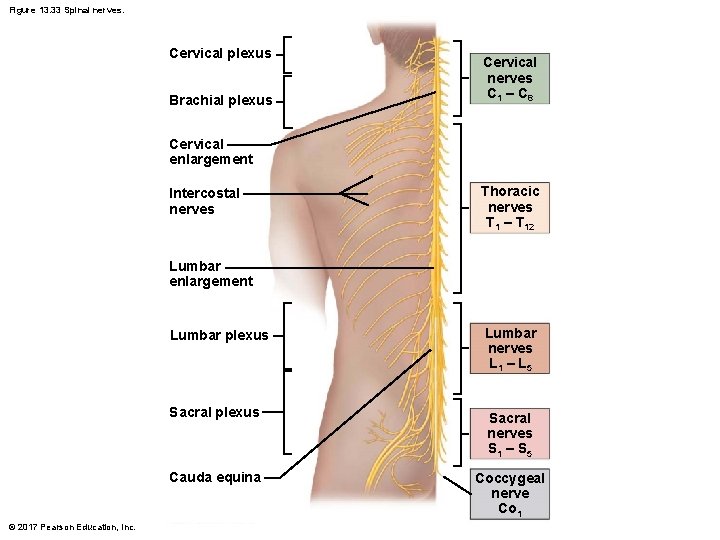
13. 8 31 pairs of spinal nerves innervate the body • Spinal nerves arise from the spinal cord and supply all parts of the body except the head and part of the neck • All are mixed nerves named for point of issue from spinal cord • Supply all body parts except head and part of neck – 8 pairs of cervical nerves (C 1–C 8) – 12 pairs of thoracic nerves (T 1–T 12) – 5 pairs of lumbar nerves (L 1–L 5) – 5 pairs of sacral nerves (S 1–S 5) – 1 pair of tiny coccygeal nerves (Co 1) © 2017 Pearson Education, Inc.
Spinal Nerves (cont. ) • 7 cervical vertebrae give rise to 8 pairs of cervical spinal nerves because: – Each of the first 7 pairs (C 1 to C 7) exits the vertebral canal superior to vertebra for which it is named – Last spinal nerve (C 8) exits canal inferior to C 7 • Each of the other spinal nerves exits inferior to the same-numbered vertebra © 2017 Pearson Education, Inc.
Figure 13. 33 Spinal nerves. Cervical plexus Brachial plexus Cervical nerves C 1 – C 8 Cervical enlargement Intercostal nerves Thoracic nerves T 1 – T 12 Lumbar enlargement © 2017 Pearson Education, Inc. Lumbar plexus Lumbar nerves L 1 – L 5 Sacral plexus Sacral nerves S 1 – S 5 Cauda equina Coccygeal nerve Co 1
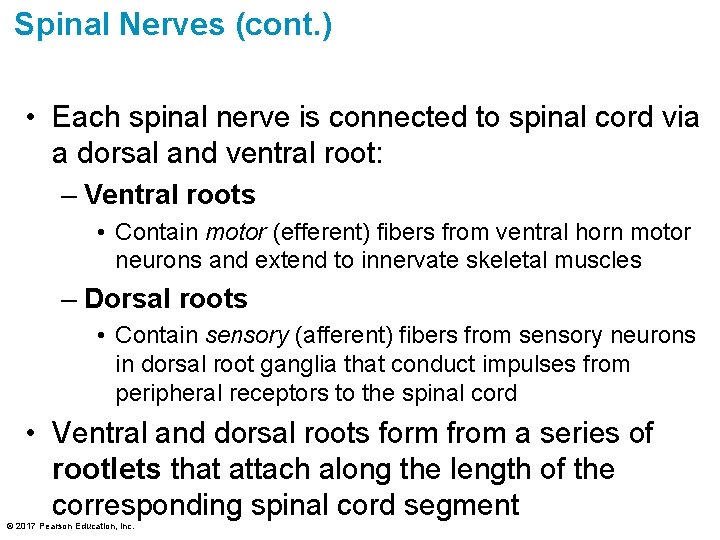
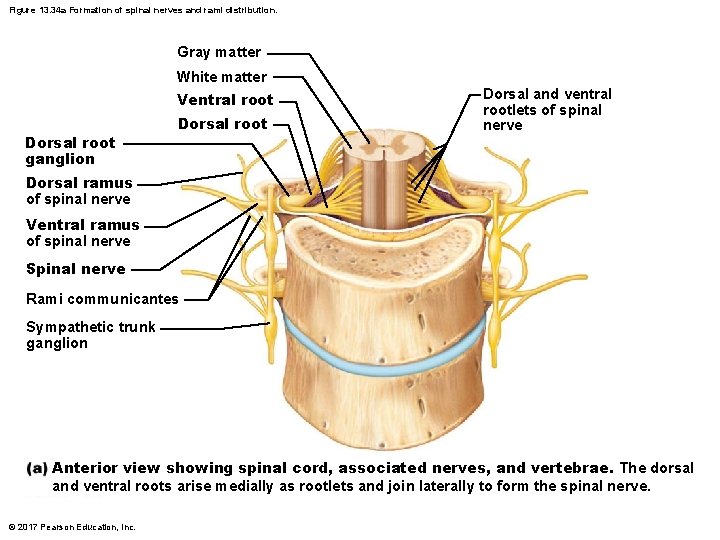
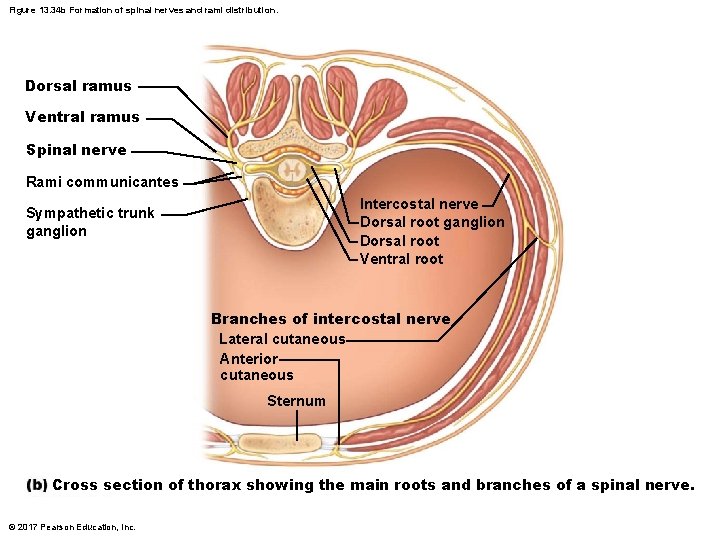
Spinal Nerves (cont. ) • Each spinal nerve is connected to spinal cord via a dorsal and ventral root: – Ventral roots • Contain motor (efferent) fibers from ventral horn motor neurons and extend to innervate skeletal muscles – Dorsal roots • Contain sensory (afferent) fibers from sensory neurons in dorsal root ganglia that conduct impulses from peripheral receptors to the spinal cord • Ventral and dorsal roots form from a series of rootlets that attach along the length of the corresponding spinal cord segment © 2017 Pearson Education, Inc.
Figure 13. 34 a Formation of spinal nerves and rami distribution. Gray matter White matter Ventral root Dorsal root ganglion Dorsal root Dorsal and ventral rootlets of spinal nerve Dorsal ramus of spinal nerve Ventral ramus of spinal nerve Spinal nerve Rami communicantes Sympathetic trunk ganglion Anterior view showing spinal cord, associated nerves, and vertebrae. The dorsal and ventral roots arise medially as rootlets and join laterally to form the spinal nerve. © 2017 Pearson Education, Inc.
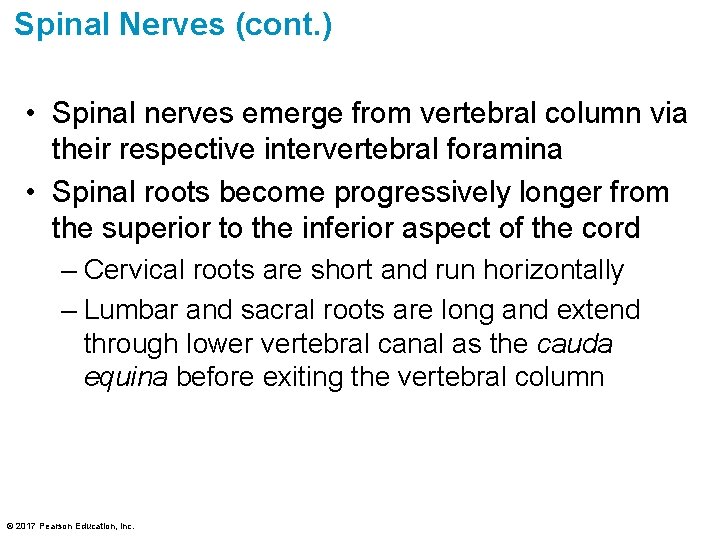
Spinal Nerves (cont. ) • Spinal nerves emerge from vertebral column via their respective intervertebral foramina • Spinal roots become progressively longer from the superior to the inferior aspect of the cord – Cervical roots are short and run horizontally – Lumbar and sacral roots are long and extend through lower vertebral canal as the cauda equina before exiting the vertebral column © 2017 Pearson Education, Inc.
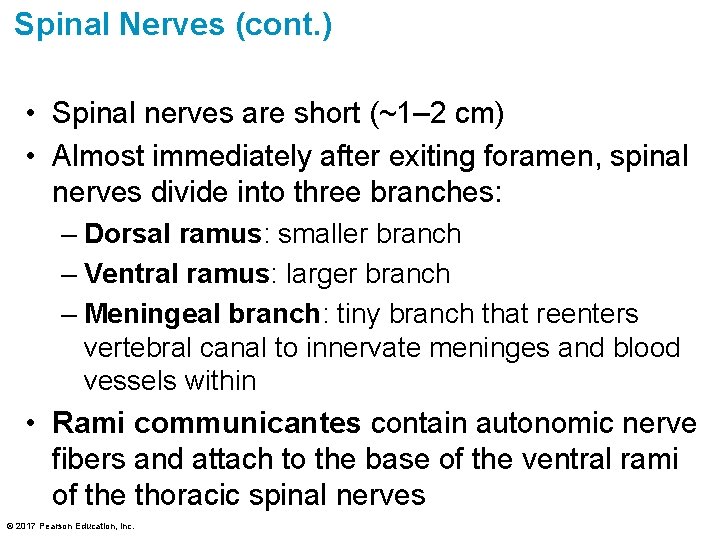
Spinal Nerves (cont. ) • Spinal nerves are short (~1– 2 cm) • Almost immediately after exiting foramen, spinal nerves divide into three branches: – Dorsal ramus: smaller branch – Ventral ramus: larger branch – Meningeal branch: tiny branch that reenters vertebral canal to innervate meninges and blood vessels within • Rami communicantes contain autonomic nerve fibers and attach to the base of the ventral rami of the thoracic spinal nerves © 2017 Pearson Education, Inc.
Figure 13. 34 b Formation of spinal nerves and rami distribution. Dorsal ramus Ventral ramus Spinal nerve Rami communicantes Intercostal nerve Dorsal root ganglion Dorsal root Ventral root Sympathetic trunk ganglion Branches of intercostal nerve Lateral cutaneous Anterior cutaneous Sternum Cross section of thorax showing the main roots and branches of a spinal nerve. © 2017 Pearson Education, Inc.
Innervation of Specific Body Regions • Spinal nerve rami and their main branches supply skeletal muscles and skin (somatic region of body) from neck down – Dorsal rami supply posterior body trunk – Ventral rami supply rest of trunk and limbs • Difference between roots and rami: – Roots lie medial to and from the spinal nerves • Each root is purely sensory or motor – Rami lie distal to and are lateral branches of spinal nerves • Carry both sensory and motor fibers © 2017 Pearson Education, Inc.
Innervation of Specific Body Regions (cont. ) • All ventral rami except T 2–T 12 branch and join one another lateral to the vertebral column, forming interlacing networks called nerve plexuses – Found in cervical, brachial, lumbar, and sacral areas and primarily serve the limbs – Only ventral rami form plexuses • Within plexus, fibers crisscross so that: 1. Each branch contains fibers from several spinal nerves © 2017 Pearson Education, Inc.
Innervation of Specific Body Regions (cont. ) 2. Fibers from each ventral ramus travel to body periphery via several routes • Each limb muscle receives nerve supply from more than one spinal nerve; advantage is that damage to one spinal segment or root cannot completely paralyze a limb muscle © 2017 Pearson Education, Inc.
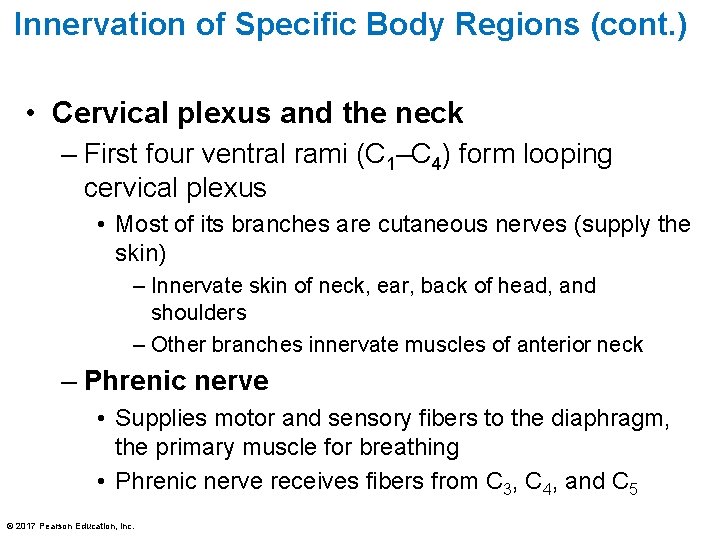
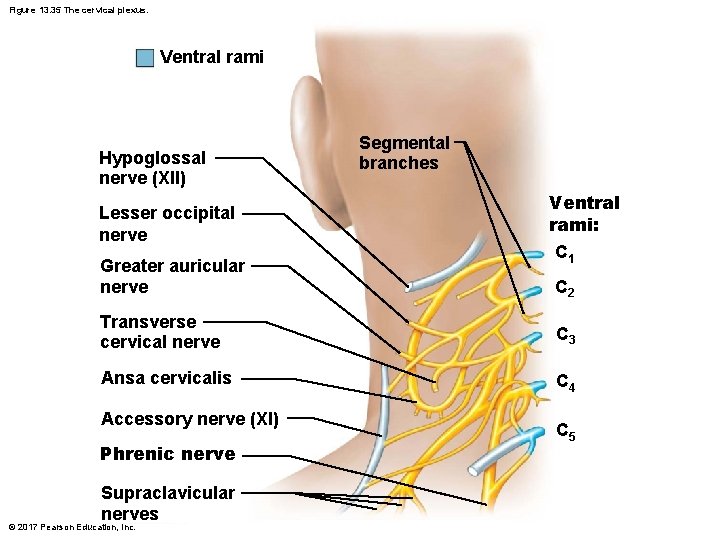
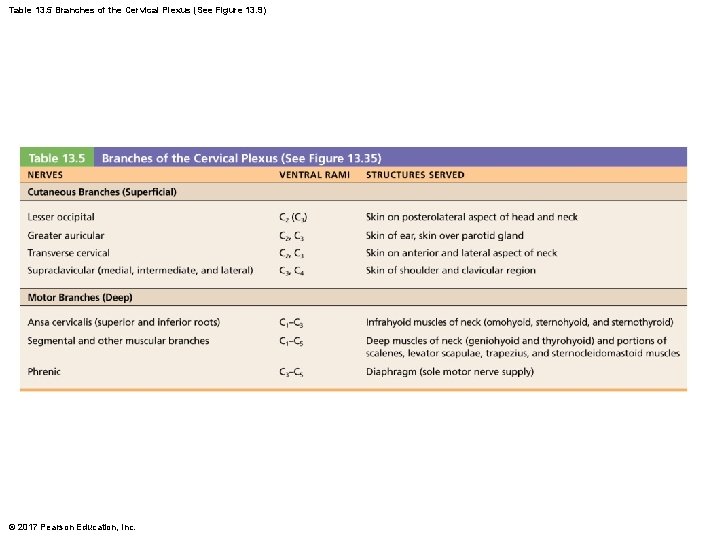
Innervation of Specific Body Regions (cont. ) • Cervical plexus and the neck – First four ventral rami (C 1–C 4) form looping cervical plexus • Most of its branches are cutaneous nerves (supply the skin) – Innervate skin of neck, ear, back of head, and shoulders – Other branches innervate muscles of anterior neck – Phrenic nerve • Supplies motor and sensory fibers to the diaphragm, the primary muscle for breathing • Phrenic nerve receives fibers from C 3, C 4, and C 5 © 2017 Pearson Education, Inc.
Figure 13. 35 The cervical plexus. Ventral rami Hypoglossal nerve (XII) Lesser occipital nerve Greater auricular nerve Segmental branches Ventral rami: C 1 C 2 Transverse cervical nerve C 3 Ansa cervicalis C 4 Accessory nerve (XI) Phrenic nerve Supraclavicular nerves © 2017 Pearson Education, Inc. C 5
Table 13. 5 Branches of the Cervical Plexus (See Figure 13. 9) © 2017 Pearson Education, Inc.
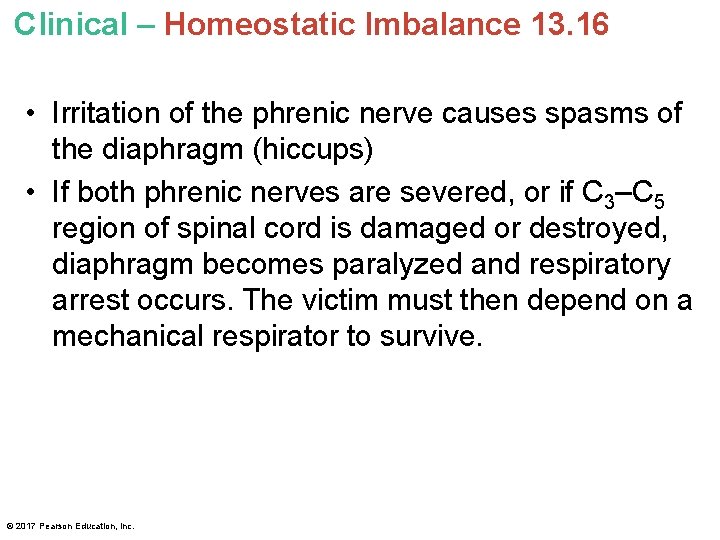
Clinical – Homeostatic Imbalance 13. 16 • Irritation of the phrenic nerve causes spasms of the diaphragm (hiccups) • If both phrenic nerves are severed, or if C 3–C 5 region of spinal cord is damaged or destroyed, diaphragm becomes paralyzed and respiratory arrest occurs. The victim must then depend on a mechanical respirator to survive. © 2017 Pearson Education, Inc.
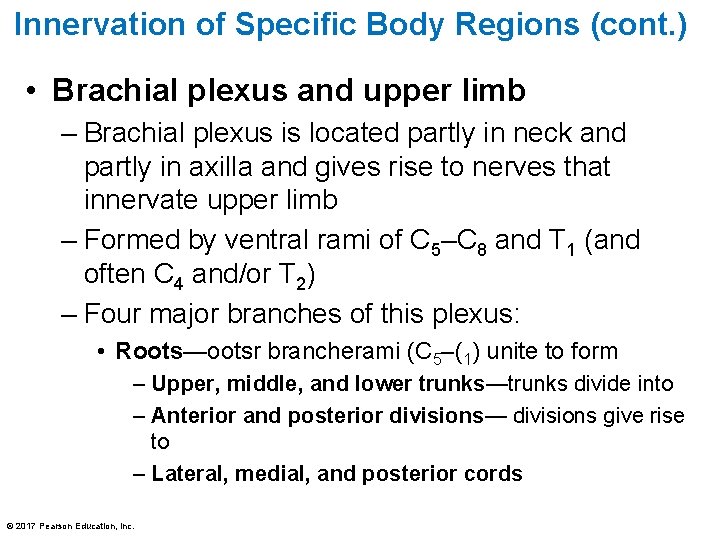
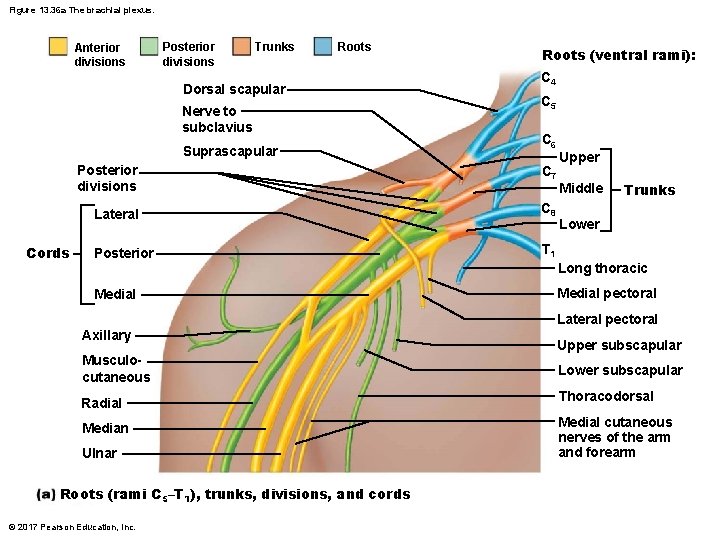
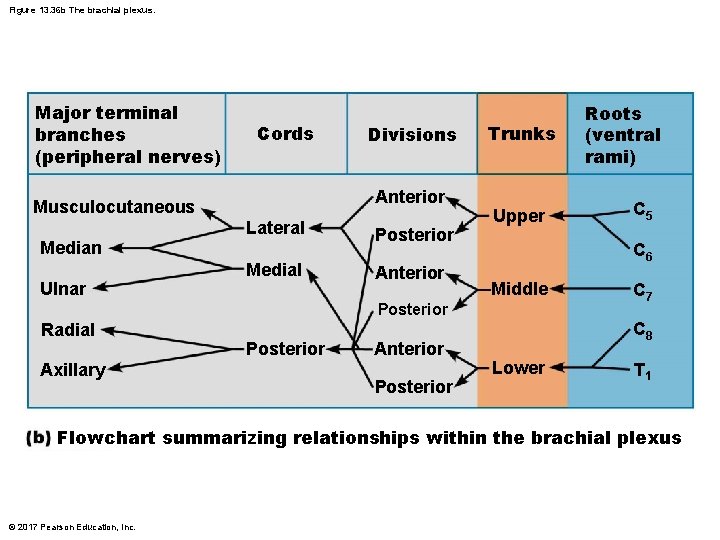
Innervation of Specific Body Regions (cont. ) • Brachial plexus and upper limb – Brachial plexus is located partly in neck and partly in axilla and gives rise to nerves that innervate upper limb – Formed by ventral rami of C 5–C 8 and T 1 (and often C 4 and/or T 2) – Four major branches of this plexus: • Roots—ootsr brancherami (C 5–(1) unite to form – Upper, middle, and lower trunks—trunks divide into – Anterior and posterior divisions— divisions give rise to – Lateral, medial, and posterior cords © 2017 Pearson Education, Inc.
Figure 13. 36 a The brachial plexus. Anterior divisions Posterior divisions Trunks Roots Dorsal scapular Nerve to subclavius Suprascapular Cords Roots (ventral rami): C 4 C 5 C 6 Posterior divisions C 7 Lateral C 8 Posterior T 1 Medial Upper Middle Trunks Lower Long thoracic Medial pectoral Lateral pectoral Axillary Musculocutaneous Radial Median Ulnar Roots (rami C 5–T 1), trunks, divisions, and cords © 2017 Pearson Education, Inc. Upper subscapular Lower subscapular Thoracodorsal Medial cutaneous nerves of the arm and forearm
Figure 13. 36 b The brachial plexus. Major terminal branches (peripheral nerves) Cords Anterior Musculocutaneous Lateral Median Ulnar Divisions Medial Posterior Anterior Trunks Upper Axillary Posterior Anterior Posterior C 5 C 6 Middle Posterior Radial Roots (ventral rami) C 7 C 8 Lower T 1 Flowchart summarizing relationships within the brachial plexus © 2017 Pearson Education, Inc.
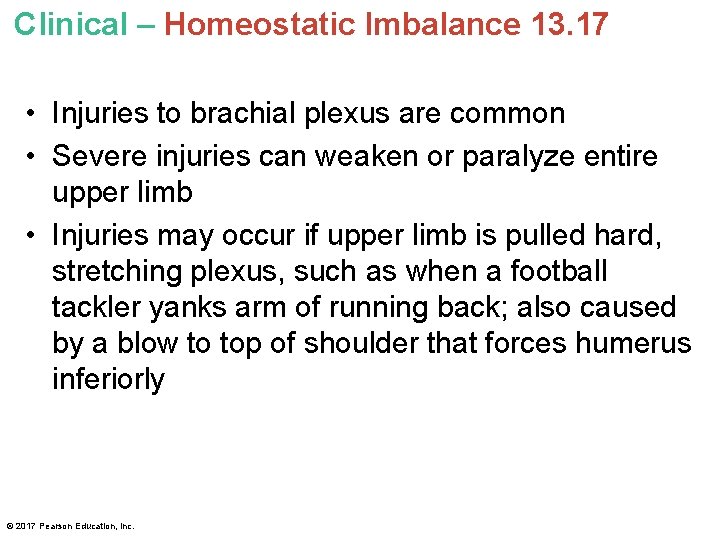
Clinical – Homeostatic Imbalance 13. 17 • Injuries to brachial plexus are common • Severe injuries can weaken or paralyze entire upper limb • Injuries may occur if upper limb is pulled hard, stretching plexus, such as when a football tackler yanks arm of running back; also caused by a blow to top of shoulder that forces humerus inferiorly © 2017 Pearson Education, Inc.
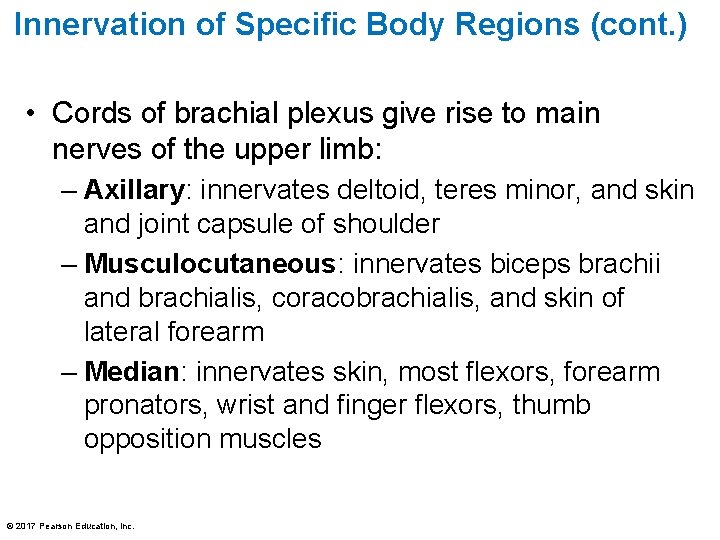
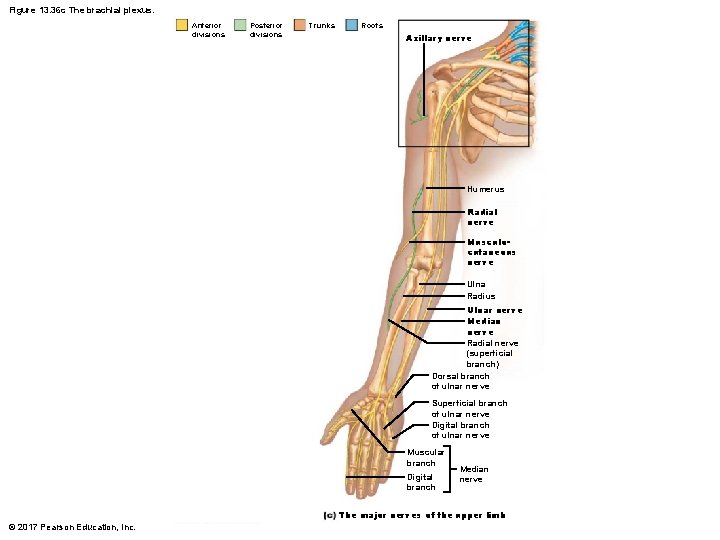
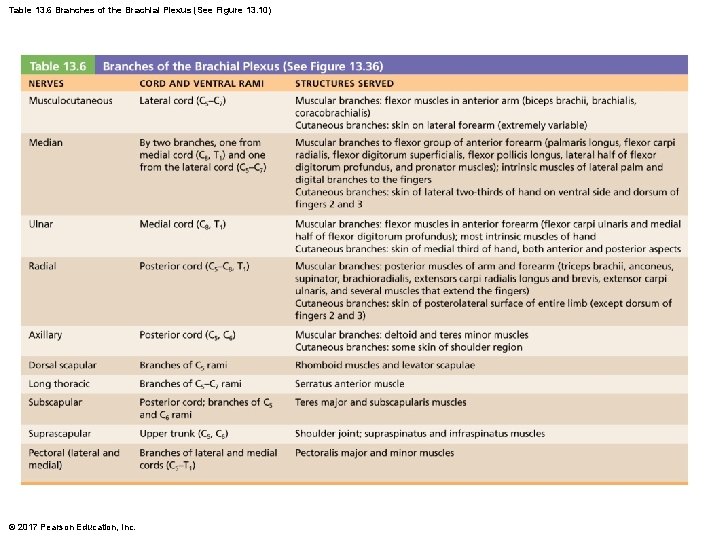
Innervation of Specific Body Regions (cont. ) • Cords of brachial plexus give rise to main nerves of the upper limb: – Axillary: innervates deltoid, teres minor, and skin and joint capsule of shoulder – Musculocutaneous: innervates biceps brachii and brachialis, coracobrachialis, and skin of lateral forearm – Median: innervates skin, most flexors, forearm pronators, wrist and finger flexors, thumb opposition muscles © 2017 Pearson Education, Inc.
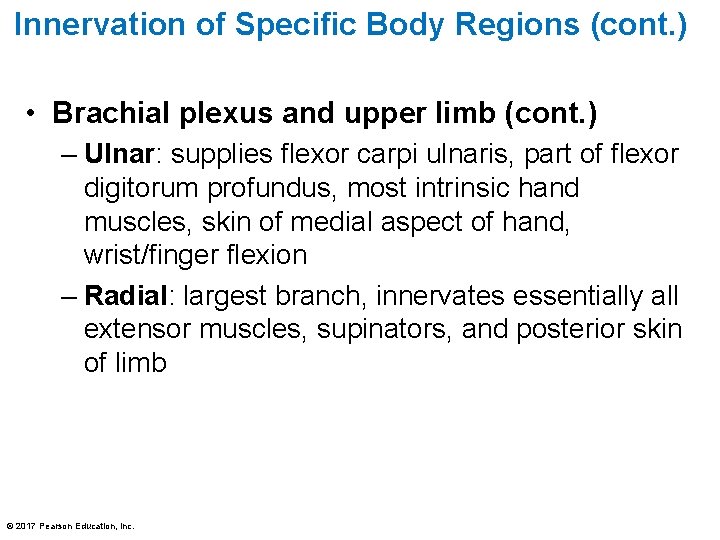
Innervation of Specific Body Regions (cont. ) • Brachial plexus and upper limb (cont. ) – Ulnar: supplies flexor carpi ulnaris, part of flexor digitorum profundus, most intrinsic hand muscles, skin of medial aspect of hand, wrist/finger flexion – Radial: largest branch, innervates essentially all extensor muscles, supinators, and posterior skin of limb © 2017 Pearson Education, Inc.
Figure 13. 36 c The brachial plexus. Anterior divisions Posterior divisions Trunks Roots Axillary nerve Humerus Radial nerve Musculocutaneous nerve Ulna Radius Ulnar nerve Median nerve Radial nerve (superficial branch) Dorsal branch of ulnar nerve Superficial branch of ulnar nerve Digital branch of ulnar nerve Muscular branch Digital branch Median nerve The major nerves of the upper limb © 2017 Pearson Education, Inc.
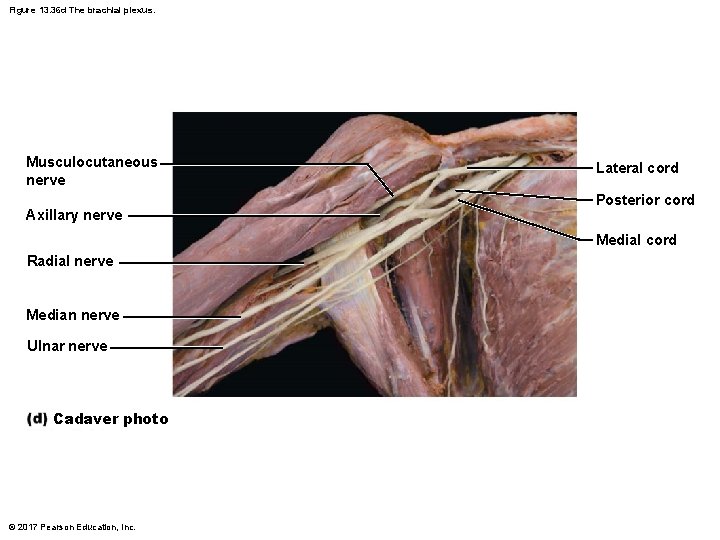
Figure 13. 36 d The brachial plexus. Musculocutaneous nerve Axillary nerve Lateral cord Posterior cord Medial cord Radial nerve Median nerve Ulnar nerve Cadaver photo © 2017 Pearson Education, Inc.
Table 13. 6 Branches of the Brachial Plexus (See Figure 13. 10) © 2017 Pearson Education, Inc.
Clinical – Homeostatic Imbalance 13. 18 • Injury to median nerve makes it difficult to use pincer grasp (opposed thumb and index finger) to pick up small objects • In carpal tunnel syndrome, the median nerve is compressed • Due to location is frequent casualty of wristslashing suicide attempts © 2017 Pearson Education, Inc.
Clinical – Homeostatic Imbalance 13. 19 • Ulnar nerve is very vulnerable to injury • Severe or chronic damage can lead to sensory loss, paralysis, and muscle atrophy – Affected individuals have trouble making a fist and gripping objects – Causes hand to contort into a clawhand • Striking the “funny bone, ” where ulnar nerve rests against medial epicondyle, makes little finger tingle © 2017 Pearson Education, Inc.
Clinical – Homeostatic Imbalance 13. 20 • Trauma to the radial nerve results in wrist drop, inability to extend the hand at the wrist • Improper use of a crutch or sleeping with arm extended over the back of a sofa or chair can compress radial nerve and impair its blood supply © 2017 Pearson Education, Inc.
Innervation of Specific Body Regions (cont. ) • Lumbosacral plexus and lower limb – Lumbar and sacral plexuses have significant overlap • Fibers of lumbar plexus contribute to sacral plexus via lumbosacral trunk • Lumbosacral plexus serves mostly lower limb; also sends some branches to abdomen, pelvis, and buttock © 2017 Pearson Education, Inc.
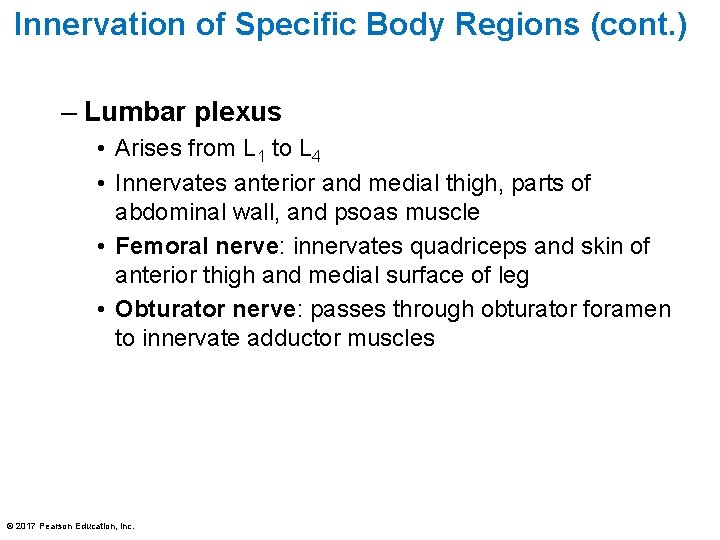
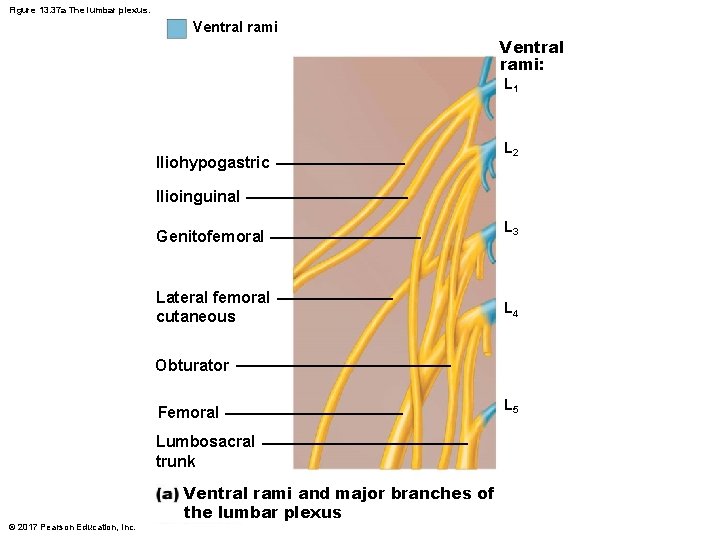
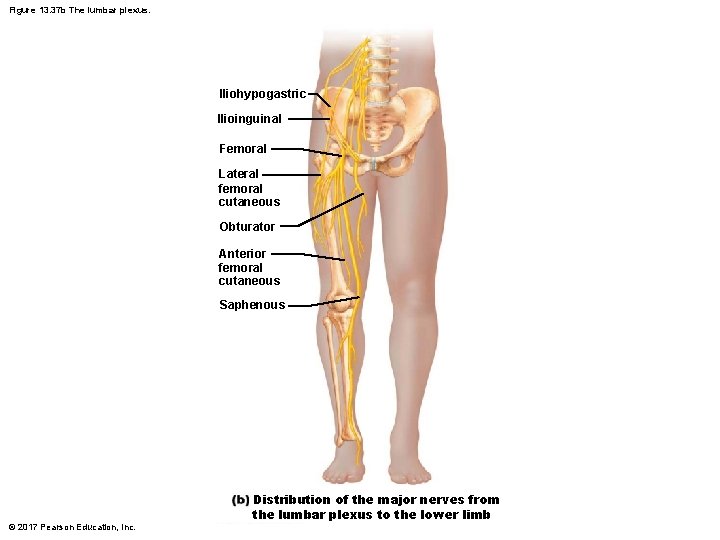
Innervation of Specific Body Regions (cont. ) – Lumbar plexus • Arises from L 1 to L 4 • Innervates anterior and medial thigh, parts of abdominal wall, and psoas muscle • Femoral nerve: innervates quadriceps and skin of anterior thigh and medial surface of leg • Obturator nerve: passes through obturator foramen to innervate adductor muscles © 2017 Pearson Education, Inc.
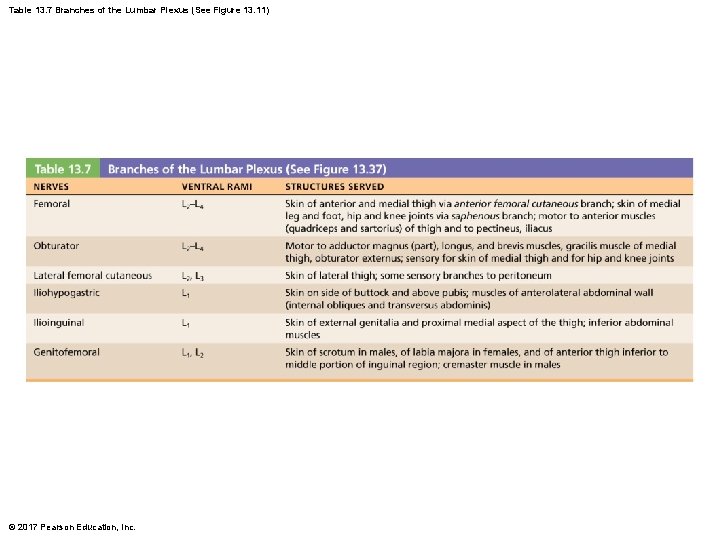
Table 13. 7 Branches of the Lumbar Plexus (See Figure 13. 11) © 2017 Pearson Education, Inc.
Figure 13. 37 a The lumbar plexus. Ventral rami: L 1 Iliohypogastric L 2 Ilioinguinal Genitofemoral Lateral femoral cutaneous L 3 L 4 Obturator Femoral Lumbosacral trunk © 2017 Pearson Education, Inc. Ventral rami and major branches of the lumbar plexus L 5
Figure 13. 37 b The lumbar plexus. Iliohypogastric Ilioinguinal Femoral Lateral femoral cutaneous Obturator Anterior femoral cutaneous Saphenous © 2017 Pearson Education, Inc. Distribution of the major nerves from the lumbar plexus to the lower limb
Clinical – Homeostatic Imbalance 13. 21 • When spinal roots of lumbar plexus are compressed (as with herniated disc), gait problems occur • Other symptoms are pain or numbness of the anterior thigh • Femoral nerve serves prime movers that flex hip and extend knee • If obturator nerve is impaired, pain experienced in medial thigh © 2017 Pearson Education, Inc.
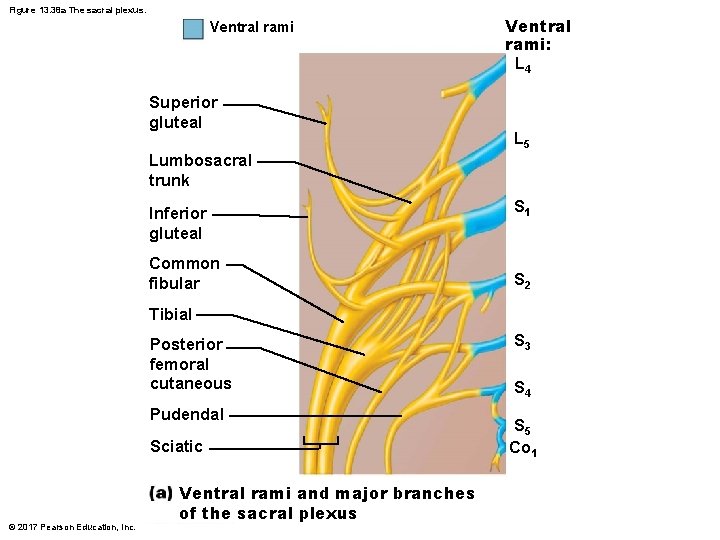
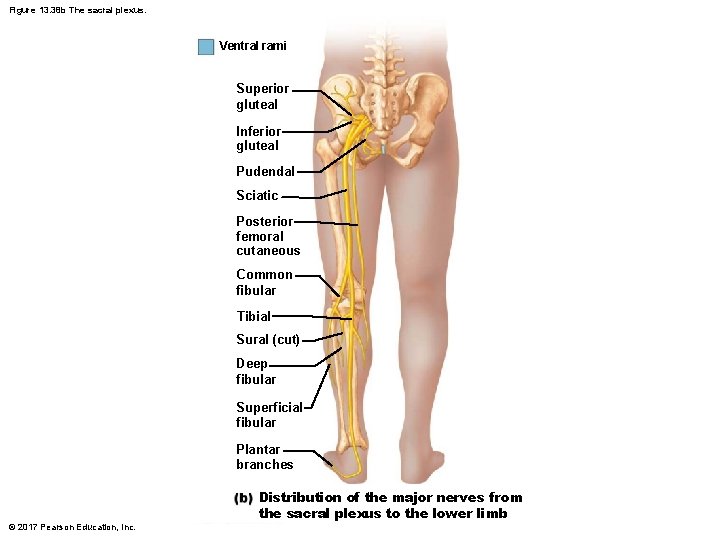
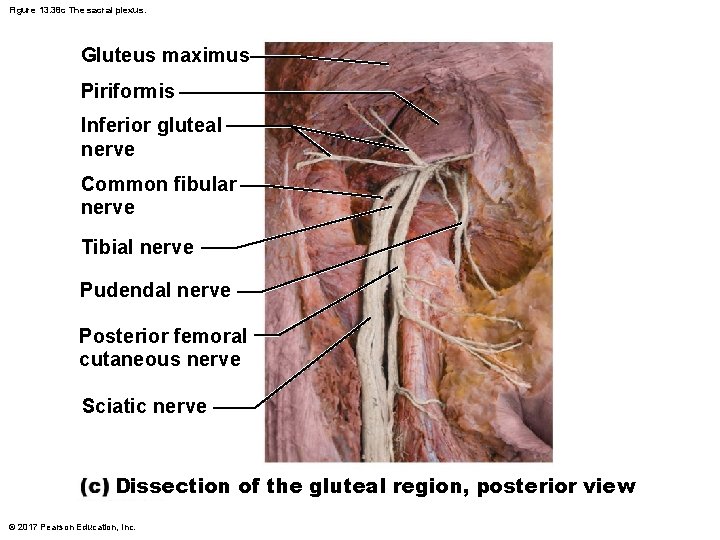
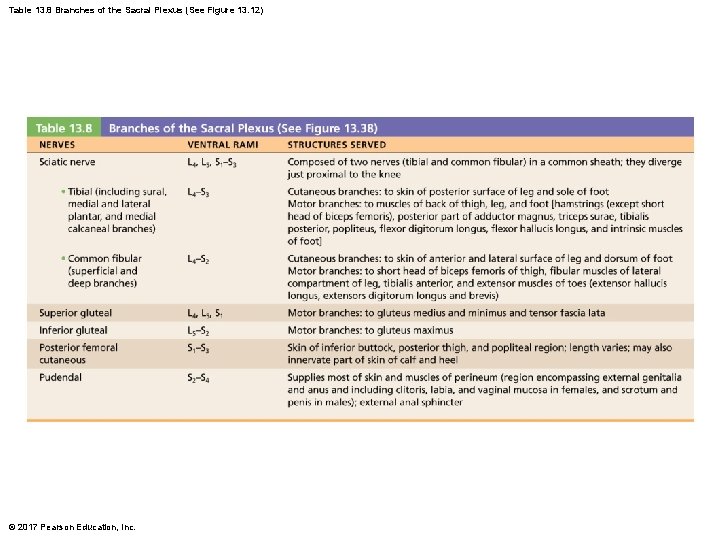
Innervation of Specific Body Regions (cont. ) – Sacral plexus • Arises from L 4 to S 4 • Serves the buttock, lower limb, pelvic structures, and perineum • Sciatic nerve – Longest and thickest nerve of body; supplies entire lower limb except for anteromedial thigh – Innervates hamstring muscles, adductor magnus, and other muscles in leg and foot – Composed of two nerves: tibial and common fibular (supplies knee joint, skin of anterior and lateral leg and dorsum of foot, and muscles of anterolateral leg) © 2017 Pearson Education, Inc.
Figure 13. 38 a The sacral plexus. Ventral rami Superior gluteal Ventral rami: L 4 L 5 Lumbosacral trunk Inferior gluteal Common fibular S 1 S 2 Tibial Posterior femoral cutaneous Pudendal Sciatic © 2017 Pearson Education, Inc. Ventral rami and major branches of the sacral plexus S 3 S 4 S 5 Co 1
Figure 13. 38 b The sacral plexus. Ventral rami Superior gluteal Inferior gluteal Pudendal Sciatic Posterior femoral cutaneous Common fibular Tibial Sural (cut) Deep fibular Superficial fibular Plantar branches Distribution of the major nerves from the sacral plexus to the lower limb © 2017 Pearson Education, Inc.
Figure 13. 38 c The sacral plexus. Gluteus maximus Piriformis Inferior gluteal nerve Common fibular nerve Tibial nerve Pudendal nerve Posterior femoral cutaneous nerve Sciatic nerve Dissection of the gluteal region, posterior view © 2017 Pearson Education, Inc.
Table 13. 8 Branches of the Sacral Plexus (See Figure 13. 12) © 2017 Pearson Education, Inc.
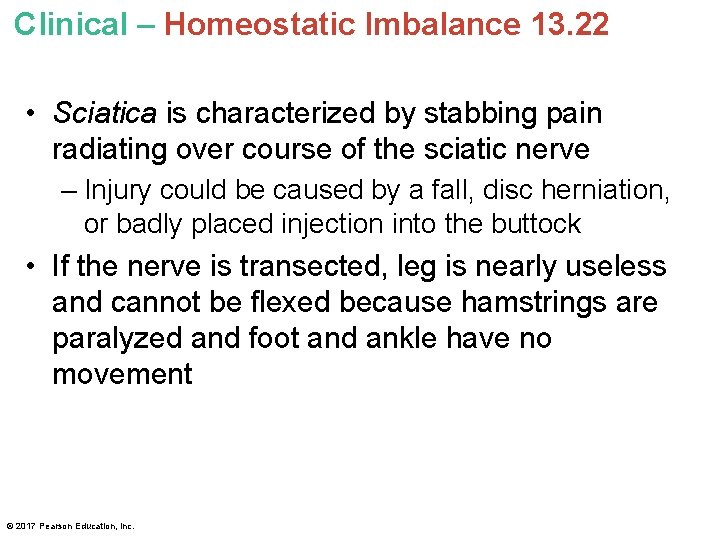
Clinical – Homeostatic Imbalance 13. 22 • Sciatica is characterized by stabbing pain radiating over course of the sciatic nerve – Injury could be caused by a fall, disc herniation, or badly placed injection into the buttock • If the nerve is transected, leg is nearly useless and cannot be flexed because hamstrings are paralyzed and foot and ankle have no movement © 2017 Pearson Education, Inc.
Clinical – Homeostatic Imbalance 13. 22 • Foot drops into plantar flexion (dangling), condition called footdrop • Recovery is usually slow and incomplete – For lesions below knee, thigh muscles are spared – If tibial nerve is injured, paralyzed calf muscles cannot plantar flex foot, and a shuffling gait develops © 2017 Pearson Education, Inc.
Innervation of Specific Body Regions (cont. ) • Anterolateral thorax and abdominal wall – Ventral rami of T 1–T 12 are intercostal nerves that supply muscles of ribs, muscle and skin of anterolateral thorax, and abdominal wall – Two unusual thoracic nerves: • Tiny T 1 • T 12, a subcostal nerve © 2017 Pearson Education, Inc.
Innervation of Specific Body Regions (cont. ) – Back • Back is innervated by dorsal rami via several branches – Each branch innervates a strip of muscle and skin in line with where it emerges from spinal column © 2017 Pearson Education, Inc.
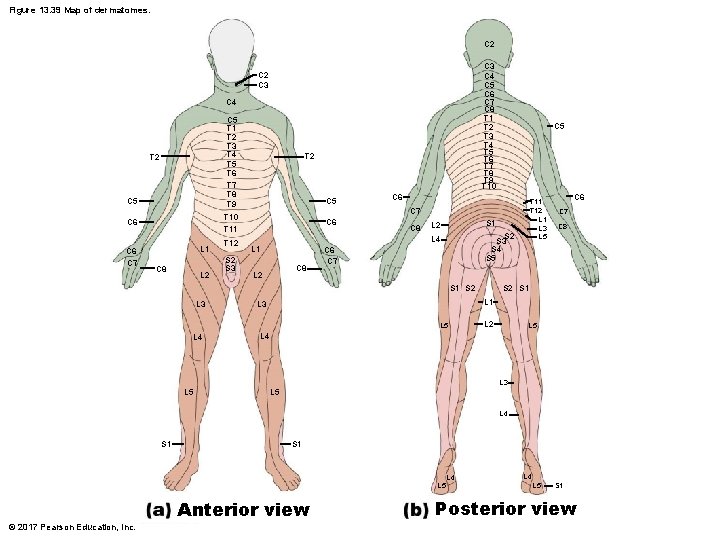
Innervation of Specific Body Regions (cont. ) • Innervation of skin: dermatomes – Dermatome: area of skin innervated by cutaneous branches of single spinal nerve – All spinal nerves except C 1 innervate dermatomes – Extent of spinal cord injuries ascertained by affected dermatomes – In the trunk, most dermatomes overlap, so destruction of a single spinal nerve will not cause complete numbness; in the limbs, the overlap is less complete and some skin regions are innervated by just one spinal nerve © 2017 Pearson Education, Inc.
Figure 13. 39 Map of dermatomes. C 2 C 3 C 4 C 5 C 6 C 7 C 8 T 1 T 2 T 3 T 4 T 5 T 6 T 7 T 8 T 9 T 10 C 2 C 3 C 4 C 5 T 1 T 2 T 3 T 4 T 5 T 6 T 7 T 8 T 9 T 2 C 5 L 1 C 8 L 2 T 12 S 3 C 6 L 1 C 8 L 2 S 1 L 4 S 2 S 3 S 4 S 5 C 6 C 7 S 1 S 2 L 3 C 6 C 7 C 8 S 2 S 1 L 3 L 5 L 4 T 11 T 12 L 1 L 3 L 5 C 7 T 10 T 11 C 6 C 7 T 2 C 5 L 2 L 5 L 4 L 3 L 5 L 4 S 1 L 4 L 5 Anterior view © 2017 Pearson Education, Inc. L 4 L 5 S 1 Posterior view
Innervation of Specific Body Regions (cont. ) • Innervation of joints – Hiltonember: Any nerve serving a muscle that produces movement at a joint also innervates the joint and the skin over the joint. © 2017 Pearson Education, Inc.