
Chapter 13 Operational DecisionMaking Tools Simulation Russell and





- Slides: 21
Chapter 13 Operational Decision-Making Tools: Simulation Russell and Taylor Operations and Supply Chain Management, 8 th Edition
Lecture Outline • Monte Carlo Simulation – Slide 4 • Computer Simulation With Excel – Slide 11 • Areas of Simulation Application – Slide 16 © 2014 John Wiley & Sons, Inc. - Russell and Taylor 8 e Supplement 13 -2
Simulation • Mathematical and computer modeling technique for replicating real-world problem situations • Modeling approach primarily used to analyze probabilistic problems – It does not normally provide a solution; instead it provides information that is used to make a decision • Physical simulation – Space flights, wind tunnels, treadmills for tires • Mathematical-computerized simulation – Computer-based replicated models © 2014 John Wiley & Sons, Inc. - Russell and Taylor 8 e Supplement 13 -3
Simulation Yesterday and Tomorrow • During the 1940’s through 1990’s, if applied mathematicians could not derive a closedform analytical mathematical solution to a mathematized process, they used simulation to understand the behavior of the process • Today simulation is the essence of video games, of movies, and of virtual reality • In the future simulations will be conducted on Holo-decks just like in Star Trek © 2014 John Wiley & Sons, Inc. - Russell and Taylor 8 e Supplement 13 -4
Three Classes of Decision Environments • Decision-making under Risk and Uncertainty – Decision tables and trees – we will not cover these— these were discussed in the Supplement to Chapter 1 that we did NOT cover • Decision Making under assumed Certainty – The optimization models we looked at. . transportation, transshipment, assignment, linear programming models • Decision Making under Change and Complexity – The simulation models we will look at today © 2014 John Wiley & Sons, Inc. - Russell and Taylor 8 e Supplement 13 -5
Simulation Models…. • Characterize process behavior over time • Are usually descriptive (telling it like it is) – The optimization models we looked at were prescriptive (telling it like it should be) • Are of two basic types – Continuous-deterministic – Discrete-stochastic • i. e. , involving probabilities and randomness—monte carlo © 2014 John Wiley & Sons, Inc. - Russell and Taylor 8 e Supplement 13 -6
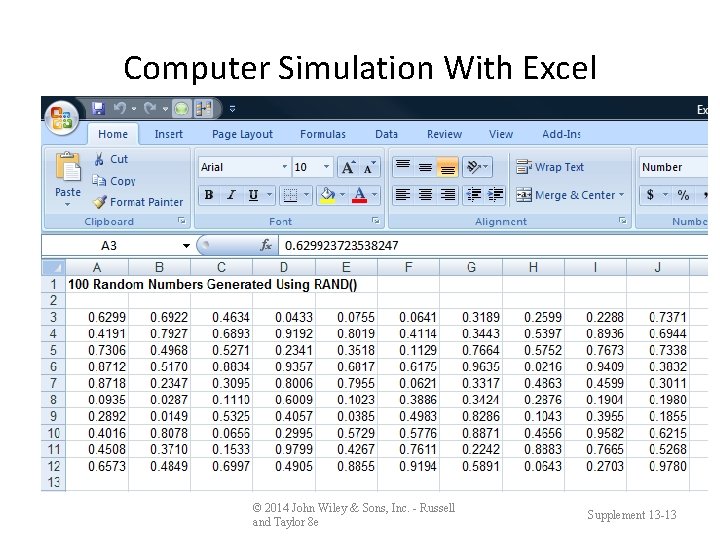
Monte Carlo Simulation • THE COMPUTER GENERATION OF RANDOM NUMBERS—all kinds of random numbers • Select numbers randomly from a probability distribution • Use these values to observe how a model performs over time • Random numbers each have an equal likelihood of being selected at random © 2014 John Wiley & Sons, Inc. - Russell and Taylor 8 e Supplement 13 -7
Major Components of Discrete Stochastic Simulation • Activities – Activities have time duration • Events – Are instants in time at which an activity begins or ends • Permanent entities • Temporary entities © 2014 John Wiley & Sons, Inc. - Russell and Taylor 8 e Supplement 13 -8
Discrete Simulation Time Advance • From one time unit to the next—Time step – From one day to the next, for example – What we use in the Excel simulations • From one event to the next chronological event to occur in time © 2014 John Wiley & Sons, Inc. - Russell and Taylor 8 e Supplement 13 -9
Examples of Activities, Events for an Airline Gate Turn • Activities – Unloading – Cabin cleanup – Loading – Refueling – Baggage unloading – Baggage loading – Refurbishing snacks • Events • Beginning of unloading • Ending of unloading/beginning of cabin cleanup • Ending of cabin cleanup/beginning of loading • Ending of unloading © 2014 John Wiley & Sons, Inc. - Russell and Taylor 8 e Supplement 13 -10
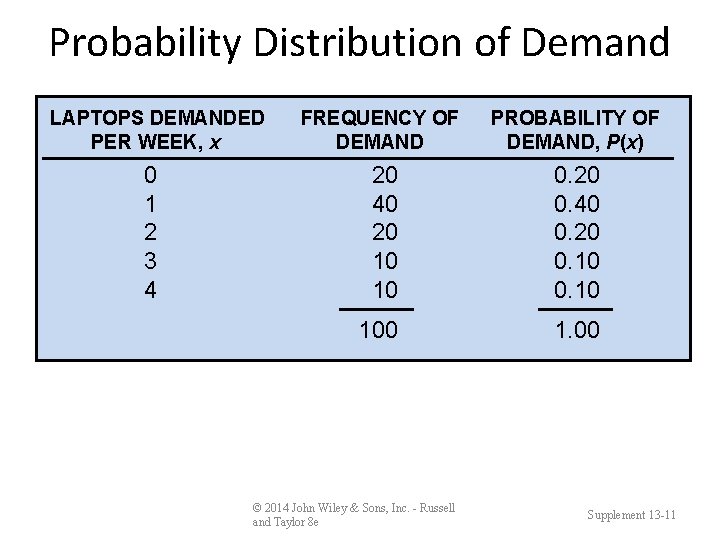
Probability Distribution of Demand LAPTOPS DEMANDED PER WEEK, x 0 1 2 3 4 FREQUENCY OF DEMAND PROBABILITY OF DEMAND, P(x) 20 40 20 10 10 0. 20 0. 40 0. 20 0. 10 100 1. 00 © 2014 John Wiley & Sons, Inc. - Russell and Taylor 8 e Supplement 13 -11
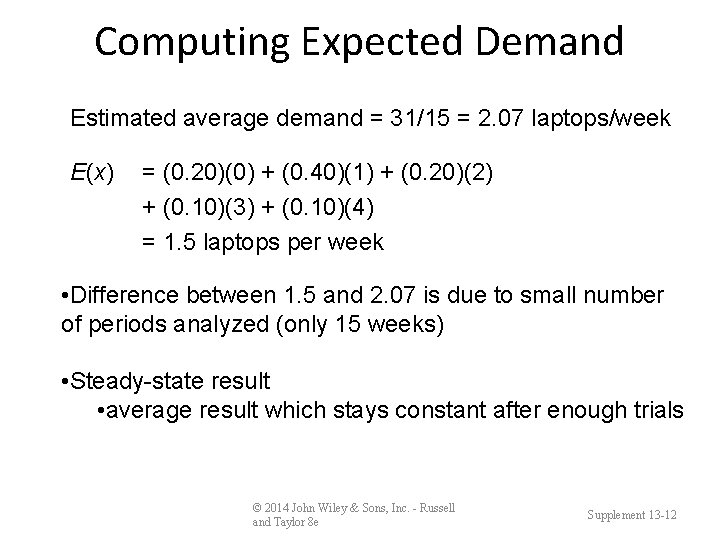
Computing Expected Demand Estimated average demand = 31/15 = 2. 07 laptops/week E(x) = (0. 20)(0) + (0. 40)(1) + (0. 20)(2) + (0. 10)(3) + (0. 10)(4) = 1. 5 laptops per week • Difference between 1. 5 and 2. 07 is due to small number of periods analyzed (only 15 weeks) • Steady-state result • average result which stays constant after enough trials © 2014 John Wiley & Sons, Inc. - Russell and Taylor 8 e Supplement 13 -12
Computer Simulation With Excel © 2014 John Wiley & Sons, Inc. - Russell and Taylor 8 e Supplement 13 -13
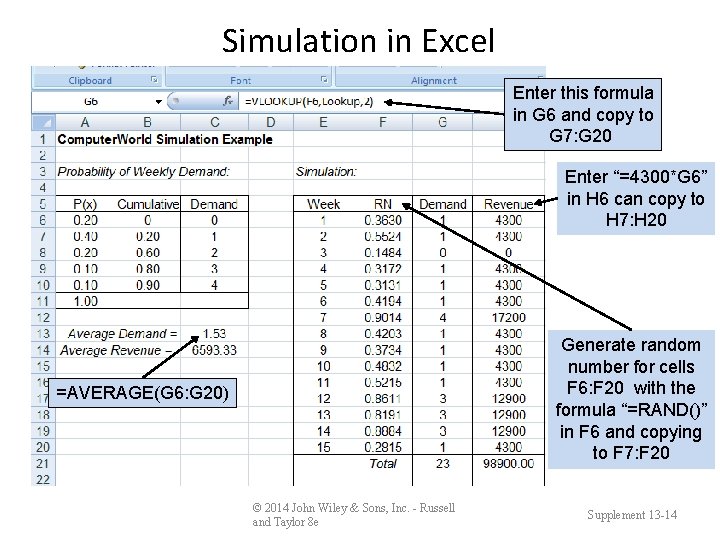
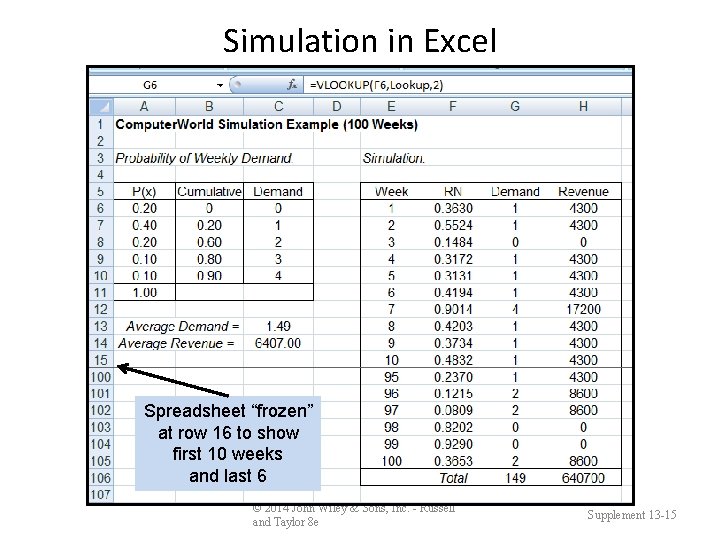
Simulation in Excel Enter this formula in G 6 and copy to G 7: G 20 Enter “=4300*G 6” in H 6 can copy to H 7: H 20 Generate random number for cells F 6: F 20 with the formula “=RAND()” in F 6 and copying to F 7: F 20 =AVERAGE(G 6: G 20) © 2014 John Wiley & Sons, Inc. - Russell and Taylor 8 e Supplement 13 -14
Simulation in Excel Spreadsheet “frozen” at row 16 to show first 10 weeks and last 6 © 2014 John Wiley & Sons, Inc. - Russell and Taylor 8 e Supplement 13 -15
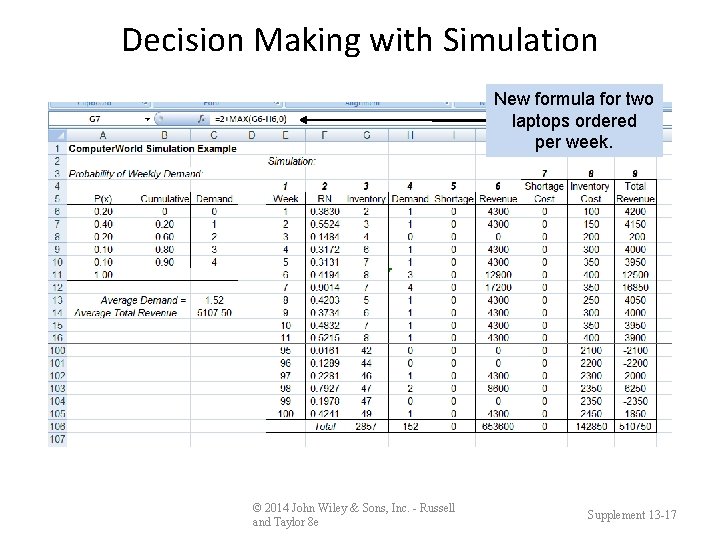
Decision Making with Simulation This formula entered in G 7 and copied to G 8: G 105 =G 6*50 entered into cell L 6 and copied to L 7: L 105 =VLOOKUP (F 6, LOOKUP, 2) in H 6 and copied to H 7: H 105 Shortages computed by entering =MIN(G 6 -H 6, 0) in I 6 and copying to I 7: I 105 © 2014 John Wiley & Sons, Inc. - Russell and Taylor 8 e Supplement 13 -16
Decision Making with Simulation New formula for two laptops ordered per week. © 2014 John Wiley & Sons, Inc. - Russell and Taylor 8 e Supplement 13 -17
Areas of Simulation Application • Waiting Lines/Service – Complex systems for which it is difficult to develop analytical formulas – Determine how many registers and servers are needed to meet customer demand • Inventory Management – Traditional models make the assumption that customer demand is certain – Simulation is widely used to analyze JIT without having to implement it physically © 2014 John Wiley & Sons, Inc. - Russell and Taylor 8 e Supplement 13 -18
Areas of Simulation Application • Production and Manufacturing Systems – Production scheduling, production sequencing, assembly line balancing, plant layout, and plant location analysis – Machine breakdowns typically occur according to some probability distributions • Capital Investment and Budgeting – Capital budgeting problems require estimates of cash flows, often resulting from many random variables – Simulation has been used to generate values of cash flows, market size, selling price, growth rate, and market share © 2014 John Wiley & Sons, Inc. - Russell and Taylor 8 e Supplement 13 -19
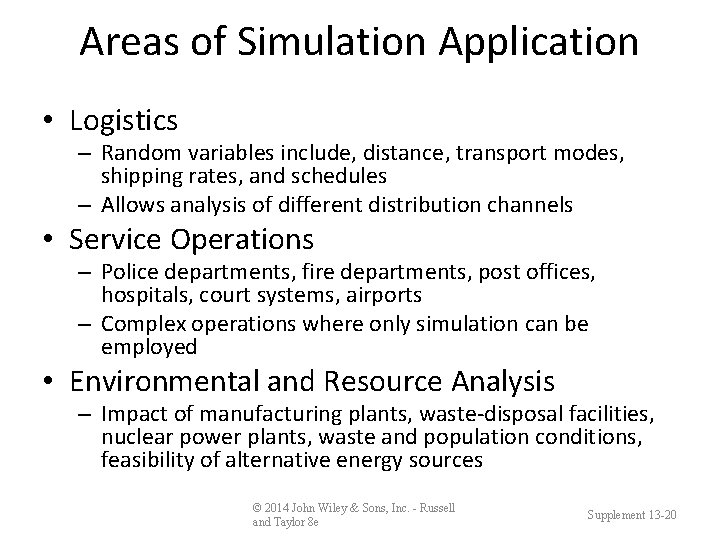
Areas of Simulation Application • Logistics – Random variables include, distance, transport modes, shipping rates, and schedules – Allows analysis of different distribution channels • Service Operations – Police departments, fire departments, post offices, hospitals, court systems, airports – Complex operations where only simulation can be employed • Environmental and Resource Analysis – Impact of manufacturing plants, waste-disposal facilities, nuclear power plants, waste and population conditions, feasibility of alternative energy sources © 2014 John Wiley & Sons, Inc. - Russell and Taylor 8 e Supplement 13 -20
Copyright 2014 John Wiley & Sons, Inc. All rights reserved. Reproduction or translation of this work beyond that permitted in section 117 of the 1976 United States Copyright Act without express permission of the copyright owner is unlawful. Request for further information should be addressed to the Permission Department, John Wiley & Sons, Inc. The purchaser may make back-up copies for his/her own use only and not for distribution or resale. The Publisher assumes no responsibility for errors, omissions, or damages caused by the use of these programs or from the use of the information herein. © 2014 John Wiley & Sons, Inc. - Russell and Taylor 8 e Supplement 13 -21