
Chapter 13 Nursing Care During Newborn Transition Copyright
Chapter 13: Nursing Care During Newborn Transition Copyright © 2018 Wolters Kluwer Health | Lippincott Williams & Wilkins

Physiologic Adaptation • The newborn must rapidly adapt to life outside the womb. • Respiratory adaptation occurs when the newborn fills his lungs with air, absorbs remaining fluid in the lungs, and begins oxygen exchange. • All the fetal shunts (foramen ovale, ductus arteriosus, and ductus venosus) must close so that blood will travel to the lungs for gas exchange and to route blood through the liver. Copyright © 2018 Wolters Kluwer · All Rights Reserved

Mechanisms of heat loss. A. Conduction. B. Convection. C. Evaporation. D. Radiation. Copyright © 2018 Wolters Kluwer · All Rights Reserved

Physiologic Adaptation (cont. ) • The newborn has poor thermoregulation because he or she is prone to heat loss through the skin and because he or she cannot produce heat through muscle movement and shivering. • Heat is lost through the processes of convection, conduction, evaporation, and radiation. • The newborn conserves heat by maintaining a flexed position and produces heat by metabolizing brown fat. Copyright © 2018 Wolters Kluwer · All Rights Reserved
Physiologic Adaptation (cont. ) • Newborn hypoglycemia is a blood glucose level less than 50 mg/d. L. • Newborns can be asymptomatic or may demonstrate multiple signs. • The most common sign is jitteriness. Copyright © 2018 Wolters Kluwer · All Rights Reserved
Copyright © 2018 Wolters Kluwer · All Rights Reserved
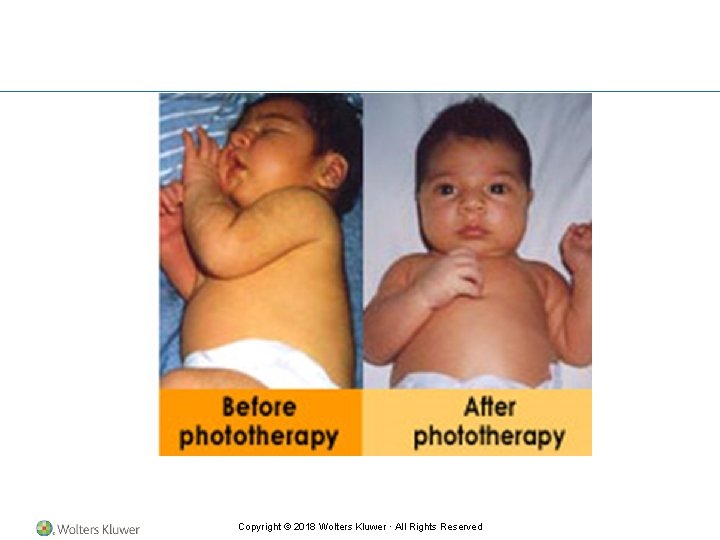
Physiologic Adaptation (cont. ) • The newborn's immature liver may not be able to handle the heavy load from the breakdown of red blood cells, and physiologic jaundice appears. • This condition is harmless if bilirubin levels do not rise dramatically and if jaundice is not present before the newborn is 24 hours old. Copyright © 2018 Wolters Kluwer · All Rights Reserved
Physiologic Adaptation (cont. ) • Not all of the necessary blood coagulation factors are manufactured directly after birth, and the gut is sterile, so vitamin K is given intramuscularly to stimulate appropriate clotting. • Each infant is unique, but all infants have similar sleep and activity patterns. – These include deep sleep, light sleep, drowsiness, quiet alert state, active alert state, and crying. Copyright © 2018 Wolters Kluwer · All Rights Reserved
Copyright © 2018 Wolters Kluwer · All Rights Reserved
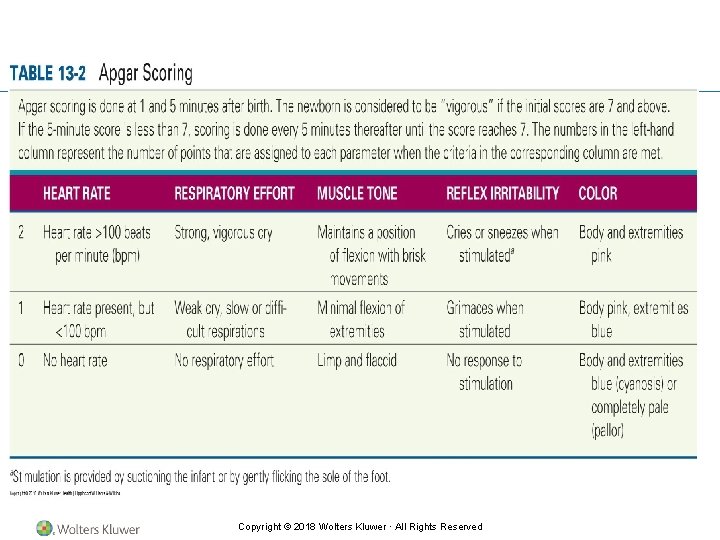
Nursing Assessment of the Normal Newborn • The RN performs immediate assessments in the delivery room, including assigning the Apgar score. • The Apgar score is a way of determining how well the newborn is transitioning to life outside the womb. • Five parameters (respiratory effort, heart rate, muscle tone, reflex irritability, and color) are used to assign a score at 1 and 5 minutes of life. • A healthy, vigorous newborn has a 5 -minute score of 7 or greater. ( see table 13 -2) Copyright © 2018 Wolters Kluwer · All Rights Reserved
Question The Apgar score, given at 1 and 5 minutes of life, is an important assessment tool for the newborn. What information is this assessment used for? a. Guides resuscitation efforts b. Helps determine intensity of newborn needs c. Indicates whether newborn is “normal” d. Used to evaluate resuscitation efforts Copyright © 2018 Wolters Kluwer · All Rights Reserved
Answer b. Helps determine intensity of newborn needs Rationale: The Apgar score is useful in determining the intensity of the needs of the newborn for the first few days of life. Copyright © 2018 Wolters Kluwer · All Rights Reserved
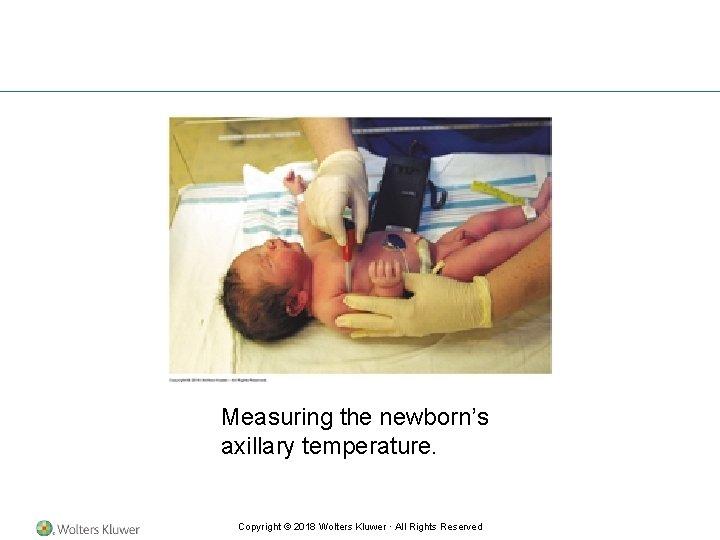
Measuring the newborn’s axillary temperature. Copyright © 2018 Wolters Kluwer · All Rights Reserved
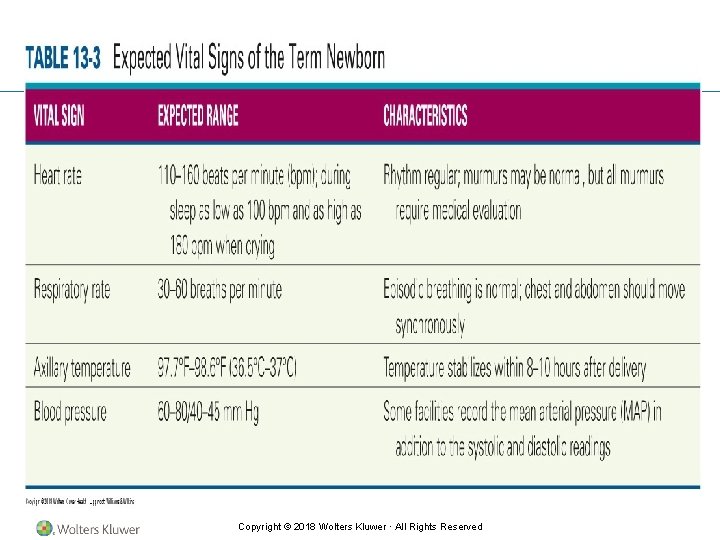
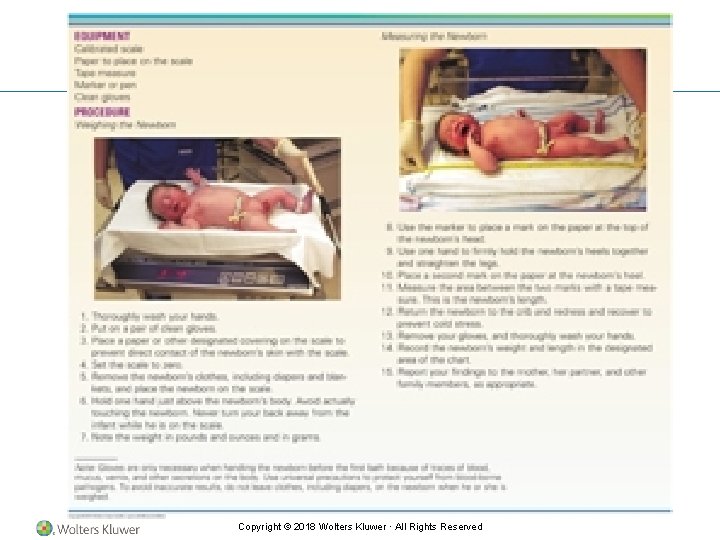
Nursing Assessment of the Normal Newborn (cont. ) • The newborn examination is an important way to determine how well the newborn is adapting to life outside the womb. • The least disturbing aspects of the examination are completed first. • Respiratory rate and heart rate are taken first, while the newborn is quiet. • Then examination proceeds in a head-to-toe manner and includes physical measurements and inspection of each body part. Copyright © 2018 Wolters Kluwer · All Rights Reserved
Copyright © 2018 Wolters Kluwer · All Rights Reserved
Copyright © 2018 Wolters Kluwer · All Rights Reserved
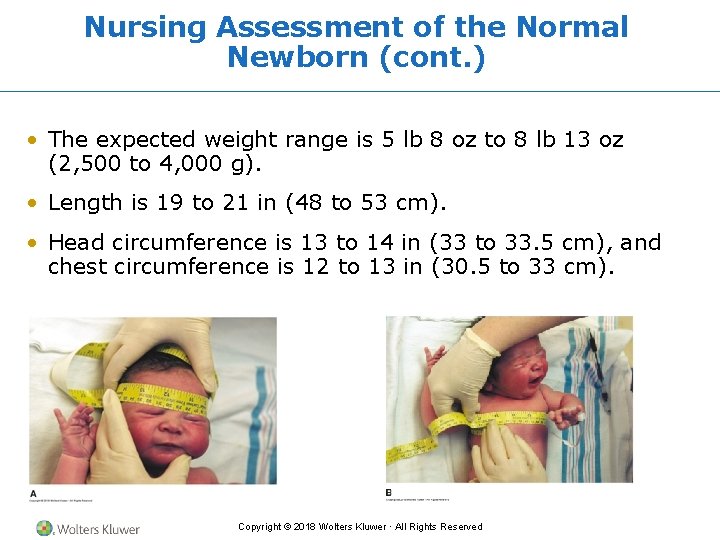
Nursing Assessment of the Normal Newborn (cont. ) • The expected weight range is 5 lb 8 oz to 8 lb 13 oz (2, 500 to 4, 000 g). • Length is 19 to 21 in (48 to 53 cm). • Head circumference is 13 to 14 in (33 to 33. 5 cm), and chest circumference is 12 to 13 in (30. 5 to 33 cm). Copyright © 2018 Wolters Kluwer · All Rights Reserved
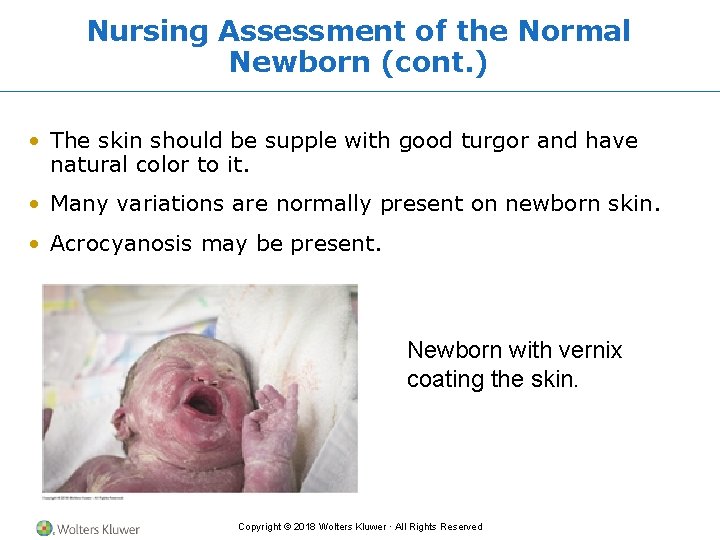
Nursing Assessment of the Normal Newborn (cont. ) • The skin should be supple with good turgor and have natural color to it. • Many variations are normally present on newborn skin. • Acrocyanosis may be present. Newborn with vernix coating the skin. Copyright © 2018 Wolters Kluwer · All Rights Reserved
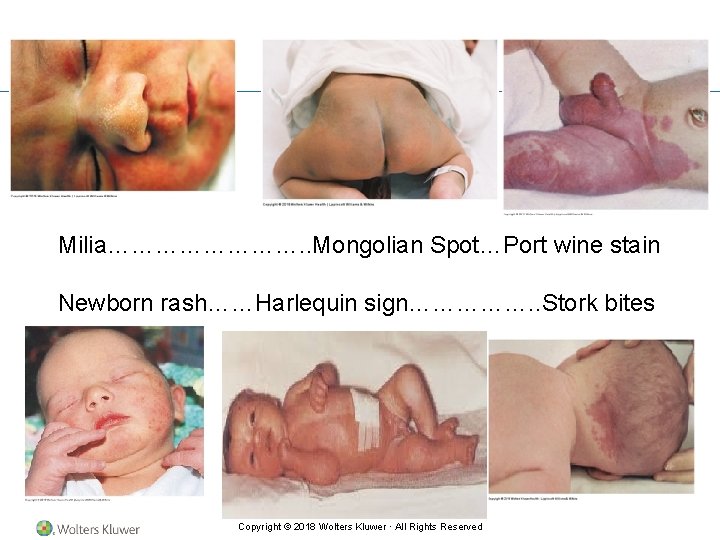
Milia…………. . Mongolian Spot…Port wine stain Newborn rash……Harlequin sign……………. . Stork bites Copyright © 2018 Wolters Kluwer · All Rights Reserved
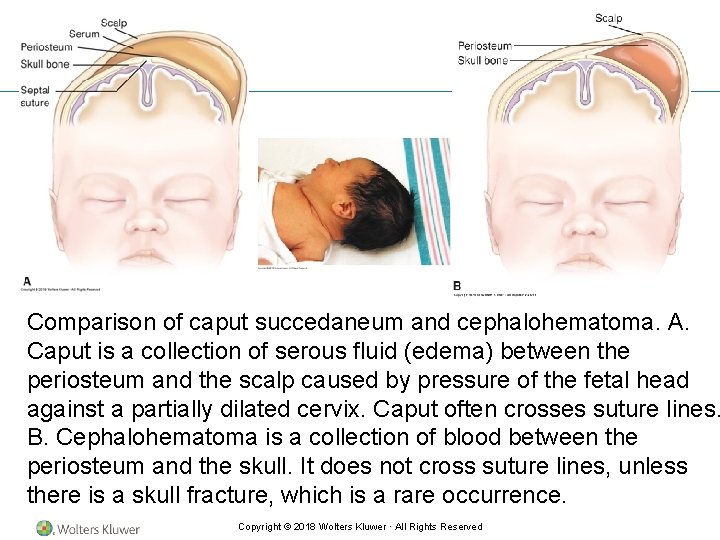
Comparison of caput succedaneum and cephalohematoma. A. Caput is a collection of serous fluid (edema) between the periosteum and the scalp caused by pressure of the fetal head against a partially dilated cervix. Caput often crosses suture lines. B. Cephalohematoma is a collection of blood between the periosteum and the skull. It does not cross suture lines, unless there is a skull fracture, which is a rare occurrence. Copyright © 2018 Wolters Kluwer · All Rights Reserved
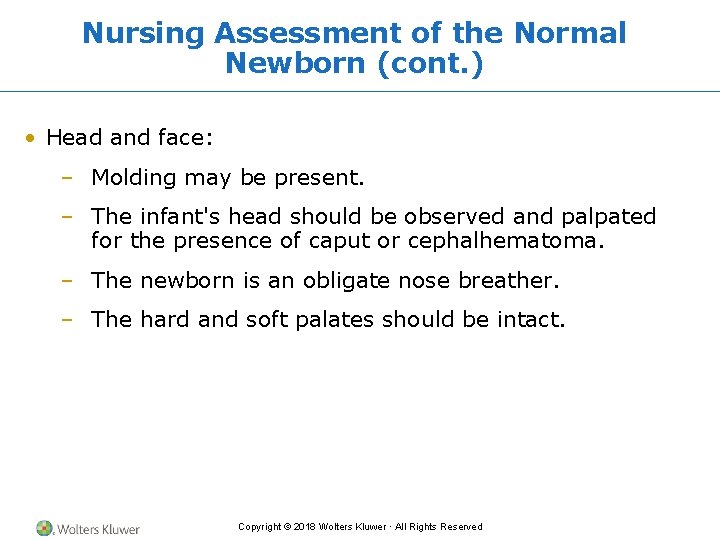
Nursing Assessment of the Normal Newborn (cont. ) • Head and face: – Molding may be present. – The infant's head should be observed and palpated for the presence of caput or cephalhematoma. – The newborn is an obligate nose breather. – The hard and soft palates should be intact. Copyright © 2018 Wolters Kluwer · All Rights Reserved
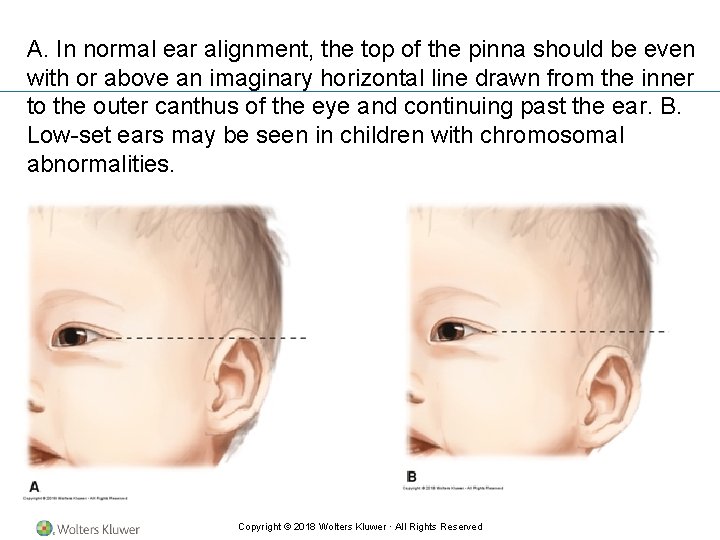
A. In normal ear alignment, the top of the pinna should be even with or above an imaginary horizontal line drawn from the inner to the outer canthus of the eye and continuing past the ear. B. Low-set ears may be seen in children with chromosomal abnormalities. Copyright © 2018 Wolters Kluwer · All Rights Reserved
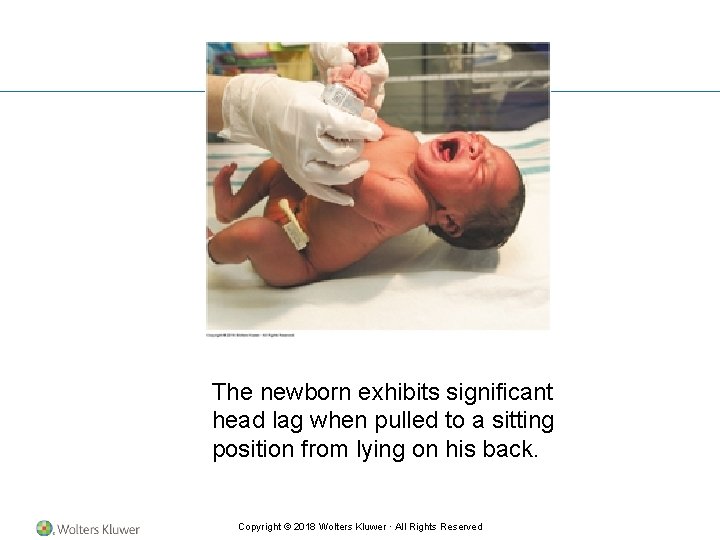
The newborn exhibits significant head lag when pulled to a sitting position from lying on his back. Copyright © 2018 Wolters Kluwer · All Rights Reserved
Nursing Assessment of the Normal Newborn (cont. ) • Neck and chest: – The neck is short and thick. – Webbing should not be present. – Periodic breathing episodes are normal. – The infant should be examined for a fractured clavicle. Swollen breast tissue in the newborn is common in both sexes and is temporary. Copyright © 2018 Wolters Kluwer · All Rights Reserved
Nursing Assessment of the Normal Newborn (cont. ) • Abdomen: – The abdomen is protuberant. – The cord should be clamped and drying with three vessels present. – Bowel sounds should be present and the newborn should pass meconium, the first stool, within the first 24 hours. Copyright © 2018 Wolters Kluwer · All Rights Reserved
Nursing Assessment of the Normal Newborn (cont. ) • Genitourinary: – The newborn should void within the first 24 hours. – Genitalia of both sexes may be swollen. Copyright © 2018 Wolters Kluwer · All Rights Reserved
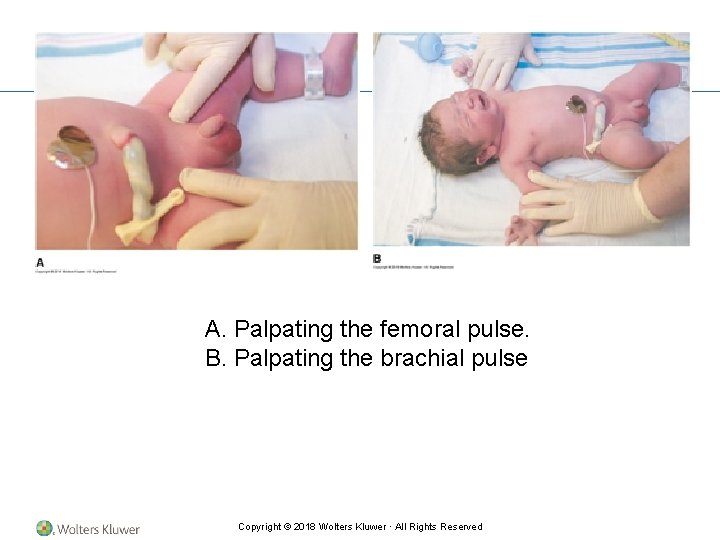
A. Palpating the femoral pulse. B. Palpating the brachial pulse Copyright © 2018 Wolters Kluwer · All Rights Reserved
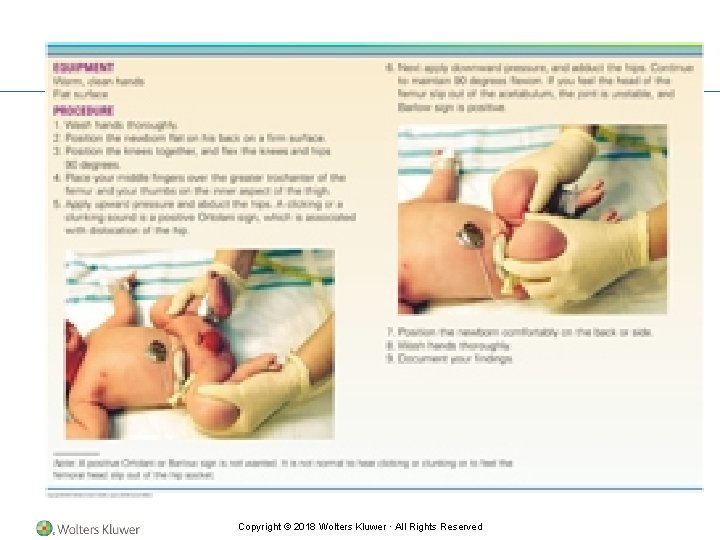
Copyright © 2018 Wolters Kluwer · All Rights Reserved
Nursing Assessment of the Normal Newborn (cont. ) • The back should be straight and free of hairy tufts, dimples, or tumors. • There should be equal and full range of motion of all extremities. Copyright © 2018 Wolters Kluwer · All Rights Reserved
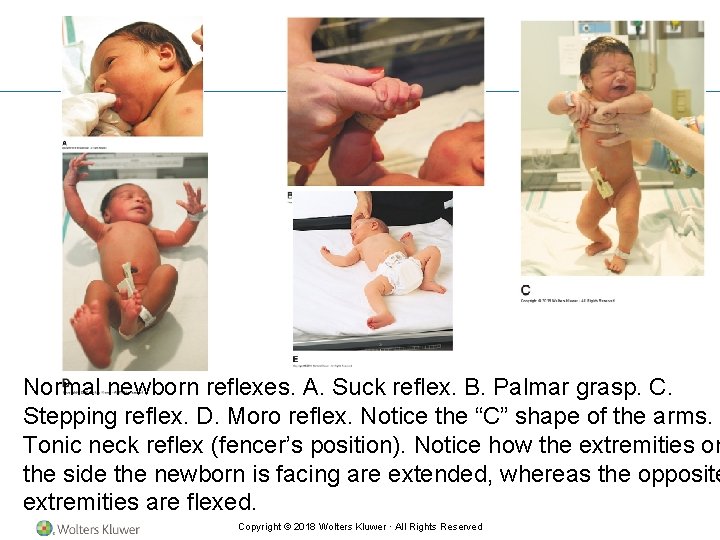
Normal newborn reflexes. A. Suck reflex. B. Palmar grasp. C. Stepping reflex. D. Moro reflex. Notice the “C” shape of the arms. Tonic neck reflex (fencer’s position). Notice how the extremities on the side the newborn is facing are extended, whereas the opposite extremities are flexed. Copyright © 2018 Wolters Kluwer · All Rights Reserved
Nursing Assessment of the Normal Newborn (cont. ) • The main reflexes tested to determine neurologic status are rooting, sucking, swallowing, grasping, Moro, Babinski, and tonic neck. Copyright © 2018 Wolters Kluwer · All Rights Reserved
Question Baby girl Smith, a healthy newborn female weighing 8 lb 2 oz, was born 2 hours ago. You note that her hands and feet are blue in color and her trunk is pink. What would you document? a. Mongolian spots noted on extremities b. Telangiectatic nevi noted on extremities c. Acrocyanosis present d. Milia present Copyright © 2018 Wolters Kluwer · All Rights Reserved
Answer c. Acrocyanosis present Rationale: Acrocyanosis, blue hands and feet with a pink trunk, results from poor peripheral circulation and is not a good indicator of oxygenation status. Copyright © 2018 Wolters Kluwer · All Rights Reserved
- Slides: 33