
Chapter 13 MidOcean Rifts The MidOcean Ridge System
- Slides: 21
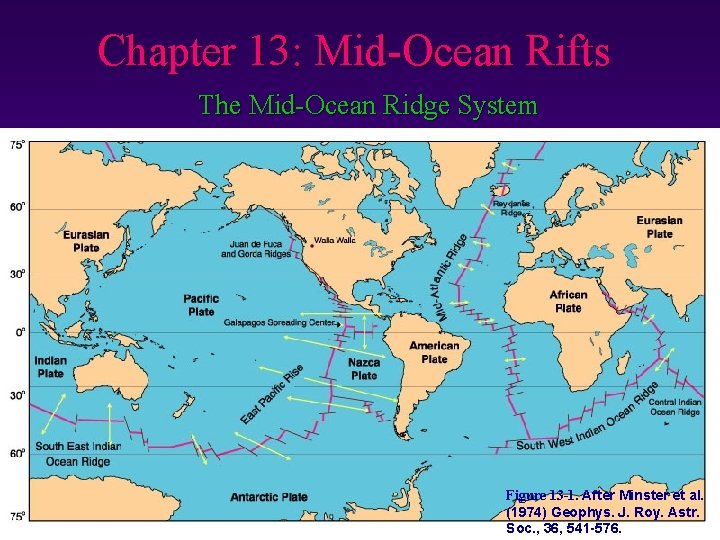
Chapter 13: Mid-Ocean Rifts The Mid-Ocean Ridge System Figure 13 -1. After Minster et al. (1974) Geophys. J. Roy. Astr. Soc. , 36, 541 -576.
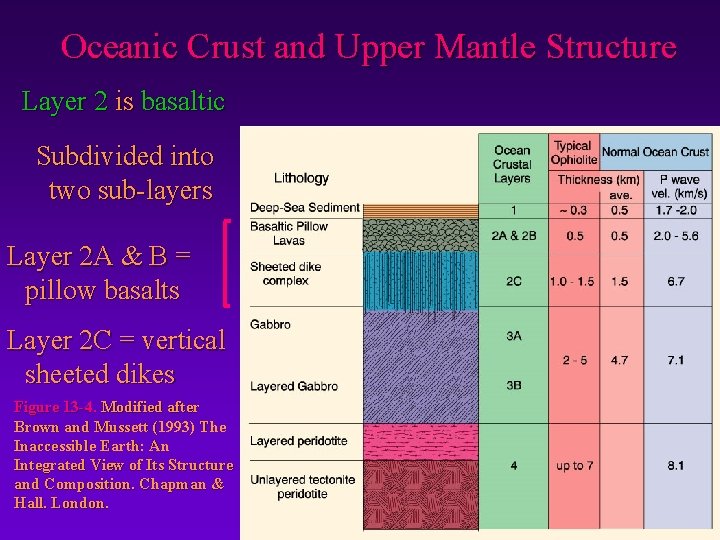
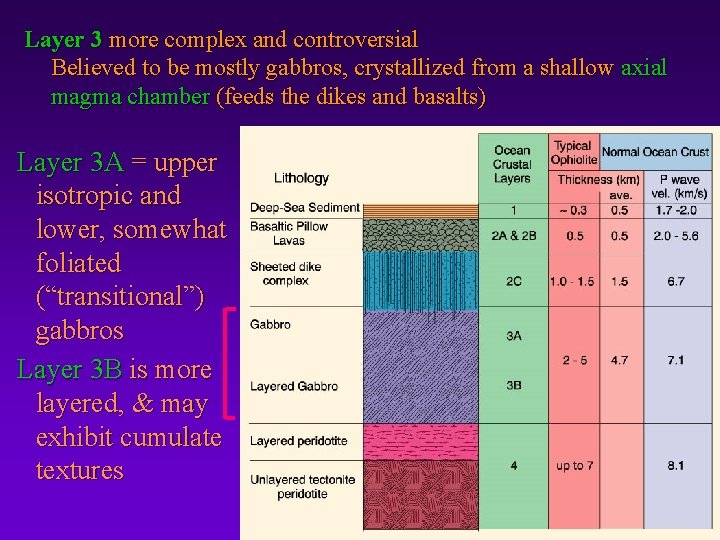
Oceanic Crust and Upper Mantle Structure l l 4 layers distinguished via seismic velocities Deep Sea Drilling Program Dredging of fracture zone scarps Ophiolites
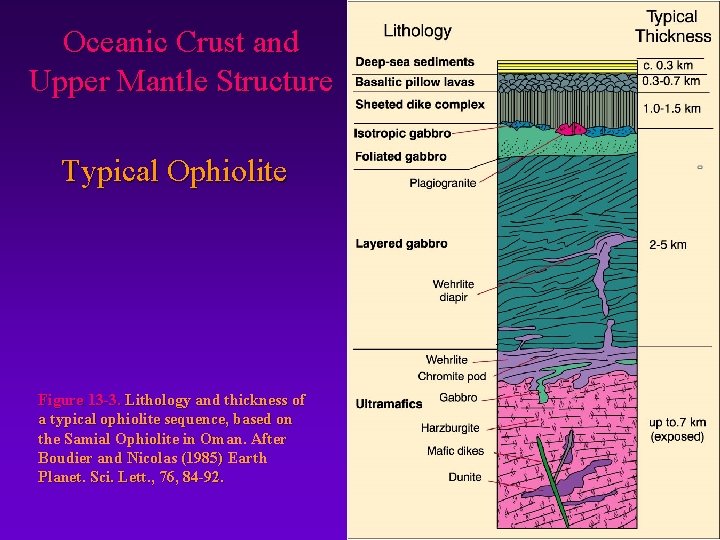
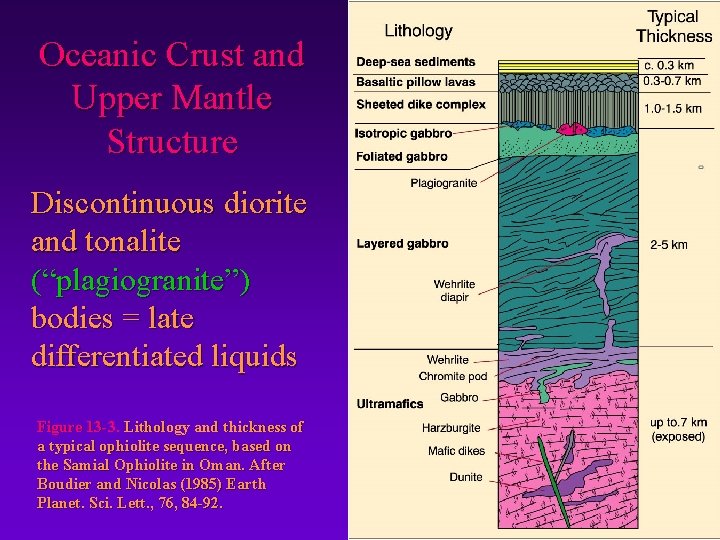
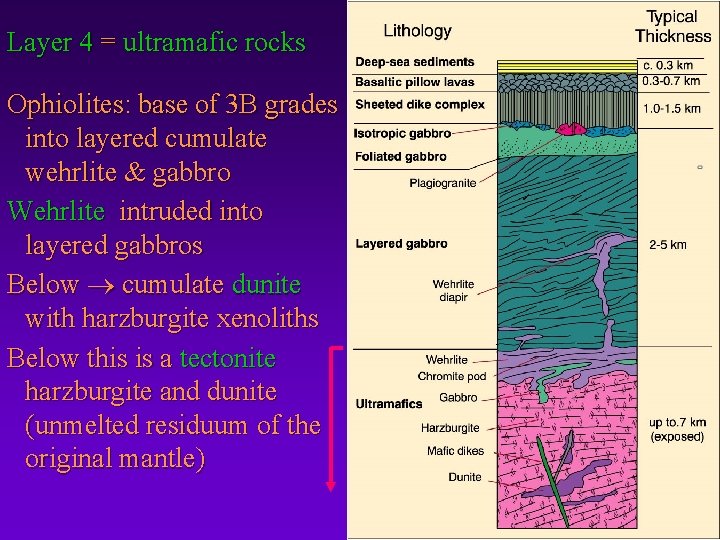
Oceanic Crust and Upper Mantle Structure Typical Ophiolite Figure 13 -3. Lithology and thickness of a typical ophiolite sequence, based on the Samial Ophiolite in Oman. After Boudier and Nicolas (1985) Earth Planet. Sci. Lett. , 76, 84 -92.
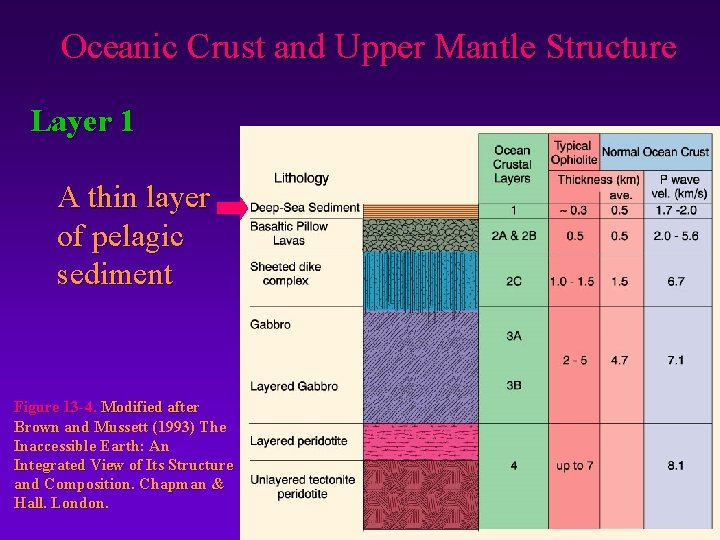
Oceanic Crust and Upper Mantle Structure Layer 1 A thin layer of pelagic sediment Figure 13 -4. Modified after Brown and Mussett (1993) The Inaccessible Earth: An Integrated View of Its Structure and Composition. Chapman & Hall. London.
Oceanic Crust and Upper Mantle Structure Layer 2 is basaltic Subdivided into two sub-layers Layer 2 A & B = pillow basalts Layer 2 C = vertical sheeted dikes Figure 13 -4. Modified after Brown and Mussett (1993) The Inaccessible Earth: An Integrated View of Its Structure and Composition. Chapman & Hall. London.
Layer 3 more complex and controversial Believed to be mostly gabbros, crystallized from a shallow axial magma chamber (feeds the dikes and basalts) Layer 3 A = upper isotropic and lower, somewhat foliated (“transitional”) gabbros Layer 3 B is more layered, & may exhibit cumulate textures
Oceanic Crust and Upper Mantle Structure Discontinuous diorite and tonalite (“plagiogranite”) bodies = late differentiated liquids Figure 13 -3. Lithology and thickness of a typical ophiolite sequence, based on the Samial Ophiolite in Oman. After Boudier and Nicolas (1985) Earth Planet. Sci. Lett. , 76, 84 -92.
Layer 4 = ultramafic rocks Ophiolites: base of 3 B grades into layered cumulate wehrlite & gabbro Wehrlite intruded into layered gabbros Below cumulate dunite with harzburgite xenoliths Below this is a tectonite harzburgite and dunite (unmelted residuum of the original mantle)
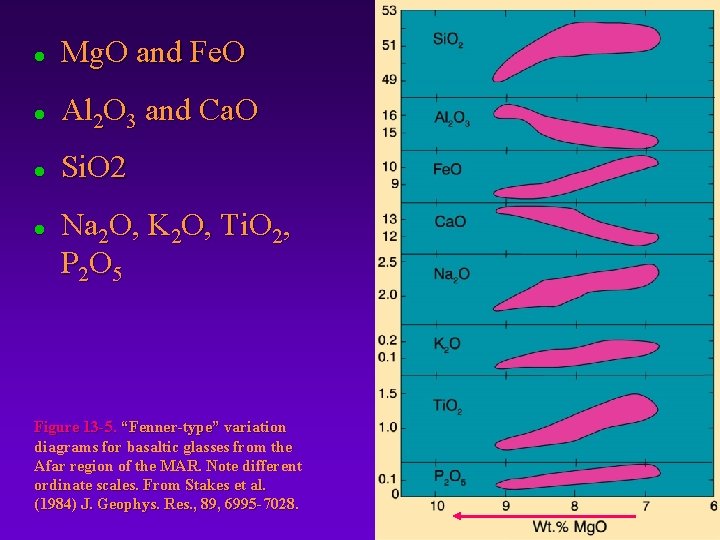
l Mg. O and Fe. O l Al 2 O 3 and Ca. O l Si. O 2 l Na 2 O, K 2 O, Ti. O 2, P 2 O 5 Figure 13 -5. “Fenner-type” variation diagrams for basaltic glasses from the Afar region of the MAR. Note different ordinate scales. From Stakes et al. (1984) J. Geophys. Res. , 89, 6995 -7028.
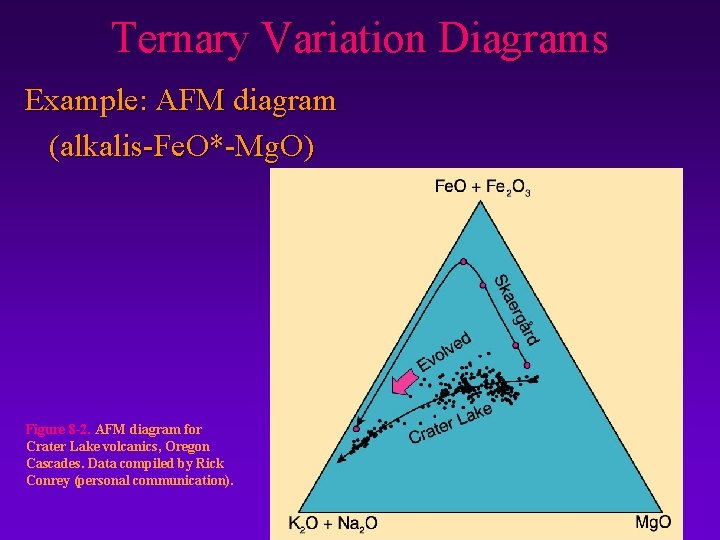
Ternary Variation Diagrams Example: AFM diagram (alkalis-Fe. O*-Mg. O) Figure 8 -2. AFM diagram for Crater Lake volcanics, Oregon Cascades. Data compiled by Rick Conrey (personal communication).
Conclusions about MORBs, and the processes beneath mid-ocean ridges F MORBs are not the completely uniform magmas that they were once considered to be s They show chemical trends consistent with fractional crystallization of olivine, plagioclase, and perhaps clinopyroxene F MORBs cannot be primary magmas, but are derivative magmas resulting from fractional crystallization (~ 60%)
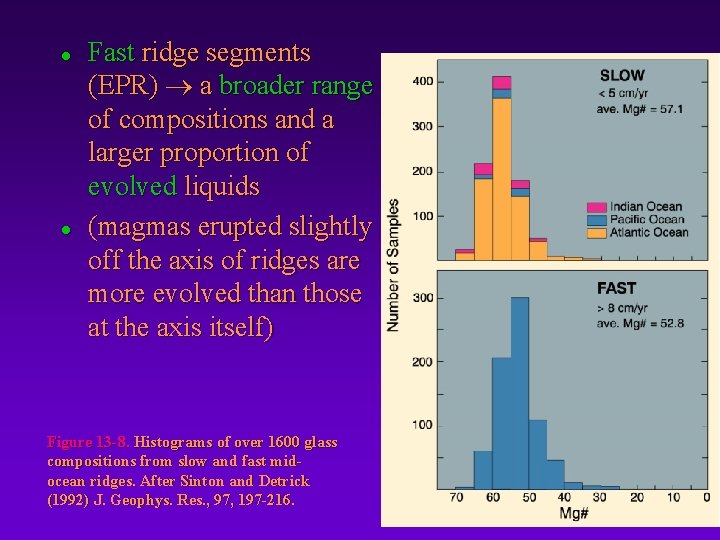
l l Fast ridge segments (EPR) a broader range of compositions and a larger proportion of evolved liquids (magmas erupted slightly off the axis of ridges are more evolved than those at the axis itself) Figure 13 -8. Histograms of over 1600 glass compositions from slow and fast midocean ridges. After Sinton and Detrick (1992) J. Geophys. Res. , 97, 197 -216.
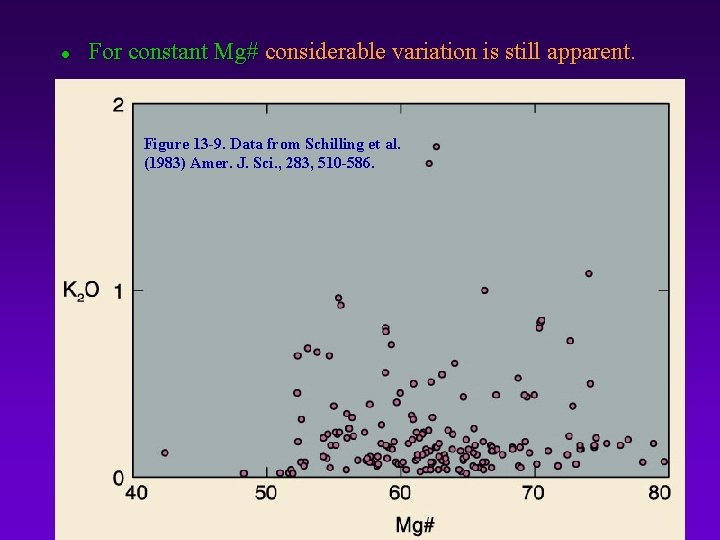
l For constant Mg# considerable variation is still apparent. Figure 13 -9. Data from Schilling et al. (1983) Amer. J. Sci. , 283, 510 -586.
Incompatible-rich and incompatible-poor mantle source regions for MORB magmas F N-MORB (normal MORB) taps the depleted upper mantle source s Mg# > 65: K 2 O < 0. 10 Ti. O 2 < 1. 0 F E-MORB (enriched MORB, also called P-MORB for plume) taps the (deeper) fertile mantle s Mg# > 65: K 2 O > 0. 10 Ti. O 2 > 1. 0
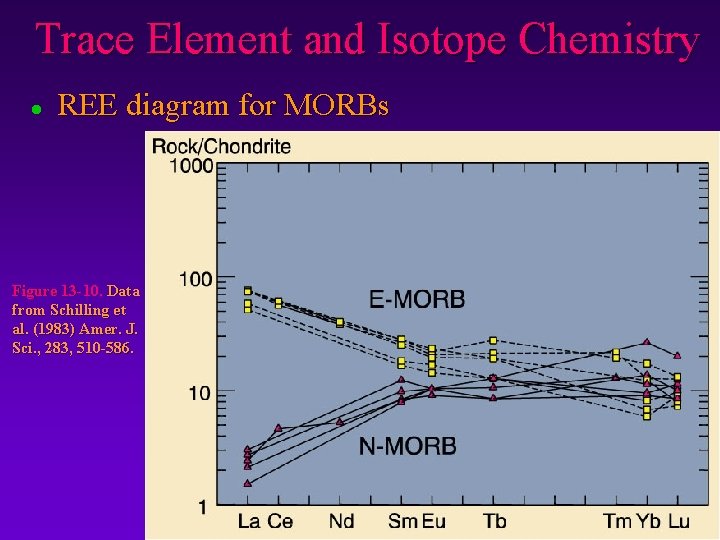
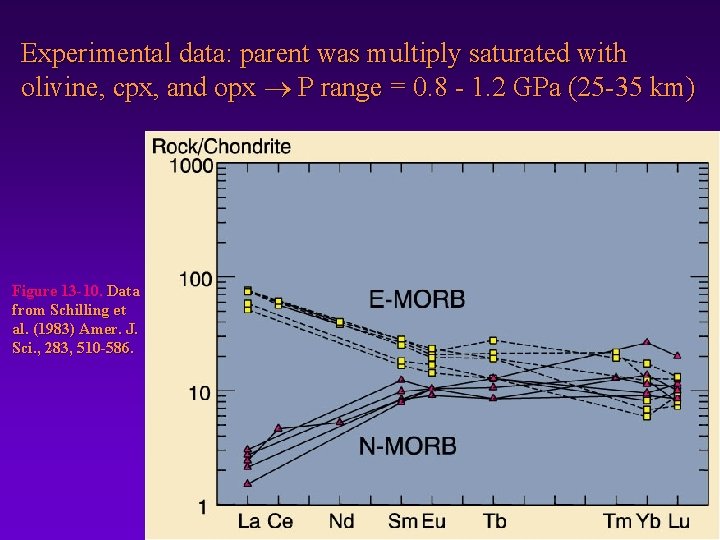
Trace Element and Isotope Chemistry l REE diagram for MORBs Figure 13 -10. Data from Schilling et al. (1983) Amer. J. Sci. , 283, 510 -586.
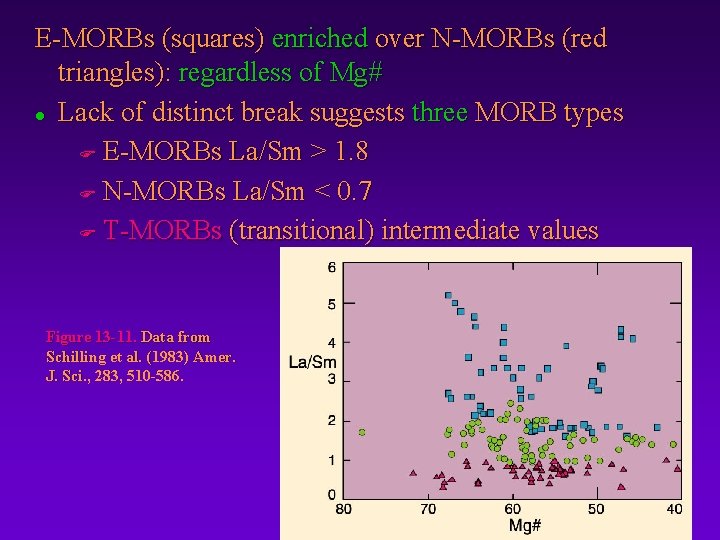
E-MORBs (squares) enriched over N-MORBs (red triangles): regardless of Mg# l Lack of distinct break suggests three MORB types F E-MORBs La/Sm > 1. 8 F N-MORBs La/Sm < 0. 7 F T-MORBs (transitional) intermediate values Figure 13 -11. Data from Schilling et al. (1983) Amer. J. Sci. , 283, 510 -586.
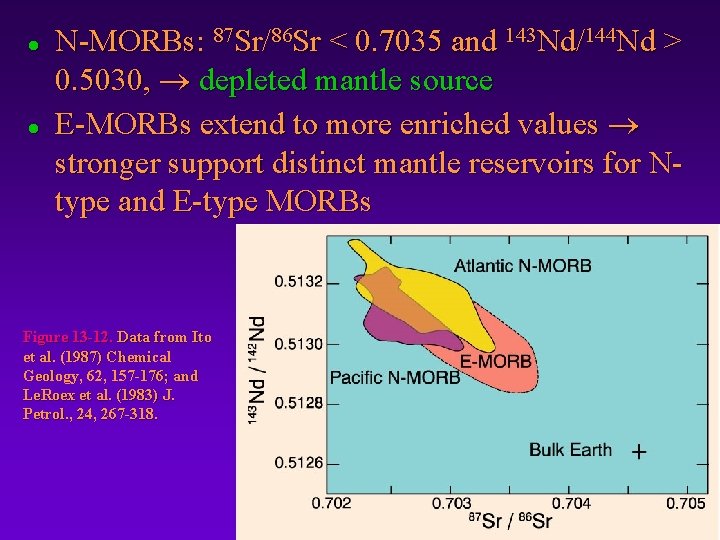
l l N-MORBs: 87 Sr/86 Sr < 0. 7035 and 143 Nd/144 Nd > 0. 5030, depleted mantle source E-MORBs extend to more enriched values stronger support distinct mantle reservoirs for Ntype and E-type MORBs Figure 13 -12. Data from Ito et al. (1987) Chemical Geology, 62, 157 -176; and Le. Roex et al. (1983) J. Petrol. , 24, 267 -318.
Conclusions: l MORBs have > 1 source region l The mantle beneath the ocean basins is not homogeneous N-MORBs tap an upper, depleted mantle F E-MORBs tap a deeper enriched source F T-MORBs = mixing of N- and E- magmas during ascent and/or in shallow chambers F
Experimental data: parent was multiply saturated with olivine, cpx, and opx P range = 0. 8 - 1. 2 GPa (25 -35 km) Figure 13 -10. Data from Schilling et al. (1983) Amer. J. Sci. , 283, 510 -586.
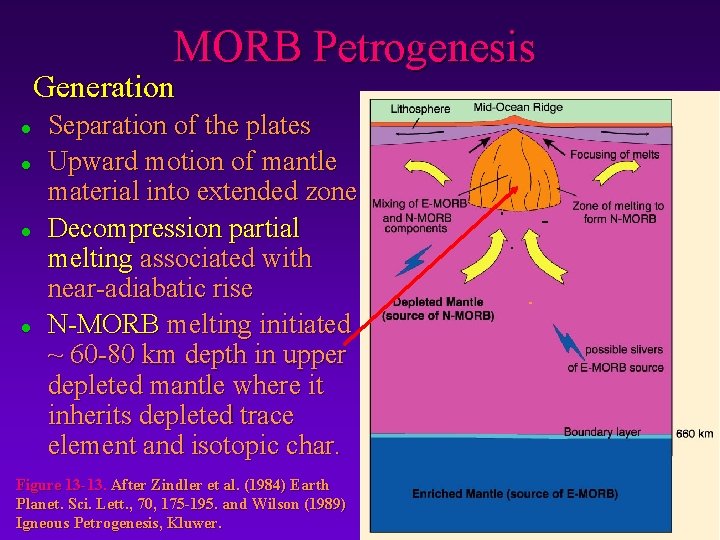
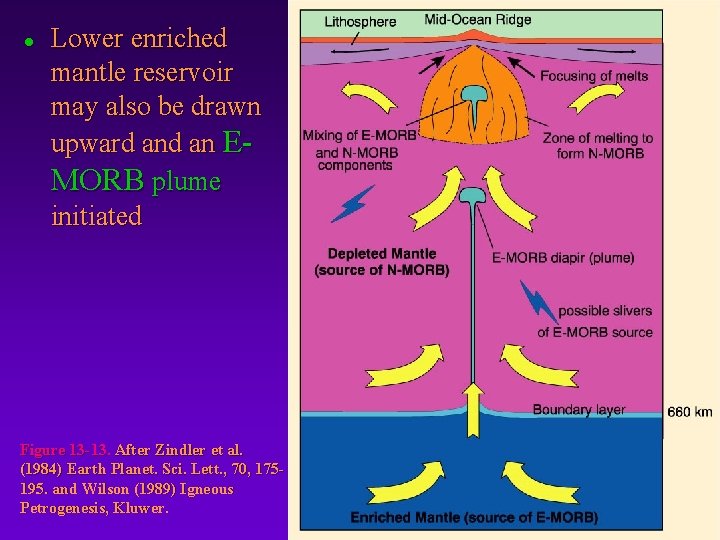
MORB Petrogenesis Generation l l Separation of the plates Upward motion of mantle material into extended zone Decompression partial melting associated with near-adiabatic rise N-MORB melting initiated ~ 60 -80 km depth in upper depleted mantle where it inherits depleted trace element and isotopic char. Figure 13 -13. After Zindler et al. (1984) Earth Planet. Sci. Lett. , 70, 175 -195. and Wilson (1989) Igneous Petrogenesis, Kluwer.
l Lower enriched mantle reservoir may also be drawn upward an EMORB plume initiated Figure 13 -13. After Zindler et al. (1984) Earth Planet. Sci. Lett. , 70, 175195. and Wilson (1989) Igneous Petrogenesis, Kluwer.