
Chapter 13 Lecture Outline Plant Names and Classification

- Slides: 20
Chapter 13 Lecture Outline Plant Names and Classification Copyright © The Mc. Graw-Hill Companies, Inc. Permission required for reproduction or display.
Outline v v Introduction Development of the Binomial System of Nomenclature • Linnaeus • The International Code of Botanical Nomenclature v Development of the Kingdom Concept v Classification of Major Groups v The Species Concept
Introduction v All living organisms given two-word Latin scientific name = species name. • Only one correct scientific name for a species. • Many common names may be given to same species. – Dicentra cucullaria - Many common names: Dutchman’s breeches, little-boy’s breeches, monkshood, boys-andgirls, soldier’s cap, white hearts, …, plus others in different languages • Or one common name may be applied to a number of different species. – Monkshood is common name for Dicentra cucullaria and for Aconitum species, which is in a different family.
Development of the Binomial System of Nomenclature v First attempt to organize and classify plants by Theophrastus in 4 th century B. C. • Classified nearly 500 plants by leaf characteristics v v 13 th century - Distinction made between monocots and dicots. Beginning of 18 th century - Details of fruit and flower structure, in addition to form and habit, used in classification schemes. • Latin phrase name given to plants and animals. – First word of phrase indicated genus (plural: genera).
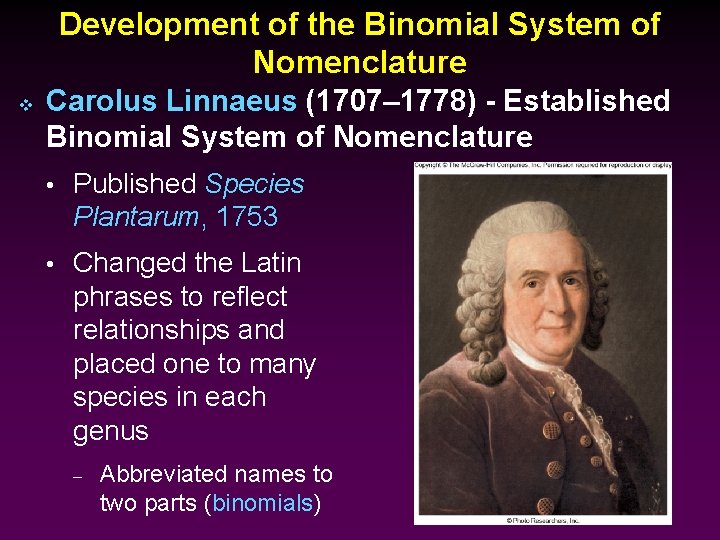
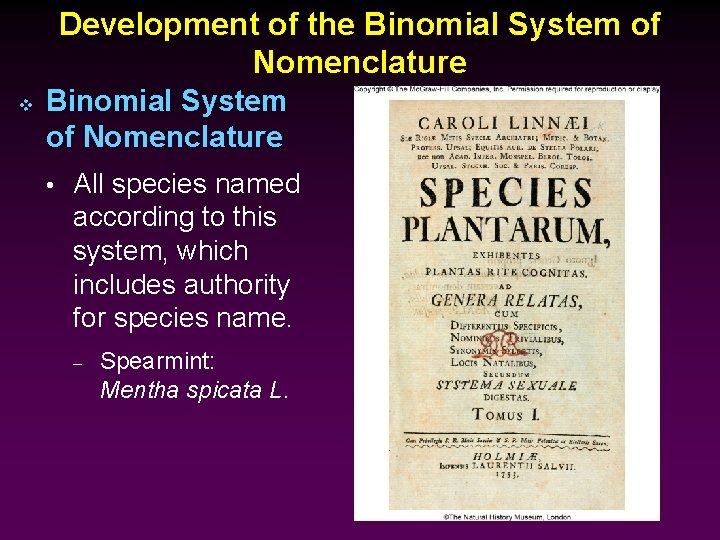
Development of the Binomial System of Nomenclature v Carolus Linnaeus (1707– 1778) - Established Binomial System of Nomenclature • Published Species Plantarum, 1753 • Changed the Latin phrases to reflect relationships and placed one to many species in each genus – Abbreviated names to two parts (binomials)
Development of the Binomial System of Nomenclature v Binomial System of Nomenclature • All species named according to this system, which includes authority for species name. – Spearmint: Mentha spicata L.
The International Code of Botanical Nomenclature v Book that standardizes rules governing the naming and classification of plants • Agreed that Linnaeus is starting point for names • Rules revised and expanded at periodic international botanical congresses. • Has English, French and German translations • Requires two steps to officially recognize new plant species: – Latin description of plant must be published in a journal or other publication. – Author must designate type specimen that is deposited in a herbarium.
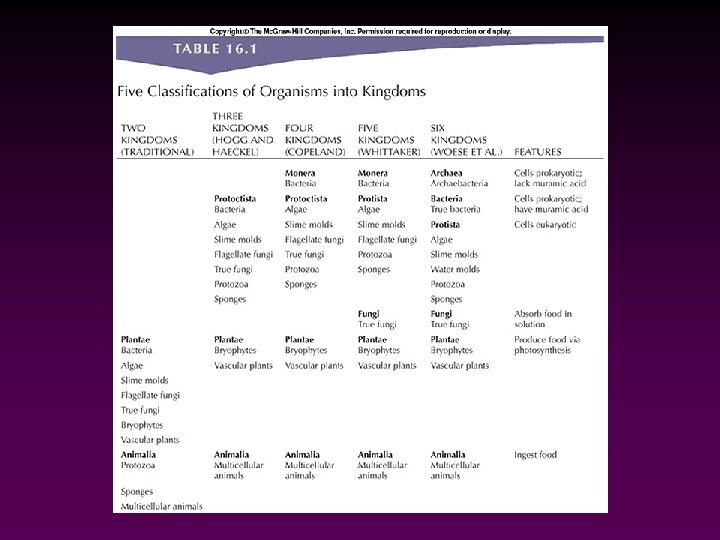
Development of the Kingdom Concept v When classification schemes first developed, organisms placed in either Plant Kingdom or Animal Kingdom. • The distinction works well for complex animals, but not for simpler organisms. v Hogg and Haeckel proposed a third kingdom in 1860’s. • All organisms that did not develop complex tissues were placed in Kingdom Protoctista.
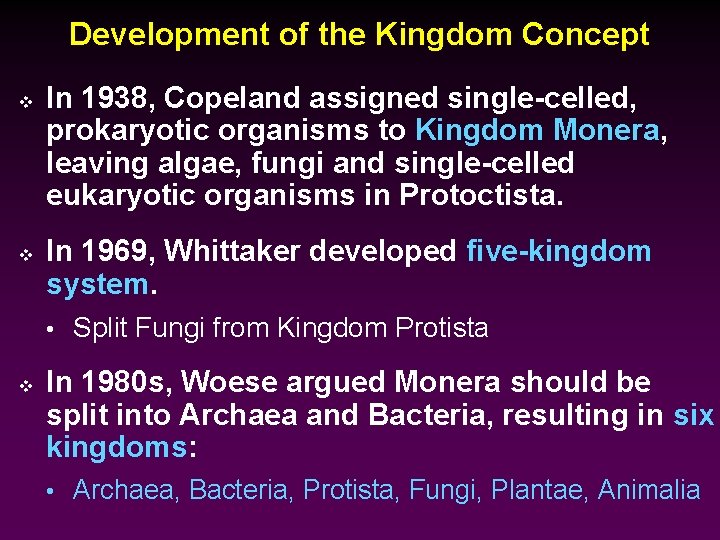
Development of the Kingdom Concept v v In 1938, Copeland assigned single-celled, prokaryotic organisms to Kingdom Monera, leaving algae, fungi and single-celled eukaryotic organisms in Protoctista. In 1969, Whittaker developed five-kingdom system. • Split Fungi from Kingdom Protista v In 1980 s, Woese argued Monera should be split into Archaea and Bacteria, resulting in six kingdoms: • Archaea, Bacteria, Protista, Fungi, Plantae, Animalia
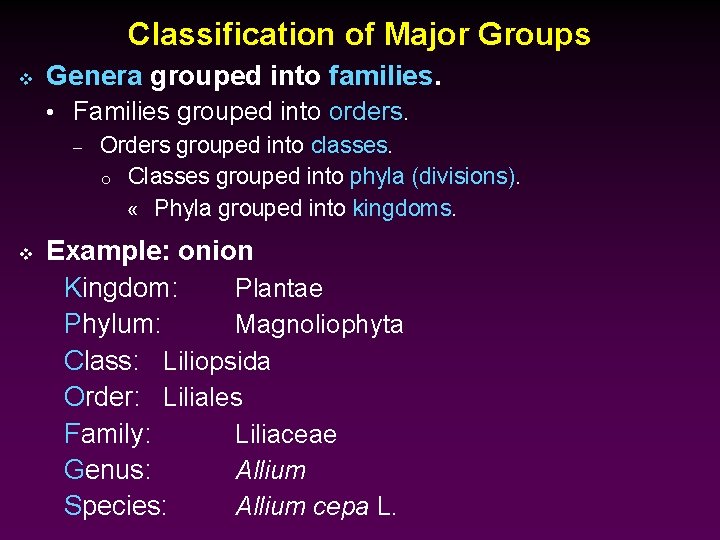
Classification of Major Groups v Genera grouped into families. • Families grouped into orders. – Orders grouped into classes. o Classes grouped into phyla (divisions). « Phyla grouped into kingdoms. v Example: onion Kingdom: Plantae Phylum: Magnoliophyta Class: Liliopsida Order: Liliales Family: Liliaceae Genus: Allium Species: Allium cepa L.
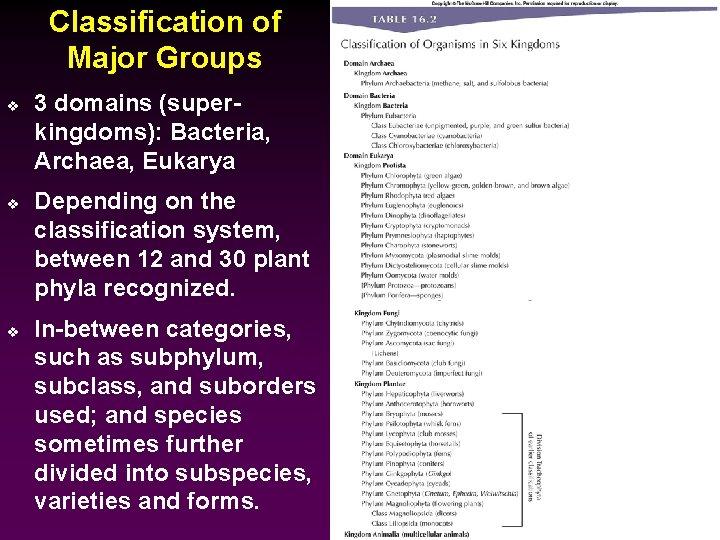
Classification of Major Groups v v v 3 domains (superkingdoms): Bacteria, Archaea, Eukarya Depending on the classification system, between 12 and 30 plant phyla recognized. In-between categories, such as subphylum, subclass, and suborders used; and species sometimes further divided into subspecies, varieties and forms.
Classification of Major Groups v Second part of species name = specific epithet. • Specific epithet followed by author(s) who named the plant. v v v Taxonomists specialize in identifying, naming, and classifying organisms. Systematists incorporate evolutionary processes to sort out natural relationships. Dichotomous keys help identify organisms. • Choose features from paired statements that most closely apply to organism
The Species Concept v v v Morphological species concept - A species is defined by morphology. Interbreeding species concept - A species is a population capable of interbreeding and is reproductively isolated from other groups. Ecological species concept - A species is a group of related individuals that occupy a unique ecological niche.
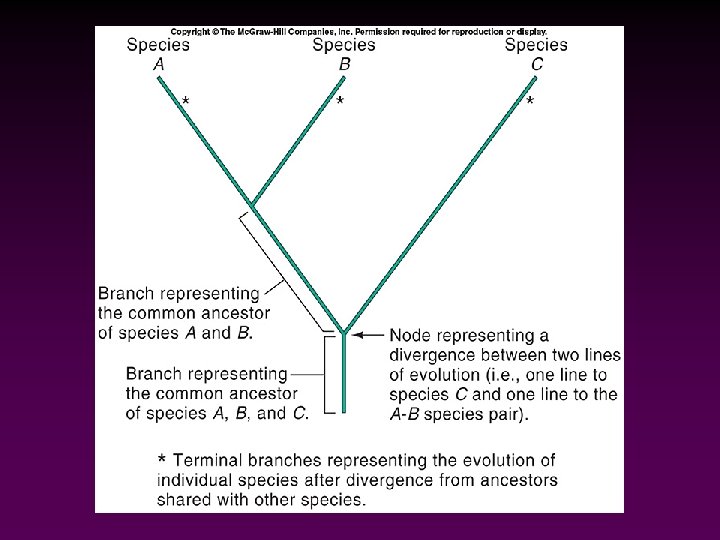
The Species Concept v Cladistic species concept - A species is determined by phylogenetic history. • Individuals with common evolutionary background considered to be a species. – Cladistic methods used to determine evolutionary history. o Examines natural relationships among organisms, based on shared features. o Relationships portrayed on cladograms. o The value or form of a feature referred to as a character state. o Hypotheses made about which state is ancestral.
The Species Concept v In trying to choose the best cladograms, taxonomists use principle of parsimony. • Occam’s razor - “One should not make more assumptions than the minimum needed to explain anything. ” v Best cladogram is interpreted as that which requires fewest evolutionary changes in taxa involved.
The Species Concept v Eclectic species concept - Single criterion not sufficient to identify species. • Morphological, geographical, biological and ecological criteria must be used when defining species. v Nominalistic species concept - Species do not exist. • Evolutionary unit of importance is local interbreeding population.
Review v v Introduction Development of the Binomial System of Nomenclature • Linnaeus • The International Code of Botanical Nomenclature v Development of the Kingdom Concept v Classification of Major Groups v The Species Concept