
Chapter 13 Lecture 1 Viruses Angelika Stollewerk Associate
- Slides: 36
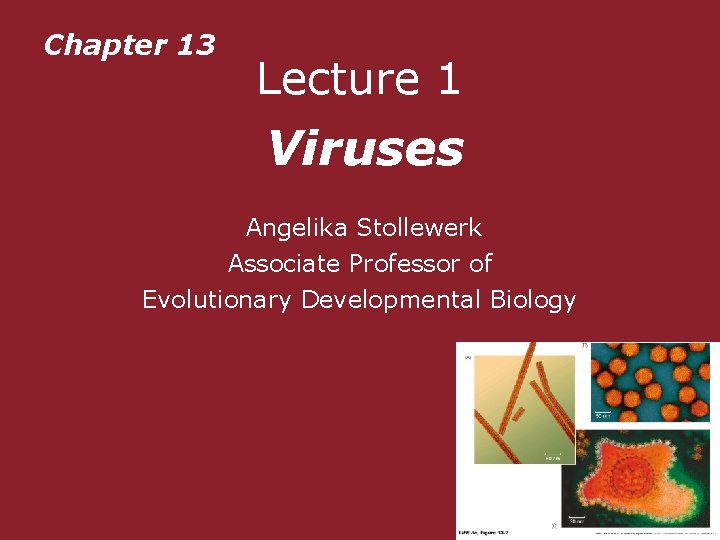
Chapter 13 Lecture 1 Viruses Angelika Stollewerk Associate Professor of Evolutionary Developmental Biology
Viruses Aims: • To appreciate the basic structure of viruses • To be able to discuss the reproduction of bacteriophages • To appreciate the differences in viruses in humans
Viruses Aims: • To appreciate the basic structure of viruses • To be able to discuss the reproduction of bacteriophages • To appreciate the differences in viruses in humans This lecture forms part of the knowledge required for learning outcome 2: Describe basic organism structure and diversity (LOC 2).
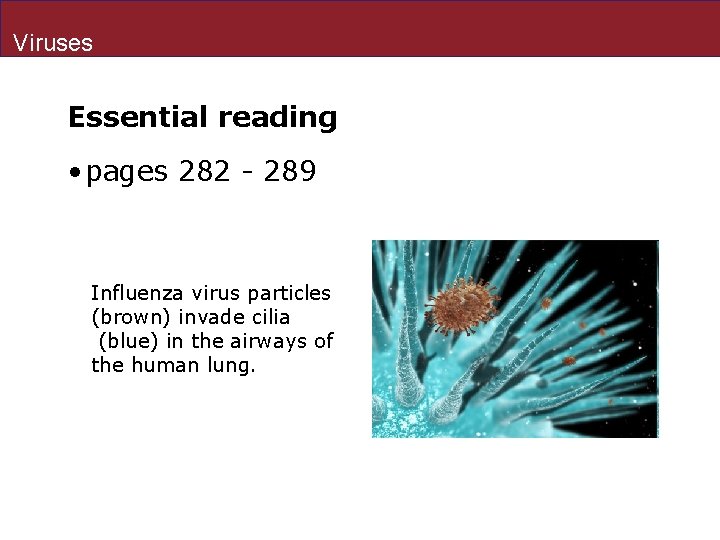
Viruses Essential reading • pages 282 - 289 Influenza virus particles (brown) invade cilia (blue) in the airways of the human lung.
13 The Genetics of Viruses and Prokaryotes • 13. 1 How Do Viruses Reproduce and Transmit Genes?
13. 1 How Do Viruses Reproduce and Transmit Genes? Prokaryotes and viruses make good model organisms: • Small genomes • Reproduce quickly • Usually haploid
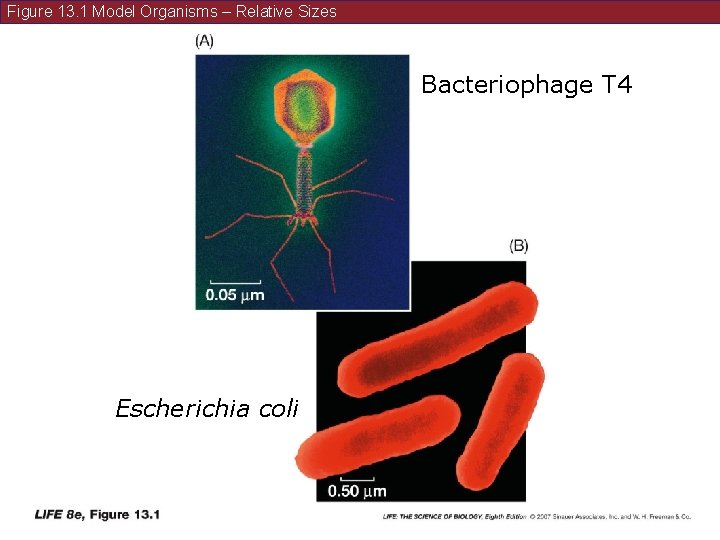
Figure 13. 1 Model Organisms – Relative Sizes Bacteriophage T 4 Escherichia coli
13. 1 How Do Viruses Reproduce and Transmit Genes? Viruses are acellular. Most are composed only of nucleic acids and some proteins. Viruses do not: • Regulate transport of materials into and out of themselves • Perform any metabolic functions
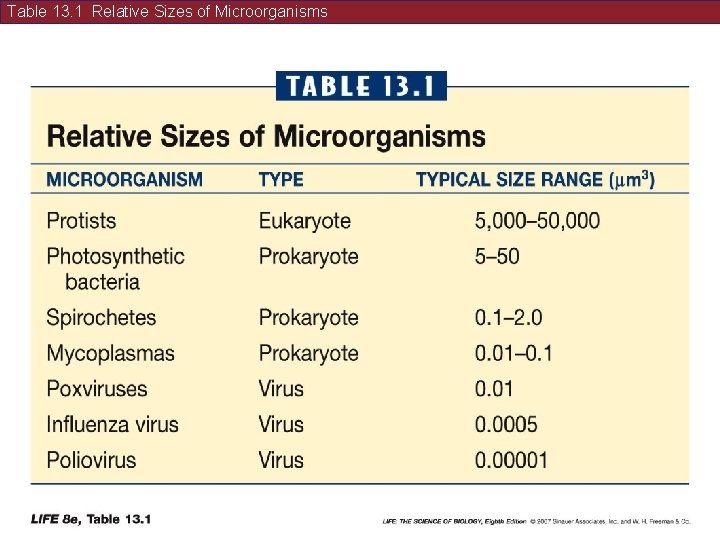
Table 13. 1 Relative Sizes of Microorganisms
13. 1 How Do Viruses Reproduce and Transmit Genes? The first virus was discovered in the 1890 s—it was an agent that causes tobacco mosaic disease. The “agent” could pass through a filter that retained bacteria, and could diffuse through an agar gel. The agent was crystallized in 1930 s.
13. 1 How Do Viruses Reproduce and Transmit Genes? Viruses are obligate intracellular parasites. They use the host cell’s DNA replication and protein synthesis machinery to reproduce themselves.
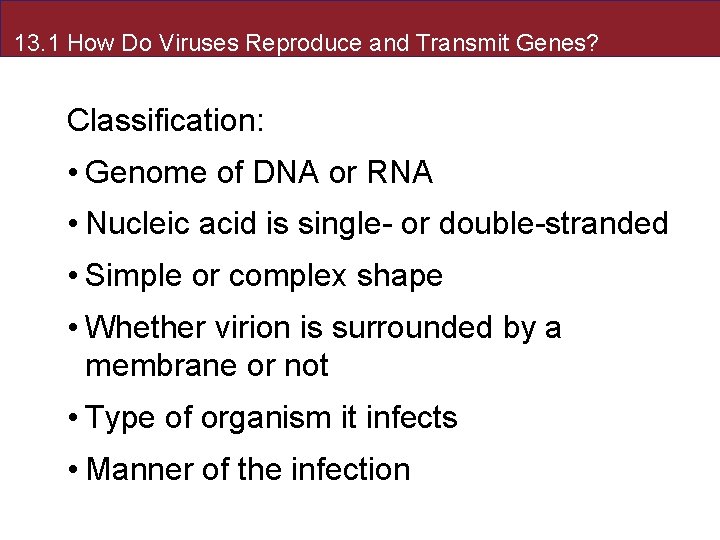
13. 1 How Do Viruses Reproduce and Transmit Genes? Viruses outside the host cell are called virions. They consist of a central core of DNA or RNA, surrounded by a capsid of proteins. Viruses are not affected by antibiotics that target bacterial cell walls or ribosomes.
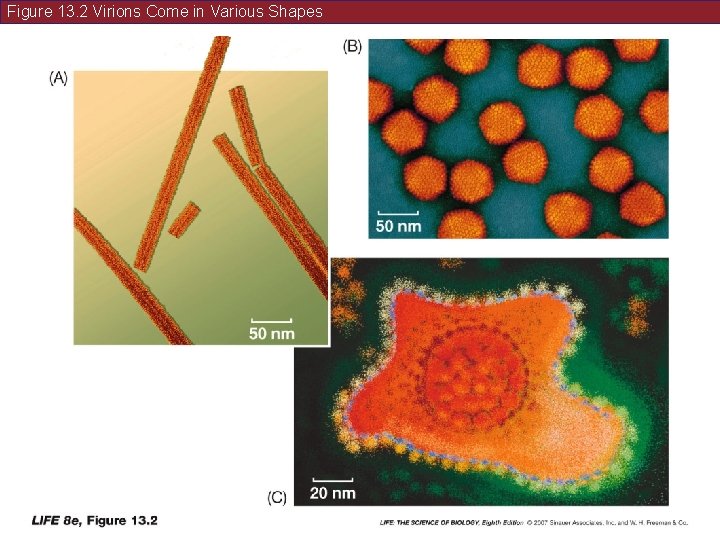
13. 1 How Do Viruses Reproduce and Transmit Genes? Classification: • Genome of DNA or RNA • Nucleic acid is single- or double-stranded • Simple or complex shape • Whether virion is surrounded by a membrane or not • Type of organism it infects • Manner of the infection
Figure 13. 2 Virions Come in Various Shapes
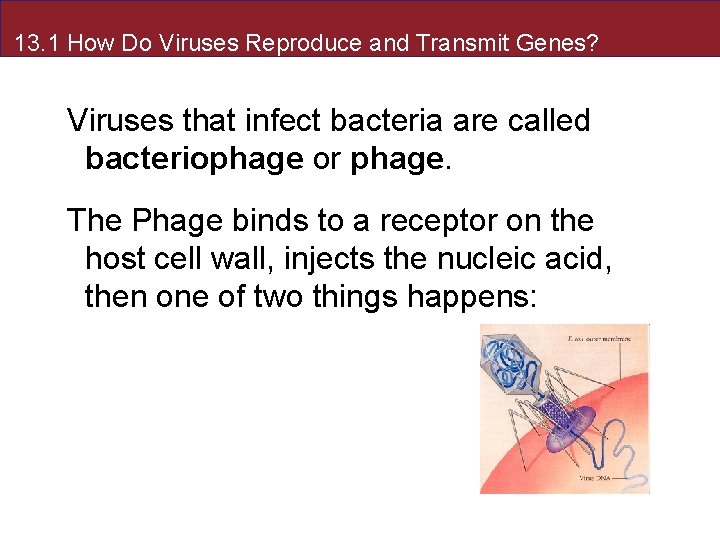
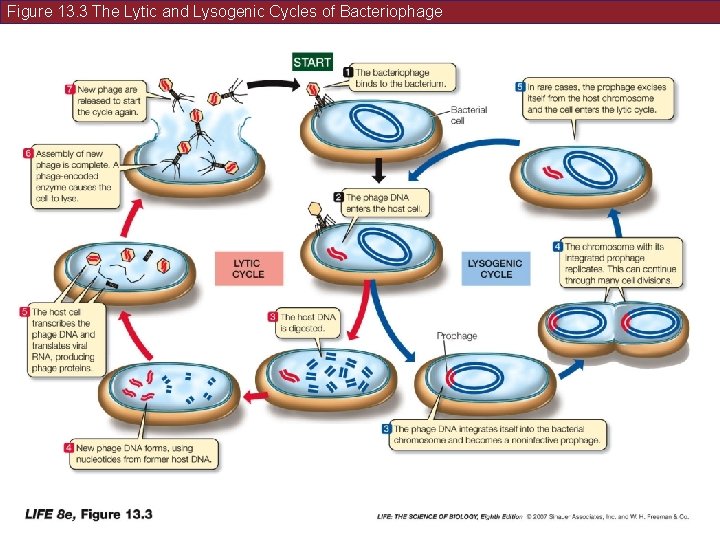
13. 1 How Do Viruses Reproduce and Transmit Genes? Viruses that infect bacteria are called bacteriophage or phage. The Phage binds to a receptor on the host cell wall, injects the nucleic acid, then one of two things happens:
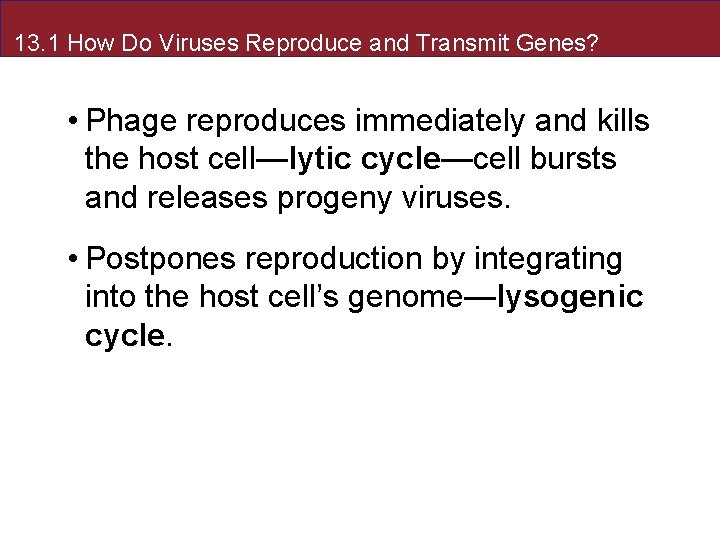
13. 1 How Do Viruses Reproduce and Transmit Genes? • Phage reproduces immediately and kills the host cell—lytic cycle—cell bursts and releases progeny viruses. • Postpones reproduction by integrating into the host cell’s genome—lysogenic cycle.
Figure 13. 3 The Lytic and Lysogenic Cycles of Bacteriophage
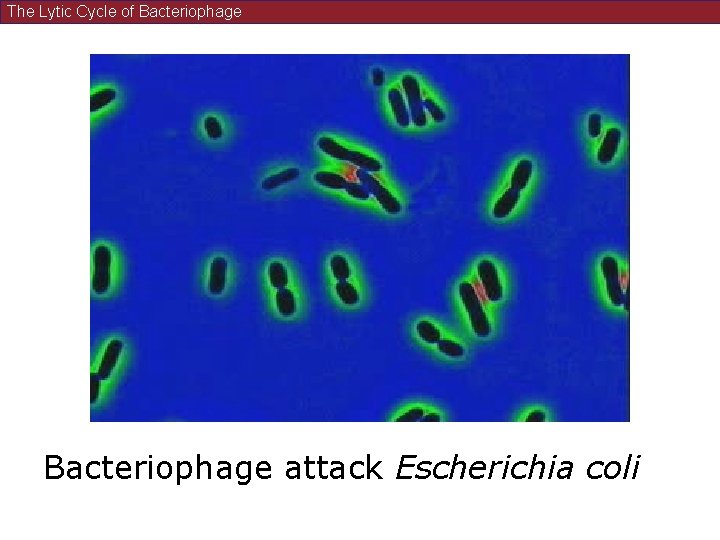
The Lytic Cycle of Bacteriophage attack Escherichia coli
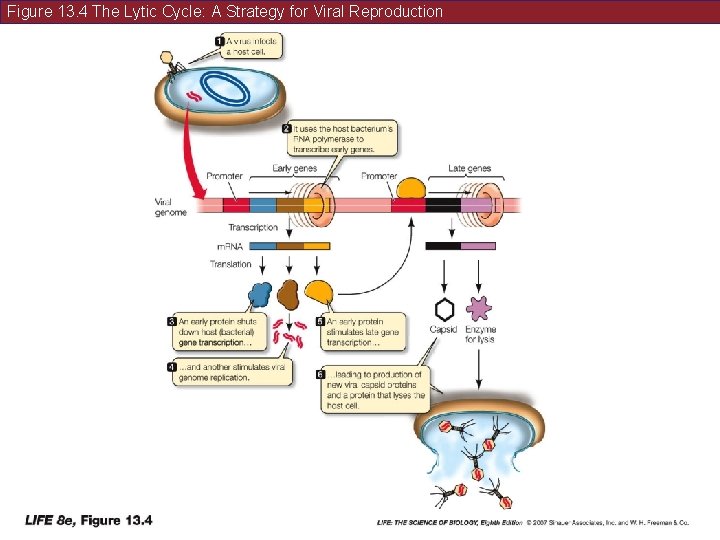
13. 1 How Do Viruses Reproduce and Transmit Genes? A virulent virus reproduces only by the lytic cycle. Early stage: The virus genome has a promoter that attracts host RNA polymerase. Viral genes adjacent to the promoter are transcribed. Products are proteins that shut down host transcription, stimulate viral transcription, and digest the host’s chromosomes to provide nucleotides.
13. 1 How Do Viruses Reproduce and Transmit Genes? Late stage: The viral genes that code for the capsid and proteins to lyse the host cell are transcribed. Sequence is controlled so that lysis does not occur prematurely.
Figure 13. 4 The Lytic Cycle: A Strategy for Viral Reproduction
13. 1 How Do Viruses Reproduce and Transmit Genes? Two viruses can infect one cell. With two different viral genomes in the same cell, there is the possibility of genetic recombination by crossing over— producing new strains.
13. 1 How Do Viruses Reproduce and Transmit Genes? Temperate viruses have a lysogenic cycle. Bacteria harboring them are called lysogenic bacteria. The viral genome is a prophage, incorporated into the bacterial genome. Activation results in phage entering the lytic cycle.
13. 1 How Do Viruses Reproduce and Transmit Genes? Bacteriophage have been tested as possible control agents for bacteriacaused diseases.
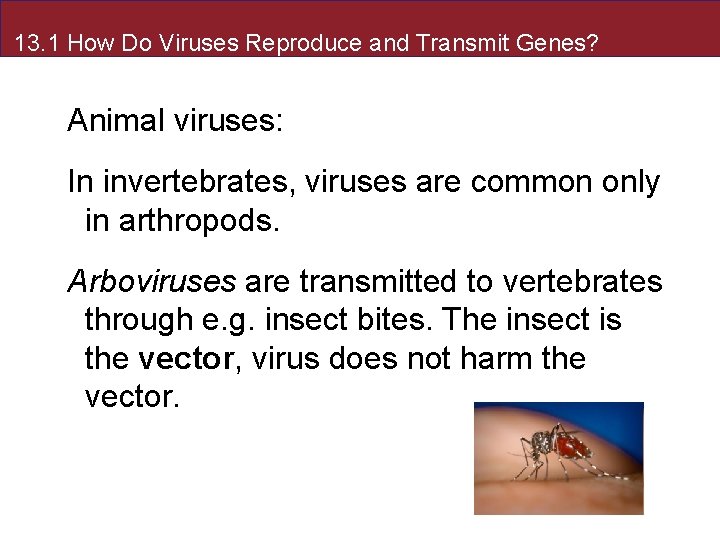
13. 1 How Do Viruses Reproduce and Transmit Genes? Animal viruses: In invertebrates, viruses are common only in arthropods. Arboviruses are transmitted to vertebrates through e. g. insect bites. The insect is the vector, virus does not harm the vector.
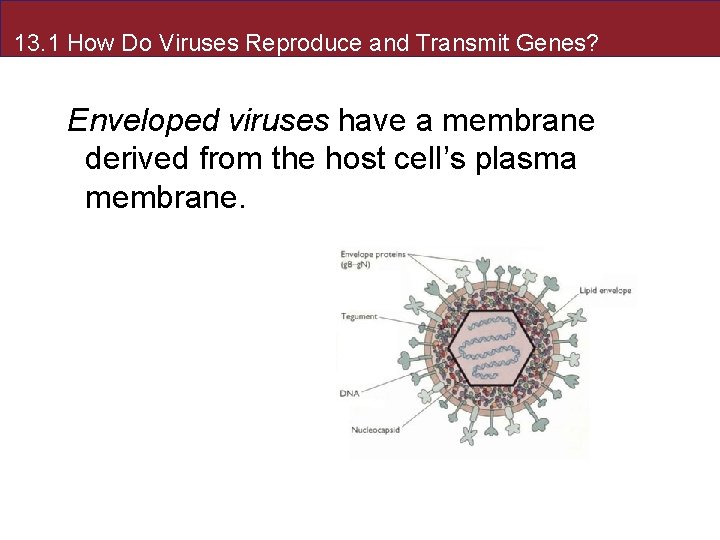
13. 1 How Do Viruses Reproduce and Transmit Genes? Enveloped viruses have a membrane derived from the host cell’s plasma membrane.
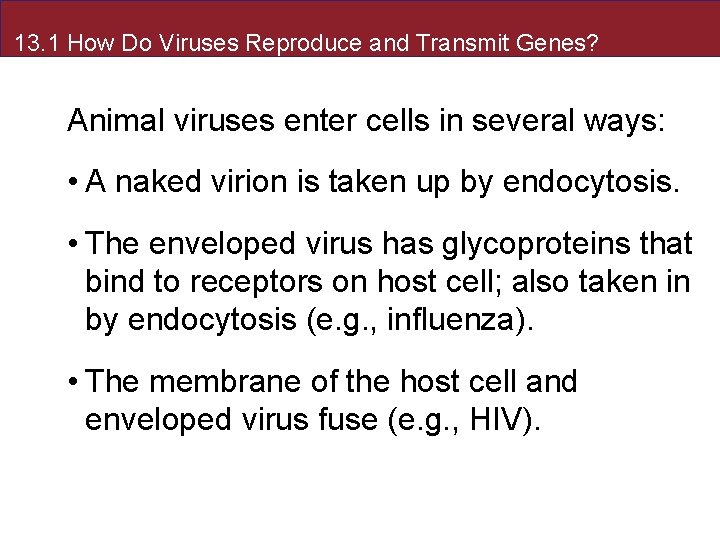
13. 1 How Do Viruses Reproduce and Transmit Genes? Animal viruses enter cells in several ways: • A naked virion is taken up by endocytosis. • The enveloped virus has glycoproteins that bind to receptors on host cell; also taken in by endocytosis (e. g. , influenza). • The membrane of the host cell and enveloped virus fuse (e. g. , HIV).
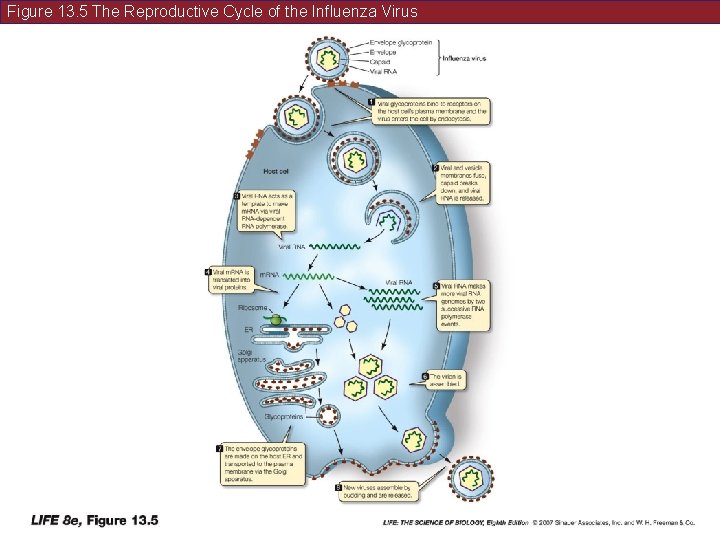
Figure 13. 5 The Reproductive Cycle of the Influenza Virus
13. 1 How Do Viruses Reproduce and Transmit Genes? After reproduction, enveloped viruses escape the cell by a budding process. An envelope is acquired from the host cell’s plasma membrane in the process.
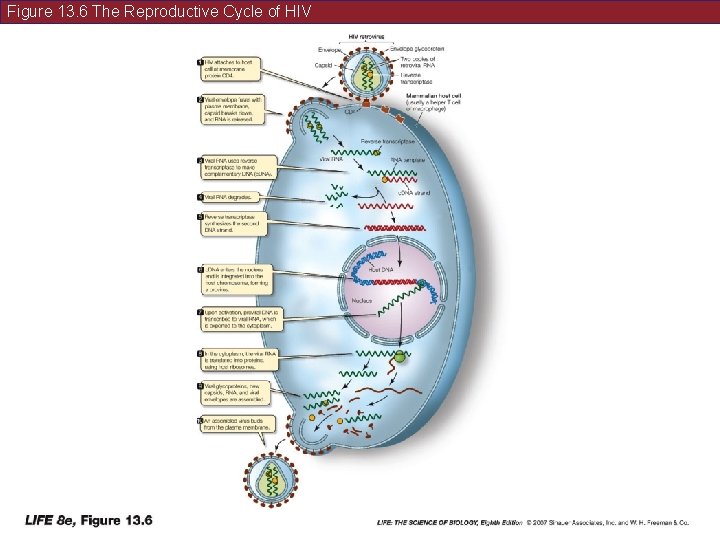
13. 1 How Do Viruses Reproduce and Transmit Genes? HIV is a retrovirus, it has reverse transcriptase, which transcribes RNA into DNA. A DNA provirus is produced that is integrated permanently into the host’s genome. When proviral DNA is activated, new virions are produced.
Figure 13. 6 The Reproductive Cycle of HIV
13. 1 How Do Viruses Reproduce and Transmit Genes? Plant viruses may be passed horizontally, from one plant to another. Or vertically, from parent to offspring. Virus must pass cell wall and plasma membrane—usually associated with vectors, often insects. In the plant, viruses may spread through the plasmodesmata.
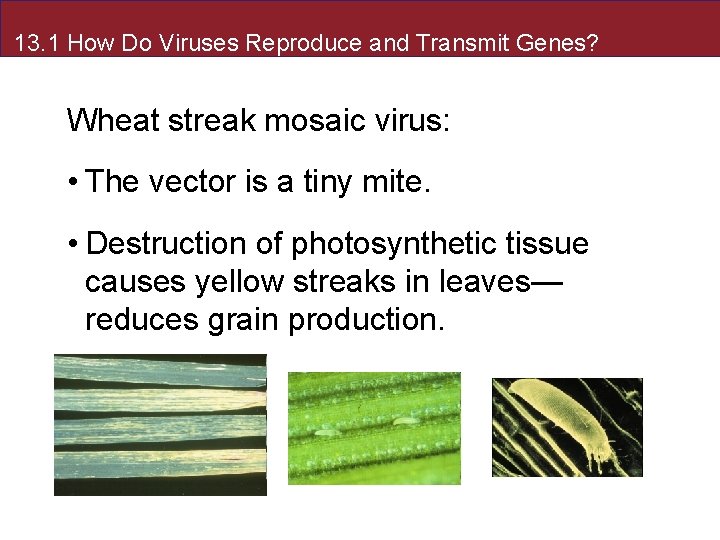
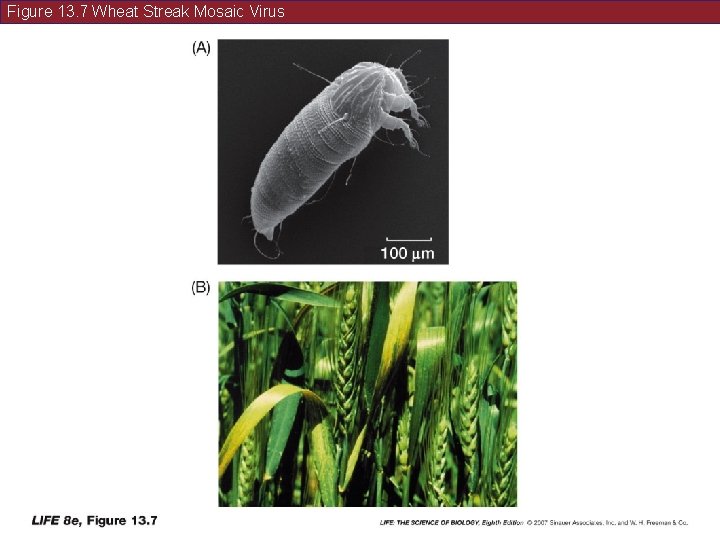
13. 1 How Do Viruses Reproduce and Transmit Genes? Wheat streak mosaic virus: • The vector is a tiny mite. • Destruction of photosynthetic tissue causes yellow streaks in leaves— reduces grain production.
Figure 13. 7 Wheat Streak Mosaic Virus
Viruses Check out 8 th editon: 13. 1 Recap, page 289 13. 1 Chapter summary, page 303 Check out 10 th edition: 26. 4 Recap, pages 543 -548 Self-Quiz (8 th edition) Page 304: questions 2 & 3 For Discussion (8 th edition) Page 305: questions 1 & 2
Viruses Key terms: Acellular (non-cellular), adenovirus, bacteriophage (phage), capsid, intracellular, lysis, lysogenic cycle, lytic cycle, methanogen, obligate, parasites, prophage, provirus, replication, retrovirus, reverse transcriptase, temperate virus, vector, virion, virulence, virus (viruses)