
Chapter 13 Leadership Power Point Presentation by Charlie
Chapter 13 Leadership Power. Point Presentation by Charlie Cook © Copyright The Mc. Graw-Hill Companies, Inc. , 2003. All rights reserved.
Learning Objectives • After studying the chapter, you should be able to: ØDescribe what leadership is, when leaders are effective and ineffective, and the sources of power that enable managers to be effective leaders. ØIdentify the traits that show the strongest relationship to leadership, the behaviors leaders engage in, and the limitations of the trait and behavioral models of leadership. ØExplain how contingency models of leadership enhance our understanding of effective leadership and management in organizations. © Copyright Mc. Graw-Hill. All rights reserved. 2
Learning Objectives (cont’d) ØDescribe what transformational leadership is, and explain how managers can engage in it. ØCharacterize the relationship between gender leadership. © Copyright Mc. Graw-Hill. All rights reserved. 3
Chapter Outline • The Nature of Leadership ØPersonal Leadership Style and Managerial Tasks ØLeadership Styles Across Cultures ØPower: The Key to Leadership ØEmpowerment: An Ingredient in Modern Management • Trait and Behavior Models of Leadership ØThe Trait Model ØThe Behavior Model © Copyright Mc. Graw-Hill. All rights reserved. 4
Chapter Outline (cont’d) • Contingency Models of Leadership ØFiedler’s Contingency Model ØHouse’s Path-Goal Theory ØThe Leader Substitutes ØBringing It All Together • Transformational Leadership ØBeing a Charismatic Leader ØStimulating Subordinates Intellectually ØEngaging in Developmental Considerations ØDistinction Between Transformational and Transactional Leadership © Copyright Mc. Graw-Hill. All rights reserved. 5
Chapter Outline (cont’d) • Transformational Leadership (cont’d) ØDistinction Between Transformational and Transactional Leadership • Gender and Leadership • Emotional Intelligence and Leadership © Copyright Mc. Graw-Hill. All rights reserved. 6
The Nature of Leadership • Leadership ØThe process by which a person exerts influence over others and inspires, motivates and directs their activities to achieve group or organizational goals. • Effective leadership increases the firm’s ability to meet new challenges. • Leader ØAn individual who is able to exert influence over other people to help achieve group or organizational goals © Copyright Mc. Graw-Hill. All rights reserved. 7
The Nature of Leadership • Personal Leadership Style ØThe specific ways in which a manager chooses to influence others shapes the way that manager approaches the other tasks of management. • Leaders may delegate and support subordinates, while others are very authoritarian. ØThe challenge is for managers at all levels to develop an effective personal management style. © Copyright Mc. Graw-Hill. All rights reserved. 8
Leadership Across Cultures • Leadership styles may vary among different countries or cultures. ØEuropean managers tend to be more peopleoriented than American or Japanese managers. ØJapanese managers are group-oriented, while U. S managers focuses more on profitability. ØTime horizons also are affected by cultures. • U. S. firms often focus on short-run efforts and results. • Japanese firms have a longer-run perspective. • European firms fall somewhere between the U. S. and Japanese orientations. © Copyright Mc. Graw-Hill. All rights reserved. 9

Sources of Managerial Power © Copyright Mc. Graw-Hill. All rights reserved. Figure 13. 1 10

Power: The Key to Leadership • Legitimate Power ØThe authority that a manager has by virtue of his or her position in the firm. • Example: the power to hire or fire employees. • Reward Power ØThe ability of a manager to give or withhold tangible and intangible rewards. • Example: awarding pay raises or providing verbal praise for good performance. ØEffective managers use reward power to signal to employees that they are doing a good job. © Copyright Mc. Graw-Hill. All rights reserved. 11

Power: The Key to Leadership (cont’d) • Coercive Power ØThe ability of a manager to punish others. • Examples: verbal reprimand, pay cuts, and dismissal • Limited in effectiveness and application; can have serious negative side effects. • Expert Power ØPower that is based on special knowledge, skills, and expertise that the leader possesses. • First-line and middle managers have the most expert power; most often consists of technical ability. © Copyright Mc. Graw-Hill. All rights reserved. 12
Power: The Key to Leadership (cont’d) • Referent Power ØPower that comes from subordinates’ and coworkers’ respect for the personal characteristics of a leader which earns their loyalty and admiration. ØUsually held by and available for use by likable managers who are concerned about their workers. © Copyright Mc. Graw-Hill. All rights reserved. 13
Empowerment: An Ingredient in Modern Management • Empowerment ØThe process of giving workers at all levels more authority to make decisions and the responsibility for their outcomes. ØEmpowerment helps managers: • Get workers involved in the decisions. • Increase worker commitment and motivation. • Have time to focus on other issues. • Effective managers usually empower substantial authority to workers. © Copyright Mc. Graw-Hill. All rights reserved. 14
Leadership Models • Trait Model ØAttempted to identify personal characteristics that cause for effective leadership. • Research shows that certain personal “traits” do appear to be connected to effective leadership. • Many “traits” are the result of skills and knowledge and effective leaders do not necessarily possess all of these traits. © Copyright Mc. Graw-Hill. All rights reserved. 15
Leadership Models (cont’d) • Behavioral Model ØIdentifies the two basic types of behavior that many leaders engaged in to influence their subordinates: • Consideration: employee-centered leadership behavior indicating that a manager trusts, respects, and cares about subordinates • Initiating structure: job-oriented leadership behavior that managers engage in to ensure that work gets done, subordinates perform their jobs acceptably, and the organization is efficient and effective. • Both behaviors are independent; managers can be high or low on both behaviors. © Copyright Mc. Graw-Hill. All rights reserved. 16
Contingency Models of Leadership • Fiedler’s Model ØEffective leadership is contingent on both the characteristics of the leader and of the situation. ØLeader style is the enduring, characteristic approach to leadership that a manager uses and does not readily change. • Relationship-oriented style: leaders concerned with developing good relations with their subordinates and to be liked by them. • Task-oriented style: leaders whose primary concern is to ensure that subordinates perform at a high level so the job gets done. © Copyright Mc. Graw-Hill. All rights reserved. 17
Fiedler’s Model • Situation Characteristics ØHow favorable a situation is for leading to occur. ØLeader-member relations—determines how much workers like and trust their leader. ØTask structure—the extent to which workers tasks are clear-cut; clear issues make a situation favorable for leadership. ØPosition Power—the amount of legitimate, reward, and coercive power leaders have due to their position. When positional power is strong, leadership opportunity becomes more favorable. © Copyright Mc. Graw-Hill. All rights reserved. 18
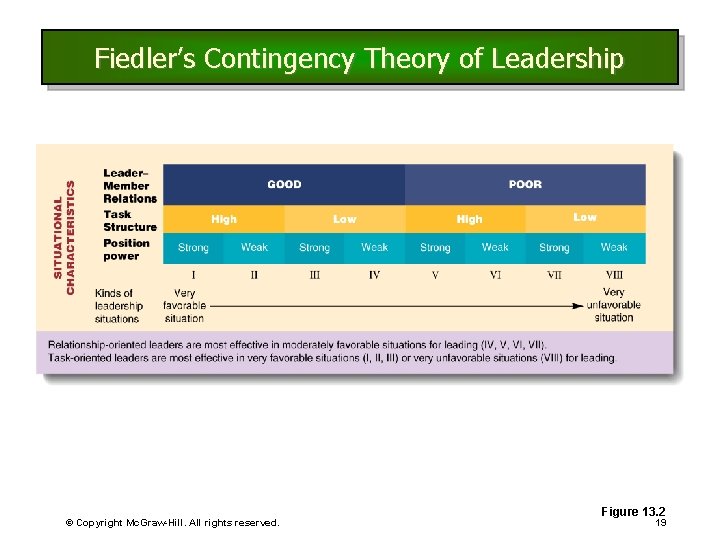
Fiedler’s Contingency Theory of Leadership © Copyright Mc. Graw-Hill. All rights reserved. Figure 13. 2 19
Fiedler’s Model in Application • Combines considerations of leader-member relations, task structure, and position power to identify leadership situations. ØIdentifies situations where given types of managers might perform best. ØLeader style is a characteristic managers cannot change; managers will be most effective when: • they are placed in situations that suit their leader style. • the situation can be changed to fit the manager’s leader style. © Copyright Mc. Graw-Hill. All rights reserved. 20
House’s Path-Goal Theory • A contingency model of leadership proposing the effective leaders can motivate subordinates by: 1. Clearly identifying the outcomes workers are trying to obtain from their jobs. 2. Rewarding workers for high-performance and goal attainment with the outcomes they desire 3. Clarifying the paths to the attainment of the goals, remove obstacles to performance, and express confidence in worker’s ability. © Copyright Mc. Graw-Hill. All rights reserved. 21
Motivating with Path-Goal • Path-Goal identifies four leadership behaviors: ØDirective behaviors: set goals, assign tasks, show to do things. ØSupportive behavior: look out for the worker’s best interest. ØParticipative behavior: give subordinates a say in matters that affect them. ØAchievement-oriented behavior: Setting very challenging goals, believing in worker’s abilities. • Which behavior to be used depends on the nature of the subordinates and the tasks. © Copyright Mc. Graw-Hill. All rights reserved. 22
The Leader Substitutes Model • Leadership Substitute ØActs in the place of a leader and makes leadership unnecessary. Possible substitutes can be found in: • Characteristics of the subordinates: their skills, experience, motivation. • Characteristics of context: the extent to which work is interesting and fun. ØWorker empowerment or self-managed work teams reduce leadership needs. ØManagers should be aware that they do not always need to directly exert influence over workers. © Copyright Mc. Graw-Hill. All rights reserved. 23
Transformational Leadership • Leadership that: ØMakes subordinates aware of the importance of their jobs and performance to the organization by providing feedback to the worker. ØMakes subordinates aware of their own needs for personal growth and development. ØMotivates workers to work for the good of the organization, not just themselves. © Copyright Mc. Graw-Hill. All rights reserved. 24
Being a Charismatic Leader • Charismatic Leader ØAn enthusiastic, self-confident transformational leader able to clearly communicate his or her vision of how good things could be by: • Being excited and clearly communicating excitement to subordinates. • Openly sharing information with employees so that everyone is aware of problems and the need for change. • Empowering workers to help with solutions. • Engaging in the development of employees by working hard to help them build skills. © Copyright Mc. Graw-Hill. All rights reserved. 25
Transactional Leadership • Transactional Leaders ØUse their reward and coercive powers to encourage high performance—they exchange rewards for performance and punish failure. ØPush subordinates to change but do not seem to change themselves. ØDo not have the “vision” of the transformational leader. © Copyright Mc. Graw-Hill. All rights reserved. 26
Gender and Leadership • The number of women managers is rising but is still relatively low in the top levels of management. ØStereotypes suggest women are supportive and concerned with interpersonal relations. Similarly, men are seen as task-focused. • Research indicates that actually there is no genderbased difference in leadership effectiveness. • Women are seen to be more participative than men because they adopt the participative approach to overcome subordinate resistance to them as managers and they have better interpersonal skills. © Copyright Mc. Graw-Hill. All rights reserved. 27
Emotional Intelligence and Leadership • The Moods of Leaders: ØAffect their behavior and effectiveness as leaders. ØAffect the performance of their subordinates. • Emotional Intelligence ØHelps leaders develop a vision for their firm. ØHelps motivate subordinates to commit to the vision. ØEnergizes subordinates to work to achieve the vision. © Copyright Mc. Graw-Hill. All rights reserved. 28
- Slides: 28