
Chapter 13 Inheritance Animated Version The Mc GrawHill


- Slides: 43
Chapter 13 Inheritance Animated Version ©The Mc. Graw-Hill Companies, Inc. Permission required for reproduction or display. Chapter 13 - 1
Learning Objectives • After you have read and studied this chapter, you should be able to – Describe the nature of inheritance – Explain the benefits of inheritance – Define reusable classes based on inheritance, abstract classes and abstract methods. – Differentiate the abstract classes and Java interfaces. – Define methods, using the protected modifier. ©The Mc. Graw-Hill Companies, Inc. Permission required for reproduction or display. Chapter 13 - 2
Definition of Inheritance • Inheritance : – deriving a new class from an existing class. • The existing class is called a superclass or parent. • The derived class is called a subclass or child. • The subclass inherits all the fields and methods available in the superclass. – **Exception: Constructors are NOT inherited, but can be invoked from the subclass. ©The Mc. Graw-Hill Companies, Inc. Permission required for reproduction or display. Chapter 13 - 3
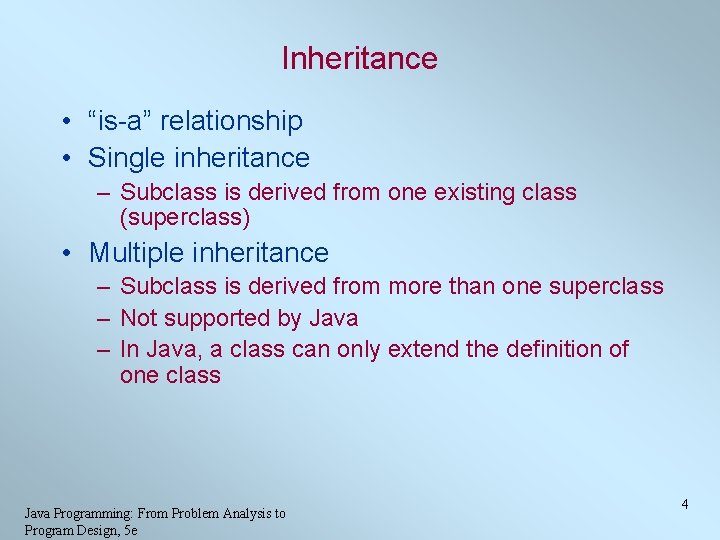
Inheritance • “is-a” relationship • Single inheritance – Subclass is derived from one existing class (superclass) • Multiple inheritance – Subclass is derived from more than one superclass – Not supported by Java – In Java, a class can only extend the definition of one class Java Programming: From Problem Analysis to Program Design, 5 e 4
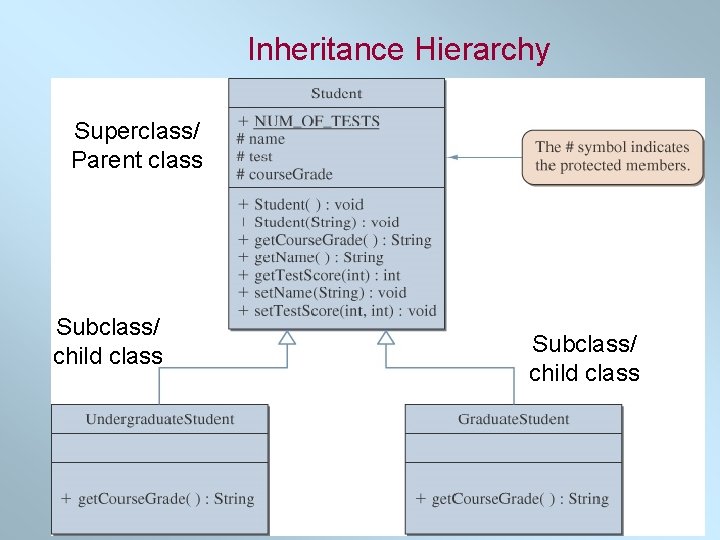
Inheritance Hierarchy Superclass/ Parent class Subclass/ child class
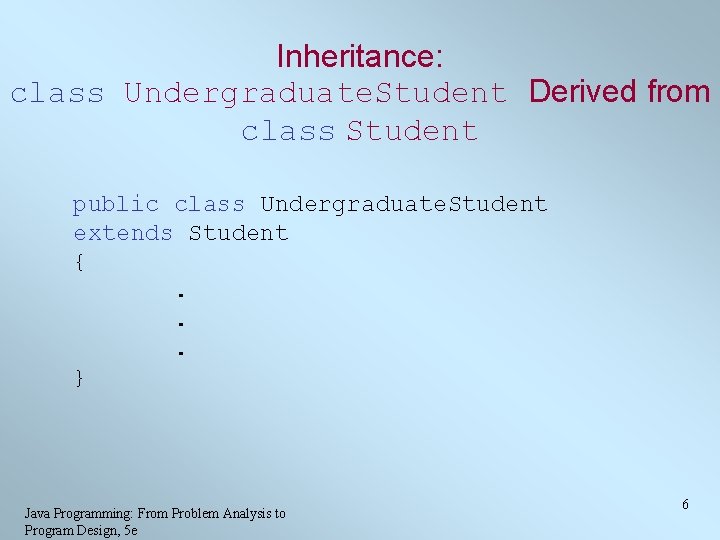
Inheritance: class Undergraduate. Student Derived from class Student public class Undergraduate. Student extends Student {. . . } Java Programming: From Problem Analysis to Program Design, 5 e 6
Modeling Two Types of Students • There are two ways to design the classes to model undergraduate and graduate students. – We can define two unrelated classes, one for undergraduates and one for graduates. – We can model the two kinds of students by using classes that are related in an inheritance hierarchy. • Two classes are unrelated if they are not connected in an inheritance relationship. ©The Mc. Graw-Hill Companies, Inc. Permission required for reproduction or display. Chapter 13 - 7
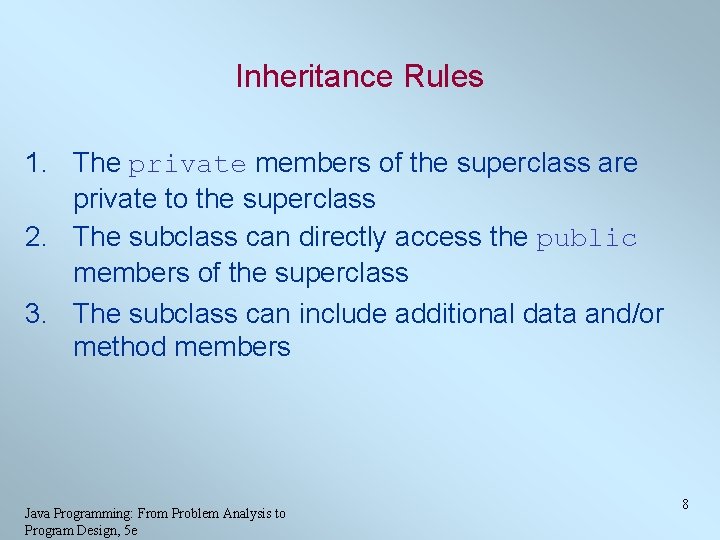
Inheritance Rules 1. The private members of the superclass are private to the superclass 2. The subclass can directly access the public members of the superclass 3. The subclass can include additional data and/or method members Java Programming: From Problem Analysis to Program Design, 5 e 8
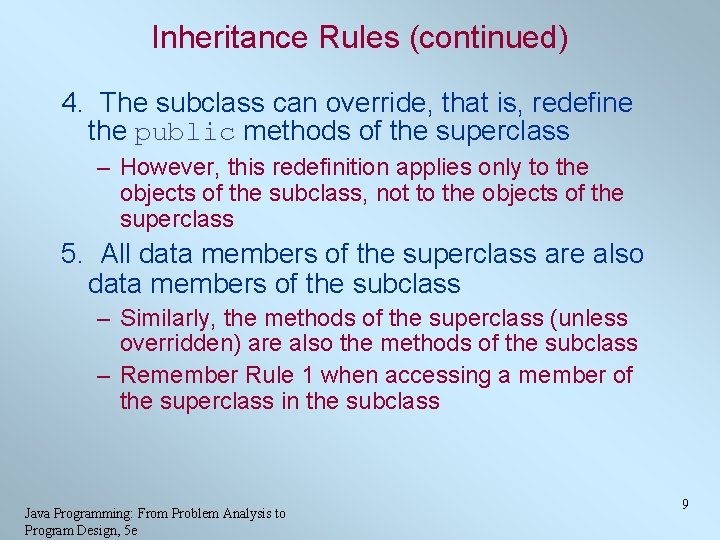
Inheritance Rules (continued) 4. The subclass can override, that is, redefine the public methods of the superclass – However, this redefinition applies only to the objects of the subclass, not to the objects of the superclass 5. All data members of the superclass are also data members of the subclass – Similarly, the methods of the superclass (unless overridden) are also the methods of the subclass – Remember Rule 1 when accessing a member of the superclass in the subclass Java Programming: From Problem Analysis to Program Design, 5 e 9
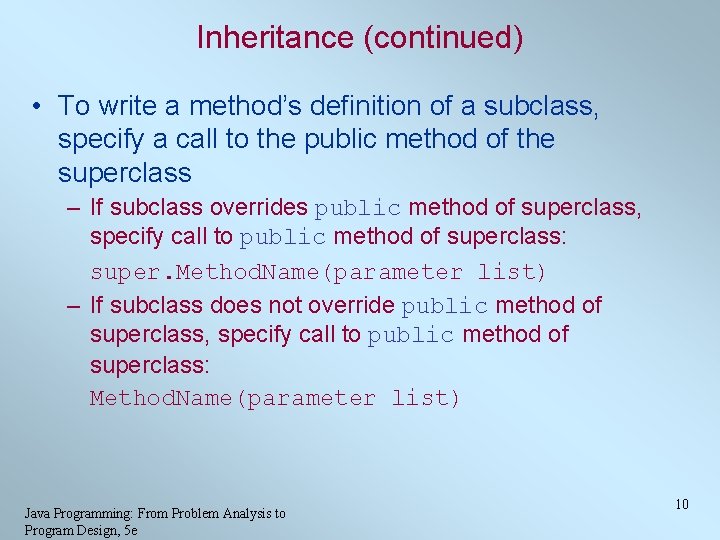
Inheritance (continued) • To write a method’s definition of a subclass, specify a call to the public method of the superclass – If subclass overrides public method of superclass, specify call to public method of superclass: super. Method. Name(parameter list) – If subclass does not override public method of superclass, specify call to public method of superclass: Method. Name(parameter list) Java Programming: From Problem Analysis to Program Design, 5 e 10
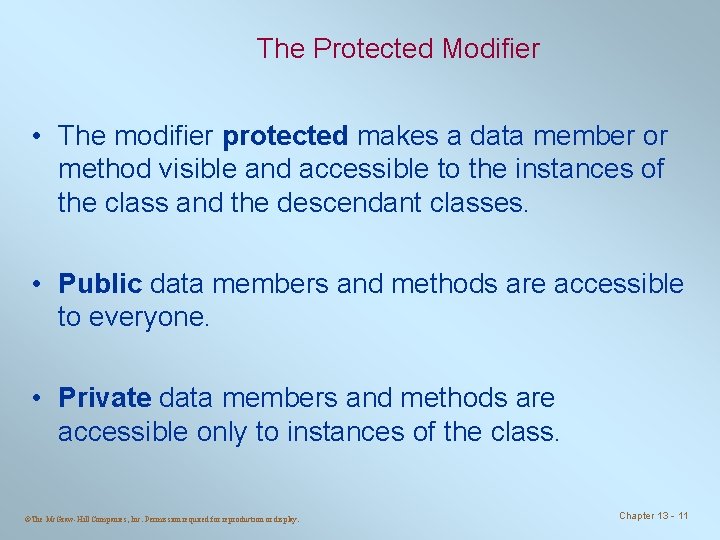
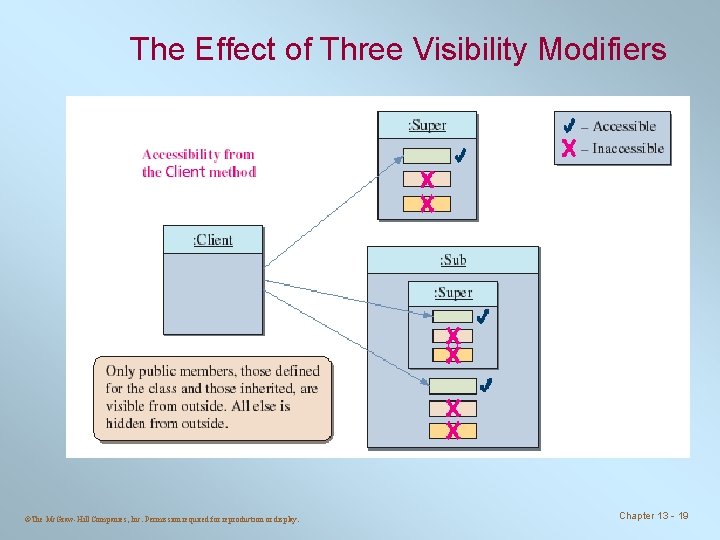
The Protected Modifier • The modifier protected makes a data member or method visible and accessible to the instances of the class and the descendant classes. • Public data members and methods are accessible to everyone. • Private data members and methods are accessible only to instances of the class. ©The Mc. Graw-Hill Companies, Inc. Permission required for reproduction or display. Chapter 13 - 11
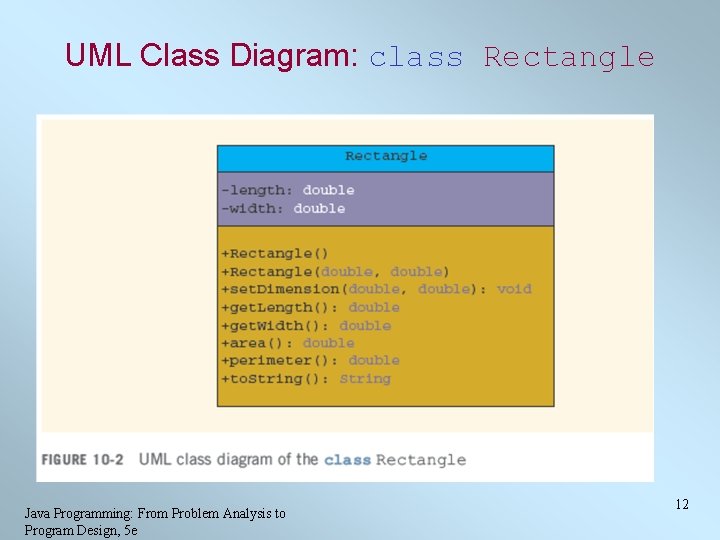
UML Class Diagram: class Rectangle Java Programming: From Problem Analysis to Program Design, 5 e 12
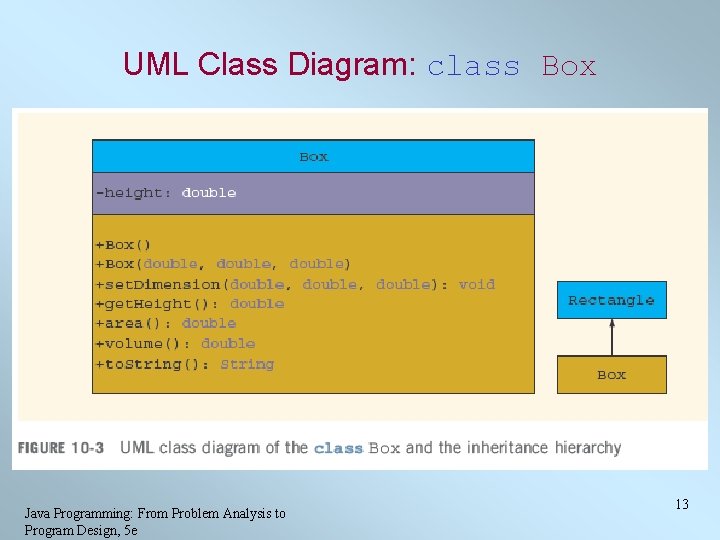
UML Class Diagram: class Box Java Programming: From Problem Analysis to Program Design, 5 e 13
class Box public String to. String() { return super. to. String() //retrieve length and width + "; Height = " + height; } public void set. Dimension(double l, double w, double h) { super. set. Dimension(l, w); if (h >= 0) height = h; else height = 0; } public double area() { return 2 * (get. Length() * get. Width() + get. Length() * height + get. Width() * height); } Java Programming: From Problem Analysis to Program Design, 5 e 14
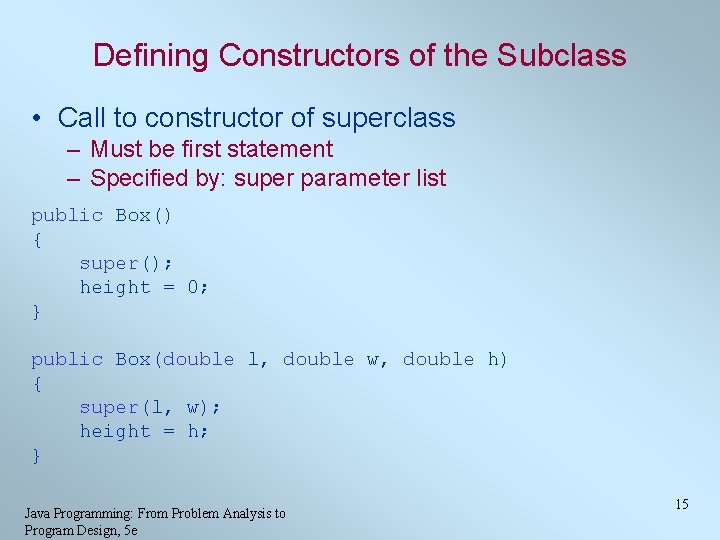
Defining Constructors of the Subclass • Call to constructor of superclass – Must be first statement – Specified by: super parameter list public Box() { super(); height = 0; } public Box(double l, double w, double h) { super(l, w); height = h; } Java Programming: From Problem Analysis to Program Design, 5 e 15
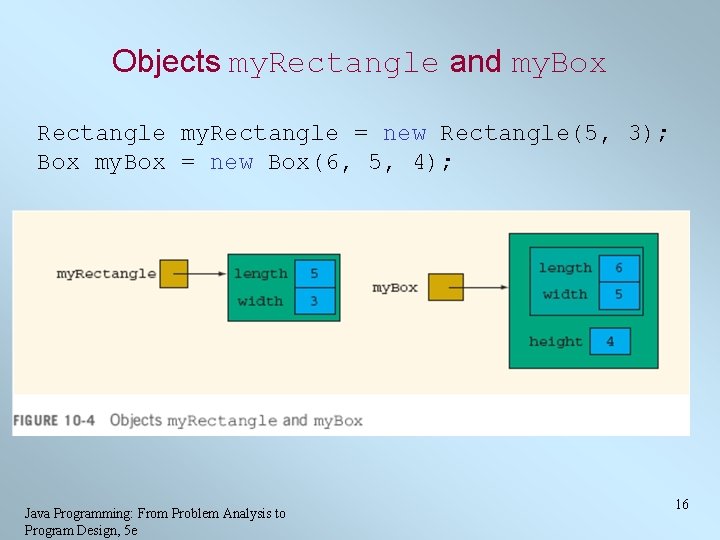
Objects my. Rectangle and my. Box Rectangle my. Rectangle = new Rectangle(5, 3); Box my. Box = new Box(6, 5, 4); Java Programming: From Problem Analysis to Program Design, 5 e 16
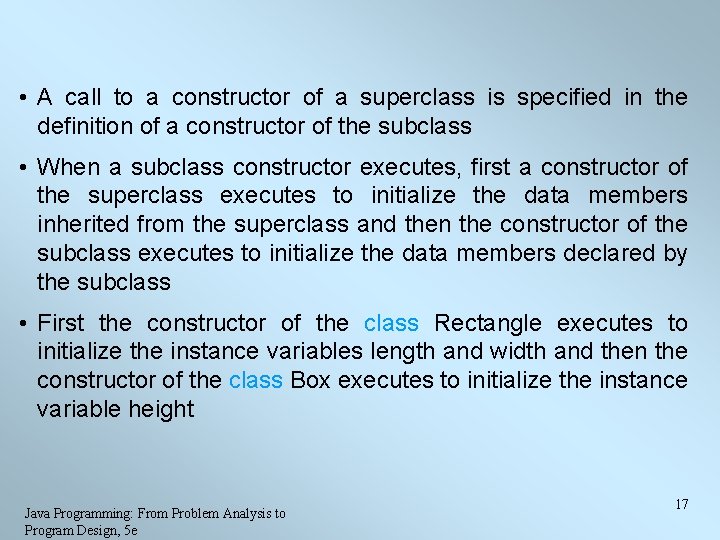
• A call to a constructor of a superclass is specified in the definition of a constructor of the subclass • When a subclass constructor executes, first a constructor of the superclass executes to initialize the data members inherited from the superclass and then the constructor of the subclass executes to initialize the data members declared by the subclass • First the constructor of the class Rectangle executes to initialize the instance variables length and width and then the constructor of the class Box executes to initialize the instance variable height Java Programming: From Problem Analysis to Program Design, 5 e 17
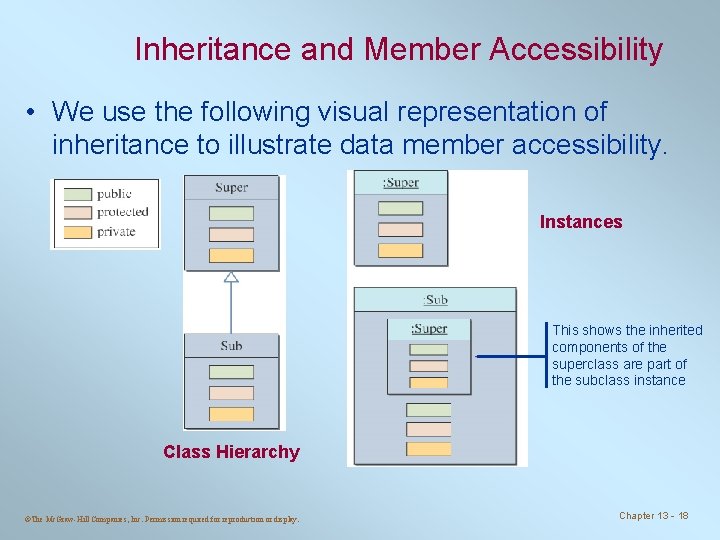
Inheritance and Member Accessibility • We use the following visual representation of inheritance to illustrate data member accessibility. Instances This shows the inherited components of the superclass are part of the subclass instance Class Hierarchy ©The Mc. Graw-Hill Companies, Inc. Permission required for reproduction or display. Chapter 13 - 18
The Effect of Three Visibility Modifiers ©The Mc. Graw-Hill Companies, Inc. Permission required for reproduction or display. Chapter 13 - 19
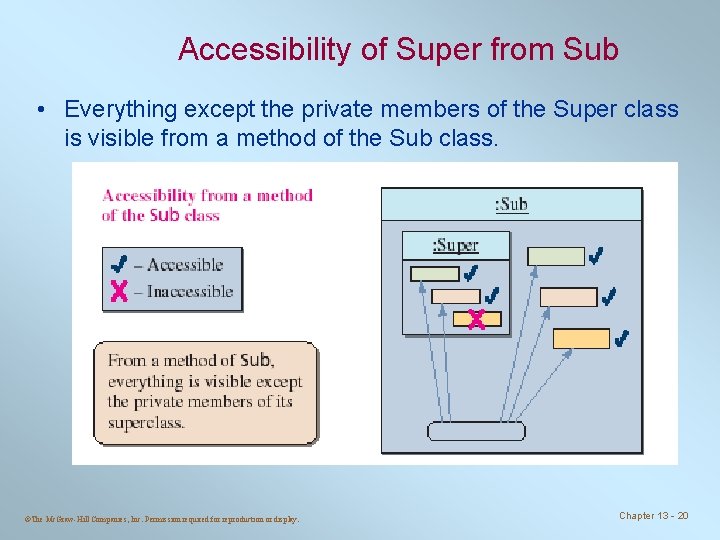
Accessibility of Super from Sub • Everything except the private members of the Super class is visible from a method of the Sub class. ©The Mc. Graw-Hill Companies, Inc. Permission required for reproduction or display. Chapter 13 - 20
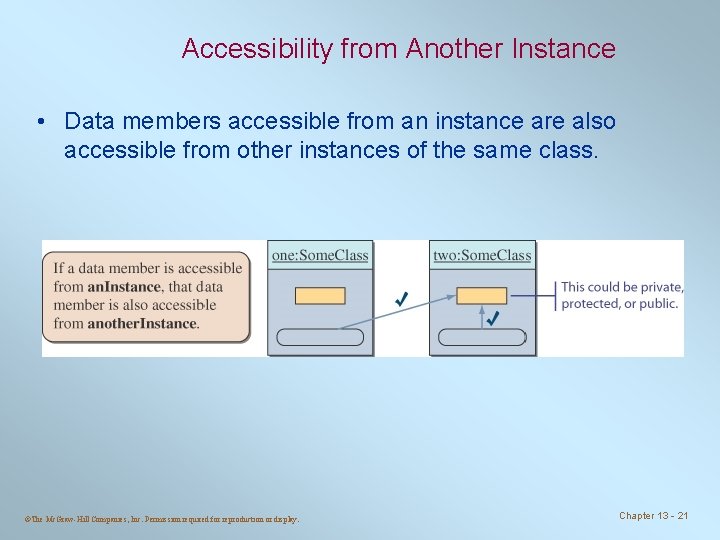
Accessibility from Another Instance • Data members accessible from an instance are also accessible from other instances of the same class. ©The Mc. Graw-Hill Companies, Inc. Permission required for reproduction or display. Chapter 13 - 21
Inheritance and Constructors • Unlike members of a superclass, constructors of a superclass are not inherited by its subclasses. • You must define a constructor for a class or use the default constructor added by the compiler. • The statement super(); calls the superclass’s constructor. • If the class declaration does not explicitly designate the superclass with the extends clause, then the class’s superclass is the Object class. ©The Mc. Graw-Hill Companies, Inc. Permission required for reproduction or display. Chapter 13 - 22
Abstract Superclasses and Abstract Methods • When we define a superclass, we often do not need to create any instances of the superclass. • Depending on whether we need to create instances of the superclass, we must define the class differently. • We will study examples based on the Student superclass defined earlier. ©The Mc. Graw-Hill Companies, Inc. Permission required for reproduction or display. Chapter 13 - 23
Definition: Abstract Class • An abstract class is a class – defined with the modifier abstract OR – that contains an abstract method OR – that does not provide an implementation of an inherited abstract method • An abstract method is a method with the keyword abstract, and it ends with a semicolon instead of a method body. – Private methods and static methods may not be declared abstract. • No instances can be created from an abstract class. ©The Mc. Graw-Hill Companies, Inc. Permission required for reproduction or display. Chapter 13 - 24
Case 1 • Student Must Be Undergraduate or Graduate – If a student must be either an undergraduate or a graduate student, we only need instances of Undergraduate. Student or Graduate. Student. – Therefore, we must define the Student class so that no instances may be created of it. ©The Mc. Graw-Hill Companies, Inc. Permission required for reproduction or display. Chapter 13 - 25
Case 2 • Student Does Not Have to Be Undergraduate or Graduate. • In this case, we may design the Student class in one of two ways. – We can make the Student class instantiable. – We can leave the Student class abstract and add a third subclass, Other. Student, to handle a student who does not fall into the Undergraduate. Student or Graduate. Student categories. ©The Mc. Graw-Hill Companies, Inc. Permission required for reproduction or display. Chapter 13 - 26
Which Approach to Use • The best approach depends on the particular situation. • When considering design options, we can ask ourselves which approach allows easier modification and extension. ©The Mc. Graw-Hill Companies, Inc. Permission required for reproduction or display. Chapter 13 - 27
Inheritance versus Interface • The Java interface is used to share common behavior (only method headers) among the instances of different classes. • Inheritance is used to share common code (including both data members and methods) among the instances of related classes. • In your program designs, remember to use the Java interface to share common behavior. Use inheritance to share common code. • If an entity A is a specialized form of another entity B, then model them by using inheritance. Declare A as a subclass of B. ©The Mc. Graw-Hill Companies, Inc. Permission required for reproduction or display. Chapter 13 - 28
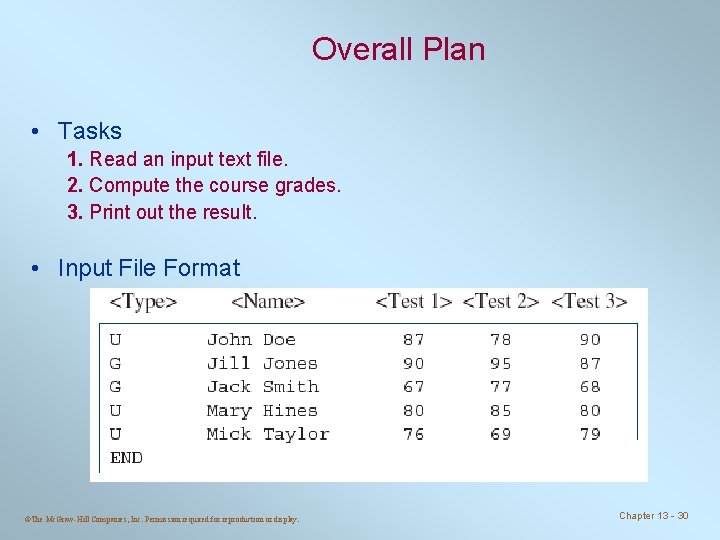
Problem Statement Write an application that reads in a text file organized in the manner shown below and displays the final course grades. The course grades are computed differently for the undergraduate and graduate students based on the formulas listed on page 710. The input text file format is as follows: • A single line is used for information on one student. • Each line uses the format <Type> <Name> <Test 1> <Test 2> <Test 3> where <Type> designates either a graduate or an undergraduate student, <Name> designates the student’s first and last name, and <Test i> designates the ith test score. • End of input is designated by the word END. The case of the letters is insignificant. ©The Mc. Graw-Hill Companies, Inc. Permission required for reproduction or display. Chapter 13 - 29
Overall Plan • Tasks 1. Read an input text file. 2. Compute the course grades. 3. Print out the result. • Input File Format ©The Mc. Graw-Hill Companies, Inc. Permission required for reproduction or display. Chapter 13 - 30
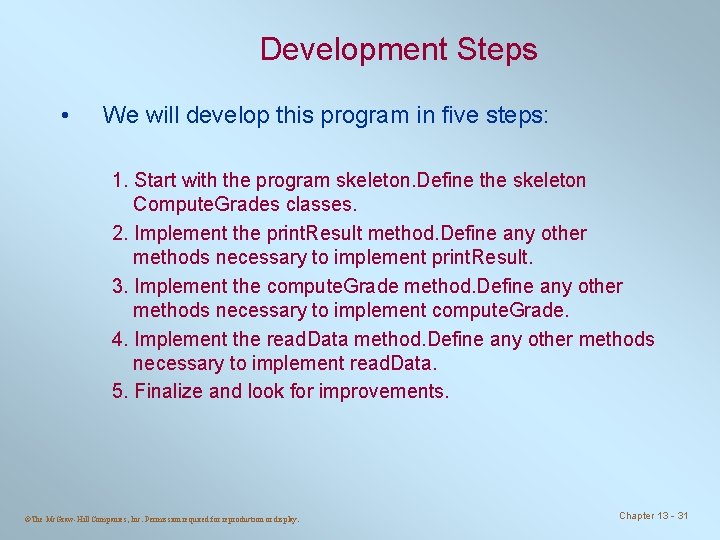
Development Steps • We will develop this program in five steps: 1. Start with the program skeleton. Define the skeleton Compute. Grades classes. 2. Implement the print. Result method. Define any other methods necessary to implement print. Result. 3. Implement the compute. Grade method. Define any other methods necessary to implement compute. Grade. 4. Implement the read. Data method. Define any other methods necessary to implement read. Data. 5. Finalize and look for improvements. ©The Mc. Graw-Hill Companies, Inc. Permission required for reproduction or display. Chapter 13 - 31
Step 1 Design • We start with a program skeleton. • We will define two constructors so the programmer can create a roster of default size or the size of her choice. ©The Mc. Graw-Hill Companies, Inc. Permission required for reproduction or display. Chapter 13 - 32
Step 1 Code Program source file is too big to list here. From now on, we ask you to view the source files using your Java IDE. Directory: Chapter 13/Step 1 Source Files: Compute. Grades. java ©The Mc. Graw-Hill Companies, Inc. Permission required for reproduction or display. Chapter 13 - 33
Step 1 Test • We include a temporary output statement inside the (currently stub) method we define. • We run the test main class and verify that the methods are called correctly. ©The Mc. Graw-Hill Companies, Inc. Permission required for reproduction or display. Chapter 13 - 34
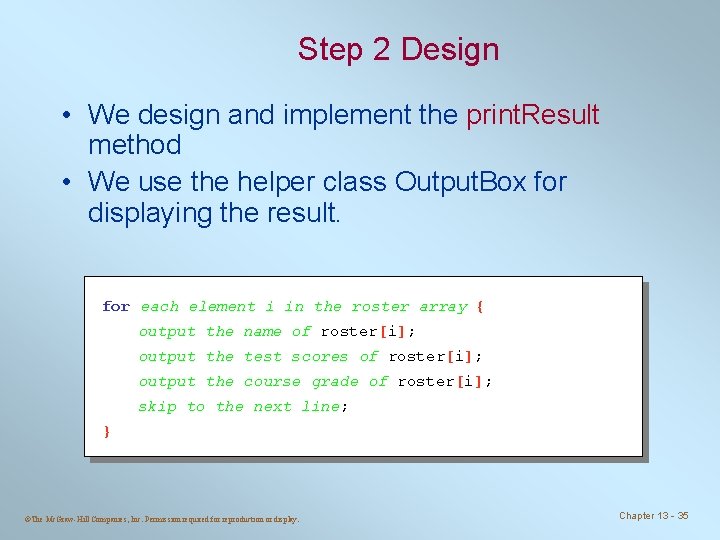
Step 2 Design • We design and implement the print. Result method • We use the helper class Output. Box for displaying the result. for each element i in the roster array { output the name of roster[i]; output the test scores of roster[i]; output the course grade of roster[i]; skip to the next line; } ©The Mc. Graw-Hill Companies, Inc. Permission required for reproduction or display. Chapter 13 - 35
Step 2 Test • We verify the temporary read. Data method is working correctly. This confirms that we are using the correct student classes and using their methods correctly. • We verify the print. Result method does indeed display the data in our desired format. ©The Mc. Graw-Hill Companies, Inc. Permission required for reproduction or display. Chapter 13 - 37
Step 3 Design • We design and implement the compute. Grade method. • The code for actually determining the course grade is embedded in individual student classes – So the code to add to the Compute. Grades class is very simplistic. – This is a direct benefit of using polymorphism effectively. ©The Mc. Graw-Hill Companies, Inc. Permission required for reproduction or display. Chapter 13 - 38
Step 3 Test • We will repeat the same test routines from Step 2. • Instead of seeing four asterisks, we should be seeing the correct grades. • We test both the passing and not passing test scores. ©The Mc. Graw-Hill Companies, Inc. Permission required for reproduction or display. Chapter 13 - 40
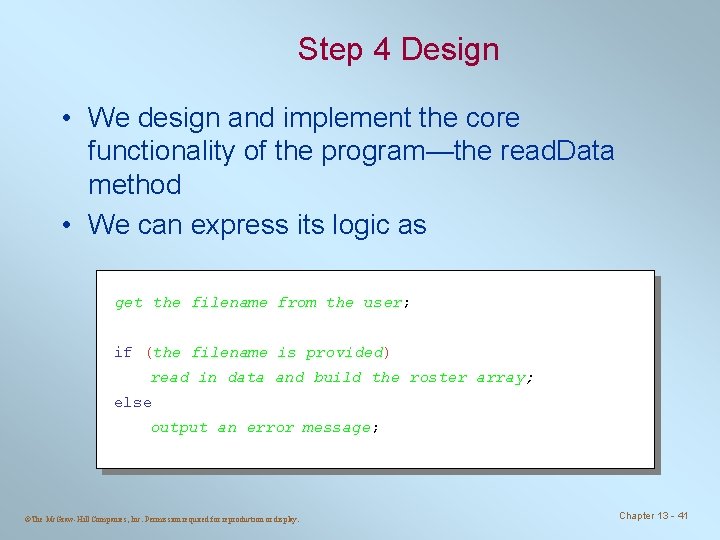
Step 4 Design • We design and implement the core functionality of the program—the read. Data method • We can express its logic as get the filename from the user; if (the filename is provided) read in data and build the roster array; else output an error message; ©The Mc. Graw-Hill Companies, Inc. Permission required for reproduction or display. Chapter 13 - 41
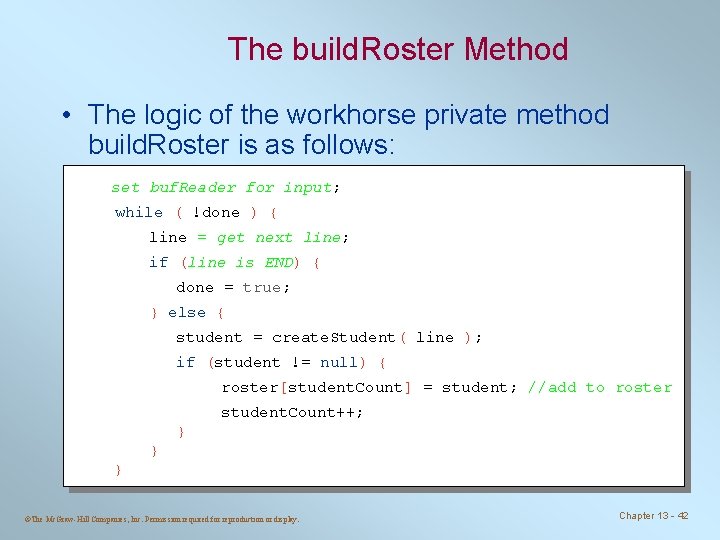
The build. Roster Method • The logic of the workhorse private method build. Roster is as follows: set buf. Reader for input; while ( !done ) { line = get next line; if (line is END) { done = true; } else { student = create. Student( line ); if (student != null) { roster[student. Count] = student; //add to roster student. Count++; } } } ©The Mc. Graw-Hill Companies, Inc. Permission required for reproduction or display. Chapter 13 - 42
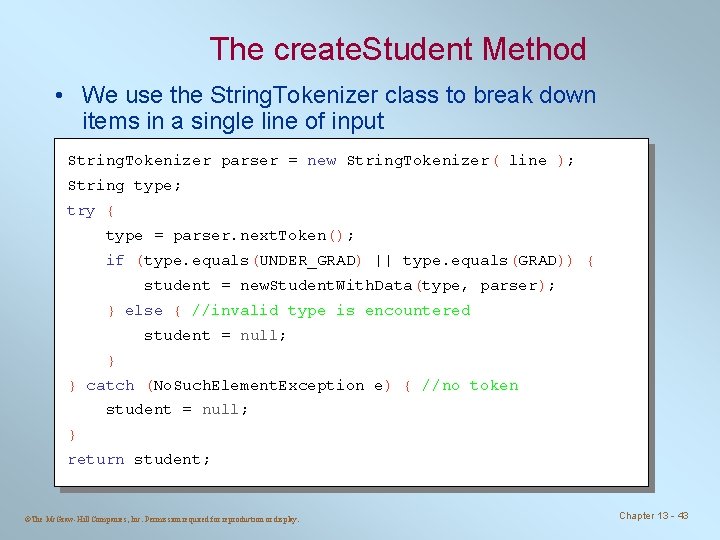
The create. Student Method • We use the String. Tokenizer class to break down items in a single line of input String. Tokenizer parser = new String. Tokenizer( line ); String type; try { type = parser. next. Token(); if (type. equals(UNDER_GRAD) || type. equals(GRAD)) { student = new. Student. With. Data(type, parser); } else { //invalid type is encountered student = null; } } catch (No. Such. Element. Exception e) { //no token student = null; } return student; ©The Mc. Graw-Hill Companies, Inc. Permission required for reproduction or display. Chapter 13 - 43
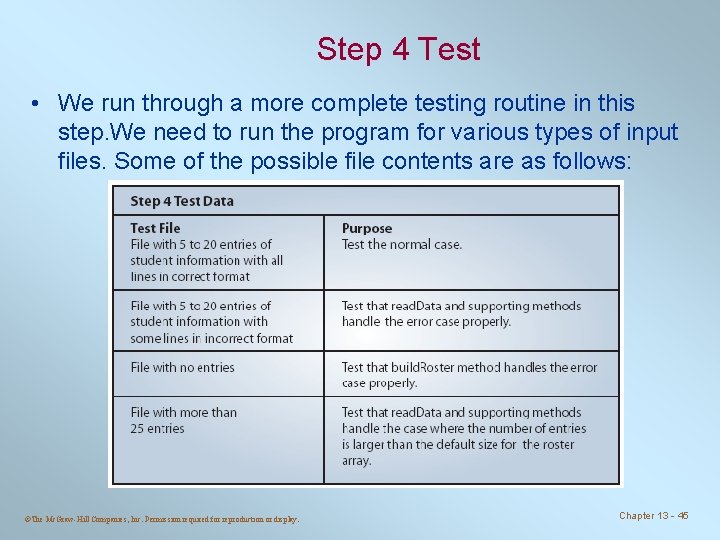
Step 4 Test • We run through a more complete testing routine in this step. We need to run the program for various types of input files. Some of the possible file contents are as follows: ©The Mc. Graw-Hill Companies, Inc. Permission required for reproduction or display. Chapter 13 - 45
Step 5: Finalize and Improve • We finalize the program by correcting any remaining errors, inconsistency, or unfinished methods. • We want to review the methods and improve them as necessarily. • One problem (which would have been identified in step 4 testing) we need to correct is the missing method for expanding the roster array when the input file includes more student entries than the set default size of 25. – We leave this method as Exercise 3. – We also leave some of the possible improvements as exercises. ©The Mc. Graw-Hill Companies, Inc. Permission required for reproduction or display. Chapter 13 - 46