
Chapter 13 Implementing Basic Differences Tests Learning Objectives
Chapter 13 Implementing Basic Differences Tests
Learning Objectives • To learn how differences are used for market segmentation decisions • To understand when t tests or z tests are appropriate and why you do not need to worry about this issue when using SPSS • To be able to test the differences between two percentages or means for two independent groups • To know what a paired samples difference test is and when to use it • To comprehend ANOVA and how to interpret ANOVA output • To learn how to perform differences tests for means using SPSS Copyright © 2014 Pearson Education, Inc. 13 -2
Copyright © 2014 Pearson Education, Inc. 13 -3
Why Differences are Important • Market segmentation is based on differences between groups of consumers. • One commonly used basis for market segmentation is the discovery of differences that are the following: 1 -Statistically significant 2 -Meaningful 3 -Stable 4 -Actionable differences Copyright © 2014 Pearson Education, Inc. 13 -4
1 -Differences must be statistically significant. -Statistical significance of differences : means the differences found in the sample(s) truly exist in the population(s) from which the random samples are drawn. - To be potentially useful to marketing researcher or manager , differences must , at minimum be statistically significant. Copyright © 2014 Pearson Education, Inc. 13 -5
2 - Differences must be meaningful. – Meaningful difference: one that the marketing manager can potentially use as a basis for marketing decisions. – The differences between the market segments should be of such a magnitude that the market can target them individually. Copyright © 2014 Pearson Education, Inc. 13 -6
3 -Differences should be stable. -Stable difference is one that will be in place for the foreseeable future. -To be potentially useful to marketing researcher or manager , differences must , if statistically significant and meaningful , be stable. Copyright © 2014 Pearson Education, Inc. 13 -7
4 - Differences must be actionable. - Actionable difference means the marketer can focus various marketing strategies and tactics, such as product design or advertising, on the market segments to accentuate the differences between segments. -To be potentially useful to marketing researcher or manager , differences must , if statistically significant , meaningful , stable and actionable. Copyright © 2014 Pearson Education, Inc. 13 -8
Small Sample Sizes: The Use of a t Test or z Test and How SPSS Eliminates the worry • t Test: statistical inference test to be used with small sample sizes (n ≤ 30) • z Test: statistical inference test to be used when the sample size is 30 or greater • Note: Most computer statistical programs report only the t value because it is identical to the z value with large samples. Copyright © 2014 Pearson Education, Inc. 9 13 -9
• The great advantage to using statistical routines on a computer is that they are programmed to computer the correct statistic. Copyright © 2014 Pearson Education, Inc. 10 13 -10
Testing for Significant Differences Between Two Groups • Statistical tests are used when researcher wants to compare the means or percentages of two different groups or samples. Copyright © 2014 Pearson Education, Inc. 13 -11
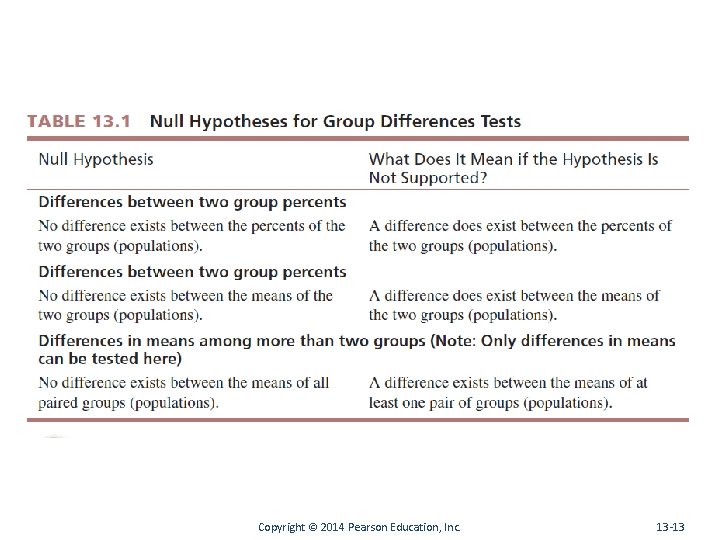
Differences Between Percentages with Two Groups (Independent Samples) • Independent samples are treated as representing two potentially different populations. • Null hypothesis: the hypothesis that the difference in the population parameters is equal to zero • With a differences test, the null hypothesis states that there is no difference between the percentages (or means) being compared. • alternative to the null hypothesis is that there is a true difference between the population parameters. Copyright © 2014 Pearson Education, Inc. 13 -12
Copyright © 2014 Pearson Education, Inc. 13 -13
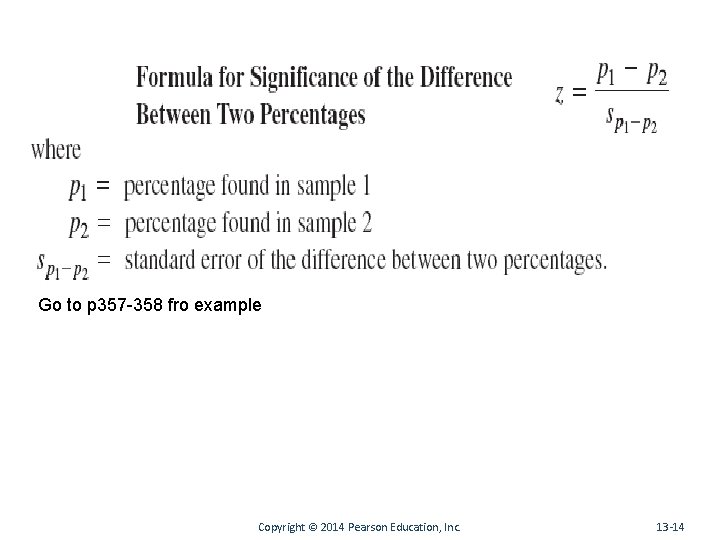
Go to p 357 -358 fro example Copyright © 2014 Pearson Education, Inc. 13 -14
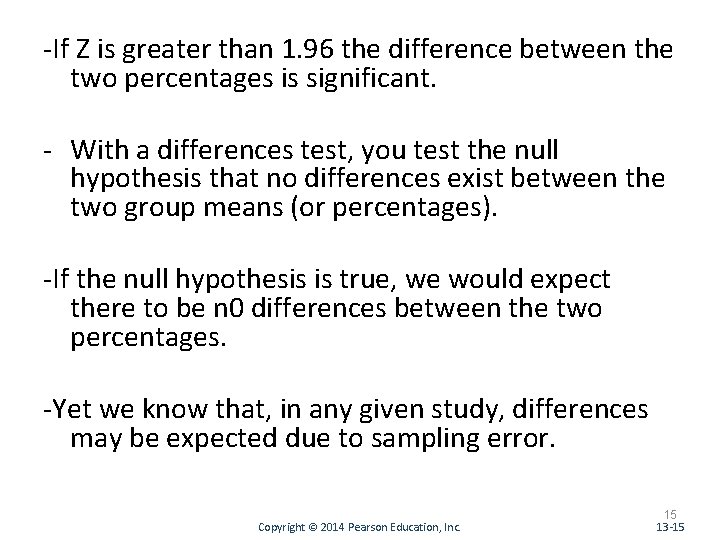
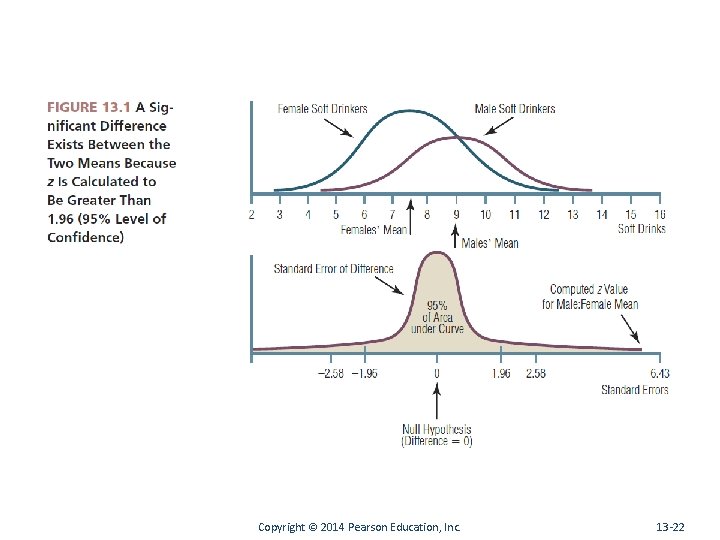
-If Z is greater than 1. 96 the difference between the two percentages is significant. - With a differences test, you test the null hypothesis that no differences exist between the two group means (or percentages). -If the null hypothesis is true, we would expect there to be n 0 differences between the two percentages. -Yet we know that, in any given study, differences may be expected due to sampling error. Copyright © 2014 Pearson Education, Inc. 15 13 -15
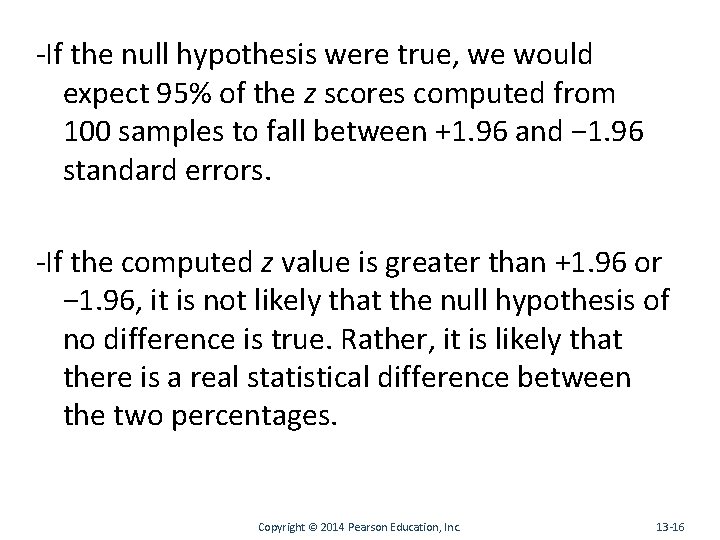
-If the null hypothesis were true, we would expect 95% of the z scores computed from 100 samples to fall between +1. 96 and − 1. 96 standard errors. -If the computed z value is greater than +1. 96 or − 1. 96, it is not likely that the null hypothesis of no difference is true. Rather, it is likely that there is a real statistical difference between the two percentages. Copyright © 2014 Pearson Education, Inc. 13 -16
Using SPSS for Differences Between Percentages of Two Groups • SPSS does not perform tests of significance of the difference between the percentages of two groups, but you can use SPSS to generate the relevant information and perform a hand calculation. • Use the SPSS command FREQUENCIES to produce the percentages you need. Copyright © 2014 Pearson Education, Inc. 13 -17
Testing the Difference Between Means • We have three testing difference between means; 1 -Differences between two means from independent samples 2 -Differences between three or more means from independent samples 3 -Differences between paired means Copyright © 2014 Pearson Education, Inc. 13 -18
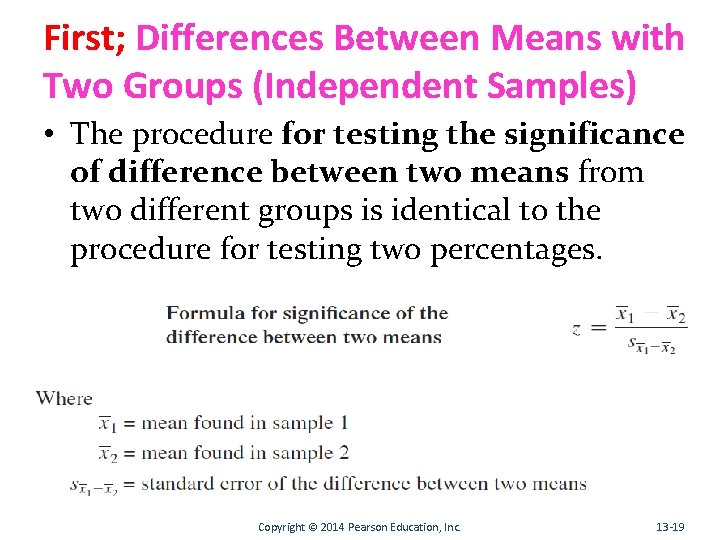
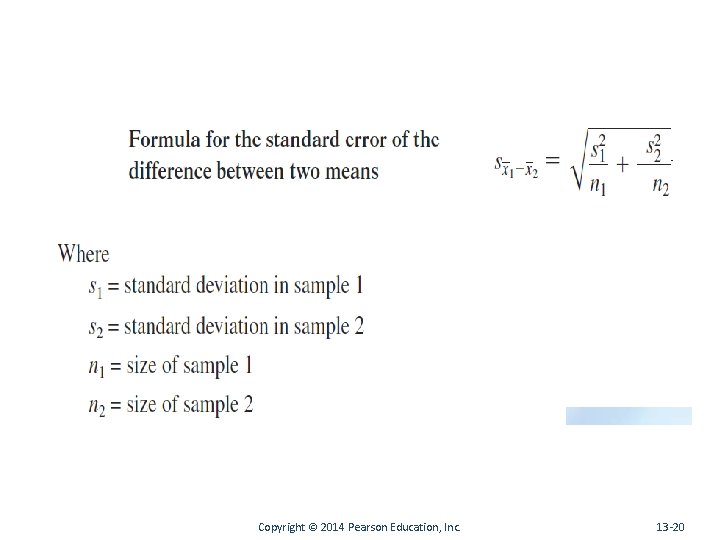
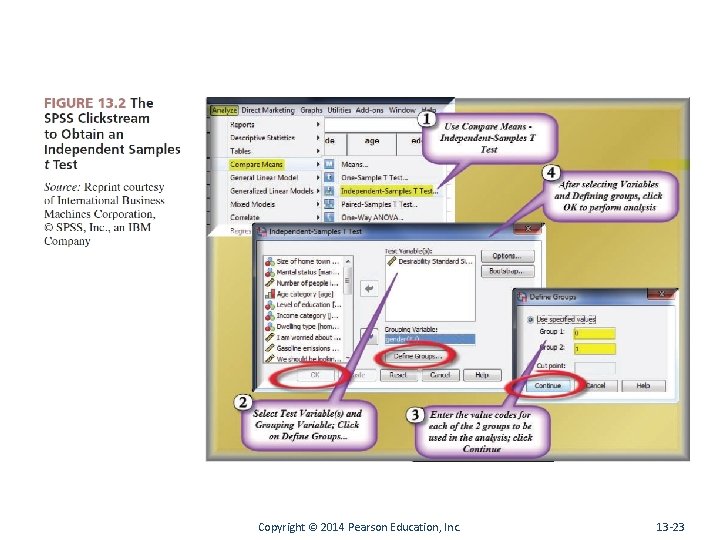
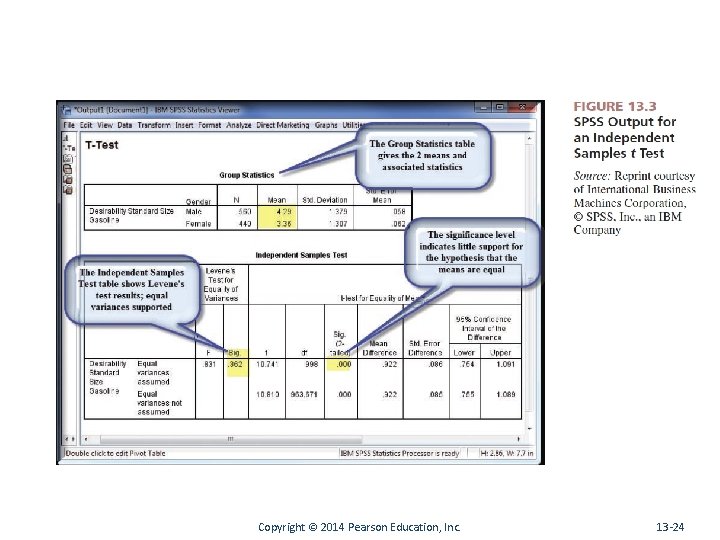
First; Differences Between Means with Two Groups (Independent Samples) • The procedure for testing the significance of difference between two means from two different groups is identical to the procedure for testing two percentages. Copyright © 2014 Pearson Education, Inc. 13 -19
Copyright © 2014 Pearson Education, Inc. 13 -20
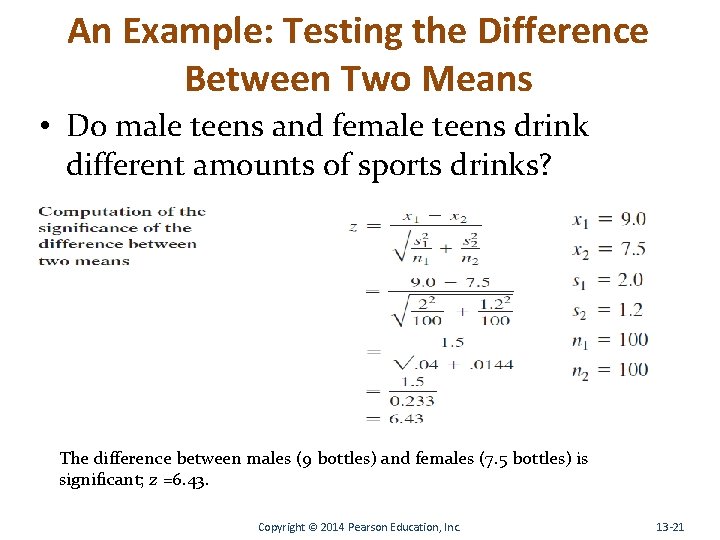
An Example: Testing the Difference Between Two Means • Do male teens and female teens drink different amounts of sports drinks? The difference between males (9 bottles) and females (7. 5 bottles) is significant; z =6. 43. Copyright © 2014 Pearson Education, Inc. 13 -21
Copyright © 2014 Pearson Education, Inc. 13 -22
Copyright © 2014 Pearson Education, Inc. 13 -23
Copyright © 2014 Pearson Education, Inc. 13 -24
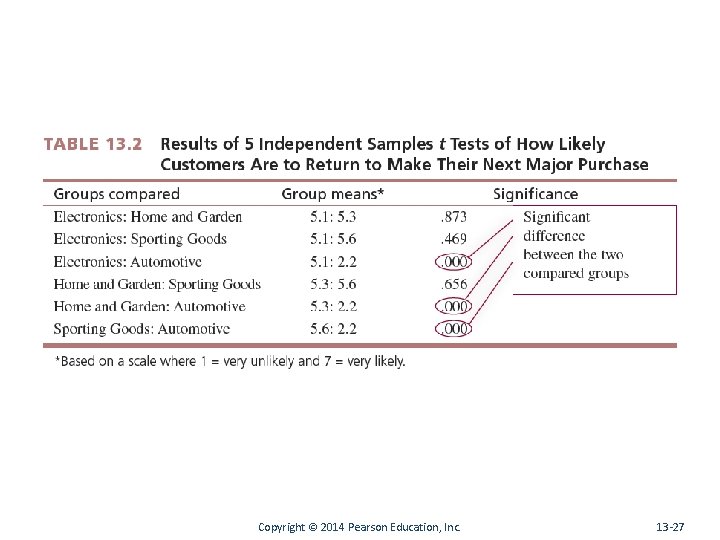
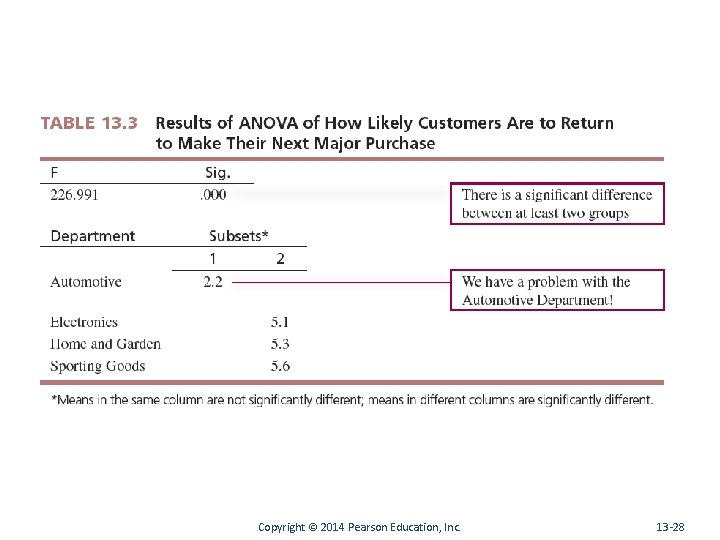
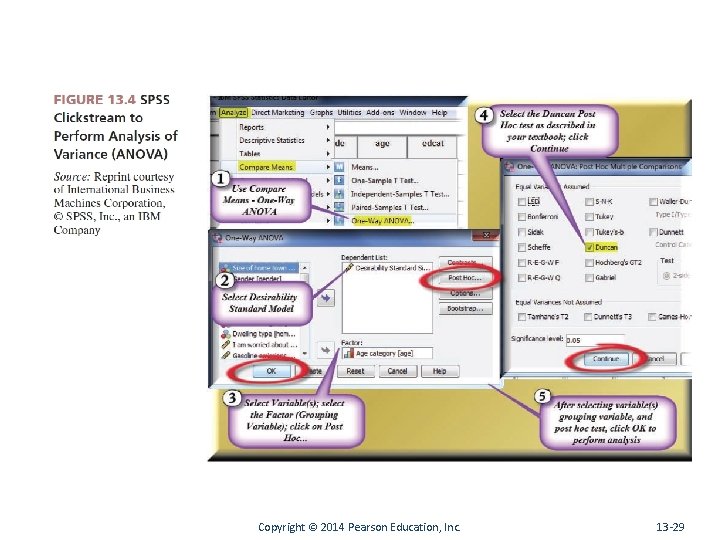
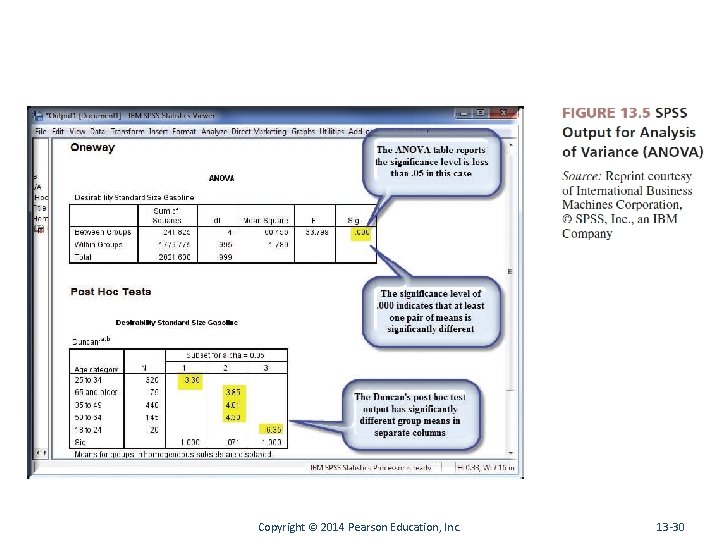
Second; Testing for significant differences in means Among than two Group; Analysis of Variance • Analysis of variance (ANOVA): used when comparing the means of three or more groups • ‘ANOVA is an investigation of the differences between the group means to ascertain whether sampling errors or true population differences explain their failure to be equal. Copyright © 2014 Pearson Education, Inc. 13 -25
• ANOVA will “flag” when at least one pair of means has a statistically significant difference, but it does not tell which pair. Copyright © 2014 Pearson Education, Inc. 13 -26
Copyright © 2014 Pearson Education, Inc. 13 -27
Copyright © 2014 Pearson Education, Inc. 13 -28
Copyright © 2014 Pearson Education, Inc. 13 -29
Copyright © 2014 Pearson Education, Inc. 13 -30
ANOVA Advantages; • ANOVA has two distinct advantages over performing multiple t tests of the significance of the difference between means. 1 -Immediately notifies researcher if there is any significant difference 2 -Arranges the means so the significant differences can be located and interpreted easily Copyright © 2014 Pearson Education, Inc. 13 -31
Post Hoc Tests: Detect Statistically Significant Differences Among Group Means • Post hoc tests: options that are available to determine where the pair(s) of statistically significant differences between the means exist(s) – Duncan’s multiple range test: provides output that is mostly a “picture” of what means are significantly different – The Duncan multiple range test’s output is much less statistical than most other post hoc tests and is easy to interpret. Copyright © 2014 Pearson Education, Inc. 13 -32
Copyright © 2014 Pearson Education, Inc. 13 -33
Copyright © 2014 Pearson Education, Inc. 13 -34
Reporting Group Differences Tests to Clients • Finding significant differences is exciting to marketing researcher because it means they will have something that is potentially useful to report to clients. • The reporting of finding has a significant ethical burden for marketing researcher as they cannot choose to report only “good news” to client. Copyright © 2014 Pearson Education, Inc. 13 -35
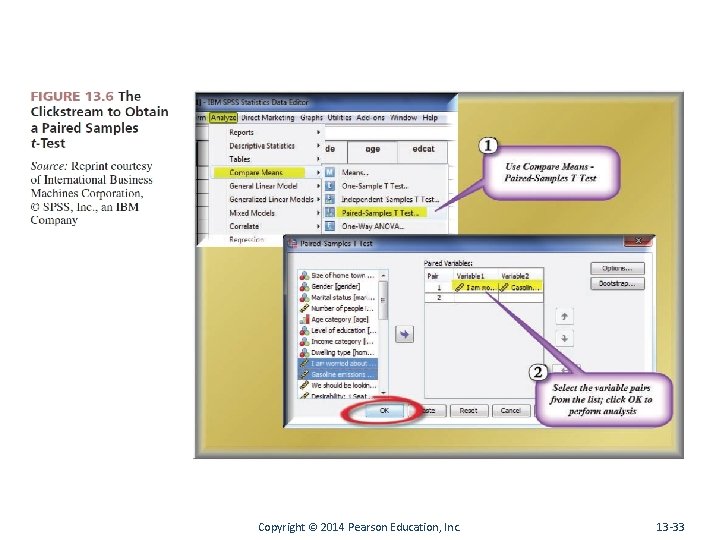
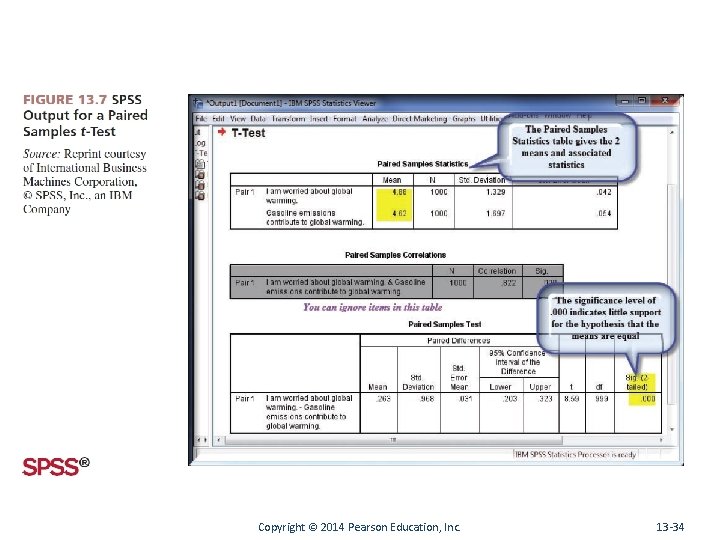
Third ; Differences Between Two Means Within the Sample (Paired Sample) • You can test the significance of the difference between two means for two different questions answered by the same respondents using the same scale. • Paired samples test for the differences between two means: a test to determine if two means of two different questions using the same scale format and answered by the same respondents in the sample are significantly different. Copyright © 2014 Pearson Education, Inc. 36 13 -36
- Slides: 36