
Chapter 13 Gravitation Physics I 2048 Newtons law








- Slides: 25
Chapter 13 Gravitation Physics. I 2048
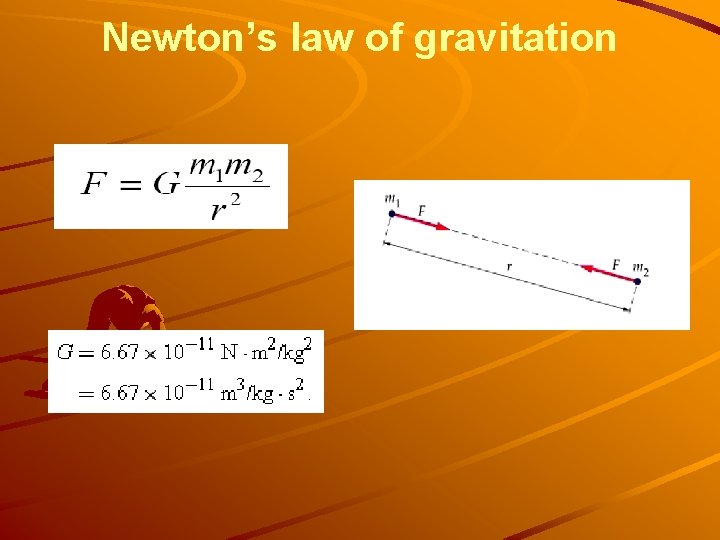
Newton’s law of gravitation Besides the three laws of motion, Newton also discovered the universal law of gravitation. The force of gravity between two point object of mass m 1 and m 2 is attractive and of magnitude where r is the distance between the masses and G is a constant referred as the universal gravitation constant.
Newton’s law of gravitation
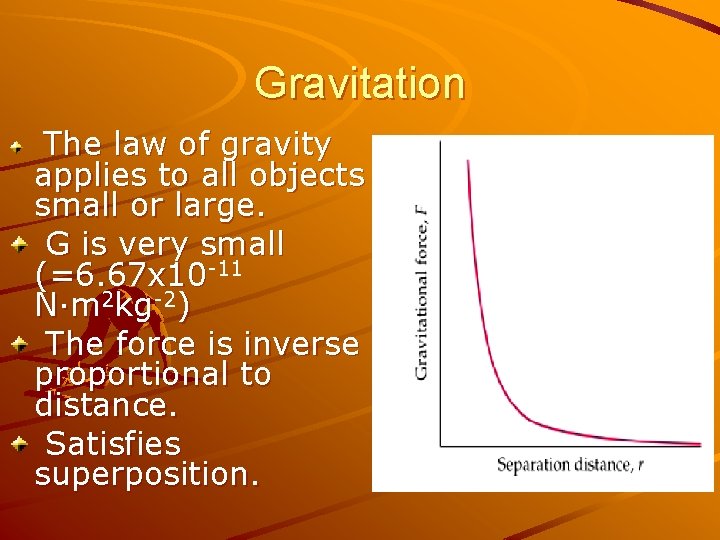
Gravitation The law of gravity applies to all objects small or large. G is very small (=6. 67 x 10 -11 N·m 2 kg-2) The force is inverse proportional to distance. Satisfies superposition.
Gravitation and the Principle of Superposition Where F 1, netis the net force on particle 1 due to n particles
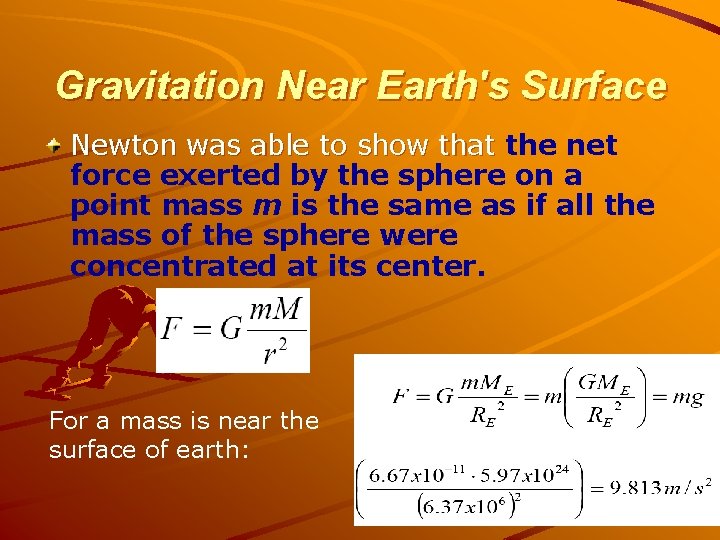
Gravitation Near Earth's Surface Newton was able to show that the net force exerted by the sphere on a point mass m is the same as if all the mass of the sphere were concentrated at its center. For a mass is near the surface of earth:
Variation of ag with Altitude
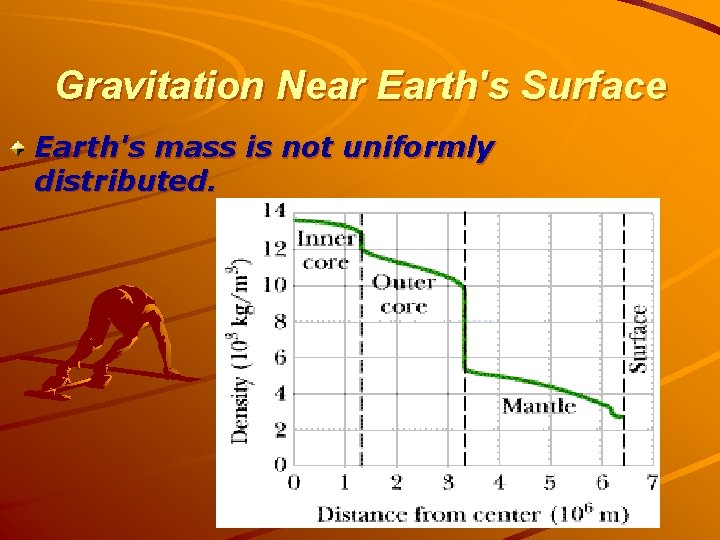
Gravitation Near Earth's Surface Earth's mass is not uniformly distributed.
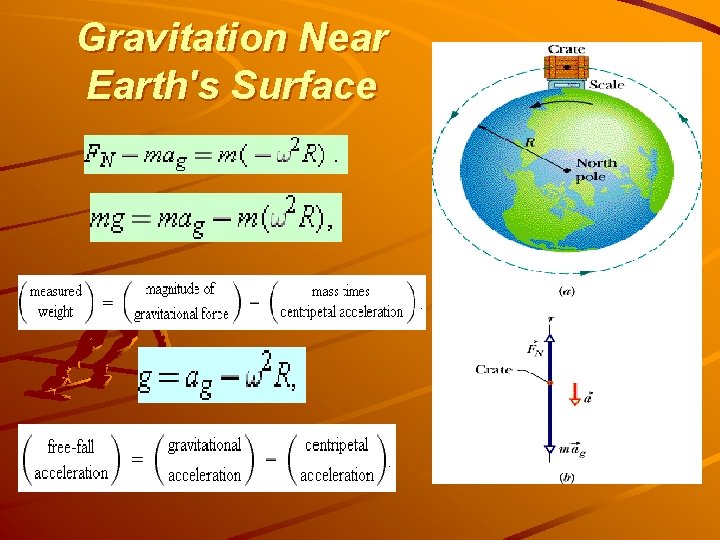
Gravitation Near Earth's Surface Earth is not a sphere. Earth is approximately an ellipsoid, flattened at the poles and bulging at the equator. Earth is rotating. The rotation axis runs through the north and south poles of Earth.
Gravitation Near Earth's Surface
Gravitational Potential Energy
Proof of the gravitational potential energy equation Let us shoot a baseball directly away from Earth along the path in Figure
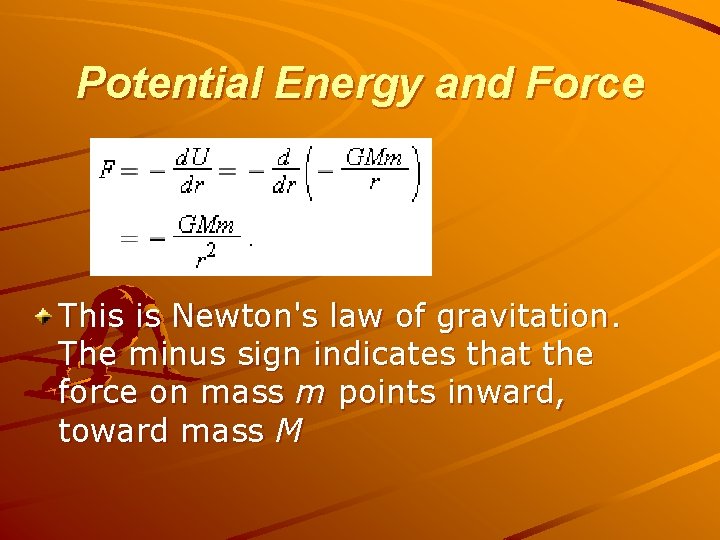
Potential Energy and Force This is Newton's law of gravitation. The minus sign indicates that the force on mass m points inward, toward mass M
Escape Speed When the projectile reaches infinity, it stops and thus has no kinetic energy. It also has no potential energy because an infinite separation between two bodies is zero potential energy
Some Escape Speeds
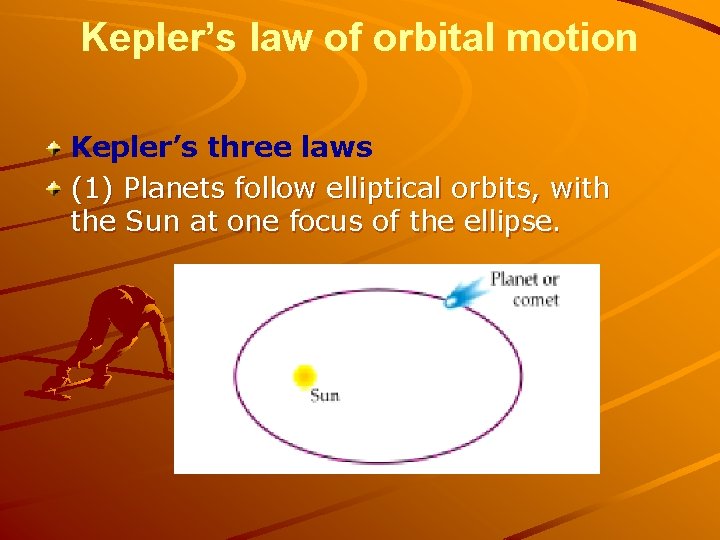
Kepler’s law of orbital motion Kepler’s three laws (1) Planets follow elliptical orbits, with the Sun at one focus of the ellipse.
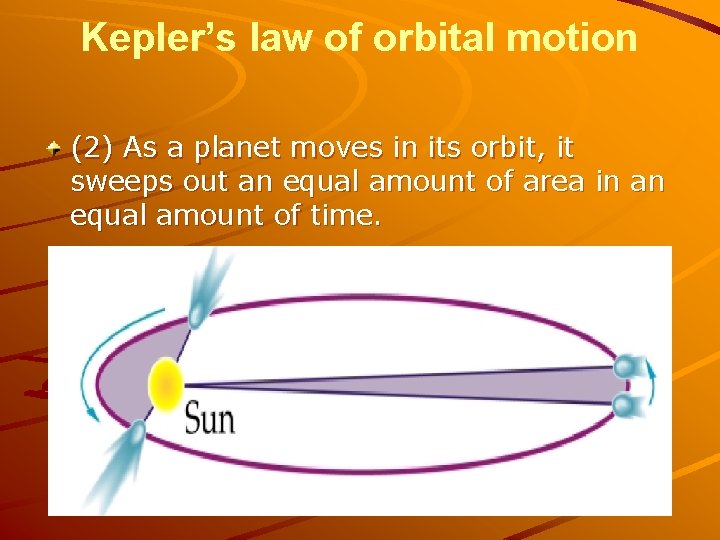
Kepler’s law of orbital motion (2) As a planet moves in its orbit, it sweeps out an equal amount of area in an equal amount of time.
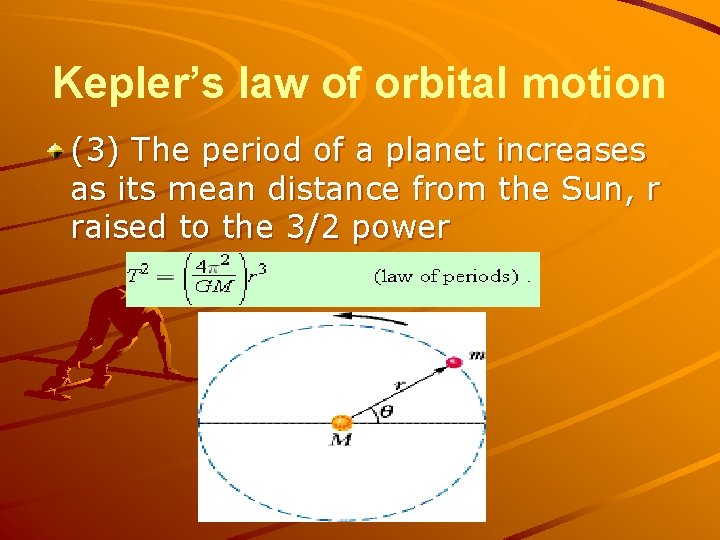
Kepler’s law of orbital motion (3) The period of a planet increases as its mean distance from the Sun, r raised to the 3/2 power
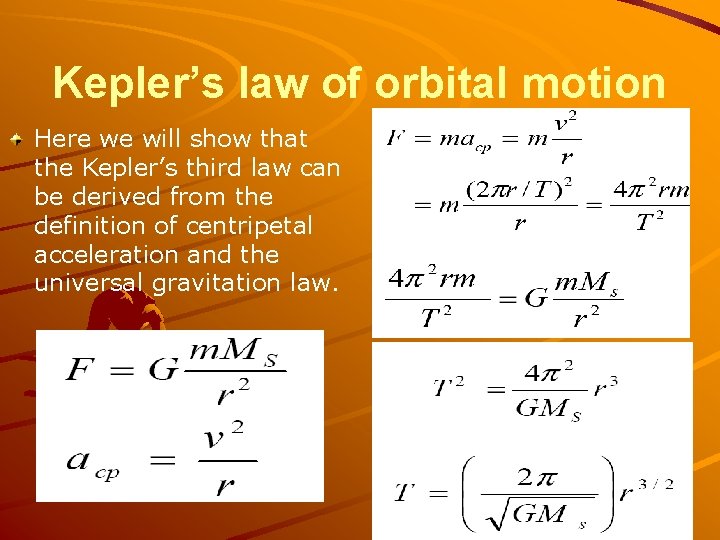
Kepler’s law of orbital motion Here we will show that the Kepler’s third law can be derived from the definition of centripetal acceleration and the universal gravitation law.
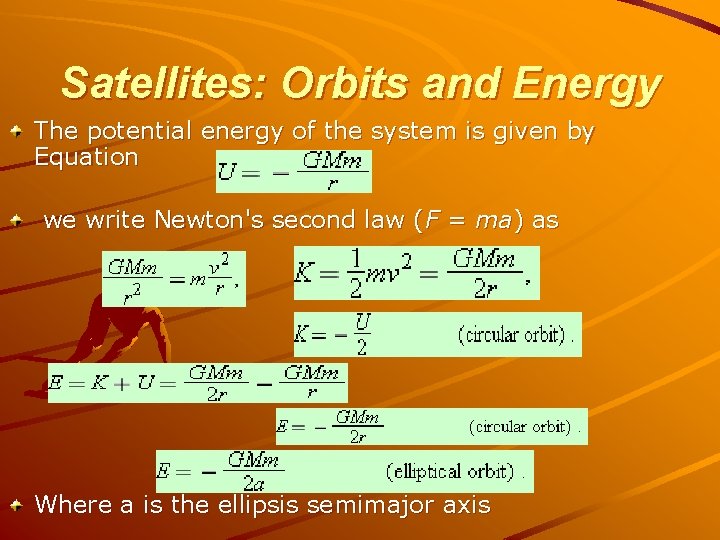
Satellites: Orbits and Energy The potential energy of the system is given by Equation we write Newton's second law (F = ma) as Where a is the ellipsis semimajor axis
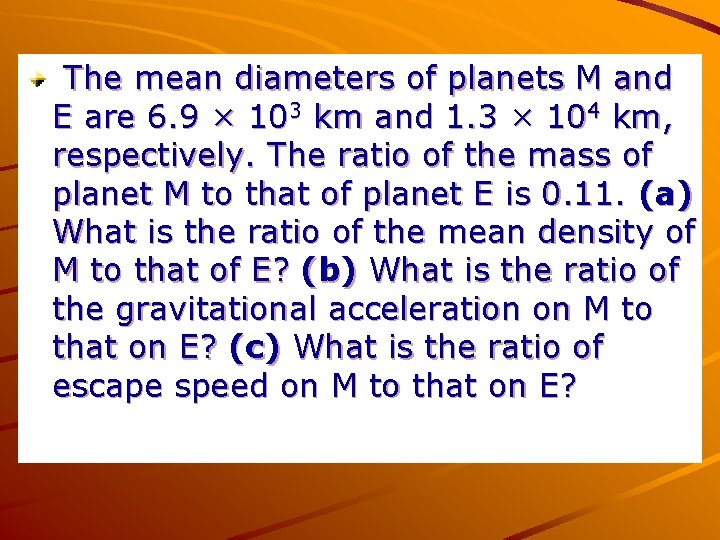
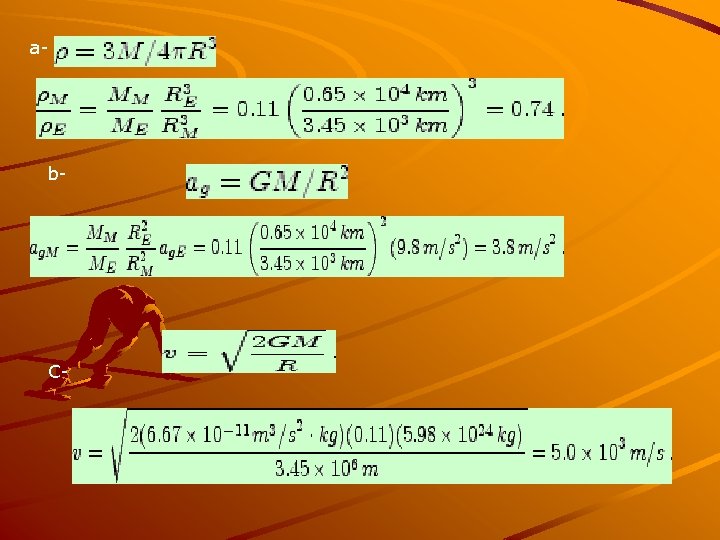
The mean diameters of planets M and E are 6. 9 × 10³ km and 1. 3 × 10⁴ km, respectively. The ratio of the mass of planet M to that of planet E is 0. 11. (a) What is the ratio of the mean density of M to that of E? (b) What is the ratio of the gravitational acceleration on M to that on E? (c) What is the ratio of escape speed on M to that on E?
a- b- C-
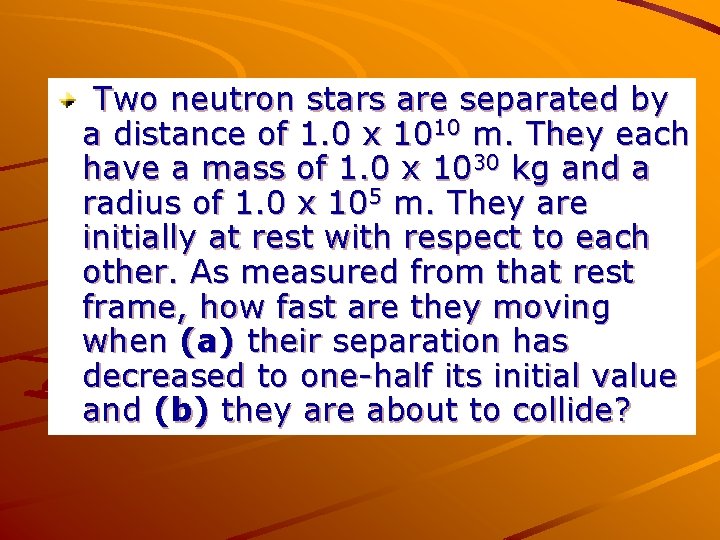
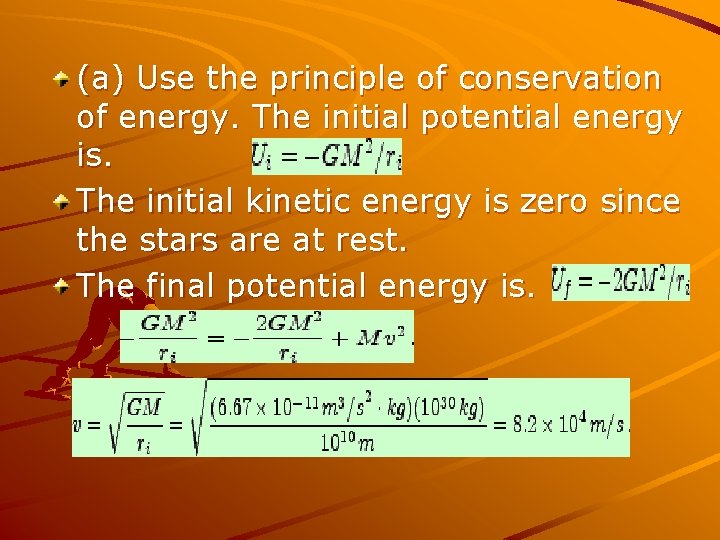
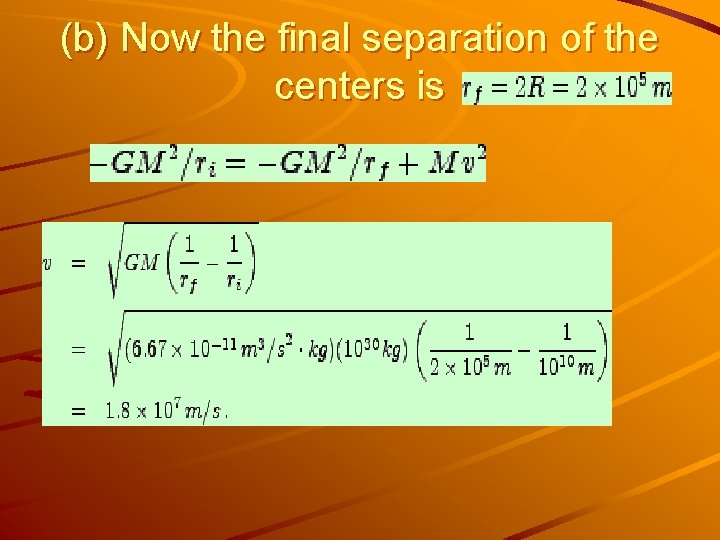
Two neutron stars are separated by a distance of 1. 0 x 1010 m. They each have a mass of 1. 0 x 1030 kg and a radius of 1. 0 x 105 m. They are initially at rest with respect to each other. As measured from that rest frame, how fast are they moving when (a) their separation has decreased to one-half its initial value and (b) they are about to collide?
(a) Use the principle of conservation of energy. The initial potential energy is. The initial kinetic energy is zero since the stars are at rest. The final potential energy is.
(b) Now the final separation of the centers is