
Chapter 13 Good News from Age to Age









- Slides: 65
Chapter 13: Good News from Age to Age: The Church’s Understanding of Jesus Christ
The Church’s History Church-community of persons who have come to some personal recognition of the risen Jesus in their lives Church expresses themselves as a community in 4 ways Recalling their past experiences of Jesus Committing themselves to care for one another Celebrating Jesus’ risen and living presence through signs and symbols (breaking bread, etc. ) Going out as renewed people to share the Good News with others Church spread to many different areas with different cultures and customs In order to keep Church stability, they introduced many traditions for all to follow The history of the Church has always been guided by the presence of God’s spirit That is why the church is called the Body of Christ Church has survived much turmoil because of deep and constant faith of its members
Church continues to develop today Needs to find balance between unity of all members and having a healthy diversity Each new insight and development is like a stone thrown into a pool of water “ripple effect” One question that is constantly asked is “Did Jesus ever intend to form a community of faith at all, let alone like the church as we know it today? ” To find the answer we must look at The Scriptures If Jesus did want a church, he would not have envisioned one that had so many strict regulations like the Catholic Church today Most of Jesus’ followers enjoyed some sort of communal experience when Jesus taught Teachings of Jesus show a concern for communal nature of everyone Jesus’ training of the Apostles seems to indicate an intention for them to found some sort of gathering for those who followed Jesus The church has often suffered between two problems Finding a balance between Jesus’ humanity and divinity Conflict between intellectual and emotional views of Jesus
For Review Briefly, how did the early church form?
For Review What do Christians believe has been the guiding force behind the church’s journey through history?
For Review What importance does the question of whether Jesus intended to found a church have for individual Christians? Briefly summarize the evidence supporting the claim that Jesus intended to found some kind of continuing community.
For Review Name the persistent tensions in the church’s historical struggle to understand Jesus and his message.
Understanding Jesus in the Early Centuries The early Christians believed the risen Jesus would come again soon The four Gospels were written to preserve and pass on the story and message of Jesus Tensions increased between Christians and Jews The canon of the Hebrew Scriptures was set
A New Way of Thinking By the end of the second century, theologians trained in Greek philosophy of the time dominated the church’s thinking These theologians tried to translate the experiences of the Apostles and the earliest Christian communities into a language that made sense to themselves and suited their audiences These men – today referred to as the fathers of the church –tried to re-evaluate the new Testament in terms of their own way of thinking about and understanding the world
The Great Christological Heresies and Councils What eventually resulted from the influence of Greek thought was that many Christians began talking about Jesus in more technical and complex terms Three major heresies, or false teachings, arose out of the debates over how to explain Jesus Each one of these heresies resulted in the calling of a church council, or official gathering of church leaders, to responded to the false teachings and clarify the church’s statement of who Jesus is
Jesus: More than Human, Less than Divine About the year 300 C. E. , a priest named Arius began teaching that Jesus was not one with God, as the early church claimed him to be. Rather, Arius saw Jesus as a special creature of God, a being of a very high order created by God at a particular point in time In other words, he viewed Jesus as more than human but less than divine. Arius’s false teachings became known as the Arian heresy, or Arianism This teaching led to the calling of the first ecumenical, or worldwide, council of the church: the First Council of Nicaea, in the year 325 This council solemnly declared that in Jesus, God had truly appeared on earth in the person of God’s own Son The Nicene Creed, the profession of faith that is commonly recited in Eucharistic celebrations, was first drawn up by this council
Jesus: Two Different Beings? About the year 400 C. E. , a theory was proposed that Jesus was two different persons – one who was divine and one who was human – rather than one person who was both divine and human At this time, a debate also flared up about the mother of Jesus, Mary, and her role in God’s plan of salvation One side argued that Mary could not be given the title Mother of God because, among other reasons, a human mother could not be said to give birth to a divine being who already existed from eternity The other side argued that if Jesus were truly to be recognized as both God and human and yet one person, then Mary could rightly be called Mother of God, because she gave birth to one who was both human and divine In response to these disagreements, the Council of Ephesus was convened in 431 This council proclaimed that despite the differences between his divine and human natures, there is but one person in Jesus. The council also formally and officially gave Mary the title Mother of God, though this title was more an attempt to make a statement about Jesus than an attempt to describe the nature of Mary herself
Jesus: Only Pretending to be Human? Another group of devout people proposed that Jesus possessed a divine nature only, and that despite all the apparent indications of his humanity while on earth, he was not truly human In the year 451, the Council of Chalcedon was called to deal with this heresy. This council solemnly declared that Jesus was not only divine but also fully human Though other church councils have dealt with the identity of Jesus, the three councils of Nicaea, Ephesus, and Chalcedon – often referred to as the Great Christological Councils – were by far the most formative
The Council of Nicaea defended Jesus’ divinity The Council of Ephesus defended his unity as both God and man The Council of Chalcedon defended his full humanity These conclusions about Jesus literally laid the foundation of the church’s understanding of Jesus
For Review What significant things were happening in the early church at the time it began searching for a full understanding of Jesus?
For Review What role did the fathers of the church play?
For Review Identify the three Great Christological Councils and briefly explain what each council decided about Jesus’ identity,
For Review Why did the church officially give Mary the name Mother of God?
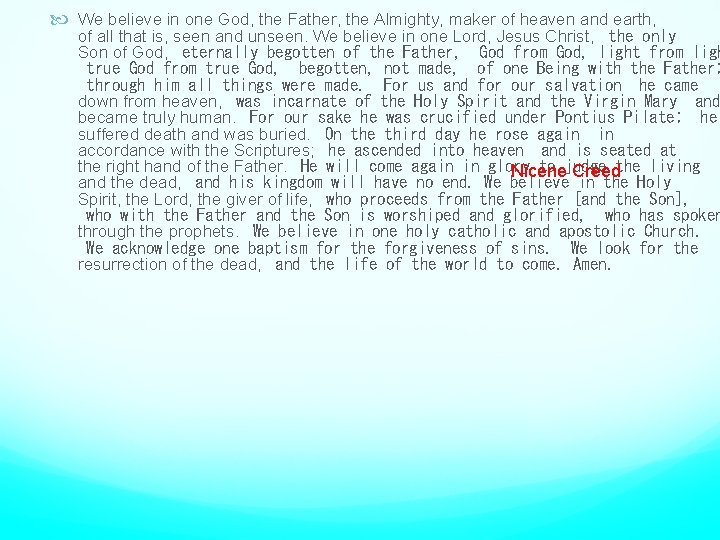
We believe in one God, the Father, the Almighty, maker of heaven and earth, of all that is, seen and unseen. We believe in one Lord, Jesus Christ, the only Son of God, eternally begotten of the Father, God from God, light from ligh true God from true God, begotten, not made, of one Being with the Father; through him all things were made. For us and for our salvation he came down from heaven, was incarnate of the Holy Spirit and the Virgin Mary and became truly human. For our sake he was crucified under Pontius Pilate; he suffered death and was buried. On the third day he rose again in accordance with the Scriptures; he ascended into heaven and is seated at the right hand of the Father. He will come again in glory to judge the living Nicene Creed and the dead, and his kingdom will have no end. We believe in the Holy Spirit, the Lord, the giver of life, who proceeds from the Father [and the Son], who with the Father and the Son is worshiped and glorified, who has spoken through the prophets. We believe in one holy catholic and apostolic Church. We acknowledge one baptism for the forgiveness of sins. We look for the resurrection of the dead, and the life of the world to come. Amen.
Understanding Jesus in the Middle Ages The Rise of Scholasticism The influence of Greek philosophy on the church's understanding of Jesus continued through the centuries and reached its peak in the Middle Ages with the rise of Scholasticism This was a form of philosophy based on the concepts of the Greek philosopher Aristotle, and it relied greatly on order and logic As a philosophy, or way of understanding philosophy, it has endured to this day Its primary advocate in the church was Saint Thomas Aquinas (1224 – 1274)m almost without question the greatest and most influential theologian in the entire history of the church An Emphasis on Order Scholastic philosophy, as applied to the Christian faith by Thomas and others, became the basis for the thinking and teaching employed by the church for nearly seven hundred years It was the approach used in the religious education of many of today’s adult Catholics, especially those who were formally taught in either Catholic schools or parish religious education programs before the 1970 s
Scholasticism involves a very ordered and organized approach to reality Just as the adoption of Greek ways of thinking early in the church’s history may have saved the church from disappearing altogether, so Scholastic theology broadened and therefore strengthened the church’s understanding of Jesus As the foundation of the Catholic teaching for centuries, particularly in seminaries and universities, this approach has no doubt strengthened the faith of millions of Christians Balancing the Mind and the Heart The Scholastic approach to understanding Jesus and matters of Christian faith can be useful, but it is not the only approach – nor should it be Scholasticism’s intellectual approach needs to be balanced with a “heart” emphasis In other words, we need to grasp the meaning of Jesus not only with our mine but also with our heart And what matters most, as the Gospels repeatedly show us, is a believer's personal, heartfelt response to Jesus and his message The church is always challenged to try to balance the intellectual and the emotional in its understanding of the mysteries of the Christian faith
Rediscovering the Common Touch Earlier in this chapter, it was stated that whenever the church begins to lose its bearings, the Spirit of God leads it back to a balanced view of Jesus During the Middle Ages, the Spirit worked through a strong reaction by “the common folk” against the image of Jesus presented by theologians who relied heavily on Greek philosophy in their teachings about Jesus For example, people like Saint Francis of Assisi (1181 – 1226) recognized the need for a more personal and human understanding of Jesus, and they started a popular movement based on imitating the Jesus of the Gospels and performing other acts of piety A New Problem Despite the great benefits of the popular movement, however, a new problem gradually evolved: the danger shifted from over complicating to over simplifying the person of Jesus and his message When the approach to understanding Jesus is governed by a need for emotional experiences or when people seek artificial experiences of the sacred or mysterious dimensions in life, they can be open to superstition, distortion, and even magical understandings of Jesus This happened in the Middle Ages as legends about Jesus began to develop, art forms began to reflect false notions about him, and people initiated popular practices that were out of touch with the Jesus of the Gospels
The Struggle for Balance Continues Of course, nonscriptural notions about Jesus have not been confined to the church of the Middle Ages (500 – 1500 C. E. ) This recurring tension in the church is reflected in its celebrations of major liturgical feats For example, Christmas as a celebration of the birth of Jesus emerged as a major Christian feast only in the fourth century Before that time, Easter, the celebration of Jesus’ Resurrection from the dead, was recognized as the central Christian feast Christmas became the major focus of popular devotion during the medieval period, when many of the traditions that surround the Christmas season today originated In recent years, the Catholic church has attempted to recover the sense of Easter as the central Christian feast Unfortunately, some Christians try to emphasize Easter by criticizing the cultural celebration of Christmas. Certainly, much of the commercialism and materialism associated with Christmas seems to conflict with the message of Jesus But perhaps the chief lesson of this tension is that the struggle to find balance in the church’s understanding of Jesus continues to this day
The Protestant Reformation Rooted in a Desire for Renewal Toward the end of the Middle Ages, the kind of philosophical analysis and discussion of Jesus that had characterized the church for centuries began to fade somewhat The church became increasingly concerned about itself – its own identity, purpose, and role in the world New teachings and ideas challenged the church’s accepted traditions, and scandalous behavior among the clergy became commonplace These factors, combined with a rise in an awareness of the Scriptures and a heightened personal spirituality among some members of the church, led many people to yearn for a renewal of the church Out of this climate of great tensions and desire for change, the Protestant Reformation was born in the sixteenth century, and Protestant churches (the name given to those who “protested” against the Roman church) gradually formed
Conflicts over the Church, Not Jesus During the Protestant Reformation, ideas and teachings about Jesus were discussed more in the context of disagreement about the nature of the church than as points of contention about Jesus Martin Luther (1483 – 1546), for example, revolted not against the church’s teachings about Jesus but against the Roman understanding of the church, the pope, and the questionable practices by some leaders in the church For the next three centuries, Catholics and Protestants were caught up in debate about who was right and who was wrong in the church, about proper forms of church government, about the number and nature of the sacraments, and so on Often the debates seemed to be more important to the church than following the way of Jesus and the God he revealed The church was dangerously close to losing touch with the Jesus of the Gospels
For Review Define the term Scholasticism. Why is Scholasticism alone inadequate for understanding Jesus and Christian faith?
For Review What popular response did the extreme use of Scholasticism evoke during the Middle Ages? What were the dangers of the new movement?
For Review What factors led Christians such as Martin Luther to yearn for a renewal of the church?
For Review What was the central conflict of the Protestant Reformation? What was in danger of being lost because of the conflict?
Understanding Jesus in the Modern Age An Antireligious Cultural Climate Though the study of science and technology as we know it today had its start in the sixteenth century, the scientific approach exploded during the eighteenth and nineteenth centuries This period is often referred to as the Age of Enlightenment With this explosion came a completely new set of problems for the church Chief among these problems was the religious beliefs and practices began to be looked down upon as “unenlightened” and obsolete Explaining Away Jesus and God During the Age of Enlightenment, some people tried to prove that Jesus had never existed or, more commonly, that he had just been an ordinary person with no special relationship to the divine
The Apostles’ belief in and reaction to the Resurrection were explained away by some people as symptoms of psychological disorders From this perspective, human beings were increasingly seen as self- sufficient, and God was explained as a “projection of people’s minds, ” a kind of psychological “father figure” created by people through the years to explain the mysteries of the world Atheism, or the rejection of a belief in any God, was proposed as a philosophical position Defending the Faith The Catholic church was already in a defensive posture from its experience with the Reformation The increasingly scientific mentality of the modern age, with all the doubts and questions it raised, only strengthened the church’s commitment to defend the faith against all attacks Christian education, for example, became recognized as the process of preparing Catholics to become “soldiers of Christ, ” ready to stand in defense of the faith For that role, students were expected to memorize answers to basic questions about Catholic belief
For some Catholics, the approach of knowing correct answers intellectually did not easily lend itself to developing a love relationship with God in and through Jesus This approach was predominant until just the last few decades in the church, but it is clearly not so today The Contemporary Church The Catholic church of today, particularly since the Second Vatican Council in the early 1960’s, has responded to its long history in a variety of ways, many of them dramatic, and nearly all of them touching on its understanding of Jesus What’s New in the Church Today Just a few of the more significant changes that have had the greatest effect on current Catholic understandings about Jesus are outlined below These changes have taken place within the Catholic church, in large part, as a result of the Second Vatican Council
A return to the Scriptures For many years, lay Catholics were not encouraged to read the Scriptures as part of their private devotions, at least not nearly to the extent that Protestants were As a result of the Second Vatican Council. However, a tremendous renewal had taken place in the church’s interest in and study of the Scriptures Today, many more Catholics are reading and studying the Gospels The result is that more and more Catholics are getting a better sense of Jesus and the Gospels A different understanding of the church A different perception of the church itself has emerged – a movement away from the sense of it as a defensive protector of the faith and toward and image of a faith-filled “People of God” With this new image has come the desire to get in touch with Christianity’s roots in the early church of the New Testament The idea that the church is on a journey guided by the Spirit toward the Reign of God is emphasized as well A decreased tension between religion and science
Finally, the modern faith community has experienced a new awareness of the relationship between science and religion, and a decrease between the two To a great extent, the breaking down of the division has made a renewed understanding of the Scriptures possible by opening us to the real contributions that can be made by the sciences For example, without the help of archaeology, it would be difficult to know much about the world in which Jesus lived With the Impact of a Boulder With these new developments in the church’s understanding of both Jesus and itself, Catholic Christians have witnessed a dramatic change in all their expressions of faith – in their sacramental worship, in their discussions of theology and the meaning of Jesus, and in their relationships with Christians in other churches and denominations Recall the analogy made earlier in this chapter between the effects of changes in the church’s life and understanding of Jesus and a stone being thrown into a pool of calm water The Second Vatican Council , and the increase in biblical scholarship that was so much a part of it, struck the deceptively calm body of water that was the church of the eighteenth, nineteenth, and early twentieth centuries with the impact of a huge boulder
The resulting waves of change have amounted to a tidal wave for some adult Catholics, at times completely shaking them from their roots in the past But for many others, the effects of this monumental period in the church have only served to cleanse and purify the community of faith, thrusting members not into chaos but back to their deepest roots in the Gospel proclamation of the early community of faith
A Shift In Starting Points Those who seek to understand Jesus may do so by beginning either with his divinity or his humanity. Christology –This is the branch of theology that studies the person, role, nature and message of Jesus. The approach that starts with Jesus’ divinity and then moves to his humanity is known as a Christology from above. The approach that starts with Jesus’ humanity and moves to his divinity is known as a Christology from below. Goal is to recognize full humanity and divinity of Jesus and the difference is in where we first focus our attention.
Christology from Above In this Christians begin their discussion and understanding of Jesus with recognition of his special eternal relationship with God. This rightly affirms Jesus as our divine Song of God, sent by God to take on our humanity in order to save us from our sins and lead us to salvation. Incarnation- formal term for the teaching that the Son of God took on human nature in Jesus is seen as freely accepting death as a perfect offering to his Father, and satisfying our debts to God and opening the gates of heaven to us once again, and this understanding of Jesus form above is the dominant teaching of the church.
Christology from Below This is how today’s scholars and teachers refer to an understanding of Jesus that starts at the other end. Christians begin not with his divinity but with his humanity, historical life as a faith-filled Jewish preacher of first-century Palestine. Following the Disciples’ Lead Contemporary Christians now consider how the disciples only slowly grew to a full awareness of the identity of Jesus. These Christians se Jesus not as a superman, but as a marvelous person who, while being divine, also truly shared in their humanity. In this view of Jesus, everything about him comes together and makes sense, not just in his death on the cross but even more so in the event that followed it the Resurrection.
A different path to the same truth Christology from below is not about the discovery of “new” truths, but rather another path to precisely the same essential truths the church has always professed. This approach follows the common journey of humans more closely, making once mysterious teachings much easier to follow and understand.
One Without the Other Doesn’t Work The church must constantly strive for balance as it searches for a sound and truthful understanding of Jesus. The church must portray an understanding of Jesus that emphasizes both his divinity and his humanity. Without this balance, our understandings of Jesus are limited.
For Review Define Age of Enlightenment and describe its attitude toward religion. How did the church respond to the Age of Enlightenment?
For Review In the early part of the twentieth century, how did many Catholics view Jews?
For Review Name three significant changes resulting from the Second Vatican Council that have had great impact on current Catholic understandings about Jesus.
For Review Briefly compare the major characteristics of an approach to Jesus “from above” with an approach “from below” – including the benefits and limitations of both.
The Journey of Faith in Jesus: Heir to a Rich History The invitation and challenge to come to your own understanding of Jesus is an intensely personal one. What you ultimately decide about Jesus comes from your own honesty and willingness, not what others tell you. The history of the church shows however that ones search for Jesus’ identity often takes place best in communion with other believers. As you search out your own answers about Jesus, you are invited to do so along with other people in the church community.
For Review Why is it important for a person to be in community with other believers as he or she seeks to make a personal decision about Jesus?
Videos Storyside B – Be Still Monty Python – Burn the Witch Peace One Day Stephen Colbert on Religion Kanye West – Jesus Walks (Clean)
Game
Briefly, how did the early church form?
What do Christians believe has been the guiding force behind the church’s journey through history?
What importance does the question of whether Jesus intended to found a church have for individual Christians? Briefly summarize the evidence supporting the claim that Jesus intended to found some kind of continuing community.
Name the persistent tensions in the church’s historical struggle to understand Jesus and his message.
What significant things were happening in the early church at the time it began searching for a full understanding of Jesus?
What role did the fathers of the church play?
Identify the three Great Christological Councils and briefly explain what each council decided about Jesus’ identity,
Why did the church officially give Mary the name Mother of God?
Define the term Scholasticism. Why is Scholasticism alone inadequate for understanding Jesus and Christian faith?
What popular response did the extreme use of Scholasticism evoke during the Middle Ages? What were the dangers of the new movement?
What factors led Christians such as Martin Luther to yearn for a renewal of the church?
What was the central conflict of the Protestant Reformation? What was in danger of being lost because of the conflict?
Define Age of Enlightenment and describe its attitude toward religion. How did the church respond to the Age of Enlightenment?
In the early part of the twentieth century, how did many Catholics view Jews?
Name three significant changes resulting from the Second Vatican Council that have had great impact on current Catholic understandings about Jesus.
Briefly compare the major characteristics of an approach to Jesus “from above” with an approach “from below” – including the benefits and limitations of both.
Why is it important for a person to be in community with other believers as he or she seeks to make a personal decision about Jesus?