
Chapter 13 Firms in Competitive Markets What is
- Slides: 32
Chapter 13 Firms in Competitive Markets
What is a Competitive Market? • The meaning of competition • Competitive market – Market with many buyers and sellers – Trading identical products – Each buyer and seller is a price taker – Firms can freely enter or exit the market 2
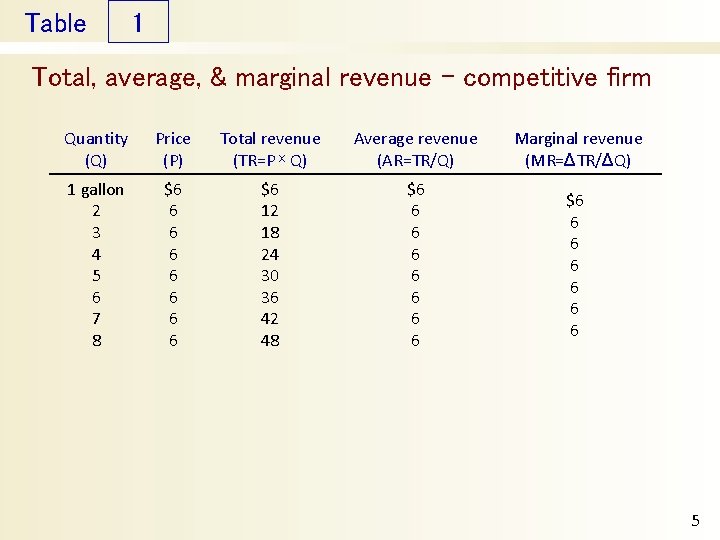
What is a Competitive Market? • The revenue of a competitive firm – Maximize profit • Total revenue minus total cost • Total revenue = price times quantity = P ˣ Q – Proportional to the amount of output • Average revenue – Total revenue divided by the quantity sold 3
What is a Competitive Market? • The revenue of a competitive firm • Marginal revenue – Change in total revenue from an additional unit sold • For competitive firms – Average revenue = P – Marginal revenue = P 4
Table 1 Total, average, & marginal revenue - competitive firm Quantity (Q) Price (P) Total revenue (TR=P ˣ Q) Average revenue (AR=TR/Q) Marginal revenue (MR=ΔTR/ΔQ) 1 gallon 2 3 4 5 6 7 8 $6 6 6 6 $6 12 18 24 30 36 42 48 $6 6 6 6 5
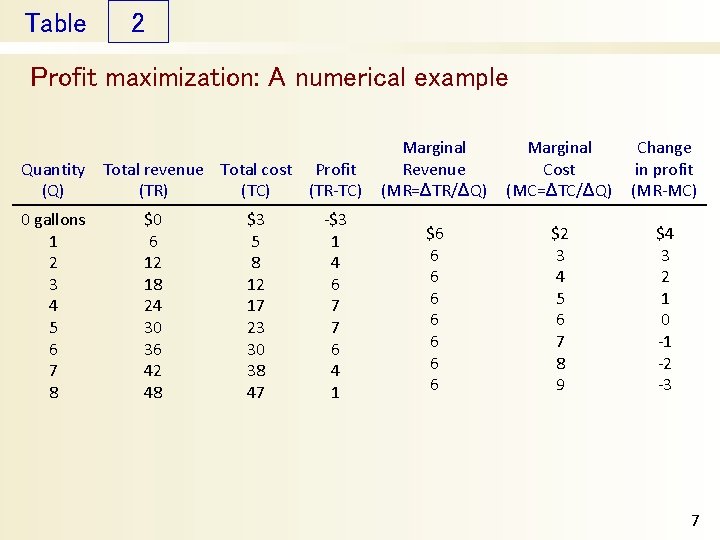
Profit Maximization& Competitive Firm’s Supply Curve • A simple example of profit maximization • Maximize profit – Produce quantity where total revenue minus total cost is greatest – Compare marginal revenue with marginal cost • If MR > MC – increase production • If MR < MC – decrease production 6
Table 2 Profit maximization: A numerical example Quantity Total revenue Total cost Profit (Q) (TR) (TC) (TR-TC) 0 gallons 1 2 3 4 5 6 7 8 $0 6 12 18 24 30 36 42 48 $3 5 8 12 17 23 30 38 47 -$3 1 4 6 7 7 6 4 1 Marginal Revenue (MR=ΔTR/ΔQ) Marginal Cost (MC=ΔTC/ΔQ) Change in profit (MR-MC) $6 6 6 6 $2 3 4 5 6 7 8 9 $4 3 2 1 0 -1 -2 -3 7
Profit Maximization& Competitive Firm’s Supply Curve • The marginal-cost curve and the firm’s supply decision – MC curve – upward sloping – ATC curve – U-shaped – MC curve crosses the ATC curve at the minimum of ATC curve – P = AR = MR 8
Profit Maximization& Competitive Firm’s Supply Curve • The marginal-cost curve and the firm’s supply decision • Three general rules for profit maximization: – If MR > MC - firm should increase output – If MC > MR - firm should decrease output – If MR = MC - profit-maximizing level of output 9
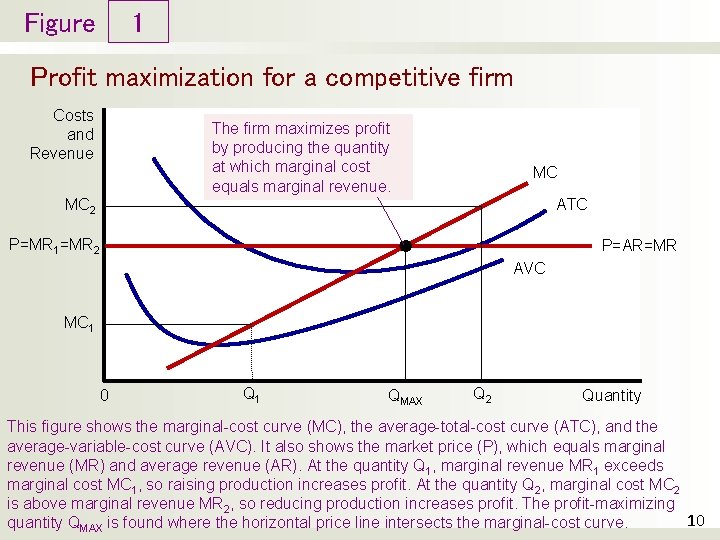
Figure 1 Profit maximization for a competitive firm Costs and Revenue The firm maximizes profit by producing the quantity at which marginal cost equals marginal revenue. MC ATC MC 2 P=MR 1=MR 2 P=AR=MR AVC MC 1 0 Q 1 QMAX Q 2 Quantity This figure shows the marginal-cost curve (MC), the average-total-cost curve (ATC), and the average-variable-cost curve (AVC). It also shows the market price (P), which equals marginal revenue (MR) and average revenue (AR). At the quantity Q 1, marginal revenue MR 1 exceeds marginal cost MC 1, so raising production increases profit. At the quantity Q 2, marginal cost MC 2 is above marginal revenue MR 2, so reducing production increases profit. The profit-maximizing 10 quantity QMAX is found where the horizontal price line intersects the marginal-cost curve.
Profit Maximization& Competitive Firm’s Supply Curve • The marginal-cost curve and the firm’s supply decision • Marginal-cost curve – Determines the quantity of the good the firm is willing to supply at any price – Is the supply curve 11
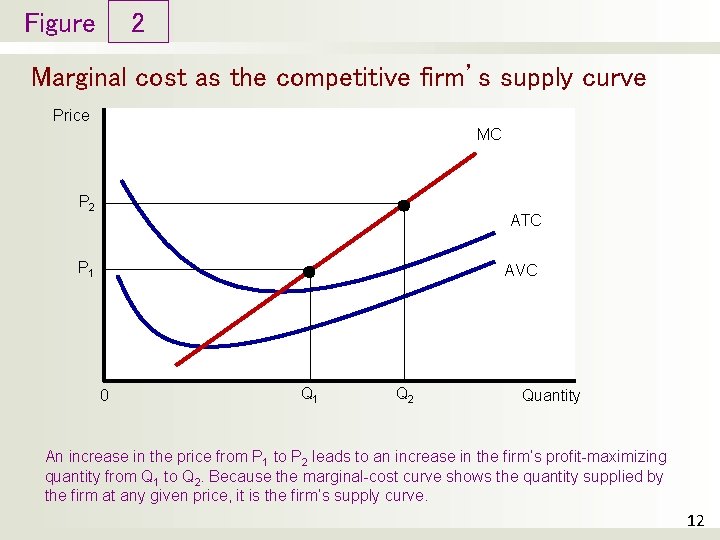
Figure 2 Marginal cost as the competitive firm’s supply curve Price MC P 2 ATC P 1 AVC 0 Q 1 Q 2 Quantity An increase in the price from P 1 to P 2 leads to an increase in the firm’s profit-maximizing quantity from Q 1 to Q 2. Because the marginal-cost curve shows the quantity supplied by the firm at any given price, it is the firm’s supply curve. 12
Profit Maximization& Competitive Firm’s Supply Curve • Shutdown – Short-run decision not to produce anything • During a specific period of time • Because of current market conditions – Firm still has to pay fixed costs • Exit – Long-run decision to leave the market – Firm doesn’t have to pay any costs 13
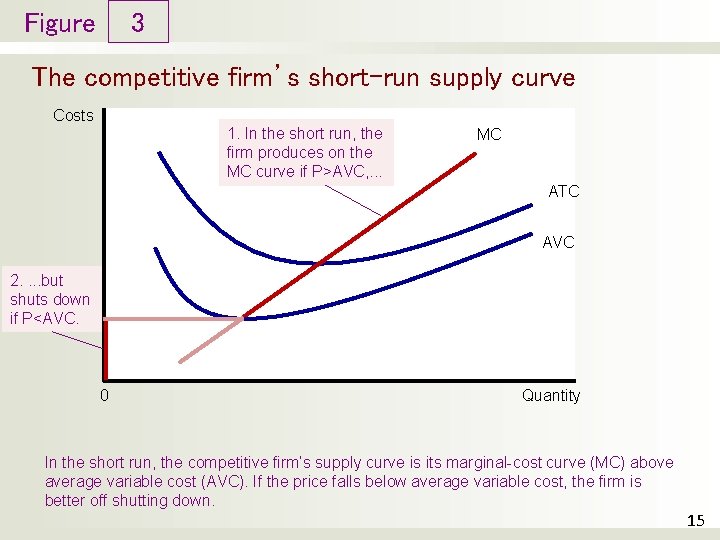
Profit Maximization& Competitive Firm’s Supply Curve • The firm’s short-run decision to shut down – TR = total revenue – VC = variable costs • Firm’s decision: – Shut down if TR<VC (P<AVC) • Competitive firm’s short-run supply curve – The portion of its marginal-cost curve – That lies above average variable cost 14
Figure 3 The competitive firm’s short-run supply curve Costs 1. In the short run, the firm produces on the MC curve if P>AVC, . . . MC ATC AVC 2. . but shuts down if P<AVC. 0 Quantity In the short run, the competitive firm’s supply curve is its marginal-cost curve (MC) above average variable cost (AVC). If the price falls below average variable cost, the firm is better off shutting down. 15
Profit Maximization& Competitive Firm’s Supply Curve • Spilt milk and other sunk costs • Sunk cost – Has already been committed – Cannot be recovered – Ignore them when making decisions 16
Near-empty restaurants and off-season miniature golf • Restaurant – stay open for lunch? – Fixed costs • Not relevant • Are sunk costs in short run – Variable costs – relevant – Shut down if revenue from lunch < variable costs – Stay open if revenue from lunch > variable costs • Operator of a miniature-golf course – Ignore fixed costs – Stay open if revenue > variable costs 17
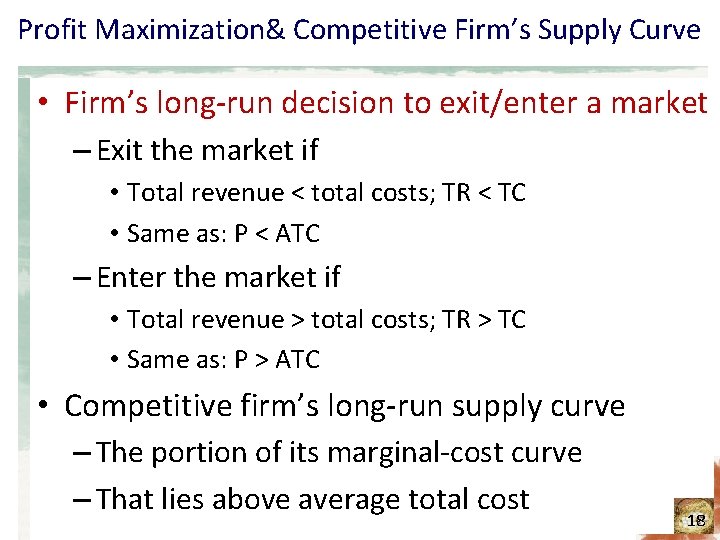
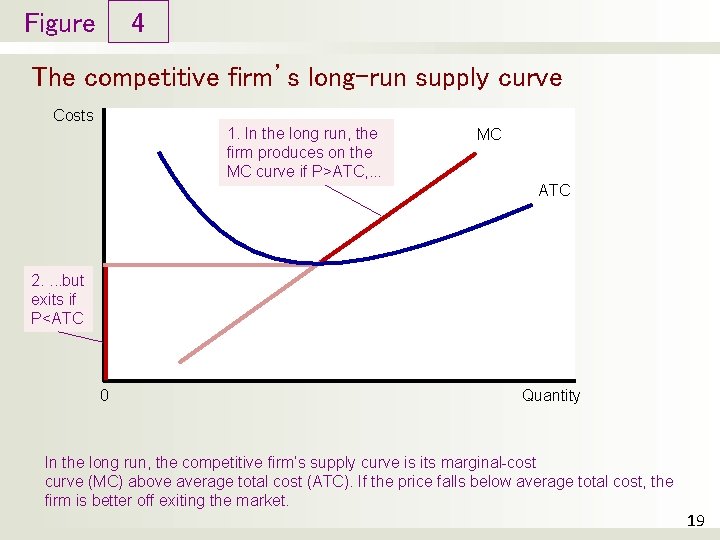
Profit Maximization& Competitive Firm’s Supply Curve • Firm’s long-run decision to exit/enter a market – Exit the market if • Total revenue < total costs; TR < TC • Same as: P < ATC – Enter the market if • Total revenue > total costs; TR > TC • Same as: P > ATC • Competitive firm’s long-run supply curve – The portion of its marginal-cost curve – That lies above average total cost 18
Figure 4 The competitive firm’s long-run supply curve Costs 1. In the long run, the firm produces on the MC curve if P>ATC, . . . MC ATC 2. . but exits if P<ATC 0 Quantity In the long run, the competitive firm’s supply curve is its marginal-cost curve (MC) above average total cost (ATC). If the price falls below average total cost, the firm is better off exiting the market. 19
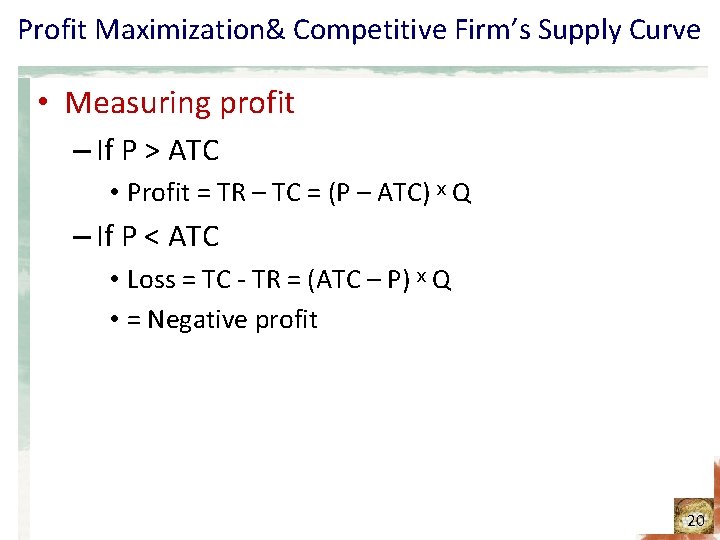
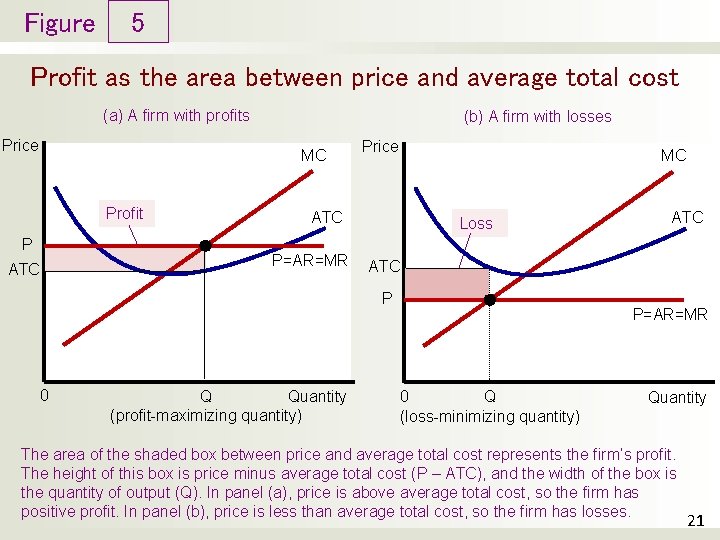
Profit Maximization& Competitive Firm’s Supply Curve • Measuring profit – If P > ATC • Profit = TR – TC = (P – ATC) ˣ Q – If P < ATC • Loss = TC - TR = (ATC – P) ˣ Q • = Negative profit 20
Figure 5 Profit as the area between price and average total cost (a) A firm with profits Price (b) A firm with losses MC Profit P ATC Price MC ATC P=AR=MR Loss ATC P 0 Q Quantity (profit-maximizing quantity) ATC P=AR=MR 0 Q (loss-minimizing quantity) Quantity The area of the shaded box between price and average total cost represents the firm’s profit. The height of this box is price minus average total cost (P – ATC), and the width of the box is the quantity of output (Q). In panel (a), price is above average total cost, so the firm has positive profit. In panel (b), price is less than average total cost, so the firm has losses. 21
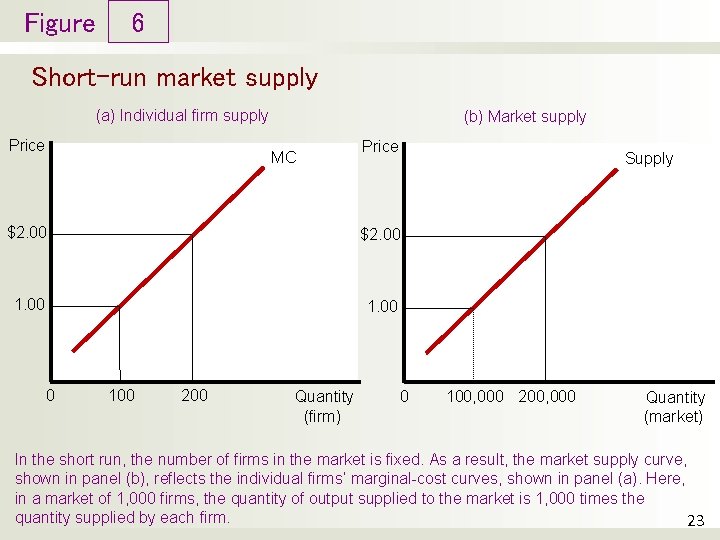
Supply Curve in a Competitive Market • Short run: market supply with a fixed number of firms – Short run – number of firms is fixed – Each firm – supplies quantity where P = MC • For P > AVC: supply curve is MC curve – Market supply • Add up quantity supplied by each firm 22
Figure 6 Short-run market supply (a) Individual firm supply Price (b) Market supply MC Price Supply $2. 00 1. 00 0 100 200 Quantity (firm) 0 100, 000 200, 000 Quantity (market) In the short run, the number of firms in the market is fixed. As a result, the market supply curve, shown in panel (b), reflects the individual firms’ marginal-cost curves, shown in panel (a). Here, in a market of 1, 000 firms, the quantity of output supplied to the market is 1, 000 times the quantity supplied by each firm. 23
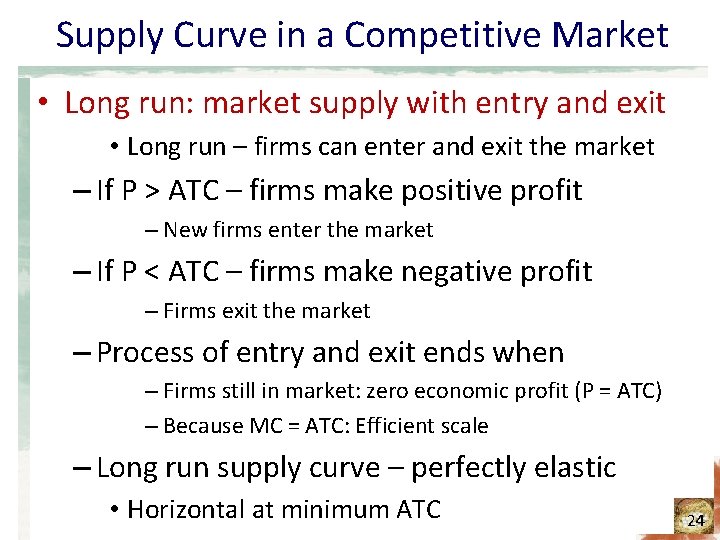
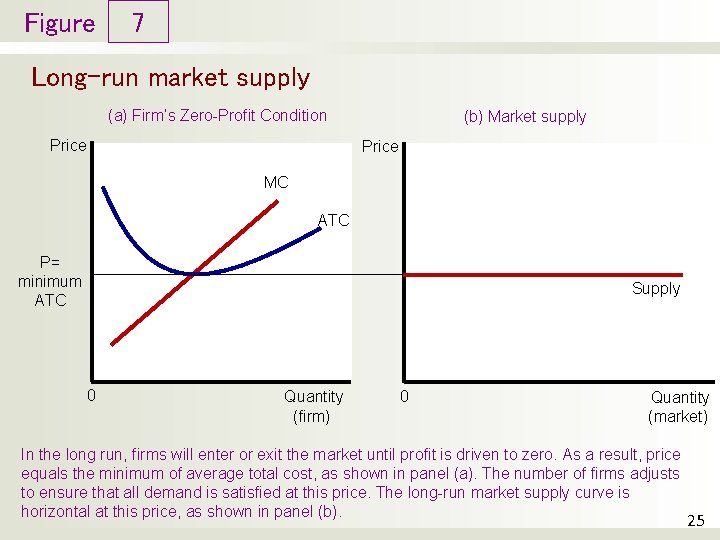
Supply Curve in a Competitive Market • Long run: market supply with entry and exit • Long run – firms can enter and exit the market – If P > ATC – firms make positive profit – New firms enter the market – If P < ATC – firms make negative profit – Firms exit the market – Process of entry and exit ends when – Firms still in market: zero economic profit (P = ATC) – Because MC = ATC: Efficient scale – Long run supply curve – perfectly elastic • Horizontal at minimum ATC 24
Figure 7 Long-run market supply (a) Firm’s Zero-Profit Condition Price (b) Market supply Price MC ATC P= minimum ATC Supply 0 Quantity (firm) 0 Quantity (market) In the long run, firms will enter or exit the market until profit is driven to zero. As a result, price equals the minimum of average total cost, as shown in panel (a). The number of firms adjusts to ensure that all demand is satisfied at this price. The long-run market supply curve is horizontal at this price, as shown in panel (b). 25
Supply Curve in a Competitive Market • Why do competitive firms stay in business if they make zero profit? – Profit = total revenue – total cost – Total cost – includes all opportunity costs – Zero-profit equilibrium • Economic profit is zero • Accounting profit is positive 26
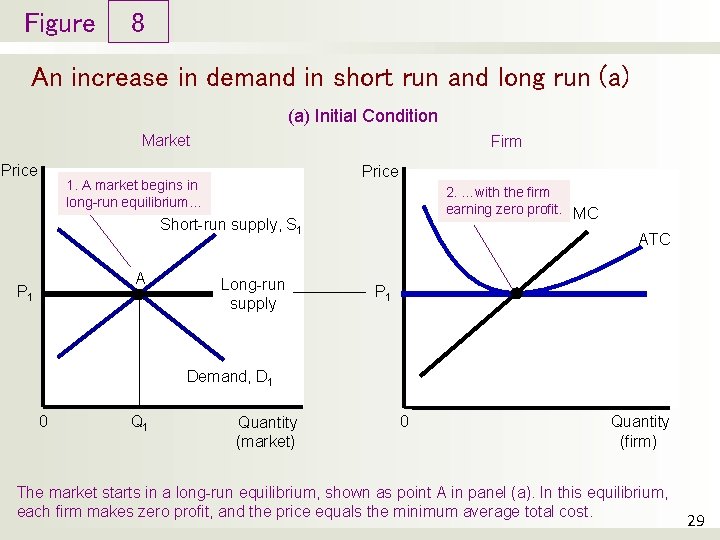
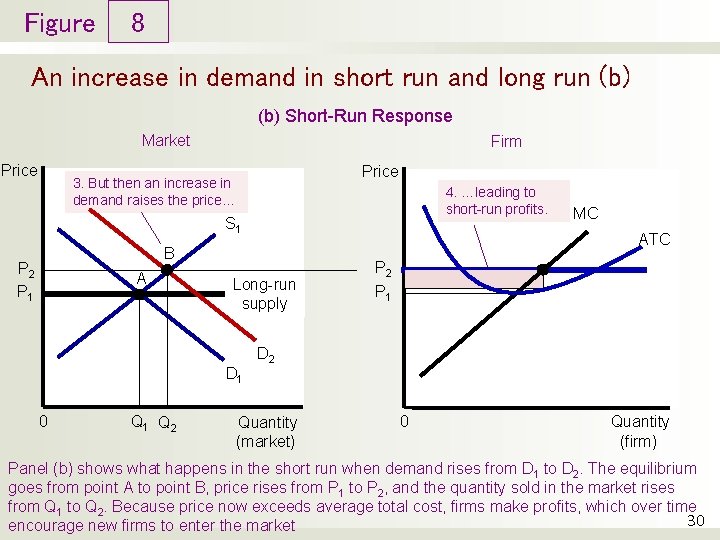
Supply Curve in a Competitive Market • A shift in demand in the short run & long run • Market – in long run equilibrium – P = minimum ATC – Zero economic profit • Increase in demand – Demand curve – shifts outward – Short run • Higher quantity • Higher price: P > ATC – positive economic profit 27
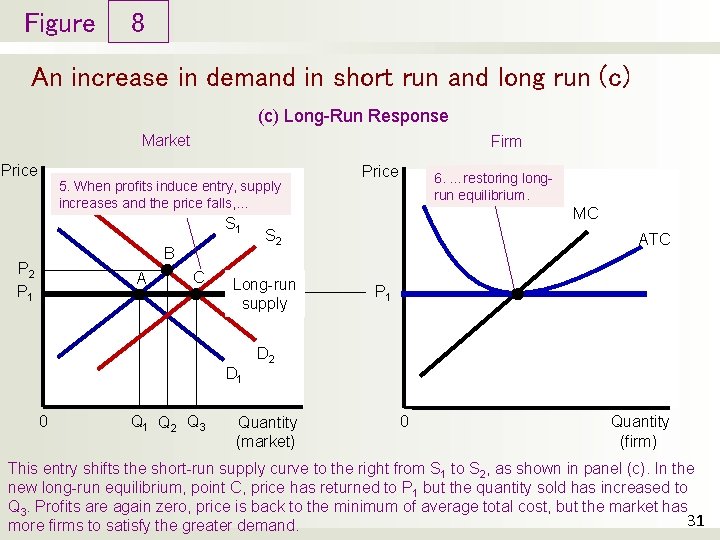
Supply Curve in a Competitive Market • A shift in demand in the short run & long run • Because: positive economic profit in short run • Long run – firms enter the market – Short run supply curve – shifts right – Price – decreases back to minimum ATC – Quantity – increases • Because there are more firms in the market – Efficient scale 28
Figure 8 An increase in demand in short run and long run (a) Initial Condition Market Price Firm Price 1. A market begins in long-run equilibrium… 2. …with the firm earning zero profit. MC Short-run supply, S 1 A P 1 Long-run supply ATC P 1 Demand, D 1 0 Q 1 Quantity (market) 0 Quantity (firm) The market starts in a long-run equilibrium, shown as point A in panel (a). In this equilibrium, each firm makes zero profit, and the price equals the minimum average total cost. 29
Figure 8 An increase in demand in short run and long run (b) Short-Run Response Market Price Firm Price 3. But then an increase in demand raises the price… 4. …leading to short-run profits. S 1 ATC B P 2 P 1 A Long-run supply D 1 0 Q 1 Q 2 MC P 2 P 1 D 2 Quantity (market) 0 Quantity (firm) Panel (b) shows what happens in the short run when demand rises from D 1 to D 2. The equilibrium goes from point A to point B, price rises from P 1 to P 2, and the quantity sold in the market rises from Q 1 to Q 2. Because price now exceeds average total cost, firms make profits, which over time 30 encourage new firms to enter the market
Figure 8 An increase in demand in short run and long run (c) Long-Run Response Market Price Firm 5. When profits induce entry, supply increases and the price falls, … S 1 B P 2 P 1 A C 0 Q 1 Q 2 Q 3 6. …restoring longrun equilibrium. MC S 2 Long-run supply D 1 Price ATC P 1 D 2 Quantity (market) 0 Quantity (firm) This entry shifts the short-run supply curve to the right from S 1 to S 2, as shown in panel (c). In the new long-run equilibrium, point C, price has returned to P 1 but the quantity sold has increased to Q 3. Profits are again zero, price is back to the minimum of average total cost, but the market has 31 more firms to satisfy the greater demand.
Supply Curve in a Competitive Market • Why the long-run supply curve might slope upward – Some resource used in production may be available only in limited quantities • Increase in quantity supplied – increase in costs – increase in price – Firms may have different costs • Some firms earn profit even in the long run • Long-run supply curve – More elastic than short-run supply curve 32