
Chapter 13 FABRIC FINISHES 1 FINISHING PROCESSES Finish

Chapter 13 FABRIC FINISHES 1

FINISHING PROCESSES Finish = special treatments applied to improve a fabric’s appearance, texture or performance Finishes added to reduce undesirable characteristics Some add a design like a stripe or print Some add soft, firm or smoother han 2
COLOR & DESIGN FINISHES � Gray goods = fabric first off the loom lacks color � Cleaned soil to remove oils, resins, gums or 3

DYEING TEXTILES � Dyes are compounds that penetrate and color fibers � Obtained from plants, insects, shellfish and minerals � Synthetic developed by accident in 1856 4

� Today computers develop exact formulas for dyeing 5
5 METHODS: � Stock dyeing= natural fibers dyed before they are spun into yarns � Permits yarns spinning of tweed and multicolored � Solution dyeing=manufactured fibers are produced and dye is put in liquid solution and run through spinnerets (permanent part) 6
� Yarn dyeing = yarns are dyed before weaving or knitting � Used � Piece for plaids, checks and stripes dying =dyed after weaving or knitting � Garment dyeing =fabric cut and sewn into finished product and then entire garment is dyed 7

COLORFASTNESS � Colorfast � Most = fabric color won’t change dyes aren’t colorfast to everything � Always read the label � Some are supposed to loose color like denim jeans and madras (woven fabric that bleeds) 8
PRINTING TEXTILES � Printing = color is transferred to the surface of a fabric to form a pattern � Some printing techniques are very old and still used by some craftsmen 9
4 COMMON PRINTING METHODS 1 = screen printing � Metal mesh screens stretched on frames � Each screen prepared with color and design � 2 = roller printing � Roller chemically etched with pattern part for a particular color � Raised sections of roller pick up desired color � 10
3 = rotary screen printing � Faster � Produces 3500 yards per hour � � Metal foil, less costly 4 = heat-transfer printing � Paper pattern for design with heat sensitive dyes � Design on reverse side � Transferred to fabric when heat applied � 11
TEXTURE & PERFORMANCE FINISHES � Texture finishes � Type of finish that improves surface texture and hand 12
� Calendering � Fabric passes between 2 heated rollers that smooth fabric and improve luster 13
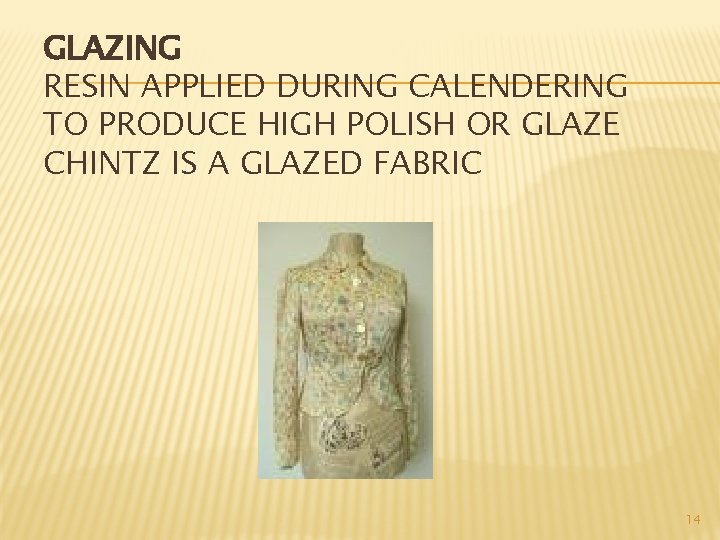
GLAZING RESIN APPLIED DURING CALENDERING TO PRODUCE HIGH POLISH OR GLAZE CHINTZ IS A GLAZED FABRIC 14
� Embossing � Fabric is given a raised design on surface � Cire ` (suh-RAY) � Super-glossy finish is obtained by applying wax � Sometimes used in lightweight jackets 15
� Moire` (mwah-RAY) � Watered or wavy pattern is obtained by calendering 2 layers of fabric slightly off grain � Used for evening wear 16
� Napping � Rotating wire brushes raise short fiber ends of staple yarns to create a soft and fuzzy surface called NAP � Flannel is napped 17
� Stone washing and acid washing � Pumice stones sometimes dampened with an oxidizing bleach to laundry process � Provide abrasion that makes denim look worn and partially faded 18
� Mercerization � Gives cotton added luster, strength, drapability � Improves fiber’s affinity for dye 19
� Sizing � Starches or resins are added to fabric for extra body � Usually only a temporary finish 20
PERFORMANCE FINISHES � Antibacterial/antiseptic � Finish checks the growth of bacteria, fungi (mold and mildew) � Germs that cause odor, disease and infectin are reduced or even eliminated � Brand names are Sanitized and Pacificate 21
� Antistatic � Finish reduces fabric dryness that causes static electricity � Fabrics don’t cling 22
� Crease-resistant � CRF – resin finish that helps fabrics resist wrinkling � Applied to fabrics made from fibers that wrinkling easily including cotton, rayon and flax 23
� Durable press � Maintain a pressed appearance despite repeated washings and wearings � Through heat setting resin curing or an ammonia process fabric fibers are stabilized � 100% cotton is treated this way � “Wrinlke free, wrinkle resistant, no iron” 24
� Flame-resistant and flame retardant � Finishes reduce flaming and burinng in fabrics exposed to flame or high heat � Used in children’s sleepwear � Special care may be needed to maintain finish 25
� Mothproof � Repel moths and other fiber eating insects � Wool fibers � Added when dye is added 26
� Shrinkage � Don’t � But control guarantee no shrinkage will be minimal even after laundering � “Sanforized” assures that it won’t shrink more than 1% 27
� Soil release � Dirt and stains remove more easily � Durable through 40 – 50 washings 28
� Water � Help and stain repellent fabric repel water and oil based stains � Coated with chemical that resists water and other liquids � Drops remain on surface- can get wet though � May have to be redone if dry cleaned 29
� Waterproof � Finishes � Coated keep fabric and wearer dry or treated so no water penetrates � May be uncomfortable to wear but newer ones are more breathable (Gor. Tex) 30
SUMMARY � Finishes are applied to improve a fabric’s appearance, texture, and performance � Some finishes are permanent and some are temporary 31
� Some finishes add color or designs to fabirs or fabrics � Texture finishes change a fabric’s look, feel and hand 32
� Performance finishes make fabrics easier to care for and more useful � Some finishes can be diminished or destroyed by improper fabric care 33
- Slides: 33