
CHAPTER 13 Ethernet and TCPIP Networking The Architecture



- Slides: 25
CHAPTER 13: Ethernet and TCP-IP Networking The Architecture of Computer Hardware, Systems Software & Networking: An Information Technology Approach 4 th Edition, Irv Englander John Wiley and Sons © 2010 Power. Point slides authored by Wilson Wong, Bentley University Power. Point slides for the 3 rd edition were co-authored with Lynne Senne, Bentley College
Chapter Example ▪ User sitting at a computer types a URL that contains a domain name into a web browser ▪ First, HTTP client obtains the IP address of the Web server ▪ Then HTTP client initiates the process with a request to the TCP socket to establish a logical connection with the HTTP server at the destination site Copyright 2010 John Wiley & Sons, Inc. 13 -*
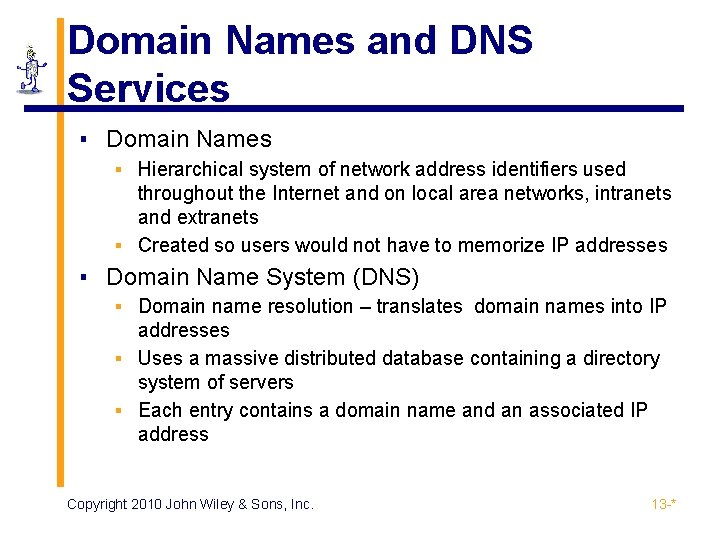
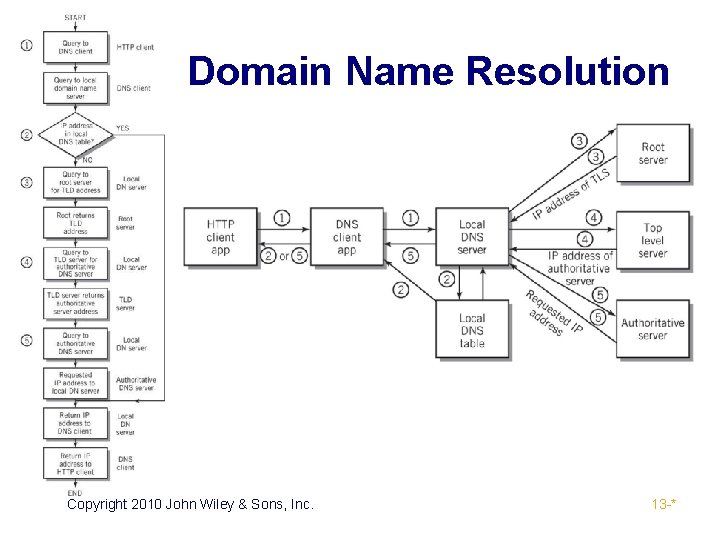
Domain Names and DNS Services ▪ Domain Names ▪ Hierarchical system of network address identifiers used throughout the Internet and on local area networks, intranets and extranets ▪ Created so users would not have to memorize IP addresses ▪ Domain Name System (DNS) ▪ Domain name resolution – translates domain names into IP addresses ▪ Uses a massive distributed database containing a directory system of servers ▪ Each entry contains a domain name and an associated IP address Copyright 2010 John Wiley & Sons, Inc. 13 -*
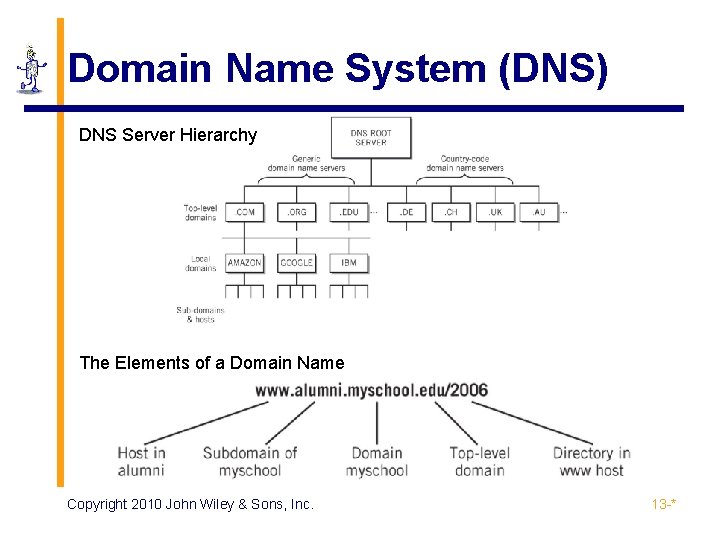
Domain Name System (DNS) DNS Server Hierarchy The Elements of a Domain Name Copyright 2010 John Wiley & Sons, Inc. 13 -*
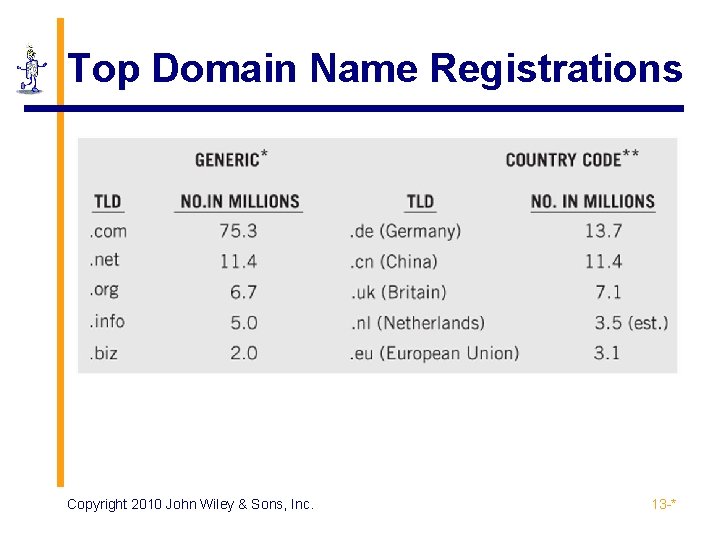
Top Domain Name Registrations Copyright 2010 John Wiley & Sons, Inc. 13 -*
Domain Name Resolution Copyright 2010 John Wiley & Sons, Inc. 13 -*
Transport Layer ▪ TCP protocol ▪ Sends a packet to TCP at the destination site, requesting a connection ▪ Handshaking – back and forth series of requests and acknowledgments ▪ If handshaking negotiations are successful, a connection is opened ▪ Connection is logically full-duplex Copyright 2010 John Wiley & Sons, Inc. 13 -*
Three-Way TCP Connection Handshake Copyright 2010 John Wiley & Sons, Inc. 13 -*
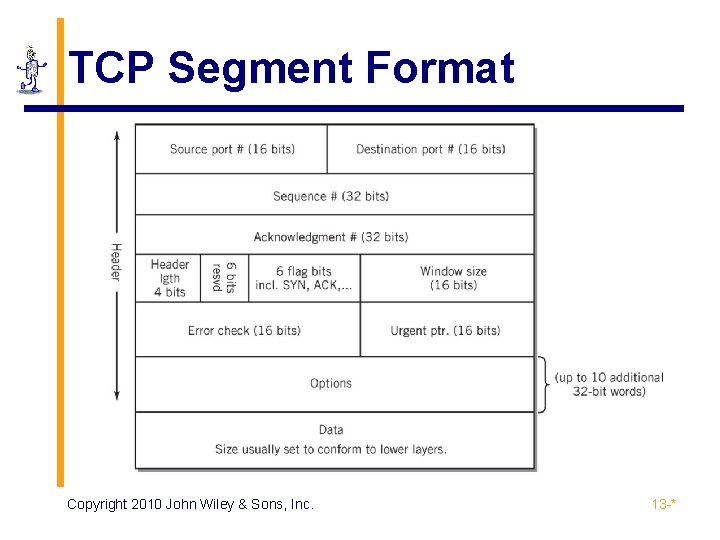
TCP Segment Format Copyright 2010 John Wiley & Sons, Inc. 13 -*
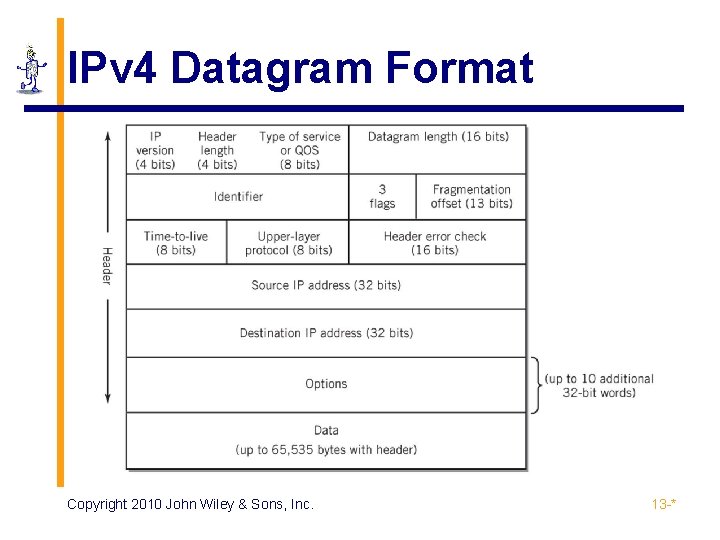
Network Layer ▪ IP protocol ▪ Responsible for relaying packets from the source end node to the destination end node through intermediate nodes ▪ Performed using datagram packet switching and logical IP addresses ▪ Best-attempt unreliable service ▪ Size of datagram ranges from 20 to 65, 536 bytes ▪ Header size between 20 and 60 bytes Copyright 2010 John Wiley & Sons, Inc. 13 -*
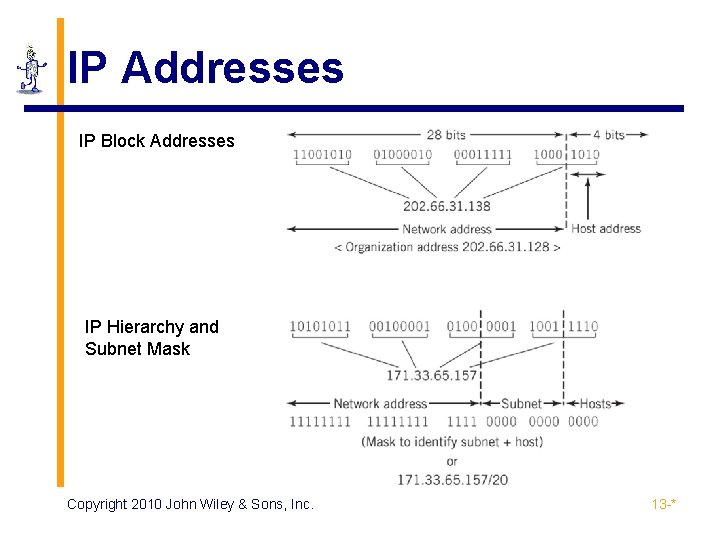
IPv 4 Addresses ▪ Registered and allocated by ICANN ▪ 32 bits long divided into 4 octets ▪ Assigned in blocks of contiguous addresses ▪ Number of addresses is a power of two ▪ Divided into three levels ▪ Network address ▪ Subnetworks (subnets) ▪ Hosts (nodes) ▪ Masks ▪ Used to separate the different parts of the address Copyright 2010 John Wiley & Sons, Inc. 13 -*
IPv 4 Datagram Format Copyright 2010 John Wiley & Sons, Inc. 13 -*
IP Addresses IP Block Addresses IP Hierarchy and Subnet Mask Copyright 2010 John Wiley & Sons, Inc. 13 -*
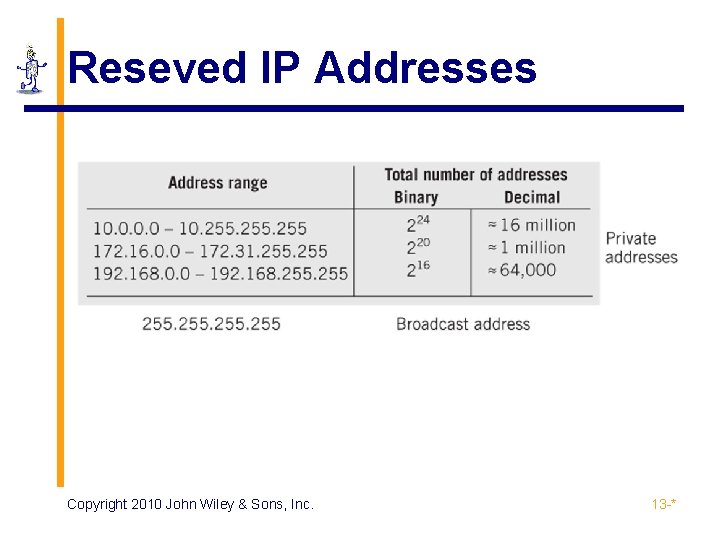
Reseved IP Addresses Copyright 2010 John Wiley & Sons, Inc. 13 -*
DHCP Two methods to distribute IP addresses more efficiently: 1. Use of private network IP addresses behind a router • • The router must readdress traffic passing between the Internet and the local network Management of readdressing becomes difficult with large networks 2. Dynamic Host Configuration Protocol (DHCP) ▪ ▪ Maintain a bank of available IP addresses and assign them dynamically to computers for use when the computers are attached to the network Method often used by large organizations, DSL and cable providers DHCP client on computer or network device broadcasts a query to locate the DHCP server responds with a lease which includes an IP address, domain name of network, IP address of DNS server, subnet mask, IP address of gateway and other configuration parameters Copyright 2010 John Wiley & Sons, Inc. 13 -*
Operation of IP ▪ Two major functions ▪ Routes datagrams from node to node until they reach their destination node ▪ Translates IP addresses to physical addresses before it passes the packets to the data link later for delivery ▪ Address Resolution Protocol (ARP) ▪ Implemented at the network layer ▪ Translation of IP address to physical address at each intermediate node until destination is reached ▪ A broadcast of the IP address is sent to every node on the network. The matching node responds with a physical address ▪ Physical address (MAC address in the case of Ethernet) is sent in frame to the data link layer ▪ At final destination, the packet is passed up to the transport layer for deployment to the application layer Copyright 2010 John Wiley & Sons, Inc. 13 -*
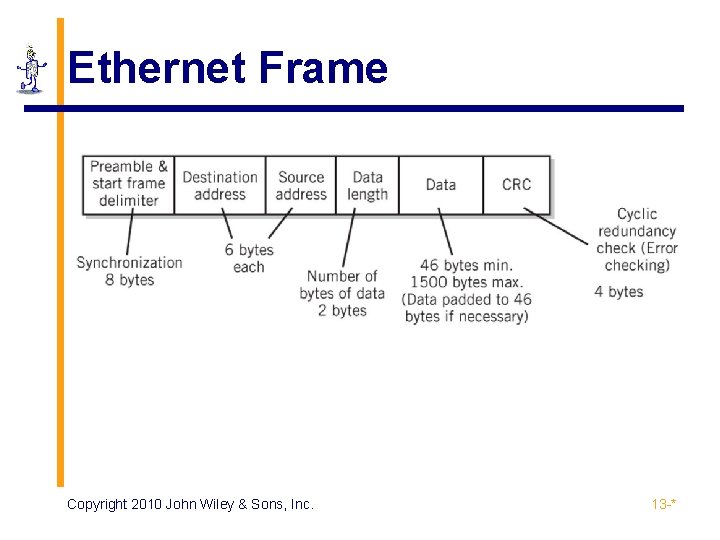
Data Link Layer ▪ Layer responsible for transmitting a packet from one node to the next node ▪ Node access defined by the medium access control (MAC) protocol ▪ Steer data to its destination ▪ Detect errors ▪ Prevent collisions ▪ Ethernet (CSMA-CD) ▪ Predominant medium-access protocol for local area networks ▪ Standard Ethernet packet is a frame (see next slide) Copyright 2010 John Wiley & Sons, Inc. 13 -*
Ethernet Frame Copyright 2010 John Wiley & Sons, Inc. 13 -*
Hub-Based Ethernet ▪ ▪ Simple means of wiring a bussed Ethernet together Logically still a bus network CSMA-CD Collision ▪ Occurs when multiple nodes access the network in such a way that their messages become mixed and garbled ▪ Network propagation delay ▪ Amount of time that it takes for one packet to get from one end of the network to the other ▪ Adequate for networks with light traffic Copyright 2010 John Wiley & Sons, Inc. 13 -*
Switched Ethernet ▪ ▪ Permits point-to-point connection of any pair of nodes Multiple pairs can be connected simultaneously Possible to connect nodes in full-duplex mode Each pair of connections operates at the maximum bit rate of the network ▪ Why can’t there be any collisions in a switched Ethernet network? Copyright 2010 John Wiley & Sons, Inc. 13 -*
Quality of Service (Qo. S) 1. Methods to reserve and prioritize channel capacity to favor packets that require special treatment 2. Service guarantees from contract carrier services that specify particular levels of throughput, delay and jitter ▪ Jitter – variation in delay from packet to packet ▪ Differentiated service (Diff. Serv) ▪ 8 -bit (DS) field in IP header ▪ Set by the application at the sender or by the first node ▪ Diffserv capable nodes such as routers can then prioritize and route packets based on the packet class Copyright 2010 John Wiley & Sons, Inc. 13 -*
Network Security Categories 1. Intrusion ▪ Keeping network and system resources free from intruders 2. Confidentiality ▪ Keeping the content of data private 3. Authentication ▪ Verifying the identity of a source of data being received 4. Data integrity and non-repudiation ▪ Protecting the content of data communication against changes and verifying the source of the message 5. Assuring network availability and access control ▪ Keep network resources operational and restricting access to those permitted to use them Copyright 2010 John Wiley & Sons, Inc. 13 -*
Network Security ▪ Network intrusions ▪ Packet sniffers read data in a packet as it passes through a network ▪ Probing attacks to uncover IP address / port numbers that accept data packets ▪ Physical and Logical Restriction ▪ Limit access to wiring and network equipment ▪ Firewall ▪ Private networks ▪ Encryption ▪ Symmetric key cryptography • • Both key used for encryption and decryption Both sender and receiver use the same key which makes security difficult ▪ Public key cryptography • Two different keys are used for encryption and decryption Copyright 2010 John Wiley & Sons, Inc. 13 -*
Alternative Protocols to TCP/IP ▪ MPLS (Multi-Protocol Label Switching) ▪ Creates a virtual circuit over packet switched networks to improve forwarding speed of datagrams ▪ ATM (Asynchronous Transfer Mode) ▪ Partial-mesh network technology in which data passes through the network in cells (53 -byte packets) ▪ SONET (Synchronous Optical Network) and SDH (Synchronous Digital Hierarchy) ▪ Protocol that uses fiber optic to create wide area networks with very high bit rates over long distances ▪ Frame Relay ▪ Slow, wide area network standard Copyright 2010 John Wiley & Sons, Inc. 13 -*
Copyright 2010 John Wiley & Sons All rights reserved. Reproduction or translation of this work beyond that permitted in section 117 of the 1976 United States Copyright Act without express permission of the copyright owner is unlawful. Request for further information should be addressed to the Permissions Department, John Wiley & Sons, Inc. The purchaser may make back-up copies for his/her own use only and not for distribution or resale. The Publisher assumes no responsibility for errors, omissions, or damages caused by the use of these programs or from the use of the information contained herein. ” Copyright 2010 John Wiley & Sons, Inc. 13 -*