
CHAPTER 13 EMPLOYEE SEPARATION Power Point Presentation by
CHAPTER 13 EMPLOYEE SEPARATION Power. Point Presentation by Charlie Cook Copyright © 2002 South-Western. All rights reserved
Employee Separation • Reasons for employee separations: –Pressures on firms to remain competitive and efficient –Decline in employee commitment to individual employers • The importance of managing separations: –Transitions of employees out of the firm go smoothly. –Continuing operations of the firm are not disrupted. –Important professional relationships are not damaged. • Types of separations –Reductions-in-force, turnover, and retirements Copyright © 2002 South-Western. All rights reserved. 2
Reductions-in-Force (RIFs) • Causes of reductions: –Restructuring as a result of mergers and acquisitions –Attempts to make the organization more cost competitive –Adjustments to declining business environment conditions • Reasons for reductions: –Inefficiency in operations –Lack of adaptability in the marketplace –A weakened competitive position in the industry • Methods for dealing with reductions: –Continuance pay and outplacement programs Copyright © 2002 South-Western. All rights reserved. 3
Reductions-in-Force (RIFs) • Worker Adjustment Retraining and Notification Act (WARN) of 1989: –Requires employers with more than 100 employees to provide affected employees with a minimum of sixty days written notice of any facility closings or large-scale layoffs of 50 or more employees. –WARN does no apply to governmental agencies. –Exceptions to WARN: • “faltering company” • “unforeseeable circumstance” • natural disaster • “temporary facility” Copyright © 2002 South-Western. All rights reserved. 4
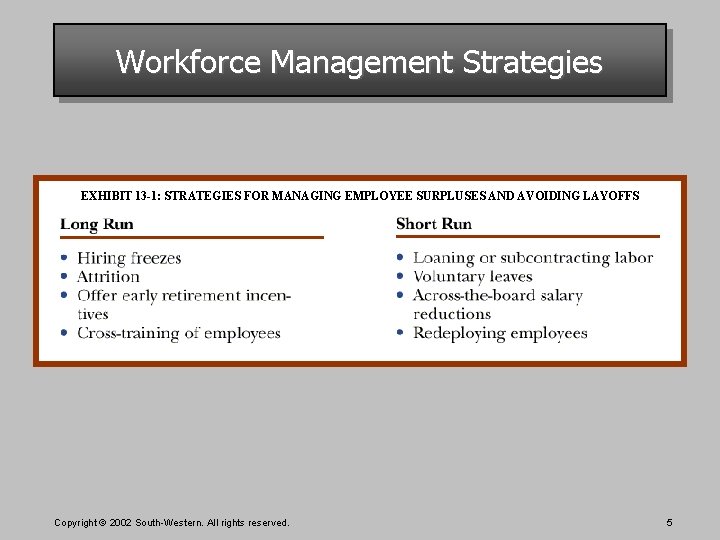
Workforce Management Strategies EXHIBIT 13 -1: STRATEGIES FOR MANAGING EMPLOYEE SURPLUSES AND AVOIDING LAYOFFS Copyright © 2002 South-Western. All rights reserved. 5
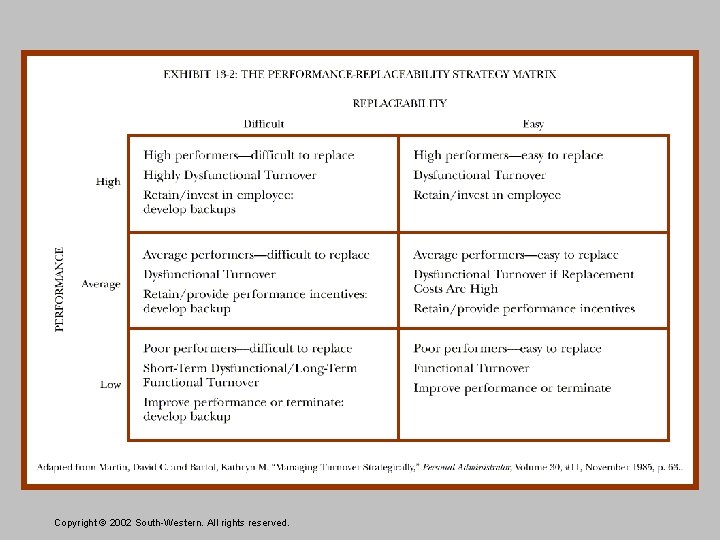
Turnover • Involuntary turnover –Employees who are asked to leave the organization for cause (e. g. , poor performance) or due to circumstances that cause a reduction-in-force. • Voluntary turnover –Employees who leave an organization on their own initiative. • “Beneficial” turnover –When low performing employees depart and/or when new higher performing employees are promoted or hired as replacements. Copyright © 2002 South-Western. All rights reserved. 6
Copyright © 2002 South-Western. All rights reserved.
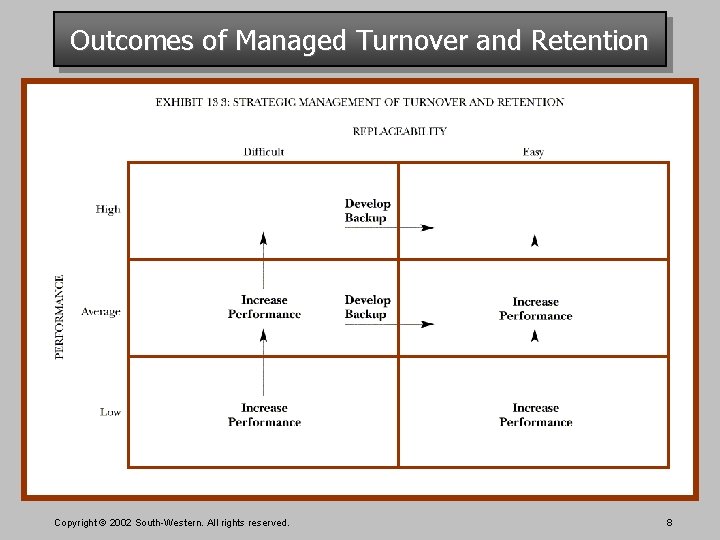
Outcomes of Managed Turnover and Retention Copyright © 2002 South-Western. All rights reserved. 8
Retirement • Age Discrimination Act of 1967 –Prohibits an employer from setting a mandatory retirement age except in certain occupations such as airline pilots. • Retirement –Creates advancement opportunities for younger employees and reduces payroll costs. –Can cause a loss of vital accumulated historical knowledge of the organization, its industry and the marketplace. –Employers can offer part-time and consulting work to older workers to ease the transition to retirement. Copyright © 2002 South-Western. All rights reserved. 9
Reading 13. 1: Holding on to High Performers: A Strategic Approach to Retention • Major turnover trends: –Increasing turnover rates are having a significant impact on organizational success. –The costs associated with turnover, especially that of high performers, continues to escalate. • Why companies fail to address the turnover issue: –A pervasive belief that high turnover is inevitable in a strong economy. –The failure of companies to develop effective strategies for managing employee turnover. Copyright © 2002 South-Western. All rights reserved. 10
Reading 13. 1: Holding on to High Performers: A Strategic Approach to Retention • Strategically managing retention involves: –Selection and orientation of individuals who possess the skills needed to succeed and also fit with the organization. –Training and career management to provide employees with growth and learning opportunities. –Offering motivation and compensation packages that provide customized non-financial performance incentives and financial rewards for individual employees. –Designing retention strategies that reflect the organization’s particular situational factors and its goals. Copyright © 2002 South-Western. All rights reserved. 11
Reading 13. 2: Retirement of Older Workers: Issues and Policies • Arguments for mandatory retirement – Assumes that job performance and age become negatively correlated after a worker reaches a certain age. – Enables “retirement with dignity” and allows for dismissal without a cause other than age. – Minimizes need to monitor and assess older worker performance. – Justifies compensation sequencing schemes that underpay younger workers and overpay older workers. – Assumes older workers are less trainable or adaptable. Copyright © 2002 South-Western. All rights reserved. 12
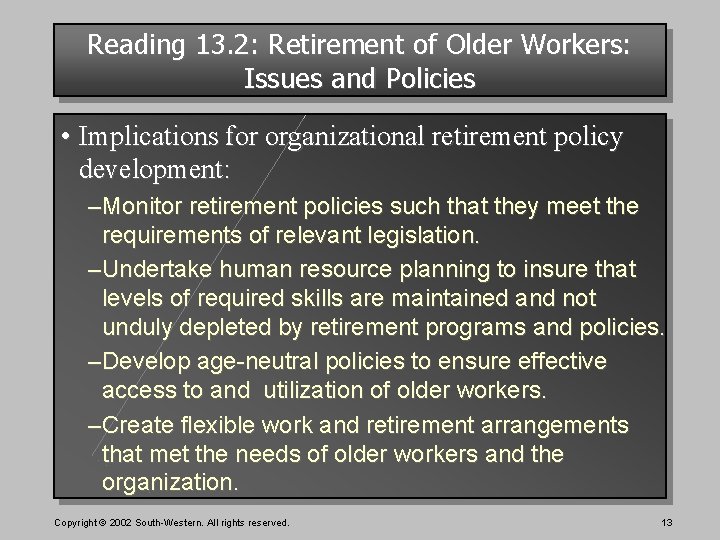
Reading 13. 2: Retirement of Older Workers: Issues and Policies • Implications for organizational retirement policy development: – Monitor retirement policies such that they meet the requirements of relevant legislation. – Undertake human resource planning to insure that levels of required skills are maintained and not unduly depleted by retirement programs and policies. – Develop age-neutral policies to ensure effective access to and utilization of older workers. – Create flexible work and retirement arrangements that met the needs of older workers and the organization. Copyright © 2002 South-Western. All rights reserved. 13
- Slides: 13