
Chapter 13 Earth Moon and Beyond Lesson 1
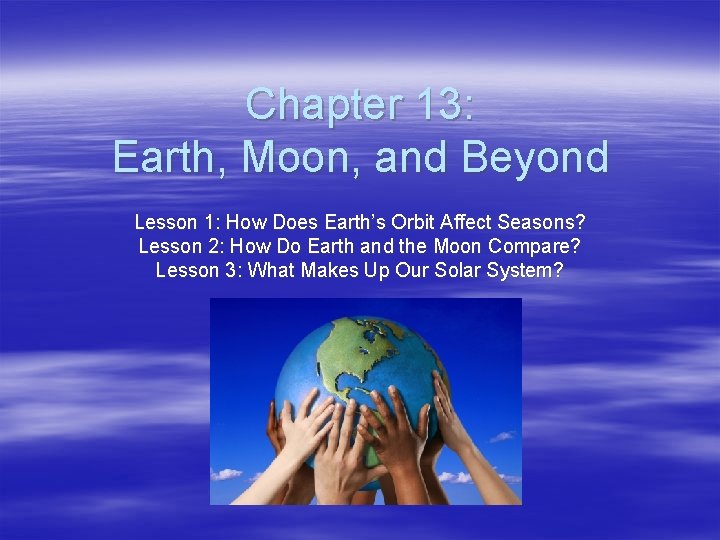
Chapter 13: Earth, Moon, and Beyond Lesson 1: How Does Earth’s Orbit Affect Seasons? Lesson 2: How Do Earth and the Moon Compare? Lesson 3: What Makes Up Our Solar System?
Lesson 1: Vocabulary § § § Sun: star at the center of our universe. rotate: to spin on an axis: An imaginary line that passes through Earth’s center and its North and South poles. revolve: To travel in a closed path. orbit: The path one body takes in space as it revolves around another. equator: An imaginary line around Earth equally distant from North and South poles.
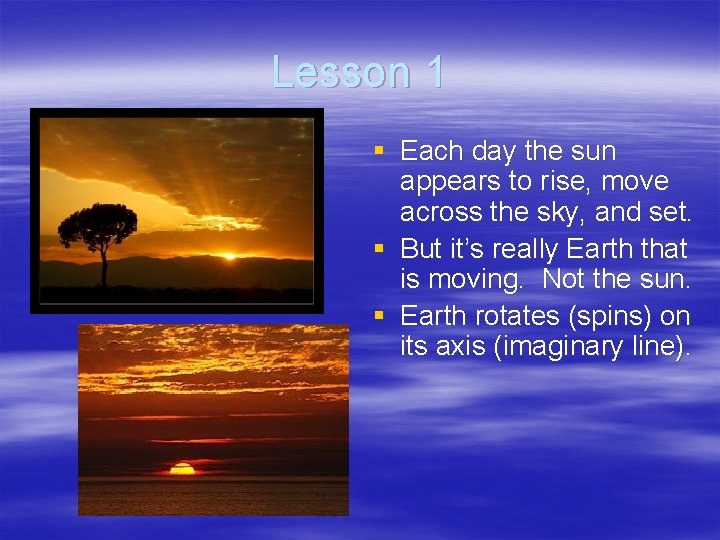
Lesson 1 § Each day the sun appears to rise, move across the sky, and set. § But it’s really Earth that is moving. Not the sun. § Earth rotates (spins) on its axis (imaginary line).
Lesson 1 § Sunrise and sunset happen at different times in different parts of the world. § Long ago, each place used its own local system of time. § This became confusing for people traveling long distances. § In 1884, people set up a time system.
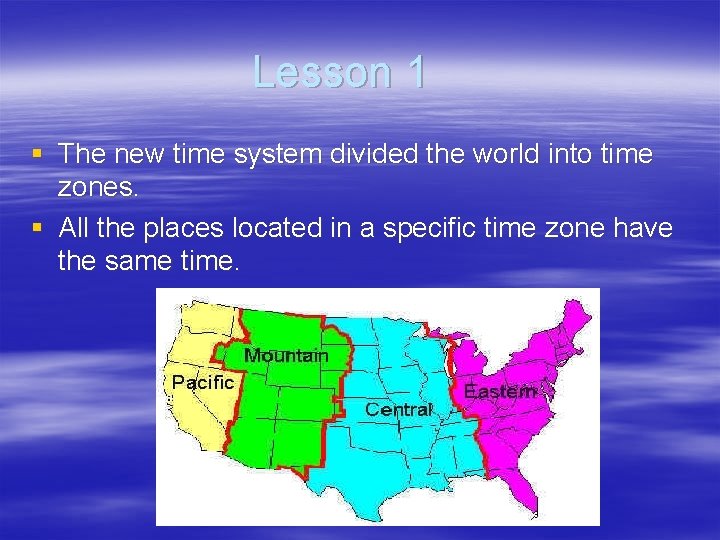
Lesson 1 § The new time system divided the world into time zones. § All the places located in a specific time zone have the same time.
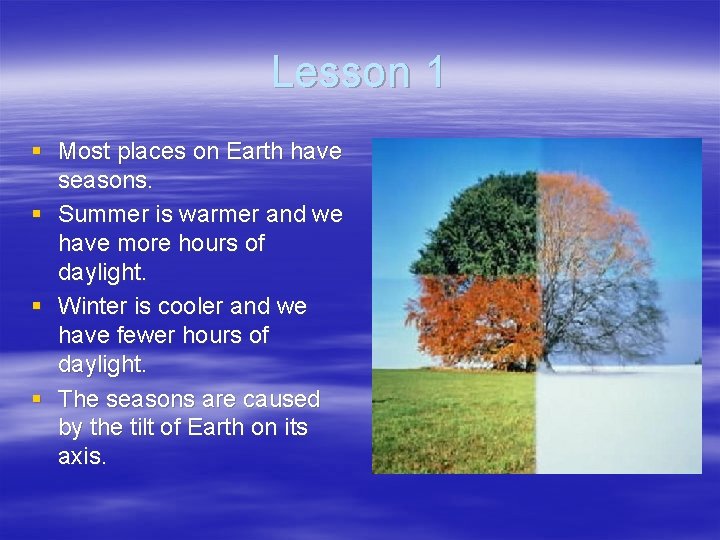
Lesson 1 § Most places on Earth have seasons. § Summer is warmer and we have more hours of daylight. § Winter is cooler and we have fewer hours of daylight. § The seasons are caused by the tilt of Earth on its axis.
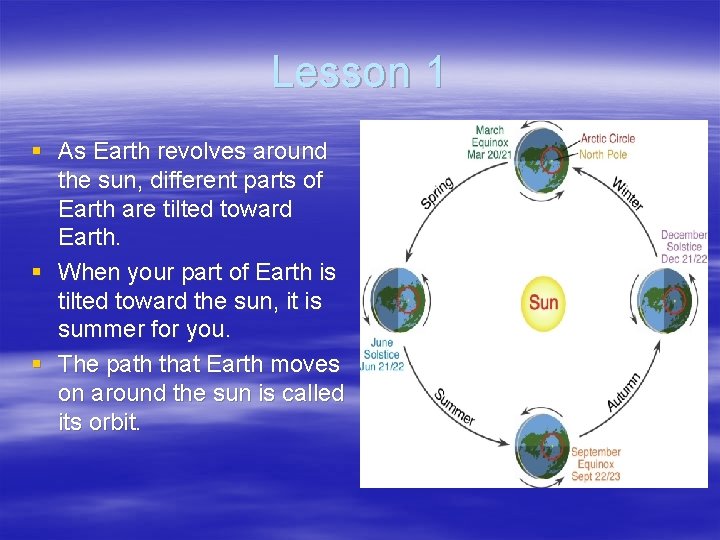
Lesson 1 § As Earth revolves around the sun, different parts of Earth are tilted toward Earth. § When your part of Earth is tilted toward the sun, it is summer for you. § The path that Earth moves on around the sun is called its orbit.
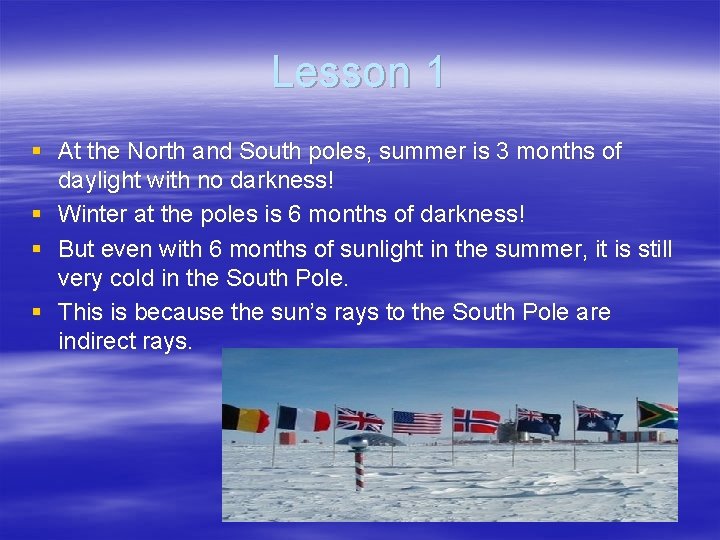
Lesson 1 § At the North and South poles, summer is 3 months of daylight with no darkness! § Winter at the poles is 6 months of darkness! § But even with 6 months of sunlight in the summer, it is still very cold in the South Pole. § This is because the sun’s rays to the South Pole are indirect rays.
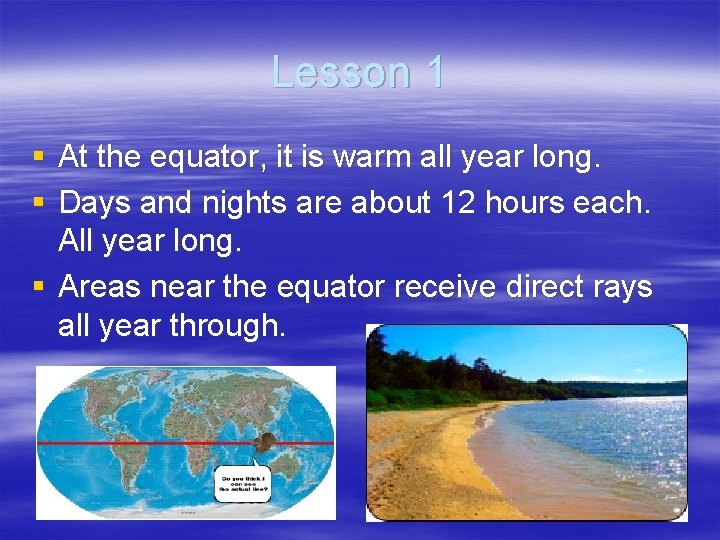
Lesson 1 § At the equator, it is warm all year long. § Days and nights are about 12 hours each. All year long. § Areas near the equator receive direct rays all year through.
Lesson 2 : Vocabulary § Moon: Any natural body that revolves around a planet. § Craters: Large, bowl-shaped areas on the moon’s surface. § Eclipse: Happens when one body in space blocks sunlight from another. § Refraction: The bending of light from the sun. § Moon phases: The different shapes of the moon.
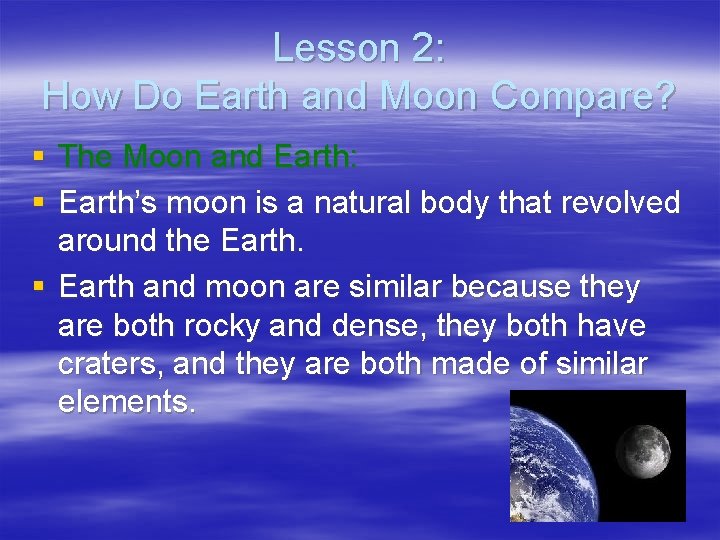
Lesson 2: How Do Earth and Moon Compare? § The Moon and Earth: § Earth’s moon is a natural body that revolved around the Earth. § Earth and moon are similar because they are both rocky and dense, they both have craters, and they are both made of similar elements.
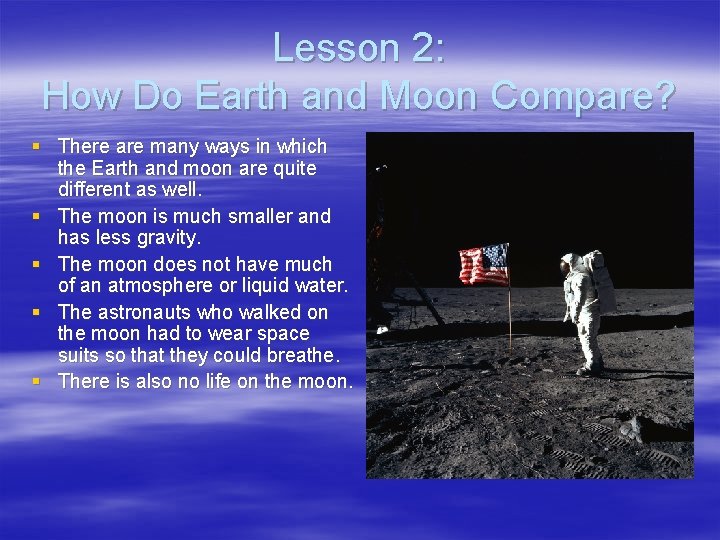
Lesson 2: How Do Earth and Moon Compare? § There are many ways in which the Earth and moon are quite different as well. § The moon is much smaller and has less gravity. § The moon does not have much of an atmosphere or liquid water. § The astronauts who walked on the moon had to wear space suits so that they could breathe. § There is also no life on the moon.
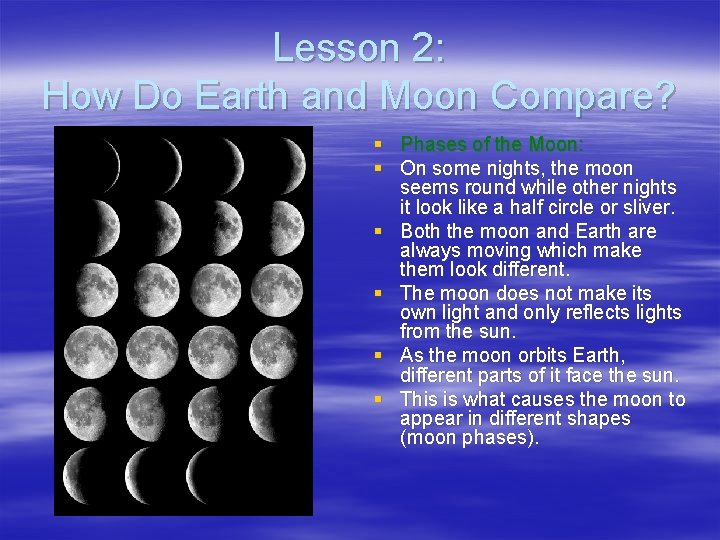
Lesson 2: How Do Earth and Moon Compare? § Phases of the Moon: § On some nights, the moon seems round while other nights it look like a half circle or sliver. § Both the moon and Earth are always moving which make them look different. § The moon does not make its own light and only reflects lights from the sun. § As the moon orbits Earth, different parts of it face the sun. § This is what causes the moon to appear in different shapes (moon phases).
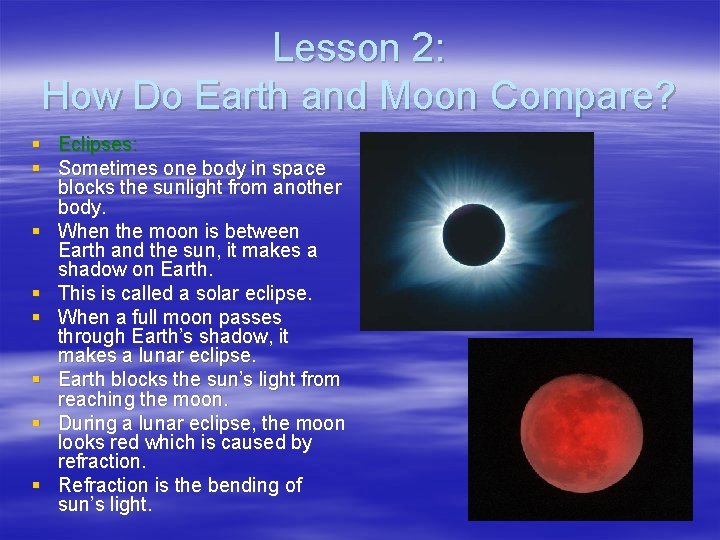
Lesson 2: How Do Earth and Moon Compare? § Eclipses: § Sometimes one body in space blocks the sunlight from another body. § When the moon is between Earth and the sun, it makes a shadow on Earth. § This is called a solar eclipse. § When a full moon passes through Earth’s shadow, it makes a lunar eclipse. § Earth blocks the sun’s light from reaching the moon. § During a lunar eclipse, the moon looks red which is caused by refraction. § Refraction is the bending of sun’s light.
Lesson 3: Vocabulary § Star: is a very large ball of hot, glowing gases in space. § Solar system: Is made up of a star (sun) and the objects that orbit the star. § Constellation: A group of stars that appears to form a picture. § Universe: Is everything that exists. § Galaxies: Groups of stars, dust, and gas, in the universe. § Planets: Bodies that revolve around the sun.
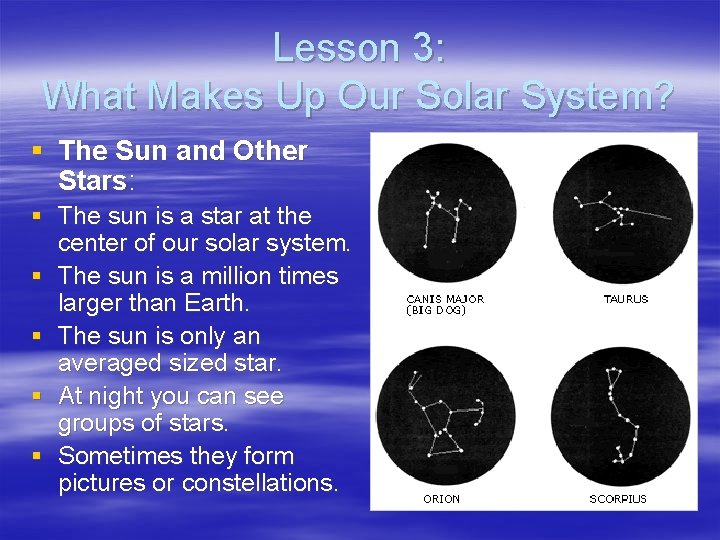
Lesson 3: What Makes Up Our Solar System? § The Sun and Other Stars: § The sun is a star at the center of our solar system. § The sun is a million times larger than Earth. § The sun is only an averaged sized star. § At night you can see groups of stars. § Sometimes they form pictures or constellations.
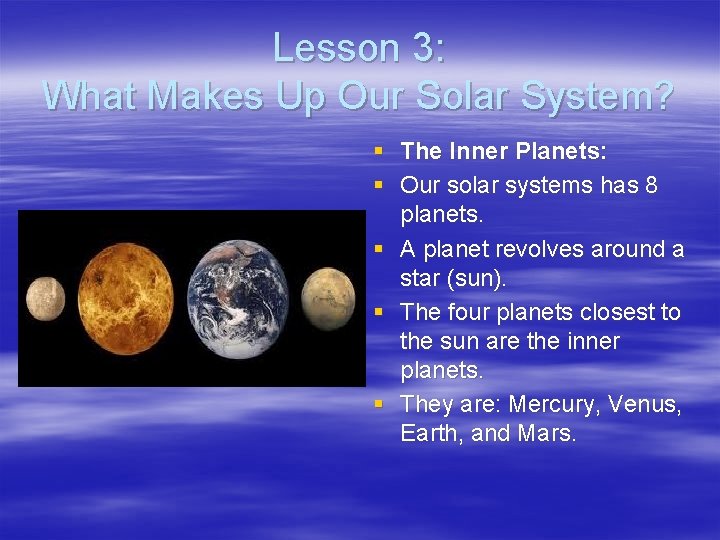
Lesson 3: What Makes Up Our Solar System? § The Inner Planets: § Our solar systems has 8 planets. § A planet revolves around a star (sun). § The four planets closest to the sun are the inner planets. § They are: Mercury, Venus, Earth, and Mars.
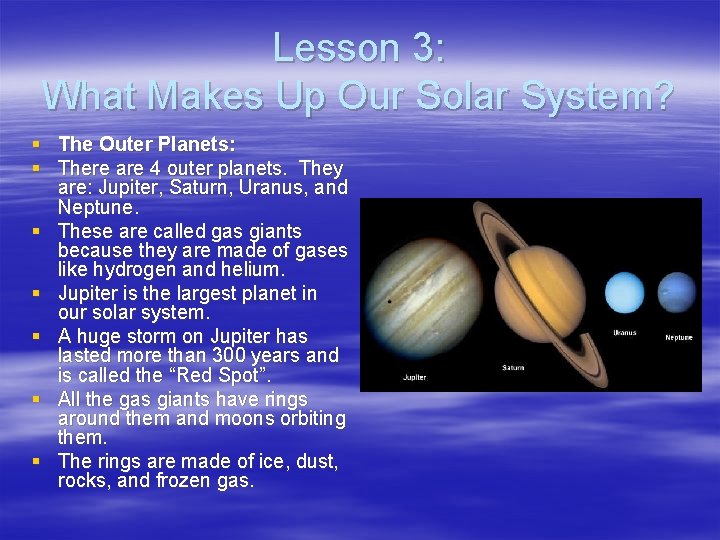
Lesson 3: What Makes Up Our Solar System? § The Outer Planets: § There are 4 outer planets. They are: Jupiter, Saturn, Uranus, and Neptune. § These are called gas giants because they are made of gases like hydrogen and helium. § Jupiter is the largest planet in our solar system. § A huge storm on Jupiter has lasted more than 300 years and is called the “Red Spot”. § All the gas giants have rings around them and moons orbiting them. § The rings are made of ice, dust, rocks, and frozen gas.
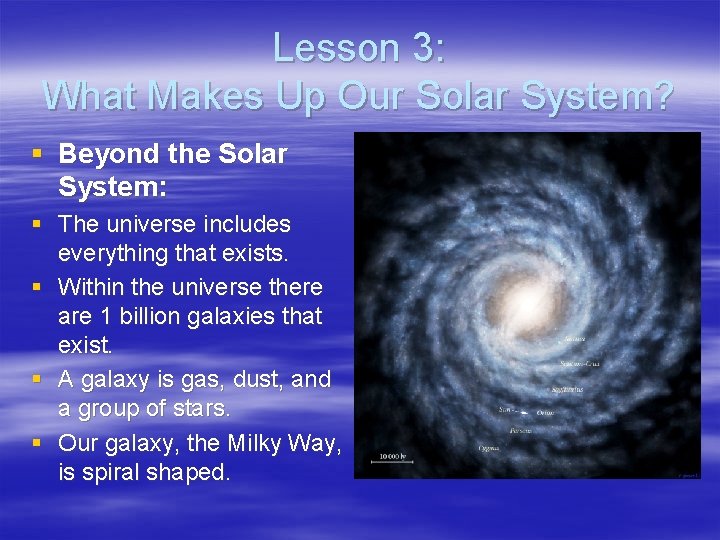
Lesson 3: What Makes Up Our Solar System? § Beyond the Solar System: § The universe includes everything that exists. § Within the universe there are 1 billion galaxies that exist. § A galaxy is gas, dust, and a group of stars. § Our galaxy, the Milky Way, is spiral shaped.
- Slides: 19