
Chapter 13 Distributing and Promoting Products Learning Objectives
Chapter 13 Distributing and Promoting Products
Learning Objectives 1. Identify the various distribution channels and explain the concept of market coverage. 2. Understand how supply chain management facilitates partnering among channel members. 3. Discuss the need for wholesalers, describe the services they provide, and identify the major types of wholesalers. 4. Distinguish among the major types of retailers and identify the types of shopping centers. 5. Explain the five most important physical distribution activities. 6. Explain how integrated marketing communications works to have the maximum impact on the customer. Copyright © Cengage Learning. All rights reserved. Chapter 13 | Slide 2
Learning Objectives (cont’d. ) 7. Understand the basic elements of the promotion mix. 8. Explain the three types of advertising and describe the major steps of developing an advertising campaign. 9. Recognize the kinds of salespersons, the steps in the personal selling process, and the major sales management tasks. 10. Describe sales promotion objectives and methods. 11. Understand the types and uses of public relations. Copyright © Cengage Learning. All rights reserved. Chapter 13 | Slide 3
Channel of Distribution …a sequence of marketing organizations that directs a product from the producer to the ultimate user. Copyright © Cengage Learning. All rights reserved. Chapter 13 | Slide 4

Middleman (Marketing Intermediary) …a marketing organization that links a producer and user within a marketing channel. Copyright © Cengage Learning. All rights reserved. Chapter 13 | Slide 5
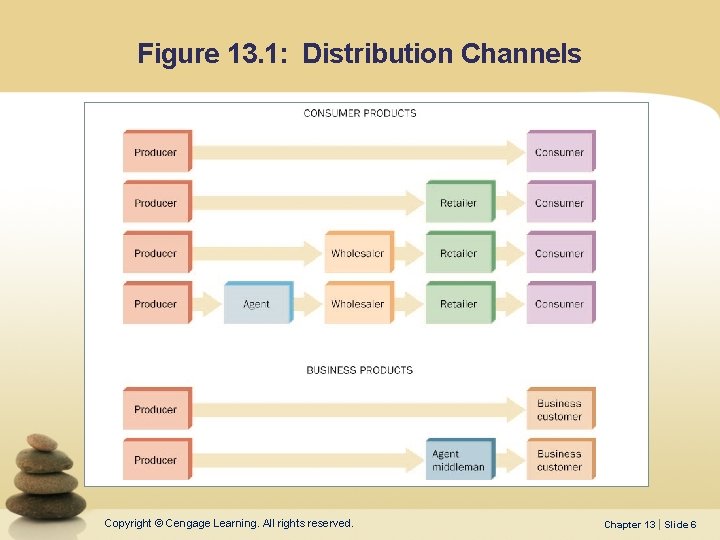
Figure 13. 1: Distribution Channels Copyright © Cengage Learning. All rights reserved. Chapter 13 | Slide 6
Retailer …a middleman that buys from producers or other middlemen and sells to consumers. Copyright © Cengage Learning. All rights reserved. Chapter 13 | Slide 7
Wholesaler …a middleman that sells products to other firms. Copyright © Cengage Learning. All rights reserved. Chapter 13 | Slide 8
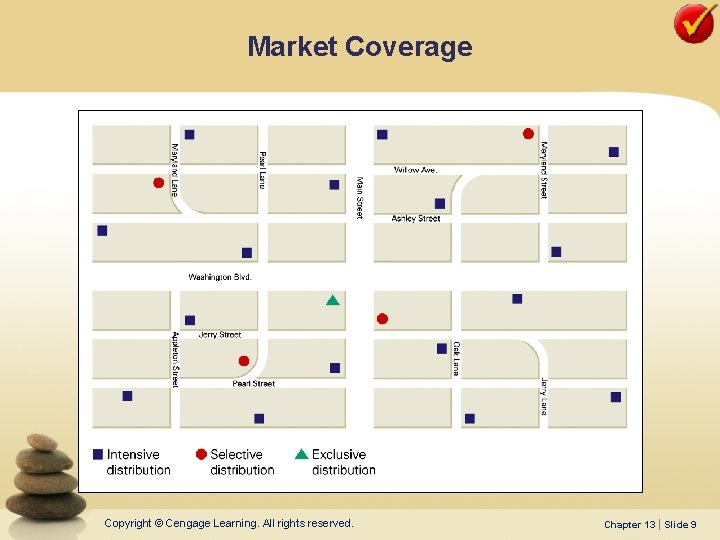
Market Coverage Copyright © Cengage Learning. All rights reserved. Chapter 13 | Slide 9
Supply Chain Management …long-term partnership among channel members working together to create a distribution system that reduces inefficiencies, costs, and redundancies while creating a competitive advantage and satisfying customers. Encourages cooperation in reducing the costs of inventory Copyright © Cengage Learning. All rights reserved. Chapter 13 | Slide 10
Wholesaler Services to Retailers § § § Buy in large quantities Sell in small quantities Deliver goods to retailers Stock variety of goods in one place Provide assistance in • Promotion • Market Information • Financial Aid Copyright © Cengage Learning. All rights reserved. Chapter 13 | Slide 11
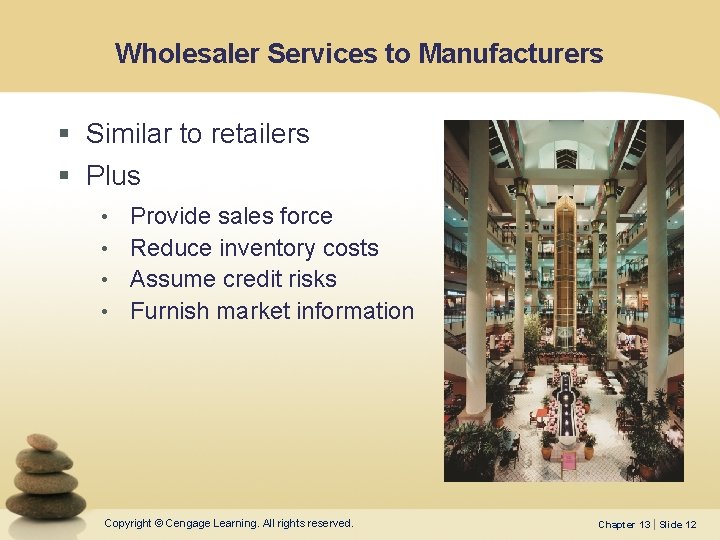
Wholesaler Services to Manufacturers § Similar to retailers § Plus • • Provide sales force Reduce inventory costs Assume credit risks Furnish market information Copyright © Cengage Learning. All rights reserved. Chapter 13 | Slide 12
Types of Wholesalers § Merchant (Jobber) Purchases goods in large quantities and sells to other wholesalers, retailers, institutions, farms, governments, professionals, or industrial users § Full-Service Performs entire range of wholesaler functions § General-Merchandise Deals in wide variety of products Copyright © Cengage Learning. All rights reserved. Chapter 13 | Slide 13
Types of Wholesalers (cont’d. ) § Limited-Line Stocks only a few product lines but carries numerous items within each line § Specialty-Line Carries a select group of products within a single line § Limited-Service Assumes responsibility for a few wholesale services only Copyright © Cengage Learning. All rights reserved. Chapter 13 | Slide 14
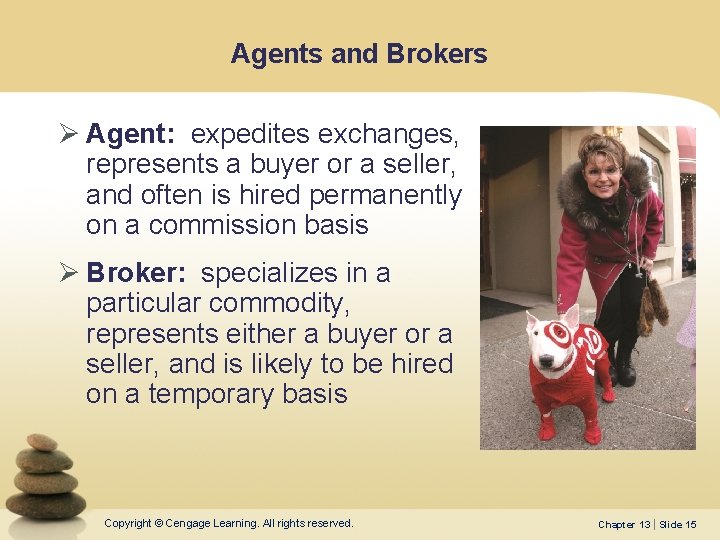
Agents and Brokers Ø Agent: expedites exchanges, represents a buyer or a seller, and often is hired permanently on a commission basis Ø Broker: specializes in a particular commodity, represents either a buyer or a seller, and is likely to be hired on a temporary basis Copyright © Cengage Learning. All rights reserved. Chapter 13 | Slide 15
In-Store Retailers Based on Store Size and Kind/Number of Products § Department Consists of several sections; wide assortment of products § Discount Self-service; sells at lower-than-usual prices § Warehouse Showroom Large, low-cost building with large on-premises inventory, minimal service § Convenience Small store that sells limited variety of products; remains open beyond normal business hours Copyright © Cengage Learning. All rights reserved. Chapter 13 | Slide 16
In-Store Retailers Based on Store Size and Kind/Number of Products (cont’d. ) § Supermarket Large self-service; sells food and household products § Superstore Large; carries not only food and nonfood products but also additional product lines § Warehouse Clubs Large-scale, members-only; features cash-and-carry wholesaling with discount retailing Copyright © Cengage Learning. All rights reserved. Chapter 13 | Slide 17
In-Store Retailers Based on Store Size and Kind/Number of Products § Traditional Specialty Narrow product mix with deep product lines § Off-Price Buys manufacturers’ seconds, overruns, returns, and off-season merchandise for resale at deep discounts § Category Killers Large specialty store; concentrates on single product line; competes with low prices and product availability Copyright © Cengage Learning. All rights reserved. Chapter 13 | Slide 18
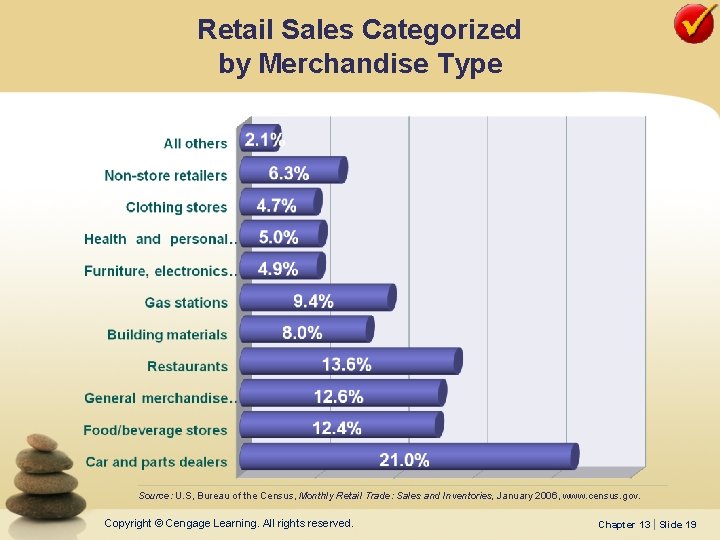
Retail Sales Categorized by Merchandise Type Source: U. S, Bureau of the Census, Monthly Retail Trade: Sales and Inventories, January 2006, www. census. gov. Copyright © Cengage Learning. All rights reserved. Chapter 13 | Slide 19
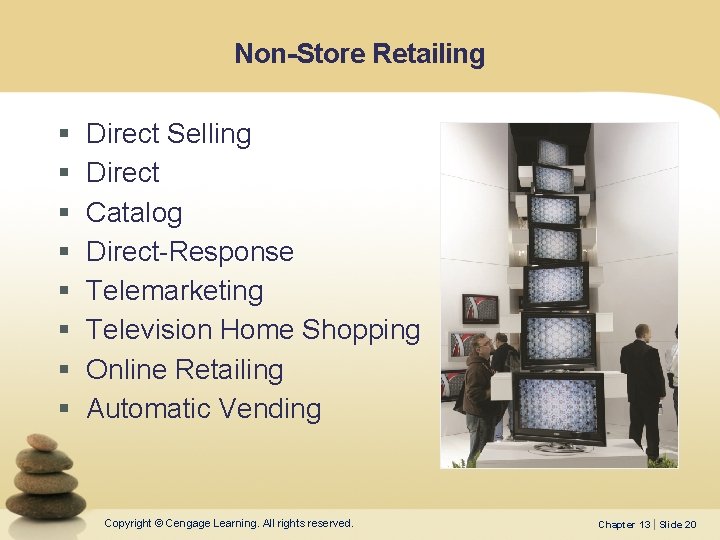
Non-Store Retailing § § § § Direct Selling Direct Catalog Direct-Response Telemarketing Television Home Shopping Online Retailing Automatic Vending Copyright © Cengage Learning. All rights reserved. Chapter 13 | Slide 20
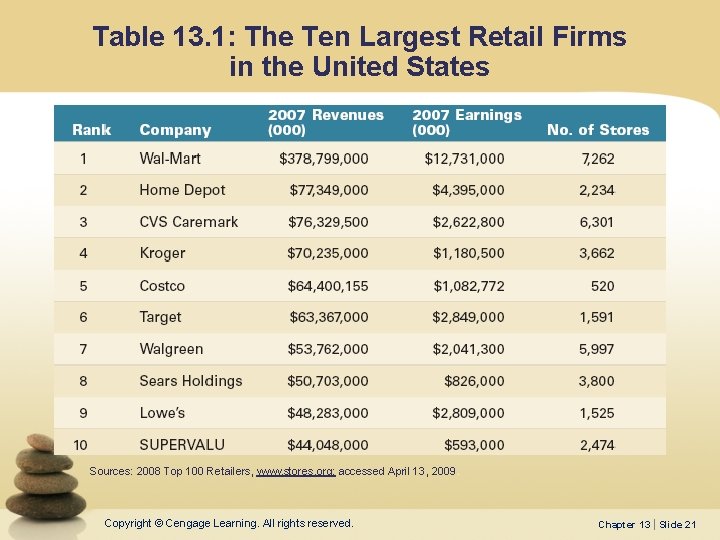
Table 13. 1: The Ten Largest Retail Firms in the United States Sources: 2008 Top 100 Retailers, www. stores. org; accessed April 13, 2009. Copyright © Cengage Learning. All rights reserved. Chapter 13 | Slide 21
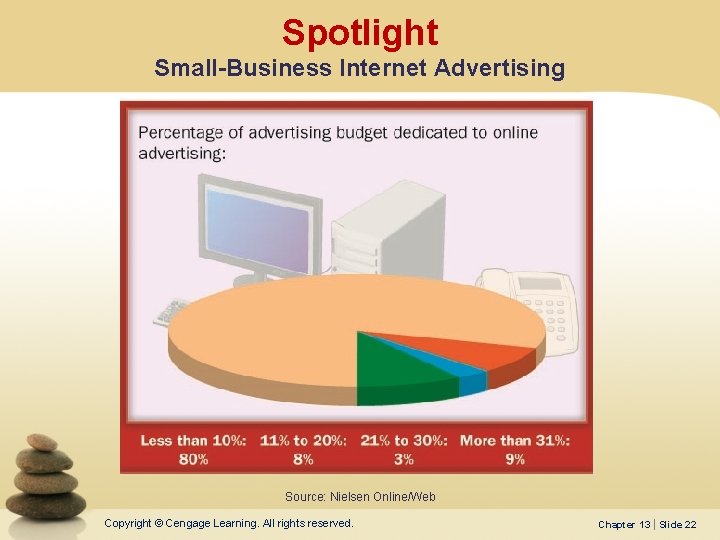
Spotlight Small-Business Internet Advertising Source: Nielsen Online/Web Copyright © Cengage Learning. All rights reserved. Chapter 13 | Slide 22
Types of Planned Shopping Centers § Lifestyle: open-air-environment shopping center with upscale chain specialty stores § Neighborhood: consists of several small convenience/specialty stores § Community: 1 or 2 department stores and some specialty stores with convenience stores § Regional: large department stores, specialty stores, restaurants, theaters, hotels Copyright © Cengage Learning. All rights reserved. Chapter 13 | Slide 23
Physical Distribution …activities concerned with the efficient movement of products from the producer to the ultimate user. Copyright © Cengage Learning. All rights reserved. Chapter 13 | Slide 24
Functions of Physical Distribution § Inventory Management: minimize holding and potential stock-out costs § Order Processing: receive and fill customers’ purchase orders § Warehousing: receive and store goods and prepare them for reshipment § Materials Handling: handle goods in warehouses and during transportation Copyright © Cengage Learning. All rights reserved. Chapter 13 | Slide 25
Warehousing Activities § Receiving Goods § Identifying Goods § Sorting Goods § Dispatching Goods to Storage § Holding Goods § Recalling, Picking, and Assembling Goods § Dispatching Shipments Copyright © Cengage Learning. All rights reserved. Chapter 13 | Slide 26
Types of Warehouses Ø Private Owned and operated by a particular firm; designed to serve firm’s specific needs Ø Public Offers services to all individuals and firms Copyright © Cengage Learning. All rights reserved. Chapter 13 | Slide 27
Transportation …the shipment of products to customers Copyright © Cengage Learning. All rights reserved. Chapter 13 | Slide 28
Carrier …a firm that offers transportation services Copyright © Cengage Learning. All rights reserved. Chapter 13 | Slide 29
Categories of Carriers § Common Available to all shippers § Contract Available for hire by one or several shippers § Private Owned and operated by the shipper § Freight Forwarder Hired by agents to handle transportation • Ensures goods loaded on carrier • Assumes responsibility for safe delivery Copyright © Cengage Learning. All rights reserved. Chapter 13 | Slide 30
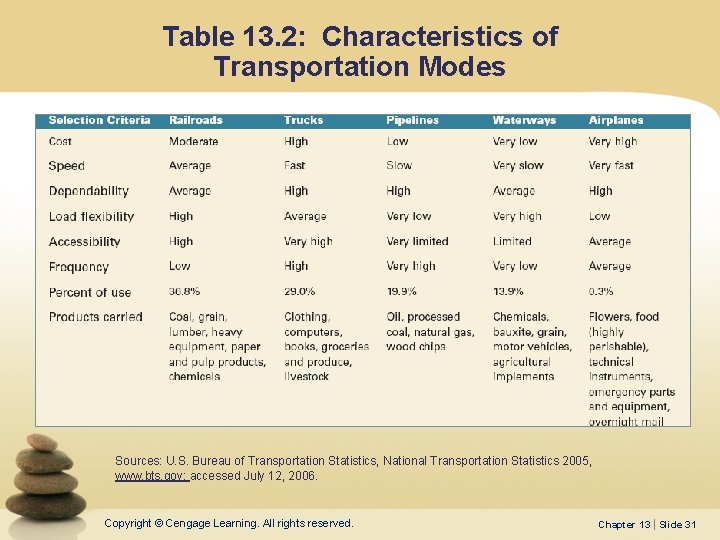
Table 13. 2: Characteristics of Transportation Modes Sources: U. S. Bureau of Transportation Statistics, National Transportation Statistics 2005, www. bts. gov; accessed July 12, 2006. Copyright © Cengage Learning. All rights reserved. Chapter 13 | Slide 31
Integrated Marketing Communications …coordination of promotion efforts to ensure maximal informational and persuasive impact on customers. Goal = Consistent message to customers Copyright © Cengage Learning. All rights reserved. Chapter 13 | Slide 32
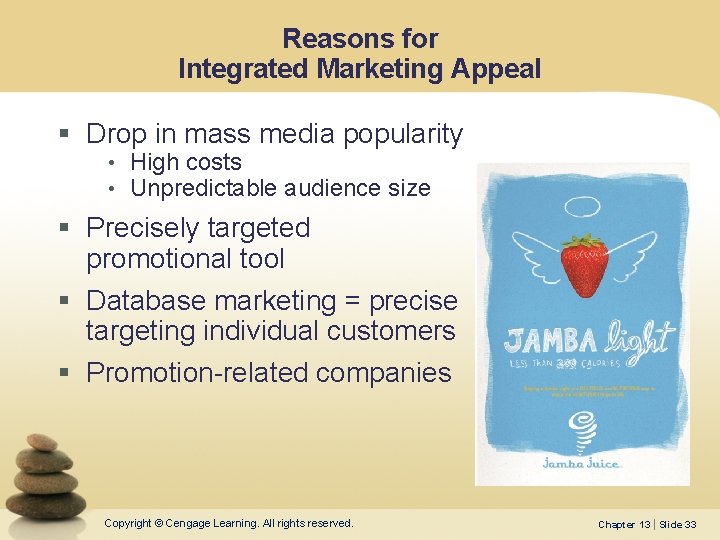
Reasons for Integrated Marketing Appeal § Drop in mass media popularity • High costs • Unpredictable audience size § Precisely targeted promotional tool § Database marketing = precise targeting individual customers § Promotion-related companies Copyright © Cengage Learning. All rights reserved. Chapter 13 | Slide 33
Promotion …communication about an organization and its products that is intended to inform, persuade, or remind target-market members. Copyright © Cengage Learning. All rights reserved. Chapter 13 | Slide 34
Promotion Mix …the particular combination of promotion methods a firm uses to reach a target market. Copyright © Cengage Learning. All rights reserved. Chapter 13 | Slide 35
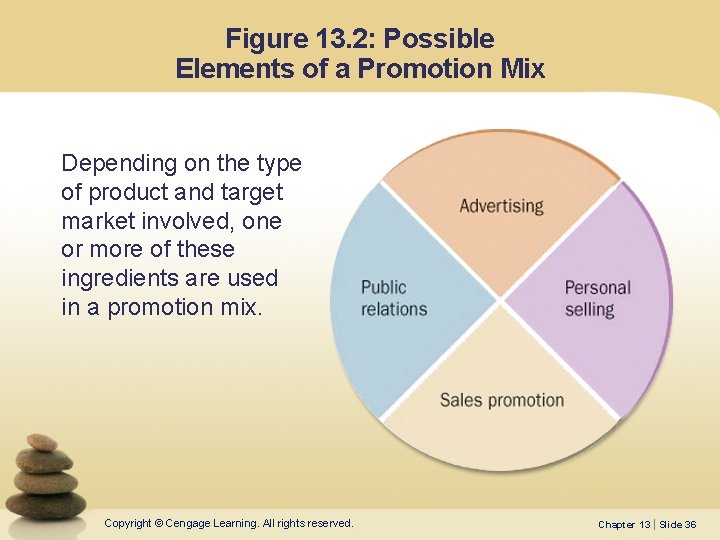
Figure 13. 2: Possible Elements of a Promotion Mix Depending on the type of product and target market involved, one or more of these ingredients are used in a promotion mix. Copyright © Cengage Learning. All rights reserved. Chapter 13 | Slide 36
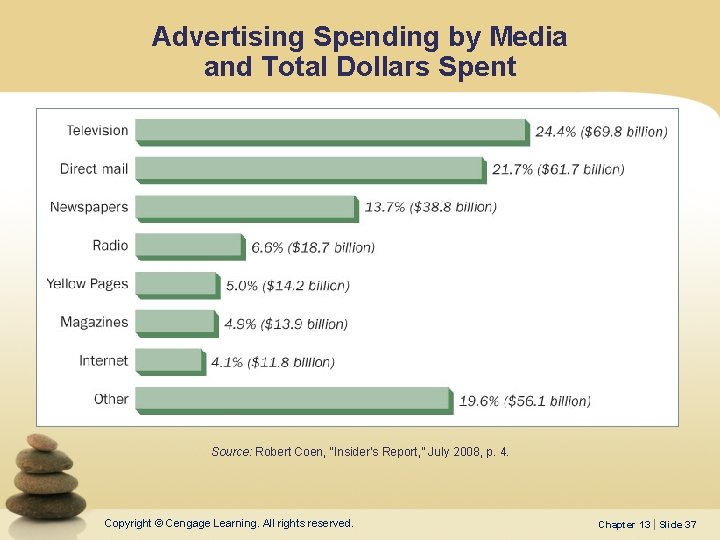
Advertising Spending by Media and Total Dollars Spent Source: Robert Coen, “Insider’s Report, ” July 2008, p. 4. Copyright © Cengage Learning. All rights reserved. Chapter 13 | Slide 37
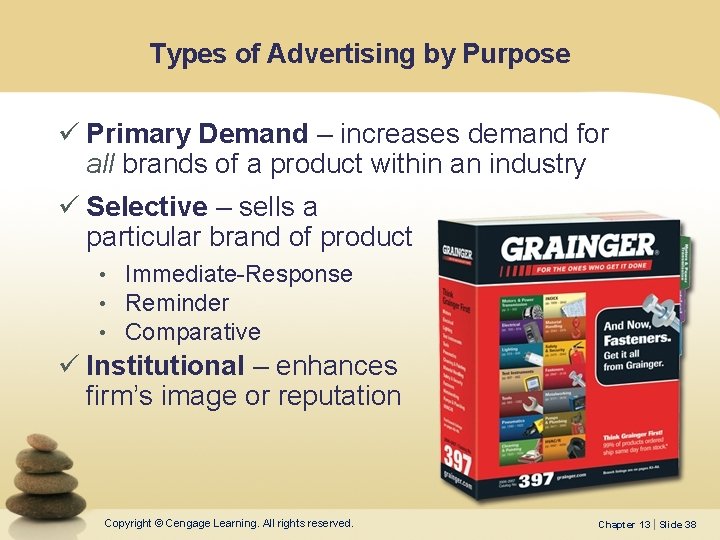
Types of Advertising by Purpose ü Primary Demand – increases demand for all brands of a product within an industry ü Selective – sells a particular brand of product • Immediate-Response • Reminder • Comparative ü Institutional – enhances firm’s image or reputation Copyright © Cengage Learning. All rights reserved. Chapter 13 | Slide 38
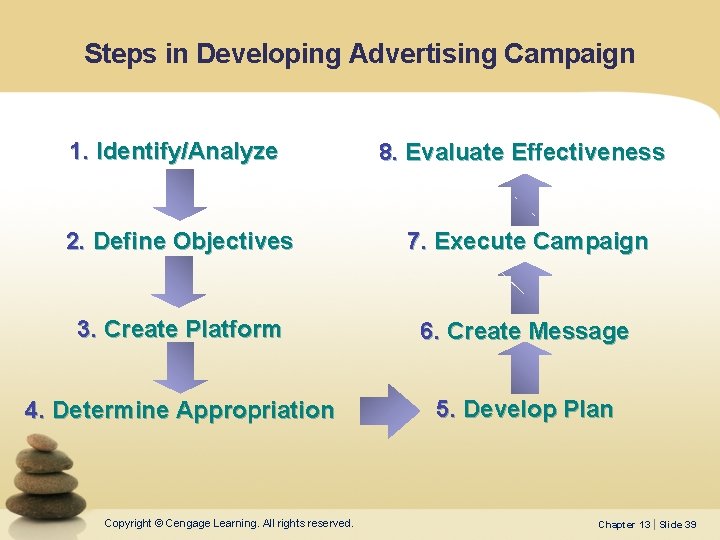
Steps in Developing Advertising Campaign 1. Identify/Analyze 8. Evaluate Effectiveness 2. Define Objectives 7. Execute Campaign 3. Create Platform 6. Create Message 4. Determine Appropriation 5. Develop Plan Copyright © Cengage Learning. All rights reserved. Chapter 13 | Slide 39
Advertising Agency …an independent firm that plans, produces, and places advertising for its clients. Copyright © Cengage Learning. All rights reserved. Chapter 13 | Slide 40
Top Ten National Advertisers 1. 2. 3. 4. 5. 6. 7. 8. 9. 10. Procter & Gamble Co. AT&T Verizon Communications General Motors Time Warner Ford Motor Co. Glaxo. Smith. Kline Johnson & Johnson Walt Disney Co. Unilever Source: Reprinted with permission of June 23, 2008 issue of Advertising Age. Copyright, Crain Communications Inc. , 2008. Copyright © Cengage Learning. All rights reserved. Chapter 13 | Slide 41
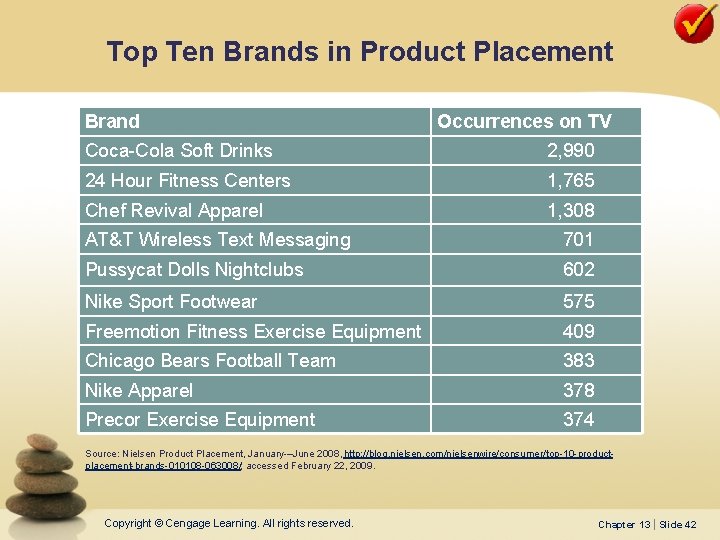
Top Ten Brands in Product Placement Brand Occurrences on TV Coca-Cola Soft Drinks 2, 990 24 Hour Fitness Centers 1, 765 Chef Revival Apparel 1, 308 AT&T Wireless Text Messaging 701 Pussycat Dolls Nightclubs 602 Nike Sport Footwear 575 Freemotion Fitness Exercise Equipment 409 Chicago Bears Football Team 383 Nike Apparel 378 Precor Exercise Equipment 374 Source: Nielsen Product Placement, January-–June 2008, http: //blog. nielsen. com/nielsenwire/consumer/top-10 -productplacement-brands-010108 -063008/; accessed February 22, 2009. Copyright © Cengage Learning. All rights reserved. Chapter 13 | Slide 42
Using the Internet • Advertising Age is the industry’s preeminent source of marketing, advertising, and media news, information, and analysis. www. adage. com Copyright © Cengage Learning. All rights reserved. Chapter 13 | Slide 43
Social and Legal Considerations in Advertising 1. Most effective and inexpensive means of communicating product information 2. Encourages competition 3. Revenues support mass-communications media 4. Provides jobs Copyright © Cengage Learning. All rights reserved. Chapter 13 | Slide 44
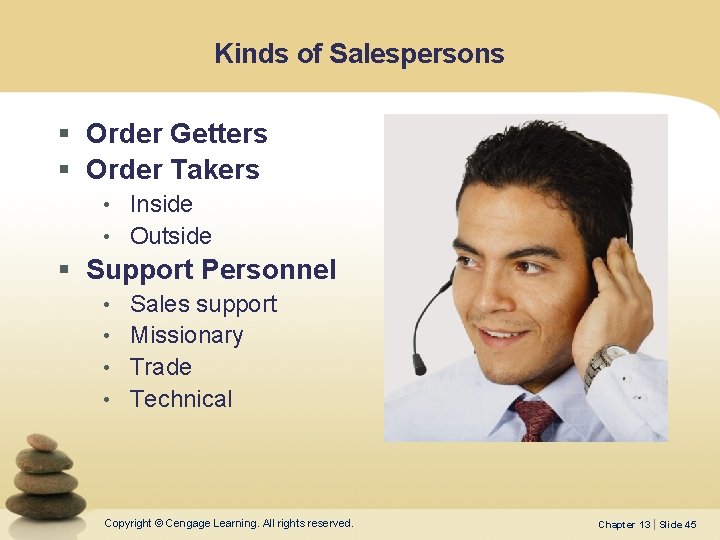
Kinds of Salespersons § Order Getters § Order Takers • Inside • Outside § Support Personnel • • Sales support Missionary Trade Technical Copyright © Cengage Learning. All rights reserved. Chapter 13 | Slide 45
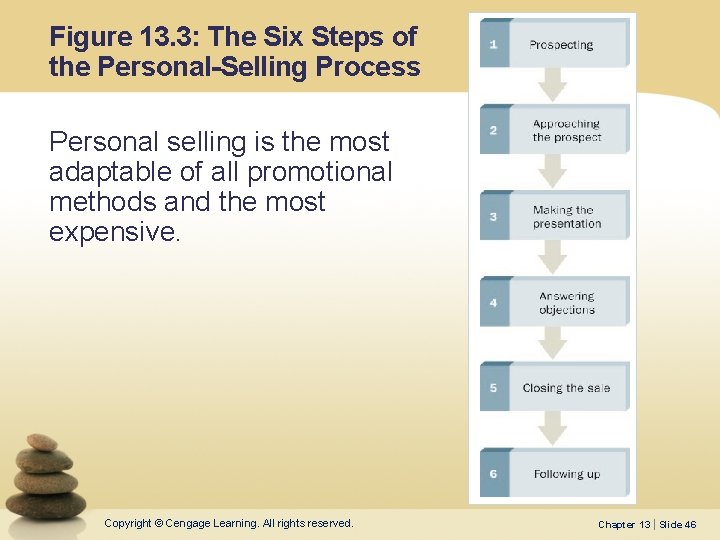
Figure 13. 3: The Six Steps of the Personal-Selling Process Personal selling is the most adaptable of all promotional methods and the most expensive. Copyright © Cengage Learning. All rights reserved. Chapter 13 | Slide 46
Sales Manager’s Responsibilities § § § § § Set Sales Objectives Adjust Size of Sales Force Attract/Hire Effective Salespersons Develop Training Program Formulate Compensation Plan Motive Salespersons Define Sales Territories Schedule/Route Sales Force Evaluate Operation Copyright © Cengage Learning. All rights reserved. Chapter 13 | Slide 47
Sales Promotion Objectives 1. Attract new customers 2. Encourage trial of new product 3. Invigorate sales of mature brand 4. Boost sales to current customers 5. Reinforce advertising 6. Increase traffic in retail stores 7. Steady irregular sales patterns 8. Build up resell inventory 9. Neutralize competition 10. Improve shelf space/displays Copyright © Cengage Learning. All rights reserved. Chapter 13 | Slide 48
Classification of Promotional Methods Ø Consumer Sales Attract consumers to particular retail stores and motivate them to purchase new/established products Ø Trade Sales Encourage wholesalers and retailers to stock and actively promote manufacturer’s product Copyright © Cengage Learning. All rights reserved. Chapter 13 | Slide 49
Sales Promotion Methods § § § Rebates Coupons Samples Premiums Frequent-User Incentives Copyright © Cengage Learning. All rights reserved. § Point-of-Purchase Displays § Trade Shows § Buying Allowances § Cooperative Advertising Chapter 13 | Slide 50
Types of Public Relations Tools § Publicity § News Release § Feature Article § Captioned Photograph Copyright © Cengage Learning. All rights reserved. Chapter 13 | Slide 51
Chapter Quiz 1. Highly perishable products such as fruits and vegetables are typically channeled from producer to a) b) c) d) e) retailer to consumer. wholesaler to retailer to consumer. functional middleman to consumer. . Copyright © Cengage Learning. All rights reserved. Chapter 13 | Slide 52
Chapter Quiz 2. A mail-order wholesaler is an example of a ______ wholesaler. a) b) c) d) e) limited-service full-service general merchandise limited-line specialty-line Copyright © Cengage Learning. All rights reserved. Chapter 13 | Slide 53
Chapter Quiz 3. A firm that operates only one retail outlet is called a(n) _____ retailer. a) b) c) d) e) chain specialty Independent merchant single Copyright © Cengage Learning. All rights reserved. Chapter 13 | Slide 54
Chapter Quiz 4. “Drink More Milk” and “Got Milk? ” are examples of a) b) c) d) e) public relations. institutional advertising. primary-demand advertising. publicity. selective-demand advertising. Copyright © Cengage Learning. All rights reserved. Chapter 13 | Slide 55
Chapter Quiz 5. Critics’ two main complaints about advertising are that it a) is malicious and it causes unnecessary competition. b) encourages society to lie and to steal. c) is useless and it is mean. d) wastes financial resources and consumers are hurt in the end due to higher prices. e) is wasteful and can be deceptive. Copyright © Cengage Learning. All rights reserved. Chapter 13 | Slide 56
- Slides: 56