
Chapter 13 Developing Strategies for Multiplication and Division


- Slides: 25
Chapter 13 Developing Strategies for Multiplication and Division Computation Copyright © 2015 Pearson Canada Inc.
Big Ideas 1. Flexible methods of computation involve taking apart and combining numbers in a wide variety of ways. 2. “Invented” strategies are flexible methods of computing that vary with the numbers and the situation. 3. Flexible methods for computation require a good understanding of the operations and properties of the operations, especially the commutative property and the distributive property for multiplication. Copyright © 2015 Pearson Canada Inc. 2
Big Ideas cont. 4. The traditional algorithms are clever strategies for computing that have been developed over time. 5. Multidigit numbers can be built up or taken apart in a variety of ways. 6. Nearly all computational estimations involve using easier‐to handle parts of numbers or substituting difficult‐to‐handle numbers with close “compatible” numbers so that the resulting computations can be done mentally. Copyright © 2015 Pearson Canada Inc. 3
Content Connections n n n Operations, Place Value, and Computation with Addition and Subtraction (Chapters 9, 11, and 12) Algebra (Chapter 14) Fractions, Decimals, and Percents (Chapters 16 and 17) Copyright © 2015 Pearson Canada Inc. 4
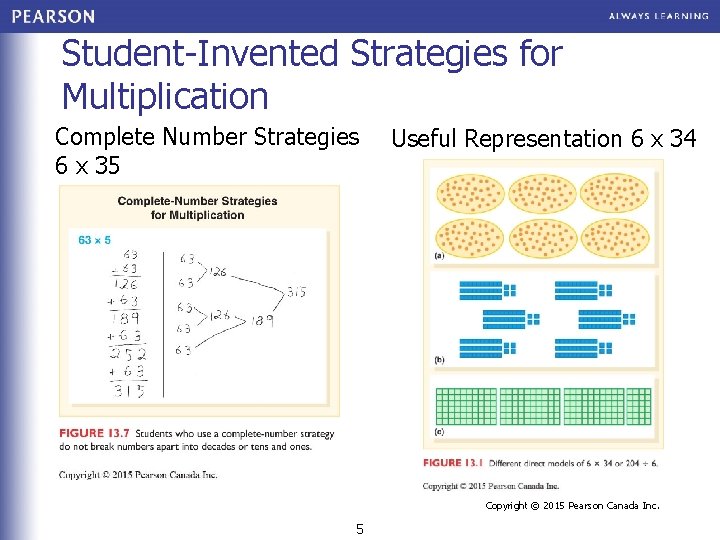
Student-Invented Strategies for Multiplication Complete Number Strategies 6 x 35 Useful Representation 6 x 34 Copyright © 2015 Pearson Canada Inc. 5
Student-Invented Strategies for Multiplication cont. Compensation strategies Manipulate numbers to make calculations easier § Compensation § One factor cut in half and other factor doubled § Close compatible number Copyright © 2015 Pearson Canada Inc. 6
Area Models 47 x 36 24 X 16 Connected array is a key visual representation Copyright © 2015 Pearson Canada Inc. 7
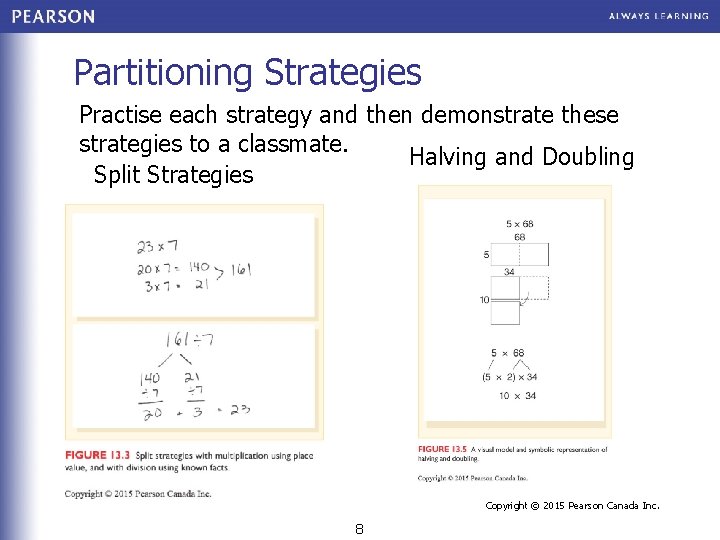
Partitioning Strategies Practise each strategy and then demonstrate these strategies to a classmate. Halving and Doubling Split Strategies Copyright © 2015 Pearson Canada Inc. 8
Multiplication of Larger Numbers Multiplication of larger numbers supports the importance of place value and focus on the number rather than separate digits. Copyright © 2015 Pearson Canada Inc. 9
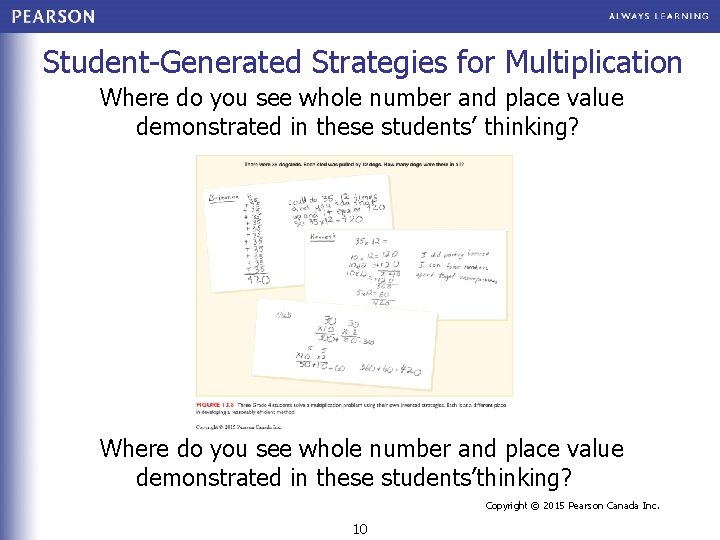
Student-Generated Strategies for Multiplication Where do you see whole number and place value demonstrated in these students’ thinking? Where do you see whole number and place value demonstrated in these students’thinking? Copyright © 2015 Pearson Canada Inc. 10
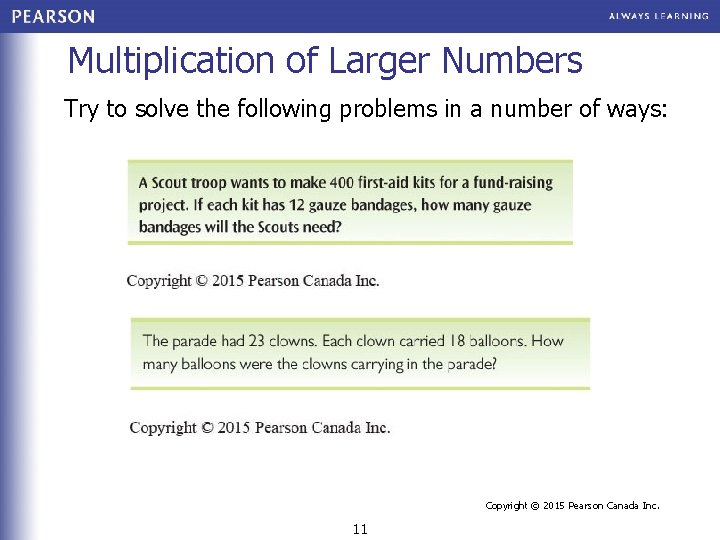
Multiplication of Larger Numbers Try to solve the following problems in a number of ways: Copyright © 2015 Pearson Canada Inc. 11
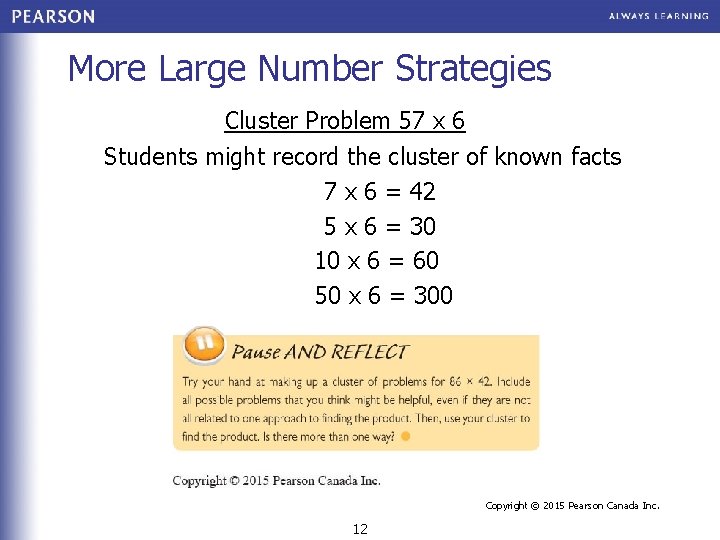
More Large Number Strategies Cluster Problem 57 x 6 Students might record the cluster of known facts 7 x 6 = 42 5 x 6 = 30 10 x 6 = 60 50 x 6 = 300 Copyright © 2015 Pearson Canada Inc. 12
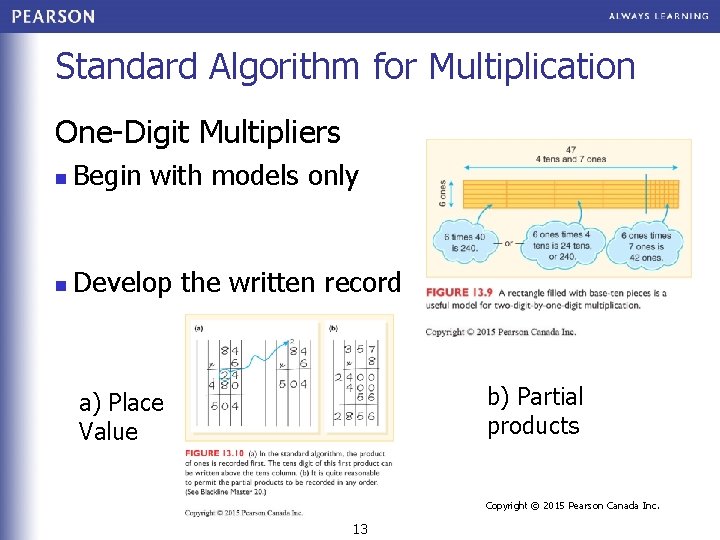
Standard Algorithm for Multiplication One-Digit Multipliers n Begin with models only n Develop the written record b) Partial products a) Place Value Copyright © 2015 Pearson Canada Inc. 13
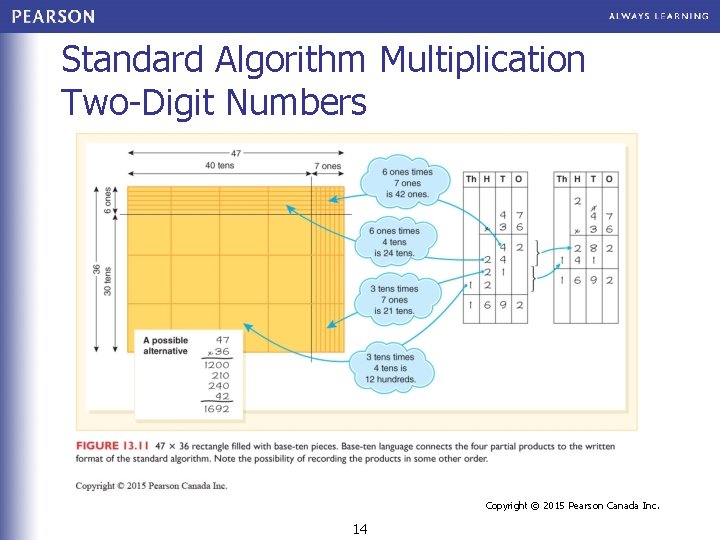
Standard Algorithm Multiplication Two-Digit Numbers Copyright © 2015 Pearson Canada Inc. 14
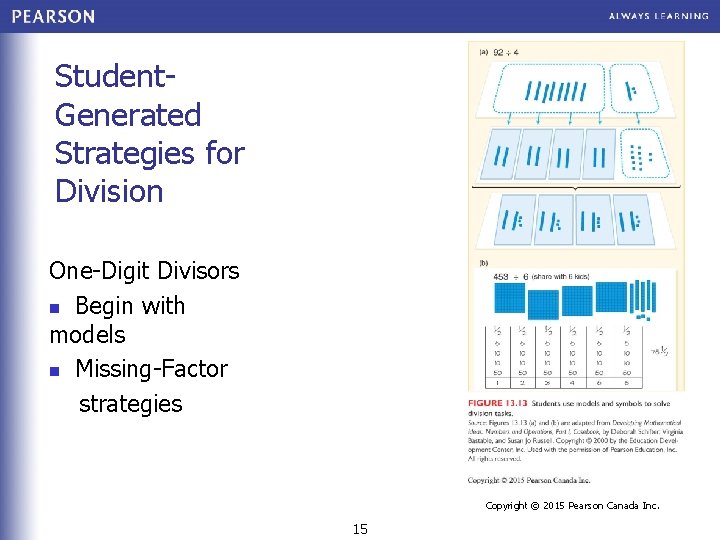
Student. Generated Strategies for Division One-Digit Divisors n Begin with models n Missing-Factor strategies Copyright © 2015 Pearson Canada Inc. 15
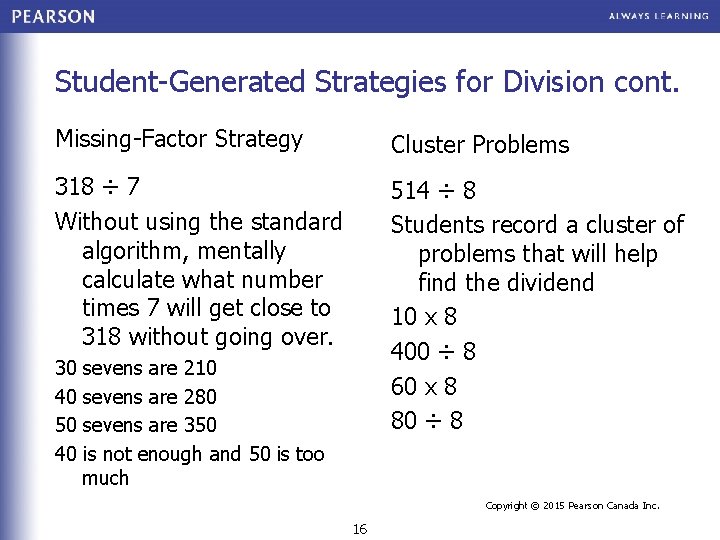
Student-Generated Strategies for Division cont. Missing-Factor Strategy Cluster Problems 318 ÷ 7 Without using the standard algorithm, mentally calculate what number times 7 will get close to 318 without going over. 514 ÷ 8 Students record a cluster of problems that will help find the dividend 10 x 8 400 ÷ 8 60 x 8 80 ÷ 8 30 40 50 40 sevens are 210 sevens are 280 sevens are 350 is not enough and 50 is too much Copyright © 2015 Pearson Canada Inc. 16
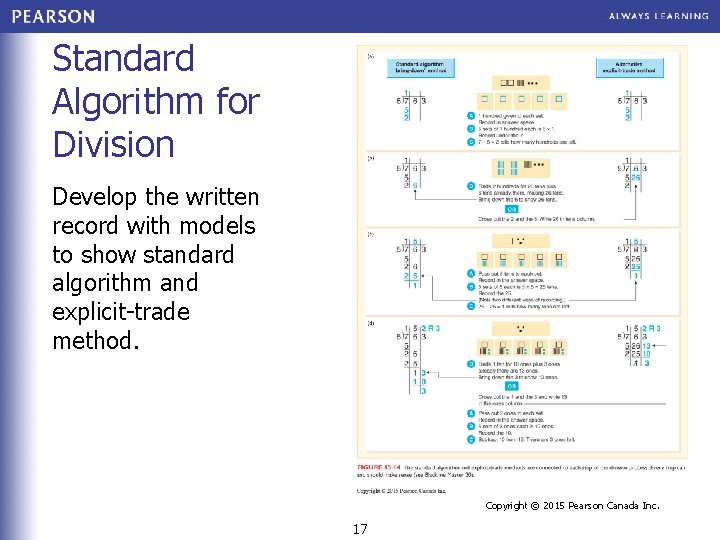
Standard Algorithm for Division Develop the written record with models to show standard algorithm and explicit-trade method. Copyright © 2015 Pearson Canada Inc. 17
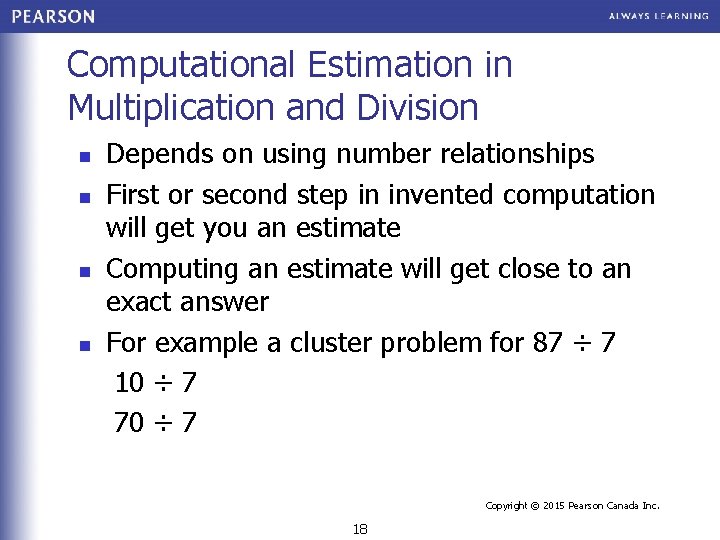
Computational Estimation in Multiplication and Division n n Depends on using number relationships First or second step in invented computation will get you an estimate Computing an estimate will get close to an exact answer For example a cluster problem for 87 ÷ 7 10 ÷ 7 70 ÷ 7 Copyright © 2015 Pearson Canada Inc. 18
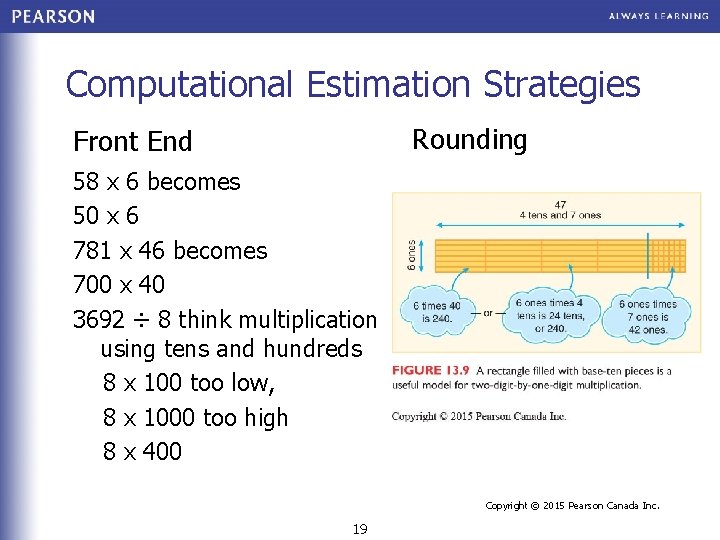
Computational Estimation Strategies Rounding Front End 58 x 6 becomes 50 x 6 781 x 46 becomes 700 x 40 3692 ÷ 8 think multiplication using tens and hundreds 8 x 100 too low, 8 x 1000 too high 8 x 400 Copyright © 2015 Pearson Canada Inc. 19
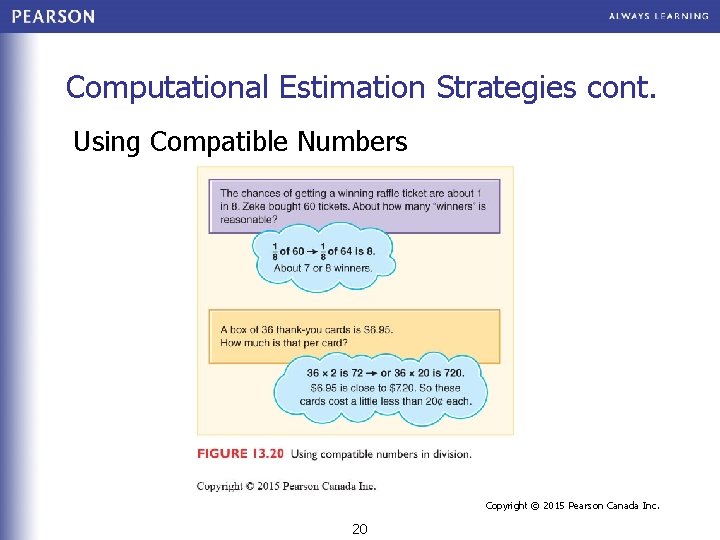
Computational Estimation Strategies cont. Using Compatible Numbers Copyright © 2015 Pearson Canada Inc. 20
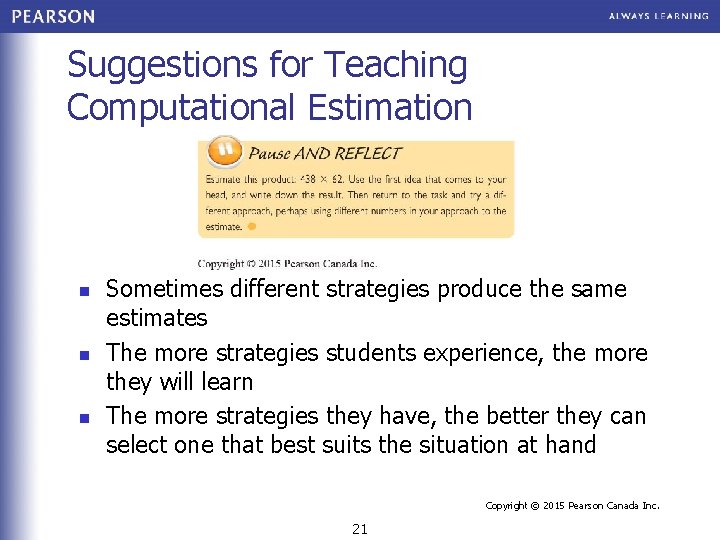
Suggestions for Teaching Computational Estimation n Sometimes different strategies produce the same estimates The more strategies students experience, the more they will learn The more strategies they have, the better they can select one that best suits the situation at hand Copyright © 2015 Pearson Canada Inc. 21
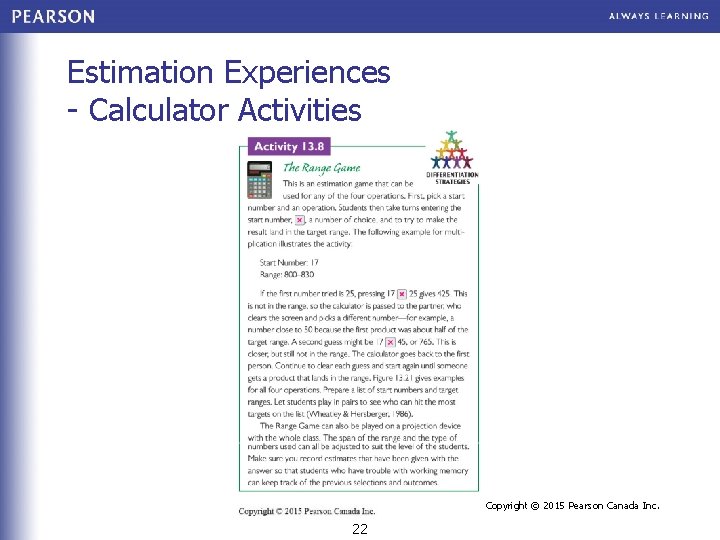
Estimation Experiences - Calculator Activities Copyright © 2015 Pearson Canada Inc. 22
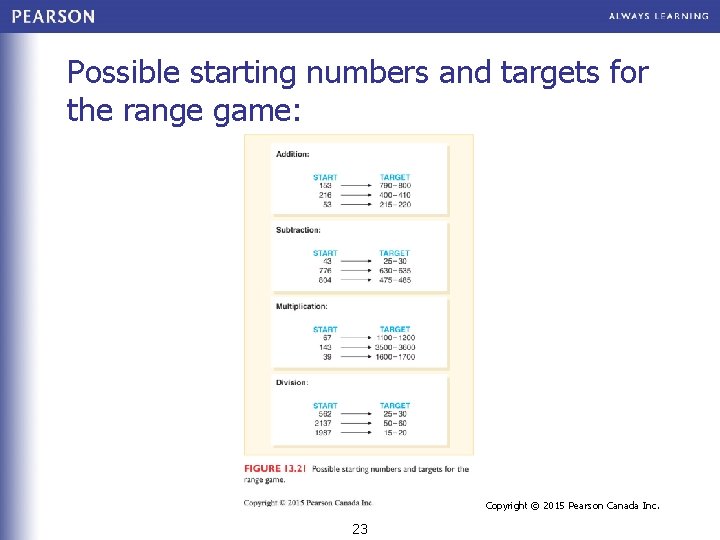
Possible starting numbers and targets for the range game: Copyright © 2015 Pearson Canada Inc. 23
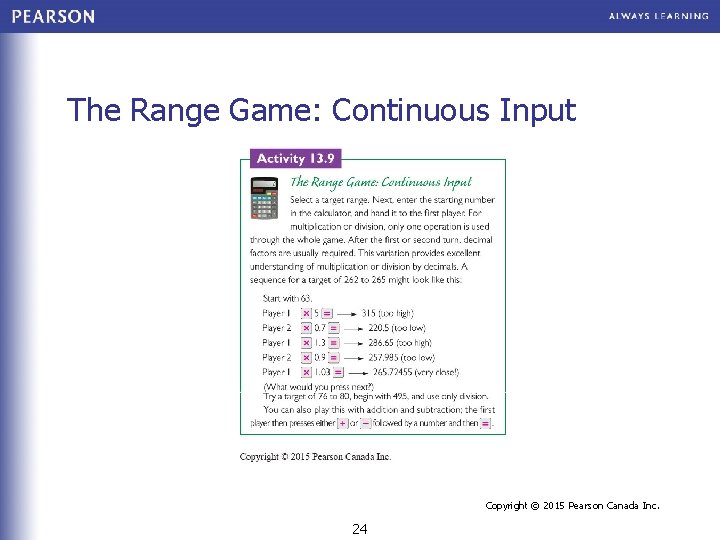
The Range Game: Continuous Input Copyright © 2015 Pearson Canada Inc. 24
Literature Connections Literature often provides excellent contexts for computation and estimates: Examples: Is a Blue Whale the Biggest Thing There Is? (Wells, 2005) Counting on Frank (Clement, 1991) Can you think of others? Copyright © 2015 Pearson Canada Inc. 25