
Chapter 13 Design Principles Overview Principles Least Privilege
- Slides: 11
Chapter 13: Design Principles • Overview • Principles – – – – Least Privilege Fail-Safe Defaults Economy of Mechanism Complete Mediation Open Design Separation of Privilege Least Common Mechanism Psychological Acceptability June 1, 2004 Computer Security: Art and Science © 2002 -2004 Matt Bishop 1
Overview • Simplicity – Less to go wrong – Fewer possible inconsistencies – Easy to understand • Restriction – Minimize access – Inhibit communication June 1, 2004 Computer Security: Art and Science © 2002 -2004 Matt Bishop 2
Least Privilege • A subject should be given only those privileges necessary to complete its task – Function, not identity, controls – Rights added as needed, discarded after use – Minimal protection domain June 1, 2004 Computer Security: Art and Science © 2002 -2004 Matt Bishop 3
Fail-Safe Defaults • Default action is to deny access • If action fails, system as secure as when action began June 1, 2004 Computer Security: Art and Science © 2002 -2004 Matt Bishop 4
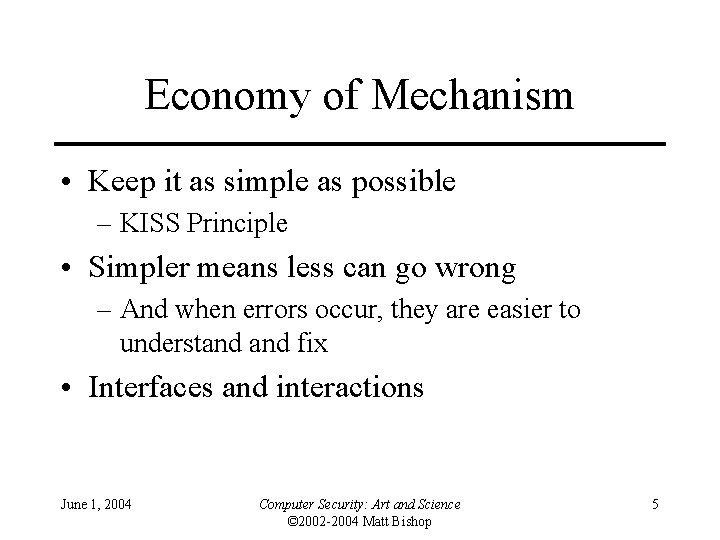
Economy of Mechanism • Keep it as simple as possible – KISS Principle • Simpler means less can go wrong – And when errors occur, they are easier to understand fix • Interfaces and interactions June 1, 2004 Computer Security: Art and Science © 2002 -2004 Matt Bishop 5
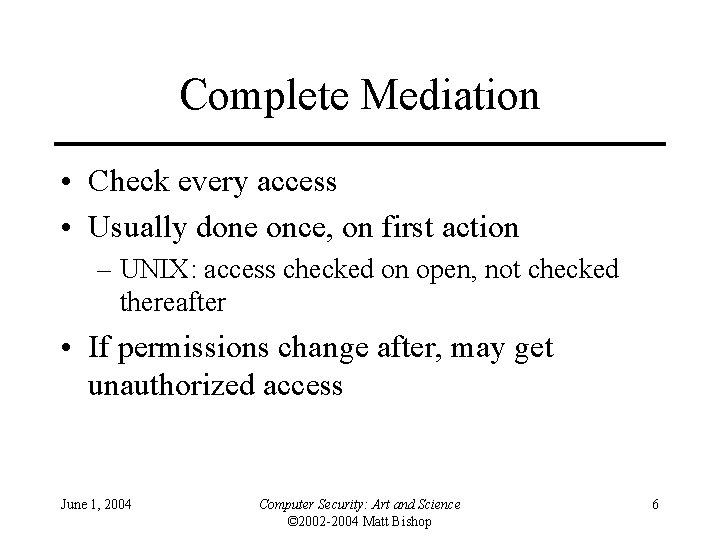
Complete Mediation • Check every access • Usually done once, on first action – UNIX: access checked on open, not checked thereafter • If permissions change after, may get unauthorized access June 1, 2004 Computer Security: Art and Science © 2002 -2004 Matt Bishop 6
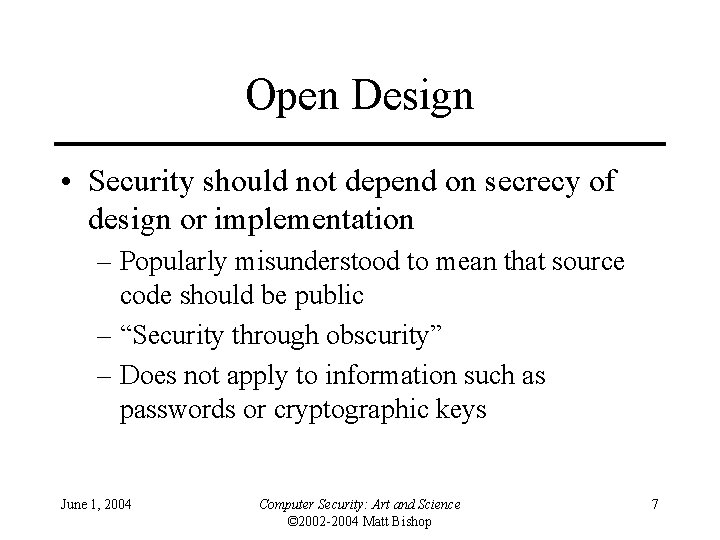
Open Design • Security should not depend on secrecy of design or implementation – Popularly misunderstood to mean that source code should be public – “Security through obscurity” – Does not apply to information such as passwords or cryptographic keys June 1, 2004 Computer Security: Art and Science © 2002 -2004 Matt Bishop 7
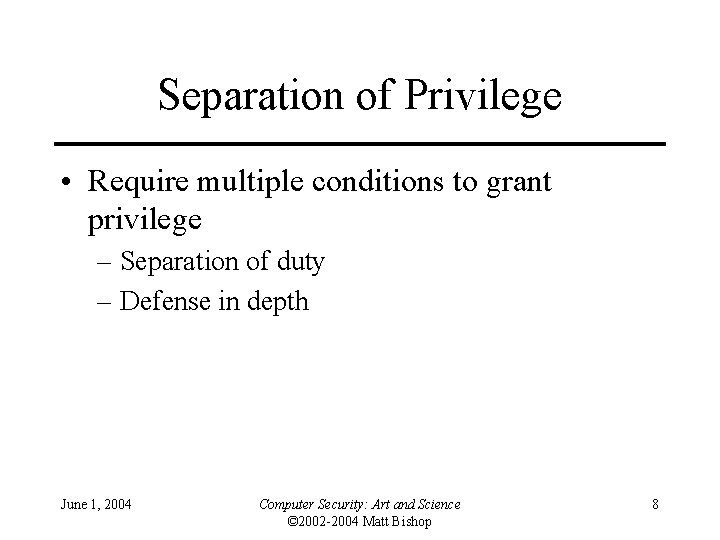
Separation of Privilege • Require multiple conditions to grant privilege – Separation of duty – Defense in depth June 1, 2004 Computer Security: Art and Science © 2002 -2004 Matt Bishop 8
Least Common Mechanism • Mechanisms should not be shared – Information can flow along shared channels – Covert channels • Isolation – Virtual machines – Sandboxes June 1, 2004 Computer Security: Art and Science © 2002 -2004 Matt Bishop 9
Psychological Acceptability • Security mechanisms should not add to difficulty of accessing resource – Hide complexity introduced by security mechanisms – Ease of installation, configuration, use – Human factors critical here June 1, 2004 Computer Security: Art and Science © 2002 -2004 Matt Bishop 10
Key Points • Principles of secure design underlie all security-related mechanisms • Require: – Good understanding of goal of mechanism and environment in which it is to be used – Careful analysis and design – Careful implementation June 1, 2004 Computer Security: Art and Science © 2002 -2004 Matt Bishop 11