
Chapter 13 Design Concepts and Principles These courseware

- Slides: 15
Chapter 13 Design Concepts and Principles These courseware materials are to be used in conjunction with Software Engineering: A Practitioner’s Approach, 5/e and are provided with permission by R. S. Pressman & Associates, Inc. , copyright © 1996, 2001 1
Analysis to Design These courseware materials are to be used in conjunction with Software Engineering: A Practitioner’s Approach, 5/e and are provided with permission by R. S. Pressman & Associates, Inc. , copyright © 1996, 2001 2
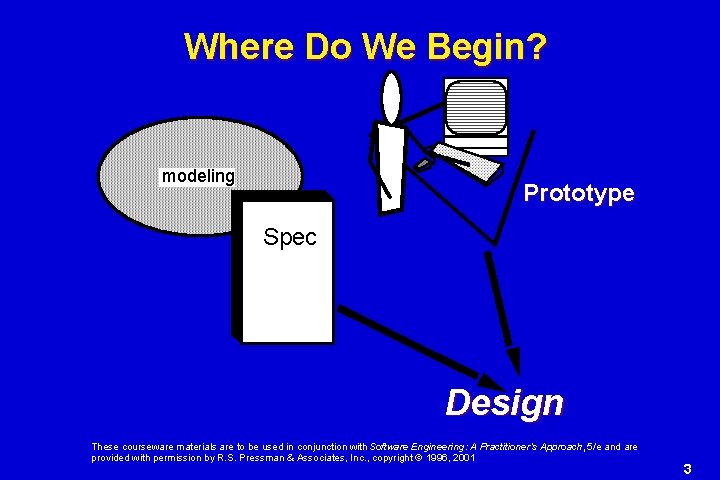
Where Do We Begin? modeling Prototype Spec Design These courseware materials are to be used in conjunction with Software Engineering: A Practitioner’s Approach, 5/e and are provided with permission by R. S. Pressman & Associates, Inc. , copyright © 1996, 2001 3
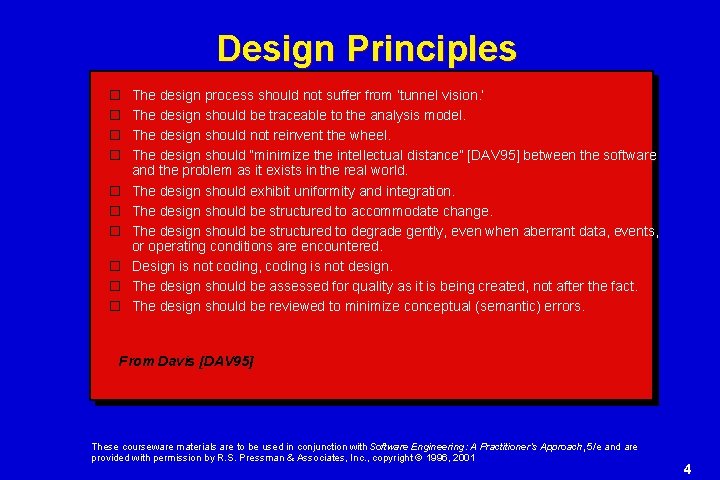
Design Principles The design process should not suffer from ‘tunnel vision. ’ The design should be traceable to the analysis model. The design should not reinvent the wheel. The design should “minimize the intellectual distance” [DAV 95] between the software and the problem as it exists in the real world. The design should exhibit uniformity and integration. The design should be structured to accommodate change. The design should be structured to degrade gently, even when aberrant data, events, or operating conditions are encountered. Design is not coding, coding is not design. The design should be assessed for quality as it is being created, not after the fact. The design should be reviewed to minimize conceptual (semantic) errors. From Davis [DAV 95] These courseware materials are to be used in conjunction with Software Engineering: A Practitioner’s Approach, 5/e and are provided with permission by R. S. Pressman & Associates, Inc. , copyright © 1996, 2001 4
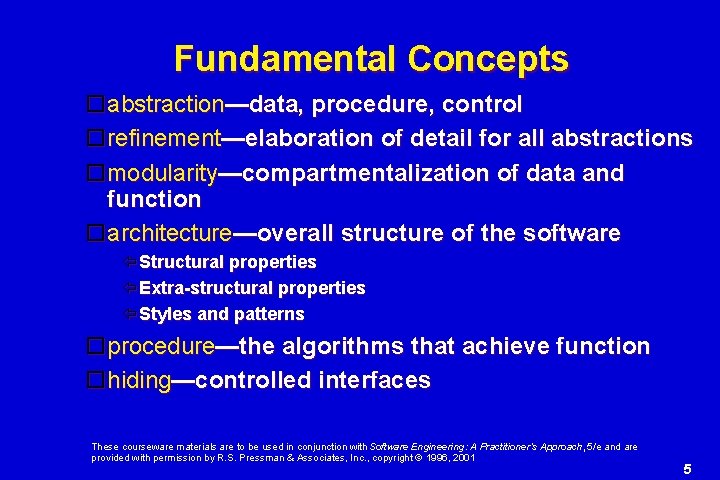
Fundamental Concepts abstraction—data, procedure, control refinement—elaboration of detail for all abstractions modularity—compartmentalization of data and function architecture—overall structure of the software Structural properties Extra-structural properties Styles and patterns procedure—the algorithms that achieve function hiding—controlled interfaces These courseware materials are to be used in conjunction with Software Engineering: A Practitioner’s Approach, 5/e and are provided with permission by R. S. Pressman & Associates, Inc. , copyright © 1996, 2001 5
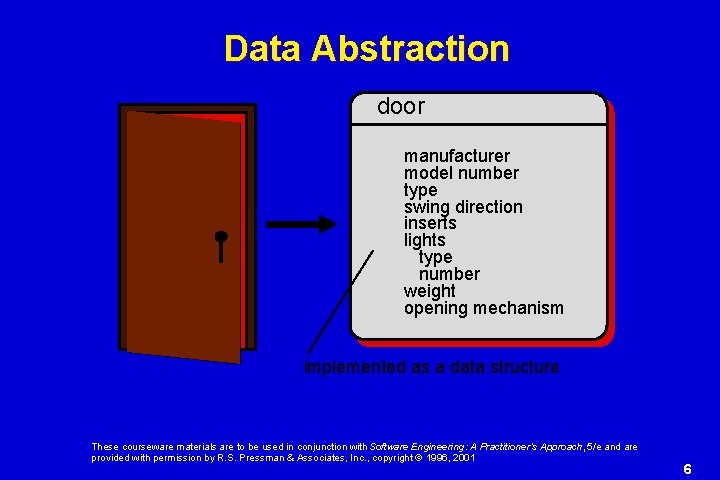
Data Abstraction door manufacturer model number type swing direction inserts lights type number weight opening mechanism implemented as a data structure These courseware materials are to be used in conjunction with Software Engineering: A Practitioner’s Approach, 5/e and are provided with permission by R. S. Pressman & Associates, Inc. , copyright © 1996, 2001 6
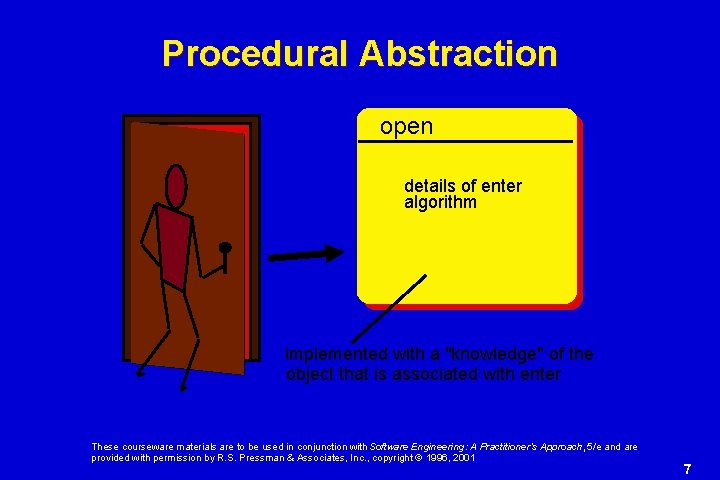
Procedural Abstraction open details of enter algorithm implemented with a "knowledge" of the object that is associated with enter These courseware materials are to be used in conjunction with Software Engineering: A Practitioner’s Approach, 5/e and are provided with permission by R. S. Pressman & Associates, Inc. , copyright © 1996, 2001 7
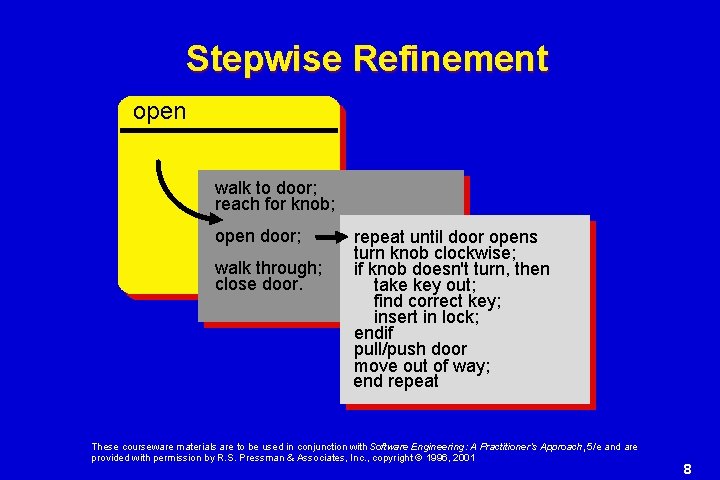
Stepwise Refinement open walk to door; reach for knob; open door; walk through; close door. repeat until door opens turn knob clockwise; if knob doesn't turn, then take key out; find correct key; insert in lock; endif pull/push door move out of way; end repeat These courseware materials are to be used in conjunction with Software Engineering: A Practitioner’s Approach, 5/e and are provided with permission by R. S. Pressman & Associates, Inc. , copyright © 1996, 2001 8
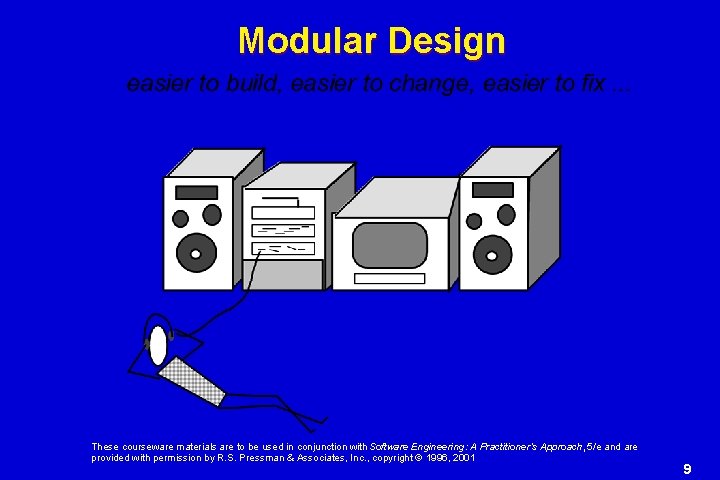
Modular Design These courseware materials are to be used in conjunction with Software Engineering: A Practitioner’s Approach, 5/e and are provided with permission by R. S. Pressman & Associates, Inc. , copyright © 1996, 2001 9
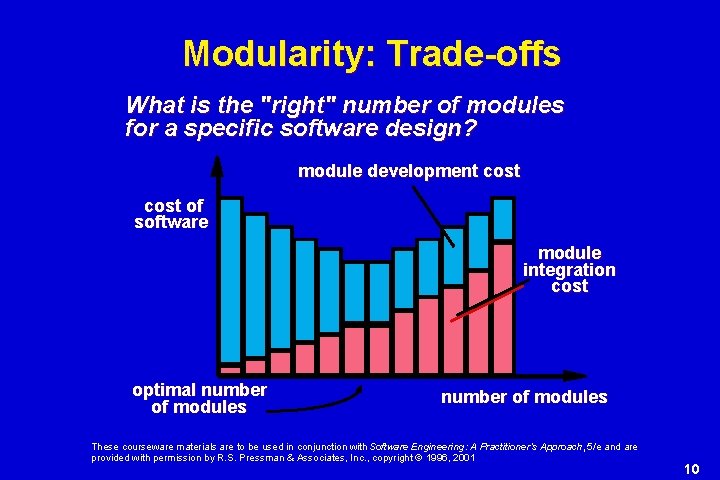
Modularity: Trade-offs What is the "right" number of modules for a specific software design? module development cost of software module integration cost optimal number of modules These courseware materials are to be used in conjunction with Software Engineering: A Practitioner’s Approach, 5/e and are provided with permission by R. S. Pressman & Associates, Inc. , copyright © 1996, 2001 10
Sizing Modules: Two Views These courseware materials are to be used in conjunction with Software Engineering: A Practitioner’s Approach, 5/e and are provided with permission by R. S. Pressman & Associates, Inc. , copyright © 1996, 2001 11
Functional Independence These courseware materials are to be used in conjunction with Software Engineering: A Practitioner’s Approach, 5/e and are provided with permission by R. S. Pressman & Associates, Inc. , copyright © 1996, 2001 12
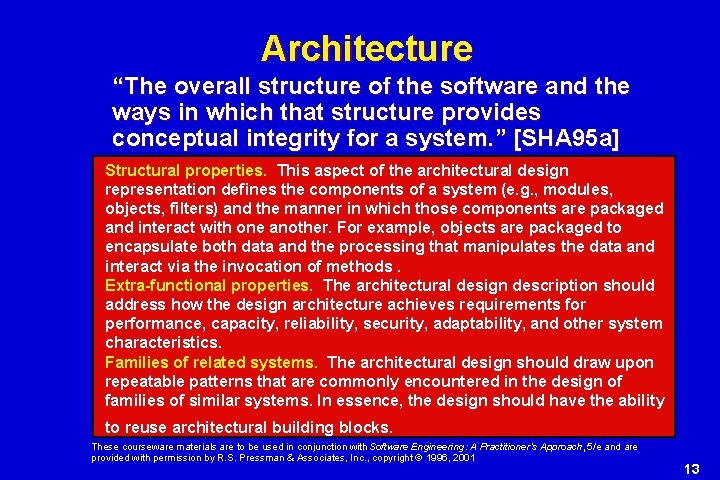
Architecture “The overall structure of the software and the ways in which that structure provides conceptual integrity for a system. ” [SHA 95 a] Structural properties. This aspect of the architectural design representation defines the components of a system (e. g. , modules, objects, filters) and the manner in which those components are packaged and interact with one another. For example, objects are packaged to encapsulate both data and the processing that manipulates the data and interact via the invocation of methods. Extra-functional properties. The architectural design description should address how the design architecture achieves requirements for performance, capacity, reliability, security, adaptability, and other system characteristics. Families of related systems. The architectural design should draw upon repeatable patterns that are commonly encountered in the design of families of similar systems. In essence, the design should have the ability to reuse architectural building blocks. These courseware materials are to be used in conjunction with Software Engineering: A Practitioner’s Approach, 5/e and are provided with permission by R. S. Pressman & Associates, Inc. , copyright © 1996, 2001 13
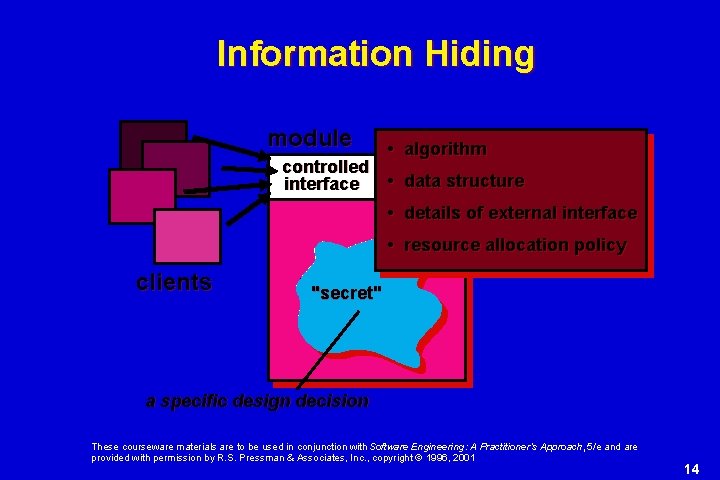
Information Hiding module controlled interface • algorithm • data structure • details of external interface • resource allocation policy clients "secret" a specific design decision These courseware materials are to be used in conjunction with Software Engineering: A Practitioner’s Approach, 5/e and are provided with permission by R. S. Pressman & Associates, Inc. , copyright © 1996, 2001 14
Why Information Hiding? reduces the likelihood of “side effects” limits the global impact of local design decisions emphasizes communication through controlled interfaces discourages the use of global data leads to encapsulation—an attribute of high quality design results in higher quality software These courseware materials are to be used in conjunction with Software Engineering: A Practitioner’s Approach, 5/e and are provided with permission by R. S. Pressman & Associates, Inc. , copyright © 1996, 2001 15