
Chapter 13 CONDENSED STATES OF MATTER States of

- Slides: 43
Chapter 13 CONDENSED STATES OF MATTER
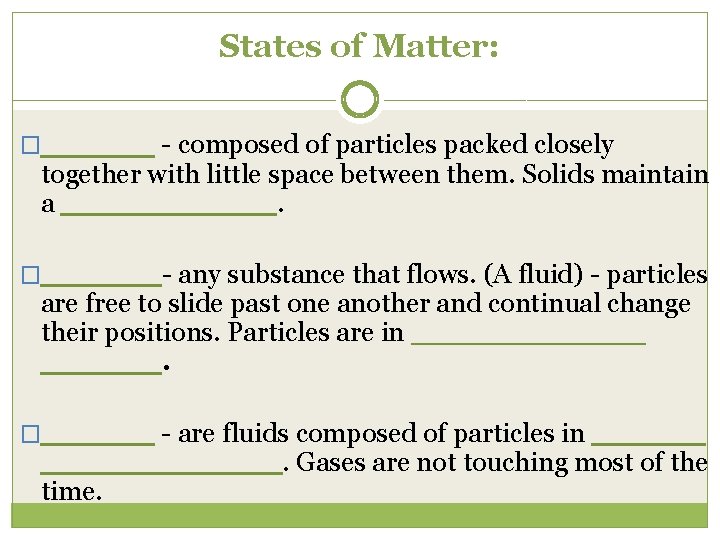
States of Matter: �______ - composed of particles packed closely together with little space between them. Solids maintain a _______. �______ - any substance that flows. (A fluid) - particles are free to slide past one another and continual change their positions. Particles are in ______. �______ - are fluids composed of particles in ______. Gases are not touching most of the time.
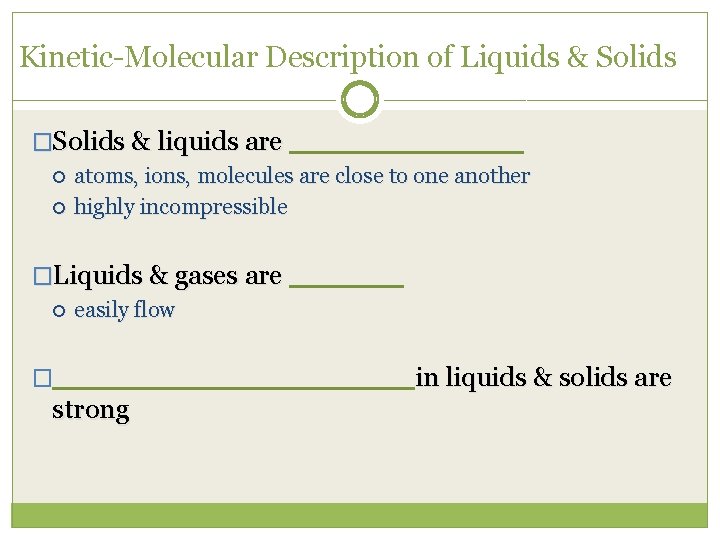
Kinetic-Molecular Description of Liquids & Solids �Solids & liquids are ______ atoms, ions, molecules are close to one another highly incompressible �Liquids & gases are ______ easily flow �______ in liquids & solids are strong
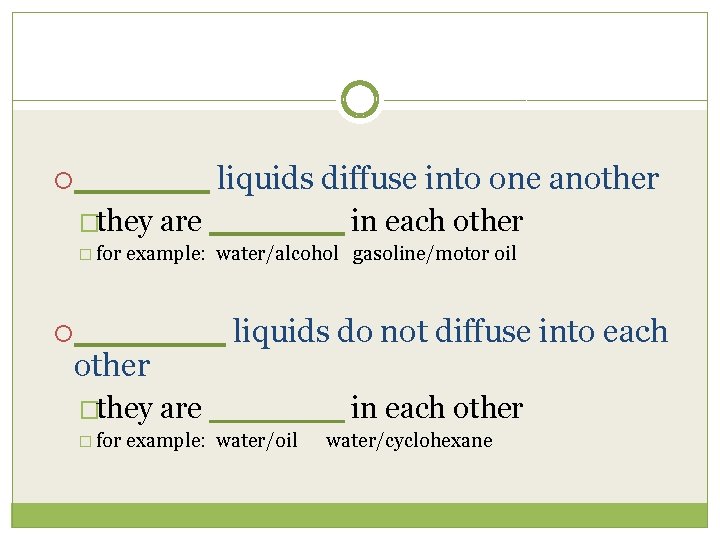
______ liquids diffuse into one another �they are ______ in each other � for example: water/alcohol gasoline/motor oil ______ other �they � for liquids do not diffuse into each are ______ in each other example: water/oil water/cyclohexane
Periodic Table Reminders �______ - called groups or families. Elements in a group have similar chemical and physical properties �______ - called periods, elements within a period have properties that change progressively across the table
Intermolecular forces, I. F. �depend on the shape of the molecules and polarity (dipole moments), Lewis structures and electronegativity �Table 13 -1 Characteristics of solids, liquids, and gases �Ex. Sulfur hexafluoride �Ex. water
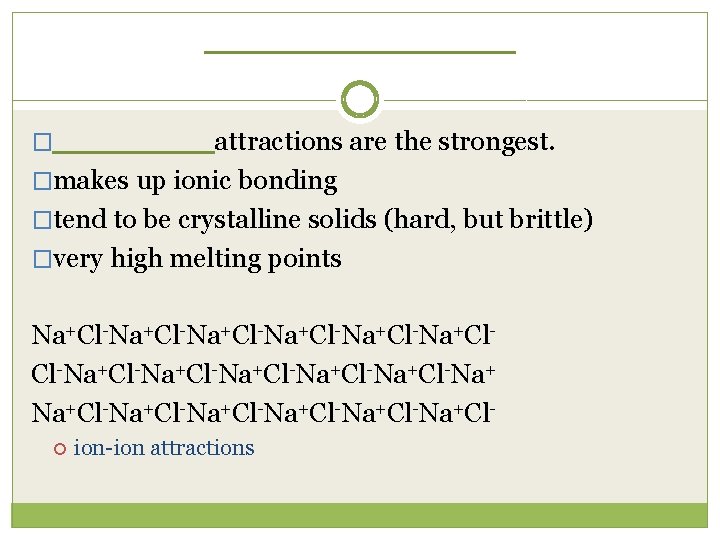
______ __ �______ attractions are the strongest. �makes up ionic bonding �tend to be crystalline solids (hard, but brittle) �very high melting points Na+Cl-Na+Cl-Na+Cl-Na+Cl-Na+Cl ion-ion attractions
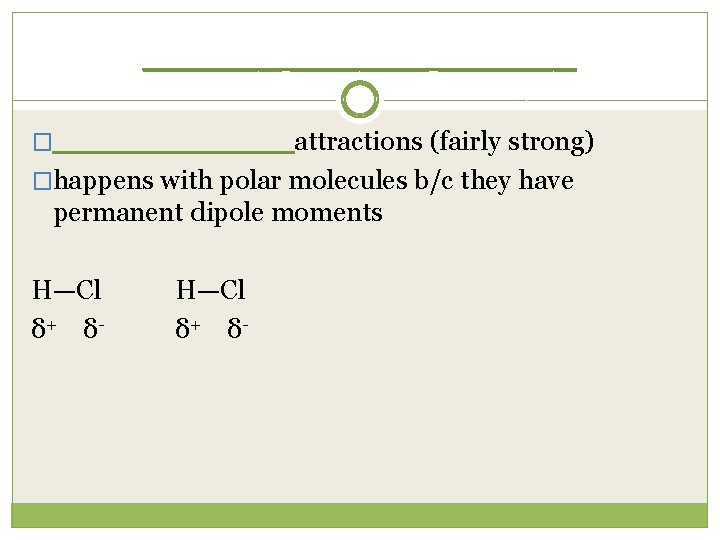
______ �______ attractions (fairly strong) �happens with polar molecules b/c they have permanent dipole moments H—Cl δ+ δ -
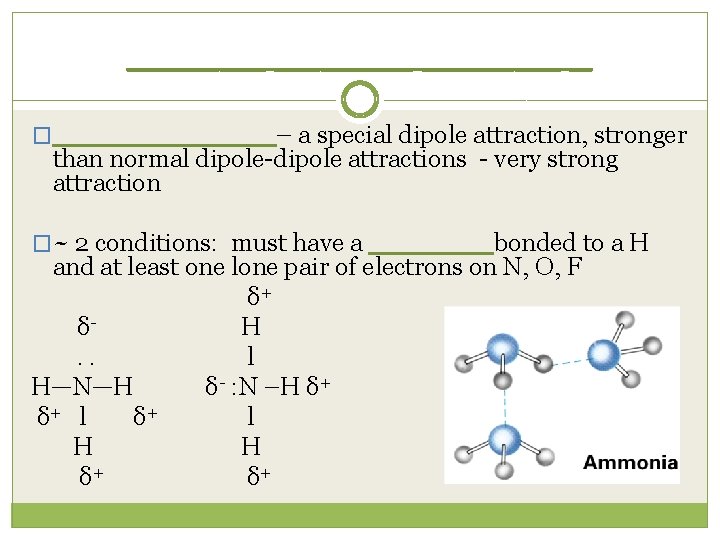
______ _ �______ – a special dipole attraction, stronger than normal dipole-dipole attractions - very strong attraction �~ 2 conditions: must have a ______ bonded to a H and at least one lone pair of electrons on N, O, F δ+ δH. . l H—N—H δ- : N –H δ+ δ+ l H H δ+ δ+
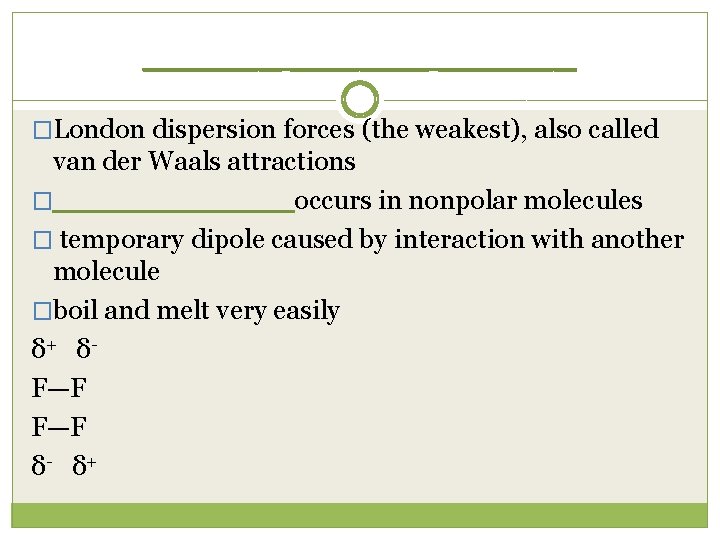
______ �London dispersion forces (the weakest), also called van der Waals attractions �______ occurs in nonpolar molecules � temporary dipole caused by interaction with another molecule �boil and melt very easily δ+ δ F—F δ- δ +
Properties of liquids �Properties of liquids at constant temperature �~ no definite ______ �~ have surface tension, diffuse, medium density, viscosity, evaporation, capillary action, and vapor pressure. ______ of each depends on I. F.
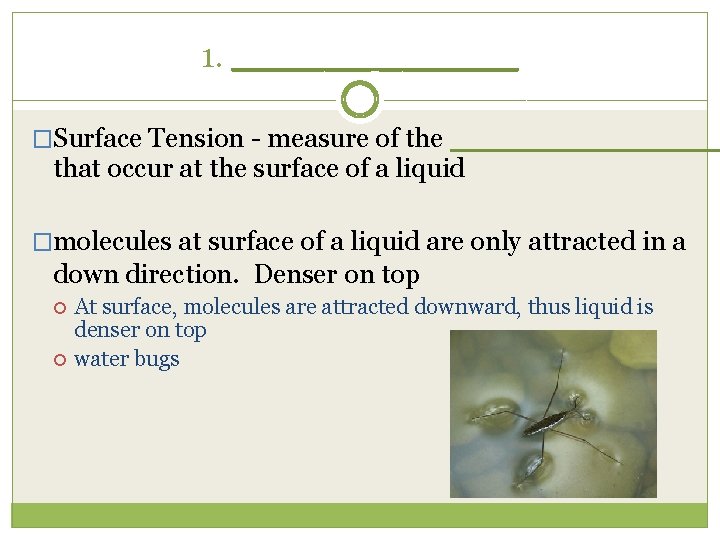
1. ______ �Surface Tension - measure of the ______ that occur at the surface of a liquid �molecules at surface of a liquid are only attracted in a down direction. Denser on top At surface, molecules are attracted downward, thus liquid is denser on top water bugs
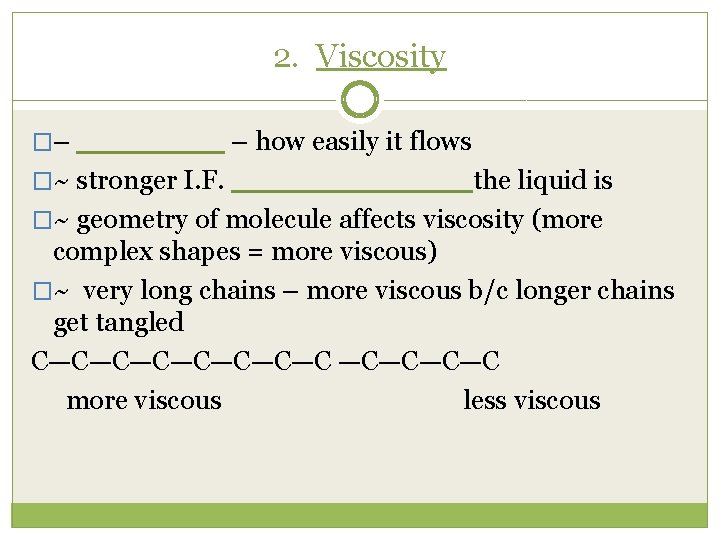
2. Viscosity �– ______ – how easily it flows �~ stronger I. F. ______ the liquid is �~ geometry of molecule affects viscosity (more complex shapes = more viscous) �~ very long chains – more viscous b/c longer chains get tangled C—C—C—C—C more viscous less viscous
3. ______ �– tendency of a liquid to be ______ or ______ by a very narrow tube - Stronger I. F. more cohesion �~ when a molecule has attraction for itself, it’s called ______ �~ when a molecule has attraction for other molecules, it is ______ capillary rise implies adhesive > cohesive (water) capillary fall implies cohesive > adhesive (mercury)
4. _____ _ �– when a liquid changes to the vapor phase at a temp. that is less than it’s boiling point. �Why? If the molecule can gain enough speed, they break through the liquid and go into the atmosphere
5. ______ �– the pressure of a gas that exists over its solid or liquid state. High I. F. = low Pvap �Does not depend on how much liquid/solid you have. Pvap depends on the temp. and type of substance. �You have vapor pressure as long as there is evaporation of a liquid. �Higher Temperature = Higher vapor pressure �Boiling occurs when the Pvap of liquid = Patm
The Liquid State �Vapor Pressure (High I. F. = low Pvapor )
______ �~ All liquids have different boiling points: based on I. F. Higher I. F. , higher the normal boiling point. �~ can separate liquids on the basis of their b. p. (distillation) �CH 3 OH has a lower boiling point than C 2 H 5 OH, so it changes to a gas first.
______ �– show the phase of matter at a variety of P and T. (pg 507) �~ Substances can be almost any phase, given the right P and T. �H 2 o is less dense in solid state (ice has lots of space in it), water has a negative slope between the solid & liquid on the phase diagram. Water is densest at 4 o. C.
______ �q = mcΔT q = heat change in temp. m = mass c = specific heat ΔT = �specific heat is the amount of energy needed to raise 1 g of a substance 1 o. C �If c is big, it’s hard to heat up or cool down. If less than one, easy to heat up or cool down. �During a phase change, the temp. stays the same. Still heating/cooling, but no temp. change due to the breaking down or forming of I. F.
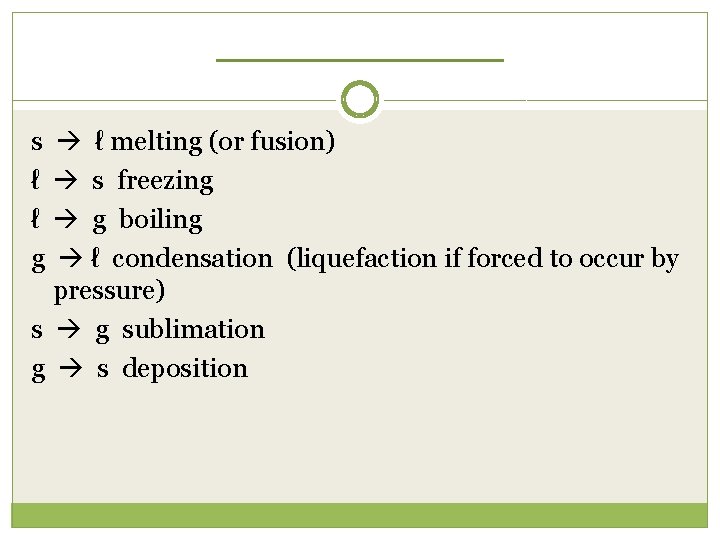
______ s ℓ melting (or fusion) ℓ s freezing ℓ g boiling g ℓ condensation (liquefaction if forced to occur by pressure) s g sublimation g s deposition
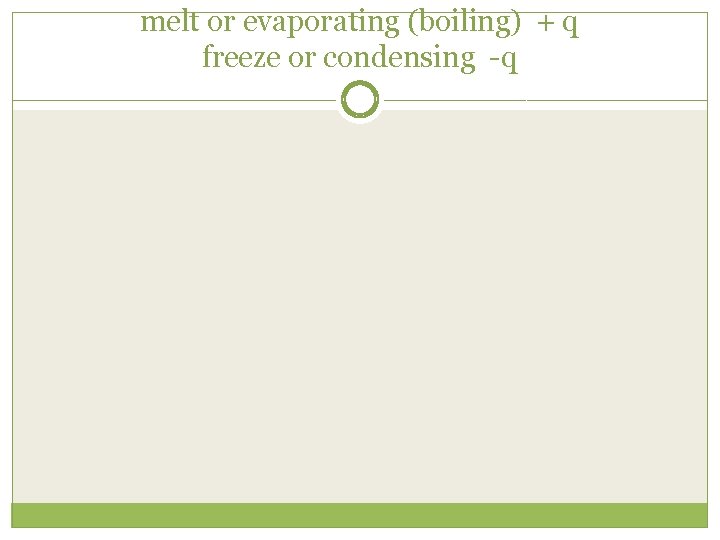
melt or evaporating (boiling) + q freeze or condensing -q
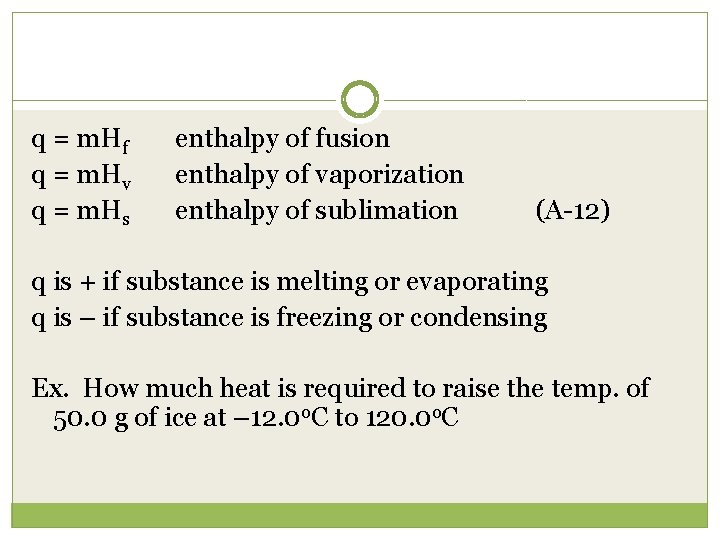
q = m. Hf q = m. Hv q = m. Hs enthalpy of fusion enthalpy of vaporization enthalpy of sublimation (A-12) q is + if substance is melting or evaporating q is – if substance is freezing or condensing Ex. How much heat is required to raise the temp. of 50. 0 g of ice at – 12. 0 o. C to 120. 0 o. C
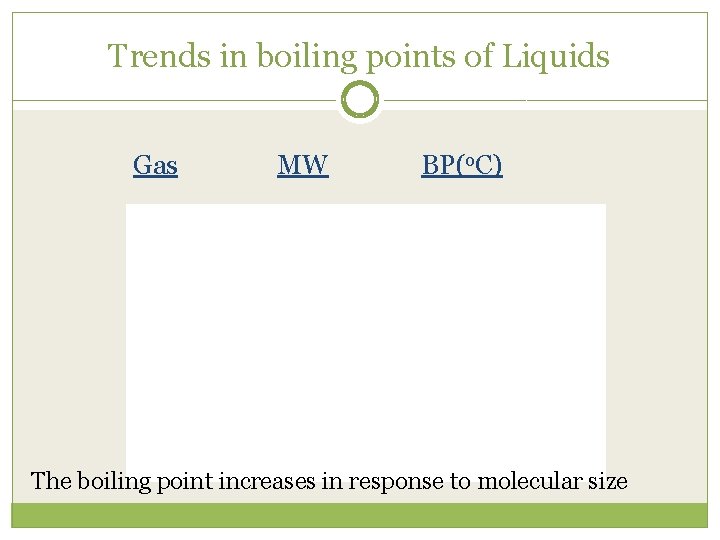
Trends in boiling points of Liquids Gas MW BP(o. C) The boiling point increases in response to molecular size
The boiling point increases in response to molecular size
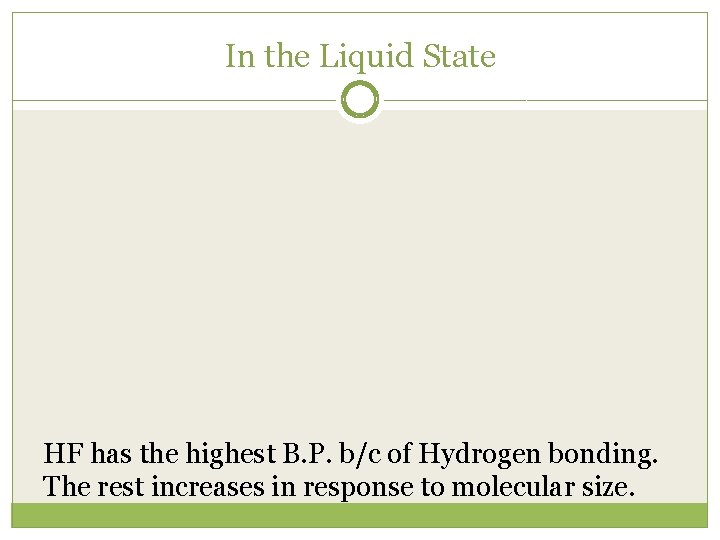
In the Liquid State HF has the highest B. P. b/c of Hydrogen bonding. The rest increases in response to molecular size.
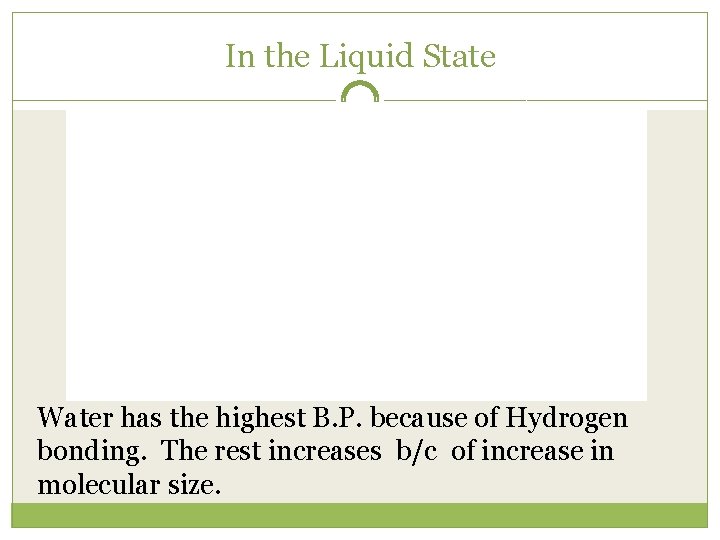
In the Liquid State Water has the highest B. P. because of Hydrogen bonding. The rest increases b/c of increase in molecular size.
Various boiling points �Arrange the following substances in order of increasing boiling points. C 2 H 6, NH 3, Ar, Na. Cl, As. H 3
Amorphous & Crystalline Solids 29 �Amorphous solids ______ have a well ordered structure. Particles are irregularly arranged so IF vary in strength within a sample Ex. �Crystalline solids have well defined structures that consist of extended array of repeating units. Have defined IF. give X-ray difraction patterns ~ see Bragg equation in book Ex.
Structure of Crystals 30 �unit cell - smallest repeating unit of a crystal Ex. bricks are repeating units for buildings � 7 basic crystal systems We do not need to learn these 7 now – just an FYI for your future…
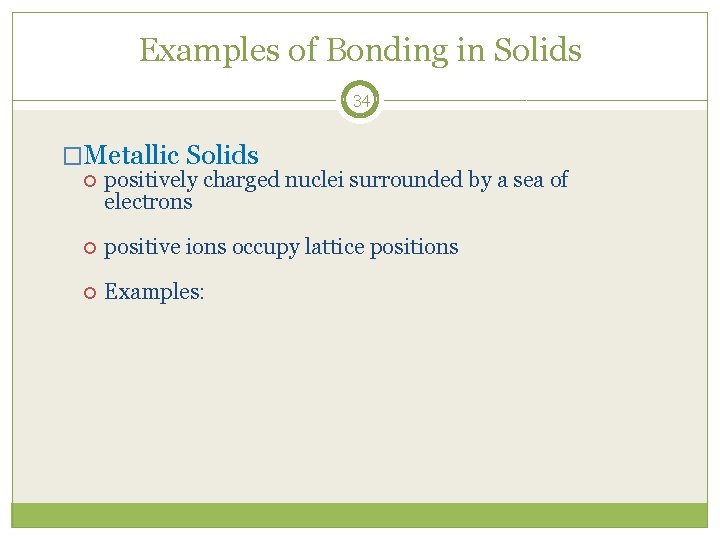
Types of Solids 4 Types of Solids: Ionic, Metallic, Molecular, Covalent ______ : positive and negative ions arranged in a specific structure. Electrostatic attractions are strong. ______ : metals where each valence electron is thought to belong to the entire structure. So metals are seen as a positive nuclei with a sea of electrons. The mobility of electrons helps explain the electrical conductivity of metals.
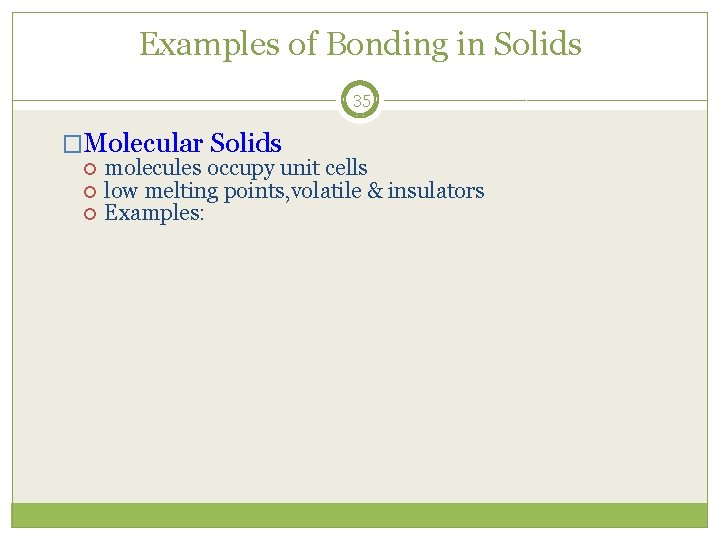
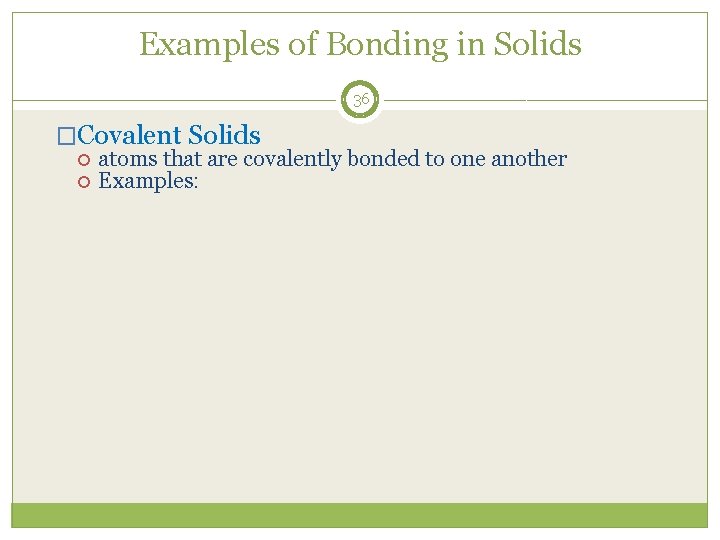
______ : are solids made up of molecules that are next to each other in unit cells. The attractive forces between individual molecules are relatively weak. They are volatile and insulators. Simple covalent compounds usually form molecular solids ______ : Network solids or giant molecules – individual atoms are covalently bonded to other atoms and those atoms are bonded to other atoms, etc. This makes covalent solids very hard with very high melting points. Most are nonconductors.
Examples of Bonding in Solids 33 �Ionic Solids ions occupy the unit cell Examples:
Examples of Bonding in Solids 34 �Metallic Solids positively charged nuclei surrounded by a sea of electrons positive ions occupy lattice positions Examples:
Examples of Bonding in Solids 35 �Molecular Solids molecules occupy unit cells low melting points, volatile & insulators Examples:
Examples of Bonding in Solids 36 �Covalent Solids atoms that are covalently bonded to one another Examples:
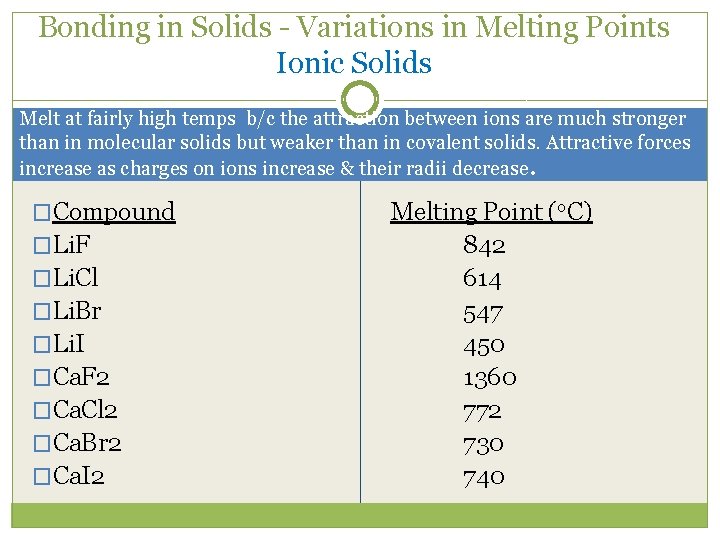
Bonding in Solids - Variations in Melting Points Ionic Solids Melt at fairly high temps b/c the attraction between ions are much stronger than in molecular solids but weaker than in covalent solids. Attractive forces increase as charges on ions increase & their radii decrease. �Compound �Li. F �Li. Cl �Li. Br �Li. I �Ca. F 2 �Ca. Cl 2 �Ca. Br 2 �Ca. I 2 Melting Point (o. C) 842 614 547 450 1360 772 730 740
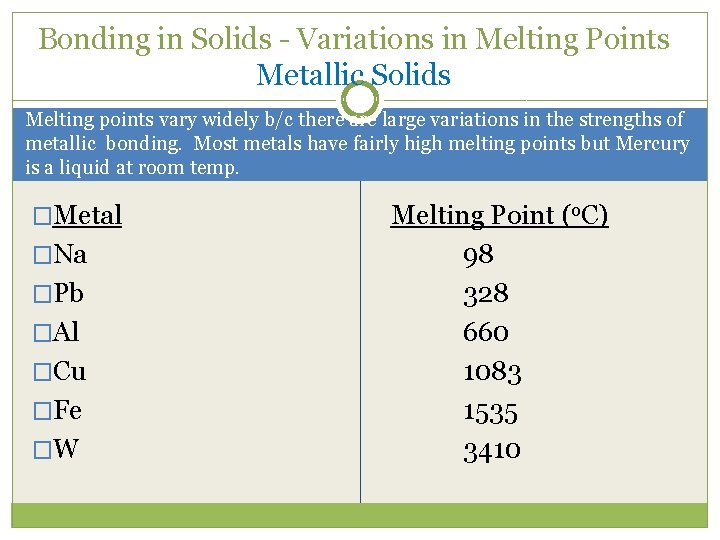
Bonding in Solids - Variations in Melting Points Metallic Solids Melting points vary widely b/c there are large variations in the strengths of metallic bonding. Most metals have fairly high melting points but Mercury is a liquid at room temp. �Metal �Na �Pb �Al �Cu �Fe �W Melting Point (o. C) 98 328 660 1083 1535 3410
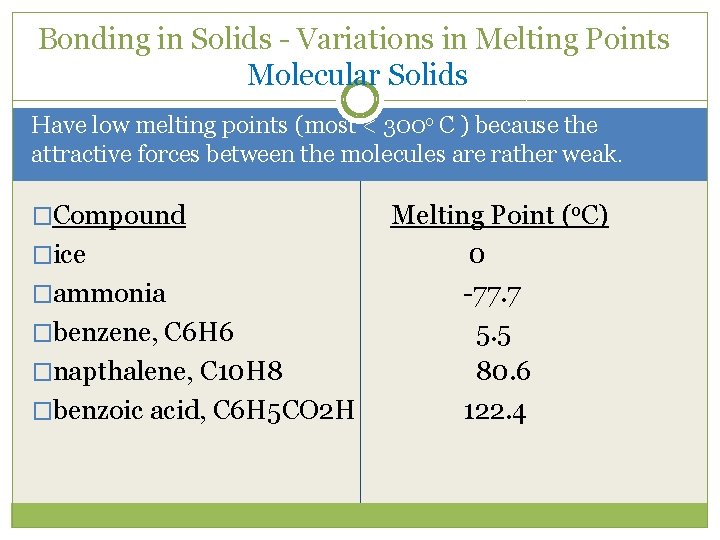
Bonding in Solids - Variations in Melting Points Molecular Solids Have low melting points (most < 300 o C ) because the attractive forces between the molecules are rather weak. �Compound �ice �ammonia �benzene, C 6 H 6 �napthalene, C 10 H 8 �benzoic acid, C 6 H 5 CO 2 H Melting Point (o. C) 0 -77. 7 5. 5 80. 6 122. 4
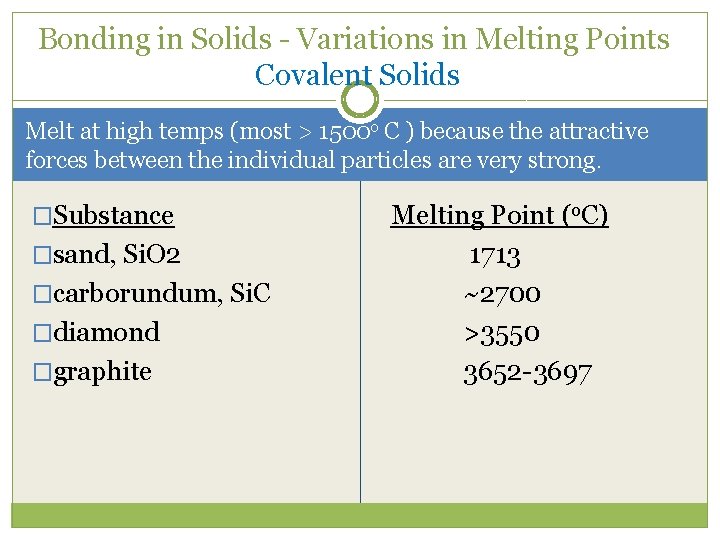
Bonding in Solids - Variations in Melting Points Covalent Solids Melt at high temps (most > 1500 o C ) because the attractive forces between the individual particles are very strong. �Substance �sand, Si. O 2 �carborundum, Si. C �diamond �graphite Melting Point (o. C) 1713 ~2700 >3550 3652 -3697
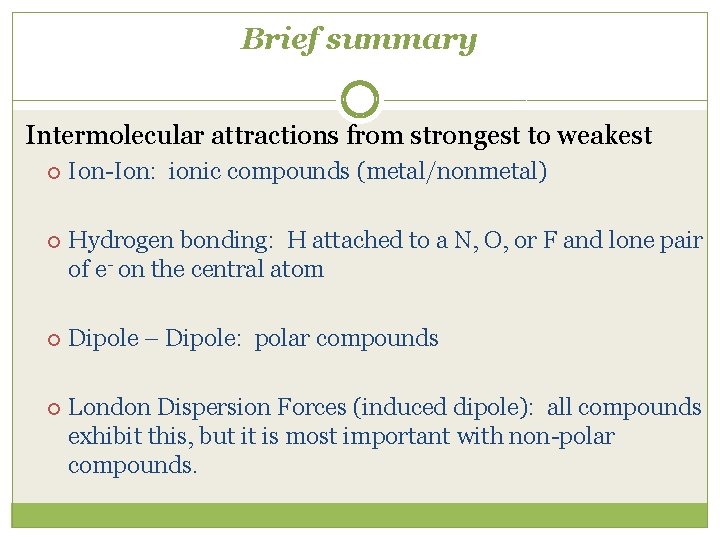
Brief summary Intermolecular attractions from strongest to weakest Ion-Ion: ionic compounds (metal/nonmetal) Hydrogen bonding: H attached to a N, O, or F and lone pair of e- on the central atom Dipole – Dipole: polar compounds London Dispersion Forces (induced dipole): all compounds exhibit this, but it is most important with non-polar compounds.
Effects of intermolecular attractions �The compound that has the highest boiling pt, melting pt, and heat of vaporization corresponds to the compound with the strongest I. F. �The highest vapor pressure corresponds to the lowest intermolecular attractions. �If two compounds are nonpolar, the one with the greatest molecular mass has the greater London Forces. �If two compounds are ionic, the one with the greatest charge ions has the greater I. F. If same charge, the smallest ions have the greatest I. F.
�For many years, the world’s record for flying gliders was 60, 000 ft. It was set by a Texan who flew into an updraft in front of an approaching storm. The pilot had to fly out of the updraft and land, not because he was our of air (there was still plenty of air in his compressed air bottle) but because he was not wearing a pressurized suit. What would have happened to the pilot’s blood if he had continued to fly higher?