
CHAPTER 13 Classical Chamber Music 2009 The Mc
CHAPTER 13 Classical Chamber Music © 2009, The Mc. Graw-Hill Companies, Inc. All Rights Reserved. 1
Chamber Sonatas Multimovement sonata form used for chamber ensembles • 2 to 9 instrumentalists • Usually one player to a part (string players sometimes double or triple parts) • Often titled according number of performers and instruments • duet (2) • trio (3) • quartet (4) • quintet (5) • sextet (6) • septet (7) • octet (8) • nonet (9) • guitar duet = 2 guitars Some titles are misleading: • Piano trio: violin, , cello, piano • Piano quartet: violin, viola, cello, piano • Piano quintet: string quartet and piano © 2009, The Mc. Graw-Hill Companies, Inc. All Rights Reserved. 2
Chamber Music • Commissioned by wealthy patrons for performances in palace chambers • Intimate - players seated close to each other • Each player easily heard • Players communicate by gesture, no conductor necessary • String quartet (2 violins, viola, cello) became the most important chamber music genre of the classical era © 2009, The Mc. Graw-Hill Companies, Inc. All Rights Reserved. 3
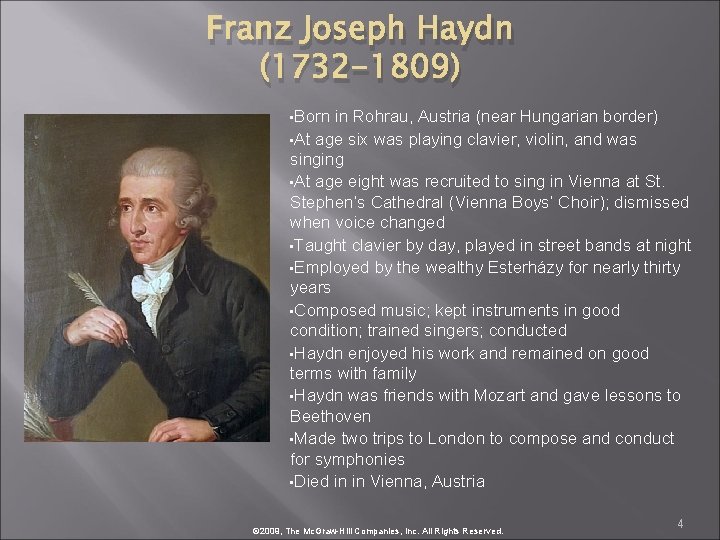
Franz Joseph Haydn (1732 -1809) • Born in Rohrau, Austria (near Hungarian border) • At age six was playing clavier, violin, and was singing • At age eight was recruited to sing in Vienna at St. Stephen’s Cathedral (Vienna Boys’ Choir); dismissed when voice changed • Taught clavier by day, played in street bands at night • Employed by the wealthy Esterházy for nearly thirty years • Composed music; kept instruments in good condition; trained singers; conducted • Haydn enjoyed his work and remained on good terms with family • Haydn was friends with Mozart and gave lessons to Beethoven • Made two trips to London to compose and conduct for symphonies • Died in in Vienna, Austria © 2009, The Mc. Graw-Hill Companies, Inc. All Rights Reserved. 4
Haydn’s Music • Called the father of the string quartet and the symphony • 104 symphonies • String quartets • Piano trios • Concertos • Masses • Operas • Cantatas • Oratorios © 2009, The Mc. Graw-Hill Companies, Inc. All Rights Reserved. 5
Featured Listening: String Quartet op. 33, no. 3 (“The Bird”), fourth movement by Haydn String quartet Presto tempo Sonata-rondo form Homophonic texture (some polyphony) String quartet (2 violins, viola, cello) Duple meter Listening Guide Excerpt from CD 1, tracks 21 -28, pp. 138 -139 Listen to the staccato (short and detached) theme from the A section: Notice the imitation of birdcalls in the melody © 2009, The Mc. Graw-Hill Companies, Inc. All Rights Reserved. 6
Rondo Form • Alternating form often used in the fourth movement of classical instrumental works • The “A” theme returns between contrasting music ( themes “B, ” “C, ” etc. ) • ABABA or ABACABA are most common • Sonata rondo merges the recurring “A” theme with a development section from the sonata form © 2009, The Mc. Graw-Hill Companies, Inc. All Rights Reserved. 7
Listening Guide: Grande Sonata no. 85 for flute and guitar, third movement by Mauro Giuliano Composed ca. 1817 Scherzo and trio form Homophonic texture Flute and guitar Triple meter Listening Guide Example from CD 4, Track 1, pp. 140 -141 Italian composer Mario Giuliani (1781 -1828) composed for the guitar – a popular chamber instrument because of its intimate sound Listen to the entire movement: © 2009, The Mc. Graw-Hill Companies, Inc. All Rights Reserved. 8
- Slides: 8