
Chapter 13 Body Defense Mechanisms Lecture Presentation Betty
Chapter 13 Body Defense Mechanisms Lecture Presentation Betty Mc. Guire Cornell University Copyright © 2012 Pearson Education, Inc.
Body Defense Mechanisms § § § § The body’s defense system Three lines of defense Distinguishing self from nonself Antibody-mediated responses and cell-mediated responses Steps of the adaptive immune response Active and passive immunity Monoclonal antibodies Problems of the immune system Copyright © 2012 Pearson Education, Inc.
The Body’s Defense System § Targets of the body’s defense mechanisms § Pathogens § Disease-causing bacteria, viruses, protozoans, fungi, parasitic worms, prions § Cancer cells § Once normal body cells whose genetic changes cause unregulated cell division Copyright © 2012 Pearson Education, Inc.

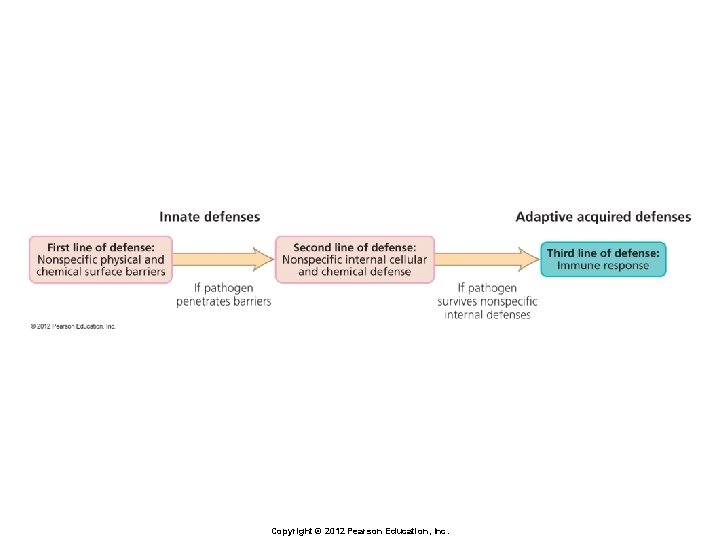
Three Lines of Defense 1. Physical and chemical surface barriers § Nonspecific § Keep foreign organisms or molecules out 2. Internal cellular and chemical defenses § Nonspecific § Attack any foreign organism or molecule that has gotten past the surface barriers 3. Immune response § Specific § Destroy specific targets and remember them Copyright © 2012 Pearson Education, Inc.
Copyright © 2012 Pearson Education, Inc.

Three Lines of Defense § First line of defense: Physical barriers § Skin § Nearly impenetrable § Waterproof § Resistant to most toxins and enzymes of invading organisms § Mucous membranes § Line the respiratory and digestive tracts § Sticky mucus traps microbes Copyright © 2012 Pearson Education, Inc.
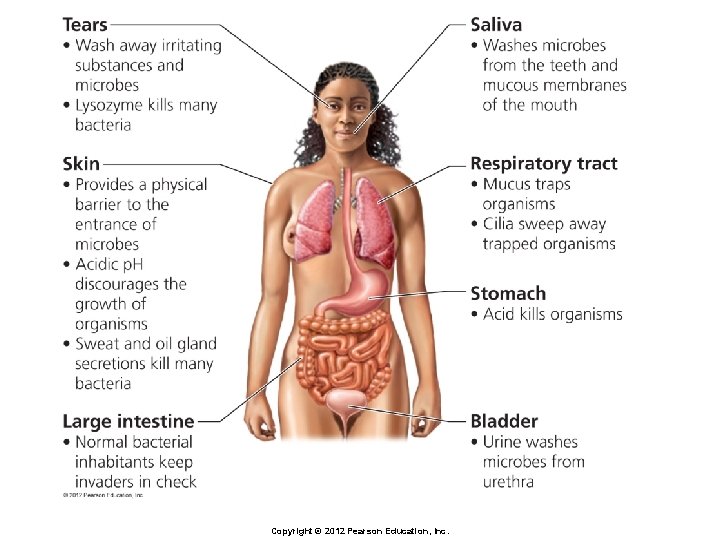
Three Lines of Defense § First line of defense: Chemical barriers § Sweat and oil glands of the skin § Produce chemicals that slow or prevent growth of bacteria § Lining of the stomach § Produces hydrochloric acid and proteindigesting enzymes that destroy pathogens Copyright © 2012 Pearson Education, Inc.
Three Lines of Defense § First line of defense: Chemical barriers (cont. ) § Urine § Slows bacterial growth with acidity § (Also washes microbes from urethra) § Saliva and tears § Contain lysozyme, an enzyme that kills bacteria Copyright © 2012 Pearson Education, Inc.
Copyright © 2012 Pearson Education, Inc.
Three Lines of Defense § Second line of defense § § Defensive cells Defensive proteins Inflammation Fever Copyright © 2012 Pearson Education, Inc.
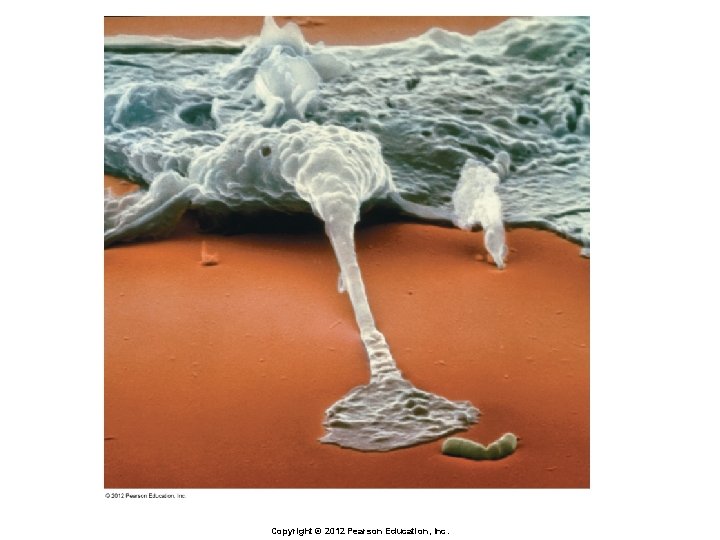
Three Lines of Defense § Defensive cells § Phagocytes (WBCs) that engulf pathogens § Neutrophils § Arrive first § Macrophages § Develop from monocytes that leave the circulatory system § Eosinophils § Attack pathogens that are too large for phagocytosis, such as parasitic worms Copyright © 2012 Pearson Education, Inc.
Copyright © 2012 Pearson Education, Inc.
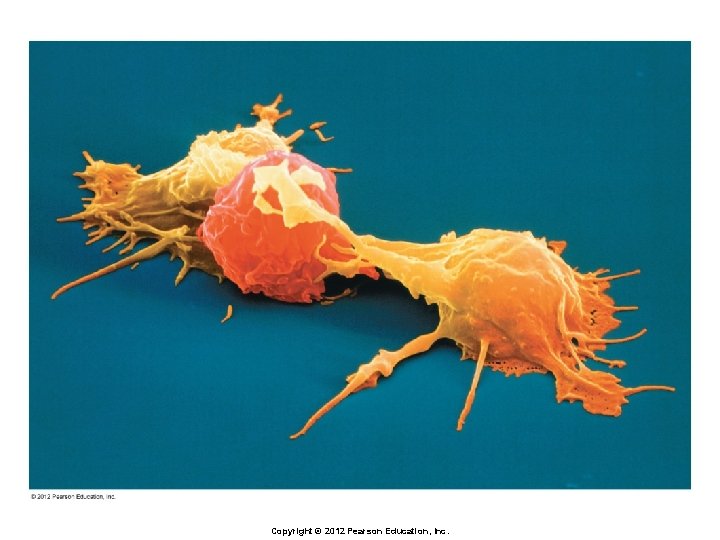
Three Lines of Defense § Defensive cells (cont. ) § Natural killer (NK) cells § Also a type of WBC § Search out abnormal cells, including cancer cells, and kill them Copyright © 2012 Pearson Education, Inc.
Copyright © 2012 Pearson Education, Inc.
Three Lines of Defense § Defensive proteins § Interferons § Slow viral reproduction § Complement system § Assists other defensive mechanisms Copyright © 2012 Pearson Education, Inc.
Three Lines of Defense § Interferons § Small proteins secreted by a cell infected by a virus § Attract macrophages and natural killer cells that destroy infected cells § Stimulate neighboring cells to make proteins that prevent the viruses from replicating in those cells Copyright © 2012 Pearson Education, Inc.
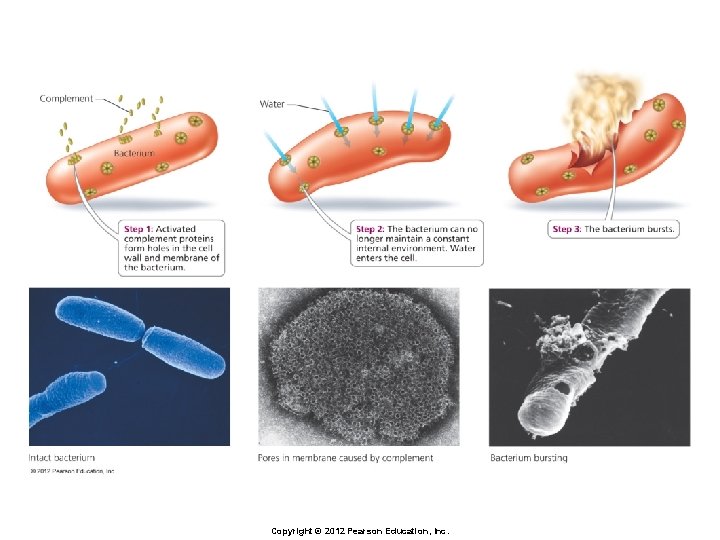
Three Lines of Defense § Complement system § Group of proteins that enhances both nonspecific and specific defense mechanisms § Destroy pathogens § Enhance phagocytosis § Stimulate inflammation Copyright © 2012 Pearson Education, Inc.
Copyright © 2012 Pearson Education, Inc.
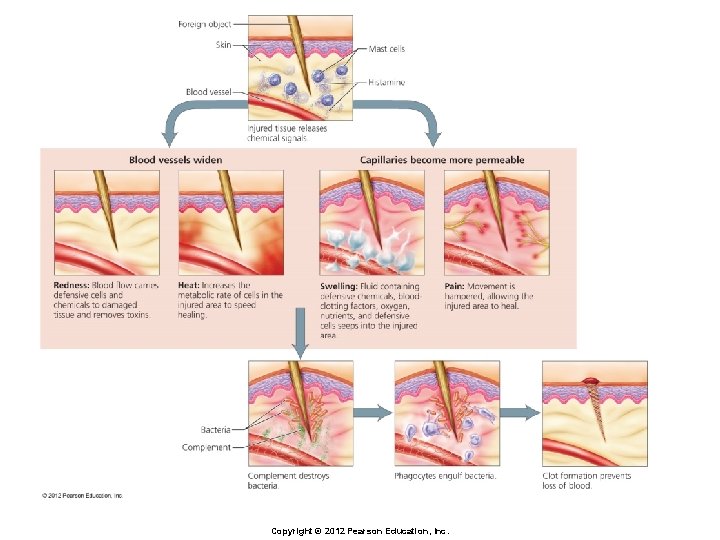
Three Lines of Defense § Inflammatory response § Destroys invaders and helps repair and restore damaged tissue § Four signs § Redness § Heat § Swelling § Pain Copyright © 2012 Pearson Education, Inc.

Three Lines of Defense § Redness § Mast cells release histamine, which causes blood vessels to dilate § Blood flow to the area increases, delivering defensive cells and removing dead cells and toxins Copyright © 2012 Pearson Education, Inc.
Three Lines of Defense § Heat § Temperature rises as a result of increased blood flow § Speeds healing and activities of defensive cells Copyright © 2012 Pearson Education, Inc.
Three Lines of Defense § Swelling § Histamine causes capillaries to become leaky and fluid seeps into tissues § Fluid brings clotting factors, oxygen, and nutrients Copyright © 2012 Pearson Education, Inc.
Three Lines of Defense § Pain § Can be caused by § Excess fluid § Bacterial toxins § Prostaglandins Copyright © 2012 Pearson Education, Inc.
Copyright © 2012 Pearson Education, Inc.
Three Lines of Defense Web Activity: The Inflammatory Response Copyright © 2012 Pearson Education, Inc.
Three Lines of Defense § Fever § An abnormally high body temperature § Caused by pyrogens § Chemicals that reset the brain’s thermostat to a higher temperature § A mild or moderate fever helps fight bacterial infection § A very high fever (over 105 F or 40. 6 C) is dangerous Copyright © 2012 Pearson Education, Inc.
Three Lines of Defense § Third line of defense: Immune system § Has specific responses and memory § Organs of the lymphatic system are important components § Defined by its function § Recognize and destroy specific pathogens or foreign molecules Copyright © 2012 Pearson Education, Inc.
Three Lines of Defense § Adaptive immune response § The body’s specific defenses § Important characteristics § Specificity § Directed at a specific pathogen § Memory § Remembers the pathogen and attacks it so quickly that illness does not result upon second exposure Copyright © 2012 Pearson Education, Inc.
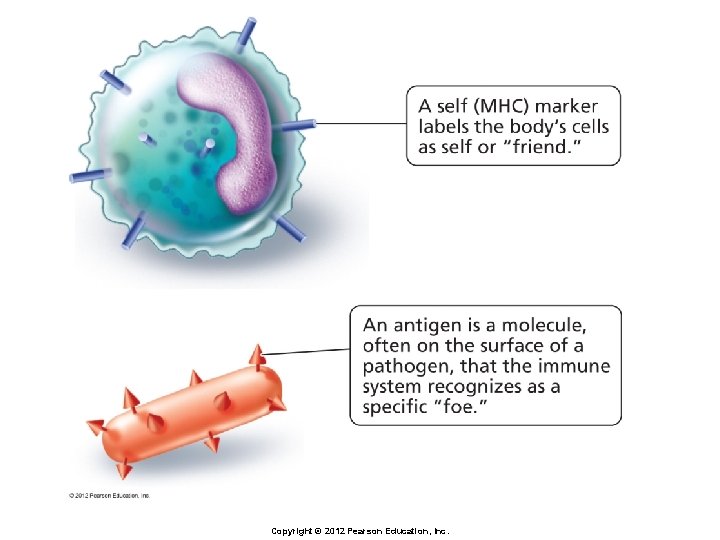
Distinguishing Self from Nonself § MHC markers § Molecules found on our own cells that label cells as “self” § Named for major histocompatibility genes that code for them § Used by the immune system to distinguish cells of your body from foreign invaders Copyright © 2012 Pearson Education, Inc.
Copyright © 2012 Pearson Education, Inc.
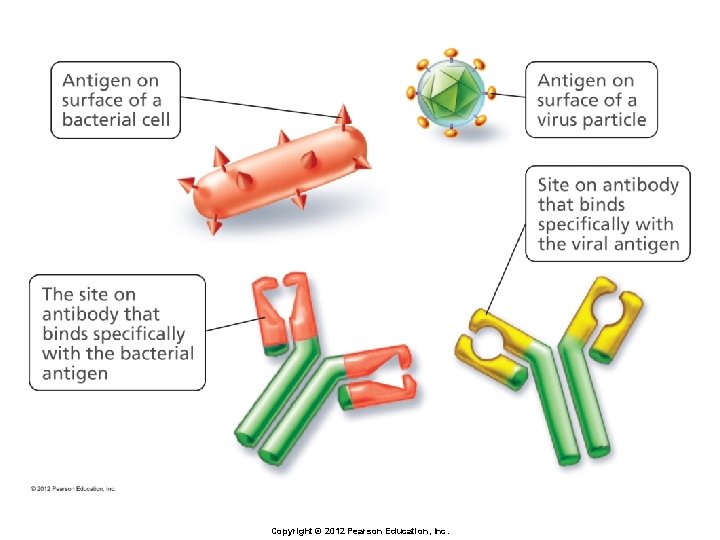
Distinguishing Self from Nonself § Antigens § Nonself substance or organism that triggers an immune response § Usually large molecules, such as proteins, polysaccharides, or nucleic acids § Often found on surface of invader Copyright © 2012 Pearson Education, Inc.
Distinguishing Self from Nonself § Lymphocytes § WBCs § Responsible for the specificity and memory of the adaptive immune response § B lymphocytes (B cells) § Form and mature in bone marrow § T lymphocytes (T cells) § Form in bone marrow and mature in thymus gland Copyright © 2012 Pearson Education, Inc.
Distinguishing Self from Nonself § T cells § Recognize MHC self markers § T cells and B cells § Programmed to recognize one particular type of antigen § Specificity results from each cell developing its own particular receptors on its surface § When an antigen fits into receptors, then the body targets that particular antigen Copyright © 2012 Pearson Education, Inc.
Distinguishing Self from Nonself § T cells and B cells (cont. ) § B cells and T cells that respond to a particular antigen divide repeatedly, forming two cell lines § Effector cells § Short-lived cells that attack the invader § Memory cells § Long-lived cells that remember the invader and mount a quick response when it is next encountered Copyright © 2012 Pearson Education, Inc.
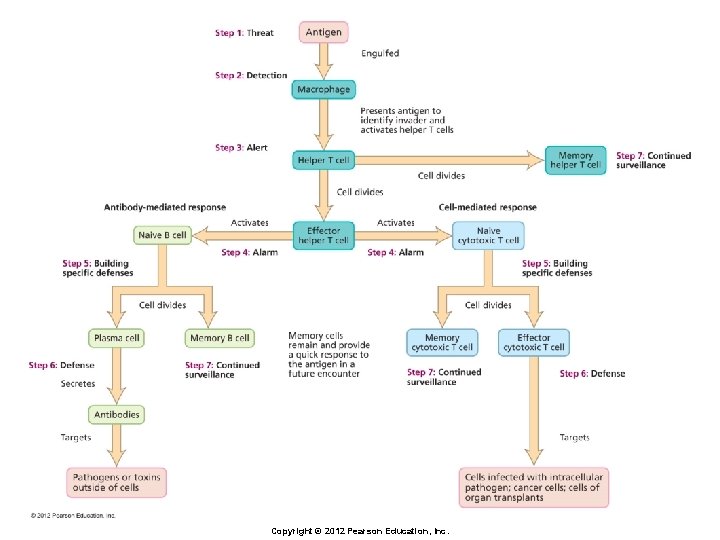
Antibody-Mediated Responses and Cell-Mediated Responses § Antibody-mediated immune responses § Defend against antigens that are free in body fluids, including toxins or extracellular pathogens § Effector B cells (plasma cells) use antibodies (Y-shaped proteins) to neutralize the antigen Copyright © 2012 Pearson Education, Inc.
Antibody-Mediated Responses and Cell-Mediated Responses § Cell-mediated immune responses § Protect against cancer cells and body cells that have become infected with viruses or other pathogens § Cytotoxic T cells cause cancer cells and infected body cells to burst Copyright © 2012 Pearson Education, Inc.
Copyright © 2012 Pearson Education, Inc.
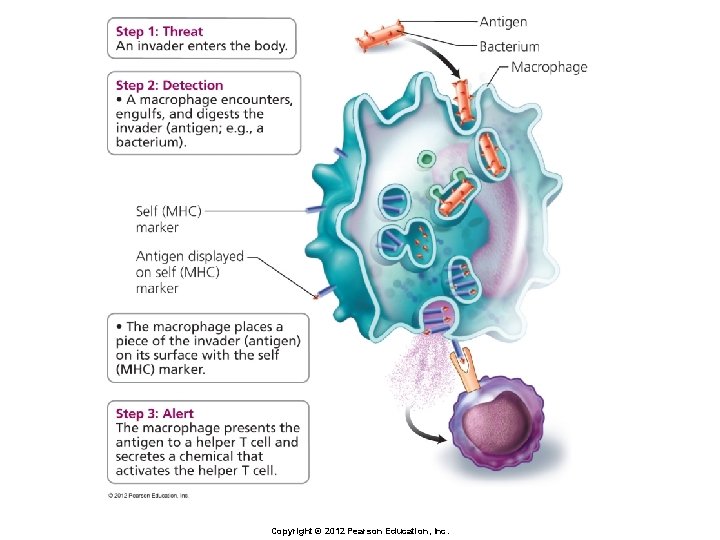
Steps of the Adaptive Immune Response 1. Threat § Foreign organism or molecule (an antigen) enters the body 2. Detection § Macrophage detects foreign organism or molecule and engulfs it Copyright © 2012 Pearson Education, Inc.
Steps of the Adaptive Immune Response 3. Alert § Macrophages present antigens to helper T cells § Macrophages are antigen-presenting cells § Helper T cells are the main switch for the adaptive immune response Copyright © 2012 Pearson Education, Inc.
Copyright © 2012 Pearson Education, Inc.
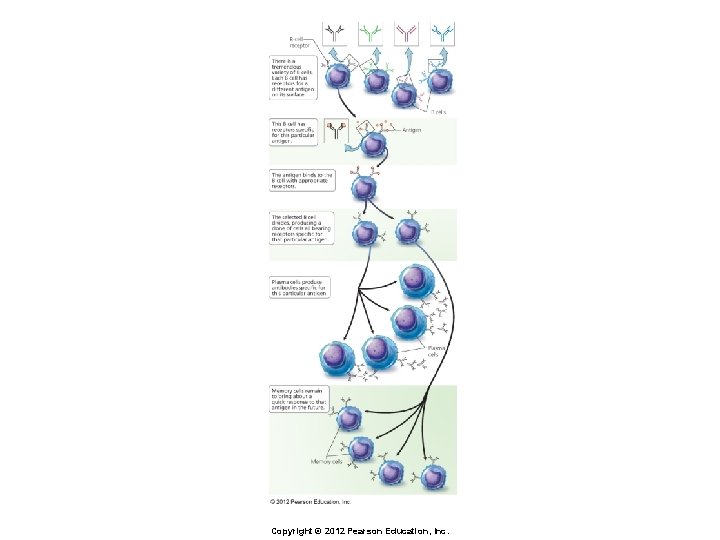
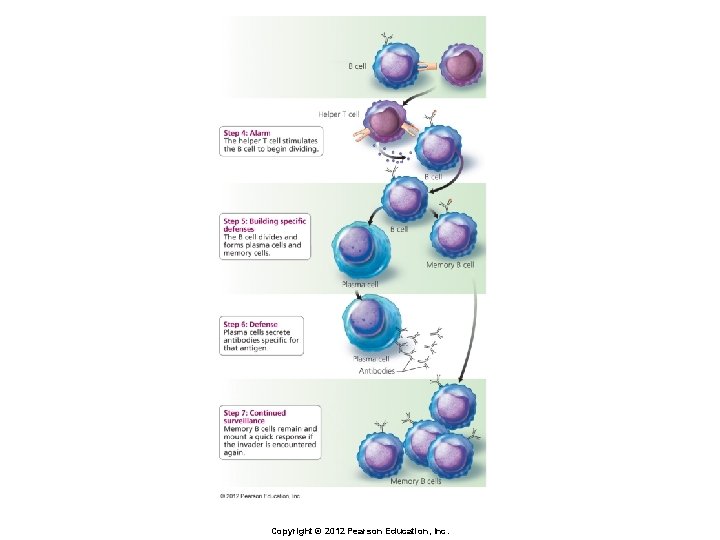
Steps of the Adaptive Immune Response 4. Alarm § Helper T cells activate appropriate B cells and T cells to destroy the specific antigen § When activated, these cells divide to form clones of cells designed to eliminate the specific antigen from the body § Clonal selection is critical to the adaptive immune response Copyright © 2012 Pearson Education, Inc.
Copyright © 2012 Pearson Education, Inc.
Steps of the Adaptive Immune Response 5. Building specific defenses § B cells form plasma cells that secrete antibodies into the bloodstream that bind to antigens § T cells form cytotoxic T cells that attack Copyright © 2012 Pearson Education, Inc.
Steps of the Adaptive Immune Response 6. Defense: The antibody-mediated response § Antibodies specific to the antigen eliminate the antigen § Precipitation § Lysis (bursting) § Attraction of phagocytes § Neutralization Copyright © 2012 Pearson Education, Inc.
Copyright © 2012 Pearson Education, Inc.
Copyright © 2012 Pearson Education, Inc.
Steps of the Adaptive Immune Response § Immunoglobulins § Five classes of antibodies, each with a special role to play in protecting against invaders § Ig. G § Ig. M § Ig. E § Ig. A § Ig. D Copyright © 2012 Pearson Education, Inc.
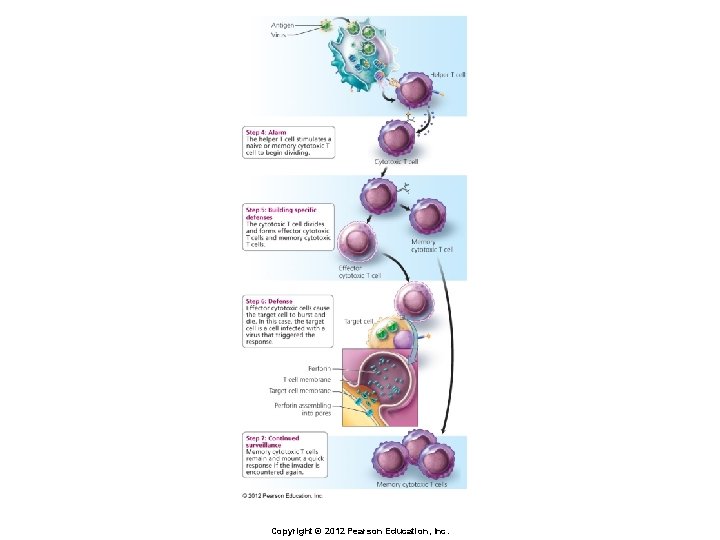
Steps of the Adaptive Immune Response 6. Defense: The cell-mediated response § An effector cytotoxic T cell releases perforins, which cause holes to form in cells with the particular antigen Copyright © 2012 Pearson Education, Inc.
Copyright © 2012 Pearson Education, Inc.
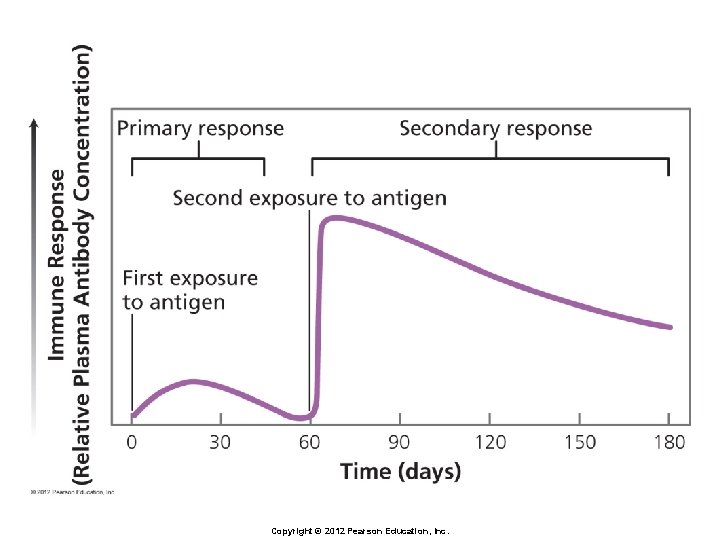
Steps of the Adaptive Immune Response 7. Continued surveillance § Immunological memory allows for a more rapid response on subsequent exposure to the antigen § Primary response § Occurs during body’s first encounter with a particular antigen § Antibody concentration rises slowly § Secondary response § Occurs during subsequent encounter with that antigen § Strong and swift due to the large number of memory cells programmed to respond to that particular antigen Copyright © 2012 Pearson Education, Inc.
Copyright © 2012 Pearson Education, Inc.
Steps of the Adaptive Immune Response 8. Withdrawal of forces § Suppressor T cells turn off the immune response when the antigen no longer poses a threat Copyright © 2012 Pearson Education, Inc.
Steps of the Adaptive Immune Response Web Activity: Antibody and Cell-Mediated Immunity Copyright © 2012 Pearson Education, Inc.
Active and Passive Immunity § Active immunity § The body produces memory B cells and T cells following exposure to an antigen § Occurs naturally whenever a person gets an infection § Can also occur through vaccination § Introduction of a harmless form of an antigen into the body to stimulate immune responses § Long-lived because memory cells are produced Copyright © 2012 Pearson Education, Inc.
Active and Passive Immunity § Passive immunity § Results when a person receives antibodies that were produced by another person or animal § Short-lived because the recipient’s body was not stimulated to produce memory cells Copyright © 2012 Pearson Education, Inc.
Monoclonal Antibodies § Monoclonal antibodies § A group of identical antibodies that bind to one specific antigen § Used in research, clinical diagnosis, and disease treatment Copyright © 2012 Pearson Education, Inc.
Problems of the Immune System § Autoimmune disorders § Occur when the immune system fails to distinguish between self and nonself and attacks tissues or organs of the body § Classification § Organ-specific § Usually caused by problematic T cells § Example: Hashimoto’s thyroiditis § Non-organ-specific § Usually caused by problematic B cells § Example: systemic lupus erythematosus Copyright © 2012 Pearson Education, Inc.
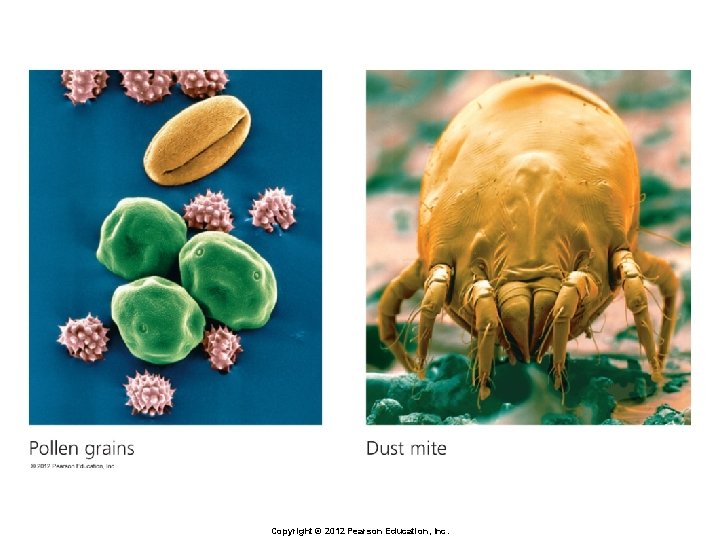
Problems of the Immune System § Allergies § Overreaction by the immune system to an antigen § The antigen is usually harmless and is called an allergen § Example: hay fever (allergic rhinitis) Copyright © 2012 Pearson Education, Inc.
Copyright © 2012 Pearson Education, Inc.
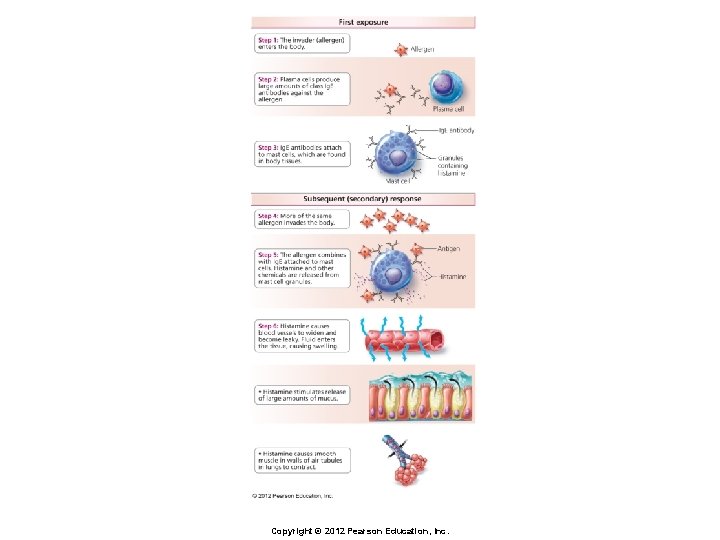
Problems of the Immune System § Steps in an allergic reaction § During the first exposure: § Allergens cause plasma cells to release class Ig. E antibodies § Ig. E antibodies bind to mast cells or basophils § On subsequent exposures: § Allergen combines with Ig. E attached to mast cells and causes release of histamine § Histamine causes redness, swelling, itching, and other symptoms of an allergic response Copyright © 2012 Pearson Education, Inc.
Copyright © 2012 Pearson Education, Inc.
Problems of the Immune System § Anaphylactic shock § Extreme allergic reaction that can be fatal § Can cause pooling of blood in capillaries, which makes breathing difficult § Common triggers § Insect stings § Medications (penicillin) § Foods (shellfish, peanuts) Copyright © 2012 Pearson Education, Inc.
Problems of the Immune System § Allergens can be identified by injecting small amounts of suspected antigens and monitoring skin response § Treatments § Antihistamines § Block the effects of histamine § Allergy shots § Inject increasing amounts of a known allergen in an effort to desensitize the person to the offending allergen Copyright © 2012 Pearson Education, Inc.
- Slides: 63