
Chapter 13 B Reaction Tendency Breaking Chemical Bonds
Chapter 13 B- Reaction Tendency
Breaking Chemical Bonds • Bonds store energy. • The strength of the bond depends on the elements that are bonding and the length of the bond. • As long as the bonds do not break or change, the energy is contained. • What happens when bonds break?
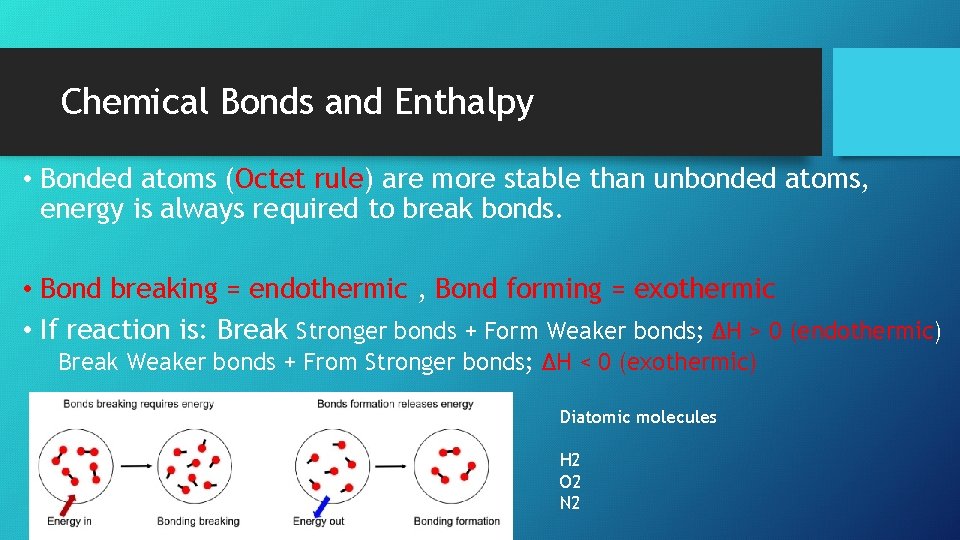
Chemical Bonds and Enthalpy • Bonded atoms (Octet rule) are more stable than unbonded atoms, energy is always required to break bonds. • Bond breaking = endothermic , Bond forming = exothermic • If reaction is: Break Stronger bonds + Form Weaker bonds; ∆H > 0 (endothermic) Break Weaker bonds + From Stronger bonds; ∆H < 0 (exothermic) Diatomic molecules H 2 O 2 N 2
Chemical Bonds and Enthalpy • Which is more favorable? (Which happen more often in nature? ) • Exothermic are more favorable, easier to happen in nature • BUT!!! -∆H does not always mean it is favorable

Entropy • What makes something favorable? • It happens spontaneously • It is exothermic (sometimes) • It makes the substance more random/ has less order • Randomness / out of order / chaotic ? • Spontaneous

Entropy • Entropy (S) is the measure of randomness or lack of order • S = 0? Perfect, not random at all • Entropy increase • Randomness increase • Particles are more randomly moving • Naturally, matter tends to go to higher entropy • Ice melts -> Water evaporates -> Gas particles move
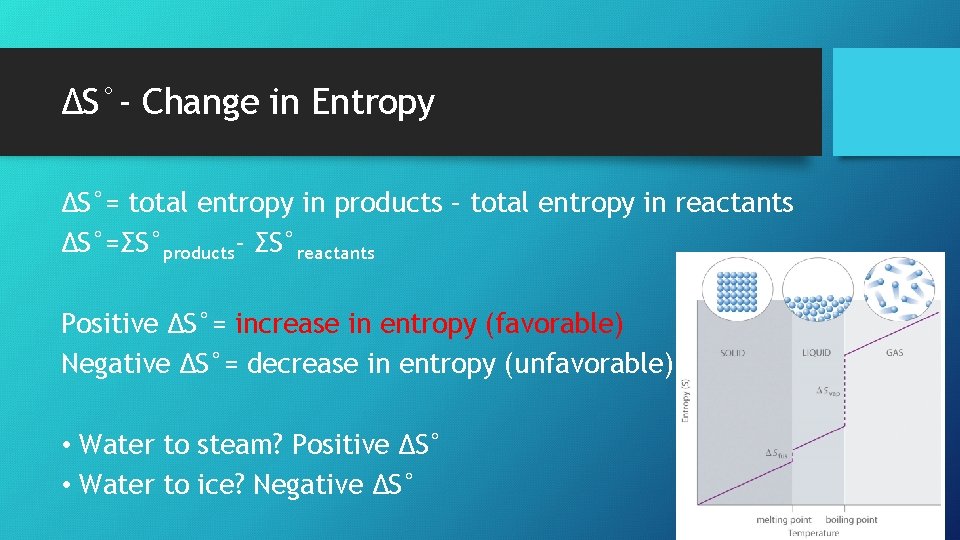
∆S°- Change in Entropy ∆S°= total entropy in products – total entropy in reactants ∆S°=ΣS°products- ΣS°reactants Positive ∆S°= increase in entropy (favorable) Negative ∆S°= decrease in entropy (unfavorable) • Water to steam? Positive ΔS° • Water to ice? Negative ΔS°
∆S°- Change in Entropy • Example: Does the reaction NH 3 (g) + HCl (g) NH 4 Cl (s) produce an increase or decrease in entropy? • Is it favorable? Or unfavorable? Note: S°(NH 3) = 192. 8 J/(mol*K) S° (HCl) = 186. 9 J/(mol*K) S° (NH 4 Cl) = 94. 6 J/(mol*K) ∆S°=ΣS°products- ΣS°reactants (94. 6) – (192. 8 + 186. 9) = -285. 1 J/mol*K , ∆S° = -285. 1 = Decrease in entropy
Free-Energy Change • Reactions try to do 2 things: decrease enthalpy (exothermic) OR increase entropy. • 4 Combinations: 1. Exothermic & increasing entropy ( -∆H, +∆S) 2. Exothermic & decreasing entropy ( -∆H, -∆S) 3. Endothermic & increasing entropy ( +∆H, +∆S) 4. Endothermic & decreasing entropy ( +∆H, -∆S)
Free-Energy Change • Reactions are driven by the combined effects of change in enthalpy (∆H) and change in entropy (∆S). • 1800 s, J. Willard Gibbs (physicist & mathematician) created term “Free Energy” or Gibbs free energy (G) • Free-energy Change (∆G) is: ∆G = ∆H - T∆S ∆G = Free energy change ∆H = change in enthalpy T = temperature (in Kelvins) ∆S = change in entropy
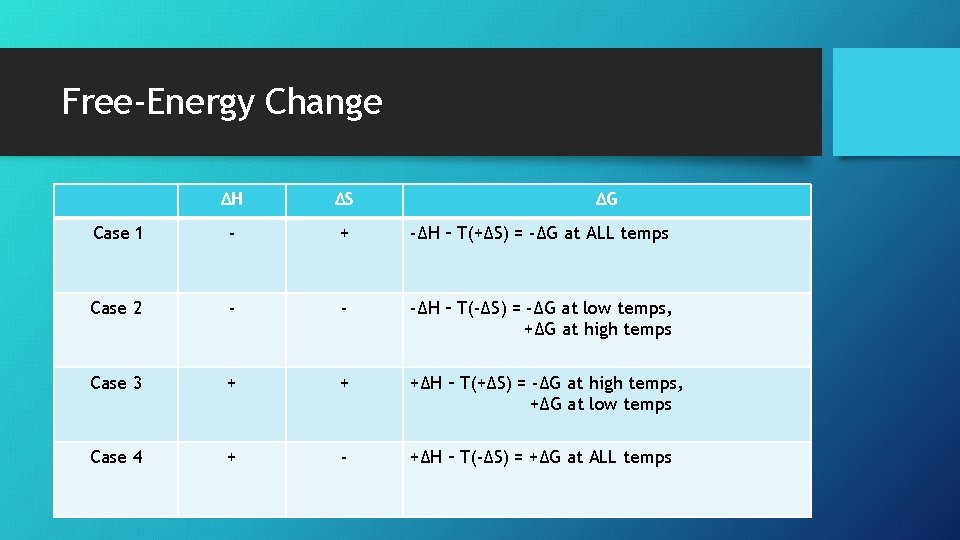
Free-Energy Change ∆H ∆S ∆G Case 1 - + -∆H – T(+∆S) = -∆G at ALL temps Case 2 - - -∆H – T(-∆S) = -∆G at low temps, +∆G at high temps Case 3 + + +∆H – T(+∆S) = -∆G at high temps, +∆G at low temps Case 4 + - +∆H – T(-∆S) = +∆G at ALL temps
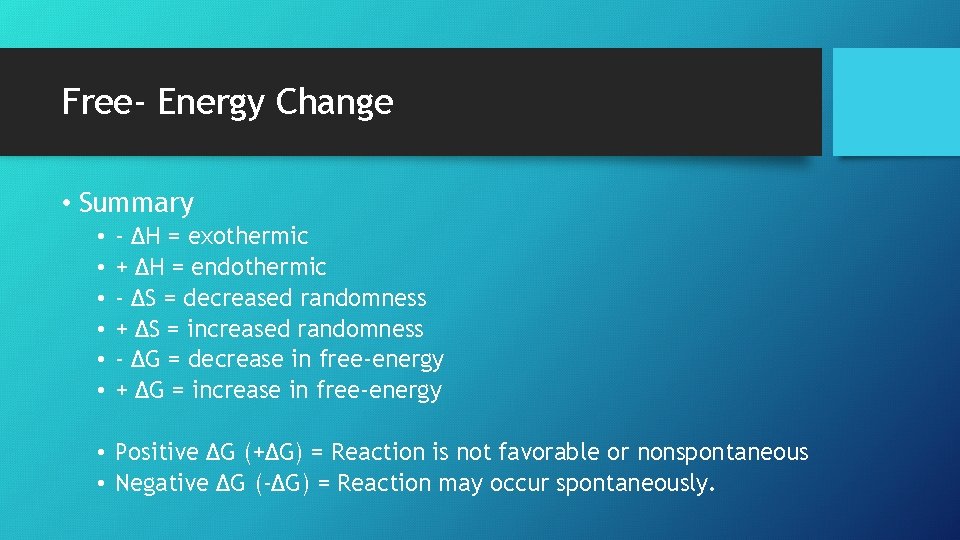
Free- Energy Change • Summary • • • - ∆H = exothermic + ∆H = endothermic - ∆S = decreased randomness + ∆S = increased randomness - ∆G = decrease in free-energy + ∆G = increase in free-energy • Positive ∆G (+∆G) = Reaction is not favorable or nonspontaneous • Negative ∆G (-∆G) = Reaction may occur spontaneously.
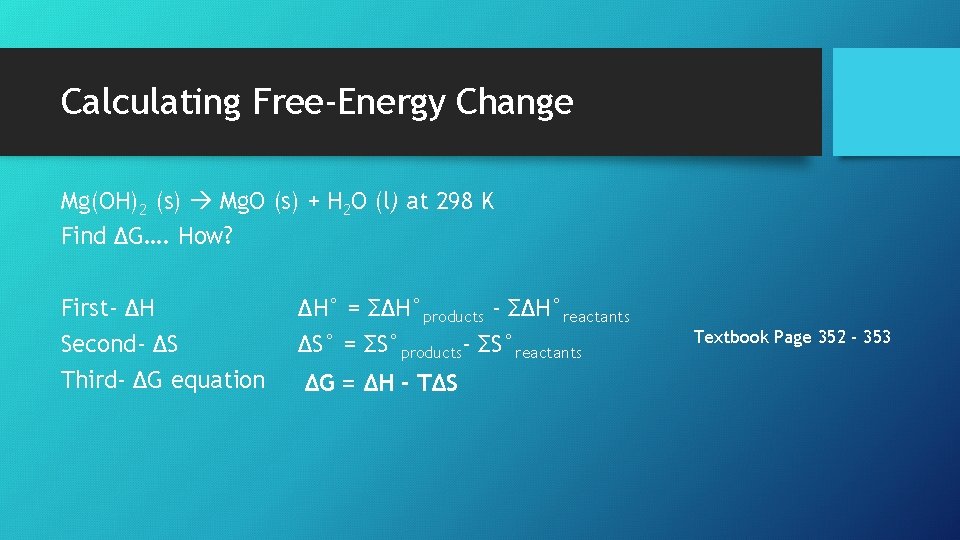
Calculating Free-Energy Change Mg(OH)2 (s) Mg. O (s) + H 2 O (l) at 298 K Find ΔG…. How? First- ΔH Second- ΔS Third- ΔG equation ΔH° = ΣΔH°products - ΣΔH°reactants ∆S° = ΣS°products- ΣS°reactants ∆G = ∆H - T∆S Textbook Page 352 - 353
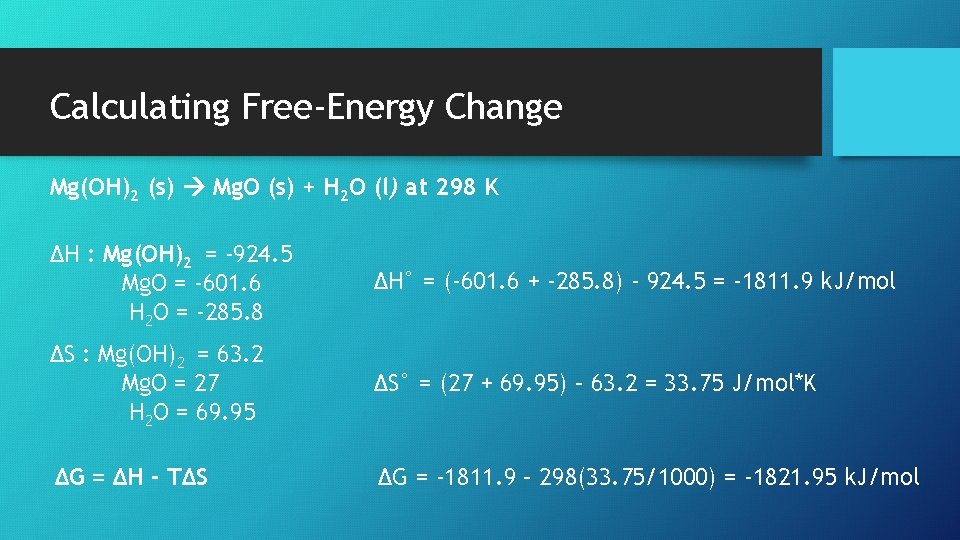
Calculating Free-Energy Change Mg(OH)2 (s) Mg. O (s) + H 2 O (l) at 298 K ΔH : Mg(OH)2 = -924. 5 Mg. O = -601. 6 H 2 O = -285. 8 ΔH° = (-601. 6 + -285. 8) - 924. 5 = -1811. 9 k. J/mol ΔS : Mg(OH)2 = 63. 2 Mg. O = 27 H 2 O = 69. 95 ΔS° = (27 + 69. 95) – 63. 2 = 33. 75 J/mol*K ∆G = ∆H - T∆S ΔG = -1811. 9 – 298(33. 75/1000) = -1821. 95 k. J/mol
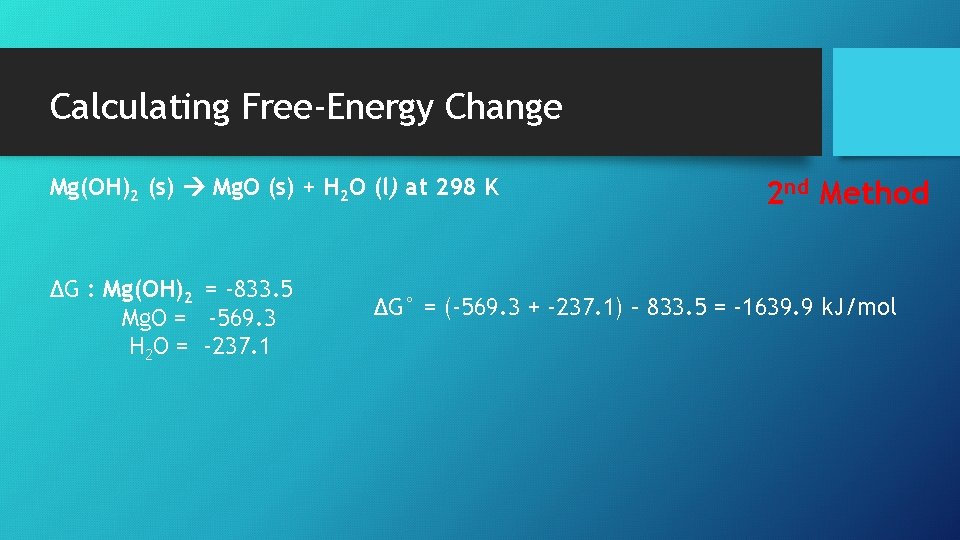
Calculating Free-Energy Change Mg(OH)2 (s) Mg. O (s) + H 2 O (l) at 298 K ΔG : Mg(OH)2 = -833. 5 Mg. O = -569. 3 H 2 O = -237. 1 2 nd Method ΔG° = (-569. 3 + -237. 1) – 833. 5 = -1639. 9 k. J/mol
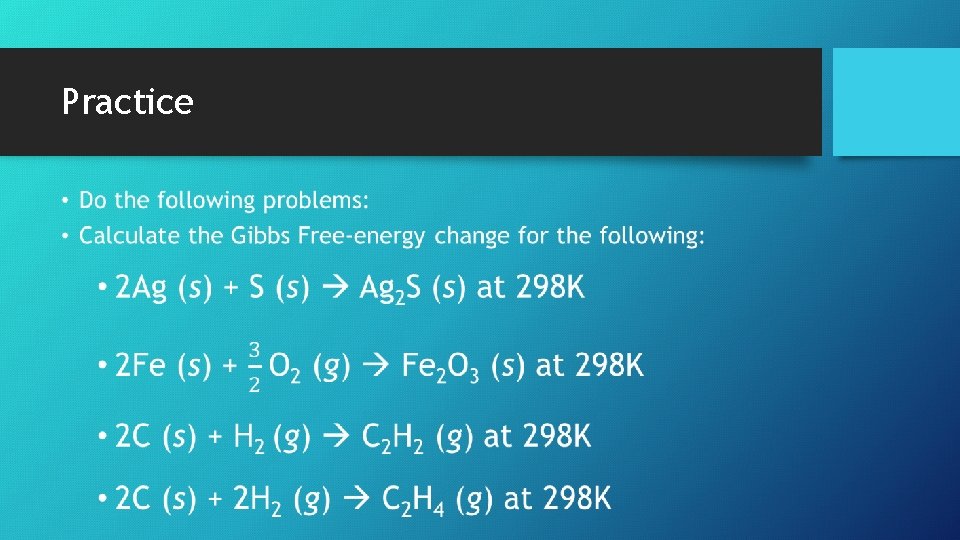
Practice •
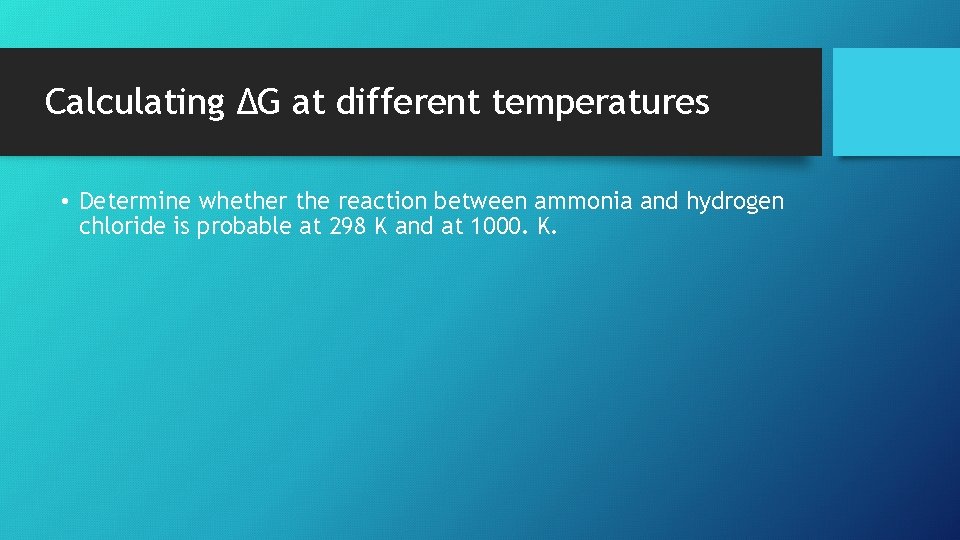
Calculating ΔG at different temperatures • Determine whether the reaction between ammonia and hydrogen chloride is probable at 298 K and at 1000. K.
- Slides: 17