
Chapter 13 Aggregate Planning 1 Planning Horizon Aggregate











- Slides: 28
Chapter 13 Aggregate Planning 1
Planning Horizon Aggregate planning: Intermediate-range capacity planning, usually covering 2 to 12 months. Long range Short range Now Intermediate range 2 months 1 Year 2
Overview of Planning Levels § Short-range plans (Detailed plans) § Machine loading § Job assignments § Intermediate plans (General levels) § Employment § Output § Long-range plans § Long term capacity § Location / layout 3
Planning Sequence Figure 13. 1 Corporate strategies and policies Economic, competitive, and political conditions Business Plan Aggregate demand forecasts Establishes operations and capacity strategies Aggregate plan Establishes operations capacity Master schedule Establishes schedules for specific products 4
Aggregate Planning § Begin with forecast of aggregate demand § Forecast intermediate range § General plan to meet demand by setting § Output levels § Employment § Finished goods inventory level § Production plan is the output of aggregate planning § Update plan periodically – rolling planning horizon always covers the next 12 – 18 months 5
Aggregate Planning Strategies We will focus on aggregate planning as matching varying demand to fixed capacity. 6
7
Aggregate Planning Outputs § Total cost of a plan § Projected levels of the following: § § § Inventory Output Employment Subcontracting Backordering 8
Aggregate Planning Inputs § Resources § Workforce § Facilities § Demand forecast § Policies § § Subcontracting Overtime Inventory levels Back orders § Costs § § § Inventory carrying Back orders Hiring/firing Overtime Inventory changes Subcontracting 9
Demand Options § Pricing § Promotion § Back orders § New demand 10
Capacity Options § § § Hire and layoff workers Overtime/slack time Part-time workers Inventories Subcontracting 11
Aggregate Planning Strategies § Maintain a level workforce § Maintain a steady output rate § Match demand period by period § Use a combination of decision variables 12
Basic Strategy § Level capacity strategy: § Maintaining a steady rate of regular-time output while meeting variations in demand by a combination of options. 13
Techniques for Aggregate Planning 1. Determine demand for each period 2. Determine capacities for each period 3. Identify policies that are pertinent 4. Determine units costs 5. Develop alternative plans and costs 6. Select the best plan that satisfies objectives. Otherwise return to step 5. 14
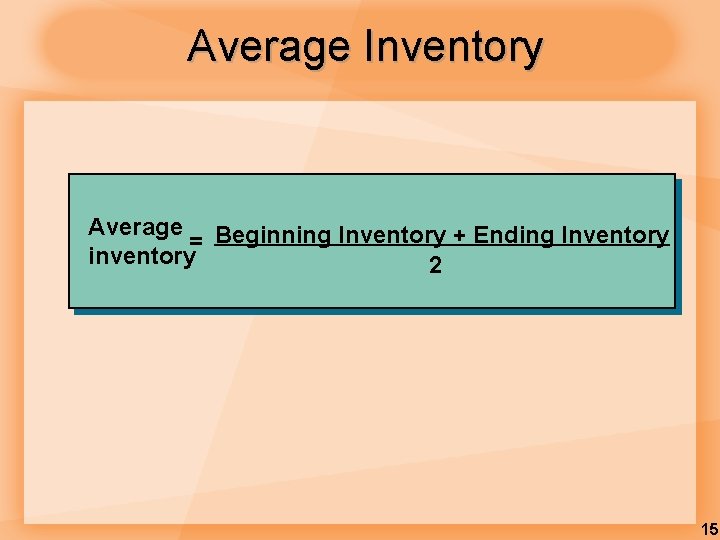
Average Inventory Average Beginning Inventory + Ending Inventory = inventory 2 15
Summary of Planning Techniques Table 13. 7 16
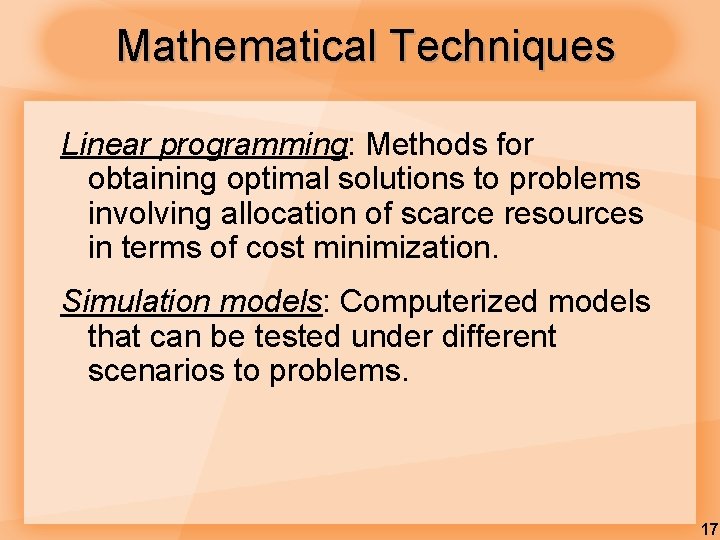
Mathematical Techniques Linear programming: Methods for obtaining optimal solutions to problems involving allocation of scarce resources in terms of cost minimization. Simulation models: Computerized models that can be tested under different scenarios to problems. 17
Try problem 10, plan B only, on page 642. The solution is given on one of the last slides of this presentation. 18
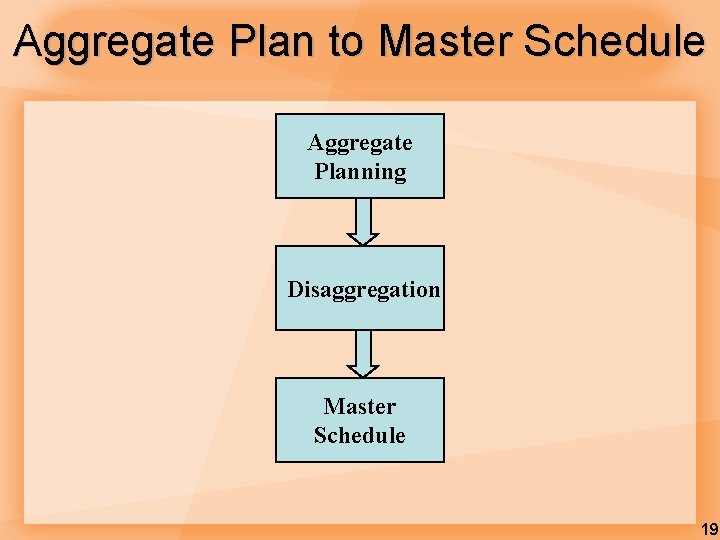
Aggregate Plan to Master Schedule Aggregate Planning Disaggregation Master Schedule 19
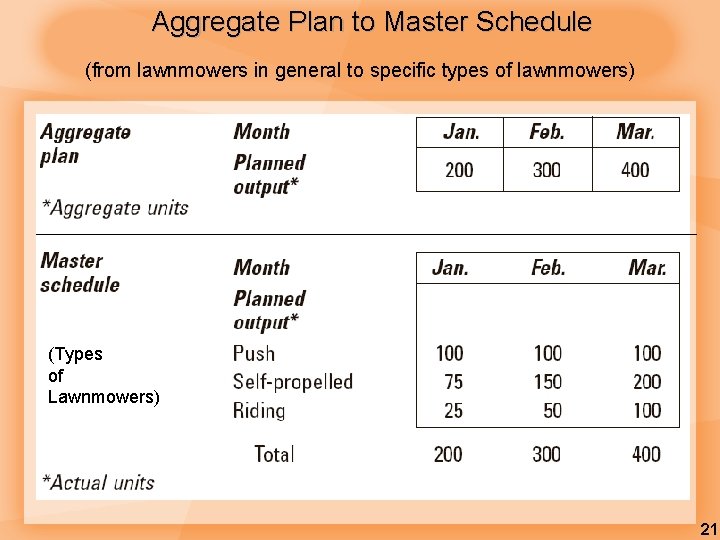
Disaggregating the Aggregate Plan § Master schedule: The result of disaggregating an aggregate plan; shows quantity and timing of specific end items for a scheduled horizon. § Rough-cut capacity planning: Approximate balancing of capacity and demand to test the feasibility of a master schedule. 20
Aggregate Plan to Master Schedule (from lawnmowers in general to specific types of lawnmowers) (Types of Lawnmowers) 21
Master Scheduling Process Inputs PROCESS Beginning inventory Forecast Outputs Projected inventory Master Scheduling Customer orders Master production schedule Uncommitted inventory Feedback Loop Adjust plan if it is less than capacity 22
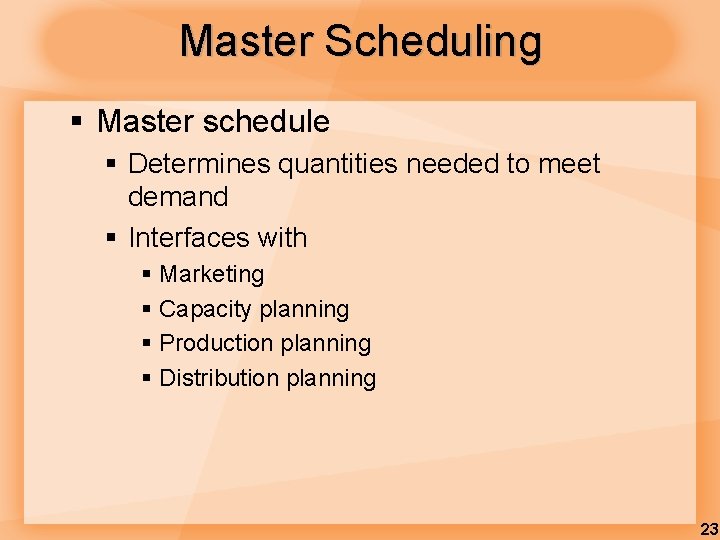
Master Scheduling § Master schedule § Determines quantities needed to meet demand § Interfaces with § Marketing § Capacity planning § Production planning § Distribution planning 23
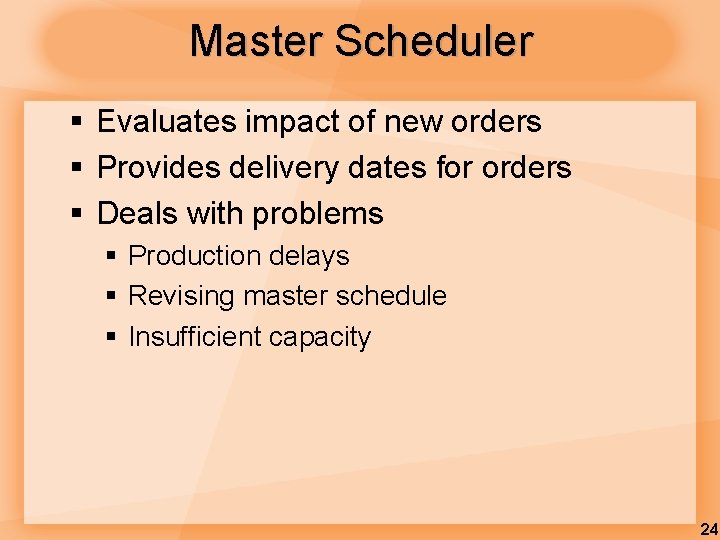
Master Scheduler § Evaluates impact of new orders § Provides delivery dates for orders § Deals with problems § Production delays § Revising master schedule § Insufficient capacity 24
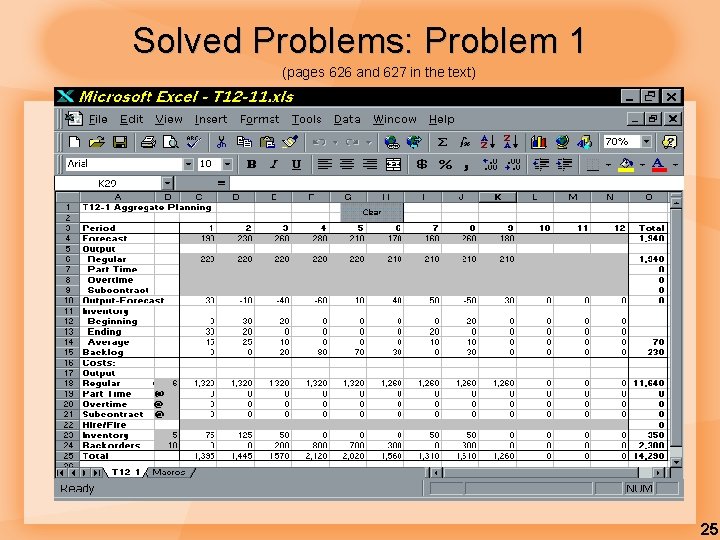
Solved Problems: Problem 1 (pages 626 and 627 in the text) 25
Solution to Problem 10, plan B, on page 642 of the text Plan B: Hire one worker and subcontract. Workforce = 20 + 1 = 21 workers. 26
Solution to Problem 10 (continued) The total cost of Plan B is $14, 140 + $200 = $14, 340 On the top of page 638, the total cost of Plan A is $14, 790. Therefore, Plan B is less costly, and it would be the preferred plan. 27
See you in our next class meeting 28