
CHAPTER 13 Acquiring Information Systems and Applications CHAPTER


- Slides: 33
CHAPTER 13 Acquiring Information Systems and Applications
CHAPTER OUTLINE 13. 1 Planning for and Justifying IT Applications 13. 2 Strategies for Acquiring IT Applications 13. 3 The Traditional Systems Development Life Cycle 13. 4 Alternative Methods and Tools for Systems Development 13. 5 Vendor and Software Selection
LEARNING OBJECTIVES 1. Define an IT strategic plan, identify three objectives it must meet, and describe the four common approaches to cost-benefit analysis. 2. Discuss the four business decisions that companies must make when they acquire new applications. 3. Identify the six processes involved in the systems development life cycle, and explain the primary tasks and importance of each process.
LEARNING OBJECTIVES (continued) 4. Describe four alternative development methods and four tools that augment development methods, and identify at least one advantage and one disadvantage of each method and tool. 5. Analyze the process of vendor and software selection.
13. 1 Planning for and Justifying IT Applications Organizations must analyze the need for the IT application. Each IT application must be justified in terms of costs and benefits. The application portfolio Just like a stock portfolio, an application portfolio should balance risk and reward – know your organization’s priorities for each
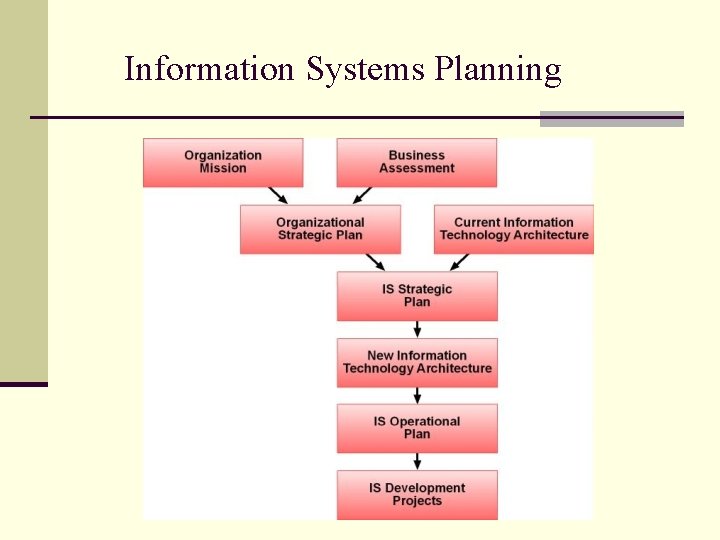
Information Systems Planning
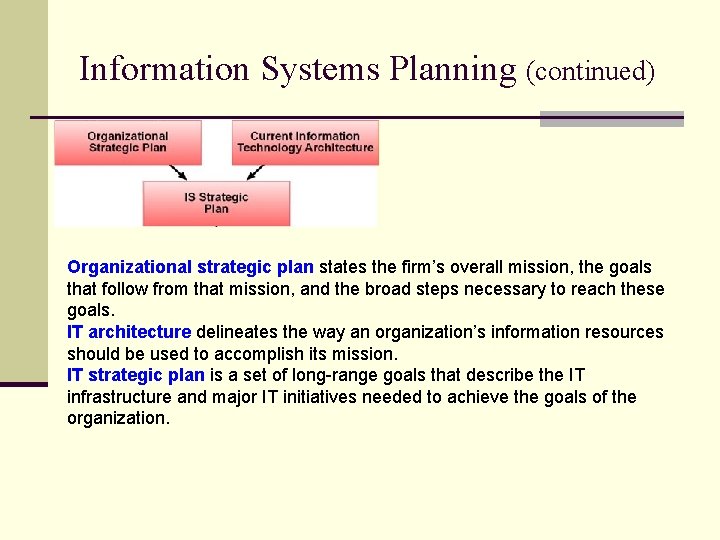
Information Systems Planning (continued) Organizational strategic plan states the firm’s overall mission, the goals that follow from that mission, and the broad steps necessary to reach these goals. IT architecture delineates the way an organization’s information resources should be used to accomplish its mission. IT strategic plan is a set of long-range goals that describe the IT infrastructure and major IT initiatives needed to achieve the goals of the organization.
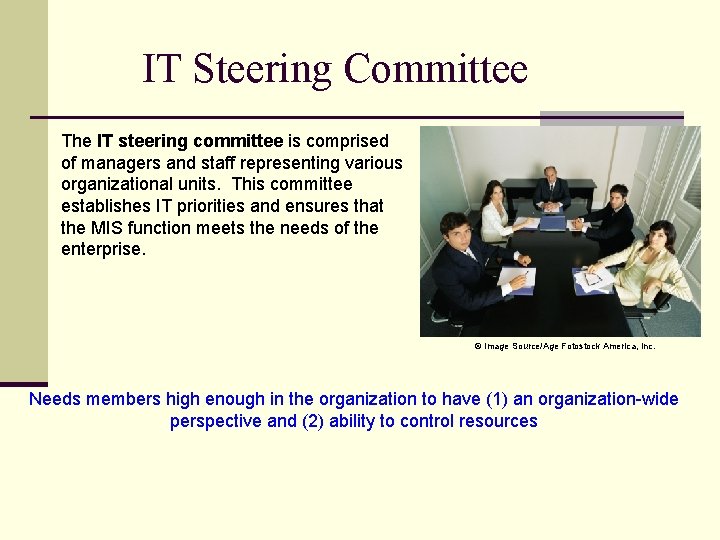
IT Steering Committee The IT steering committee is comprised of managers and staff representing various organizational units. This committee establishes IT priorities and ensures that the MIS function meets the needs of the enterprise. © Image Source/Age Fotostock America, Inc. Needs members high enough in the organization to have (1) an organization-wide perspective and (2) ability to control resources
IS Operational Plan Contains the following elements: Mission – derived from the IT strategic plan IS environment – needs for information Objectives of the IS function – how to achieve goals Constraints of the IS function – technology, financial, personnel, other Application portfolio – must be prioritized Resource allocation and project management – members must have enough authority to accomplish objectives
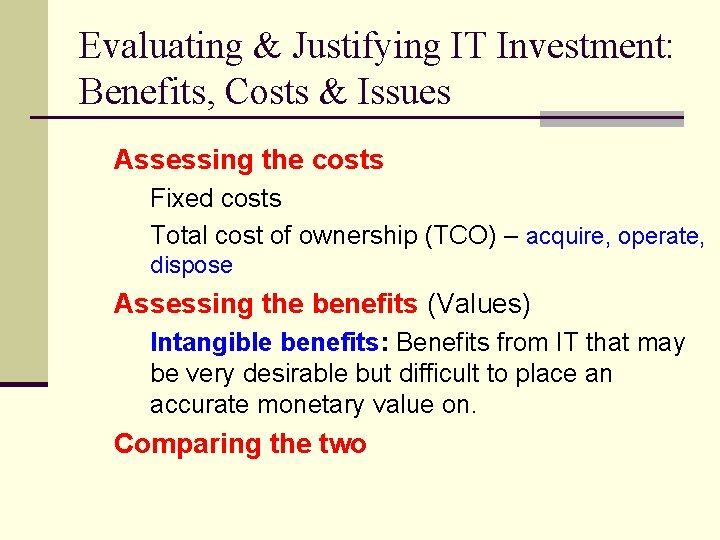
Evaluating & Justifying IT Investment: Benefits, Costs & Issues Assessing the costs Fixed costs Total cost of ownership (TCO) – acquire, operate, dispose Assessing the benefits (Values) Intangible benefits: Benefits from IT that may be very desirable but difficult to place an accurate monetary value on. Comparing the two
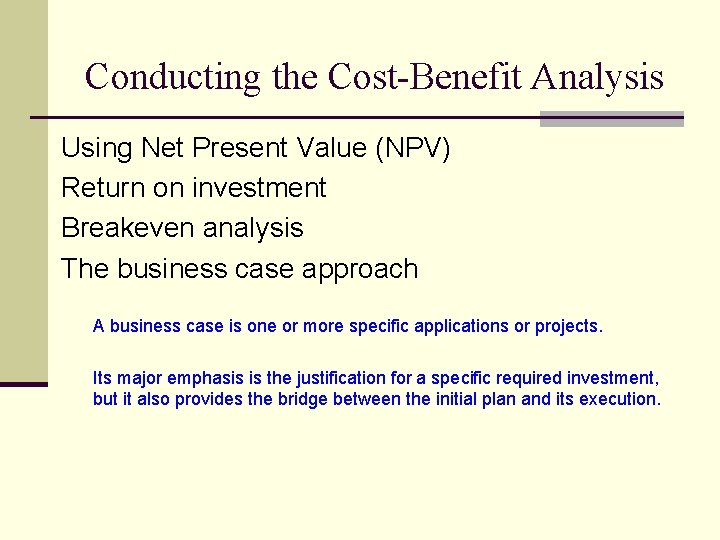
Conducting the Cost-Benefit Analysis Using Net Present Value (NPV) Return on investment Breakeven analysis The business case approach A business case is one or more specific applications or projects. Its major emphasis is the justification for a specific required investment, but it also provides the bridge between the initial plan and its execution.
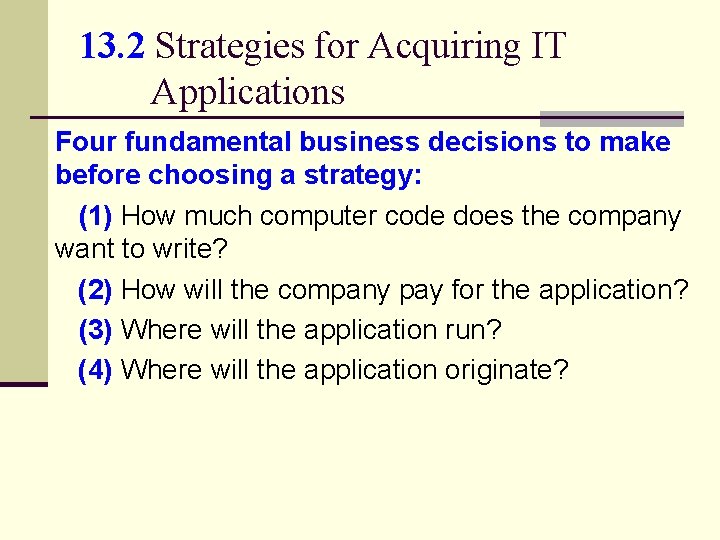
13. 2 Strategies for Acquiring IT Applications Four fundamental business decisions to make before choosing a strategy: (1) How much computer code does the company want to write? (2) How will the company pay for the application? (3) Where will the application run? (4) Where will the application originate?
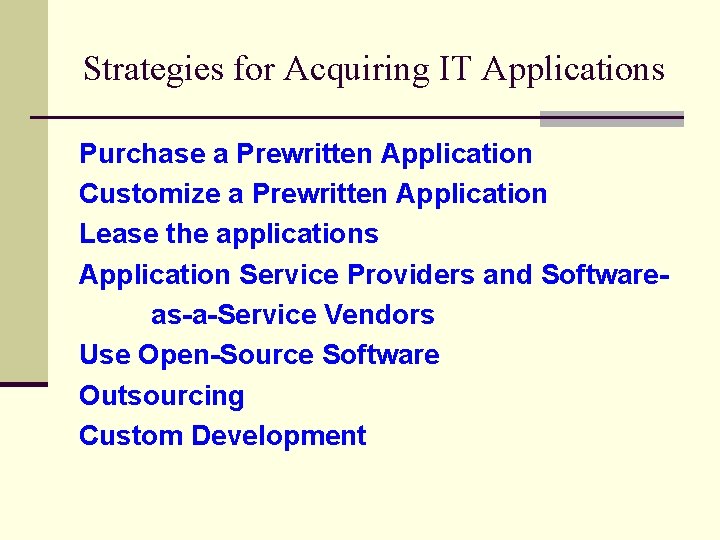
Strategies for Acquiring IT Applications Purchase a Prewritten Application Customize a Prewritten Application Lease the applications Application Service Providers and Softwareas-a-Service Vendors Use Open-Source Software Outsourcing Custom Development
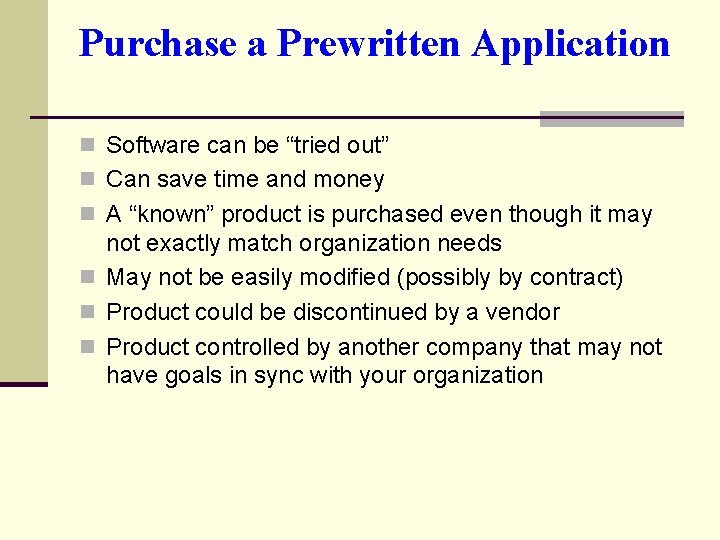
Purchase a Prewritten Application n Software can be “tried out” n Can save time and money n A “known” product is purchased even though it may not exactly match organization needs n May not be easily modified (possibly by contract) n Product could be discontinued by a vendor n Product controlled by another company that may not have goals in sync with your organization
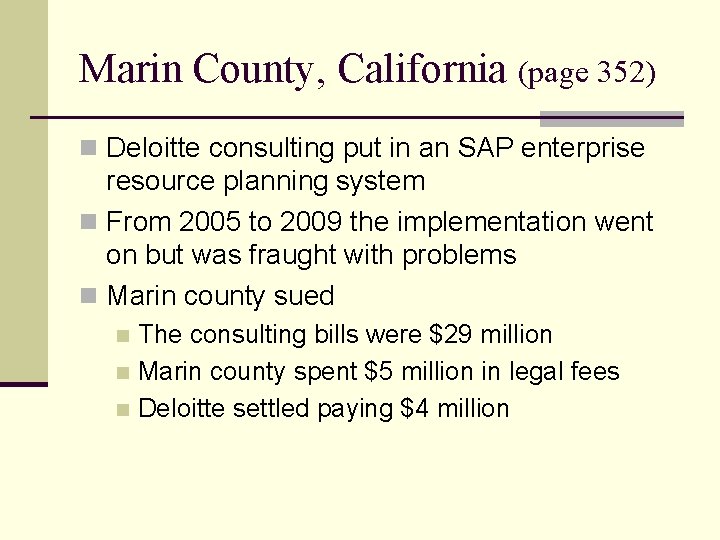
Marin County, California (page 352) n Deloitte consulting put in an SAP enterprise resource planning system n From 2005 to 2009 the implementation went on but was fraught with problems n Marin county sued The consulting bills were $29 million n Marin county spent $5 million in legal fees n Deloitte settled paying $4 million n
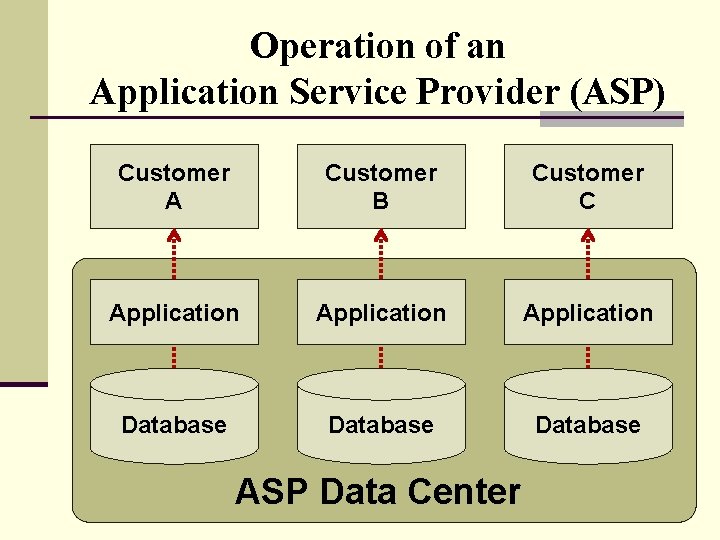
Operation of an Application Service Provider (ASP) Customer A Customer B Customer C Application Database ASP Data Center
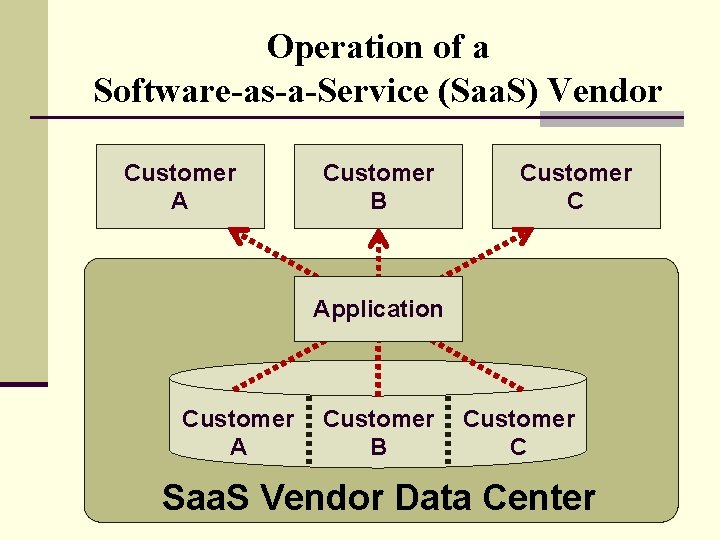
Operation of a Software-as-a-Service (Saa. S) Vendor Customer A Customer B Customer C Application Customer A Customer B Customer C Saa. S Vendor Data Center
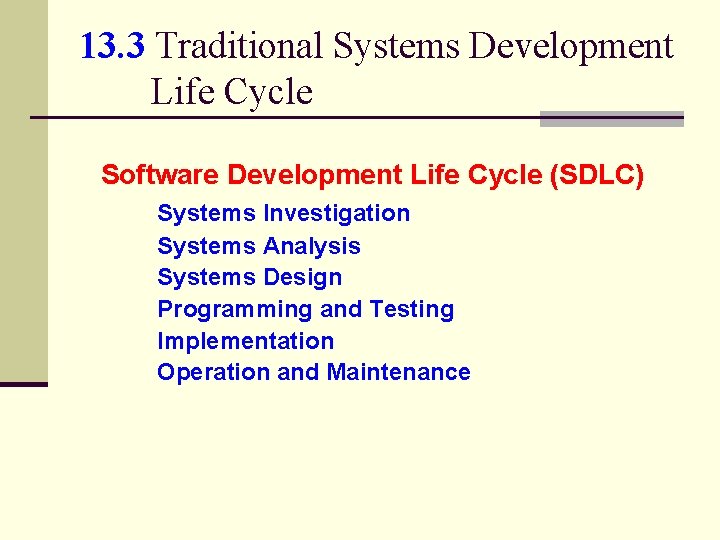
13. 3 Traditional Systems Development Life Cycle Software Development Life Cycle (SDLC) Systems Investigation Systems Analysis Systems Design Programming and Testing Implementation Operation and Maintenance
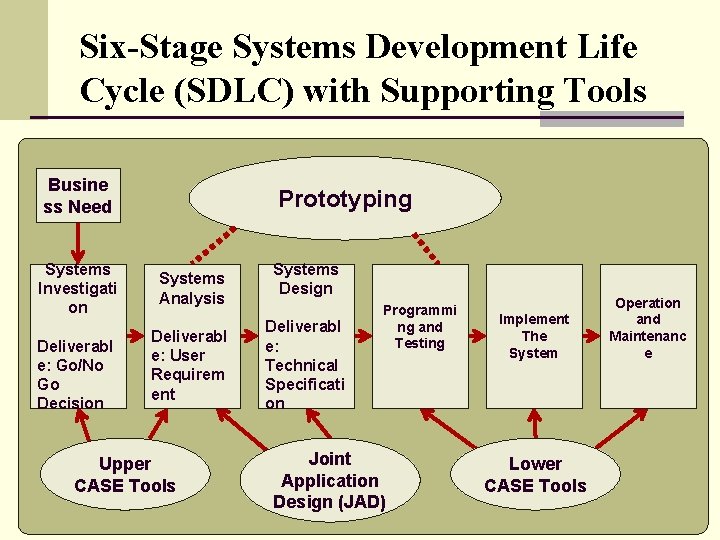
Six-Stage Systems Development Life Cycle (SDLC) with Supporting Tools Busine ss Need Systems Investigati on Deliverabl e: Go/No Go Decision Prototyping Systems Analysis Deliverabl e: User Requirem ent Upper CASE Tools Systems Design Deliverabl e: Technical Specificati on Programmi ng and Testing Joint Application Design (JAD) Implement The System Lower CASE Tools Operation and Maintenanc e
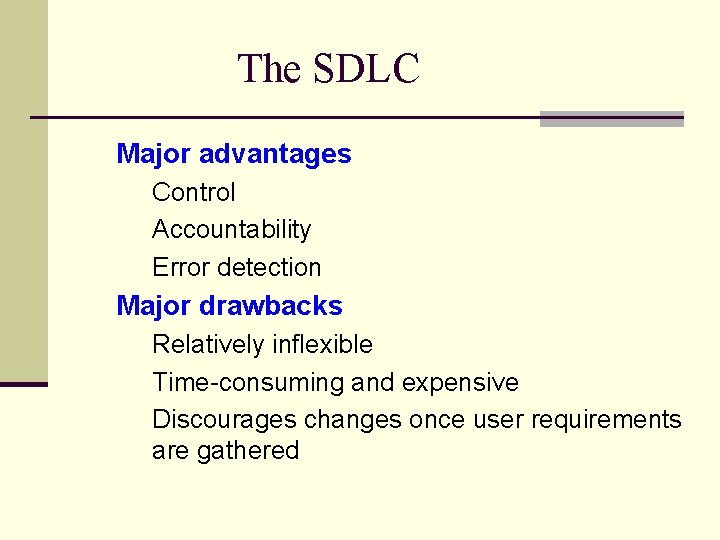
The SDLC Major advantages Control Accountability Error detection Major drawbacks Relatively inflexible Time-consuming and expensive Discourages changes once user requirements are gathered
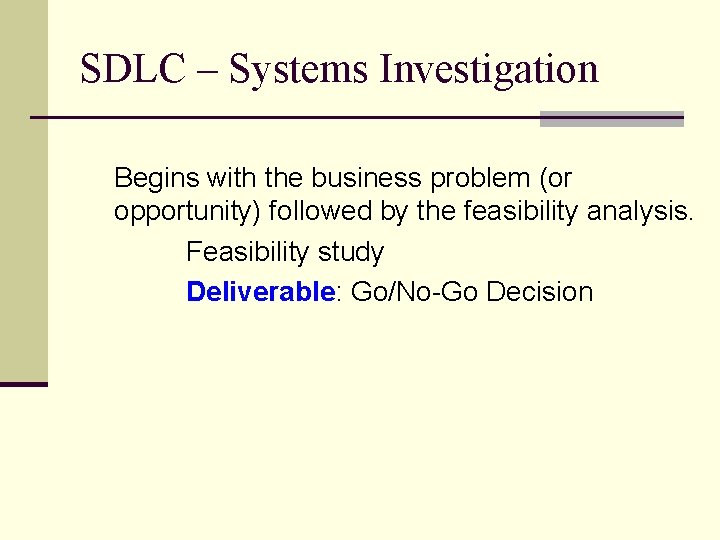
SDLC – Systems Investigation Begins with the business problem (or opportunity) followed by the feasibility analysis. Feasibility study Deliverable: Go/No-Go Decision
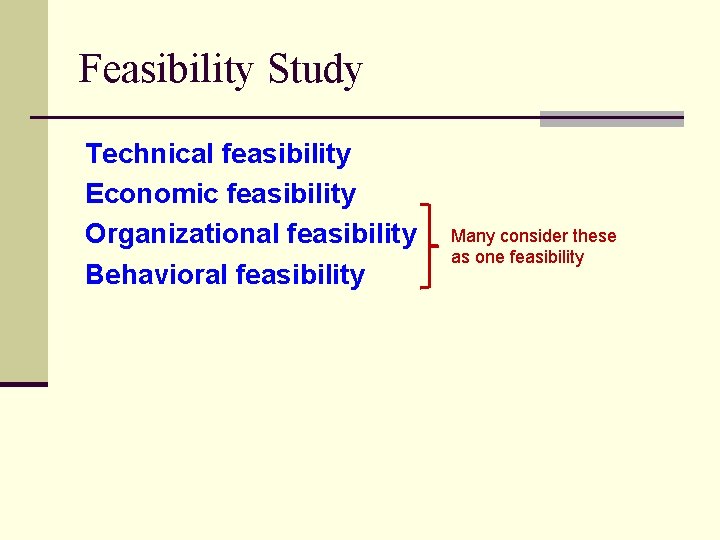
Feasibility Study Technical feasibility Economic feasibility Organizational feasibility Behavioral feasibility Many consider these as one feasibility
SDLC – System Analysis The examination of the business problem that the organization plans to solve with an information system. Main purpose is to gather information about existing system to determine requirements for the new or improved system. Deliverable is a set of system requirements, also called user requirements.
SDLC – Systems Design Describes how the system will accomplish this task. Deliverable is the technical design that specifies: System outputs, inputs, user interfaces. Hardware, software, databases, telecommunications, personnel & procedures. Blueprint of how these components are integrated.
SDLC – System Design (continued) Scope creep is caused by adding functions after the project has been initiated. Kajano/Shutterstock
SDLC – Programming & Testing Programming involves the translation of a system’s design specification into computer code. Testing checks to see if the computer code will produce the expected and desired results under certain conditions. Testing is designed to delete errors (bugs) in the computer code.
SDLC – Systems Implementation involves three major conversion strategies: Direct Conversion Pilot Conversion Phased Conversion Parallel Conversion (not used much today)
SLDC – Operation & Maintenance Audits are performed to assess the system’s capabilities and to determine if it is being used correctly. Systems need several types of maintenance. Debugging Updating Maintenance
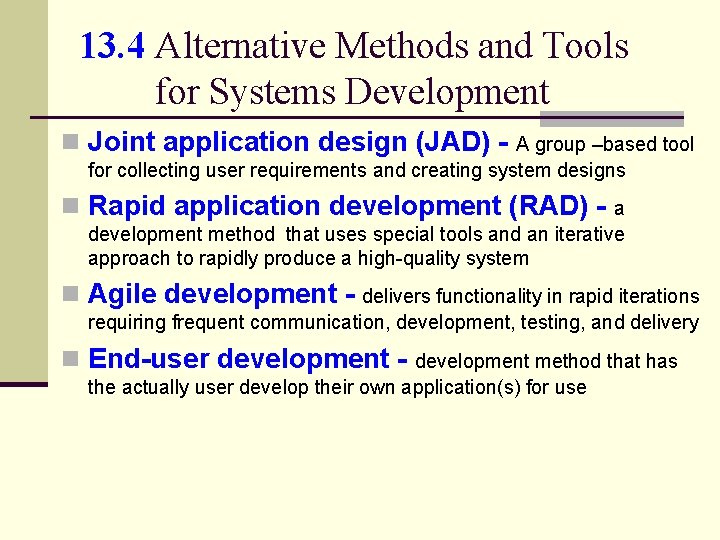
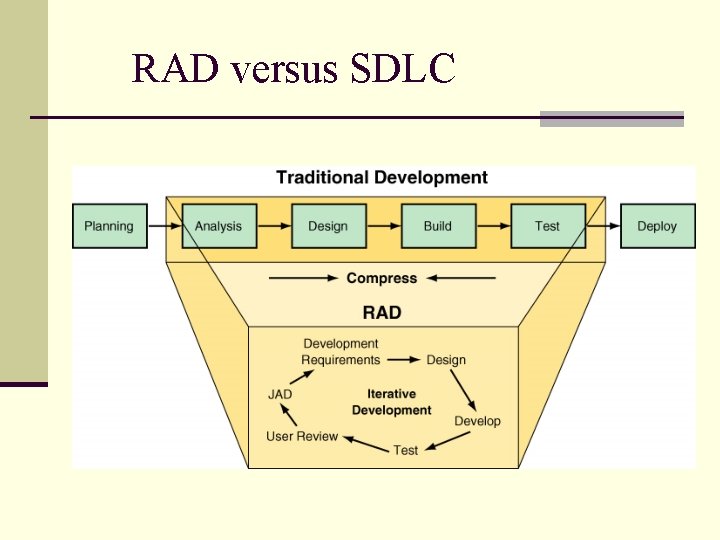
13. 4 Alternative Methods and Tools for Systems Development n Joint application design (JAD) - A group –based tool for collecting user requirements and creating system designs n Rapid application development (RAD) - a development method that uses special tools and an iterative approach to rapidly produce a high-quality system n Agile development - delivers functionality in rapid iterations requiring frequent communication, development, testing, and delivery n End-user development - development method that has the actually user develop their own application(s) for use
RAD versus SDLC
Tools for Systems Development Prototyping Integrated computer-assisted software engineering (ICASE) Component-based development Object-oriented development
13. 5 Vendor & Software Selection Step 1: Identify potential vendors. Step 2: Determine the evaluation criteria. Request for proposal (RFP) Step 3: Evaluate vendors and packages. Step 4: Choose the vendor and package Step 5: Negotiate a contract. Step 6: Establish a service level agreement. Request for proposal (RFP) is a document sent to potential vendors to submit a proposal describing their software package and explain how it would meet the company’s needs. Service Level Agreements (SLAs) are formal agreements that specify how work is to be divided between the company and its vendors.
Chapter Closing Case • The Problem • The Solution • The Results