
Chapter 13 1 13 Translation of Financial Statements





- Slides: 29
Chapter 13 -1
13 Translation of Financial Statements of Foreign Affiliates Advanced Accounting, Third Edition Chapter 13 -2
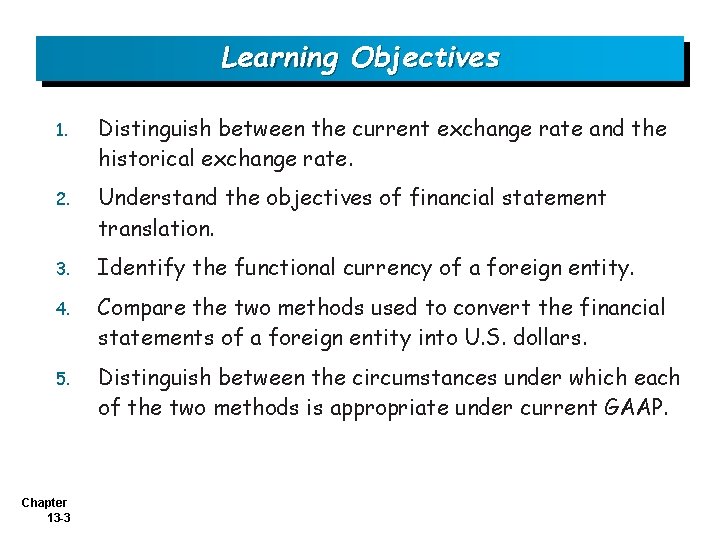
Learning Objectives 1. Distinguish between the current exchange rate and the historical exchange rate. 2. Understand the objectives of financial statement translation. 3. Identify the functional currency of a foreign entity. 4. Compare the two methods used to convert the financial statements of a foreign entity into U. S. dollars. 5. Distinguish between the circumstances under which each of the two methods is appropriate under current GAAP. Chapter 13 -3
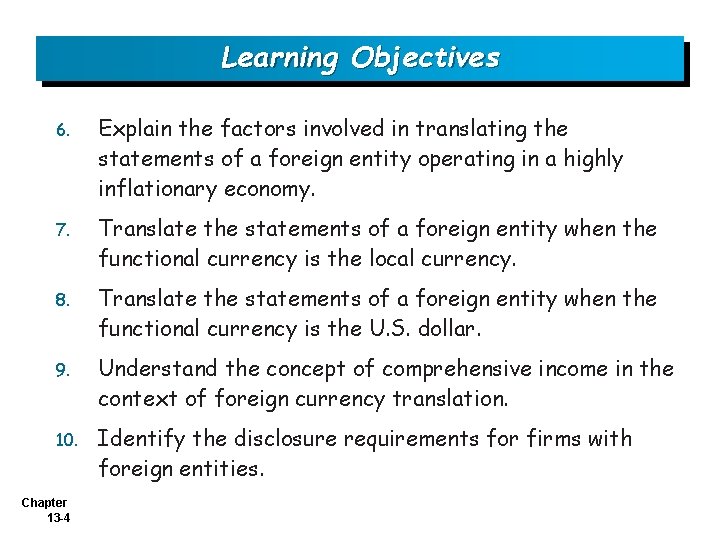
Learning Objectives 6. Explain the factors involved in translating the statements of a foreign entity operating in a highly inflationary economy. 7. Translate the statements of a foreign entity when the functional currency is the local currency. 8. Translate the statements of a foreign entity when the functional currency is the U. S. dollar. 9. Understand the concept of comprehensive income in the context of foreign currency translation. 10. Identify the disclosure requirements for firms with foreign entities. Chapter 13 -4
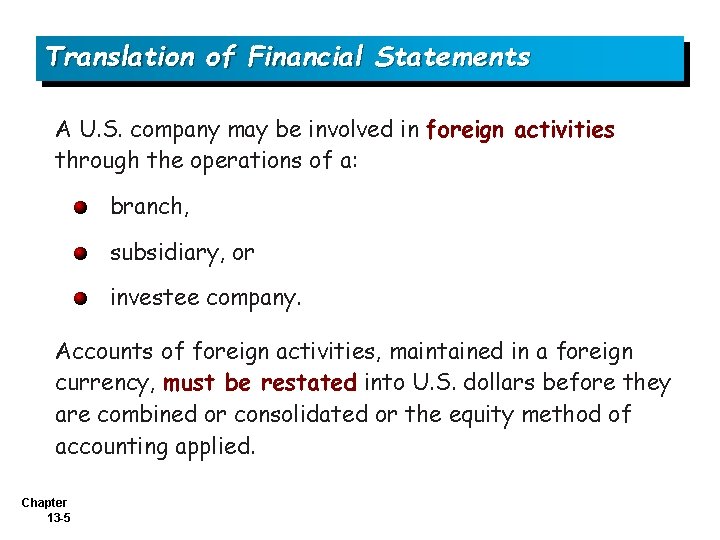
Translation of Financial Statements A U. S. company may be involved in foreign activities through the operations of a: branch, subsidiary, or investee company. Accounts of foreign activities, maintained in a foreign currency, must be restated into U. S. dollars before they are combined or consolidated or the equity method of accounting applied. Chapter 13 -5
Accounting for Operations in Foreign Countries A foreign subsidiary is consolidated if the parent company owns, directly or indirectly, a controlling interest in the voting stock of the subsidiary. Exceptions include: The intent to control is likely to be temporary. Control does not actually rest with the parent company. Ø Restriction on withdrawal of assets Ø Exchange restrictions. Foreign statements that are not in conformity with GAAP in the United States must be adjusted to conform to U. S. standards before conversion into U. S. dollars. Chapter 13 -6
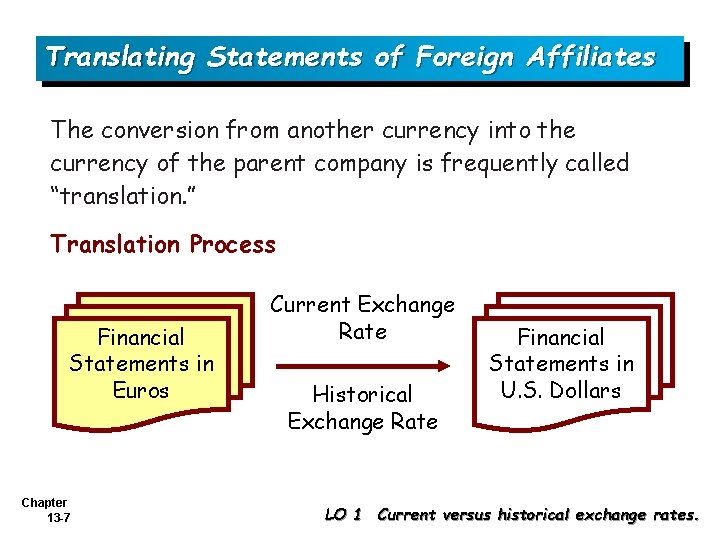
Translating Statements of Foreign Affiliates The conversion from another currency into the currency of the parent company is frequently called “translation. ” Translation Process Financial Statements in Euros Chapter 13 -7 Current Exchange Rate Historical Exchange Rate Financial Statements in U. S. Dollars LO 1 Current versus historical exchange rates.
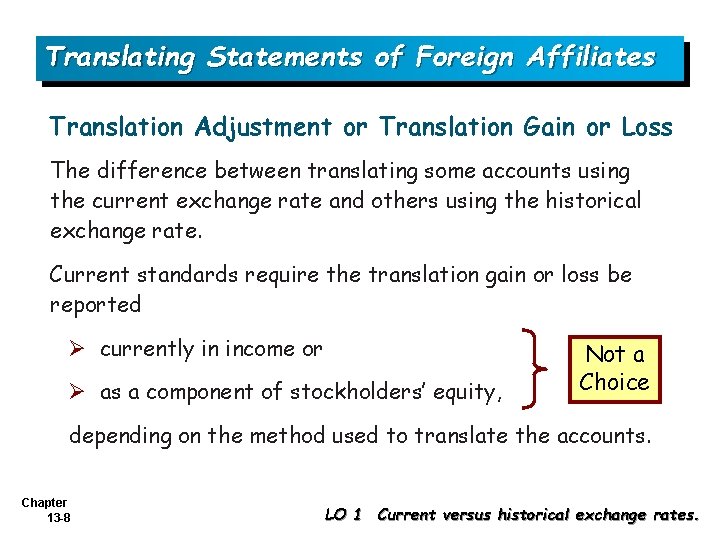
Translating Statements of Foreign Affiliates Translation Adjustment or Translation Gain or Loss The difference between translating some accounts using the current exchange rate and others using the historical exchange rate. Current standards require the translation gain or loss be reported Ø currently in income or Ø as a component of stockholders’ equity, Not a Choice depending on the method used to translate the accounts. Chapter 13 -8 LO 1 Current versus historical exchange rates.
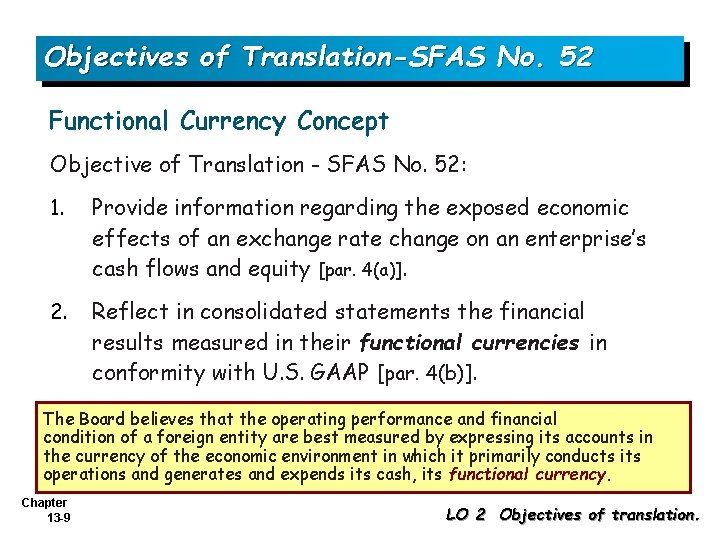
Objectives of Translation-SFAS No. 52 Functional Currency Concept Objective of Translation - SFAS No. 52: 1. Provide information regarding the exposed economic effects of an exchange rate change on an enterprise’s cash flows and equity [par. 4(a)]. 2. Reflect in consolidated statements the financial results measured in their functional currencies in conformity with U. S. GAAP [par. 4(b)]. The Board believes that the operating performance and financial condition of a foreign entity are best measured by expressing its accounts in the currency of the economic environment in which it primarily conducts its operations and generates and expends its cash, its functional currency. Chapter 13 -9 LO 2 Objectives of translation.
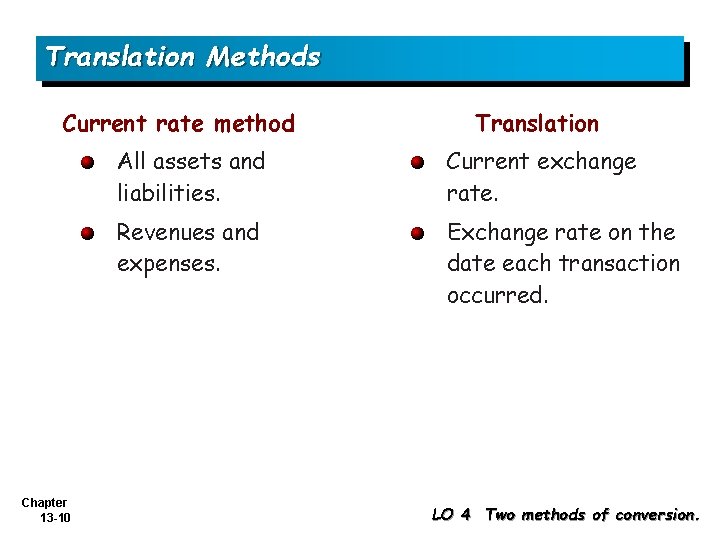
Translation Methods Current rate method Chapter 13 -10 Translation All assets and liabilities. Current exchange rate. Revenues and expenses. Exchange rate on the date each transaction occurred. LO 4 Two methods of conversion.
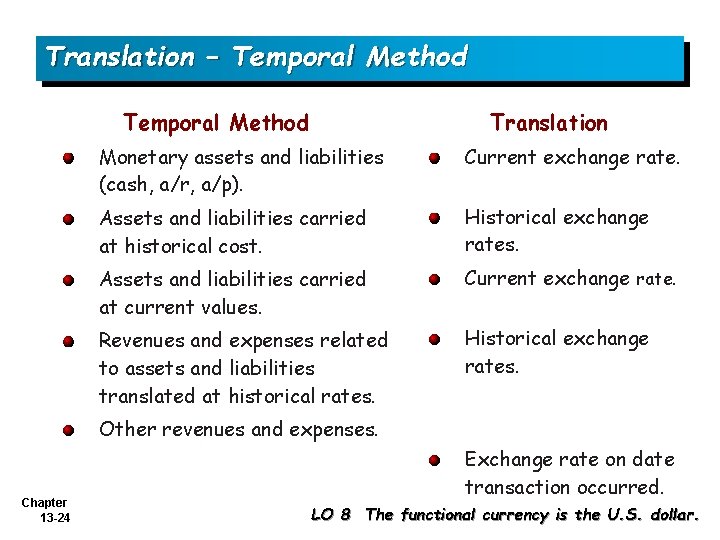
Translation Methods Temporal Method Translation Monetary assets and liabilities (cash, a/r, a/p). Current exchange rate. Assets and liabilities carried at historical cost. Historical exchange rates. Assets and liabilities carried at current values. Current exchange rate. Revenues and expenses related to assets and liabilities translated at historical rates. Historical exchange rates. Other revenues and expenses. Chapter 13 -11 Exchange rate on date transaction occurred. LO 4 Two methods of conversion.
Identifying the Functional Currency The Functional Currency may be 1. The local currency of the foreign entity, 2. The U. S. dollar, or 3. The currency of a third country. Economic Indicators of Functional Currency: Chapter 13 -12 Cash flow Expenses Sales prices Financing Sales market Intercompany transactions LO 3 Identifying the functional currency.
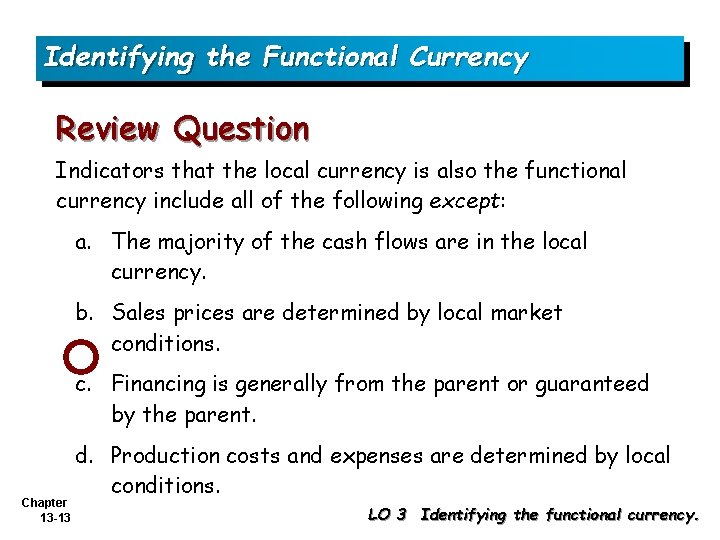
Identifying the Functional Currency Review Question Indicators that the local currency is also the functional currency include all of the following except: a. The majority of the cash flows are in the local currency. b. Sales prices are determined by local market conditions. c. Financing is generally from the parent or guaranteed by the parent. Chapter 13 -13 d. Production costs and expenses are determined by local conditions. LO 3 Identifying the functional currency.
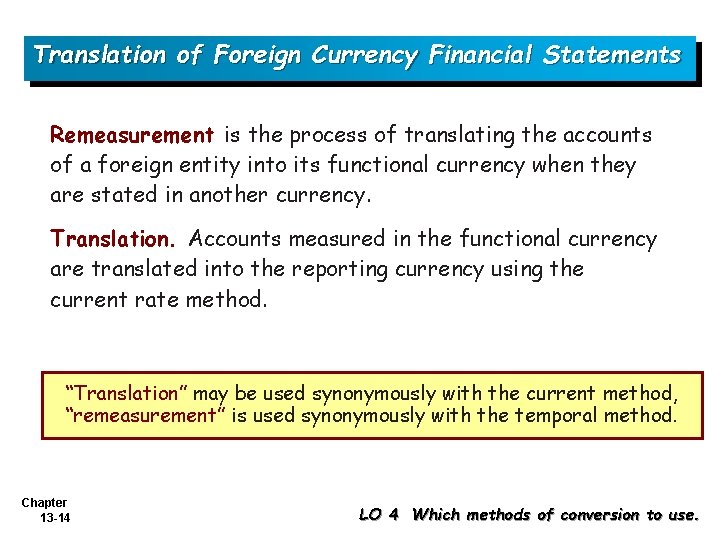
Translation of Foreign Currency Financial Statements Remeasurement is the process of translating the accounts of a foreign entity into its functional currency when they are stated in another currency. Translation. Accounts measured in the functional currency are translated into the reporting currency using the current rate method. “Translation” may be used synonymously with the current method, “remeasurement” is used synonymously with the temporal method. Chapter 13 -14 LO 4 Which methods of conversion to use.
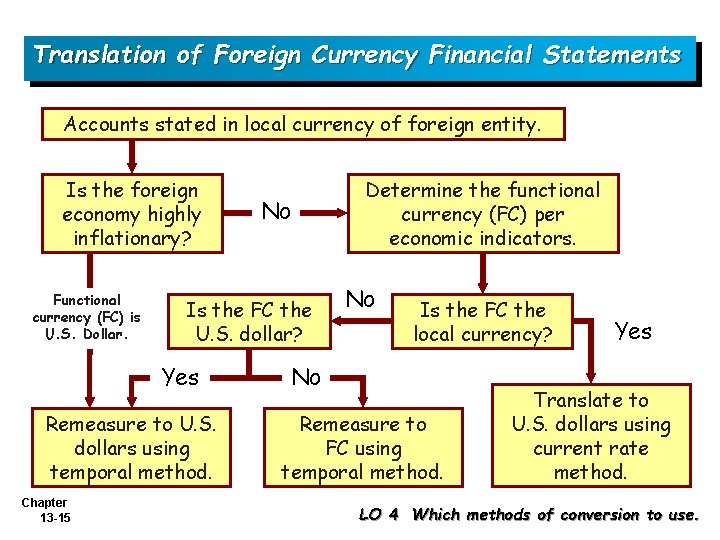
Translation of Foreign Currency Financial Statements Accounts stated in local currency of foreign entity. Is the foreign economy highly inflationary? Functional currency (FC) is U. S. Dollar. Is the FC the U. S. dollar? Yes Remeasure to U. S. dollars using temporal method. Chapter 13 -15 No Determine the functional currency (FC) per economic indicators. No Is the FC the local currency? No Remeasure to FC using temporal method. Yes Translate to U. S. dollars using current rate method. LO 4 Which methods of conversion to use.
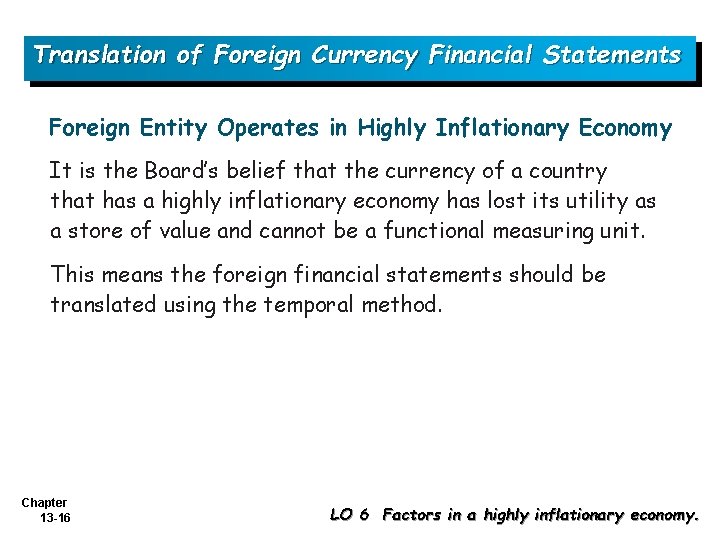
Translation of Foreign Currency Financial Statements Foreign Entity Operates in Highly Inflationary Economy It is the Board’s belief that the currency of a country that has a highly inflationary economy has lost its utility as a store of value and cannot be a functional measuring unit. This means the foreign financial statements should be translated using the temporal method. Chapter 13 -16 LO 6 Factors in a highly inflationary economy.
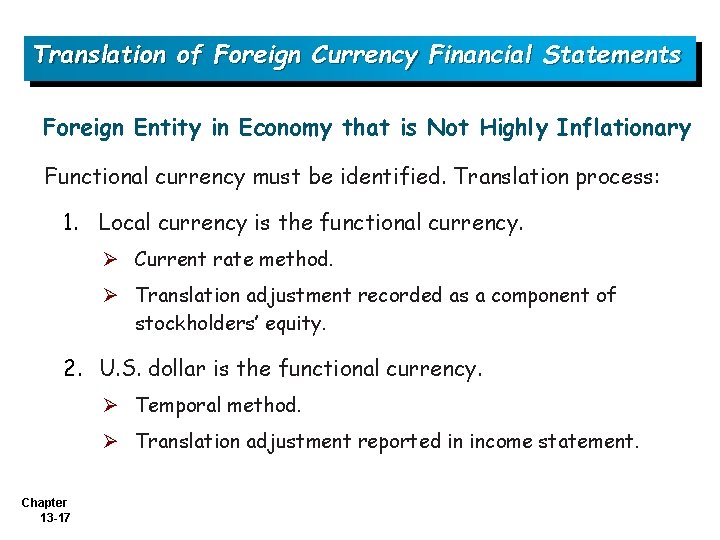
Translation of Foreign Currency Financial Statements Foreign Entity in Economy that is Not Highly Inflationary Functional currency must be identified. Translation process: 1. Local currency is the functional currency. Ø Current rate method. Ø Translation adjustment recorded as a component of stockholders’ equity. 2. U. S. dollar is the functional currency. Ø Temporal method. Ø Translation adjustment reported in income statement. Chapter 13 -17
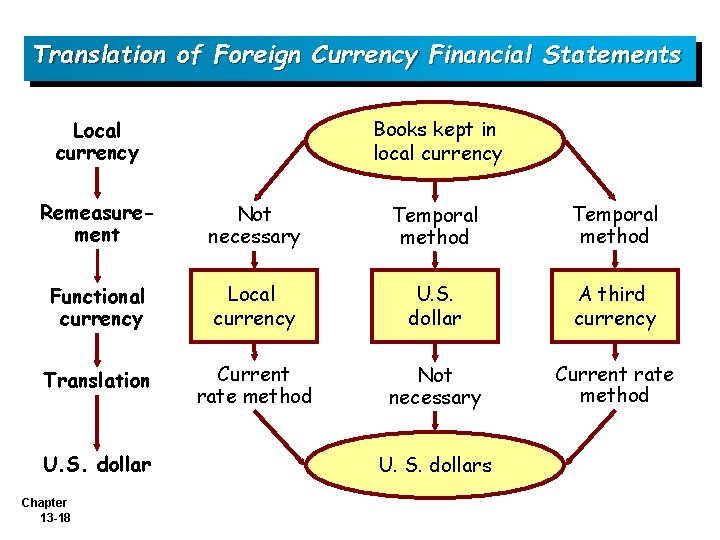
Translation of Foreign Currency Financial Statements Books kept in local currency Local currency Remeasurement Not necessary Temporal method Functional currency Local currency U. S. dollar A third currency Translation Current rate method Not necessary Current rate method U. S. dollar Chapter 13 -18 U. S. dollars
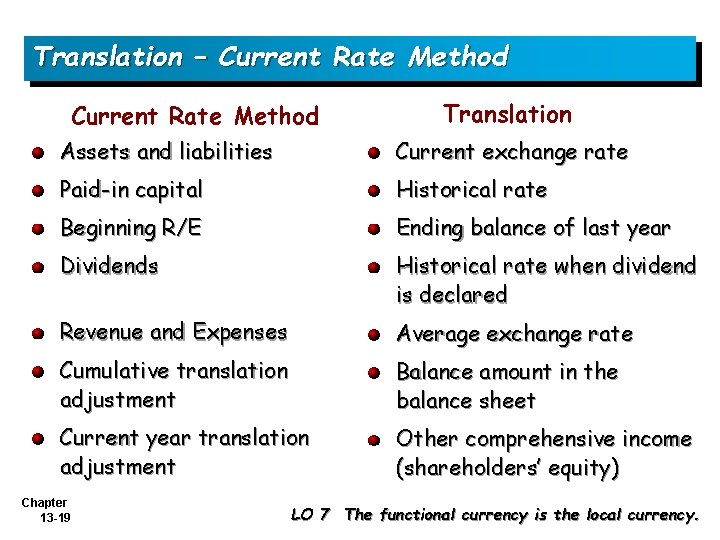
Translation – Current Rate Method Translation Assets and liabilities Current exchange rate Paid-in capital Historical rate Beginning R/E Ending balance of last year Dividends Historical rate when dividend is declared Revenue and Expenses Average exchange rate Cumulative translation adjustment Balance amount in the balance sheet Current year translation adjustment Other comprehensive income (shareholders’ equity) Chapter 13 -19 LO 7 The functional currency is the local currency.
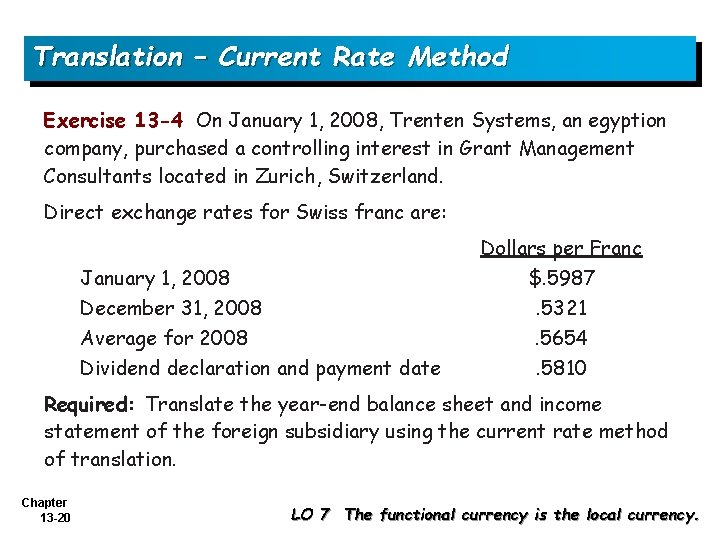
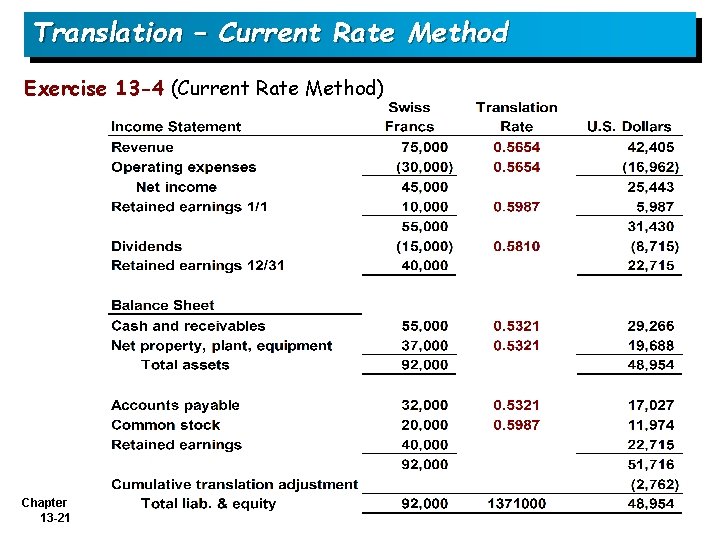
Translation – Current Rate Method Exercise 13 -4 On January 1, 2008, Trenten Systems, an egyption company, purchased a controlling interest in Grant Management Consultants located in Zurich, Switzerland. Direct exchange rates for Swiss franc are: Dollars per Franc January 1, 2008 December 31, 2008 Average for 2008 $. 5987. 5321. 5654 Dividend declaration and payment date . 5810 Required: Translate the year-end balance sheet and income statement of the foreign subsidiary using the current rate method of translation. Chapter 13 -20 LO 7 The functional currency is the local currency.
Translation – Current Rate Method Exercise 13 -4 (Current Rate Method) Chapter 13 -21
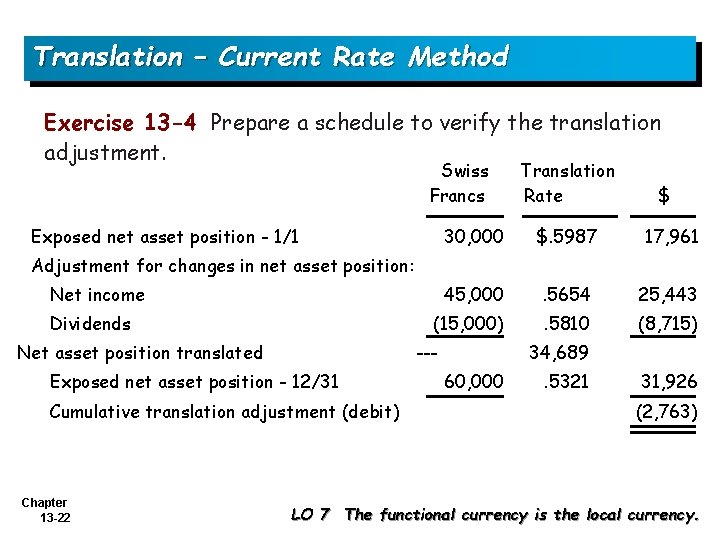
Translation – Current Rate Method Exercise 13 -4 Prepare a schedule to verify the translation adjustment. Swiss Francs Translation Rate $ 30, 000 $. 5987 17, 961 45, 000 . 5654 25, 443 (15, 000) . 5810 (8, 715) Exposed net asset position - 1/1 Adjustment for changes in net asset position: Net income Dividends Net asset position translated --- Exposed net asset position - 12/31 Cumulative translation adjustment (debit) Chapter 13 -22 34, 689 60, 000 . 5321 31, 926 (2, 763) LO 7 The functional currency is the local currency.
Translation – Current Rate Method Review Question Under the current method of currency translation, which of the following balance sheet accounts is translated at historical exchange rates? a. Cash b. Accounts Receivable c. Bonds Payable d. Common Stock Chapter 13 -23 LO 7 The functional currency is the local currency.
Translation – Temporal Method Translation Monetary assets and liabilities (cash, a/r, a/p). Current exchange rate. Assets and liabilities carried at historical cost. Historical exchange rates. Assets and liabilities carried at current values. Current exchange rate. Revenues and expenses related to assets and liabilities translated at historical rates. Historical exchange rates. Other revenues and expenses. Chapter 13 -24 Exchange rate on date transaction occurred. LO 8 The functional currency is the U. S. dollar.
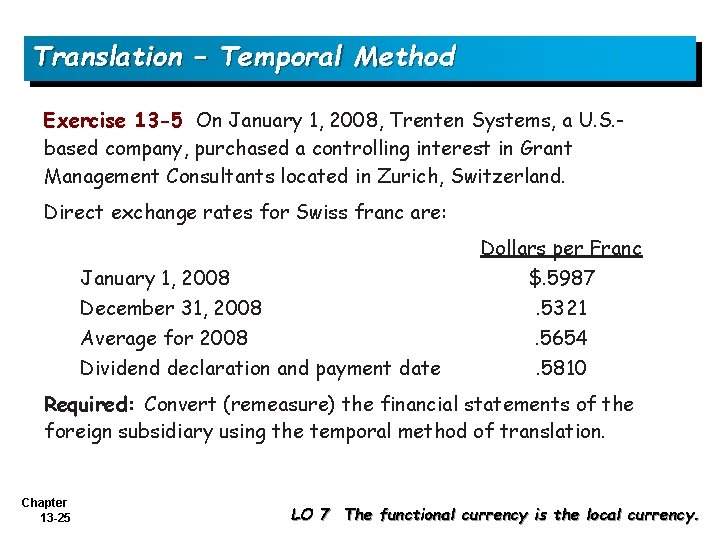
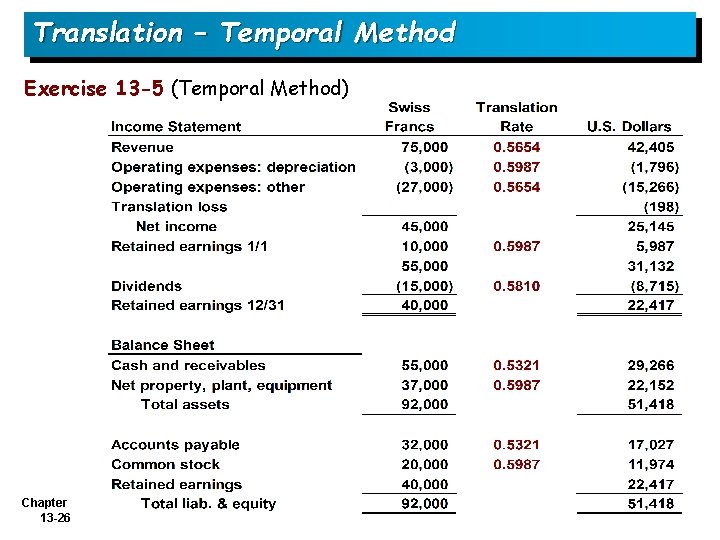
Translation – Temporal Method Exercise 13 -5 On January 1, 2008, Trenten Systems, a U. S. based company, purchased a controlling interest in Grant Management Consultants located in Zurich, Switzerland. Direct exchange rates for Swiss franc are: Dollars per Franc January 1, 2008 December 31, 2008 Average for 2008 $. 5987. 5321. 5654 Dividend declaration and payment date . 5810 Required: Convert (remeasure) the financial statements of the foreign subsidiary using the temporal method of translation. Chapter 13 -25 LO 7 The functional currency is the local currency.
Translation – Temporal Method Exercise 13 -5 (Temporal Method) Chapter 13 -26
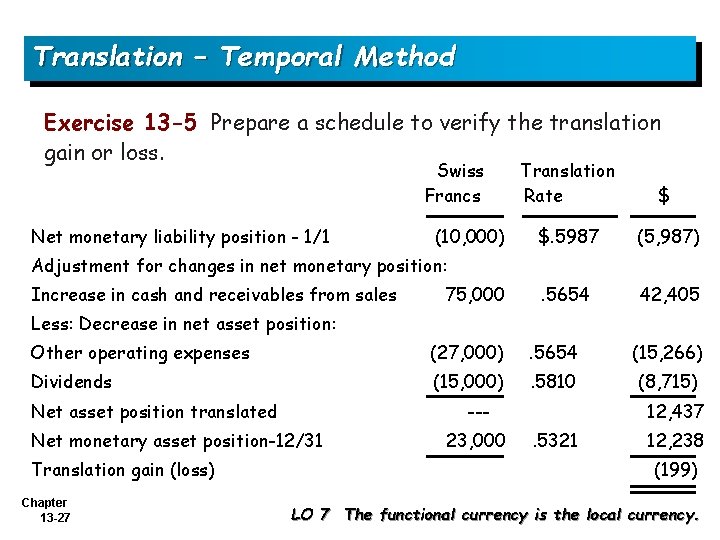
Translation – Temporal Method Exercise 13 -5 Prepare a schedule to verify the translation gain or loss. Swiss Francs Net monetary liability position - 1/1 (10, 000) Translation Rate $ $. 5987 (5, 987) . 5654 42, 405 Adjustment for changes in net monetary position: Increase in cash and receivables from sales 75, 000 Less: Decrease in net asset position: Other operating expenses (27, 000) . 5654 (15, 266) Dividends (15, 000) . 5810 (8, 715) Net asset position translated --- Net monetary asset position-12/31 Translation gain (loss) Chapter 13 -27 23, 000 12, 437. 5321 12, 238 (199) LO 7 The functional currency is the local currency.
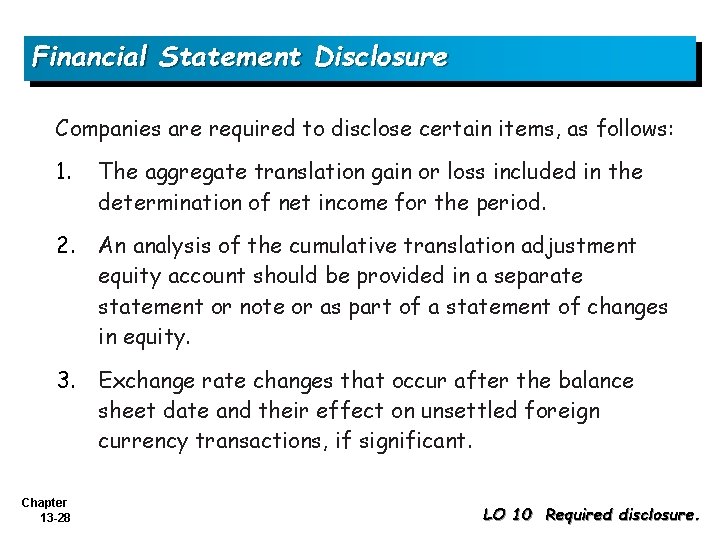
Financial Statement Disclosure Companies are required to disclose certain items, as follows: 1. The aggregate translation gain or loss included in the determination of net income for the period. 2. An analysis of the cumulative translation adjustment equity account should be provided in a separate statement or note or as part of a statement of changes in equity. 3. Exchange rate changes that occur after the balance sheet date and their effect on unsettled foreign currency transactions, if significant. Chapter 13 -28 LO 10 Required disclosure.
Copyright © 2008 John Wiley & Sons, Inc. All rights reserved. Reproduction or translation of this work beyond that permitted in Section 117 of the 1976 United States Copyright Act without the express written permission of the copyright owner is unlawful. Request for further information should be addressed to the Permissions Department, John Wiley & Sons, Inc. The purchaser may make back-up copies for his/her own use only and not for distribution or resale. The Publisher assumes no responsibility for errors, omissions, or damages, caused by the use of these programs or from the use of the information contained herein. Chapter 13 -29