
Chapter 12 Wireless Communications Chapter 12 Sources of
- Slides: 28
Chapter 12: Wireless Communications Chapter 12
Sources of Interference - Interference is an unwanted signal, and there are various sources of interference, in an ideal system, the interfering signals, if not eliminated, must be significantly minimized v Co-channel interference arises in a system employing the frequency reuse concept, and occurs when the wanted signal from within the cell arrives at the receiver along with the unwanted signals from other cells, while all employing the same carrier frequency v Adjacent carrier interference is caused by power from signals in adjacent carriers in the system, and occurs in multi-carrier channels with modest carrier spacing and inadequate filtering in the transmitter and receiver v Adjacent system interference is produced by signals belonging to another system using the same frequency as the wanted signal v Intermodulation interference is primarily due to the processing of the signal by a nonlinear device at or close to saturation Chapter 12 2
Sources of Loss Chapter 12 3
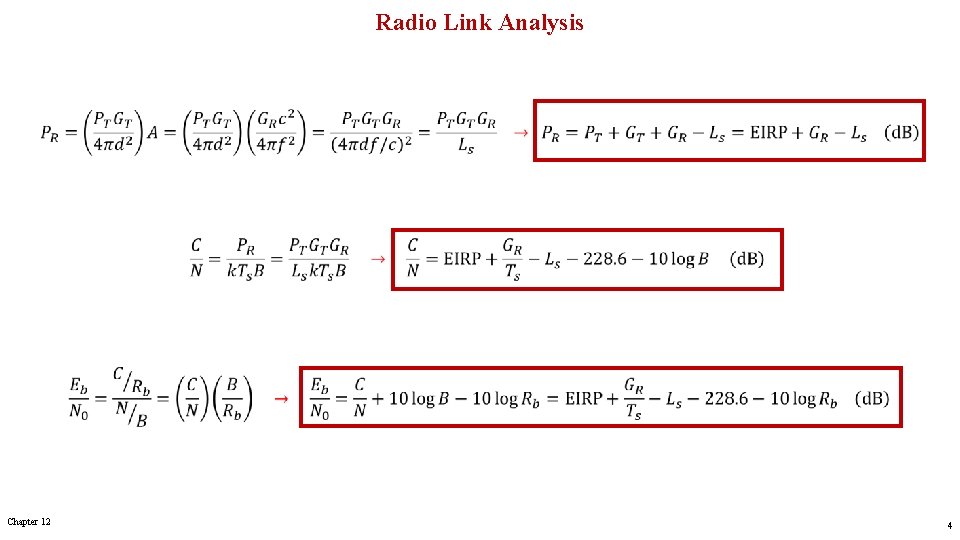
Radio Link Analysis Chapter 12 4
Polarization - Chapter 12 Polarization of electromagnetic wave propagation is the direction of its electric field vector in relationship to the surface of the earth, dual polarization exploits orthogonality, and thus allows frequency reuse There are two distinct types of polarization, linear polarization and circular polarization, and each type can have dual polarization. A linear polarized antenna radiates energy wholly in one plane containing the direction of propagation (the electric field vector does not change its orientation, i. e. , it remains the same, with respect to an observer), but a circular polarized antenna radiates energy in both the horizontal and vertical planes and all planes in between Linear polarization (LP), in turn, is of two types, horizontal and vertical In horizontal polarization (HP), the electric field vector is parallel to the surface of the earth, and in vertical polarization (VP), the electric field vector is perpendicular to the surface of the earth Circular polarization (CP), in turn, is of two types, right-hand left-hand In right-hand circular polarization (RHCP), the electric wave rotates in a clockwise direction as it travels, and in left-hand circular polarization (LHCP), it rotates in a counter-clockwise direction A linearly polarized transmit antenna can work with a circularly polarized receive antenna and vice versa, and there can be about a 3 -d. B loss in signal strength If the transmit antenna has one form of linear (circular) polarization and the receive antenna has the other linear (circular) form, a loss of about 20 d. B can be incurred 5
Spatial Separation Chapter 12 6
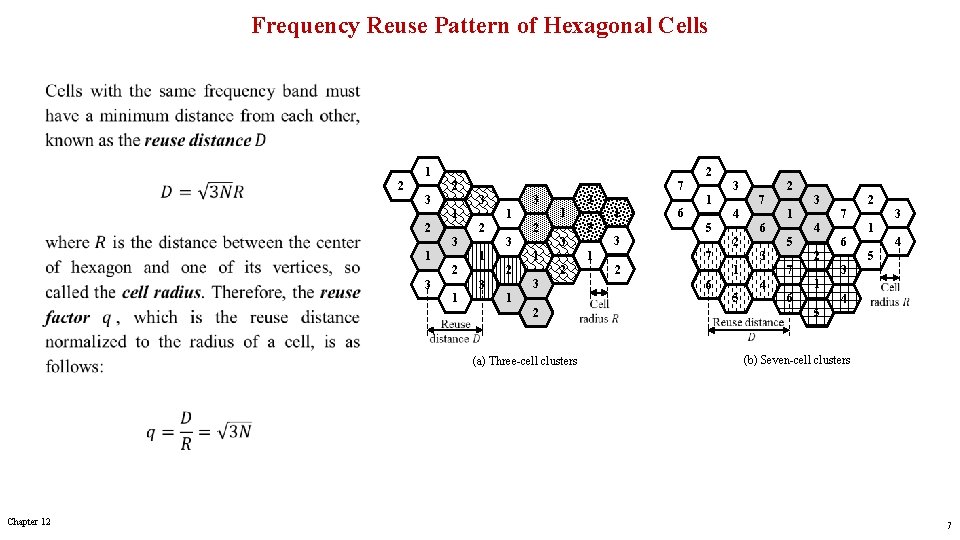
Frequency Reuse Pattern of Hexagonal Cells 2 1 2 7 2 3 3 1 3 3 3 1 2 4 (a) Three-cell clusters 3 2 4 5 1 6 3 1 4 6 2 3 7 2 7 1 6 7 5 3 1 4 5 1 2 Chapter 12 2 2 7 5 1 1 2 6 3 1 3 3 3 2 1 2 2 1 1 2 2 3 6 4 5 (b) Seven-cell clusters 7
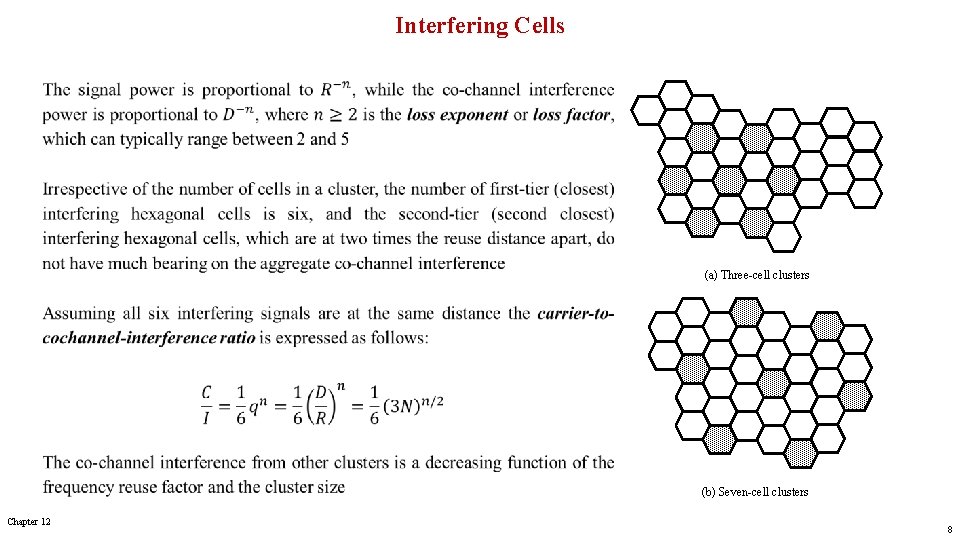
Interfering Cells (a) Three-cell clusters (b) Seven-cell clusters Chapter 12 8
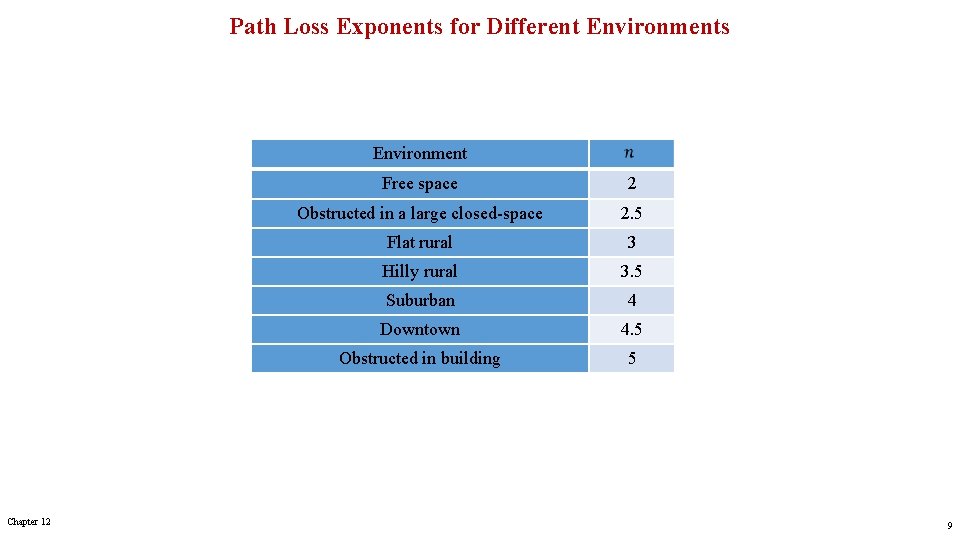
Path Loss Exponents for Different Environments Environment Chapter 12 Free space 2 Obstructed in a large closed-space 2. 5 Flat rural 3 Hilly rural 3. 5 Suburban 4 Downtown 4. 5 Obstructed in building 5 9
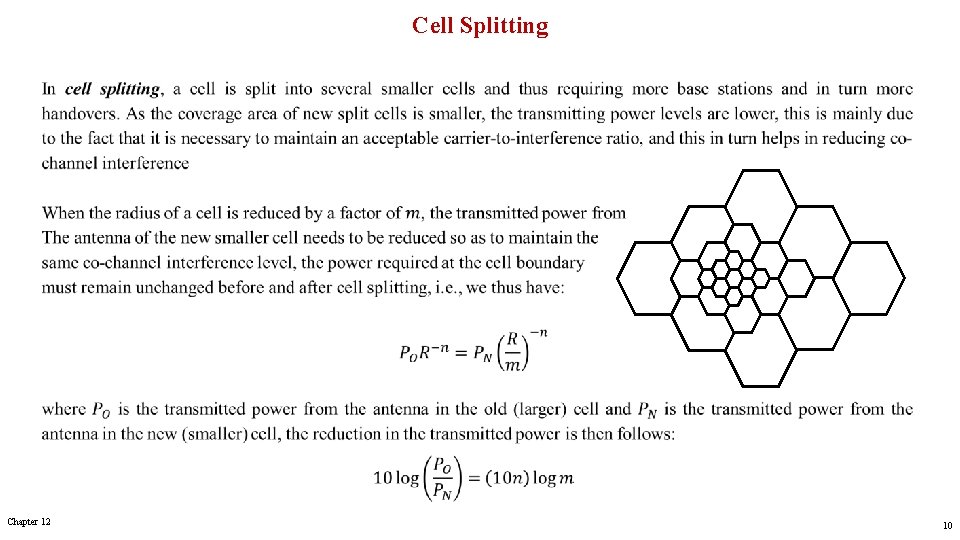
Cell Splitting Chapter 12 10
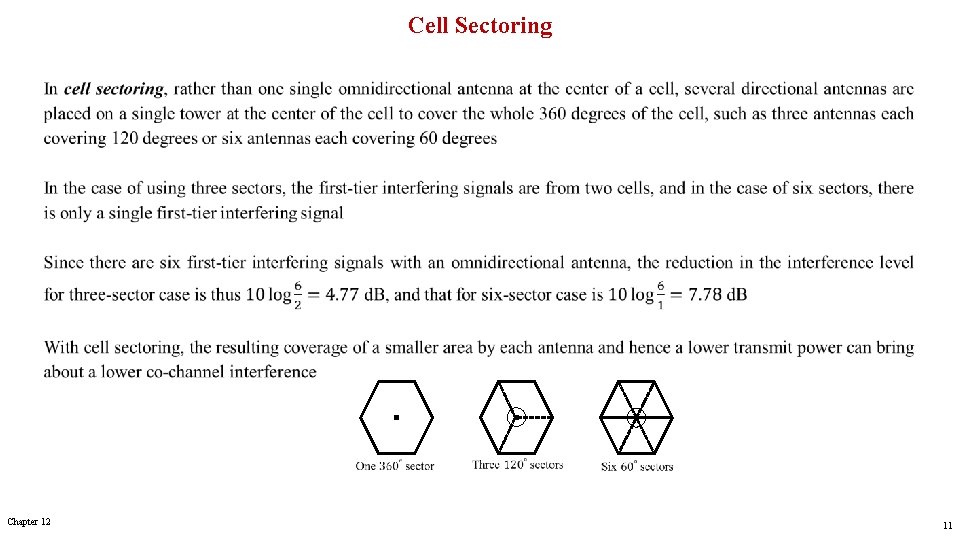
Cell Sectoring Chapter 12 11
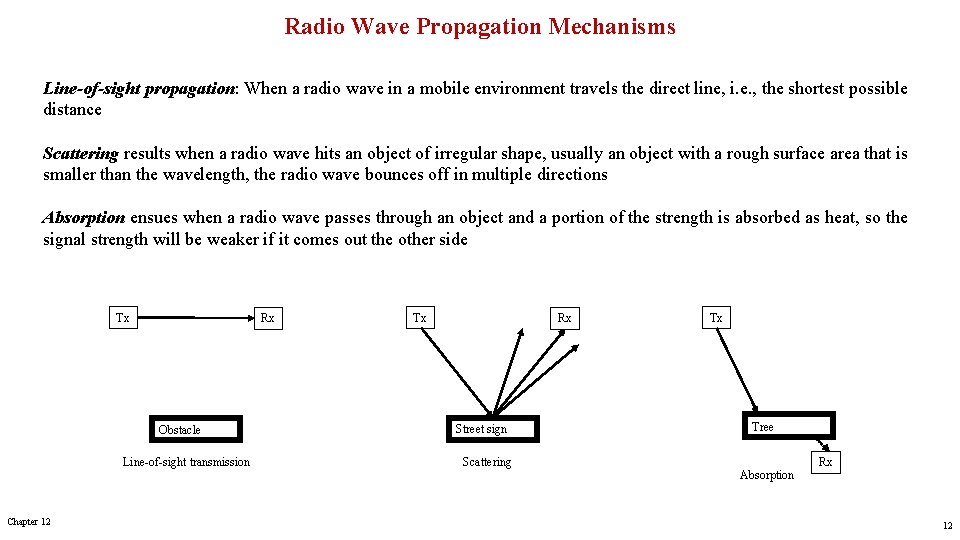
Radio Wave Propagation Mechanisms Line-of-sight propagation: When a radio wave in a mobile environment travels the direct line, i. e. , the shortest possible distance Scattering results when a radio wave hits an object of irregular shape, usually an object with a rough surface area that is smaller than the wavelength, the radio wave bounces off in multiple directions Absorption ensues when a radio wave passes through an object and a portion of the strength is absorbed as heat, so the signal strength will be weaker if it comes out the other side Tx Rx Obstacle Line-of-sight transmission Chapter 12 Tx Rx Street sign Scattering Tx Tree Absorption Rx 12
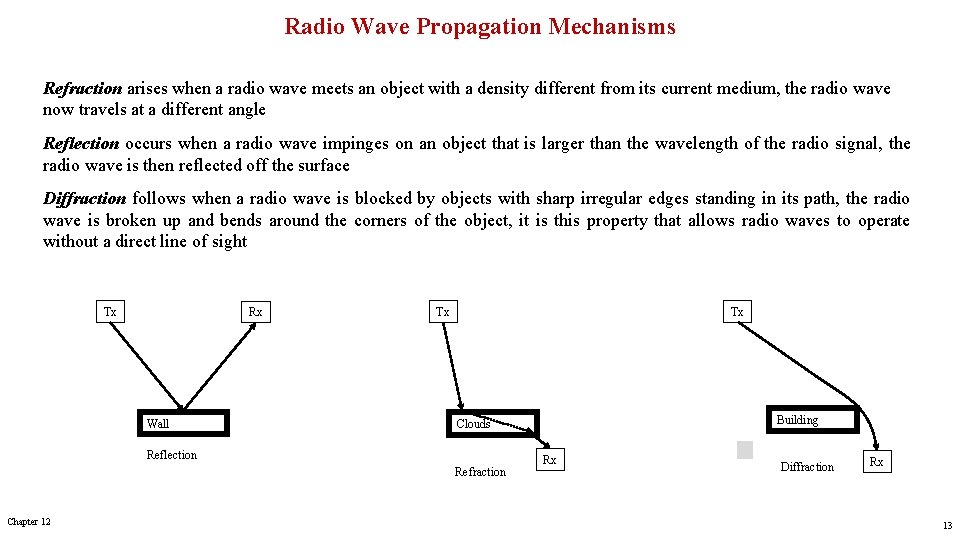
Radio Wave Propagation Mechanisms Refraction arises when a radio wave meets an object with a density different from its current medium, the radio wave now travels at a different angle Reflection occurs when a radio wave impinges on an object that is larger than the wavelength of the radio signal, the radio wave is then reflected off the surface Diffraction follows when a radio wave is blocked by objects with sharp irregular edges standing in its path, the radio wave is broken up and bends around the corners of the object, it is this property that allows radio waves to operate without a direct line of sight Tx Rx Wall Tx Tx Reflection Refraction Chapter 12 Building Clouds Rx Diffraction Rx 13
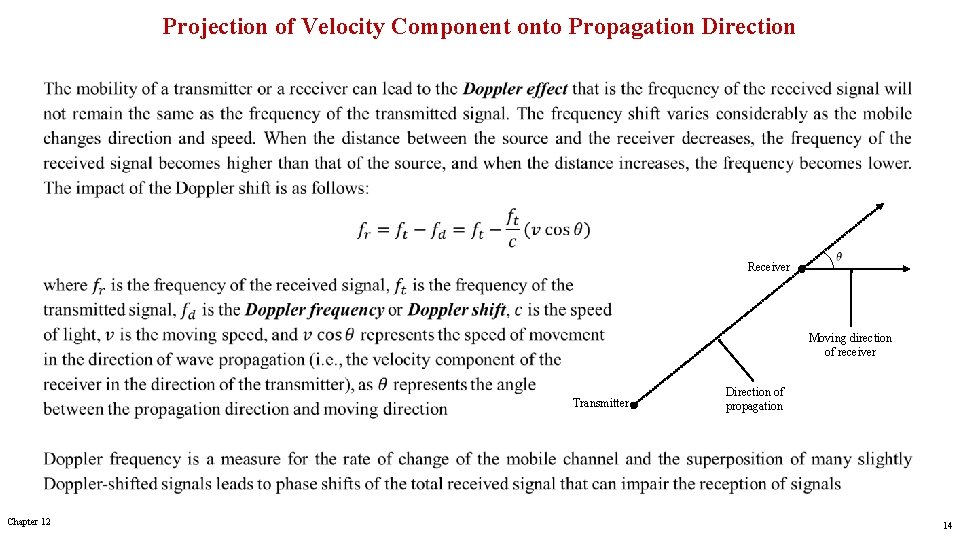
Projection of Velocity Component onto Propagation Direction Receiver Moving direction of receiver Transmitter Chapter 12 Direction of propagation 14
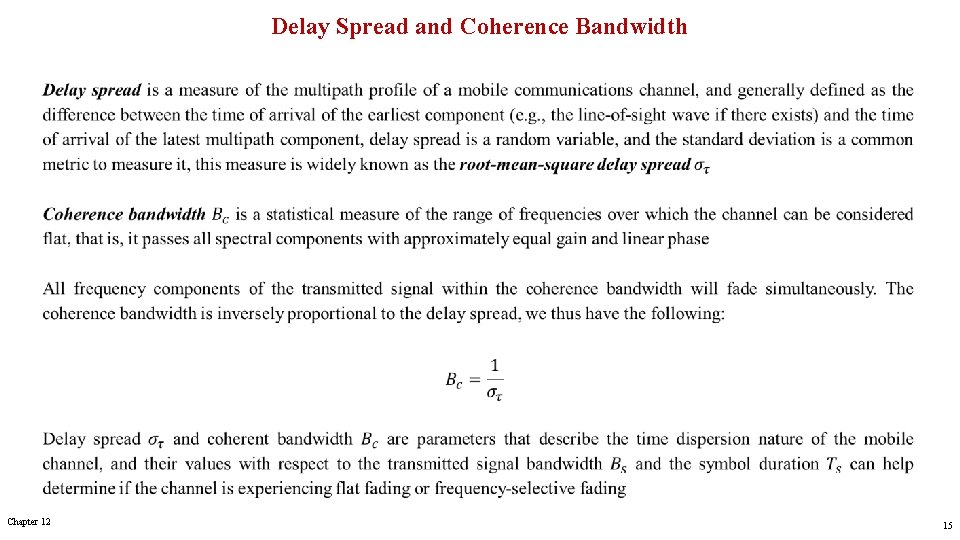
Delay Spread and Coherence Bandwidth Chapter 12 15
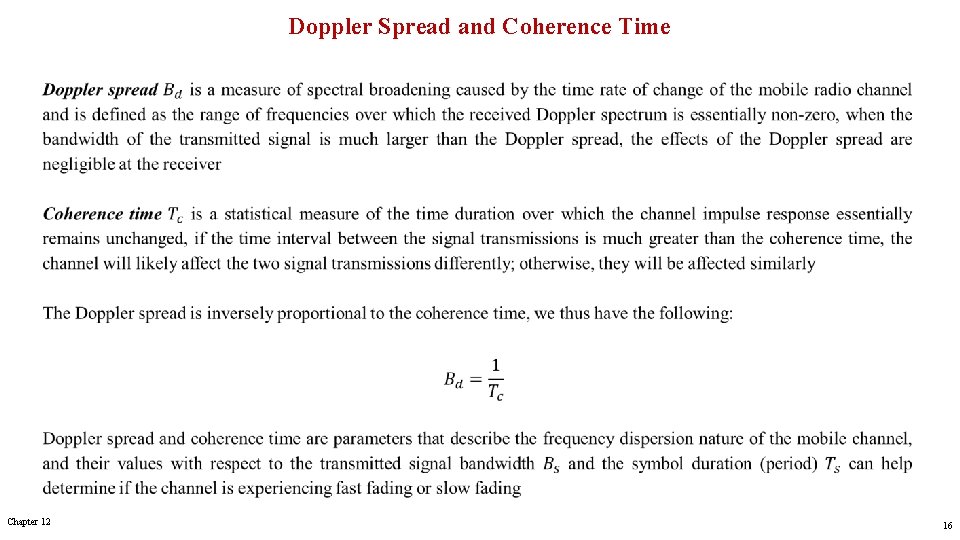
Doppler Spread and Coherence Time Chapter 12 16
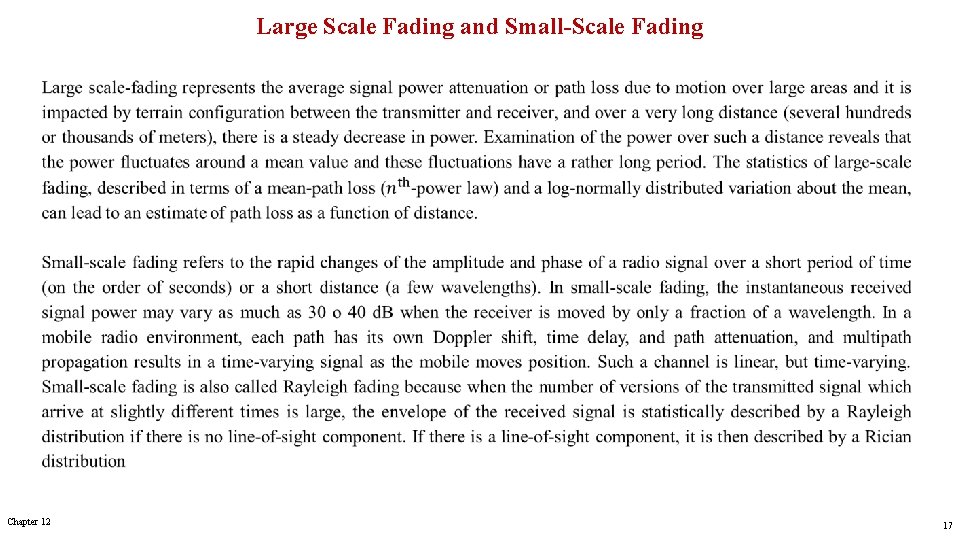
Large Scale Fading and Small-Scale Fading Chapter 12 17
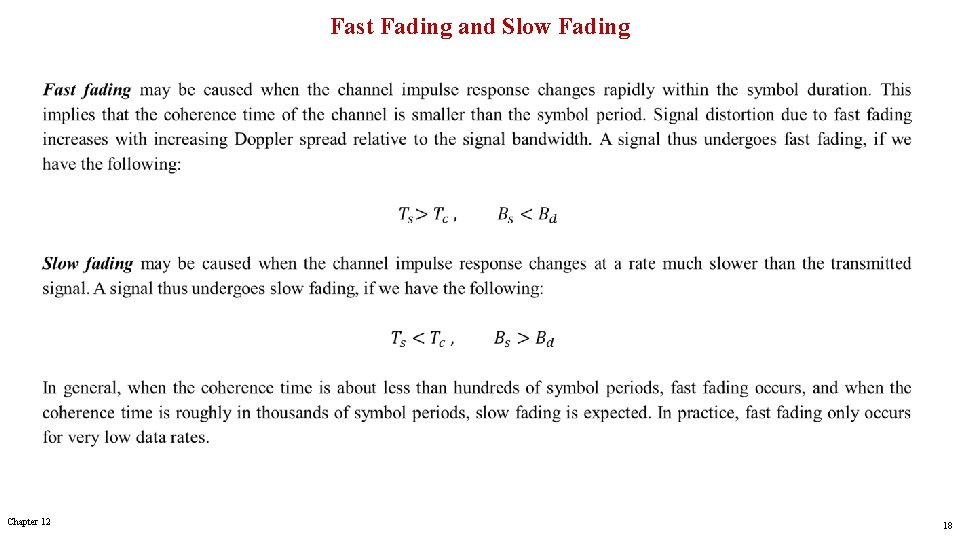
Fast Fading and Slow Fading Chapter 12 18
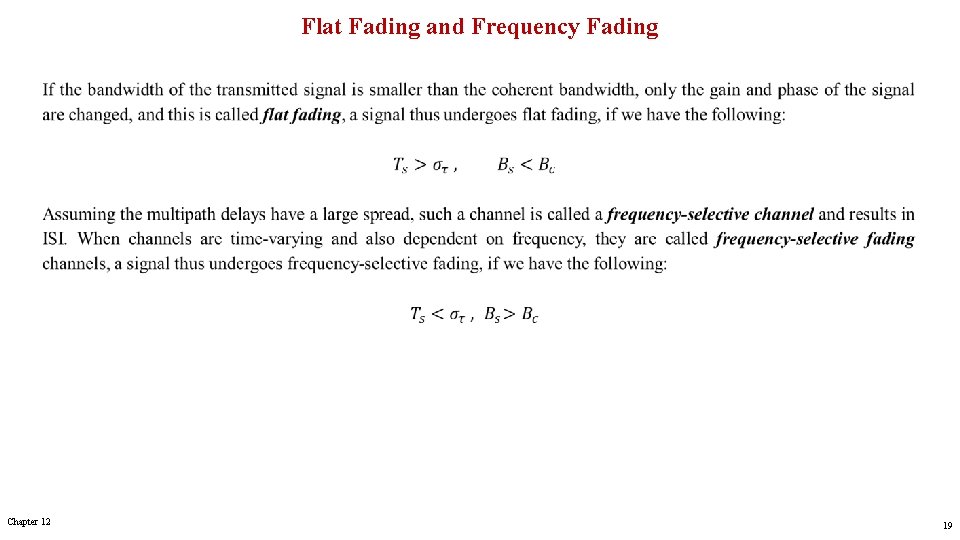
Flat Fading and Frequency Fading Chapter 12 19
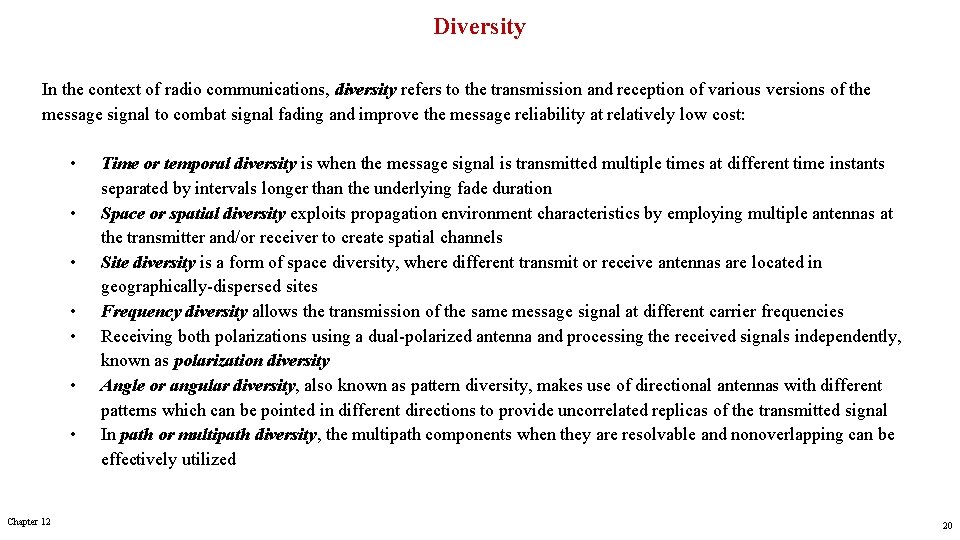
Diversity In the context of radio communications, diversity refers to the transmission and reception of various versions of the message signal to combat signal fading and improve the message reliability at relatively low cost: • • Chapter 12 Time or temporal diversity is when the message signal is transmitted multiple times at different time instants separated by intervals longer than the underlying fade duration Space or spatial diversity exploits propagation environment characteristics by employing multiple antennas at the transmitter and/or receiver to create spatial channels Site diversity is a form of space diversity, where different transmit or receive antennas are located in geographically-dispersed sites Frequency diversity allows the transmission of the same message signal at different carrier frequencies Receiving both polarizations using a dual-polarized antenna and processing the received signals independently, known as polarization diversity Angle or angular diversity, also known as pattern diversity, makes use of directional antennas with different patterns which can be pointed in different directions to provide uncorrelated replicas of the transmitted signal In path or multipath diversity, the multipath components when they are resolvable and nonoverlapping can be effectively utilized 20
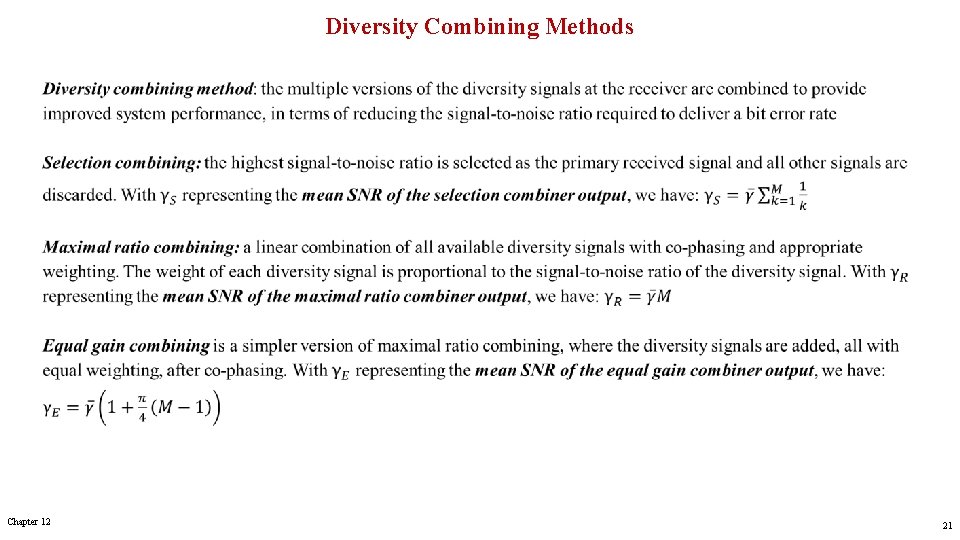
Diversity Combining Methods Chapter 12 21
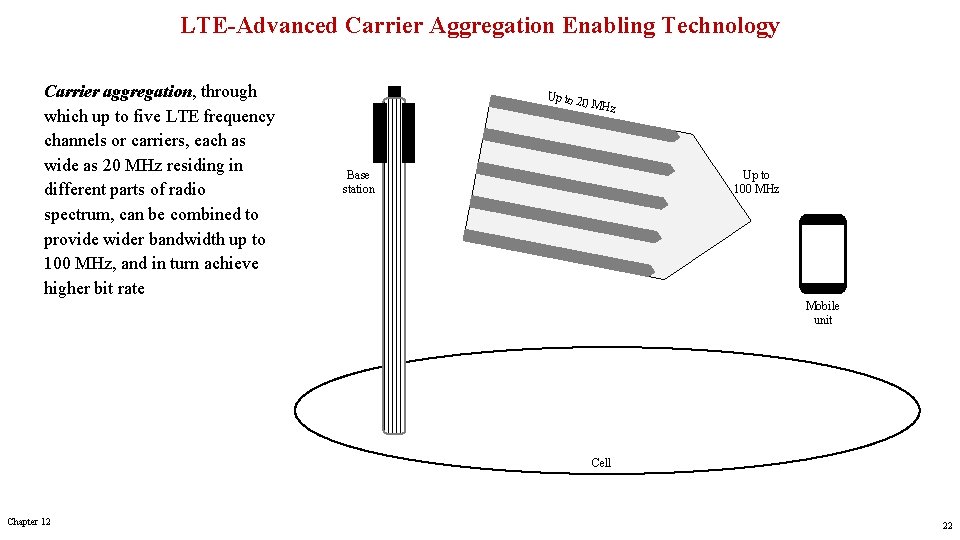
LTE-Advanced Carrier Aggregation Enabling Technology Carrier aggregation, through which up to five LTE frequency channels or carriers, each as wide as 20 MHz residing in different parts of radio spectrum, can be combined to provide wider bandwidth up to 100 MHz, and in turn achieve higher bit rate Up to 2 0 MHz Base station Up to 100 MHz Mobile unit Cell Chapter 12 22
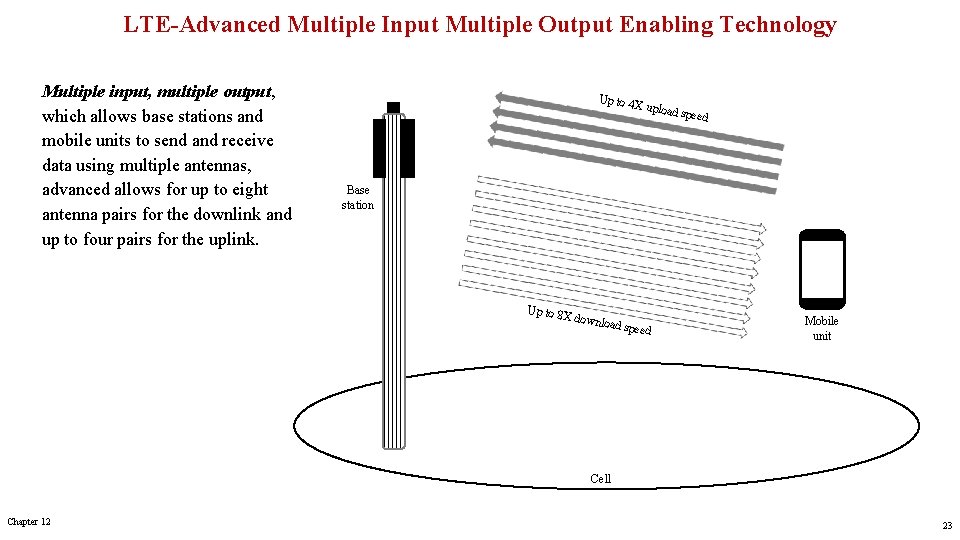
LTE-Advanced Multiple Input Multiple Output Enabling Technology Multiple input, multiple output, which allows base stations and mobile units to send and receive data using multiple antennas, advanced allows for up to eight antenna pairs for the downlink and up to four pairs for the uplink. Up to 4 X uploa d speed Base station Up to 8 X down load spe ed Mobile unit Cell Chapter 12 23
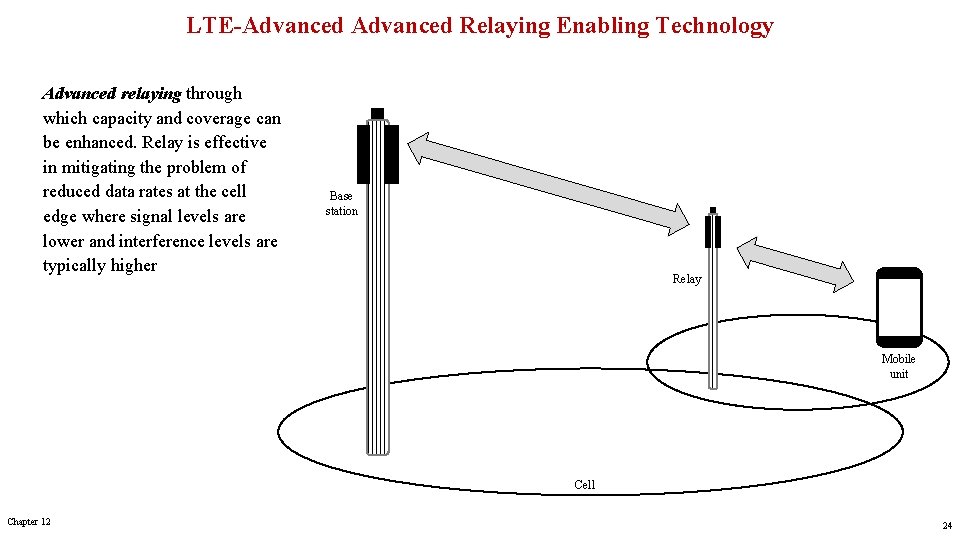
LTE-Advanced Relaying Enabling Technology Advanced relaying through which capacity and coverage can be enhanced. Relay is effective in mitigating the problem of reduced data rates at the cell edge where signal levels are lower and interference levels are typically higher Base station Relay Mobile unit Cell Chapter 12 24
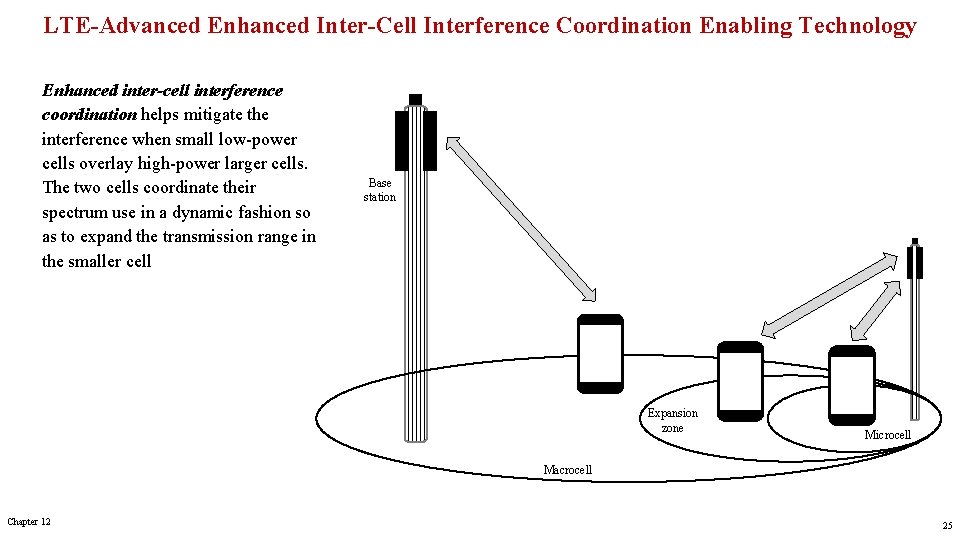
LTE-Advanced Enhanced Inter-Cell Interference Coordination Enabling Technology Enhanced inter-cell interference coordination helps mitigate the interference when small low-power cells overlay high-power larger cells. The two cells coordinate their spectrum use in a dynamic fashion so as to expand the transmission range in the smaller cell Base station Expansion zone Microcell Macrocell Chapter 12 25
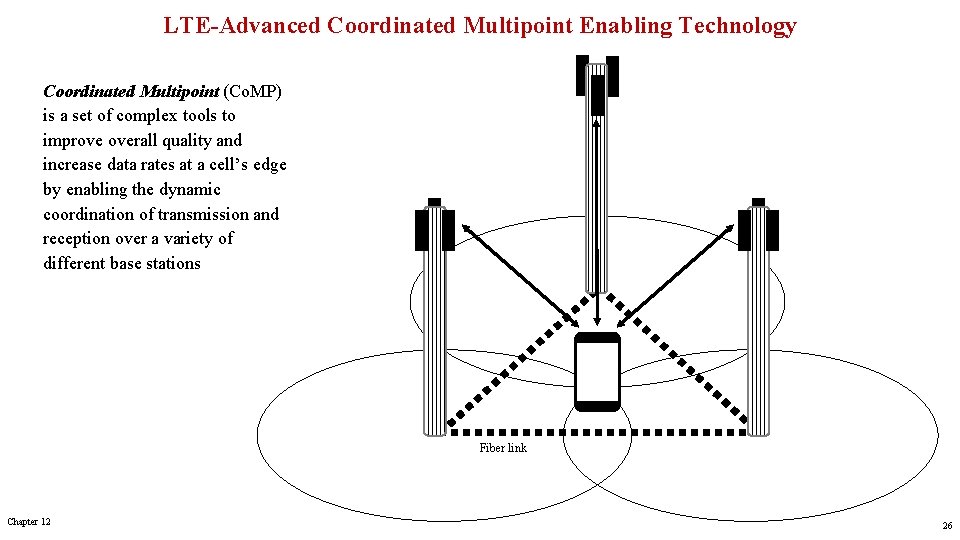
LTE-Advanced Coordinated Multipoint Enabling Technology Coordinated Multipoint (Co. MP) is a set of complex tools to improve overall quality and increase data rates at a cell’s edge by enabling the dynamic coordination of transmission and reception over a variety of different base stations Fiber link Chapter 12 26
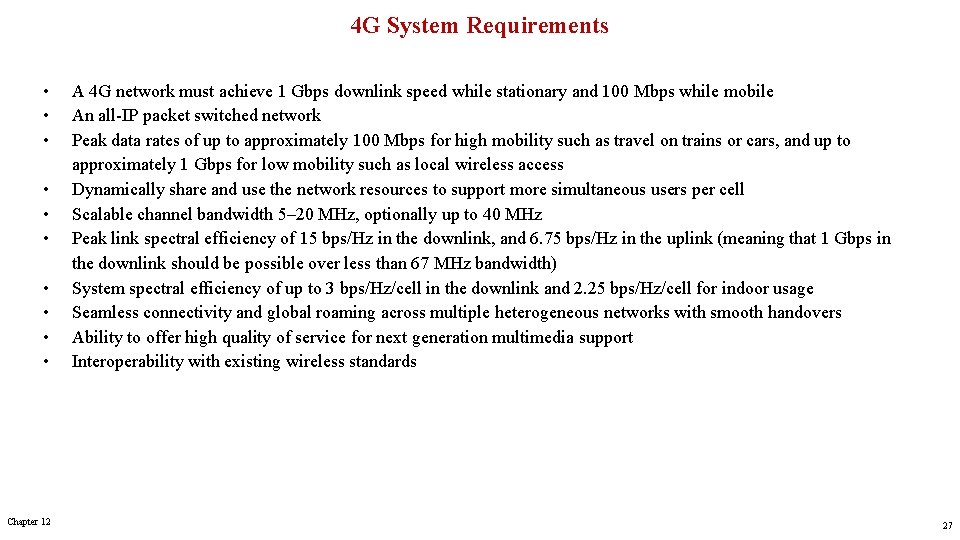
4 G System Requirements • • • Chapter 12 A 4 G network must achieve 1 Gbps downlink speed while stationary and 100 Mbps while mobile An all-IP packet switched network Peak data rates of up to approximately 100 Mbps for high mobility such as travel on trains or cars, and up to approximately 1 Gbps for low mobility such as local wireless access Dynamically share and use the network resources to support more simultaneous users per cell Scalable channel bandwidth 5– 20 MHz, optionally up to 40 MHz Peak link spectral efficiency of 15 bps/Hz in the downlink, and 6. 75 bps/Hz in the uplink (meaning that 1 Gbps in the downlink should be possible over less than 67 MHz bandwidth) System spectral efficiency of up to 3 bps/Hz/cell in the downlink and 2. 25 bps/Hz/cell for indoor usage Seamless connectivity and global roaming across multiple heterogeneous networks with smooth handovers Ability to offer high quality of service for next generation multimedia support Interoperability with existing wireless standards 27
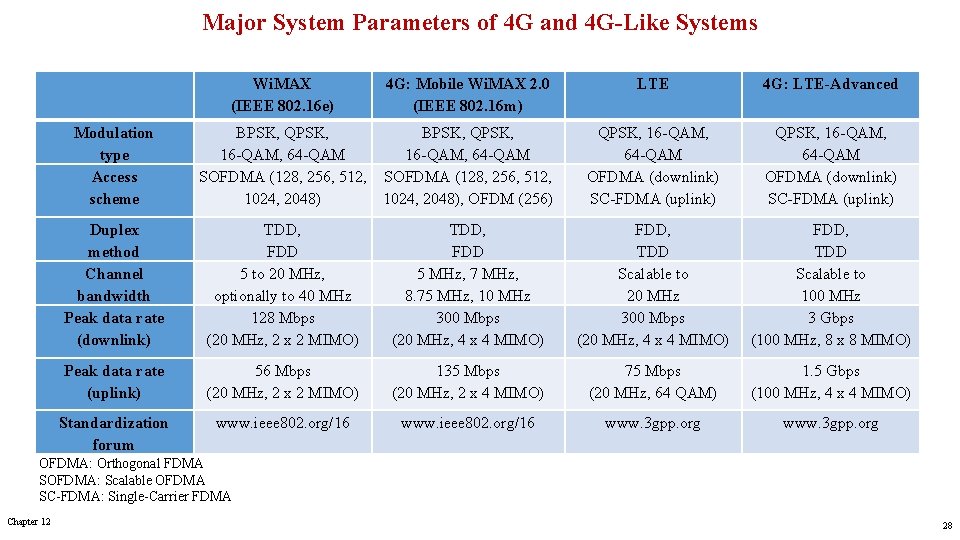
Major System Parameters of 4 G and 4 G-Like Systems Wi. MAX (IEEE 802. 16 e) 4 G: Mobile Wi. MAX 2. 0 (IEEE 802. 16 m) LTE 4 G: LTE-Advanced Modulation type Access scheme BPSK, QPSK, 16 -QAM, 64 -QAM SOFDMA (128, 256, 512, 1024, 2048), OFDM (256) QPSK, 16 -QAM, 64 -QAM OFDMA (downlink) SC-FDMA (uplink) Duplex method Channel bandwidth Peak data rate (downlink) TDD, FDD 5 to 20 MHz, optionally to 40 MHz 128 Mbps (20 MHz, 2 x 2 MIMO) TDD, FDD 5 MHz, 7 MHz, 8. 75 MHz, 10 MHz 300 Mbps (20 MHz, 4 x 4 MIMO) FDD, TDD Scalable to 20 MHz 300 Mbps (20 MHz, 4 x 4 MIMO) FDD, TDD Scalable to 100 MHz 3 Gbps (100 MHz, 8 x 8 MIMO) Peak data rate (uplink) 56 Mbps (20 MHz, 2 x 2 MIMO) 135 Mbps (20 MHz, 2 x 4 MIMO) 75 Mbps (20 MHz, 64 QAM) 1. 5 Gbps (100 MHz, 4 x 4 MIMO) Standardization forum www. ieee 802. org/16 www. 3 gpp. org OFDMA: Orthogonal FDMA SOFDMA: Scalable OFDMA SC-FDMA: Single-Carrier FDMA Chapter 12 28