
Chapter 12 Vectors and the Geometry of Space
- Slides: 34
Chapter 12 Vectors and the Geometry of Space Stewart, Calculus: Early Transcendentals, 8 th Edition. © 2016 Cengage. All Rights Reserved. May not be scanned, copied or duplicated, or posted to a publicly accessible website, in whole or in part.
12. 3 The Dot Product Stewart, Calculus: Early Transcendentals, 8 th Edition. © 2016 Cengage. All Rights Reserved. May not be scanned, copied or duplicated, or posted to a publicly accessible website, in whole or in part.
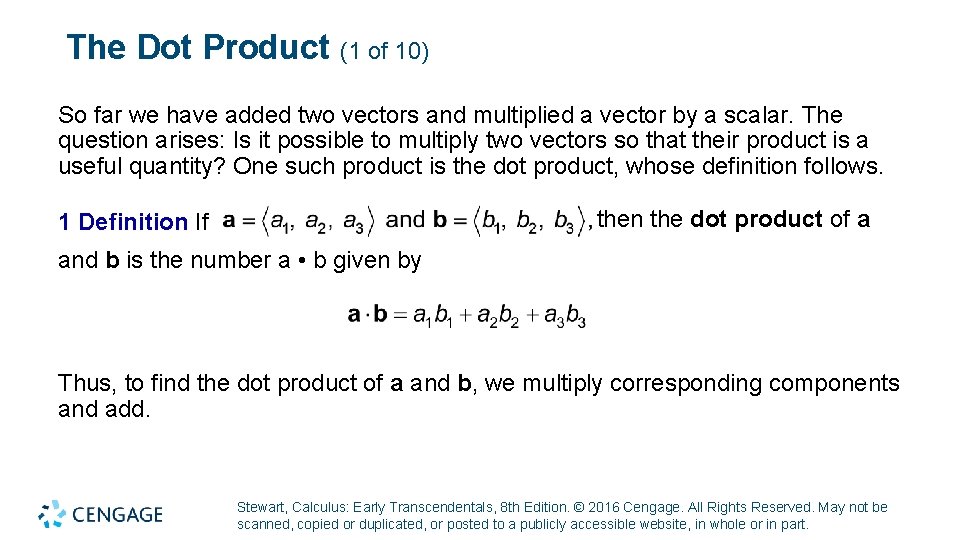
The Dot Product (1 of 10) So far we have added two vectors and multiplied a vector by a scalar. The question arises: Is it possible to multiply two vectors so that their product is a useful quantity? One such product is the dot product, whose definition follows. then the dot product of a 1 Definition If and b is the number a • b given by Thus, to find the dot product of a and b, we multiply corresponding components and add. Stewart, Calculus: Early Transcendentals, 8 th Edition. © 2016 Cengage. All Rights Reserved. May not be scanned, copied or duplicated, or posted to a publicly accessible website, in whole or in part.
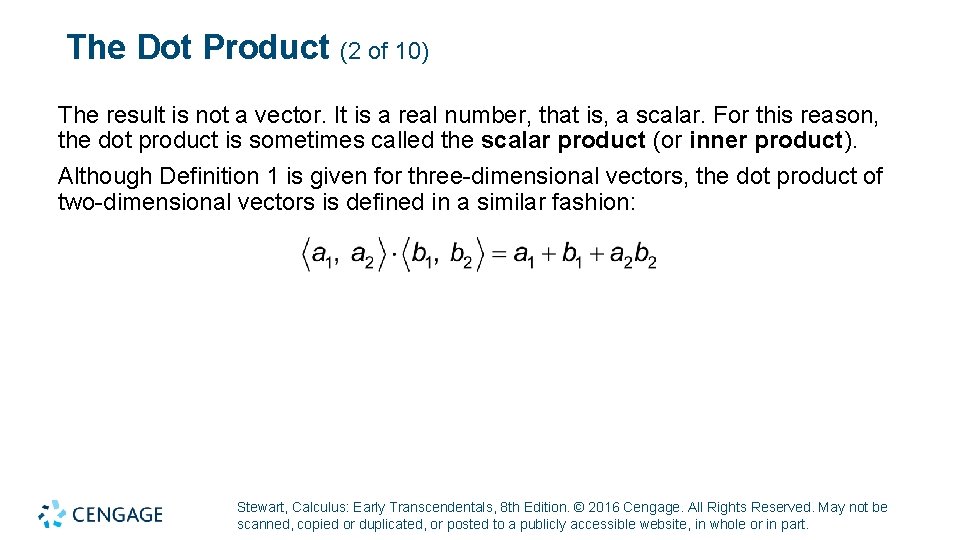
The Dot Product (2 of 10) The result is not a vector. It is a real number, that is, a scalar. For this reason, the dot product is sometimes called the scalar product (or inner product). Although Definition 1 is given for three-dimensional vectors, the dot product of two-dimensional vectors is defined in a similar fashion: Stewart, Calculus: Early Transcendentals, 8 th Edition. © 2016 Cengage. All Rights Reserved. May not be scanned, copied or duplicated, or posted to a publicly accessible website, in whole or in part.
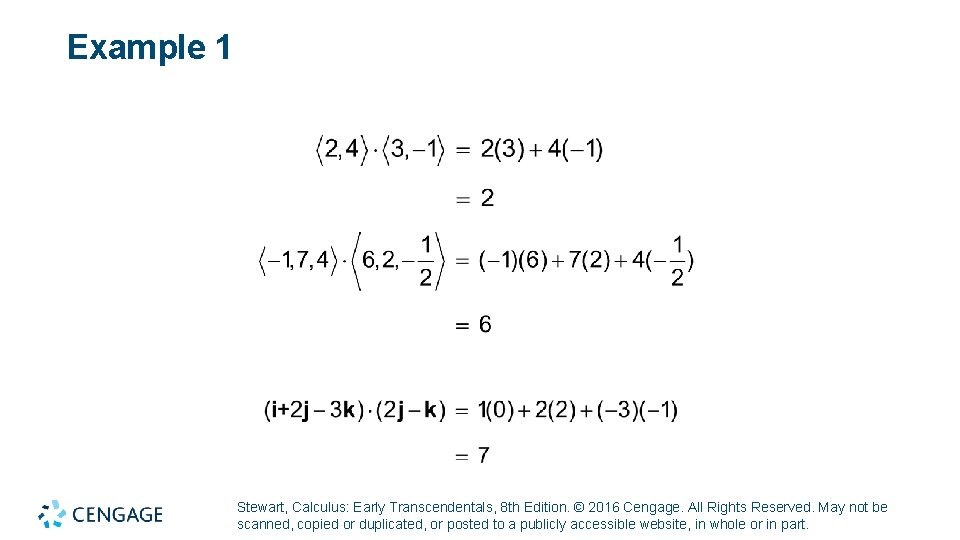
Example 1 Stewart, Calculus: Early Transcendentals, 8 th Edition. © 2016 Cengage. All Rights Reserved. May not be scanned, copied or duplicated, or posted to a publicly accessible website, in whole or in part.
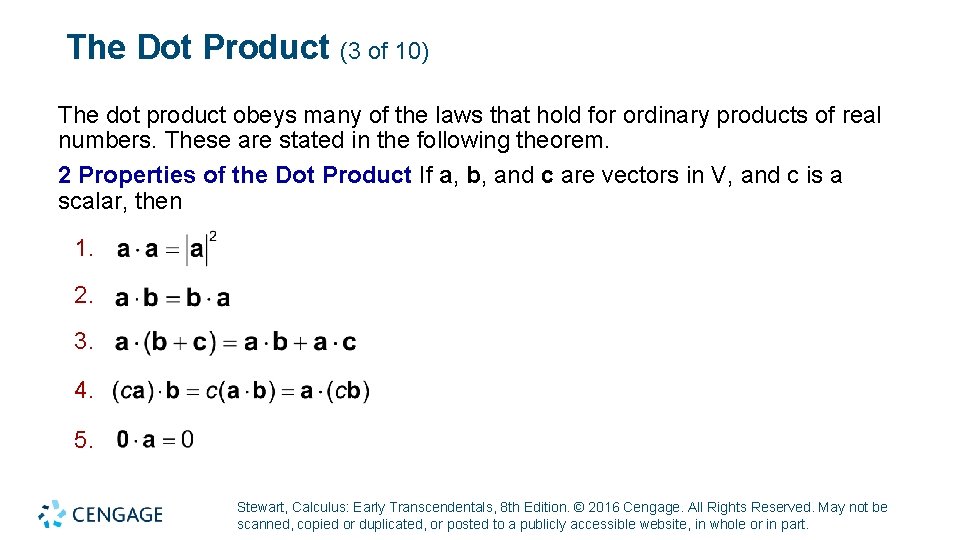
The Dot Product (3 of 10) The dot product obeys many of the laws that hold for ordinary products of real numbers. These are stated in the following theorem. 2 Properties of the Dot Product If a, b, and c are vectors in V, and c is a scalar, then 1. 2. 3. 4. 5. Stewart, Calculus: Early Transcendentals, 8 th Edition. © 2016 Cengage. All Rights Reserved. May not be scanned, copied or duplicated, or posted to a publicly accessible website, in whole or in part.
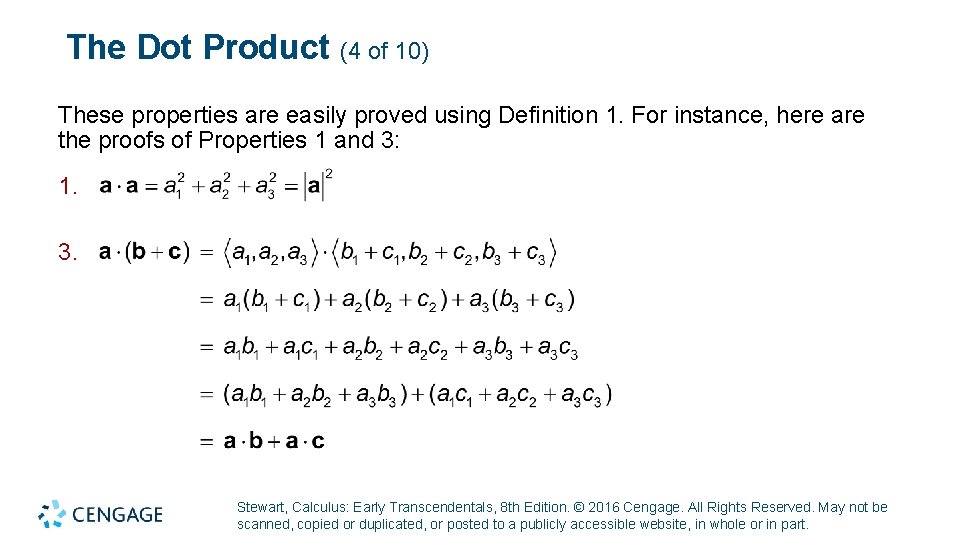
The Dot Product (4 of 10) These properties are easily proved using Definition 1. For instance, here are the proofs of Properties 1 and 3: 1. 3. Stewart, Calculus: Early Transcendentals, 8 th Edition. © 2016 Cengage. All Rights Reserved. May not be scanned, copied or duplicated, or posted to a publicly accessible website, in whole or in part.
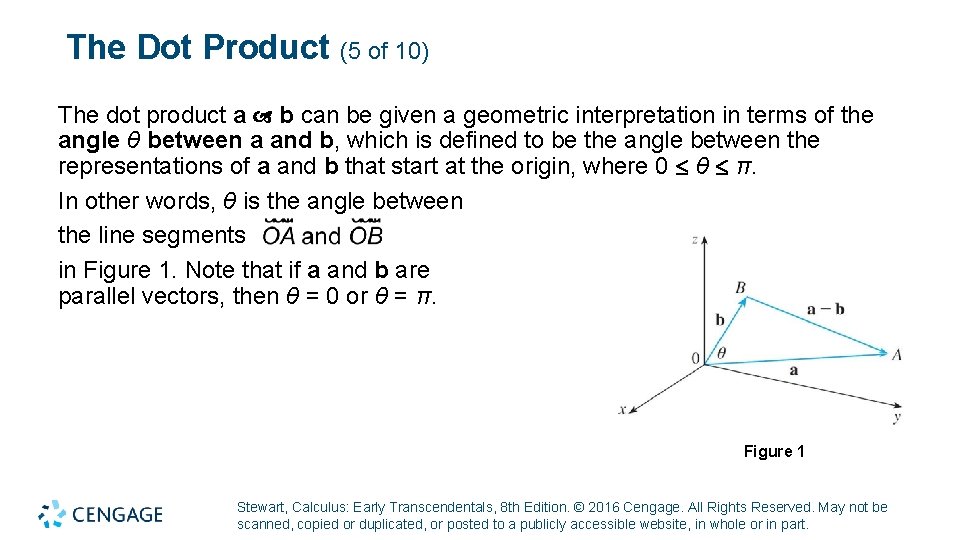
The Dot Product (5 of 10) The dot product a b can be given a geometric interpretation in terms of the angle θ between a and b, which is defined to be the angle between the representations of a and b that start at the origin, where 0 θ π. In other words, θ is the angle between the line segments in Figure 1. Note that if a and b are parallel vectors, then θ = 0 or θ = π. Figure 1 Stewart, Calculus: Early Transcendentals, 8 th Edition. © 2016 Cengage. All Rights Reserved. May not be scanned, copied or duplicated, or posted to a publicly accessible website, in whole or in part.
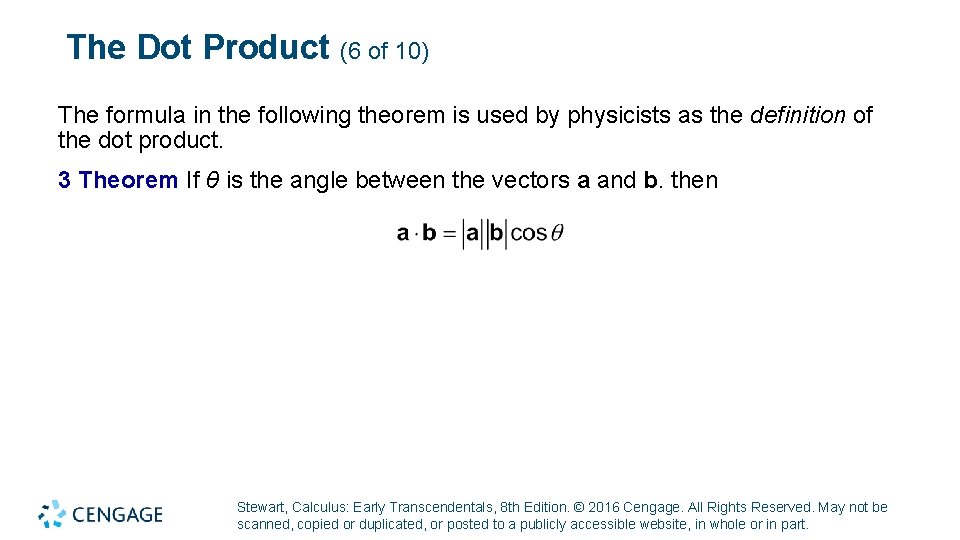
The Dot Product (6 of 10) The formula in the following theorem is used by physicists as the definition of the dot product. 3 Theorem If θ is the angle between the vectors a and b. then Stewart, Calculus: Early Transcendentals, 8 th Edition. © 2016 Cengage. All Rights Reserved. May not be scanned, copied or duplicated, or posted to a publicly accessible website, in whole or in part.
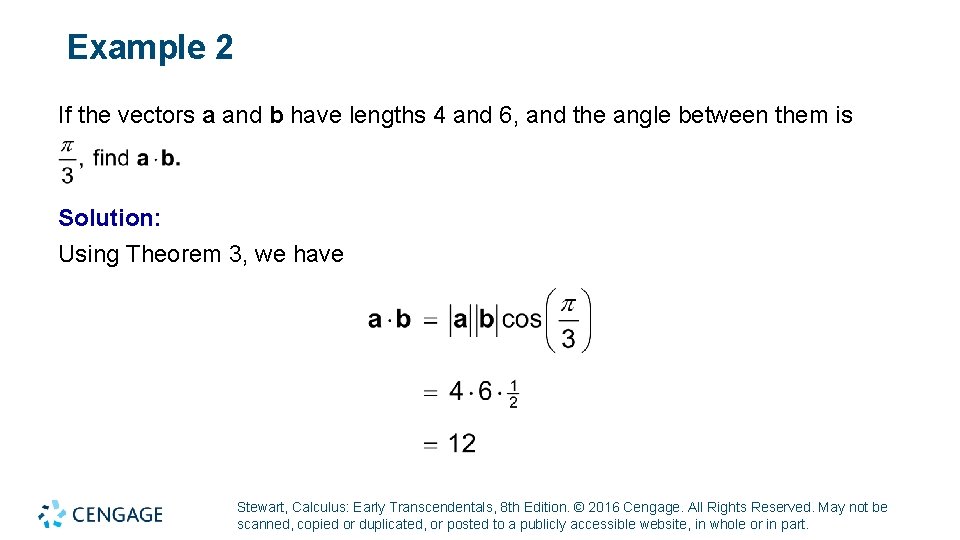
Example 2 If the vectors a and b have lengths 4 and 6, and the angle between them is Solution: Using Theorem 3, we have Stewart, Calculus: Early Transcendentals, 8 th Edition. © 2016 Cengage. All Rights Reserved. May not be scanned, copied or duplicated, or posted to a publicly accessible website, in whole or in part.
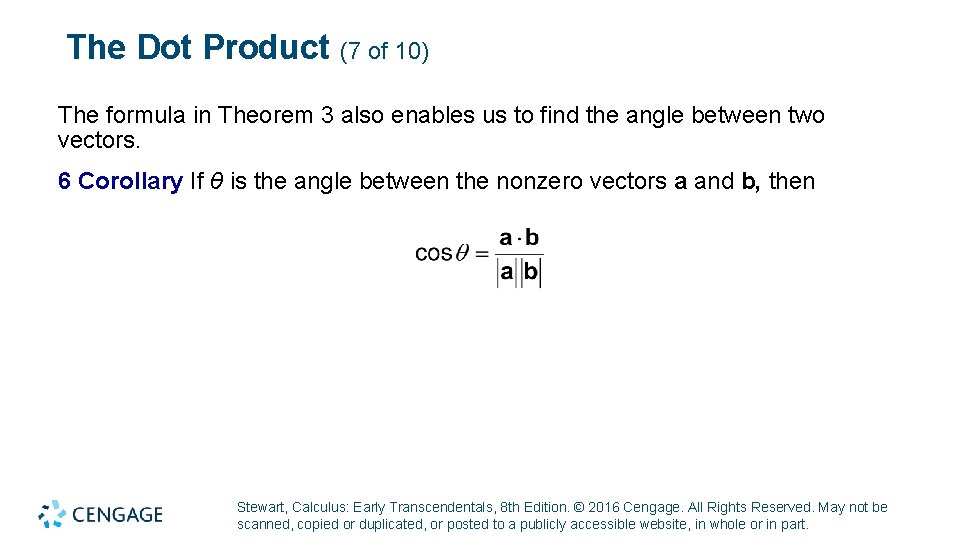
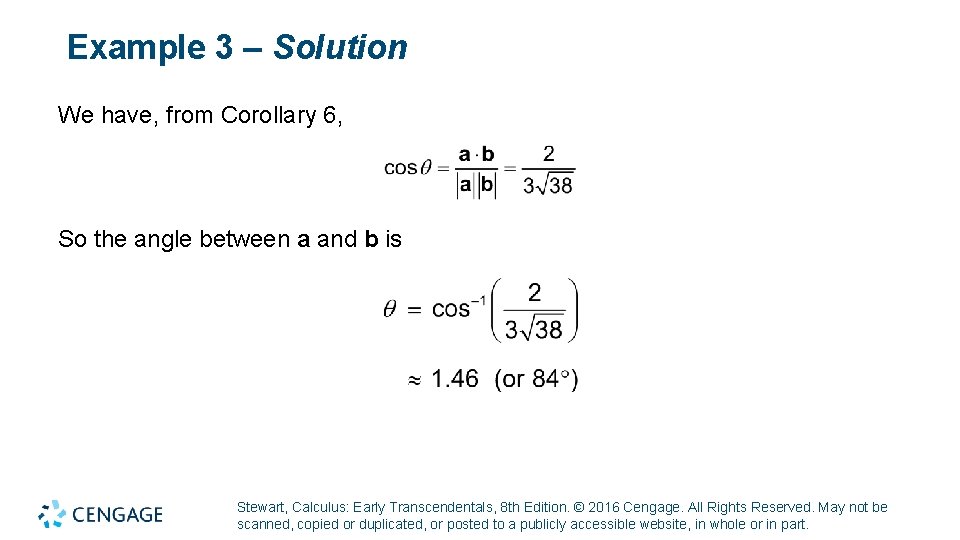
The Dot Product (7 of 10) The formula in Theorem 3 also enables us to find the angle between two vectors. 6 Corollary If θ is the angle between the nonzero vectors a and b, then Stewart, Calculus: Early Transcendentals, 8 th Edition. © 2016 Cengage. All Rights Reserved. May not be scanned, copied or duplicated, or posted to a publicly accessible website, in whole or in part.
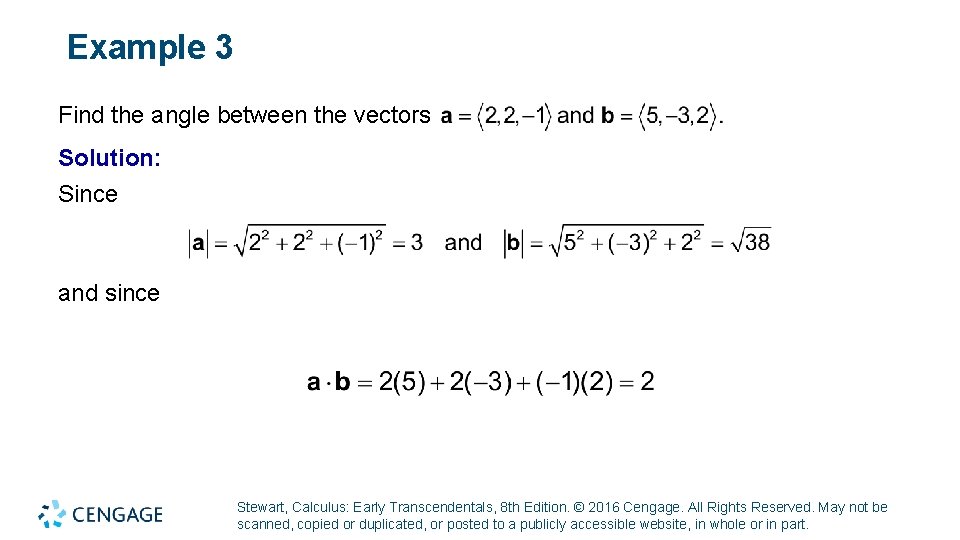
Example 3 Find the angle between the vectors Solution: Since and since Stewart, Calculus: Early Transcendentals, 8 th Edition. © 2016 Cengage. All Rights Reserved. May not be scanned, copied or duplicated, or posted to a publicly accessible website, in whole or in part.
Example 3 – Solution We have, from Corollary 6, So the angle between a and b is Stewart, Calculus: Early Transcendentals, 8 th Edition. © 2016 Cengage. All Rights Reserved. May not be scanned, copied or duplicated, or posted to a publicly accessible website, in whole or in part.
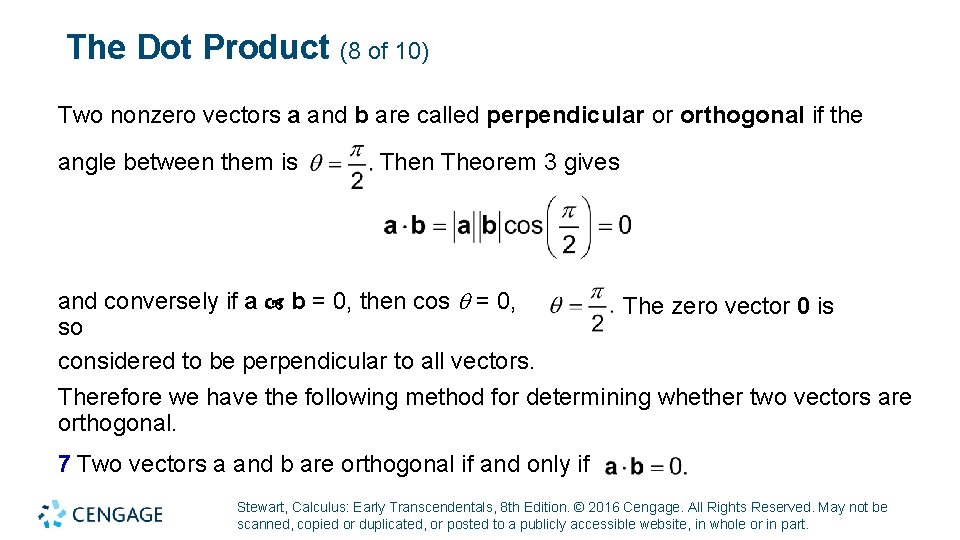
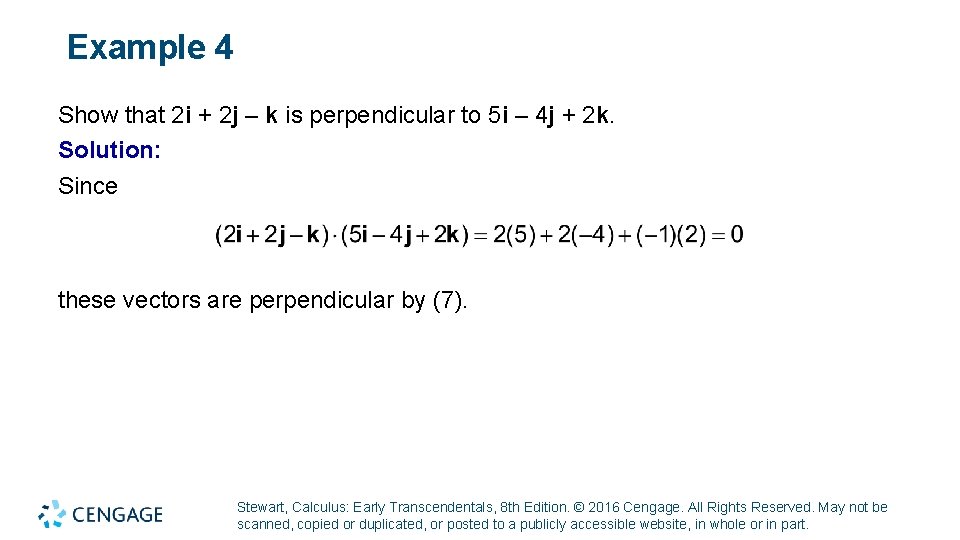
The Dot Product (8 of 10) Two nonzero vectors a and b are called perpendicular or orthogonal if the angle between them is Then Theorem 3 gives and conversely if a b = 0, then cos = 0, The zero vector 0 is so considered to be perpendicular to all vectors. Therefore we have the following method for determining whether two vectors are orthogonal. 7 Two vectors a and b are orthogonal if and only if Stewart, Calculus: Early Transcendentals, 8 th Edition. © 2016 Cengage. All Rights Reserved. May not be scanned, copied or duplicated, or posted to a publicly accessible website, in whole or in part.
Example 4 Show that 2 i + 2 j – k is perpendicular to 5 i – 4 j + 2 k. Solution: Since these vectors are perpendicular by (7). Stewart, Calculus: Early Transcendentals, 8 th Edition. © 2016 Cengage. All Rights Reserved. May not be scanned, copied or duplicated, or posted to a publicly accessible website, in whole or in part.
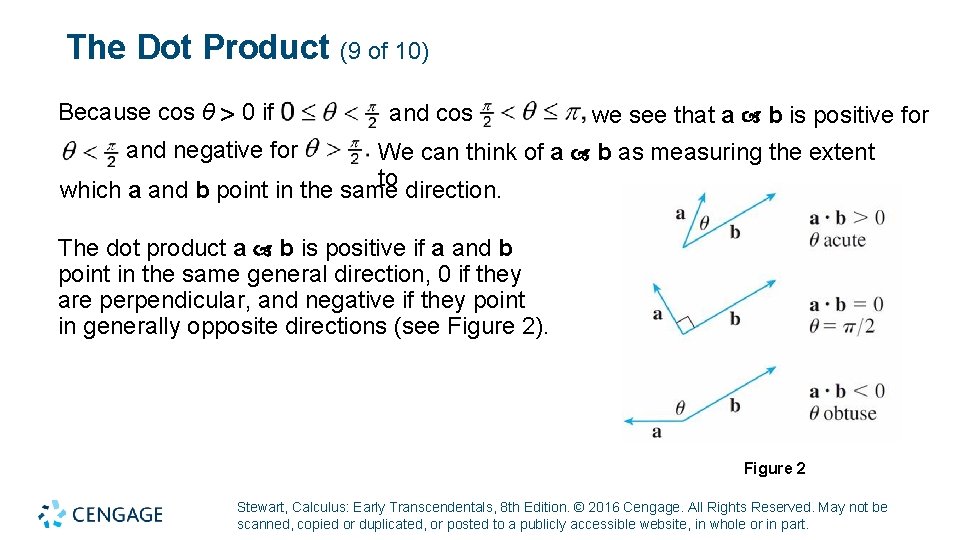
The Dot Product (9 of 10) Because cos θ 0 if and cos we see that a b is positive for and negative for We can think of a b as measuring the extent to direction. which a and b point in the same The dot product a b is positive if a and b point in the same general direction, 0 if they are perpendicular, and negative if they point in generally opposite directions (see Figure 2). Figure 2 Stewart, Calculus: Early Transcendentals, 8 th Edition. © 2016 Cengage. All Rights Reserved. May not be scanned, copied or duplicated, or posted to a publicly accessible website, in whole or in part.
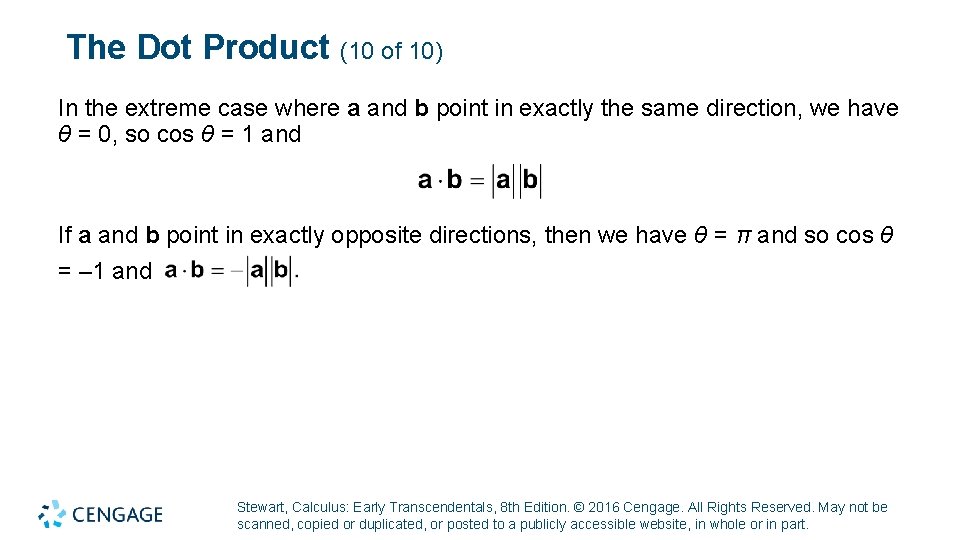
The Dot Product (10 of 10) In the extreme case where a and b point in exactly the same direction, we have θ = 0, so cos θ = 1 and If a and b point in exactly opposite directions, then we have θ = π and so cos θ = – 1 and Stewart, Calculus: Early Transcendentals, 8 th Edition. © 2016 Cengage. All Rights Reserved. May not be scanned, copied or duplicated, or posted to a publicly accessible website, in whole or in part.
Direction Angles and Direction Cosines Stewart, Calculus: Early Transcendentals, 8 th Edition. © 2016 Cengage. All Rights Reserved. May not be scanned, copied or duplicated, or posted to a publicly accessible website, in whole or in part.
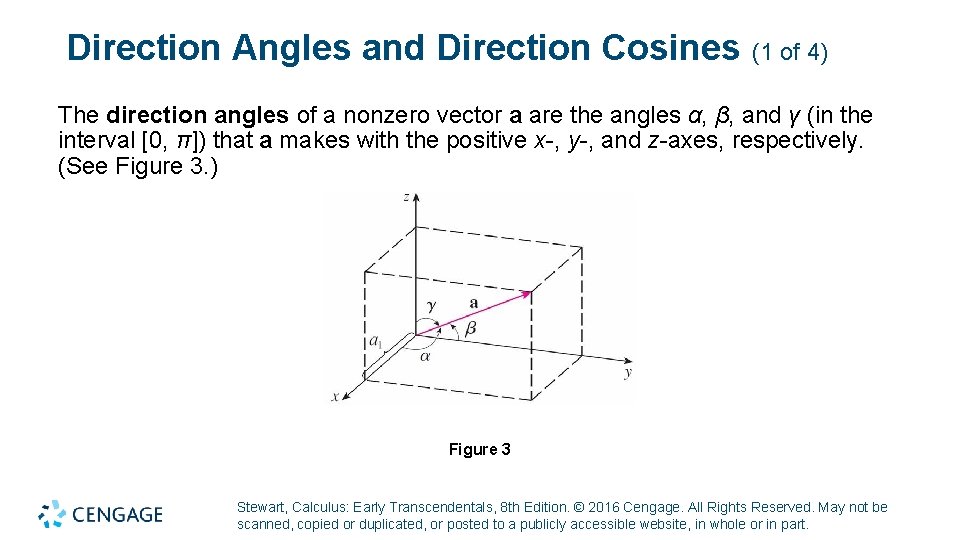
Direction Angles and Direction Cosines (1 of 4) The direction angles of a nonzero vector a are the angles α, β, and γ (in the interval [0, π]) that a makes with the positive x-, y-, and z-axes, respectively. (See Figure 3. ) Figure 3 Stewart, Calculus: Early Transcendentals, 8 th Edition. © 2016 Cengage. All Rights Reserved. May not be scanned, copied or duplicated, or posted to a publicly accessible website, in whole or in part.
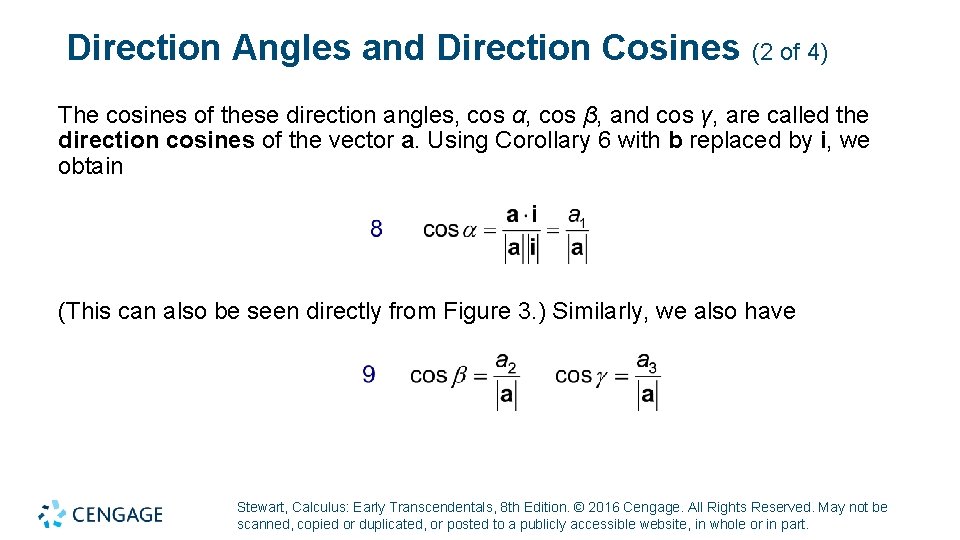
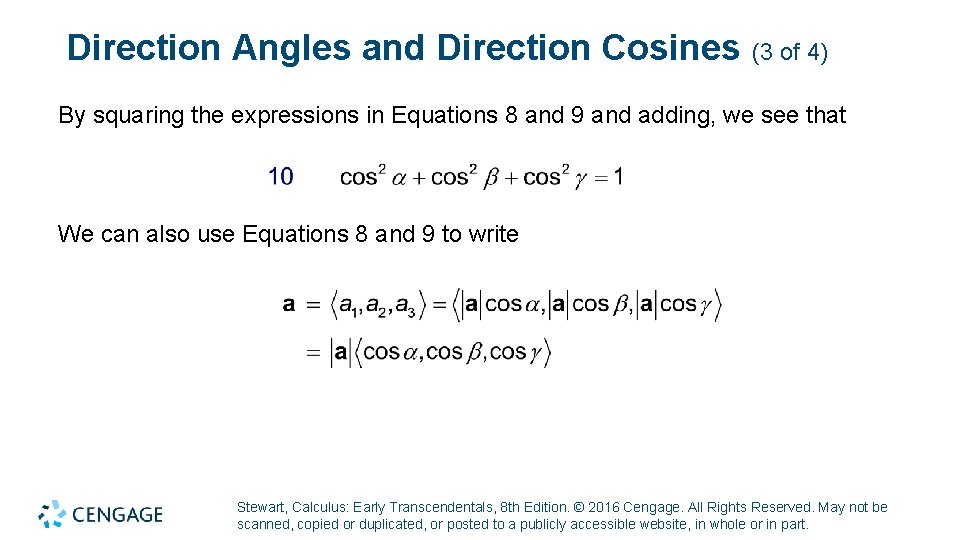
Direction Angles and Direction Cosines (2 of 4) The cosines of these direction angles, cos α, cos β, and cos γ, are called the direction cosines of the vector a. Using Corollary 6 with b replaced by i, we obtain (This can also be seen directly from Figure 3. ) Similarly, we also have Stewart, Calculus: Early Transcendentals, 8 th Edition. © 2016 Cengage. All Rights Reserved. May not be scanned, copied or duplicated, or posted to a publicly accessible website, in whole or in part.
Direction Angles and Direction Cosines (3 of 4) By squaring the expressions in Equations 8 and 9 and adding, we see that We can also use Equations 8 and 9 to write Stewart, Calculus: Early Transcendentals, 8 th Edition. © 2016 Cengage. All Rights Reserved. May not be scanned, copied or duplicated, or posted to a publicly accessible website, in whole or in part.
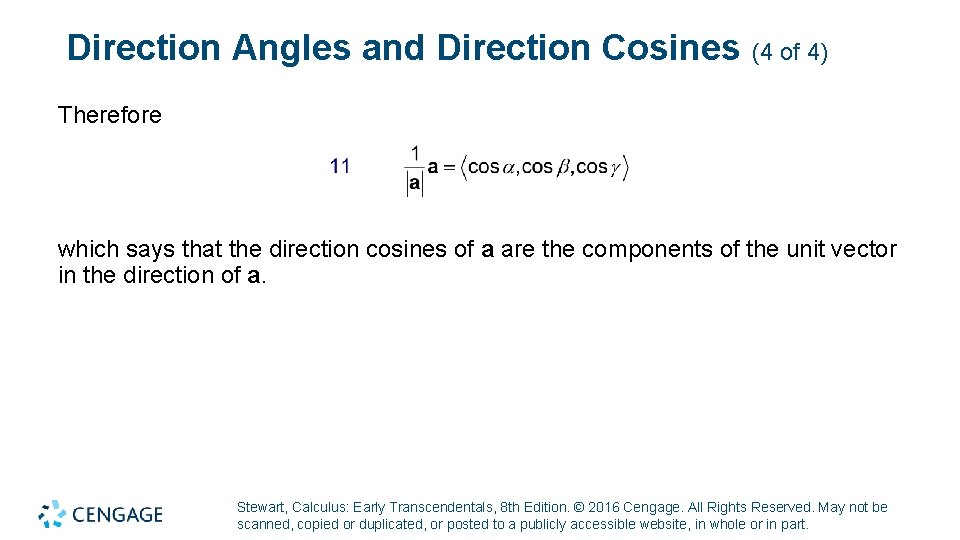
Direction Angles and Direction Cosines (4 of 4) Therefore which says that the direction cosines of a are the components of the unit vector in the direction of a. Stewart, Calculus: Early Transcendentals, 8 th Edition. © 2016 Cengage. All Rights Reserved. May not be scanned, copied or duplicated, or posted to a publicly accessible website, in whole or in part.
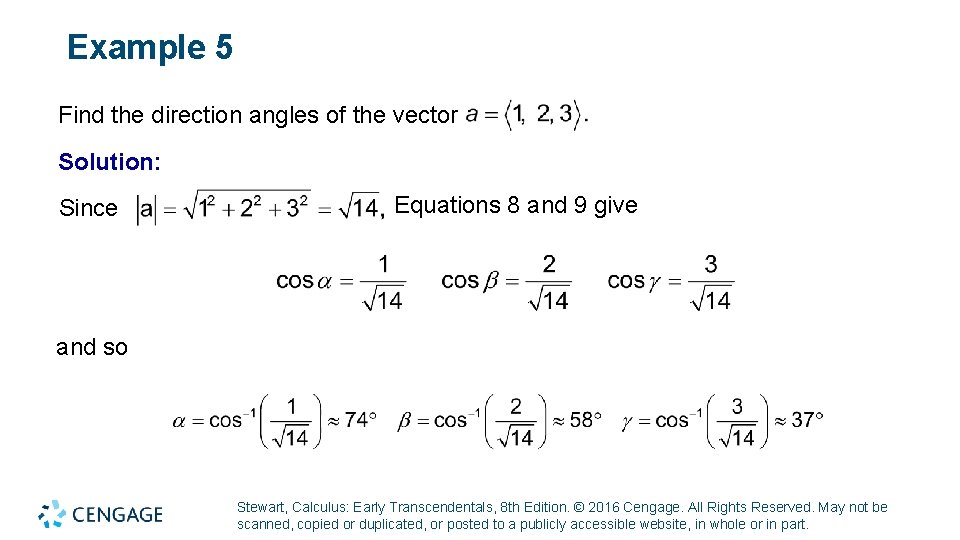
Example 5 Find the direction angles of the vector Solution: Since Equations 8 and 9 give and so Stewart, Calculus: Early Transcendentals, 8 th Edition. © 2016 Cengage. All Rights Reserved. May not be scanned, copied or duplicated, or posted to a publicly accessible website, in whole or in part.
Projections Stewart, Calculus: Early Transcendentals, 8 th Edition. © 2016 Cengage. All Rights Reserved. May not be scanned, copied or duplicated, or posted to a publicly accessible website, in whole or in part.
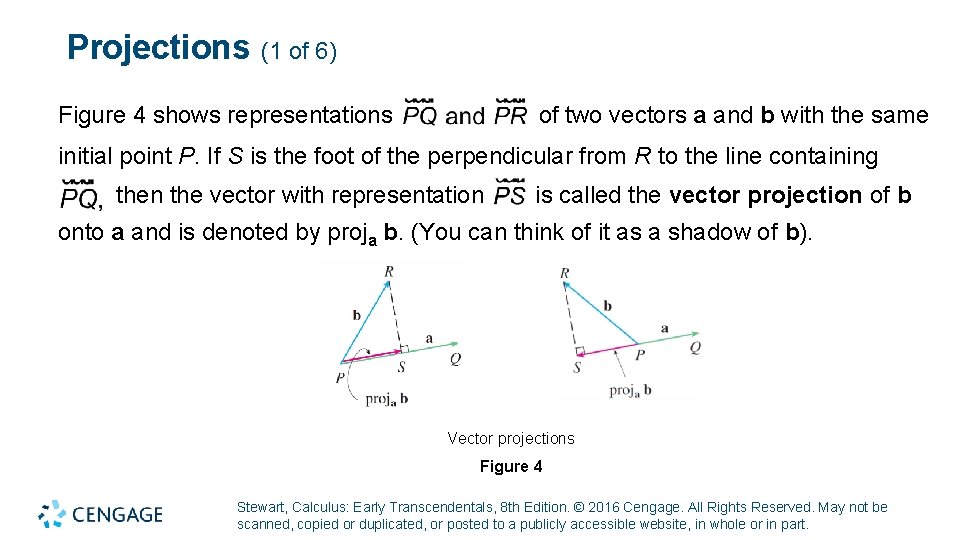
Projections (1 of 6) Figure 4 shows representations of two vectors a and b with the same initial point P. If S is the foot of the perpendicular from R to the line containing then the vector with representation is called the vector projection of b onto a and is denoted by proja b. (You can think of it as a shadow of b). Vector projections Figure 4 Stewart, Calculus: Early Transcendentals, 8 th Edition. © 2016 Cengage. All Rights Reserved. May not be scanned, copied or duplicated, or posted to a publicly accessible website, in whole or in part.
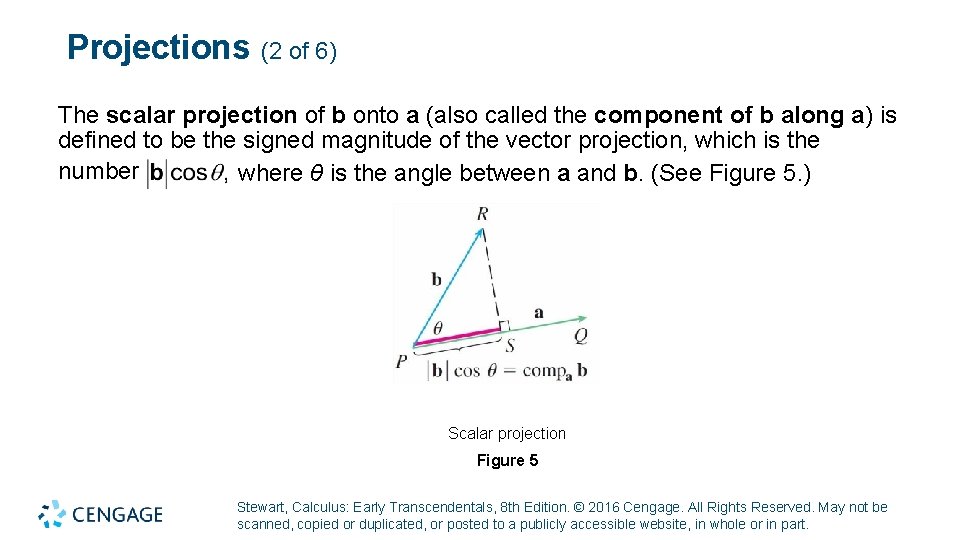
Projections (2 of 6) The scalar projection of b onto a (also called the component of b along a) is defined to be the signed magnitude of the vector projection, which is the number where θ is the angle between a and b. (See Figure 5. ) Scalar projection Figure 5 Stewart, Calculus: Early Transcendentals, 8 th Edition. © 2016 Cengage. All Rights Reserved. May not be scanned, copied or duplicated, or posted to a publicly accessible website, in whole or in part.
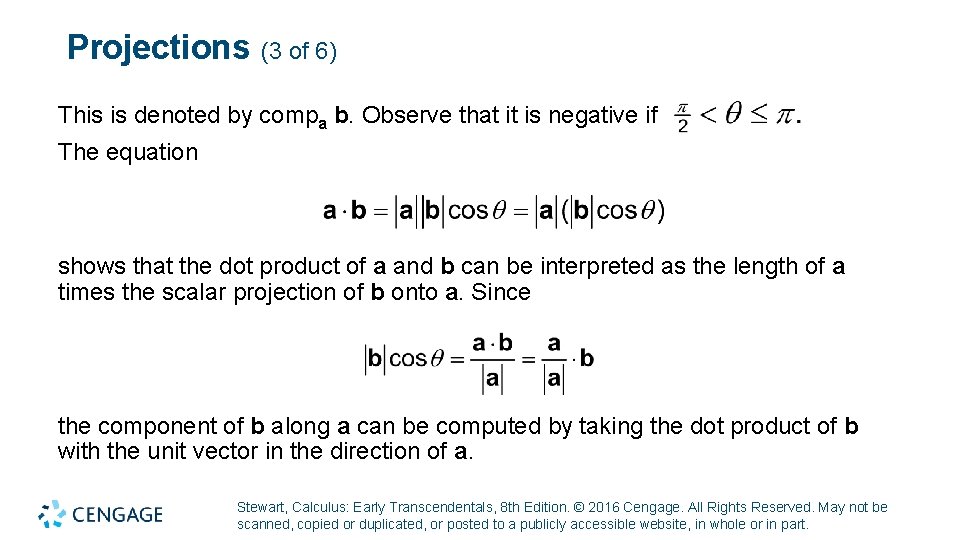
Projections (3 of 6) This is denoted by compa b. Observe that it is negative if The equation shows that the dot product of a and b can be interpreted as the length of a times the scalar projection of b onto a. Since the component of b along a can be computed by taking the dot product of b with the unit vector in the direction of a. Stewart, Calculus: Early Transcendentals, 8 th Edition. © 2016 Cengage. All Rights Reserved. May not be scanned, copied or duplicated, or posted to a publicly accessible website, in whole or in part.
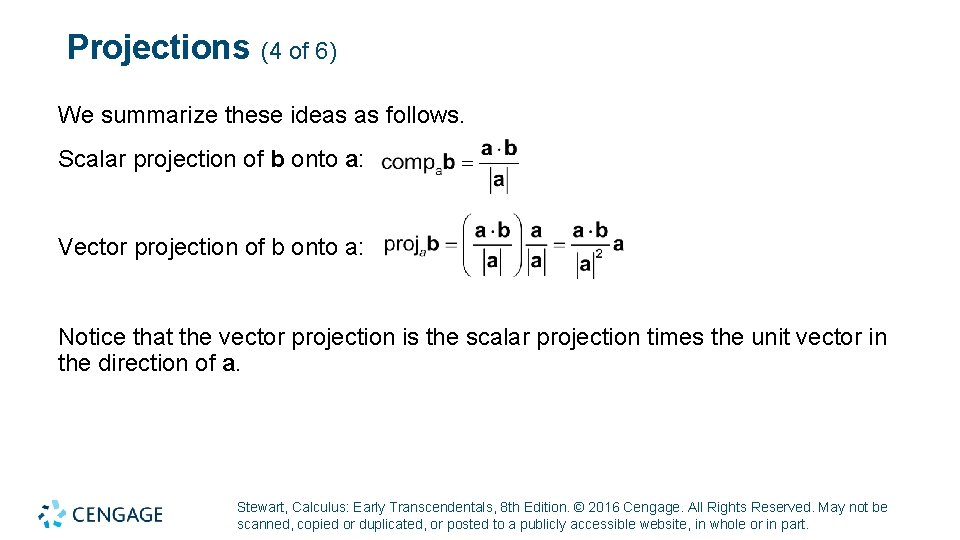
Projections (4 of 6) We summarize these ideas as follows. Scalar projection of b onto a: Vector projection of b onto a: Notice that the vector projection is the scalar projection times the unit vector in the direction of a. Stewart, Calculus: Early Transcendentals, 8 th Edition. © 2016 Cengage. All Rights Reserved. May not be scanned, copied or duplicated, or posted to a publicly accessible website, in whole or in part.
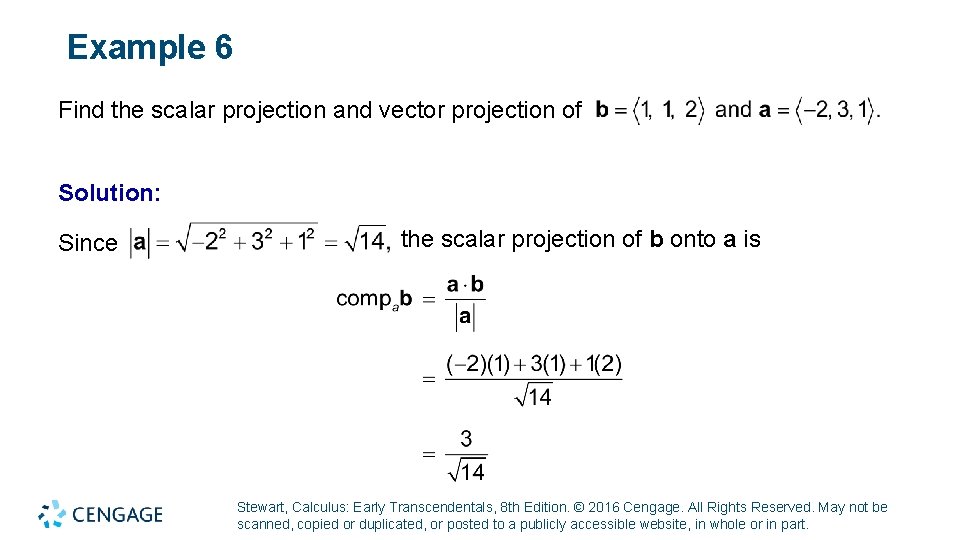
Example 6 Find the scalar projection and vector projection of Solution: Since the scalar projection of b onto a is Stewart, Calculus: Early Transcendentals, 8 th Edition. © 2016 Cengage. All Rights Reserved. May not be scanned, copied or duplicated, or posted to a publicly accessible website, in whole or in part.
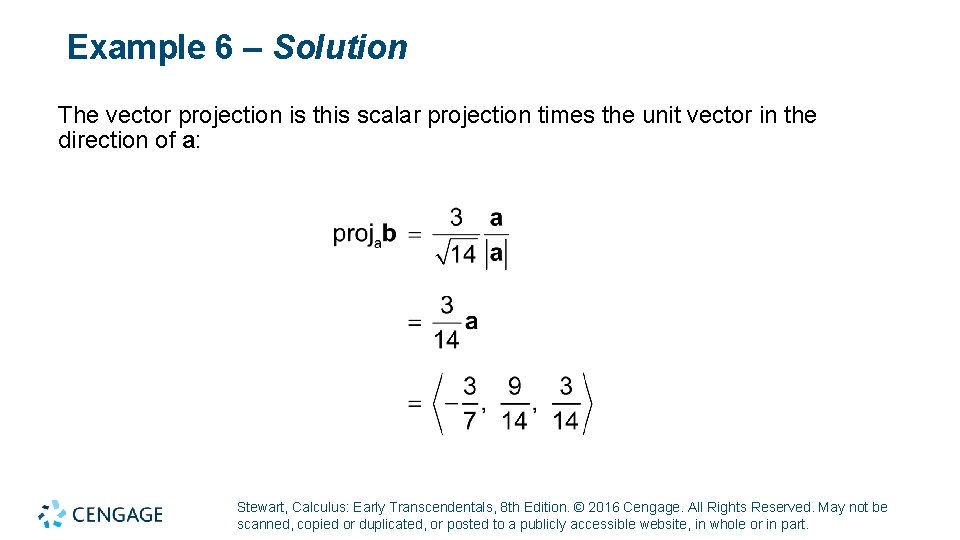
Example 6 – Solution The vector projection is this scalar projection times the unit vector in the direction of a: Stewart, Calculus: Early Transcendentals, 8 th Edition. © 2016 Cengage. All Rights Reserved. May not be scanned, copied or duplicated, or posted to a publicly accessible website, in whole or in part.
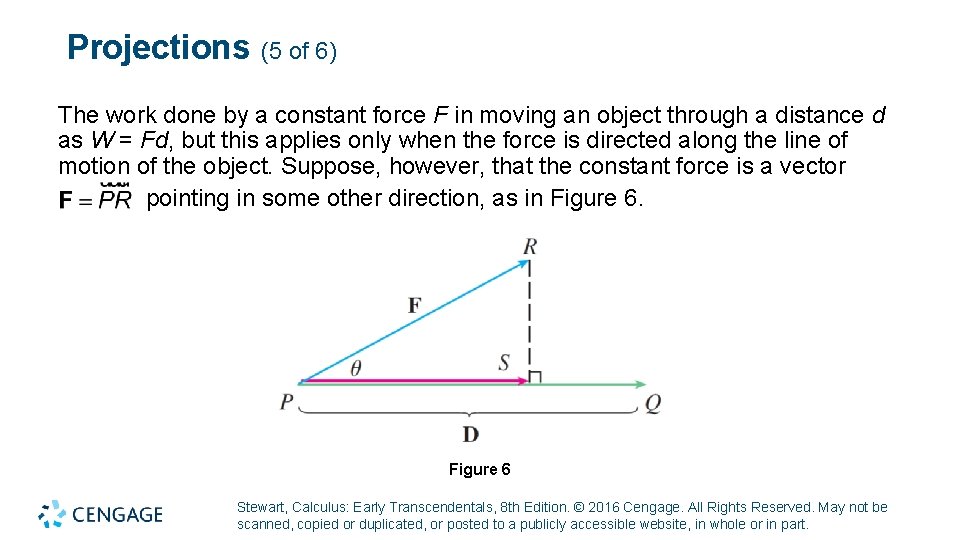
Projections (5 of 6) The work done by a constant force F in moving an object through a distance d as W = Fd, but this applies only when the force is directed along the line of motion of the object. Suppose, however, that the constant force is a vector pointing in some other direction, as in Figure 6 Stewart, Calculus: Early Transcendentals, 8 th Edition. © 2016 Cengage. All Rights Reserved. May not be scanned, copied or duplicated, or posted to a publicly accessible website, in whole or in part.
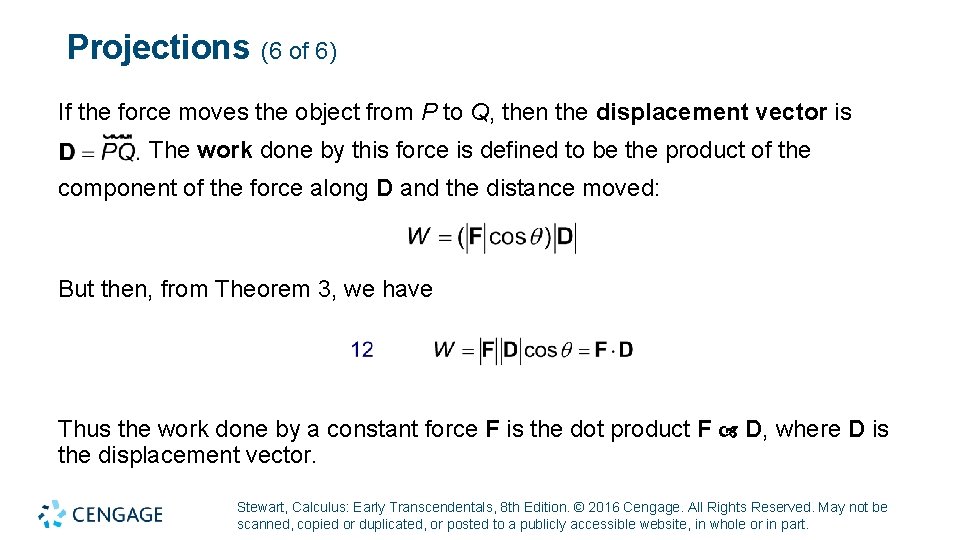
Projections (6 of 6) If the force moves the object from P to Q, then the displacement vector is The work done by this force is defined to be the product of the component of the force along D and the distance moved: But then, from Theorem 3, we have Thus the work done by a constant force F is the dot product F D, where D is the displacement vector. Stewart, Calculus: Early Transcendentals, 8 th Edition. © 2016 Cengage. All Rights Reserved. May not be scanned, copied or duplicated, or posted to a publicly accessible website, in whole or in part.
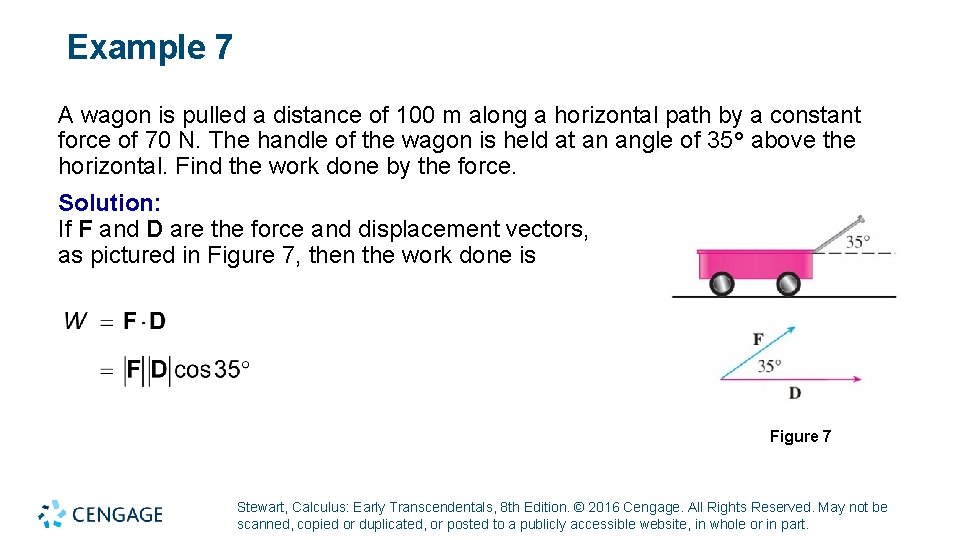
Example 7 A wagon is pulled a distance of 100 m along a horizontal path by a constant force of 70 N. The handle of the wagon is held at an angle of 35 above the horizontal. Find the work done by the force. Solution: If F and D are the force and displacement vectors, as pictured in Figure 7, then the work done is Figure 7 Stewart, Calculus: Early Transcendentals, 8 th Edition. © 2016 Cengage. All Rights Reserved. May not be scanned, copied or duplicated, or posted to a publicly accessible website, in whole or in part.
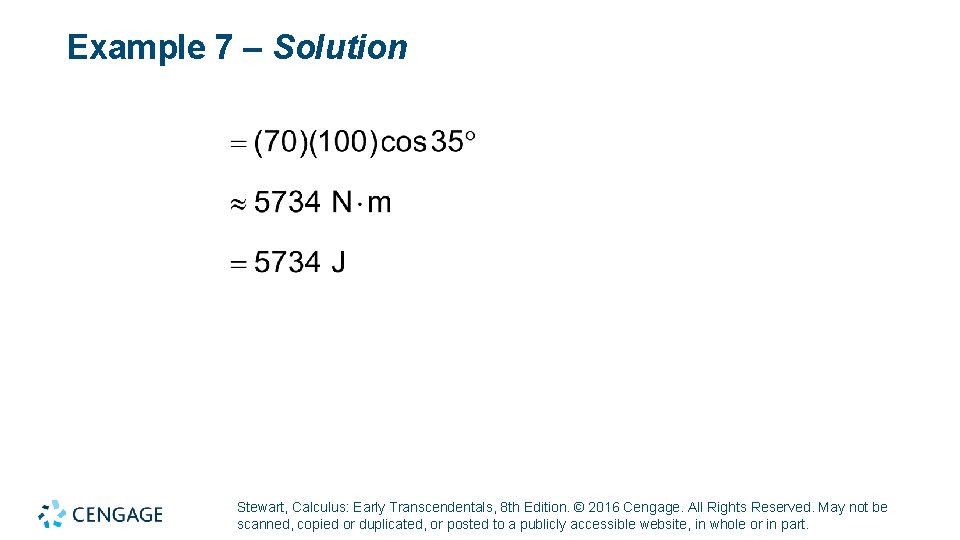
Example 7 – Solution Stewart, Calculus: Early Transcendentals, 8 th Edition. © 2016 Cengage. All Rights Reserved. May not be scanned, copied or duplicated, or posted to a publicly accessible website, in whole or in part.